
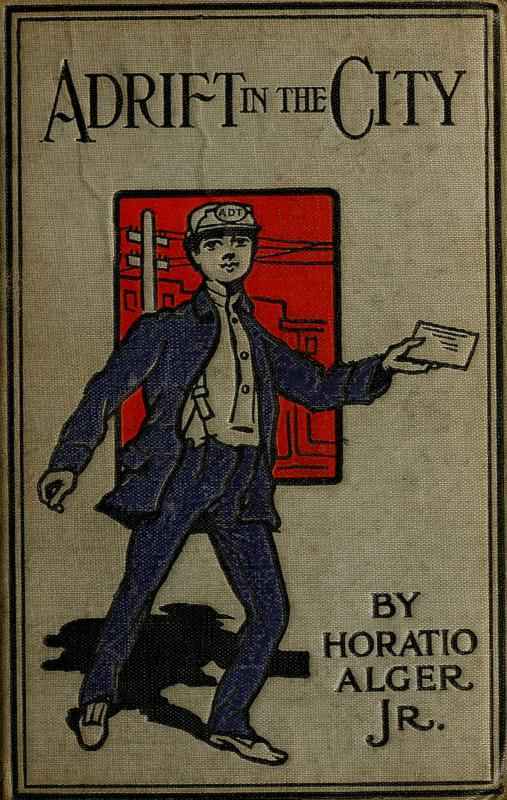
HORATIO ALGER, JR.
The enormous sales of the books of Horatio Alger, Jr., show the greatness of his popularity among the boys, and prove that he is one of their most favored writers. I am told that more than half a million copies altogether have been sold, and that all the large circulating libraries in the country have several complete sets, of which only two or three volumes are ever on the shelves at one time. If this is true, what thousands and thousands of boys have read and are reading Mr. Alger's books! His peculiar style of stories, often imitated but never equaled, have taken a hold upon the young people, and, despite their similarity, are eagerly read as soon as they appear.
Mr. Alger became famous with the publication of that undying book, "Ragged Dick, or Street Life in New York." It was his first book for young people, and its success was so great that he immediately devoted himself to that kind of writing. It was a new and fertile field for a writer then, and Mr. Alger's treatment of it at once caught the fancy of the boys. "Ragged Dick" first appeared in 1868, and ever since then it has been selling steadily, until now it is estimated that about 200,000 copies of the series have been sold.
—"Pleasant Hours for Boys and Girls."
A writer for boys should have an abundant sympathy with them. He should be able to enter into their plans, hopes, and aspirations. He should learn to look upon life as they do. Boys object to be written down to. A boy's heart opens to the man or writer who understands him.
—From "Writing Stories for Boys," by Horatio Alger, Jr.
Neither as a writer does he stand apart from the great currents of life and select some exceptional phase or odd combination of circumstances. He stands on the common level and appeals to the universal heart, and all that he suggests or achieves is on the plane and in the line of march of the great body of humanity.
The Jack Hazard series of stories, published in the late Our Young Folks, and continued in the first volume of St. Nicholas, under the title of "Fast Friends," is no doubt destined to hold a high place in this class of literature. The delight of the boys in them (and of their seniors, too) is well founded. They go to the right spot every time. Trowbridge knows the heart of a boy like a book, and the heart of a man, too, and he has laid them both open in these books in a most successful manner. Apart from the qualities that render the series so attractive to all young readers, they have great value on account of their portraitures of American country life and character. The drawing is wonderfully accurate, and as spirited as it is true. The constable, Sellick, is an original character, and as minor figures where will we find anything better than Miss Wansey, and Mr. P. Pipkin, Esq. The picture of Mr. Dink's school, too, is capital, and where else in fiction is there a better nick-name than that the boys gave to poor little Stephen Treadwell, "Step Hen," as he himself pronounced his name in an unfortunate moment when he saw it in print for the first time in his lesson in school.
On the whole, these books are very satisfactory, and afford the critical reader the rare pleasure of the works that are just adequate, that easily fulfill themselves and accomplish all they set out to do.—Scribner's Monthly.
This author wrote his "Camping Out Series" at the very height of his mental and physical powers.
"We do not wonder at the popularity of these books; there is a freshness and variety about them, and an enthusiasm in the description of sport and adventure, which even the older folk can hardly fail to share."—Worcester Spy.
"The author of the Camping Out Series is entitled to rank as decidedly at the head of what may be called boys' literature."—Buffalo Courier.
All books in this series are 12mo. with eight full page illustrations. Cloth, extra, 75 cents.
Camping Out. As Recorded by "Kit."
"This book is bright, breezy, wholesome, instructive, and stands above the ordinary boys' books of the day by a whole head and shoulders."—The Christian Register, Boston.
Left on Labrador; or, The Cruise of the Schooner Yacht "Curlew." As Recorded by "Wash."
"The perils of the voyagers, the narrow escapes, their strange expedients, and the fun and jollity when danger had passed, will make boys even unconscious of hunger."—New Bedford Mercury.
Off to the Geysers; or The Young Yachters in Iceland. As Recorded by "Wade."
"It is difficult to believe that Wade and Read and Kit and Wash were not live boys, sailing up Hudson Straits, and reigning temporarily over an Esquimaux tribe."—The Independent, New York.
Lynx Hunting: From Notes by the Author of "Camping Out."
"Of first quality as a boys' book, and fit to take its place beside the best."—Richmond Enquirer.
Fox Hunting. As Recorded by "Read."
"The most spirited and entertaining book that has as yet appeared. It overflows with incident, and is characterized by dash and brilliancy throughout."—Boston Gazette.
On the Amazon; or, the Cruise of the "Rambler." As Recorded by "Wash."
"Gives vivid pictures of Brazilian adventure and scenery."—Buffalo Courier.
Edward S. Ellis is regarded as the later day Cooper. His books will always be read for the accurate pen pictures of pioneer life they portray.
Complete Catalogue of Famous Alger Books, Celebrated Castlemon Books and Renowned Ellis Books mailed on application.
Transcriber's Notes.
| The following corrections have been made in the text: | |
| Minor punctuation errors corrected: added several periods, removed extraneous quotes. | |
| Occasional inconsistency in hyphenation has been retained. | |
| A few instances of exclamation points at the end of questions have been retained. | |
| ⭘ – |
"immiment" corrected to "imminent" (peril was imminent.) |
| ⭘ – |
"loyality" corrected to "loyalty" (faith in your loyalty,) |
| ⭘ – |
added "you" (I hope you are well, Carrie) |
| ⭘ – |
duplicated word removed 'was' (hope of escape was presented) |
| ⭘ – |
"gnardian" replaced with "guardian" (with his new guardian) |
| ⭘ – |
"power?" corrected to "power!" (get him into my power!) |
| ⭘ – |
"it?" corrected to "it!" (Gave a thousand dollars for it!") |
| ⭘ – | Speech marks removed from "And two thousand..." and "He doesn't know....", retained around "How long have you had it?" |