
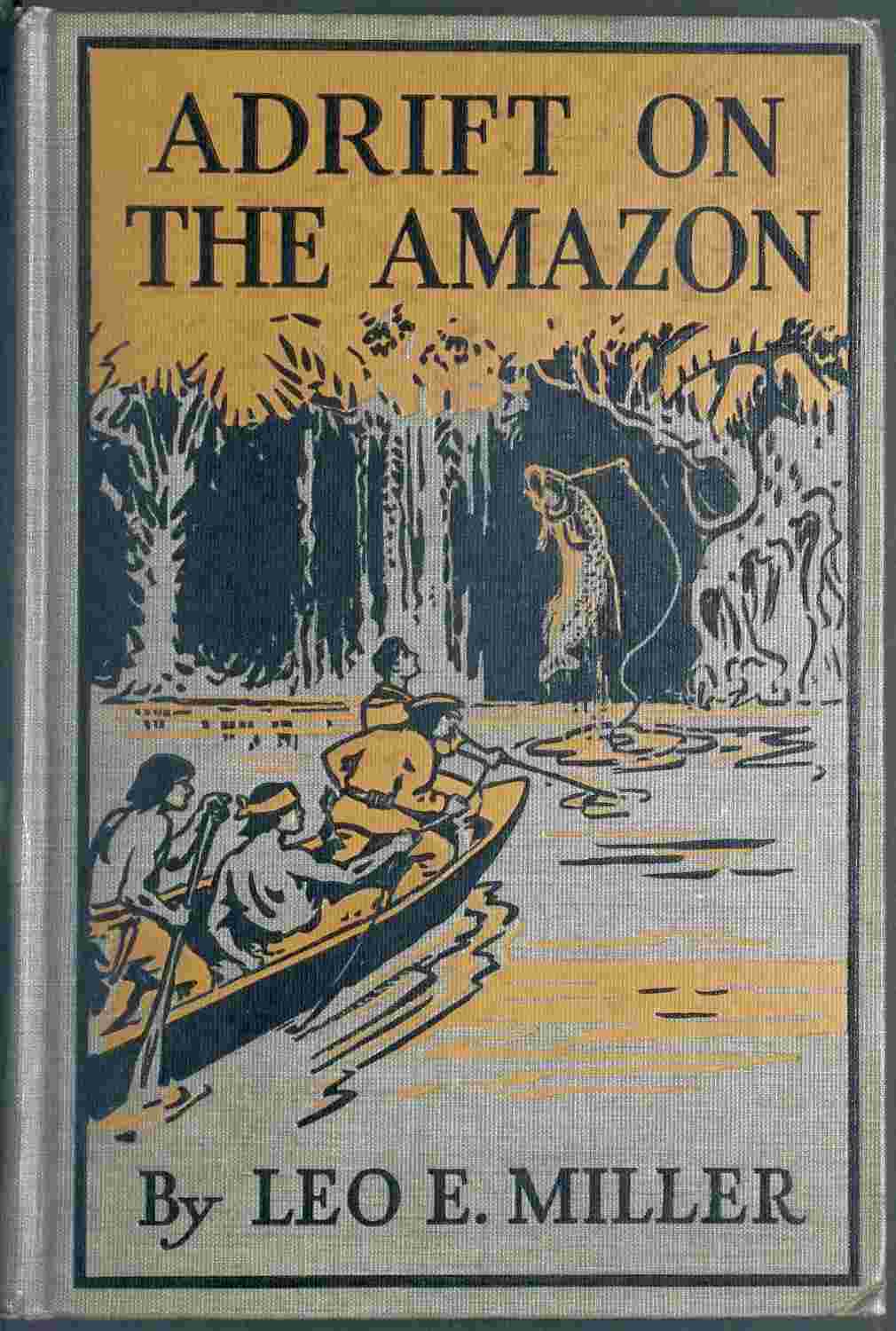
A huge silvery form ... leaped out of the water, rolled and wallowed convulsively, and sank from sight.
great sight to see the half-submerged buoy tearing a wide path through the muddy water, towed by the terrified monster deep below.
“The curare!” Don Marco shouted; but the men had already untied the dugout canoe that trailed behind the batalao. The captain, David and two of the sailors jumped into it and they were off after the fleeing keg.
“He can’t keep it up very long,” Don Marco panted as they dug deep their paddles and sped along. “A few kilometers at most and the drag will tire him out. He must be enormous—look how the keg is travelling. If the line should break he will be lost.”
After running downstream several hundred yards the float came to a stop.
“It snapped, or the harpoon did not hold. He’s gone,” were the first thoughts that came to the pursuers. But a few minutes later it moved again, this time heading upstream. That was fortunate for the men but unfortunate for the fish, for now it had to fight not only the current but pull the hampering weight against the stream also. And it was coming straight toward the canoe. Soon it was abreast, so the paddlers turned the craft and now had no difficulty in keeping up with it.
Bit by bit the fish weakened and after half an hour the keg stood still.
“Now we must get it quickly, before it can rest,” the captain called. When they reached the float he leaned over, caught the line with his hands and began to pull it in, not hurriedly, but with an even, steady movement.
This, however, gave new life to the fish. It dashed away, downstream, but the man retained possession of the cord and the canoe tore through the water at great speed, her nose ploughing so deeply that it was all but submerged.
The men dropped their paddles and began to bail out the water that poured in in a steady stream; but soon it became apparent that their efforts could not stem the flood that was rising about their feet. If the fish did not slacken its pace soon they would have to release the line or the canoe would be swamped.
But the great pirarucú was rapidly exhausting the last vestige of its strength in pulling the dugout. It was gradually coming nearer the surface; and then a huge, silvery form leaped out of the water, rolled and wallowed convulsively, and sank from sight.
Don Marco rapidly took in the line and in a moment they had reached the spot where the last ripples were dying in a widening circle; soon the prize had been brought up from the muddy depths and wallowed helplessly beside the boat.
What a beauty it was! And what a monster! A line was made fast just in back of the fins and they towed it back to the batalao, where it was hoisted aboard.
As the great fish lay on the deck, David surveyed it with a triumphant gleam in his eyes. It was fully eight feet long and the captain said it would weigh more than four hundred pounds. The glistening body was a foot and a half broad across the back and two feet wide along the greater part of its length. Silver scales the size of a dollar covered it and those on the lower half were margined with scarlet. The mouth was very large and wide open; the fish was dead.
After examining it for some time David’s feeling of exultation gave way to pity for the beautiful creature. It was of such great size, so majestic, and seemed like a fitting denizen of the Amazon, representative of the mystery and the wonder of the mighty river. It seemed so out of place on the deck of the boat.
“That is a beauty,” he commented, “but one is enough for a long time. I am not going to kill another unless it is needed very badly. What are we going to do with it?”
After taking a number of photographs of the fish, David watched the sailors dress it. Then they cut it into slabs and sprinkled salt over the pieces, which they hung up to dry.
“It will keep months now,” Don Marco said. “We shall need most of it, and what is left can be sold further up the river.”
They rowed and poled upstream a short distance above the mouth of the creek and anchored for the night.
CHAPTER VII
WHEN THE RIVER RAN RIOT
There were a number of small settlements scattered along both banks of the river, but the trader did not stop at any one of them during the first days after leaving Manaos. He said they were too near the city, to which the people made frequent trips, so they naturally purchased their supplies during these visits, knew the market value of everything, and would not pay the prices he was compelled to charge. It was further upstream, where the inhabitants were more isolated and the distance too great for them to make frequent excursions to Manaos, that he expected to glean his harvest.
The second day passed without incident. In one stretch, where the water was too deep for poling, the sailors got out long-handled hooks. They caught these in the overhanging branches and then walked along the board runways, but now they pulled as they walked instead of pushing, as they did when poling, and only half could engage in the work, as there was forest on only one side of them. Therefore, they were divided into two parties of six each, one resting while the other trudged along the wet, slippery boards.
It seemed to David as if the branches overhead harbored all the insects in the world. Each time the hooks were thrust into them a shower of ants, leaf hoppers and a multitude of other winged and crawling creatures fell into the boat.
The men seemed not to mind the hordes of creeping things streaming down their arms and bare backs, beyond an occasional exclamation of annoyance or some jesting remark when one of their number was deluged with an exceptionally large number. But when on the third day the hooks stirred up a nest of the fierce maribundi wasps their tolerant attitude quickly changed, for the insects were quick to resent the interference with their domestic affairs.
Several of the wasps darted out of the dense foliage, their red bodies gleaming like flying sparks. They made straight for the men and simultaneously there rose a chorus of wild screams mingled with the clatter and splash of poles that fell from hands now occupied in striking at the darting specks or in clutching madly at their bodies.
David came to the door of the storeroom to see what had happened; he was amazed at the strange antics of the sailors, who were now making for the opening in which he was standing. He was not kept in suspense long.
If a red-hot needle had been thrust into him the effect could not have been more painful. One of the wasps had discovered David and had plunged its fiery dagger into his arm.
He dashed back into the storeroom with a cry of pain, and the men followed in quick succession. They slammed the door as soon as the last one had entered, and at last they were safe from the attackers.
The batalao, left to its own devices, began to drift downstream, but none sought to stop it. The crew, packed tight between the boxes and bales, was too much occupied with a more vital matter, and some of the men who had been stung a number of times were screaming and moaning in agony, while from others came not a sound—they had lost consciousness.
David had never suffered such intense pain in his life. His arm throbbed and burned and was rapidly swelling to huge proportions. At times he was on the point of fainting and grasped the nearest support to keep from falling to the floor. The stifling heat in the room added to the suffering of all.
“Open the door!” Don Marco shouted. He had come through the encounter unscathed. “Get out into the fresh air,” he added; “we have drifted past the nest; the danger is over.”
Someone obeyed the first order mechanically and those who could walk went out upon the deck. They presented a sorry appearance. Some had been stung on the hands; others on the face or bare backs, the exact spots being marked by rising protuberances of an angry red color.
In the meantime David was wondering what he could do in the matter of giving relief. He thought of iodine; that would help. Then he remembered the snake-bite lancet in his pocket—a hard rubber device that looked like a short fountain pen, with a sharp steel blade in one end and a pocket of permanganate of potash crystals in the other. He would try that, on his own arm first.
After opening the wound with a quick thrust of the keen blade he rubbed a quantity of the dry powder into it. Then he painted the whole area with iodine. Relief from the burning pain followed quickly; there remained only the dull throbbing.
Encouraged, he began working on the sailors. They submitted to his ministrations and were grateful for the help he gave them.
“The maribundi wasps are terrible creatures,” Don Marco said that night. “I am more afraid of them than of anything else in the jungle; they are even worse than snakes, because there are more of them and it is impossible to escape from them when they are encountered. If a man is stung four or five times, he dies. And only one sting will often make a person sick for weeks.”
They had anchored so soon as it was possible to muster enough hands to row the boat to the bank.
“Are they very common along the river?” David asked anxiously.
“Yes, here and on the Orinoco too; and not only along the water, either. One is liable to run into them in the forest and in the clearings alike. They are quick to attack the moment they are disturbed. You must give me some of your remedy, for it is the best I have ever found. But for your quick work some of the men would have died.”
The journey was not continued until two days later; the men had recovered sufficiently by that time to resume their duties. They were obliged to use the hooks, as before, and could only trust to luck for the future.
That day they stopped at several clearings and traded with the settlers. The places were interesting—like notches hewn into the heavy jungle, openings with ragged edges where the vegetation was advancing in solid formation to reclaim its own. There was abundant other evidence that the fight of man against the forest was incessant. Second-growth sprouts sprang up in the yuca fields in back of the huts and unless they were cut down promptly they soon formed dense thickets that smothered the cultivated plants. Besides the yucas, from which the farinha was made, there were clumps of bananas, plantains, sugar cane and tree melons; also small plantations of coffee trees. These were from ten to fifteen feet high, round and bushy, and covered with clusters of small red fruits. Each of the little spheres contained two coffee beans, their flat side resting face to face, and the whole surrounded by a thin, sweet pulp. There were tall breadfruit trees near the huts, their broad leaves providing shade and the great cylindrical green fruits serving as an addition to the food supply.
The Brazilian cherries interested David greatly. They were about the size of the ones he was accustomed to at home, and of the same bright red color, but had deep grooves in them from stem to tip, so that a cross section would have the outline of a star.
Most of the people were squatters in the wilderness. They were Portuguese who had cleared their little patches of land and were subsisting on the bounty of the soil and the river. They worked little, except in fighting the forest, as all vegetation grew so luxuriantly and yielded such abundant crops that little cultivation was needed to produce all the food they required. They were easy-going, good-natured, and spent most of their time in their hammocks, conversing and sipping tea or coffee.
A few of the stations, however, were owned by residents of Manaos, who visited them occasionally and maintained hired help permanently to cultivate the soil and care for a few cows, pigs and fowls.
The dwellings were all of similar construction—flimsy structures with bamboo walls, earth floors and roofs of palm leaves. The tropical luxuriance of the foliage all around them, however, gave them a picturesque appearance so that they seemed to fit properly into their surroundings. A more substantial type of house would have been impracticable and out of place in such a climate.
“Are there no large ranches along the river?” David asked, after leaving one of the clearings.
“Yes, there are a few, but they have been started very recently. Each time I come back this way I find a few new ones, but none of them is very large. We expect to reach one of them tomorrow; I just heard about it in Manaos.”
“What is it called?”
“Las Palmas. The owner is one of your countrymen. They say he has an enormous ranch in the Argentine and is going to make Las Palmas the best and largest in the Upper Amazon. But it will be hard work and I doubt if he will succeed.”
“Do you know anything about the owner? What did they say about him in Manaos?” David asked eagerly.
“Nothing much except what I told you.”
“That might be a good place for me to stop,” David suggested.
“Tired of the river already?” Don Marco asked in surprise.
“No! Just beginning to become interested.”
“Then it must be that you do not like our company. I am sorry,” and the captain seemed offended.
“No! Nothing of the kind,” David hastened to assure him. “You have been mighty good to me and I wish I could stay with you on the whole trip. But my time is limited and I want to see some of the ranch life. To tell the truth, that is the reason I came to Brazil.”
“As you wish. But I shall be sorry to see you go.” There was a note of real regret in Don Marco’s voice. “It has been a pleasure to have you and I have enjoyed your company.”
They reached the landing just before noon of the following day.
“This must be the spot, but where is the ranch?” the Venezuelan asked, greatly puzzled, as he looked up the narrow trail leading from the high bank straight through the heavy forest. Aside from this path there was no evidence of life in the neighborhood.
“I know the river too well to be mistaken,” he continued. “This is the spot they described to me.”
But the tall, dark trees standing like sentinels over the narrow lane men’s hands had made at their foot were grim and silent, as if guarding some secret.
“It may be back from the river a short distance,” David suggested.
“It must be. But a ranch should be on the water, or very near to it. That is the custom here. They have boats and launches at Las Palmas, but where are they? This is the landing. We shall see!”
Then, calling to two of his men, Don Marco continued:
“You, Pedro and José, walk down the trail and see how far it is to the house. Come back at once after you find it. Do not tell anyone your business or mine.”
The men departed, soon disappearing among the shadows cast by the tangled branches overhead. Some of the other sailors began to fish, while David got together his things preparatory to leaving. The cook prepared slices of the salted pirarucú for the departing guest, for David had found the flesh delicious and had said so on several occasions. It was just as well that the cook had taken for granted that the remarks referred to his cooking, rather than to the natural quality of the fish, for he showed appreciation in various ways, the most acceptable of which was the frequent preparation of those things David liked best to eat.
Hour after hour passed, but the two men did not return. Some of the men waiting on the boat began to fear that they had lost their way or had met with a mishap. And David, remembering the many things he had heard about Las Palmas and the fate that would befall anyone attempting to enter the place, began to wonder if he were not to blame, for he had failed to warn them of their danger. It was now too late for regrets, for the men had been gone more than three hours.
“Why don’t we go after them?” he finally asked the captain. “I will go. They may be lost.”
“Impossible,” Don Marco returned. “Both are good woodsmen and know how to find their way.”
“Could they have been attacked by Indians or some animal?”
“It is possible, but I think not. They know how to fight.”
“Then why don’t they return?”
“Quien sabe! We will wait a while longer and see what happens.”
After another hour had gone by the two men returned, tired and mopping the perspiration from their faces.
“Well?” their employer asked.
“Caramba!” one panted. “Such a place! Caramba!”
“Yes,” the other added, “such a place.”
“What is the matter with it?” impatiently. “You act like a pair of dunces.”
“Miserable,” the first man said. “I never saw anything like it. First you have to walk your legs off to get there, and when you arrive you find it is for nothing.”
“That is the truth,” from the second man, “and the trail is terrible. We had to cross streams on log bridges, wade through ponds filled with yacarés, and splash through mud nearly up to our knees. Caramba!”
“But what did you find out?” Don Marco asked impatiently.
“After we had been walking several hours—long after leaving the forest—a man on horseback rode up to us and asked us what we wanted. There were houses and sheds not far ahead and he came from that direction. When we told him he began shooting at us and chased us away.
“We came back faster than we went—much faster, or we should not be here yet. There were Indians in the woods, too, but we escaped them.”
“But did you tell them you only wanted to find out how far——”
“We tried to, but the barbarian gave us only a half minute’s start before he began to shoot. We could not talk and run at the same time.”
“You two cowards,” said the captain in disgust. “We have lost a whole afternoon on your account.”
“Anybody would have acted as we did.”
“Perhaps the man was joking,” David ventured. He was far from being comfortable.
“We could not read his mind. We know what he said and did, and that was not very funny,” they said hastily.
“What kind of a place was it—I mean the houses?” David continued. “Did it look like a real ranch?”
“It did not look like much—from a distance,” one of the men replied. “But we did not get very near to it.”
“I suppose I shall have to find out for myself then,” he said with a sigh.
“Are you going to stop here anyway?” asked the captain in surprise.
“Yes. You will have to leave me here.”
“It will be a long walk—and no telling what will happen when you get there, according to the report of these two.”
“Well, I will have to take a chance. I can follow the trail and go slowly. I am sure they will not try to chase me away.”
David wanted to start right away, but the captain would not hear of it. It was too late in the day to undertake such a long tramp through the forest. And for one unfamiliar with the country the attempt to spend the night under such circumstances was ill-advised, to say the least, for the trail was indistinct and difficult to follow even in the daytime.
David reluctantly agreed to the force of these arguments, and as the boat was to remain there anyway for the night he decided that he would stay aboard.
After supper they rowed a short distance into the stream and anchored.
It was well that he did not ignore Don Marco’s advice not to attempt to spend the night alone in that, to him, unknown jungle, for the onrush of darkness had scarcely enveloped the earth when one of the terrific storms, as greatly feared as they are common on the Amazon, swooped out of the west and for two hours held land and river helpless in its merciless grasp.
The onslaught came suddenly. Before the first warning drops had awakened the sleepers, a wall of wind and falling water swept down the river and struck the batalao with such force that it nearly capsized.
The men sprang from their hammocks and crowded into the storeroom, where they were held prisoner while the storm spent its fury.
The downpour thundered steadily over their heads and here and there a small rivulet found its way through the roof. Below them, the waves hissed and boomed as they dashed against the sides of the dancing craft. And from the forest came an occasional roar, followed by a crash which told the fate of some great tree that had succumbed to the force of the gale.
Although sweltering in the close atmosphere of their quarters the men were in no danger, for thanks to their preparedness the boat was far enough from the bank to prevent its grounding; and the anchor held fast.
After a while the rain stopped, but the wind did not die down until daylight came. By this time the waves had attained a great height and the boat pitched and rocked so violently that those aboard began to be uncomfortable. All the while one other sound reached their ears above the shrieking of the wind and the pounding of the waves. It was a dull, muffled noise coming singly sometimes like the booming of a distant gun, and again in a rapid succession of roars, rumblings and crashes—some nearby, others far distant.
Daylight revealed the cause of the disturbance. The constant beating of the waves had undermined sections of the river bank and long, narrow strips of it were falling into the water. It was a wonderful yet terrible sight to see the great masses of trees begin to shudder, then bow low and finally plunge headlong into the heaving, yellow flood that had washed the foundation from under their roots.
After this din the whole tangled mass disappeared, only to come to the surface in a few moments to be swept downstream, the branches waving above the angry water like so many struggling arms appealing frantically for assistance.
Each landslide further agitated the water and added to the power of the waves. And as the men looked up and down the broad expanse of river it seemed as if the work of destruction must encompass all the land. But with the coming of the sun the wind slackened and the waves subsided, and the slides were less frequent and of smaller extent. Finally they stopped.
Don Marco said they had witnessed a sight that was as unusual as it was awe-inspiring. Not until days later would the last of the débris disappear down the stream.
David took his possessions and went ashore and shortly after he had entered the dripping forest the batalao resumed its way up the turbulent river.
CHAPTER VIII
THE ROAD TO LAS PALMAS
That lonesome walk through the towering forest was an experience David would never forget.
How tall the tree-trunks were and how thick and straight. It must have taken centuries to grow to that size. On some, the lowest branches did not start until fifty feet or more above the ground; they reached toward and intermingled with their neighbors, forming a sturdy framework for the canopy of leaves that shut out the sunlight except in scattered spots where a bright shaft penetrated the thick mat and cast a dazzling, wavering blotch on the sombre forest floor.
The steady drip of water came from overhead, and the ground underfoot was soft and spongy from the drenching of the previous night, so that there was not a sound as David walked rapidly up the narrow trail.
Suddenly it came upon David that the silence was not only under his feet; it was all about him. While he had expected to find the jungle teeming with life, there was not a sign of life. Instead of the chorus of screams, roars and howls that should have greeted his ears there was only the breathless silence of a vast solitude, so intense that the beating of his own heart seemed to pound in his ears like the blows of a sledgehammer.
The wilderness was full of life—it must be—but where was it? David felt that inquisitive, eager, even menacing eyes were gazing at him from places of concealment in the dense vegetation; but he could not see their owners. This thought added to the uncanny feeling that was slowly taking possession of him.
What if he should be charged by a jaguar? Or suppose a herd of ferocious peccaries should surround him? The trees were too thick to be climbed. There was no means of escape open to him.
A twig snapped in back of him. He wheeled instantly, but saw nothing. Standing motionless, he waited a few minutes. Not a leaf stirred, but a faint, shuffling sound reached his ears, like the footfalls of some heavy creature stealing away. Without awaiting further developments he opened his pack and took out his revolver; he strapped the holster to his waist. That gave him a feeling of security and he continued the tramp through the gloomy forest.
As time passed the pack on his back seemed to grow heavier and the perspiration ran down his face in rivulets. Also, the parcel was a serious impediment in crossing the numerous little streams spanned by a single log and that, frequently, of small size.
Walking across the slippery foothold with the deep, murky water below was precarious in itself; the pack rendered it doubly so. He walked across the larger trunks and hitched over those of more slender proportions.
David had just negotiated one of the latter and had stopped to readjust the weight of his burden. A faint rustle made him turn suddenly and look down the trail. There, not a dozen paces from the stream he had just left, stood an Indian, a long bow in one hand, an arrow in the other. The brown skin of the savage, marked with stripes of black paint, blended well with the sombre tree-trunks and dark foliage.
For a moment neither stirred but each gazed at the other, David in surprise and consternation, the Indian with an air of resentment at having been discovered. Then the latter advanced a step menacingly and raised the bow to the level of his shoulders. David’s hand flew to the holster on his belt and a shot, aimed high, rang out clear and sharp in the silent forest. The Indian gave a wild yell, sprang to one side and dashed away. The thud of his feet and the swishing of the branches were ample proof that he had no intention of stopping in the near vicinity.
“I guess that fixed him for the present,” thought David; “but I’ll have to hurry; he might come back with others and then it would not be so easy to scare away the whole pack.”
A hundred yards up the trail he stopped, slipped the pack off his back, and hid it in a mass of ferns growing between the buttressed roots of a great tree. After that he could walk more rapidly.
When another hour had passed he noticed that the forest was becoming more open in character. The trees were further apart and the sunlight found its way to the ground in numerous splashes and pools of bright light. About the same time he heard the call of a bird—the first sign of animal life on all that long, solitary tramp. It was fortunate that he saw the author of the sound, for it was a shrill, quavering note that was unearthly and weird in the extreme.
The bird was of the shape and size of a guinea hen, but of a rich brown color. It ran out into the trail just ahead of him and stood looking at the man with bright, black eyes until he was nearly upon it, when it flew away with a loud whirr of wings. It was a poor flyer, however, for although it hurtled through the air at great speed, its course was erratic; it darted one way, then another, until it dashed against a tree-trunk and fell to the ground, where it lay fluttering. David started toward it, but before he had covered half the distance separating him from the now quiet creature a lithe form sprang out of the cover on one side of the path, picked up the bird in its mouth and darted out of view again.
The marauder was of the cat family and spotted like a leopard, though not so large. Its sudden appearance gave David a start, for it proved that there was life in the silent forest in spite of the hush that prevailed. Unseen eyes and keen ears were about him; it required only the proper combination of circumstances to bring the creatures from their hiding-places. This thought was far from comforting and the lone wanderer redoubled his vigilance in an effort to forestall a surprise attack on himself.
At last the forest gave way to a scrubby growth, and this was soon replaced by open country; that is, it seemed open in comparison to the jungle through which David had just passed.
There were low bushes in scattered groups; between them lay grassy areas of considerable extent. Clumps of trees stood like dark islands in the sea of lighter green; and here and there was the glint of water—lagoons fringed by reedy marshes.
The picture was that of a perfect wilderness, but it was an enticing one. It bore the stamp of primeval nature and seemed pregnant with the promise of rich rewards for the one who cared to go in quest of them.
“The ranch cannot be much farther,” David thought. “It would have to be out in the open, of course.” And he scanned the country in all directions for some signs of the buildings or their occupants.
But the wilderness stretched on unendingly on all sides, with only the narrow thread of a trail to give evidence of the fact that the country was not unknown to man.
There were other foot-paths, too, but they had been made by animals—deer, peccaries and tapirs, and occasionally there was the deep, broad imprint of a jaguar’s foot, or the smaller, uncertain track of an ocelot.
Birds of many kinds dotted the sky and were spread out over the landscape. Parrots and great macaws sped by overhead; herons and egrets covered the trees as with a snowy mantle; and rafts of ducks floated on the quiet water, while smaller birds dabbled among the grass and reeds lining the lagoons. Of the latter, one kind in particular attracted David’s attention. They had long legs and long necks and could have been mistaken for snipe but for the fact that they seemed to run and skip over the surface of the water with the ease of covering firm ground. But when David drew nearer he saw that the birds had wide-spreading toes which enabled them to use the mats of small, floating plants as a footing. They were reluctant to fly, but when they did they fluttered like grasshoppers, exposing a greenish patch of color in each wing, and uttered queer, cackling, scolding notes.
Some of the smaller ponds or sloughs had begun to dry. The water that remained was muddy and teemed with fish that had been left stranded far inland by the flood of the last rainy season. The imprisoned creatures were struggling frantically in the slimy liquid, dashing back and forth in futile efforts to find an outlet into some larger and friendlier basin. In their frenzy they attacked one another and numbers threw themselves out upon the land, where they gasped their last. Apparently this state of affairs had been going on for some time, for the ground was littered with heaps of the remains in the form of white bones that had been crushed by opossums and other nocturnal prowlers.
The depressing sight and the stench made David avoid these places by wide detours whenever possible.
It seemed as if the trail ran on interminably, winding between the lagoons and forest islands, traversing the highest, dryest places of the open country, but always leading on and on. If the ranch were in the neighborhood, there should be some indications of it. But so far neither horses nor cattle, smoke nor houses could be seen.
David was beginning to wonder if he might not have taken some branch of the original trail that was simply taking him deeper and deeper into the wilderness. He stopped for a moment to consider what best had be done. As he scanned the country his eyes caught sight of moving objects in the distance and a first glimpse convinced him that they were horsemen. He could have shouted for joy, for now it was but a matter of minutes until they should see him and then they would soon take him to the ranch. It never occurred to him that the riders might not want to see him or that they would refuse to help him if they could not avoid him, and that, too, in spite of the things he had been told he was to expect from the owner of Las Palmas. Just beyond, the ground was more open; he decided to go there and wave his hat to attract the attention of the men.
As he started through the thick grass a warning bellow from directly in front stopped him in his tracks; he looked in the direction from which the sound had come, but could see nothing. A moment later a second bellow, more like a roar, reached his ears and at the same time he caught sight of a long, waving object like the head and neck of a great snake. Before he had time for action of any kind a huge, grayish body leaped out of the grass and charged. It was a rhea or South America ostrich. Onward it came with lowered head, hissing as it sped over the ground, the short wings drooping and feathers ruffled in a terrifying manner. It was upon David in a few seconds. The attack had been so sudden that he had not had time to grasp his revolver; as the great bird lunged at him he stepped aside and caught the outstretched neck in his hands. That action, unexpected as it was new to the bird, bewildered it and it stopped. However, the surprise of the reception lasted but a moment.
David clung desperately to the creature’s neck. Back and forth they struggled, the bird striking with its huge feet, beating with its wings and bellowing in its frantic efforts to break the man’s hold.
The outcome of the struggle depended upon endurance. Sooner or later one of the two must give out, and for a time it was impossible to guess which would be that one. The bird was first to show signs of succumbing to the strain. Its struggles grew weaker and finally they ceased altogether, much to David’s relief, for he too was on the verge of exhaustion.
When the rhea was quiet he relaxed his grasp. Instantly it again became charged with life. It gave a powerful wrench and the thick neck slipped from his aching fingers. But instead of renewing the attack, the bird seemed to have but one thought, but one desire, and that was to leave the locality as quickly as possible. It turned and fled in a series of long strides, its head held high, wings stretched out like sails, and feet that moved so rapidly the eye could not follow them in their prodigious leaps.
The supposed horsemen had come nearer all the while and David now saw that they were a flock of the ostriches, which his attacker joined, when the entire company turned and soon disappeared in the distance.
David went to the spot where he had first sighted the bird. To his delight he found a mound of huge eggs. They were of an oval shape, creamy white color, glossy, and so large he could not span one with his fingers. There were twenty of them, neatly arranged in a slight hollow scooped in the ground. He could not take them with him, of course, on account of their great weight and size, but thinking that he might have need of them at some time in the near future he tore a strip of cloth from his trousers—rent by the bird’s sharp claws during the struggle—and tied it to the highest reed near the nest, to serve as a marker for the spot.
Another half hour’s walk under the broiling sun and the end of the trail was in sight. There it was at last, but it looked nothing like the ranch-house David had pictured. Instead of the long, low, rambling building he had expected to find, with its corrals, and groups of saddled horses standing dejectedly under the shade trees, there was a ramshackle structure built of bamboo poles and covered with a thatched roof. A dozen or so smaller huts were scattered about the immediate vicinity. Here and there grew a cluster of tall, graceful palm trees; that was why the place was called Las Palmas.
The surrounding country did not appear very inviting. It looked forsaken and, under the hot sun, almost desolate.
David drew a deep breath and kept on his way. Perhaps the new life he had chosen was not going to be so interesting as he had imagined; but he would keep on just the same. This was no time for regrets. He must stick by his determination to see the thing through.
As he approached the largest house a lone dog darted out from some place of concealment, growling and bristling; he called to it in a friendly manner, but it bared its teeth and slunk away. A man, obviously a native, came to the doorway of the nearest hut and stared at the stranger in open astonishment. David started toward him; the man gave him a malicious look and faded from view in the darkened interior of the hut.
“Not a very inviting atmosphere around the place,” thought David. “But I’ll walk right into the big house as if I owned it and see what happens.”
On the threshold he stopped, however, and knocked. There was no response from within, but, hearing the sound of voices in back of him, he turned quickly to see who was responsible for it. A small group of natives stood in the doorway of each hovel, or in front of it, eyeing him in a curious manner.
“Enter!” one of them called to him. “The patron is inside.”
David heeded this advice and walked in. He found himself in a long, low room with a hard-packed earth floor. A number of benches lined the walls and at one end were a wooden table and a chair. A man of burly appearance sat on the chair; his back was turned toward the doorway so that David could not see his face, but the neck was dark brown—David did not know whether the color was that of a native or caused by the hot sun. His clothes—a tan silk shirt and khaki-colored riding breeches, with tall boots and huge spurs—were neat and not unattractive.
The youth saw that much during the minute he waited respectfully just inside the room. Then, as the man paid no attention to him, he took a few steps forward.
“Didn’t I tell you to keep out of here?” The man’s voice sounded like a roar, but still he did not look up from the papers before him. “Wait just a minute—then I’ll kick you out, so you will remember it the next time.”
The man stood up and turned quickly.
“Well, for the—” he exploded and stopped short in apparent surprise. His face was tanned also and smooth, and his eyes were blue. But for the fierce scowl he wore he would have been a most amiable-looking sort of a person.
“Who are you? Where did you come from? How did you get here? What do you want?”
The questions were hurled in such rapid succession that David was bewildered.
“I am Jones,” he said, after an instant’s hesitation, and he tried to smile.
“Jones? Jones who?”
“David Jones. You are expecting me.”
“Boy, you must be crazy. I am not expecting anybody”—with a sneer—“and furthermore, if I find out who brought you here I’ll break his neck.”
“You don’t understand—” David began, but the other interrupted him.
“Don’t you tell me I don’t know my own business,” he snapped.
“Pardon me. I did not intend to be rude. But I understood that my father and you were old friends and that he had made arrangements for my coming here. He sent several cables——”
“Oh, that’s it, is it? Just because he happened to know me he thinks he can send his lazy, shiftless son to me to look after. What does he think this is, a kindergarten? What I want is men, real men—not babies. What do you know, what can you do? Nothing.”
David’s first feeling of consternation was giving way; also, he felt decidedly less important than he had when telling of his plans just before sailing, and on the steamer. What did he know after all? What had he ever accomplished? Now that he was actually face to face with the rugged type of man he had held up as his ideal, he felt very small indeed.
“You are right,” he said meekly. “I don’t amount to much. I knew it, and that is why I wanted to get away to a place where I had to depend on myself and would have the chance to make good under trying conditions.”
“You picked out the poorest place in the world. Don’t lie to me; you thought you could come here as Mr. David Jones, son of the big New York business man, and that I would let you hang around as an ornament, wear fancy cow-boy clothes, so you could send pictures to your friends at home to admire; and that I would pay you a big salary for the honor of having you here. Well, you guessed wrong.”
“I didn’t think of any of those things. I don’t want a cent until I honestly earn it. All I expect is a chance to do the things I have always wanted to do. My father did not send me away to get rid of me; I had a hard time to get him to let me come here.”
The ranchman seemed to relent a little and, encouraged, David told him all, including his difficulties at Manaos and how he had finally succeeded in reaching the ranch on the trader’s boat.
“You did have tough luck all around,” Rice commented, “but if I let you stay, it would only grow worse. Everything here has to be done by men who know their work; we haven’t time to be teachers. So you can rest up a bit; then I’ll send you back down the river. And that settles it.”
A loud knock sounded on the door-frame.
“Come in,” Rice called, and into the room stepped a tall, lean man, dressed in a blue cotton shirt and fringed, leather breeches. He had a cruel, swarthy face and small, restless eyes.
“Now what?” his employer asked.
“The launch is back from the Iguari; there has been more trouble with the Indians.” He cast a meaning look at David.
“I’ll go outside,” David quickly said.
“No!” Rice bellowed. “You will stay right here until I tell you to go.”
David stopped and quickly turned to face the two.
CHAPTER IX
THE BEAST
“Now, what’s the trouble?” Rice demanded in an angry voice.
“It’s the Indians, mostly,” the foreman replied, shifting his feet uneasily. “They fight us every step of the way, when we get a few miles from the camp.”
“Why don’t you fight back—kill them all. That’s the only way to handle the savages.”
“We do, but there are so many of them that there are always others to take the places of the ones we kill. They seem to spring up like weeds, right out of the ground.”
“Well? Go on! What else?”
“The snakes are worse than ever this year.”
“So you are afraid of snakes, too!” Rice said with a sneer. “You are a fine person to be entrusted with the management of the rubber camp. If you can’t do better than that, I’ll kick you out and put one of the half-breeds in your place. At least, they are not cowards.”
“I’m not afraid of the snakes myself, but when one or more of the men are bitten and die each day, it is not long before they all get scared and want to quit. And besides, every one we lose leaves one man less to collect rubber.”
“Is it really as bad as that?” Apparently Rice had underestimated the seriousness of the situation.
“Oh, worse. It was bad enough in ordinary times, but this year the drought is driving all the snakes to the river. They like the huts of the men to use as hiding places, and are always dropping down out of the thatched roofs or crawling over the floor at night; they even get into the hammocks. I have never seen anything like it. Mariano found a twenty-foot anaconda in his hammock the night before we left; that’s why no one has seen Mariano since—he left camp in such a hurry he did not even take his clothes.”
“Snakes or no snakes, the rubber crop must be gathered.” Rice seemed to have made up his mind and spoke with an air of finality. “Soon the rains will be here and then the season will be over. You must get more men and try it again; we must have the rubber even if you lose every single man in the end.”
“We can fight against the Indians and the snakes,” the foreman ventured, timidly, “but there is one thing we can’t overcome and that is the fever. There never was so much of it as this year—on account of the drought, they say. Most of the men who escaped the other two plagues are too sick to work.”
“Don’t tell me any more!” Rice thundered. “I’ve got troubles of my own. It’s up to you to harvest that rubber, so go do it. You are the foreman. Do anything you want to. Take every soul on the place; it don’t matter if none gets back alive, just so you bring back the rubber. Now, get out and do something.”
The foreman did not wait to hear more. He quickly made for the door and disappeared. David was alone again with the viper.
He was speechless with amazement at the things he had just heard. Had he been given his choice now, it is but natural that the first impulse would have been to start for home as soon as possible. But he was not asked to make known his desires.
“I’ve changed my mind about you,” Rice bellowed. “You will stay. You’ll make one more hand to get that rubber crop in before the rains start—even if you’re nothing but a boy. Can you swim?”
“Yes,” David answered meekly.
“Can you ride a horse?”
“Yes.”
“Can you throw a rope?”
“No. I never tried, but I can learn.”
“You are a fine one to come to a ranch—expecting to run it. I ought to chase you out, and I would if I didn’t need you so badly. The rubber camp will soon bring out the kind of stuff you’re made of. But just remember this; we won’t tolerate any smart ideas or new notions. You don’t know anything and you’ll do exactly as you are told. You are not Mr. Jones’ son so long as you stay around here. Your official name is Nobody, and that’s what I’ll call you. You are right down on the bottom and you’ll stick there, too, if I am any judge of character. Now go, and tell Carlos where you hid your pack, so he can send for it. He’ll fix you up with what you need, and remember, he’s your boss. Do whatever he says and if he thinks you worth the trouble, he’ll take you up-river. Get out just as fast as you can and don’t bother me again.”
David was too bewildered to resent anything that had been said to him. It had all come like a thunderbolt, suddenly, unexpected and terrible. He merely stammered “Yes, Sir,” and hastily departed. Outside the door he drew a deep breath of relief. What a frightful character Rice was! He had not the slightest regard for life. No wonder they called him the viper, but David could not think of any creature that was so repulsive to him as this man, unless possibly it was a hyena.
How could his father have sent him to such a place? Then the truth occurred to him. He had not been sent. He had insisted on having his way. If he had known the truth; if only he had listened to the advice of others who knew the world better than he, and——. But, no! He dared not think such thoughts. He had gone this far and there must be no quitting. He would see the thing through. Somehow, some way, matters would straighten themselves out and if they didn’t he would force them to.
Seeing the foreman near one of the larger huts, David went toward him unaware that the eyes of the beast were following his every movement. The look of cruelty had gone from the eyes and a smile was on his face—a smile partly of amusement and partly of pity, as he looked at the forlorn figure approaching the burly Don Carlos.
“Hm!” he chuckled. “He’s showing the right stuff, so far. Getting here the way he did wasn’t easy. I didn’t think he could do it. I can’t help but admire him and if he don’t make good, I’ll be disappointed.”
“Mr. Rice sent me to you,” David addressed the foreman. “I guess I am to go with your outfit.”
“What, you?” sarcastically. “You wouldn’t be good for anything except to cook for the mozos or some such work.”
“All right. You are the boss.”
Evidently the foreman was not prepared for such a reply and for a moment he was at a loss as to what to say.
“Very well,” he said finally. “If that is the way you feel about it, I guess we can use you. But I warn you in advance that you’ll have a hard time of it. You’ll be the only white man; the others are Indians and Mozos. They have to work hard and put up with anything, and so will you.”
“I am not asking any favors. I’ll do the best I can.”
“Come along then. I’ll show you where you’ll live while we are here. Where is your pack?” the foreman asked.
David told him where he had hidden it.
“I’ll send for it. There’s a short cut you don’t know so it’ll be easier for one of the men to get it.”
They entered one of the shacks, the interior of which was larger than the outside indicated. Stout poles set into the ground and covered with a veneer of grass formed the walls; the roof was made of palm leaves. The floor was hard-packed earth. A number of hammocks had been swung between the poles and small, wooden chests and bags of various kinds lined the walls. Light was admitted through one window opening and the doorway. The place was gloomy and stuffy and David recoiled at sight of his quarters, but said nothing.
“Put up your hammock in the best place you can find,” the foreman said. “If you have none draw one from the supply house. You’ll have to sign a receipt for it, and for anything else you get and it will be charged to your account. That’s the way things are issued here.”
By nightfall the newcomer had been installed in his new quarters. His pack had arrived and he had drawn a number of things he needed from the supply house. There had also been the first meal at the ranch mess shack—chunks of beef roasted on sticks before a wood fire, boiled beans with farinha and coffee. It was the first food David had had since early morning, and it seemed wonderful to him.
After supper the men gathered in their huts and played guitars, sang songs and smoked. They did not enter their hammocks until a late hour and even then they conversed in loud voices for some hours longer.
It was uncomfortably warm under the mosquito netting, but the humming of the insects just outside the cloth dissuaded David from removing it. Better suffer the heat than permit the mosquitoes to feast on him and perhaps inoculate him with the germs of the dread malarial fever of which he had heard and read so much.
The night came to an end somehow and again David was forcibly reminded of his surroundings by the babble of voices around him for an hour before their owners slid from their hammocks.
That day was a busy one. He spent the first part of it getting acquainted as best he could with the men about him who would be his constant companions. They were a ragged, unkempt crowd of all shades from yellow, through brown, to black and at first they regarded him with suspicion. But after he had assured them that he was to be one of them and later distributed a generous supply of tobacco, they regarded him in a more favorable light and one or two called him camarada which word they used in addressing one another.
However, they seemed unable to comprehend why a white man should be relegated to their lowly, unhappy station. That situation was new to them and time alone would accustom them to it.
One of the group, Miguel by name, however, did not hesitate to show open resentment toward what he considered an intrusion by a stranger who was not of their kind. He was of heavier build than the others, apparently with Indian blood in his veins and occupied the place of leader of the party. When they sang he announced the songs; he led the conversation and talked in the loudest voice; and when they worked, he selected the easiest tasks for himself.
In David he saw a possible rival; but he had met similar situations before and he knew of various ways of handling them.
David, after asking permission of the foreman, drew more things from the keeper of supplies. Among them was a rope, for he must become proficient in its use in roping cattle upon his return from the rubber camp. His object was, of course, to learn thoroughly the ranching business; all other things were but a means toward that end.
Asking questions judiciously, David learned many things. The men told him that there were cattle on the place—many of them, but at the present time they were far away roaming the grasslands and attended only by a few rangers who would head the roving bands back to the ranch with the coming of the rainy season when grass would be abundant in the country nearby. And that he had reached the place by an old, seldom used trail; the new one was only a score of yards long. The launches came up a small creek that flowed almost past the doors of the ranch houses. They all agreed that the rubber camp was an extremely unattractive place and about Rice, owner of the place, they refused to talk.
Preparations for the departure were being made in a leisurely manner. True, there was need of haste, for the dry season would not last forever. Doing things slowly was, however, typical of the country. The men simply could not be hurried beyond a given point. Probably the climate was to blame for the fact that the people did not possess the energy and initiative of those of a more northern latitude.
There were bales of charque or dried, salt beef that looked like bundles of leather scraps; bags of beans, coffee and brown sugar; and many bags of farinha. In the course of his inspection of the settlement, David had the opportunity to see how the latter was made.
One whole hut was given over to the manufacture of the coarse meal, and women exclusively were engaged in the work. Yucas, which were tubers like very large potatoes, were being brought from the plantation some distance away. The women carried the heavy burdens on their heads, balancing them without using their hands to steady them. Others took them, pared and grated them; for the latter process they had a board on which small, sharp stones had been glued. The juice was then extracted by filling long, tubular baskets with the mash and suspending them from the ceiling; a heavy stone was tied to the bottom of the filled baskets. The weight pulled the baskets downward, contracting them and thus expressing the juice from the pulp. This liquid was caught in wooden containers and allowed to ferment after which it was used as a beverage.
After the greater part of the moisture had been removed the contents of the baskets were emptied into a vat; they were taken from this as needed and placed into shallow pans over low fires. The women stirred the steaming masses constantly with long-handled paddles until they had thoroughly dried, when the particles separated into a coarse meal. That was the finished product—called farinha.
The next day they began loading the launch. David joined the line of mozos and carried his share of the bales and bags. Most of them were very heavy, so it was hard work and the perspiration ran in streams down his bare back. But he stuck to the task without complaint or comment.
On his return from one of the trips to the launch David found Rice standing near the passing file of men, surveying them with an appraising eye.
“Good morning,” he said, halting.
“What?” The voice that replied was filled with sudden anger. “Whining already? Want to go home? I expected it!”
“Why,” David started in surprise. “I only said good morning.”
“Don’t good morning me. And don’t say anything else, either. You are not to talk to me unless I speak first—no peon is allowed to.”
“Very well.”
“The foreman is your boss; you are nobody—with a little n. When I have anything to say to you I’ll let you know pretty quick; and you keep your mouth shut. Now move on.”
David moved on without further urging. He felt as if somebody had given him a sound thrashing, but after all, what could he expect from the beast? He had agreed to start at the bottom although he had not known how low that bottom might be but he expected no favors—wanted none. He would show them that he could stand on his own feet without their help and even in spite of anything they might do; time alone would tell the story.
When night came he was so tired that he sought his hammock right after supper. Neither the loud voices of the mozos nor the uncomfortable position he was forced to assume on account of the short stretch of the ropes kept him awake. For the first time in several nights he slept soundly, and it seemed but a moment when someone called them all to tumble out in a hurry to prepare for the journey up the river.