
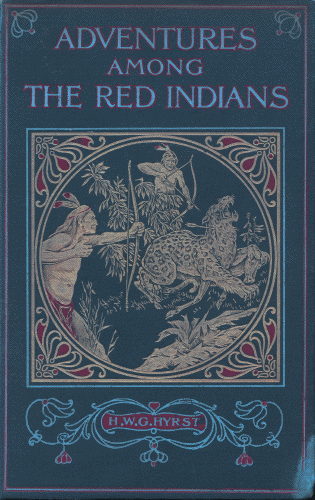
The Project Gutenberg eBook of Adventures Among the Red Indians
Title: Adventures Among the Red Indians
Author: Sidney Harry Wright
Release date: December 16, 2010 [eBook #34675]
Language: English
Credits: Produced by Chris Curnow, Lindy Walsh, Dan Horwood and the
Online Distributed Proofreading Team at http://www.pgdp.net
A Startling Experience
The world seemed to turn over and slip from under him, his head struck the gunwale smartly, and he gradually got a dim notion that he was standing with his back against something hard, and his body at right angles to that of the Indian in the bows.
ADVENTURES
AMONG
THE RED INDIANS
ROMANTIC INCIDENTS AND PERILS AMONGST THE INDIANS OF NORTH AND SOUTH AMERICA
BY
H. W. G. HYRST
AUTHOR OF
“ADVENTURES IN THE GREAT FORESTS,” “ADVENTURES IN THE ARCTIC REGIONS”
&c. &c.
WITH SIXTEEN ILLUSTRATIONS
LONDON
SEELEY AND CO. LIMITED
38 GREAT RUSSELL STREET
1911
UNIFORM WITH THIS VOLUME
THE LIBRARY OF ADVENTURE
Extra Crown 8vo. With many Illustrations. 5/- each
“Delightful books of adventure, beautifully printed and tastefully got up.”—Educational Times.
“Boy readers will find a kaleidoscope of brilliant and picturesque scenes from all lands collected for their benefit.”—Spectator.
|
ADVENTURES ON THE HIGH MOUNTAINS BY RICHARD STEAD, B.A. F.R.HIST.SOC. With Sixteen Illustrations “Deeds of heroism and daring fill these lively pages.”—Globe |
ADVENTURES IN THE GREAT DESERTS BY H. W. G. HYRST With Sixteen Illustrations “As stirring as any story of fictitious adventure.”—Glasgow Herald |
|
ADVENTURES IN THE GREAT FORESTS BY H. W. G. HYRST With Sixteen Illustrations “The kind of book a healthy English boy will delight in.”—Country Life |
ADVENTURES ON THE GREAT RIVERS BY RICHARD STEAD With Sixteen Illustrations “Thrilling stories-plentifully illustrated.”—Globe |
|
ADVENTURES ON THE HIGH SEAS BY RICHARD STEAD With Sixteen Illustrations |
ADVENTURES AMONG WILD BEASTS BY H. W. G. HYRST With Twenty-four Illustrations |
|
ADVENTURES IN THE ARCTIC REGIONS BY H. W. G. HYRST With Sixteen Illustrations |
ADVENTURES AMONG THE RED INDIANS BY H. W. G. HYRST With Sixteen Illustrations |
SEELEY & COMPANY LIMITED
These pages describe the adventures of men whom duty or inclination has brought into contact with the Indians of the entire American continent; and, since every day sees the red race diminishing, or abandoning the customs and mode of life once characteristic of it, such adventures must necessarily relate mainly to a bygone generation.
To-day the Indians form a bare sixtieth of the American population, a falling off for which the colonist has been responsible both actively and involuntarily. The history of the red man’s relations to those who ultimately were to be his rulers is a painful one; massacres and cruelties on the one side led to reprisals of a similar nature on the other. Happily the days of persecution and revolt are now ended; some few of the natives have intermarried with whites and have adapted themselves to the conditions of modern civilisation; others have settled down to an inoffensive and gypsy-like life on reserves granted by the white governments. Meanwhile the whole race—particularly in the north—continues to diminish. It is not improbable that in the days of Cortez and Pizarro the Indians were already a dying people; and that collision with the white invaders only hastened their demise. The result of this collision is melancholy, and the author of “Westward Ho!” 8 has put it all into a nutshell. “The mind of the savage, crushed by the sight of the white man’s superior skill, and wealth, and wisdom, loses at first its self-respect, while his body, pampered with easily-obtained luxuries, instead of having to win the necessaries of life by heavy toil, loses its self-helpfulness; and with self-respect and self-help vanish all the savage virtues.”
Bishop Bompas, who spent his life among the Indians of the far north, says, “the whole of the Tenni race seem to be of a sickly habit, and are dwindling in numbers. They are not much addicted to ardent spirits, nor are these now supplied to them, but they have an inveterate propensity to gamble. Though almost wholly free from crimes of violence, and not much inclined to thieve, yet heathen habits still cling to them, and they exhibit the usual Indian deficiency in a want of stability and firmness of character.... In sickness the Indians are very pitiful. They soon lose heart, and seem to die more fro despondency than disease. The constant removals are trying to the weak and infirm, and in times of distress those who cannot follow the band are left behind to perish.... The old women employ themselves in twisting grass or roots or sinew into twine for sewing or fishing-nets. The men and boys are often busied in shaping bows, arrows, snowshoes, and sledges.... Their capacity for civilisation is very limited; none become business men.”
| page | |
| CHAPTER I | |
| CHEROKEE WARFARE | |
| Indian insurgents and their rifles—The rising of 1793—March of Lieutenants Lowry and Boyd—The Indian attack—Sergeant Munson—Saving an officer’s life—Walking into the battle instead of out of it—The third Indian contingent—Munson wounded—Prisoners—Taken through the forest—The camp on Lake Erie—The chief’s sentence—Slavery!—Plans for flight—Munson’s escape by water—The Cherokee canoemen | 17 |
| CHAPTER II | |
| THE INVASION OF CORRIENTES | |
| Southern Indians as soldiers—Andresito Artegas—The war of 1818-20—An awkward time for British residents—The panic in Corrientes—The march of the Indian army—A magnanimous chief—Mr. Postlethwaite—Hindrances to good fellowship—A quaint vengeance—Schemes for flight—Andresito as a guest—A Peruvian blackguard—Flight and pursuit—Running for it—A ship in sight—The last struggle for liberty | 32 |
| CHAPTER III | |
| A CAPTIVE AMONG ARGENTINE INDIANS | |
| The Guaranian Family—A story of Don Pedro Campbell—Indians in pursuit—Ascencion and her sister captured—Taken to the tolderia—“The Cordoban soldiers are coming!”—Escape of the Indians—The two girls made slaves—Murder of a young Spaniard—An evening alarm—The Macabis—The battle—Ascencion’s sister killed—Another flight—A strange ship in the river—The Portuguese commander—Peter Campbell as rescuer—The Indians subdued—Punishing a would-be assassin | 44 |
| CHAPTER IV | |
| THE IROQUOIS OF THE CANADIAN BOUNDARY | |
| The Iroquoian family—Surgeon Bigsby—Coasting on Lake Ontario—A strange reception—Saluting “royalty”—Landing in the Indian village—The chief’s remarkable speech—The excitement that a red tunic may cause—The old chief’s generosity—Further popularity for the doctor—The chief’s 10 dinner-party—Farewell gifts—The next halt—Troubles of a geologist—“César Auguste”—An unwelcome passenger—Getting rid of the half-breed | 55 |
| CHAPTER V | |
| CREEK INDIANS AT PLAY | |
| U.S. Government and Indians—Captain Basil Hall, R.N.—The Creeks—A disappointment—The real Indians—A well-timed visit—The local band—The eve of a great festival—Dancing—Scarifying—The great day of the year—The match-ground—Where are the players?—The two teams—A discourteous commencement—Other preliminaries—The ball-play begins—Some alterations much needed—The end of the game | 67 |
| CHAPTER VI | |
| WITH THE DELAWARES AND CREES | |
| Sir George Head—Across Nova Scotia—Up the St. John River—Indian salmon-spearing—A ducking for the Major—A novel method of life-saving—The guides’ limit—A ferocious Cree—Engaging the new guide—Irishwoman versus Indian—The ride through the pine-forest—Snow—Wolf-tracks—Provisions short—The wolves’ attack—Keeping the guide in order—Trying to be wiser than an Indian—How to kill wolves—The Indian camp—Dances | 79 |
| CHAPTER VII | |
| AMONG THE FUEGIAN INDIANS | |
| The Pesherahs of Tierra del Fuego—Admiral Fitzroy—Fuegians as boat-thieves—Hostages—An experiment—Fitzroy’s second voyage—Met by the natives—Compliments and curiosity—A puzzle—Indian vanity—Ashore again—Hostile natives—“Yammerskooner”—An uncomfortable plight for English sailors—A night among unpleasant neighbours—Jemmy Button’s meeting with his relatives—Mr. Matthews’s experiences—Jemmy again—Why Jemmy stayed among his people | 95 |
| CHAPTER VIII | |
| THE END OF THE “BLACK HAWK” WAR | |
| What’s in a name?—Black Hawk—The Treaty of 1804—How it was kept—The Treaty of 1830—The beginning of the end—The Illinois militia—Through Wisconsin—Cholera—General Atkinson’s march continued—The Bad Axe River—An unlooked-for meeting—On board the Warrior—A dialogue—A mauvais quart d’heure—The white men’s revenge—Fording the river, in pursuit—A brief battle—The Sioux—Capture of Black Hawk—Væ victis! | 106 |
| CHAPTER IX | |
| PERUVIAN INDIANS | |
| Lieutenant Smyth, R.N.—The H.M.S. Samarang survey—A rash offer—The Jevero Indians—The guides’ opinion of their employers—How 11 the mountain Indians defy hunger—Coca balls—A gruesome neighbourhood—Alma perdida—Up the Huallaga River—Manatee hunters—Trouble caused by the guides—Smyth’s presence of mind | 119 |
| CHAPTER X | |
| THE CARIBS OF GUATEMALA | |
| John Lloyd Stephens—A delicate mission—Belize—Reception by the British Commanding Officer—Up the river—A genial Franciscan—Caught in the storm—A rude awakening—“Squaring” the Caribs—Central Guatemala—Agricultural Caribs—Hospitality—Catherwood seized with fever—The Chargé d’Affaires in a hole—The native doctor to the rescue—Any port in a storm—A miraculous cure—Caribs and Mestizo rebels—Joining forces with the officers—The scuffle—The long mile back to British soil—Safe over the boundary | 128 |
| CHAPTER XI | |
| A PRINCE’S ADVENTURES IN BRAZIL | |
| Prince Adalbert of Prussia—Journey across South America—No guides—The Brazilian forest—A path discovered—Gathering cherries—The mysterious Carib—The visit to the village—The cacique’s banquet—An unlooked-for taboo—The bull-fight dance—Carib guides—The Amazon at last—Indians among the trees and on the river—The party captured by Guaranis—Taken before the cacique—Ransom—An unexpected ally—The penitent Guaranis—A tapir hunt | 140 |
| CHAPTER XII | |
| INDIAN WARFARE IN CALIFORNIA | |
| Captain Wise, U.S.N.—Sent ashore at Monterey—The march of the boat’s crew—A Yankee trapper settlement—News of the Apaches and Comanches—Indians in the pay of Mexico—Preparing for an attack—The night alarm—“Hy-yah!”—The four Comanches—The palaver—Trouble ahead—The sudden volley—Pursuing the Apaches—Following the trail—From the forest to the prairie—A dilemma—The battle of the Indians—Capture of the fugitives—A surprise | 154 |
| CHAPTER XIII | |
| WITH THE AYMARAS AND MOXOS | |
| Prevalence of Indian tribes in Bolivia—The Colla or Aymara people—Hugh de Bonelli—The Aymaras as walkers—A walk along Lake Titicaca—Seventy miles a day—The Moxos—A glorious canoe-ride—Family parties of Indians on the river—The gathering of the tribe—The cacique—The start for the egg-hunt—Turtle “nests”—A large family—Commencement of the digging—Five days’ hard work—Breaking the eggs—Procuring the oil | 166 |
| 12CHAPTER XIV | |
| A SPORTING TRIP ACROSS THE PRAIRIES | |
| The Hon. Henry Coke—Across the prairies—Bluffs—The Crow guide—Brought to a full stop—Bison in sight—Disappearance of the guide and some of the baggage—Pursuing him—A hopeless chase in the dark—The Indians’ camp-fire—The Pawnees—Bargaining for a prisoner’s life—The new guides—Bison—Cautioning the new hands—Some very risky hunting—Cut off from the herd—Man down!—Attacked by an infuriated bison—Saved by an Indian’s presence of mind | 175 |
| CHAPTER XV | |
| HOW THE YO-SEMITE VALLEY WAS DISCOVERED | |
| The Sierra Nevada—The Snakes, or Shoshonees—San Francisco—John Savage—José Jerez—Indian dissatisfaction—Impressing the savages—Trouble with drunken Indians—An anxious drive—Home again—Boycott?—Terrible news—Attack on the Frezno River store—The return—Indians kept at bay by the diggers—An opportune arrival—A wife stolen—Pursuit—Volunteers to the rescue—Guided by prisoners—Found at last—The surrender in the Yo-Semite Valley | 189 |
| CHAPTER XVI | |
| AMONG THE NIQUIRANS AND APACHES | |
| Julius Froebel—A hazardous project—A travelling Indian tribe—A hot march—Niquiran hospitality—“El Dorado”—A deserted village—The villagers’ gold-mine—Froebel’s reception—The baskets and their contents—A very ill-judged action—Flight—Froebel’s wanderings—Ancient ruins—A new occupation for the wanderer—The Apaches—Firing on the Mexicans’ camp—Pursuit through the darkness—An unexpected arrest | 204 |
| CHAPTER XVII | |
| ACROSS THE UNITED STATES IN A WAGGON | |
| Mexican Boundary Commission—John Russell Bartlett—An ethnologist’s hunting-ground—Panic among horses and teamsters—The cause—A remarkable sight—A bison-surround—Wanton carnage—Approach of the Missouris—The presents—The delicate part of the bison—Grave warnings—Breakdown of the waggon—The Apaches—“Mangus Colorado”—The attack on the inn—The Apaches put to flight | 216 |
| CHAPTER XVIII | |
| A JOURNEY TO THE GRAN CHACO | |
| The Gran Chaco of Western Paraguay—Charles Blachford Mansfield—Up the Para—The madman’s cold dip—Corrientes—Finding canoemen—The Indians—A dangerous landing-place—Pitching the camp—Supper—Maté—A jaguar—Game easily obtained—Nearing Asuncion—An inexplicable scare—Hunting on the Chaco | 226 |
| 13CHAPTER XIX | |
| AMONG THE SERIS OF MEXICO | |
| Gustav Ferdinand von Tempsky—A risky journey—A tropical thunderstorm—A warm reception for the travellers—Mistaken for Indians—The road to Durango—“They have burnt another village!”—Dr. Steel as leader—Von Tempsky’s “capture”—The Mexican lancers—A scraggy army—Tracking the redskins— Sudden appearance of three hundred Indians—Working with awkward tools—The fight—Reinforced by Yankees | 239 |
| CHAPTER XX | |
| A HOLIDAY AMONG THE OJIBEWAS | |
| The Algonquin family—Charles Richard Weld—A holiday tour in Southern Canada—A coach ride over the prairie—Indian bullies—Getting rid of them—A rattlesnake hunt—Extraordinary method of snake-killing—Ojibewa guides—Rapid-shooting without warning—English strangers—Major Strickland’s farm—Ojibewas as indoor and outdoor servants—A great prong-buck hunt—Hunting methods of the Ojibewas—The battue | 252 |
| CHAPTER XXI | |
| CHIPPEWYANS AND COLUMBIAN GOLD-DIGGERS | |
| The Columbian gold find of 1857—H.M.S. Plumper’s task—Lieut. Mayne, R.N.—The Yale rising—Up the Fraser in a pinnace—Coming in at the end—The Indians’ complaint—Night march of the bluejackets—Excitement of the Indian guides—Glee turned to fear—Reaching the scene of disorder—The miners’ outpost—An awful sight—Quelling the mob—Struggle of the Indians to save their wigwams from the rioters—Disarming the diggers—The Chippewyan reinforcement—The lieutenant in an awkward dilemma—The palaver—An anxious night | 264 |
| CHAPTER XXII | |
| THE CHIPPEWYANS OF THE COLUMBIAN MOUNTAINS | |
| John Keast Lord—Across the Columbian Coast range—Disadvantage of an escort—Lord’s best weapon of defence—“Held up” by Indians—Between danger and safety—The assailants become guides—Suspicions on both sides—A night at the Indian camp—The Canadian’s discovery—Lord on his mettle—The escape—Indian notion of keeping an oath—Signalling—The gorge—The ambush—The truth | 277 |
| CHAPTER XXIII | |
| TWO DAYS IN A MOHAWK VILLAGE | |
| Johann Georg Kohl—The Quebec Mohawks—The Indian village—Some of the villagers—Lodgings—The chief—His recollections and his house—His sons—Supper—The evening chat—Kohl 14 a persona grata—A morning in the forest—Lynx traps—“Scratching the Russian”—The black bear—Native sport—Old and new customs—A betrothal.... | 289 |
| CHAPTER XXIV | |
| CANADIAN LAKE AND RIVER INDIANS | |
| The Athapascan family—The Chippewyans—Rev. C. Colton—From New York to the Saskatchewan—A curious demonstration—Making ready for the Chippewyans—The steam-launch aground—Surrounded by the canoes—“Sturgeons!”—Making the Indians pay the piper—The Lake of the Woods—The Indian fur-traders’ camp—Bargaining—Chippewyan “lodges”—Start of the canoe flotilla—Experiments—The strange river—Too late to turn—Rapids—An awful fate ahead—The canoemen’s presence of mind—A way of escape—Scaling the cañon—Towing | 302 |
| CHAPTER XXV | |
| A WALK ABOUT URUGUAY | |
| Indians of Uruguay—Thomas Woodbine Hinchcliff—A solitary walk—The mountain-forest—Lost—A very remarkable bull—Sudden appearance of Indian cattle-hunters—Lassoing—Breakfast with the Indians—Riding, under difficulties—A critical moment—Strange method of persuading a horse—Thirst—Help in sight, but running away—The Indian fellow-traveller—A surprise—Sticking up for the Indian—What the vice-consul had to say | 316 |
| CHAPTER XXVI | |
| THE EXPLORATION OF THE SALADO VALLEY | |
| Thomas Hutchinson, F.R.S.—In Santa Fé—A fortunate meeting—The steam-launch—Up the Salado—The Gaucho farmstead—The Quiteño guide—His luggage—Warnings—Visit from the “man-eaters”—The parley from the boat—Feeding the savages—Their terror at sight of smoke—Fear of the Quiteño—Men who have sunk to monkey level—Fish-bone spears—A very indiscreet question—Getting rid of the savages—Other Indians—Ostrich-hunting—The Quiteño’s contempt for the ox-waggon, and its remedy | 328 |
| CHAPTER XXVII | |
| BUSINESS AND PLEASURE ON THE LLANOS | |
| Venezuela—Don Ramon Paez—An extraordinary commission—Looking for Indians—Finding them—Native fishermen on the Orinoco—The payara and the caribe—A vicious fish—In search of the three thousand wild horses—Business-like lassoing—The aide-de-camp’s first attempt—The struggle with a wild horse—The race—Rescued by a Carib—Deer-hunting with masks | 340 |
| A Startling Experience | Frontispiece |
| PAGE | |
| A Gallant Rescue | 20 |
| A Narrow Escape | 40 |
| A Plucky Rescue | 52 |
| A Bully Well Served | 64 |
| A Game at Ball | 76 |
| The Snow-shoe Dance of the Red Indians | 92 |
| A Fierce Retort | 126 |
| Almost a Tragedy | 186 |
| Red Indian Attack on a Store | 198 |
| A Bison Surround | 220 |
| Stocking the Larder | 234 |
| A Primitive System of Telegraphy | 286 |
| A Novel Bridal Ceremony | 298 |
| An Arduous Task | 312 |
| Crane Stalking-Masks | 346 |
It has been said by certain historians that, after the American War of Independence, British agents were employed not only to poison the minds of those Siouan and Iroquoian tribes that dwelt on the United States side of the Boundary, but even to keep them supplied with rifles and ammunition.
Be that as it may, it is certainly a fact that, in 1793, the Cherokee and Seneca tribes of the Iroquois were not only at war with the Crows, Iowas, etc., of the rival Sioux faction, but were turning their mysteriously obtained rifles on the white people of the States; and the celebrated General Wayne was sent into Ohio with a strong force of cavalry and infantry to restore order. He pitched his camp near Fort Jefferson, on Lake Erie, and having driven away the insurgents, sent a hundred foot-soldiers, under Lieutenants Lowry and Boyd, across the lake to a fort near Detroit, to bring back by road three hundred horses and extra 18 provisions, and, incidentally, to disarm any quarrelsome redskins they might meet with.
The return march was destined to be a very unpleasant one. Large and small bodies of the Indians whom Wayne had driven to the forests persistently harried the column, flank and rear, firing from behind rocks and among the trees, till, in a couple of days, the hundred men had become only seventy, and many of the horses had escaped or been stolen. At noon on the third day the men halted for dinner on a barren tract between a range of hills and a thick forest; and, in order to guard against a surprise, Lieutenant Boyd with twenty men was sent to patrol the woods while the rest ate their meal in comfort. Half an hour later, while Lieutenant Lowry was preparing to send another twenty men to relieve the scouts, the report of a gun, followed quickly by a dozen others, warned him that the day was not to be gone through without further trouble.
A Gallant Rescue
Lieutenant Boyd had been sent with twenty men to patrol the wood while the main body ate their meal. Presently shots were heard, and Sergeant Munson was sent to bring back an immediate report. He found the Lieutenant trying to bind his shattered leg. Shooting the foremost redskin, the Sergeant mounted the officer on his back and, after several narrow escapes, brought him into camp.
Every soldier caught up his rifle and made ready to defend the horses and stores which had been placed in the centre of the camp. Lowry called a couple of sergeants to him and pointed to the new patrol.
“Take these to Mr. Boyd’s assistance; and you, Munson” (to the younger sergeant) “bring me back word of what is going on. Hark at that!” A rapid, running fire was beginning, and above Boyd’s voice, which was shouting directions or encouragement to his men, there rose the truly fearful war-whoop peculiar to the Cherokee Indians. “Hurry; off with you! I’ve enough men here to guard the horses in case——”
The little squad plunged into the wood and made 19 for the scene of action, which could not be far away, judging by the distinctness of the voices. They arrived after a minute’s quick double, and the sight that awaited them was not an encouraging one. Ten of their comrades were already dead or dying; the rest were fighting desperately against a score of Indians, most of whom were armed with rifles in addition to their bows and hatchets, while, leaning back against a tree, and doing his best to cheer on the survivors, sat Lieutenant Boyd, his shin-bone shattered by a bullet.
The new-comers fired a volley; several Indians fell, and the rest were speedily charged with fixed bayonets. Again came the horrible war-whoop, this time from a second batch of Indians who either had just arrived or had been in hiding, and these hastened to pour flight after flight of arrows into the rescuers from behind.
Young Munson, who was now fighting on the right wing of the little force, turned swiftly, and, firing off the charge which he had just rammed down, shot the foremost of the bowmen. But, even as he started to reload, he remembered his officer’s command to return at once with news; in the hurry and excitement of the last few minutes he had forgotten all about it. He looked round for the quickest exit from the wood, and, in so doing, caught sight of Boyd who, faint with the loss of blood, had been feebly endeavouring to bandage his wound with a handkerchief. The sergeant threw one more glance back at the soldiers; many of them had already fallen before the Indian arrows, and the rest, paying no attention to their new 20 assailants, were pursuing those who had guns. Then he turned again to the officer. To leave him here was to abandon him to death, perhaps by torture.
“Can you get on my back, sir? he said hurriedly. Quick; the redskins’ll be on us in another minute. Here, give me a hold of your pistol; I must leave my rifle unless you can carry it for me.”
But the officer had scarcely strength enough to enable him to stand. With difficulty Munson hauled him upright against the tree-trunk, snatched up the pistol in case he should need it on the perilous little journey which he was undertaking, and, hoisting Boyd on his back, darted among the trees out of sight of the approaching Indians. On every side of him shooting seemed to be going on; an arrow fell at his very feet, and the next moment a stray musket-ball flattened itself against the tree which he was passing. What he could not understand was that, the nearer he came with his burden to the camp, the louder and more frequent did the firing sound. Had his mates already driven the enemy into the open?
A few steps more and he would be out of the wood. But what was all this prancing and stamping? The horses could hardly have broken loose, for, since his recent losses, Lowry had had them tethered in batches whenever a halt of any length was made. The firing grew louder and faster than ever, and all doubt in his mind was ended when he heard the lieutenant’s voice ordering the men to charge.
While the two bodies of Indians worked such fearful havoc among the patrols, a third and stronger 21 party—fifty in number, and many of them mounted—had worked round to the open and were attacking the remainder of the company with tomahawks and spears. The horses, many of them already liberated by the savages, were plunging and screaming. Lowry, who had leapt on to the back of one of them, was cutting right and left with his sword at the mounted Indians, while his men, though they fought furiously, were retreating rather than charging, for these Cherokee redskins, unlike the timid, treacherous bullies of the southern and western tribes, knew no such thing as fear; moreover, in addition to their unquestioned bravery, they often displayed, in their warfare, an amount of forethought and method that would not have discredited a white regiment.
Naturally, Munson’s first care was to get rid of his burden; and he resolutely turned his back on the fighting and made for the little tent that had been hastily rigged up for the two officers when the company halted. Depositing the wounded man here, he snatched up a rifle and hurried breathlessly back to take part in the fray, which was but a small part, for, all in a moment, a spear, thrown with terrific force, struck him in the shoulder and he dropped to the ground, striking his head on a boulder so violently that he lost consciousness.
When he recovered himself, some Indians were bending over him, and one of them asked him, by signs, if he could stand. He contrived to stagger to his feet; then, finding that his water-flask was still at his belt, took a long drink from it, for his lips and throat seemed as dry as the back of his hand.
“Well done, sergeant; bravo!” said someone behind him; and other voices echoed the sentiment. He turned his head dazedly, and gave a start of astonishment. Under a tree near him stood ten men of his company, some of them with heads or limbs roughly bandaged.
“What’s up? he asked. What’s happened, anyhow?”
One of the Indians here took him by the arm, led him over to the tree, and signified that he must take his stand with the rest; and now he could see that those of his comrades who were not wounded had their hands bound, and that every man had a lasso-like thong tied about his waist, the other end of which at present trailed loosely on the ground.
“We’re all on us prisoners; that’s what’s happened,” said a corporal by whose side he had been placed. “I thought you was done for; ’pon my word I did.”
“Where’s all the rest?”
“Dead, or else cut their lucky. Lowry, he’s gone out, poor feller.”
“How about Left’nant Boyd?”
“Guess he got clear after all. I seen two o’ the boys gettin’ him on to a saddle-horse. There’s one thing, them as got away on horseback’ll soon take the news to Wayne, so if these varmints don’t tomahawk us or set light to us, I surmise he’ll soon be along to rescue us.... What’s their game now?”
Several mounted redskins were coming over to the prisoners, and after a few words with those who had been taking charge of them, made a sign to the Yankees that they must be prepared to march. The loose ends 23 of the thongs that bound them were handed up to one or other of the horsemen, and they were soon being dragged forward at a brisk walking pace. Munson indicated that he could not walk far till his wound had received attention, whereupon, instead of treating him like the rest, the Indians lifted him on to a spare horse, fastened his ankles under the animal’s belly, and one of the mounted Cherokees, seizing the bridle, rode on with his captive.
The procession turned at once into the thickest part of the forest, the horses stepping along so quickly, nevertheless, that those on foot could scarcely keep up with them. Although there was no visible track for them to follow, the redskins appeared to know quite well where they were going; they conversed very little among themselves, and Munson was riding too far away from his comrades to be able to communicate with them. As nearly as he could guess by the light, it must have been after five o’clock, and he had eaten nothing since midday. He signed to his companion that he was hungry, but the Indian merely shook his head. In about an hour from the time of starting the horses were stopped, a short conversation ensued among the riders, and then, to the sergeant’s dismay, all moved on again, every one of the prisoners being taken in a different direction.
Munson’s captor, who was now joined by two other savages, turned in the direction of the lake shore, and, quickening their pace to a canter, they rode a good twelve miles without stopping. By dark they arrived at an encampment where there were at least sixty wigwams pitched. The horses were pulled up, 24 the prisoner’s feet were freed, and he was ordered to dismount. He again made signs that he was hungry, and this time one of the Indians pointed encouragingly to a cooking-pot that hung over the nearest fire, and bade him sit down on the grass.
Presently a squaw brought a kind of meal cake, and, plunging a wooden fork into the pot, brought out a bird rather larger than a pigeon, which she laid on the cake and handed to the captive, the three Indians helping themselves in a similar manner. After a while, voices and the tramp of more horses became audible, and about fifty Indians, seemingly of the same tribe as those who had attacked the soldiers, marched or rode into the camp. Many of these must have been away on a hunting expedition, for they had with them a good supply of birds, deer, hares, and foxes.
Feeling considerably stronger and more hopeful after his meal, the American cast his eyes round in search of a way of escape. He was unbound, and might possibly succeed in crawling, inch by inch, down to the water-side; yet, with his shoulder in its present condition, he could neither swim nor—supposing he should have the luck to find a canoe—work a paddle; reason, moreover, suggested that a semi-permanent camp such as this appeared to be, would assuredly be far enough away from any white station or boat-route.
While he was still revolving plans, two redskins crossed over to him, made him stand, seized his arms and bound them securely, though not unmercifully, behind his back, and motioned to him to follow them. 25 They conducted him towards the largest of the wigwams, outside which sat the chief of the tribe, solemnly smoking. After an interval of dead silence, that personage gave a little shout, and all the men in the camp collected round about the prisoner. A lengthy harangue followed, addressed partly to Munson, partly to the bystanders; and, at the close of this, one of the Indians drew a knife and whetted it on his moccasin.
Young Munson pulled himself together and endeavoured to take courage from the fact that, if death had now come, it had come while he was doing his duty; a man of his calling must expect to meet it any day of the week; indeed, how many of his old comrades-in-arms had met it within the last few hours? At least the savages should see that he could die like a man, without making a fuss.
The Indians nearest to him took him by the shoulders and forced him into a sitting posture, and the man with the knife walked slowly up to him and stood grinning over him. Then a horrible thought came to him; they were going to give him a punishment almost worse than death—to scalp him, in fact—an indignity which only a man who had lived all his life in the neighbourhood of Indians could fully appreciate. He wriggled himself free and, springing up again, kicked out fiercely at his tormentors. For this they seemed to care little; the man’s hands were tied and he was at their mercy. He was forced down again and held motionless; then, while one man gripped him by the back of his neck so that he could not possibly move his head, the operator with the knife entered upon his task.