
CONTENTS
- THE DOG AND THE WOLF 5
- THE HERDSMAN 8
- THE BOYS AND THE FROGS 11
- THE COCK AND THE JEWEL 13
- THE MAN AND THE LION 15
- THE FOX AND THE CRANE 18
- THE TRAVELLER AND THE SATYR 22
- THE TRAVELLERS AND THE PURSE 25
- THE MOUTH AND THE LIMBS 27
- THE HARE AND THE TORTOISE 31
- THE MILKMAID 34
- THE LARK AND HER YOUNG ONES 39
- THE PHILOSOPHER AND THE ACORN 43
- THE WOLF AND THE CRANE 45
- THE DOG AND THE SHADOW 48
- THE TRAVELLERS AND THE BEAR 50
- THE FROGS AND THE BULL 52
- THE COUNCIL OF MICE 54
- THE WOLF AND THE LAMB 57
- THE BEASTS IN PARTNERSHIP 60
- THE LION AND THE MOUSE 64
- THE JEALOUS ASS 67
- THE TOWN AND COUNTRY MICE 71
- THE FOX AND THE CROW 75
- THE LION AN THE ECHO 79
- THE PAPER KITE 82
- THE RATS AND THE CHEESE 85
- AURELIA AND THE SPIDER 88
- THE REDBREAST AND THE SPARROW 90
- THE POET AND THE COBWEBS 92
- THE EPICURE AND THE PHYSICIAN 96
- THE FROGS DESIRING A KING 101
- THE HARE AND THE BRAMBLE 104
- THE HORSE AND THE STAG 106
- THE CAT AND THE OLD MOUSE 108
- THE FOX AND THE VISOR MASK 110
- THE GOOSE THAT LAID THE GOLDEN EGGS 112
- THE FOX AND THE GRAPES 114
- THE MOUSE AND THE WEASEL 116
- THE MISER AND HIS TREASURE 118
- THE JACKDAW AND THE PEACOCKS 120
- THE SPARROW AND THE HARE 122
- THE ASS AND THE LION 123
- THE STAG AND THE FOUNTAIN 125
- THE EAGLE, THE CAT, AND THE SOW 127
- THE EAGLE, THE RAVEN AND THE TORTOISE 129
- THE FLAY AND THE HORSE 131
- ESOP AT PLAY 132
- THE OLD PILOT AND THE SAILORS 134
- THE CRAB AND HER DAUGHTER 135
- THE SUN AND THE WIND 137
- THE TWO POTS 139
- HERCULES AND THE CARTER 141
- THE ANT AND THE GRASSHOPPER 142
- THE CROW AND THE PITCHER 144
- THE ANGLER AND THE LITTLE FISH 145
- THE FROG AND THE FOX 146
- THE APE AND HR YOUNG ONES 147
- THE FIR TREE AND THE THORN 149
- THE ASS IN THE LION'S SKIN 151
- THE DOG IN THE MANGER 153
- THE STAG AND THE VINE 154
- THE FIR MISCHIEVOUS DOG 155
- THE SICK MAN AND THE PHYSICIAN 156
- THE FARMER AND HIS SONS 158
- THE SWALLOW AND THE BIRDS 160
- THE BOASTING TRAVELLER 162
- THE OLD WOMAN AND HER MAIDS 164
- THE FIR INDUSTRY AND SLOTH 166
- THE SHEPHERD TURNED MERCHANT 168
- THE SPENDTHRIFT AND THE SWALLOW 170
- THE EAGLE AND THE CROW 171
- THE WOLF AND THE SHEPHERD'S BOY 173
- THE FOX WITHOUT A TAIL 175
- THE MEN AND THE OYSTER 177
- THE SHEPHERD AND HIS DOG 179
- THE COUNTRYMAN AND THE JUSTICE 181
- THE COCK AND THE FOX 183
- THE BLIND MAN AND THE LAME 185
- THE MAN AND THE SERPENT 187
- THE TWO STREAMS 189
- THE SOT AND HIS WIFE 191
- THE FARMER AND HIS QUARRELSOME SONS 193
- THE FIG TREE AND THE FLOWERING SHRUB 195
- THE FARMER AND THE LANDLORD 197
- THE SCHOOL-BOY AND THE MONITOR 199
- THE MILLER AND HIS ASS 201
- THE DREAMER AND HIS SONS 204
- THE OLD MAN AND DEATH 206
- THE PAINTER 209
- THE COBBLER AND THE NABOB 212
- THE HORSE AND HIS RIDER 215
- THE GOOD MINISTER 219
- THE SWAN AND THE COOK 221
- THE LYNX AND THE MOLE 223
- THE OLD CAT AND THE YOUNG MOUSE 225
- THE TWO FRIENDS 227
- THE SICK STAG 230
- THE FOREST AND THE WOODMAN 232
- THE ELEPHANT AND THE MONKEY OF JUPITER 234
- THE WOODCUTTER AND DEATH 237
- THE RAT AND THE OYSTER 239
- THE PHYSICIANS 242
- THE MOUNTAIN IN LABOR 244
- THE CAT METAMORPHOSED INTO A WOMAN 246
- THE FROG AND THE RAT 248
- THE LION AND THE FLY 251
- THE TWO MULES 253
- THE JUPITER AND THE FARMER 255
- THE COCK, THE CAT, AND THE LITTLE MOUSE 258
- THE MONKEY 261
- THE HORSE AND THE ASS 263
- THE ASTROLOGER WHO FELL INTO A WELL 265
- THE ANIMALS SICK WITH THE PLAGUE 269
- THE CANDLE 273
- THE HOG, THE GOAT, AND THE SHEEP 275
- THE DELICATE HERON 278
- THE BLACKAMOOR AND HER MISTRESS 280
- THE BEAR AND THE GARDENER 282
- THE VULTURES AND THE PIGEONS 284
- THE BEAR AND THE BEES 287
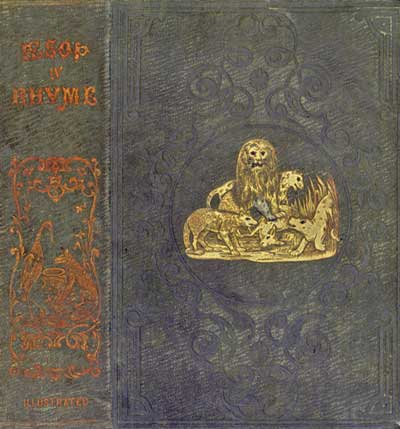
ÆSOP,
IN RHYME;
OR,
OLD FRIENDS IN A NEW DRESS.
BY MARMADUKE PARK.
PHILADELPHIA:
C. G. HENDERSON, & CO.,
N. W. CORNER ARCH AND FIFTH STREETS.
1852.
Entered according to Act of Congress, in the year 1852,
BY C. G. HENDERSON & CO.,
in the Clerk's Office of the District Court of the United States, in and for the Eastern District of Pennsylvania.
THE DOG AND THE WOLF.
A wolf there was, whose scanty fare
Had made his person lean and spare;
A dog there was, so amply fed,
His sides were plump and sleek; 'tis said
The wolf once met this prosp'rous cur,
And thus began: "Your servant, sir;
I'm pleased to see you look so well,
Though how it is I cannot tell;
I have not broke my fast to-day;
Nor have I, I'm concern'd to say,
One bone in store or expectation,
And that I call a great vexation."
"Indeed it is," the dog replied:
"I know no ill so great beside;
But if you do not like to be
So poorly fed, come live with me."
"Agreed," rejoined the wolf, "I'll go:
But pray, what work am I to do?"
"Oh, guard the house, and do not fail
To bark at thieves, and wag your tail."
So off they jogg'd, and soon arrived
At where the friendly mastiff lived.
"Well," said the wolf, "I can't deny
You have a better house than I."
"Not so," the other then replied,
"If you with me will hence abide."
"Oh," said the wolf, "how kind you are!
But what d'ye call that, hanging there?
Is it an iron chain, or what?"
"Friend," said the dog, "I quite forgot
To mention that; sometimes, you see,
They hook that little chain to me;
But it is only meant to keep
Us dogs from walking in our sleep,
And should you wear it, you would find,
It's nothing that you need to mind."
"I'll take your word," the wolf replied.
"It's truth by me shall ne'er be tried;
I'll have my liberty again,
And you your collar and your chain."
MORAL.
Our neighbors sometimes seem to be
A vast deal better off than we;
Yet seldom 'tis they really are,
Since they have troubles too to bear,
Which, if the truth were really known,
Are quite as grievous as our own.
THE HERDSMAN.
A herdsman, who lived at a time and a place
Which, should you not know, is but little disgrace,
Discover'd one morning, on counting his stock,
That a sheep had been stolen that night from the flock.
"Oh, I wish I had caught ye, whoever ye be,
I'd have soon let you know, I'd have soon let ye see,
What he had to expect," said the herdsman, "I trow;
But I've thought of a scheme that will trouble you now."
So what did he do, sir, but put up a board,
Describing the thief, and proposed a reward
Of a lamb, to the man who would give information
Concerning the thief, and his true designation.
The project succeeded; for soon there applied
A certain near neighbor, with others beside.
"But tell me the thief," said the herdsman, "at least;"
"Come hither," said they, "and we'll show you the beast!"
"The beast!" said the rustic, who thought he should die on
The spot, when he found that the thief was a lion!
"Ill luck to my hurry, what now shall I do?
I promised a lamb to detect you 'tis true;
But now I'd consent all my substance to pay,
If I could but with safety get out of your way."
MORAL.
Silly people ask things that would ruin, if sent;
They demand them in haste, and at leisure repent.
THE BOYS AND THE FROGS.
Some boys, beside a pond or lake,
Were playing once at duck and drake?
When, doubtless to their heart's content,
Volleys of stones were quickly sent.
But there were some (there will be such)
Who did not seem amused so much;
These were the frogs, to whom the game,
In point of sport was not the same.
For scarce a stone arrived, 'tis said,
But gave some frog a broken head;
And scores in less than half an hour,
Perished beneath the dreadful shower.
At last, said one, "You silly folks, I say,
Do fling your stones another way;
Though sport to you, to throw them thus,
Remember, pray, 'tis death to us!"
MORAL.
From hence this moral may be learn'd:
Let play be play to all concern'd.
THE COCK AND THE JEWEL.
A cock there was: a sage was he
(If Esop we may trust,)
Who wish'd to make a meal, you see,
As other sages must.
With this intent, as heretofore,
When on the hunt for grain;
Our hero scratch'd the litter o'er
With all his might and main.
But scarce a minute had he scratch'd,
When, to his great surprise,
A gem, with golden chain attach'd,
He saw with both his eyes.
"Alack!" quoth he, "what have we here?
A diamond, I protest!
Which lords and ladies buy so dear,
And hold in such request.
"But one good barley-corn to me
Has more intrinsic worth
Than all the pearls now in the sea,
Or gold now in the earth."
MORAL.
The moral here, in Esop's mind,
Was this, there's not a doubt:
Things have most value, which we find
We cannot do without.
THE MAN AND THE LION.
A man and a lion once had a dispute,
Which was reckon'd the greatest, the man or the brute;
The lion discoursed on his side at some length,
And greatly enlarged on his courage and strength.
The man, one would think, had enough to reply
On his side the question, which none could deny;
But like many others who make a pretence,
He talk'd perfect nonsense, and thought it good sense.
"So," says he, "don't be prating,—look yonder, I pray,
At that sculpture of marble, now what will you say?
The lion is vanquished; but as for the man
He is striding upon him; deny it who can."
"But pray," said the lion, "who sculptured that stone?"
"One of us," said the man, "I must candidly own."
"But when we are sculptors," the other replied,
"You will then on the man see the lion astride."
MORAL.
The man might have added, if he had been wise,
"But a beast cannot sculpture a stone, if he tries."
That sufficiently shows where the difference lies.
THE FOX AND THE CRANE.
"I certainly think," said a fox to a crane,
"That face, ma'am of yours is remarkably plain;
That beak that you wear is so frightful a feature,
It makes you appear a most singular creature."
The crane, much offended at what she had heard,
March'd off at full speed, without saying a word:
"Oh dear!" said the fox, "Mrs. Crane, I protest
You misunderstand me, 'twas only a jest."
"Come, don't be affronted—stay with me and dine;
You know very well 'tis this temper of mine
To say such odd things to my intimate friends;
But you know that poor Reynard no mischief intends."
So the crane thought it best not to break with him quite,
But to view his remarks in a good-natured light.
So she put on as pleasant a face as she could
When he ask'd her to dine, and replied that she would.
But alas! she perceived that his jokes were not over,
When Reynard removed from the victuals its cover
'Twas neither game, butcher's meat, chicken, not fish;
But plain gravy-soup, in a broad shallow dish.
Now this the fox lapp'd with his tongue very quick,
While the crane could scarce dip in the point of her beak;
"You make a poor dinner," said he to his guest;
"Oh, dear! by no means," said the bird, "I protest."
But the crane ask'd the fox on a subsequent day,
When nothing, it seems, for their dinner had they
But some minced meat served up in a narrow-neck'd jar;
Too long, and narrow, for Reynard by far.
"You make a poor dinner, I fear," said the bird;
"Why, I think," said the fox, "'twould be very absurd
To deny what you say, yet I cannot complain,
But confess, though a fox, that I'm matched by a crane."
MORAL.
Cunning folks who play tricks which good manners condemn,
Often find their own tricks play'd again upon them.
THE TRAVELLER AND THE SATYR.
A luckless wight, in winter slow,
Travelling once a forest through
Cold and hungry, tired and wet,
Began in words like these to fret:
"Oh, what a sharp inclement day!
And what a dismal, dreary way!
No friendly cot, no cheering fields,
No food this howling forest yields;
I've nought in store or expectation!
There's nought before me but starvation."
"Not quite so bad," a voice replied;
Quickly the traveller turned aside,
And saw the satyr of the wood,
Who close beside his dwelling stood.
"Here is my cave hard by," said he,
"Walk in, you're welcome, pray be free."
The traveller did not hesitate,
Hoping for something good to eat,
But follow'd to his heart's content,
Blowing his finger as he went.
"Pray," said the satyr, "may I know
For what you blow your fingers so?"
"What! need you," said the man, "be told?—
To warm my fingers, 'numb'd with cold."
"Indeed!" was all his host replied,
Intent some pottage to provide,
Which heated well, with spice infused,
Was to his shivering guest produced:
It made our traveller scald his tongue;
And wishing not again to do it,
Our hero could not wait, but blew it.
"What?" said his host, in accent rough,
"Is not your pottage hot enough?"
"Yes," said the man, "full well I know it,
'Tis far too hot, that's why I blow it."
"You artful villain! do you so?"
His host replied, with angry brow;
"My cave shall not a moment hold
A man that blows both hot and cold!
By none but rogues can that be done,
You double-dealing wretch, begone!"
MORAL.
The traveller scarce deserved such wrath,
For warming fingers—cooling broth.
No statutes old or new forbid it,
Although with the same mouth he did it:
Yet this beware of old and young,
What Esop meant—a double tongue;
Which flatters now with civil clack,
And slanders soon behind one's back.
THE TRAVELLERS AND THE PURSE.
Two friends once were walking in sociable chat,
When a purse one espied on the ground;
"Oh, see!" said he, (thank my fortune for that,)
"What a large sum of money I've found!"
"Nay, do not say I" said his friend, "for you know
'Tis but friendship to share it with me;"
"I share it with you," said the other. "How so?
He who found it the owner should be."
"Be it so," said his friend, "but what sound do I hear?
'Stop thief!' one is calling to you;
He comes with a constable close in the rear!"
Said the other, "Oh, what shall we do?"
"Nay, do not say we," said his friend, "for you know
You claimed the sole right to the prize!
And since all the money was taken by you,
With you the dishonesty lies."
MORAL.
When people are selfish, dishonest, and mean,
Their nature, in dealing, will quickly be seen.
THE MOUTH AND THE LIMBS.
In days of yore, they say, 'twas then
When all things spoke their mind;
The arms and legs of certain men,
To treason felt inclined.
These arms and legs together met,
As snugly as they could,
With knees and elbows, hands and feet,
In discontented mood.
Said they, "'Tis neither right nor fair,
Nor is there any need,
To labor with such toil and care,
The greedy mouth to feed."
"This we're resolved no more to do,
Though we so long have done it;"
"Ah!" said the knees and elbows too,
"And we are bent upon it."
"I," said the tongue, "may surely speak,
Since I his inmate am;
And for his vices while you seek,
His virtues I'll proclaim.
"You say the mouth embezzles all,
The fruit of your exertion;
But I on this assembly call
To prove the base assertion.
"The food which you with labor gain,
He too with labor chews;
Nor does he long the food retain,
But gives it for your use.
"But he his office has resign'd
To whom you may prefer;
He begs you therefore now to find
Some other treasurer."
"Well, be it so," they all replied;
"His wish shall be obeyed;
We think the hands may now be tried
As treasurers in his stead."
The hands with joy to this agreed,
And all to them was paid;
But they the treasure kept indeed,
And no disbursements made.
Once more the clam'rous members met,
A lean and hungry throng;
When all allowed, from head to feet,
That what they'd done was wrong.
To take his office once again,
The mouth they all implored;
Who soon accepted it, and then
Health was again restored.
MORAL.
This tale for state affairs is meant,
Which we need not discuss;
At present we will be content,
To find a moral thus:
The mouth has claims of large amount,
From arms, legs, feet, and hands;
But let them not, on that account,
Pay more than it demands.
THE HARE AND THE TORTOISE.
Said a hare to a tortoise, "Good sir, what a while
You have been only crossing the way;
Why I really believe that to go half a mile,
You must travel two nights and a day."
"I am very contented," the creature replied,
"Though I walk but a tortoise's pace,
But if you think proper the point to decide,
We will run half a mile in a race."
"Very good," said the hare; said the tortoise, "Proceed,
And the fox shall decide who has won,"
Then the hare started off with incredible speed;
But the tortoise walk'd leisurely on.
"Come tortoise, friend tortoise, walk on," said the hare,
"Well, I shall stay here for my dinner;
Why, 'twill take you a month, at that rate, to get there,
Then how can you hope to be winner?"
But the tortoise could hear not a word that she said
For he was far distant behind;
So the hare felt secured while at leisure she fed,
And took a sound nap when she dined.
So at last this slow walker came up with the hare,
And there fast asleep did he spy her;
And he cunningly crept with such caution and care,
That she woke not, although he pass'd by her.
"Well now," thought the hare, when she open'd her eyes,
"For the race,—and I soon shall have done it;"
But who can describe her chagrin and surprise,
When she found that the tortoise had won it!
MORAL.
Thus plain plodding people, we often shall find,
Will leave hasty confident people behind.
THE MILKMAID.
A milkmaid, who poized a full pail on her head,
Thus mused on her prospects in life, it is said:
"Let's see—I should think that this milk will procure
One hundred good eggs, or fourscore to be sure.
"Well then—stop a bit,—it must not be forgotten,
Some of these may be broken, and some may be rotten;
But if twenty for accidents should be detach'd,
It will leave me just sixty sound eggs to hatch'd.
"Well, sixty sound eggs—no; sound chickens, I mean;
Of these some may die—we'll suppose seventeen—
Seventeen!—not so many—say ten at the most,
Which will leave fifty chickens to boil or to roast.
"But then there's their barley; how much will they need?
Why they take but one grain at a time when they feed,
So that's a mere trifle; now then let us see,
At a fair market price, how much money there'll be?
"Six shillings a pair—five—four—three-and-six,
To prevent all mistakes, that low price I will fix;
Now what will that make? fifty chickens, I said,
Fifty times three-and-sixpence—I'll ask brother Ned.
"Oh! but stop—three-and-sixpence a pair I must sell 'em;
Well, a pair is a couple—now then let us tell 'em;
A couple in fifty will go—(my poor brain!)
Why just a score times, and five pair will remain.
"Twenty-five pair of fowls—now how shameful it is,
That I can't reckon up as much money as this!
Well, there's no use in trying; so let's give a guess;
I will say twenty pounds, and it can't be no less.
"Twenty pounds, I am certain, will buy me a cow,
Thirty geese, and two turkeys—eight pigs and a sow;
Now if these turn out well, at the end of the year,
I shall fill both my pockets with guineas 'tis clear.
"Then I'll bid that old tumble-down hovel good-bye;
My mother she'll scold, and my sisters they'll cry:
But I won't care a crow's egg for all they can say;
I sha'n't go to stop with such beggars as they!"
But forgetting her burden, when this she had said,
The maid superciliously toss'd up her head
When alas! for her prospects—the milk pail descended!
And so all her schemes for the future were ended.