
CHAPTER XIII
A JOURNEY TO AMATONGALAND (concluded)
Receive information concerning the haunts of the inyala—Heavy thunderstorm—Start for Gugawi's kraal—Cross the Usutu river—Reach Gugawi's—Go out hunting—Crested guinea-fowl seen—Two inyalas shot—Angas's description of the inyala antelope—Inyala skins prepared for mounting—Now safe in Natural History Museum—A third inyala shot—One missed—Move farther up the Usutu river—Country denuded of game—Bushbucks scarce—Hippopotamuses in river—Heavy thunderstorm—Two more male inyalas shot—Start on return journey to Delagoa Bay—Tedious journey—Intense heat—End of trip—Slight attacks of fever.
There were now abundant signs that I was approaching the haunts of the beautiful antelope I had come so far to seek, as inyala skins and horns were very much in evidence round Mr. Wissels's store, and several of the latter had manifestly been but recently killed. All these animals, Longman assured me, had been shot by the Amatonga within a short distance of the store, in the dense jungles lying in the angle between the Usutu and Pongolo rivers, which I could now see covering some low ridges at a distance of not more than six or seven miles from where we stood. Had it not been for the rain, I should have gone on the same afternoon; however, I gathered a good deal of information and arranged for a start with fresh carriers as early as possible the following day—my objective point being the kraal of an Amatonga headman named Gugawi, who, I was told, lived a few miles up the Usutu river, on the very edge of the jungle where inyalas were said to be plentiful. I noticed, however, that my informants were not over confident about my being likely to shoot any of these animals. When I asked if I should be sure to see some, they replied, "The imbala-intendi (the local name in this part of Amatongaland for the inyala) is very cunning; he lives in the very densest jungle, and never comes into the open except at nights; he is very cunning; he is a witch is the imbala-intendi." They all agreed, however, in declaring that there were plenty of them, although they were difficult to get a sight of. Well, there was nothing for it but to do my best, and deserve success even if I could not attain it.
That night we had a most tremendous thunderstorm, the rain falling in torrents; and as the place in which I was sleeping was not water-tight, I had rather a bad time of it, and was very glad when day broke.
The thunderstorm had cleared the air, and Sunday, September 27, dawned bright and clear, with every prospect of its being a fine day. I had all my things packed up pretty early, and with four new women carriers, and accompanied by two men who knew the way to Gugawi's kraal, managed to get off about an hour after sunrise, and reached my destination before ten o'clock. On our way we crossed the Usutu river—here a clear, swift-flowing stream, about two hundred yards in breadth, running over a bed of sand. We waded across it, and found the water quite shallow for the most part, and never more than three feet deep.
On reaching the kraal we were making for, I told Longman to cook me some breakfast; and whilst he was frying me some reedbuck steaks, I had a talk with the headman Gugawi and told him the reason of my visit. He replied that the "imbala-intendi" were numerous in the jungle just behind his kraal, and promised to do his best to help me to secure the specimens I wanted, though, like every one else, he said the animals were very cunning and difficult to get a sight of. As soon as I had had my breakfast, I asked Gugawi to give me a man who was well acquainted with the habits of the inyala, as I wished to go into the bush after them without any loss of time. He gave me one of his sons, and, accompanied by Longman and one of the Kafirs who had come from Mr. Wissels's store, we forthwith entered the jungle, which extended to within a few yards of the kraal. From this we were not distant more than two hundred yards before we saw fresh inyala spoor plainly imprinted in the wet ground. The rain at least had done us this service, that it had washed out all old spoor and rendered any fresh tracks quite conspicuous.
We now commenced to creep very cautiously through the thick thorny bush, making our way for the most part through tunnels made by hippopotamuses during their night excursions in search of food. We had usually to walk bent nearly double, often having to creep on our hands and knees; and, as the air was very hot and steamy, we were soon bathed in perspiration. Now and again we came to little open spaces in the bush, and in one of these, which we passed through soon after leaving the kraal, I saw a very handsome crested guinea-fowl, the same species, no doubt (Guttera edouardi), as that met with on the central Zambesi, to the east of the Victoria Falls.
We had been creeping about the bush in the uncomfortable manner I have described for about an hour, when we came suddenly upon a little circular opening some fifty or sixty yards in diameter. As we approached the edge of this open space, advancing very cautiously in a stooping attitude down a hippopotamus path, my guide suddenly dropped to the ground. As he did so, I got a clear view past him, and saw, standing amongst the grass and bush, just on the further side of the opening, what I knew was an inyala doe, as I could distinctly see it was reddish in colour. I could see no other animal near her, and as I required two specimens of inyala does, the one for the British and the other for the South African Museum, I lost no time about firing at the animal in question, which I saw drop instantly to the shot. But even as she did so, there appeared in her place, or very close to where she had stood, a great black shaggy form, which, indistinctly as I could see it in the deep shadow of the bush, I knew was a male inyala—the first that my eyes had ever looked upon in the flesh. My rifle was a single-barrelled one; and before I could fire the shot that might make that rare and beautiful beast mine, I had to open the breech of my rifle, take another cartridge from my belt, slip it into the chamber, close the breech again, and then raise the rifle to my shoulder and take aim. All this meant time and noise. Would the inyala, which stood like a statue by the dead body of his mate, give me the few seconds I required to take his own life too? I little thought he would, but he did; and as I raised my rifle once more, and took a quick but careful sight on his dark shoulder, I felt, as I pulled the trigger, that he was mine.
"I KNEW IT WAS A MALE INYALA—THE FIRST THAT MY EYES HAD EVER LOOKED UPON."
As the report of the rifle sounded, he plunged madly forward, and was instantly lost to sight in the thick scrub. But I felt sure he carried death with him; and so it proved, for we found him lying dead not twenty yards from where he had stood when the bullet struck him. The fatal missile had passed right through his shoulders, and having expanded on impact, had torn his heart to pieces. I had the dead female brought to where the male had fallen, and laid them side by side; then stood admiring them for a long time before I could bring myself to skin them. To thus secure a very handsome pair of inyala antelopes—whose excellently mounted skins are now safe in the Mammalian Gallery of the Natural History Museum at South Kensington—on the very first day I had ever hunted for them, and after little more than an hour's search—was indeed a most glorious and exceptional piece of good fortune, which, however, has been balanced by many and many a day that I can remember of unrequited labour in search of game.
I think I had here better give Mr. Angas's very careful descriptions of the inyala antelope, male and female, as they are so detailed and precise that they cannot be improved upon—except that, for a reason which I shall refer to presently, I imagine that the male whose skin he described could not have been fully adult.
Mr. Angas tells us that his notes "were drawn up from recently killed specimens which he in vain attempted to purchase from the Boers who possessed them," and are as follows: "The adult male is about 7 feet 6 inches in total length, and 3 feet 4 inches high at the shoulder. Though elegant in form, and with much of the grace of the solitary koodoo, the robust and shaggy aspect of the male bears considerable resemblance to that of the goat. Legs clean, hoofs pointed and black, with two oval cream-coloured spots in front of each fetlock, immediately above the hoof. Horns of the specimen in question, 1 foot 10 inches long,[18] twisted and sublyrate, very similar to those of the bushbuck, but rather more spiral; very sharp polished extremities of a pale straw colour, rest of horns brownish black, deeply ridged from the forehead to about half the length of the horn. Prevailing colour, greyish black, tinged with purplish brown and ochre; on the neck, flanks, and cheeks marked with several white stripes like the koodoo. Forehead brilliant sienna brown, almost approaching to orange; mane black down the neck, and white from the withers to the insertion of the tail; ears, 8 inches long, oval, rufous, tipped with black, and fringed inside with white hairs. A pale ochreous circle round the eyes, which are connected by two white spots, forming an arrow-shaped mark on a black ground; nose black; a white spot on each side of the upper lip; chin and gullet white; and three white marks under each eye; neck covered with long shaggy hair, extending also under the belly and fringing the haunches to the knees; two white spots on the flanks, and a patch of long white hair on the interior portion of the thigh; a white tuft under the belly, and another on the dewlap. On the outer side of the forelegs is a black patch above the knee surrounded by three white spots; legs below the knee bright rufous colour; tail, 1 foot 8 inches long, black above, with tip and inside white." This most detailed description is, I think, that of an animal not fully adult, as in the three full-grown male inyalas which I saw in the flesh all the buff, ochreous, and orange tints described by Mr. Angas had turned to greyish black, except to a slight extent below the knees, whilst none of them had any white stripes on the cheeks or neck; and, as the general ground colour of the young male is reddish brown, and that of a full-grown male greyish black, it goes without saying that, as the young animal grows from kidhood to maturity, the former colour gradually gives place to the latter—till, in a very old male, there is no buff or ochre left except on the legs below the knees. Of the female, Mr. Angas's description is as follows: "Smaller than the male, and without horns; total length, 6 feet; nose, to insertion of ear, 10 inches; length of ear, 6-1/2 inches; height from forefoot to shoulder, 2 feet 9 inches; tail, 1 foot 3 inches in length; becoming very pale on the belly and lower parts and white inside the thighs; a black dorsal ridge of bristly hair extends from the back of the crown to the tail; nose black; the white spots on various parts of the body nearly resembling those of the male, only the white stripes on both sides are more numerous and clearly defined, amounting to twelve or thirteen in number; tail, rufous above and white below, tipped with black."
[18] It may be remembered that the unidentified antelope shot by Captain Faulkner on the shore of Lake Nyasa, near Cape Maclear, stood 3 feet 4 inches at the shoulder, whilst the length of its horns was 1 foot 9 inches.
As soon as I had stripped the skins, with the leg-bones still attached, from my two beautiful specimens, I had them carried, together with the skulls, to Gugawi's kraal, on the edge of the bush, and there spent the remainder of the day in preparing them for mounting. Of the meat, which was all brought in, I sent a couple of haunches over to Mr. Wissels, and then, after keeping a small piece for myself, gave the remainder to Gugawi, to divide amongst his people as he thought fit.
Next morning I was up and out in the bush just as day was breaking, accompanied only by my guide of yesterday and Longman, who, however, kept some distance behind, in order to allow my guide and myself to approach our game as noiselessly as possible. We had been creeping about in the dense jungle for some three hours without having seen anything, although there was a good deal of fresh spoor about, and twice we had heard inyalas dash away through the bush without getting a sight of them, when suddenly my guide crouched to the ground, at the same time pointing towards a large ant-heap growing out of the dense scrub, and itself covered with undergrowth. Following the direction of his arm, I made out a reddish patch not fifteen yards away in the gloom of the bush; and, taking it for an inyala doe, I fired into it point-blank, as I required another specimen for mounting. At the shot, the animal fell, and on creeping up to it, I found that it was a young male. It was something less in size than a full-grown female, from which it did not differ in any way in coloration and the number and distribution of white stripes and spots. It was thus interesting, as showing that the male inyala changes in general colour from bright red to dark grey, only losing the rufous and orange tints on the ears and forehead—which were still conspicuous in the type specimen described by Mr. Angas—when fully adult.
As it was now getting on for midday, I had the young inyala carried forthwith to the kraal, where I remained until about four o'clock, then again sallied forth, and did another two hours' jungle-creeping before dark. I saw an inyala doe, and could have fired at her, but, thinking there might have been a male accompanying her, did not care to do so too hurriedly, and whilst I was straining my eyes peering into the bush all around her, she either saw or winded me, and bounded off, quite alone as far as I could make out.
Early the following morning I was again in the bush, and just after sunrise came on a male inyala close to the river. He was standing behind a mass of tree stems, with just his tail showing on one side and part of his head on the other. He was evidently looking at us, and as I knew he would be off in a moment, giving but little chance of a shot, I thought I had better try and put a bullet into him through an interstice amongst the tree stems, where I could see what I took to be part of his neck. I made a bad shot, however, as my bullet, instead of passing through the opening, imbedded itself in the wood of one of the tree stems, and the inyala went off uninjured.
On returning to the kraal, Gugawi proposed to take me to a spot some few miles higher up the Usutu, where he said there were plenty of inyalas, whilst at the same time the bush was not so dense as near his kraal. Being by this time thoroughly sick of crawling about bent nearly double, I hailed with delight the idea of finding the game I was seeking in a country where I could walk upright, and visions of inyalas feeding through open glades passed through my mind—visions, alas, which were never realised, for in my small experience I never found these antelopes anywhere except in dense bush. However, I was glad of the change, and soon had everything ready for a move.
In the afternoon we travelled some five or six miles up the river, and pitched camp in a bit of jungle near the water's edge. The Usutu river is here very broad, and reminded me strongly of parts of the Chobi; but whereas the banks of the latter river, as I knew it in the early 'seventies, abounded in game of many descriptions, from the elephant downwards, there was not a track to be seen along the Usutu of any kind of animal with the exception of the inyala. All the wealth of wild life which Baldwin saw in this same district in 1854 had melted away before the guns of the native Amatonga hunters; for, be it noted, this is a country in which but very little game has been killed by white men. Rhinoceroses, buffaloes, koodoos, waterbucks, impalas, lions,—all are gone, the only game left being the inyalas, which owe their preservation to the dense jungles in which they live; and even they are being rapidly killed off, as the natives are always after them, lying in wait for them in the paths made by the hippopotamuses or creeping stealthily through the bush in their pursuit.
Curiously enough, in these thickets, where inyalas are so numerous, there are very few bushbucks, although the surroundings are in every respect suited to their requirements. I can only account for the scarcity of the bushbucks, where inyalas are plentiful, by supposing that the latter animals will not tolerate the former—considering them too nearly akin to themselves to make good neighbours; for a male bushbuck might be excused, I think, for making love to an inyala doe, which scarcely differs from one of his own females in any way except size, and that probably not to a sufficient degree to stop his advances during the rutting season; which, of course, would be resented by the male inyala, and the latter being the more powerful animal, has been able to drive his rival out of his preserves. If jealousy is not answerable for the scarcity of bushbucks in these jungles where inyalas are so plentiful, I fail to understand why the former animals should be so numerous lower down the river under exactly similar conditions, except that there there are no inyalas.
In the open expanse of water, some half a mile in breadth, just opposite our camp, several hippopotamuses were grunting and playing about on our arrival, and as long as we remained here there were always some of these animals in sight. In the evening I went out after inyala, but though I saw plenty of spoor, I did not catch sight of one of the animals themselves. Soon after dark a heavy thunderstorm came up from the south, and continued with much lightning and torrents of rain till long after midnight. Having neither a tent nor a waterproof sheet, I, like my native companions, of course got soaking wet; and we had to sit shivering in our drenched blankets until daylight, as the heavy rains had put our fires out and we could not get another alight, everything being wet.
Soon after dawn, however, we managed to get a fire under way, and I then had a cup of warm coffee. Just as the sun was rising I went out into the dripping bush, and returned to camp dry and warm before midday. In spite of what Gugawi had said as to the bush being more open round this camp than near his own kraal, I found but little difference, and should describe all the bush in which I hunted on the Usutu river as dense jungle. In the course of the morning I just caught a glimpse of an inyala—a male evidently by his colour—but failed to get a shot at him. I also saw a large number of the beautiful crested guinea-fowls, which in this district seem to be more numerous than the common South African species. During the heat of the day I remained at our bivouac, and, as the sun was intensely hot, managed to thoroughly dry all my belongings, which had got so wet during the previous night's rain. In the evening I again went out into the bush, and just at dusk caught sight of the hind-quarters of an antelope amongst the thick scrub ahead of me. The light was fast failing, and although I felt sure it was an inyala, as there were apparently no other kinds of antelopes in the district, yet I could not in the least tell whether it was a male or female, but, hoping for the best, fired, and saw nothing more.
On forcing my way through the scrub to where the animal had been when I fired, I found a fine inyala doe lying on the ground, just on the point of death, the bullet having struck her in the left thigh and passed through the whole length of her body into the cavity of the chest. Although disappointed that it was not a male, I skinned her carefully for mounting; and she now forms part of the fine collection of South African mammalia which is in the Museum at Cape Town.
It would be but tedious reading were I to continue to describe in detail my further bush-crawling experiences in search of inyalas. Suffice it to say that, on October 1 and 2, I secured two more fine males, whose heads I preserved for my own collection. Although I should have liked to have got a fourth male for the South African Museum, I did not think it prudent to remain any longer in my camp on the edge of a swamp, where I knew the air must be reeking with malarial poison, as, besides the exhalations from the marsh, the ground (from which I was only separated at nights by a little dry grass and a blanket) had been soaked to the depth of two feet by the recent rain, thus rendering the conditions more than usually unhealthy. The weather, too, was now again looking very threatening, and I did not relish the idea of any further lying out in the rain; as I knew, from former experience, that I should probably have to pay for the wettings I had already suffered, by some attacks of fever—a disease from which I had been entirely exempt for seven years, but the poison of which I knew was still in my blood, and would be likely to be again stirred into activity by my recent exposure to unhealthy conditions.
Hence, on Saturday, October 3, I packed up my things and returned to Gugawi's kraal, walking on in the afternoon to Mr. Wissels's store. At Gugawi's I met an Englishman, who informed me that he had come down from Barberton, and was travelling about amongst the Amatonga, buying skins of wild cats, jackals, etc., which he hoped to sell again at a profit to the Kafirs working in the mines in the Transvaal. He seemed much surprised when I told him that I had only come to Amatongaland in order to shoot an inyala, and frequently remarked in the course of our conversation, "Well, I'm ——; so you've come all this —— way to shoot a —— buck." He also informed me that he was not very well, as he had been "on the burst" for the last three days; but this confidence was superfluous, as no one could have approached within ten yards of him without realising his condition.
On my arrival at the store I was disappointed to find that Mr. Wissels was absent, having again returned to Delagoa Bay for another cargo of maize. Had he been at home, I should have endeavoured to obtain a specimen of Livingstone's antelope—a species which I have never shot, and which Mr. Wissels had informed me was numerous in most of the jungles near his store. These little animals are very similar in habits to the diminutive blue buck of Natal, and as they inhabit dense bush, are not often shot, except by driving, and Mr. Wissels had promised that when I returned to his station he would collect a lot of Kafirs and get up a drive for me. However, as I did not know when he would return, and was anxious to get back to Kimberley as soon as possible now that I had accomplished the main object of my journey, I did not care about waiting for him, but determined to get on as quickly as possible. Had Mr. Wissels been at home I should probably have returned to Delagoa Bay by boat, but now I had the prospect of an eighty-mile walk. I had no difficulty in getting carriers, as Gugawi's men, who had brought my things to the store, and with whom I had been associated for the last week, volunteered to go on with me to Delagoa Bay; and it pleased me very much to find that they did not insist on being paid beforehand, but trusted to my honour to deal fairly with them.
On the evening of the day on which I returned to Mr. Wissels's store, the weather looked very unsettled; but on the following morning all signs of rain had cleared off, and the sun rose red and fiery in a cloudless sky. I got away early, and on the evening of the third day slept within sight of the lights amongst the shipping in Delagoa Bay. During those three days the heat had been intense, and in those eighty miles I never put my foot on a piece of firm ground, but plodded painfully through deep white sand, like the soft sand of the sea-shore. Indeed, all this flat country to the south of Delagoa Bay must once have been at the bottom of the sea—from which it has been upheaved probably at no very distant time, geologically speaking, as I noticed that the patches of sandy soil which were under cultivation were full of oyster and other sea-shells. Water seemed to be everywhere close below the surface, but was not good—having an unhealthy, slimy taste, and making bad tea. Indeed, except in the actual stream of the Usutu river, I never tasted anything but swamp water during this trip. As I tramped along mile after mile in the deep sand and beneath the blazing sun, I could not but think regretfully of my elephant-hunting days of over twenty years before, when I used to do the same sort of work day after day and month after month without feeling it, and got up every morning without an ache or pain, fresh and ready for the next day's work. But one cannot last for ever; and on this long weary tramp there were moments when I would have given a good deal for a horse, or even a donkey, and on the first day's walk the sun gave me a bad headache.
On the evening of the first and the morning of the second day we passed through some quite uninhabited country, and here I shot two duiker antelopes and a steinbuck. I also saw some quite fresh elephant spoor, and just caught a glimpse of a little Livingstone's antelope, whose local name is "schlengarn," in a patch of thick bush. The country was looking fresh and green, with the sprouting grass after the recent heavy rains; and hundreds of beetles were now running over the sand, which was a good deal more than warm. Indeed, it was so hot that I think a baboon would have hesitated to sit down on it.
But my weary tramp came to an end at last, and early on the morning of October 7 I crossed the Bay of Delagoa to the town of Lourenço Marques, and, thanks to the kind assistance of Mr. Edixhoven, got all my specimens packed and conveyed on board the Pembroke Castle the same day, for transport to England, where they duly arrived in very good order.
The same evening I left Delagoa Bay by train for the Transvaal, and finally reached Kimberley on October 10. Here I had a slight attack of malarial fever—a matter of a few hours only—succeeded by two more in Cape Town, and a final attack on board ship on my way to England. But these attacks were very slight and only lasted for a few hours at a time, and I can only say, with Drummond, that ample amends have been made for any little inconveniences I may have suffered, by the pleasure of the thought that I have not only added a pair of inyala heads to my own private collection, but have also enriched our National Museum of Natural History with two beautiful specimens of this rare and handsome antelope.
CHAPTER XIV
NOTES ON THE GEMSBUCK
Number of African antelopes—The eland—Roan and sable antelopes—The greater koodoo—Other antelopes—The gemsbuck—Limited range—Habitat—Keen sight—Speed and endurance—Chase after four gemsbucks—Two shot—Sight of vultures—Oxen frightened—Horse wounded by lioness—Gemsbuck bull shot—Visit from natives—Gemsbucks and zebras—Gemsbucks ridden to a standstill—Fine specimens shot—Length of horns—Character of the gemsbuck—Probably unaffected by the rinderpest—Likely to survive for long time.
There is such a wealth of splendid-looking antelopes to be found on the great African continent that it is hard, nay, impossible to say which amongst them is the grandest prize of all that can fall to a hunter's rifle. In bulk nothing approaches the eland, and an old bull of this species, with his massive form, low-hanging dewlap, and great neck surmounted by a striking and beautifully proportioned head, is in truth a noble animal, but at the same time one that looks fitter in every way to adorn a park than to be hunted to the death. The eland is, in fact, one of those beasts that ought to have been trained to the service of man, and would have been in all probability had it existed in Asia instead of in Africa. Such an animal few can slay without a certain feeling of regret, for even when desperately wounded, nothing but reproach can be read in its mild dark eyes.
How different is the quiet resignation shown by the dying eland to the fierce defiance of every look and gesture of a roan or sable antelope brought to bay and fighting desperately to the very last. These two latter animals are amongst the finest of all the African antelopes, and by many sportsmen the last named is considered the noblest of them all. The magnificent greater koodoo, too, has many warm admirers, whilst the inyala, lesser koodoo, and Grant's gazelle, if not amongst the grandest of the several genera to which they belong, are certainly some of the most beautiful.
But there is yet another species, whose praises have of late years been sung by few, the successful pursuit of which has always given me more satisfaction than that of any other of the larger antelopes of Southern Africa. This is the gemsbuck, the grandest of all the handsome oryx family. Cornwallis Harris, Gordon Cumming, Oswell, Baldwin, and others of those fortunate Englishmen who travelled and hunted in South Africa when the last century was only middle-aged have all written enthusiastically of the chase of the gemsbuck and the joy of securing a good head of this species.
But with the spread of European settlements and the steady advance of civilisation, these beautiful animals have been driven from many of their former haunts, and are now only to be found in the most arid districts of Western South Africa; and though their range extends from the north-western portion of the Cape Colony in the south to the southern part of the Portuguese province of Angola in the north, there can, I think, be but few districts left where they are to be met with at the present day in anything but small and widely scattered herds. At least, a herd of about fifteen is the greatest number that I have ever seen together, though it must be remembered that I have only met with the gemsbuck in the more easterly portions of its range, and it is quite possible that in the recesses of the Kalahari it may at certain seasons of the year collect into larger droves than anything that I have ever seen.
Compared with other South African game, I have shot but few gemsbuck—only twenty-five, I find by reference to my note-books—partly because I have done the greater part of my hunting in the more easterly parts of the country where these animals are unknown, but also for the reason that even when in countries where they existed I never found them anything but scarce.
The gemsbuck, as I have said before, is an inhabitant of Western South Africa, and lives and thrives in parts of the country where not only are there no running streams, but where for months together every year there is absolutely no surface water at all. In such districts there are almost limitless expanses of level plains covered with low scrub and thorny bush studded with small glittering white salt-pans, and intersected by forest-covered country, with sometimes a thick undergrowth amongst the trees, and it is in such surroundings that the gemsbuck is at home.
As a rule, they confine themselves to the arid, scrub-covered plains, but sometimes wander into the forests. If the sun is not shining full upon them—when they look almost white—the pale grey colour of their coats harmonises wonderfully well with all their surroundings, for the soil on which they stand is generally much the colour of their hides, whilst the parched and thorny scrub around them is always of a pale neutral tint, for it is usually leafless, and even when in leaf the leaves are rather grey than green.
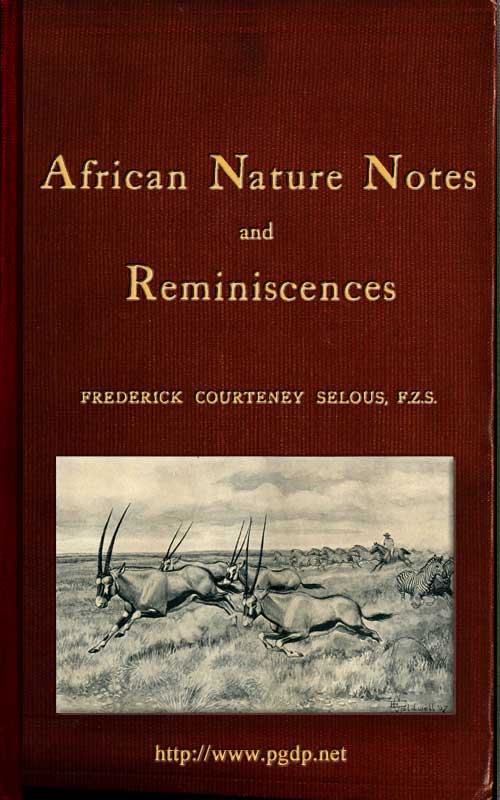
Like the striping of the zebra, the brilliant black and white markings of the gemsbuck's face can be plainly seen when near at hand, but are inconspicuous at any distance over four hundred yards, and the presence of these animals is often first betrayed by the sun glinting on their long black horns. The sight of the gemsbuck is very keen, and the Bushmen say that, like the ostrich, he trusts more to this sense for his safety than to scent, which is no doubt the case as long as he is in country of an open character. There is no more splendid sight than that of a herd of gemsbucks galloping over the arid wastes of their desert home; for, owing to the fact that the cows have longer horns than the bulls, every individual member of the herd looks as if it carried a head worth winning. They run at a steadier pace than any other animal with which I am acquainted, holding their heads rather low, so that their long black horns stand well up, only slanting slightly backwards. As they gallop, their long bushy black tails almost sweep the ground, as they swing from side to side.
In comparing the speed and endurance of various species of South African antelopes, it is first of all necessary to eliminate all cows heavy with calf, as these are so heavily handicapped that they do not afford any criterion of the real powers, under ordinary circumstances, of the species to which they belong. Every one who has ridden after sable and roan antelopes in August or September knows how easy it is at that time of year to bring the heavier cows to a standstill, but I have never yet been able to gallop down a bull of either species, though I have had many a good try.
The gemsbuck is often spoken of as the fleetest and most enduring of all the South African antelopes. My own experience is not sufficient to justify me in dogmatising on this subject, but all those I have shot I have galloped after, and I have also had a considerable experience in riding after most other South African antelopes; and my verdict is, that although gemsbuck run with great speed and endurance, they are inferior in these respects to the tsessebe, Cape hartebeest, Lichtenstein's hartebeest, blue and black wildebeest, and to the blesbok. I should put their running powers much on a par with those of the sable and roan antelope.
Gemsbucks being usually found in open country, as a rule get a good start, and I can well believe that a man mounted on a horse in low condition or only grass-fed would never get up to them at all; but a good South African shooting pony, in hard condition and fed regularly morning and evening on maize, ought to carry a twelve-stone man up to a herd of gemsbucks every time.
I have twice found gemsbucks in company with a herd of Burchell's zebras, and on both occasions in very open ground. On sighting me the former animals at once took the lead and galloped off, closely followed by the latter. On the first occasion they had a long start, and husbanding my horse, I only drew up to them gradually. There were only four gemsbucks—three cows and a bull—and about a dozen zebras; and these latter, when I at length drew up within a hundred yards, entirely prevented my getting a shot at the more coveted game. The horse I was riding had a very good turn of speed, so I then let him out as hard as he could go, and galloped right through the zebras, which scattered to either side of me, and then reforming in one herd, went off by themselves. The gemsbucks were now going at their utmost speed, and when I had passed the zebras were still sixty or seventy yards in front of me. The bull was only to be distinguished from the cows by his somewhat heavier build and shorter though stouter horns. Pulling my horse in as quickly as possible, I jumped to the ground, and aiming for the centre of the black patch which bedecks the hind-quarters of these antelopes, fired. My shot, as it turned out, struck him exactly right, an inch or so above the root of the tail, and must have broken or injured the vertebral column, as his hind-quarters gave way at once, bringing the doomed animal into a sitting position, from which he was unable to recover himself. My after-rider, a light-weight Griqua lad, was now close up behind me, so shouting to him to despatch the bull (whose head I wanted for my own collection), I galloped on after the cows, the best of which I wished to secure for our National Museum of Natural History, for which I had already got a good bull.
"THE GEMSBUCKS WERE NOW GOING AT THEIR UTMOST SPEED, AND WHEN I HAD PASSED THE ZEBRAS WERE STILL SIXTY OR SEVENTY YARDS IN FRONT OF ME."
They had now, however, got a long start, and as the chase soon led me across a succession of broad sandy ridges entirely free from all vegetation but a little coarse grass, the going became terribly heavy, and I began to think I should never get within shooting distance again. At last, however, the gemsbucks got out of the heavy sand and raced into a broad open plain, where the ground was fairly firm. They were still going strong, and were some three hundred yards ahead of me. I now made what I knew would have to be my last effort, and gradually drew nearer and nearer to the hindmost antelope, until at length I was not more than 120 yards behind it. Just then the leading gemsbuck swerved somewhat to the left, and the other two following in its tracks, gave me—for I had pulled in and jumped to the ground directly I saw the leader turn—a somewhat better chance for a shot than had been offered as long as the chase had remained exactly tail-on-end. Had I missed I should have pulled in and given up the hunt, as I did not want to overtire my horse; but I distinctly heard the bullet tell, and so remounted and galloped on again. For the next half-mile the wounded animal showed no signs of being hit, but held on close behind her companions. Presently, however, she began to fall behind, and suddenly coming to a halt, turned broadside and stood looking at her pursuer. She let me ride up to within fifty yards of her without moving, and it was only when, after having pulled in and dismounted, I had given her a shot through the heart, that she made a short rush forward and then rolled over dead.
I was now at least two miles from where I had disabled the bull, and as I knew that it would be a long time before my after-rider could come up with the Bushmen, I set to work to skin the animal just killed. She was a beautiful beast, but it was a terribly hot job skinning so large an animal without any assistance in the open shadeless plain, for it was already past midday and the heat of the sun was simply intense, and I was somewhat hungry and very thirsty as well, since I had left my waggon (which was standing at a pool of water on the road between Bamangwato and the Mababi) just at daybreak. At last my task was ended, and I then disembowelled the carcase of the dead antelope, and covered it as well as I could with dry grass, an operation that took some time, as grass only grew in scanty tussocks anywhere near at hand. I was also careful to throw sand over all the blood-stains on the ground, these precautions being necessary to keep off vultures, for although none of these birds were at the moment in sight, I was afraid that they might collect and destroy the meat after I had left, and before the Bushmen came for it.
I have satisfied myself over and over again that, in South Africa at least, vultures are guided to their food entirely by sight, and not at all by scent; for should an animal be killed in the midst of dense bush, it will often lie there for days, untouched by vultures, no matter how many of these birds may be circling about overhead; but unless the carcase of an animal killed on an open plain should be quickly hidden from view with branches of trees or grass, it will not remain long unvisited, for one or other of the vultures constantly flying round, perhaps at such a height as to be invisible to the human eye, is sure to spy it ere long, and then—something in its mode of flight no doubt suggesting that it is bent on serious business—is itself seen and followed by others, which in their turn are observed, till all the vultures in the neighbourhood are presently assembled at the feast. The Bushmen say that it is useless covering up a carcase and leaving blood-stains on the ground round about, as vultures can see these signs of slaughter at an incredible distance, and will always come down to investigate such tell-tale marks, whether the meat of the slain animal has been removed or not.
Having secured the skin of the gemsbuck (with the skull and leg-bones still attached) to my saddle, I commenced to lead my horse along his back tracks, but had not proceeded far when I met my after-rider, who, after having despatched the gemsbuck bull, had followed me up with half a dozen of the Bushmen. These latter I sent on to bring in the meat of the cow, and they overtook us again just as we had finished cutting up the bull. It was late in the afternoon when we got back to the waggon, but after a good meal, washed down with the best part of a kettleful of tea, I set to work, and before turning in got the headskin of the bull, as well as the complete skin of the cow, cleaned and prepared for mounting, with arsenical soap. The latter now stands in the Mammalian Gallery of the Natural History Museum at South Kensington, and the former is in my own collection.
As there was but little game in the desert country surrounding the pool where I was encamped—nothing, in fact, but a few giraffes, ostriches, gemsbucks, springbucks, and hartebeests—and the Bushmen had told me that there were absolutely no lions in the district, I had allowed my cattle, donkeys, and horses to feed and lie loose at nights. On this evening I was lying reading in the waggon after having prepared the gemsbuck skins, when I suddenly heard my troop of cattle (some thirty in number, including cows) galloping. They must have been feeding or lying down a few hundred yards behind the waggon, when something startled them and they came rushing towards the waggon in a solid phalanx; but on the driver and some of the boys running towards them and shouting, they halted close down to the edge of the pool. That something had frightened them, there could be no doubt, and as I have never known oxen show any fear of hyænas, I couldn't help thinking that, in spite of what the Bushmen had said, there was a lion about. I therefore had my oxen at once tied up, and taking the lantern, called up some of the Bushmen and went out to look for the rest of my live stock. We soon found the two horses that had been ridden that day and the donkeys, but of my third horse, a very powerful stallion, we could find no trace, though he had had his feed of maize at sundown with the others. I went back to the waggon, therefore, feeling very anxious about him.
At daylight the next morning I saddled up my best horse, and accompanied by some of the Bushmen, rode round to the spot from which the oxen had stampeded. The ground was very hard, as the pool of water by which we were encamped was situated in a limestone formation, and for some time we could discover nothing; but on riding back along the waggon track for about a mile to sandy ground, we there at once found the spoor of a lion, or more probably a lioness, as the tracks looked small. These tracks even the Bushmen were unable to follow over the limestone; but about a mile away on the other side of the pool we found the stallion lying down, and soon discovered that he had been both bitten and clawed during the night. I believe that his assailant must have been a very old and weakly lioness, which had found him lying down and attacked him whilst he was in that position. He had been somewhat severely bitten in the back of the neck, and clawed on the left shoulder and in both flanks, but being a very powerful animal, he had managed to throw his assailant off. I at once syringed out the stallion's wounds with a very strong cauterising solution of carbolic acid, and they never sloughed at all, but healed up very rapidly, though if the bite of a lion is not cauterised it takes a long time to heal.
The strangest part of this experience is that I never saw or heard anything more of this lion or lioness. With a dozen of the finest trackers in the world to help me, nothing could be done on the hard limestone ground, which in one direction extended for miles; nor, though I remained in the same camp for a week, did the baffled beast ever make any further attempt to interfere with my cattle. Possibly the stallion, after shaking his assailant off, had given him or her a kick. The Bushmen told me that this was the first lion that had visited the neighbourhood of their camp for years, though a lion and lioness had together killed a cow giraffe near another permanent water, some thirty miles to the west, about a month before. No doubt the brute that had attacked my stallion—probably an old and half-famished lioness—had come a long way on the spoor of my cattle.
I secured my most beautiful gemsbuck head in April 1888, in the desert country between the lower course of the Nata river and the northern extremity of the great Makari-kari Salt-pan.
On the previous day I had come across a solitary bull in an open rolling sandy plain, destitute of any kind of vegetation but coarse tussocky grass. Owing to the very open nature of the ground in which I found him, this gemsbuck spied me from afar and went off with a very long start. I was, however, very well mounted, and after a long and exciting chase, at length got within shot of and killed him. Whilst racing along in full pursuit of this bull, I had seen in the distance quite a large herd of gemsbucks, and as I knew that there must be some fine heads among them, I had half a mind to take up their tracks later in the day, but gave up the idea, as I only had a sufficient number of Bushmen with me to carry the meat of the animal already shot.
On arriving at my waggon, I found a party of Matabele Kafirs there who had come to the Makari-kari to collect rock salt, which they find there deposited in layers a couple of inches in thickness. This rock salt is reddish brown in colour, and very impure, containing apparently a great deal of lime. Although most of these Matabele carried guns, they told me they had scarcely seen a head of game since leaving home, and having shot nothing, had consequently had nothing to eat, after they had exhausted the small stock of grain with which they had started on their journey, but berries and tortoises, eked out with whatever they had been able to steal from the Bushmen. They certainly looked half starved, and on my presenting them with a hind-leg of the gemsbuck I had just shot, they very speedily devoured it, and then begged me to try and shoot them something on the following day, that they might lay in a stock of meat for their journey back to Matabeleland.
I promised to do my best for them, and at daylight the next morning, accompanied by a dozen Matabele and several Bushmen, rode out in search of the herd of gemsbucks I had seen the previous day whilst chasing the bull. We took up their yesterday's tracks, and after following them for several hours, found that they had joined company with a herd of Burchell's zebras, with which animals they were still feeding when we at last overtook them. There were about fifteen gemsbucks (the largest number of these animals I have ever seen together) and as many zebras. The country where we found them being perfectly open, they, of course, saw us when we were still a long way off, and at once went off, with a long start, the gemsbucks leading and the zebras running close behind them.
The horse I was riding—the same with which I had chased the gemsbuck bull on the previous day—was one of the finest shooting horses I ever owned, and though no longer young, was both fast and possessed of great staying power. He was, too, a wonderfully sure-footed animal, and just now in splendid hard condition. Had the zebras been alone, they would have gone off at a leisurely pace, but being led by the gemsbucks, they kept close on their heels. These latter animals, according to my experience, when disturbed never run off in a leisurely way, nor even, if not pressed, do they keep stopping and looking back at their pursuer like almost all other antelopes, but go off at once at such a tearing pace, that although it is not the utmost speed they are capable of when hard pressed, is yet sufficiently fast to make it impossible to get near them at all without hard galloping. Owing to the long start they had got, I daresay I had galloped two, perhaps three, miles before my horse had carried me close up behind the zebras. These latter, running well together some fifty yards behind the gemsbucks, raised a tremendous dust, and, as in the former instance I have described, effectually hid the long-horned antelopes from my view. In fact, it was quite impossible to shoot a gemsbuck without passing the zebras. This I set myself to do, and before long I was galloping alongside of the hindmost animals, keeping above the wind so as to escape the dust they raised as much as possible.
In another few moments I think I should have fairly galloped past all the zebras, but they did not wait for me to do so, for suddenly the whole troop of them swerved off down wind and left me alone with the gemsbucks. These latter were all cows, and most of them carried good heads, but the horns of one seemed specially long and thin, and these I determined to secure. For some time, however, she kept well in front, and I could not get a chance of a shot at her, as she was always covered by one or other of her companions. When I passed the zebras, the gemsbucks were, I believe, going at their utmost speed, and I had kept them at it for another half-mile or so, when suddenly one of them swerved out from the rest, and facing round, came to a halt. I passed within ten yards of her, and she stood looking at me as I passed, and as she remained in the same place for some time, I think I may fairly say that she was ridden to a standstill. She appeared to be a fine full-grown cow, and was probably in calf; but as it would have been at least six months before she would have dropped her calf, this could hardly have affected her running powers. This is the second gemsbuck I have overtaken on horseback, the first having been a bull (with only one horn) which I fairly rode to a standstill in 1879.
At last I got a good chance at the long-horned cow as she swerved off to one side in the van of the herd, and my bullet, hitting her at the back of the ribs, and ranging forwards to the neighbourhood of the heart, brought her to the ground dead before she had run another hundred yards. She was indeed a beautiful animal, and her horns the handsomest, though by no means the longest, that I have ever seen. They were most perfectly symmetrical, and measured 43 inches in length; but being very thin and absolutely straight—gemsbuck horns usually have a slight turn backwards—looked longer than they actually were.
In 1879 I shot another gemsbuck cow near the Botletlie river with horns of exactly the same length; but these latter, being much thicker and having a strong bend backwards, do not look their full length. I think that I am correct in saying that gemsbuck horns measuring over 42 inches in length are quite exceptional. At any rate, I only remember to have seen three pairs exceeding 43 inches. The one measuring 44-1/2 inches was shot by a Boer on the Botletlie river, and I purchased it from him for our Natural History Museum, where it now is; whilst I have seen another pair slightly longer which was shot in the Kalahari many years ago by the late Mr. W. Cotton Oswell. But the longest pair I have ever seen I found in the possession of a trader at Barclay West in December 1880. He told me that he had got them from a native hunter at Moroquain in the Southern Kalahari, and gave them to me, and I gave them to the late Mr. J. S. Jameson. I believe that this is the longest pair of gemsbuck horns known, their length being recorded in Mr. Rowland Ward's last book of horn measurements as 47-1/2 inches. Besides these heads I have mentioned, a few more pairs are known in various collections which measure between 44 and 46 inches, but these are a few exceptionally long pairs that have been picked out in the course of many years from amongst the large number of gemsbuck horns which are annually shot by natives in different parts of the vast Kalahari desert, and brought either to Kimberley or to Cape Town viâ Walfisch Bay; and these few exceptions to the general rule only serve to show how very rarely gemsbuck horns attain to a length of 44 inches and upwards. The horns of the bulls sometimes attain a length of 42 inches, but are, as a rule, several inches shorter and a good deal stouter than those of the cows.
Although gemsbucks, when brought to bay, are doubtless dangerous antagonists to dogs, and very possibly sometimes kill lions which have attacked them incautiously, I should doubt their being as fierce an animal by nature as either the sable or roan antelope. At least, I have never seen any of those I have wounded make the same threatening demonstrations as the last-named animals always do when closely approached. I once fired at a bull gemsbuck which was galloping obliquely past me, and dropped him instantly, and as he was still lying motionless when I cantered up to him, I thought he was dead. I noted the position of the bullet-mark, rather high up just behind the shoulder, and thought it must have smashed the vertebral column and so caused instant death. I then dismounted beneath a neighbouring tree, and, placing my rifle against the stem, walked towards the dead animal—as I thought. I was within a few yards of its head, when suddenly, with scarcely a preliminary kick, it rose to its feet and stood facing me. I was so near it that I thought it would be sure to charge, as almost any roan or sable antelope bull would have done so in similar circumstances. But, much to my relief, after eyeing me steadily for a few seconds, it turned and galloped off, and might easily have got away altogether, had my horse not been a good one. When I eventually killed it, I found that my first bullet had only grazed the vertebral column, and momentarily paralysed the poor animal. But it had a splendid chance for vengeance, of which it altogether failed to take advantage, and I certainly would not care to afford another of its kind a similar opportunity.
I have not heard whether or not the plague of rinderpest which swept through South Africa in 1896, and worked such terrible havoc amongst both the cattle and game of that vast territory, affected the gemsbucks. But, isolated as they are in the arid wastes of the Kalahari, I should imagine not; and since they are protected from constant persecution by the inhospitable nature of their surroundings, I fancy that they will long outlive many other species of South African game, which but a few years ago were far more numerous. May this be so; for, though the gemsbuck will always be hard to find, and by no means easy to bring to bag when found, these difficulties enhance his value, whilst his head will ever be one of the most beautiful and coveted trophies to be won in the hunting-fields of Africa.