
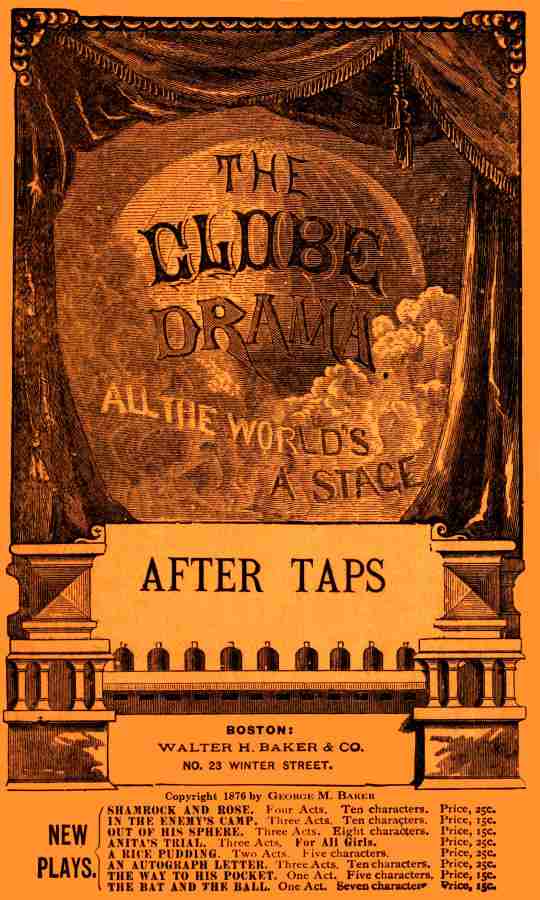
The Project Gutenberg eBook of After Taps
Title: After Taps
Author: Rachel Baker Gale
George M. Baker
Release date: June 27, 2015 [eBook #49295]
Most recently updated: October 24, 2024
Language: English
Credits: Produced by David Edwards, Gonçalo Silva and the Online
Distributed Proofreading Team at http://www.pgdp.net (This
file was produced from images generously made available
by The Internet Archive)
THE
GLOBE
DRAMA
ALL THE WORLD'S
A STAGE
AFTER TAPS
BOSTON:
WALTER H. BAKER & CO.
NO. 23 WINTER STREET.
Copyright 1876 by George M. Baker
| NEW PLAYS. |
SHAMROCK AND ROSE. Four Acts. Ten characters. | Price, 25c. | |
| IN THE ENEMY'S CAMP. Three Acts. Ten characters. | Price, 15c. | ||
| OUT OF HIS SPHERE. Three Acts. Eight characters. | Price, 15c. | ||
| ANITA'S TRIAL. Three Acts. For All Girls. | Price, 25c. | ||
| A RICE PUDDING. Two Acts. Five characters. | Price, 25c. | ||
| AN AUTOGRAPH LETTER. Three Acts. Ten characters. | Price, 25c. | ||
| THE WAY TO HIS POCKET. One Act. Five characters. | Price, 15c. | ||
| THE BAT AND THE BALL. One Act. Seven characters. | Price, 15c. |
Plays for Amateur Theatricals.
BY GEORGE M. BAKER,
Author of “Amateur Dramas,” “The Mimic Stage,” “The Social Stage,” “The Drawing-Room Stage,” “Handy Dramas,” “The Exhibition Dramas,” “A Baker's Dozen,” etc.
Titles in this Type are New Plays.
Titles in this Type are Temperance Plays.
| DRAMAS. | |
| In Four Acts. | |
| Better than Gold. 7 male, 4 female char. | 25 |
| In Three Acts. | |
| Our Folks. 6 male, 5 female char. | 15 |
| The Flower of the Family. 5 male, 3 female char. | 15 |
| Enlisted for the War. 7 male, 3 female char. | 15 |
| My Brother's Keeper. 5 male, 3 female char. | 15 |
| The Little Brown Jug. 5 male, 3 female char. | 15 |
| In Two Acts. | |
| Above the Clouds. 7 male, 3 female char. | 15 |
| One Hundred Years Ago. 7 male, 4 female char. | 15 |
| Among the Breakers. 6 male, 4 female char. | 15 |
| Bread on the Waters. 5 male, 3 female char. | 15 |
| Down by the Sea. 6 male, 3 female char. | 15 |
| Once on a Time. 4 male, 2 female char. | 15 |
| The Last Loaf. 5 male, 3 female char. | 15 |
| In One Act. | |
| Stand by the Flag. 5 male char. | 15 |
| The Tempter. 3 male, 1 female char. | 15 |
| COMEDIES AND FARCES. | |
| A Mysterious Disappearance. 4 male, 3 female char. | 15 |
| Paddle Your Own Canoe. 7 male 3 female char. | 15 |
| A Drop too Much. 4 male, 2 female char. | 15 |
| A Little More Cider. 5 male, 3 female char. | 15 |
| A Thorn Among the Roses. 2 male, 6 female char. | 15 |
| Never Say Die. 3 male, 3 female char. | 15 |
| Seeing the Elephant. 6 male, 3 female char. | 15 |
| The Boston Dip. 4 male, 3 female char. | 15 |
| The Duchess of Dublin. 6 male, 4 female char. | 15 |
| Thirty Minutes for Refreshments. 4 male, 3 female char. | 15 |
| We're all Teetotalers. 4 male, 2 female char. | 15 |
| Male Characters Only. | |
| A Close Shave. 6 char. | 15 |
| A Public Benefactor. 6 char. | 15 |
| A Sea of Troubles. 8 char. | 15 |
| A Tender Attachment. 7 char. | 15 |
| Coals of Fire. 6 char. | 15 |
| Freedom of the Press. 8 char. | 15 |
| Shall Our Mothers Vote? 11 char. | 15 |
| Gentlemen of the Jury. 12 char. | 15 |
| Humors of the Strike. 8 char. | 15 |
| My Uncle the Captain. 6 char. | 15 |
| New Brooms Sweep Clean. 6 char. | 15 |
| The Great Elixir. 9 char. | 15 |
| The Hypochondriac. 3 char. | 15 |
| The Man with the Demijohn. 4 char. | 15 |
| The Runaways. 4 char. | 15 |
| The Thief of Time. 6 char. | 15 |
| Wanted, a Male Cook. 4 char. | 15 |
| Female Characters Only. | |
| A Love of a Bonnet. 5 char. | 15 |
| A Precious Pickle. 6 char. | 15 |
| No Cure No Pay. 7 char. | 15 |
| The Champion of Her Sex. 8 char. | 15 |
| The Greatest Plague in Life. 8 char. | 15 |
| The Grecian Bend. 7 char. | 15 |
| The Red Chignon. 6 char. | 15 |
| Using the Weed. 7 char. | 15 |
| ALLEGORIES. | |
| Arranged for Music and Tableaux. | |
| Lighthart's Pilgrimage. 8 female char. | 15 |
| The Revolt of the Bees. 9 female char. | 15 |
| The Sculptor's Triumph. 1 male, 4 female char. | 15 |
| The Tournament of Idylcourt. 10 female char. | 15 |
| The War of the Roses. 8 female char. | 15 |
| The Voyage of Life. 8 female char. | 15 |
| MUSICAL AND DRAMATIC. | |
| An Original Idea. 1 male, 1 female | 15 |
| Bonbons; or, the Paint King. 6 male, 1 female char. | 25 |
| Capuletta; or, Romeo and Juliet Restored. 3 male, 1 female char. | 15 |
| Santa Claus' Frolics. | 15 |
| Snow-bound; or, Alonzo the Brave, and the Fair Imogene. 3 male, 1 female char. | 25 |
| The Merry Christmas of the Old Woman who Lived in a Shoe. | 15 |
| The Pedler of Very Nice. 7 male char. | 15 |
| The Seven Ages. A Tableau Entertainment. Numerous male and female char. | 15 |
| Too Late for the Train. 2 male char. | 15 |
| The Visions of Freedom. 11 female char. | 15 |
AFTER TAPS
A Drama in Three Acts
COMPLETED BY
RACHEL E. BAKER
FROM NOTES AND UNFINISHED MANUSCRIPT OF THE LATE
GEORGE M. BAKER
BOSTON
1891
CHARACTERS.
| GORDON GRAHAM | Colonel in Union Army |
| ROGER CARRUTH. | |
| PINKERTON POTTS | Major in Union Army |
| BIJAH BRIGHT | The Standard-bearer |
| RANDOLPH NEWCOMB | A Southern gentleman |
| PETE | A small contraband |
| PATRICK KILROY | Private |
| RUTH GRAHAM | Colonel Graham's wife |
| DOROTHY GRAHAM | Colonel Graham's sister |
| POLLY PRIMROSE. | |
| SOLDIERS AND GUARD in Act II. | |
Act I.—“Shot in the back.”
Act II.—“After Taps.”
Scene 1.—Noon. Scene 2.—Evening.
Act III.—“Home Again.”
Costumes of the period.
Copyright, 1891, by Rachel E. Baker.
AFTER TAPS.
ACT I.
SHOT IN THE BACK.
Scene.—Handsome apartment in the house of Colonel Graham in Baltimore. Door opening into hall, centre. Wide window, R.C. Mantel with fireplace L. in flat. Glass over mantel. Door R. in flat. Table L.C. Lamp on table, books. Chair beside table L. Arm-chair near mantel. Door L. in flat. Curtain raised to tune of “Yankee Doodle,” by drum and fife at head of a company of Union troops, seen passing window. Polly Primrose, discovered with duster in hand, alternately peeping out of window and dancing about stage, singing.
Polly (sings).
Along with Captain Gooding;
And there we saw the girls and boys,
As thick as hasty pudding.
Yankee Doodle keep it up,
Yankee Doodle Dandy,
Mind the music and the steps,
And with the girls be handy.”
(Speaks.)
Another thousand of Maine's boys marching down into Dixie. Bless their dear hearts! If this keeps on much longer, there will be none left for the hopeful Down-East girls and full-blown spinsters, whose natural expectations are warm corners in the hearts of these brave heroes. What a queer lot of men. Some have left their sweethearts behind them, I suppose. Heigho! There's no one to leave me behind. When I think of the good times Down East, it just makes my mouth water. I'd give a week's wages to catch a glimpse of some familiar face. (Coming down.) I wish I were a man. Nothing I'd like better than to join those ranks and march with them; but here I must stay and dust chairs (dusts spitefully) and tables. I know the military tic-tacs—no, that isn't right. I mean tactics. (Executes manual with duster.) Present—arms—no—feathers. Order—feathers. Indeed, I'd like to, for my next winter's bonnet, if there were only some one to pay the bill. Right shoulder, feathers. (Carries duster to left, in place of right.) Ha, ha, if any one could see me now, they would take me for a condensed, awkward squad. (Music outside. Polly marches up and down with duster at right shoulder.) I can feel the military thrill down to the tips of my toes. Think of the excitement when the bugle calls, and you hear the cry, “Charge feathers—charge!” (Charges with duster at door C., into the face of Bijah Bright, who appears with flag; he is bespattered with mud.)
Bijah. Phew! pooh—ah, choh! (Sneezes.) What are you trying to do, smother a fellow? Giving us the great Othello act, with me as Desdemona! (Looks at Polly.) Why, no!—yes, it is, Polly—Polly Primrose.
Polly. Bijah Bright! Well, I declare!
Bijah (taking both of Polly's hands). Why, the sight of you is good for a pair of diseased optics.
Polly. But why are you here in this house?
Bijah. It must have been the magnetism of your bright eyes, Polly. When I was marching along, I felt so drawn towards this house, sez I to myself, sez I, here, Bijah, is the place to find rest for your weary bones, and rations for an aching void. And, behold, I find you, my long-lost treasure. (Tries to embrace Polly, who steps aside.) Ah, Polly Primrose, the way you've played tag with that vital organ of my being, the heart that beats for you alone, would frighten any other man, but I've jest made up my mind,—
As all the world knows,
And Polly's my Polly,
Wherever she goes.”
Polly. Don't be so sure of that, Mr. Bright. Don't flatter yourself that you are the only man that calls me, “My Polly.”
Bijah. Let me but find him. He'll wish he hadn't been born.
Polly (laughing). Same Bijah Bright. Don't be worried (coquettishly), for I think you will find me the same Polly.
Bijah (taking both her hands). Wal, now, that's something like. When the temperature of your society is at zero, it makes my very blood congeal.
Polly. Where did you come from?
Bijah. Right from Oldtown, Polly, chuck full of patriotism and peace.
Polly. Seems to me those two words don't jine well, Bijah. Patriotism and fight make the best partnership.
Bijah. The fighting is all wrong, Polly. Do you see that flag? You bet, I'm proud of it. I've made a big wager that I can carry that flag from Oldtown to New Orleans.
Polly. How do you get along?
Bijah. Thus far, swimmingly; from Oldtown to Baltimore has been a triumphant march, but just here I've struck something.
Polly. From the looks of that eye, and the mud on that coat, I should say something had struck you. Bijah, you're a crank. Your peace and flag won't stir anything down this way. If you are not both suspended from a tree before you reach New Orleans, you may think yourself lucky. If your wits were as sharp and dazzling as your name, you would shoulder your gun and join that regiment.
Bijah. Oh, Polly, you're way off. No such work for me. I am the Standard Bearer. (Takes flag.) Think of the glory that will shine like a halo about my name. When posterity shall gently drop a tear for memory's sake, and in the language of the poet thus speak of one you knew so well:
Who gloriously did lead the fight.
No sword or musket carried he
To shed life's blood on land or sea;
His honest arm the flag did wave,
And urging on the soldiers brave,
The cause was won: a noble fight,
And thanks are due to Bijah Bright.
Polly (beaming with admiration). I declare, Bijah, jest as much of a poet as ever. Do you remember some of your poetry at the exhibition of the Oldtown School?
Bijah. Indeed I do. When old Deacon Sasafrass visited the school he always wanted something original; so, one day, thought I'd give it to him. Let me think—yes, I have it. (Recites with awkward gestures.)
Oh, never more she'll lay an egg.
The brindle cow has gone plumb dry,
And sister Sue has spoiled a pie.
Thus earth is full of sin and sorrow,
We're here to-day and gone to-morrow.
Ha, ha, Polly! Those were good times in Oldtown. Do you remember them?
Polly. Do I? Don't I?
Bijah. When I thought you were the purtiest girl in town; when the sight of you in your best bib and tucker made me feel as though there were an ice-cream factory in full operation on one side, and a hot air furnace on the other.
Polly. Oh, Bijah!
Bijah. But times are changed. The girls are changed, but you, Polly, are still a purty—
Polly. Oh, Bijah!
Bijah. Old girl.
Polly (indignantly). Bijah!
Bijah. Now, don't get excited, Polly; I'm by no means a blooming flower in the garden of youth myself. I've lived long enough to find out that money is the root of all evil; that an old rat is more capable from experience of keeping out of traps than a young one; that life may be worth living, but it isn't worth much of anything else; that an old sweetheart is at least a blessed memory; and so, when this cruel war is over, I'm going to lay my heart at the feet of—Miss Polly Primrose.
Polly. Oh, Bijah!
Bijah. In the meantime, as I am rather hungry, a bite of something from the cupboard wouldn't go bad.
Polly. Then come with me.
Bijah. Thanks, Polly; but before I accept of your hospitality, who is the proprietor of this establishment?
Polly. Colonel Gordon Graham.
Bijah. What? You don't mean it. (Aside.) Here's luck. (Aloud.) That grand old fellow?
Polly. Do you know him?
Bijah. Know him? Wal, I guess. Shot in the back. A dastardly trick.
Polly (holding out hand). Bijah, give me your hand; you are my friend for life. The colonel is one of the bravest and best of men. The shot that brought him down could not keep him there: for, beckoning to two of his men, he was carried in their arms to the head of his regiment; and, waving his sword, led them on, driving the enemy in all directions. Mr. Randolph Newcomb, one of the fine gentlemen of the city, professes great friendship for the colonel; but, I've heard it whispered about, that he tries to make him out a coward. Oh, I just hate him.
Bijah. He does, does he? I say, Polly, do they ever speak of Roger Carruth?
Polly. Law, no; poor Miss Dorothy. She's just as bright as ever: but mind you, way down deep, she just grieves and grieves. I know, for I've seen her, when she thought she was alone. You see, Mr. Newcomb is down on Mr. Roger, and he is so intimate with the colonel, who believes that he is something of a saint, that he has made the colonel down on him too. That just breaks poor Mrs. Graham's heart, for Mr. Roger is her brother, you know. I should think Mr. Roger might send Miss Dorothy some word, at least, and not leave her to fret her heart out. Oh, these men, they make me tired. Haven't a thought for any one besides themselves.
Bijah. Hush, Polly, don't say that. Haven't I marched from Oldtown just to catch a glimpse of your sweet face?
Polly. Indeed you haven't. You've done all that for glory, or, for all I know, some other girl.
Bijah. Oh, come, Polly, don't be hard on a fellow. You don't know how much stock you hold in that tender heart of mine. Its value is getting higher; better hold on to it, or some day, when the war is over, and it is above par, you will wish that you hadn't sold out. Besides, Polly, don't be down on Roger Carruth; he's “pure gold.” He'll come to the front one of these days, and Mr. Randolph Newcomb won't stand the fire.
Polly. What do you know about Mr. Newcomb, Bijah?
Bijah. Never you mind. Sufficient unto the day, is the gossip thereof. And O Polly, while that heart of mine is beating a regular nightly tattoo for you on one side, the other organ of my being, the stomach, in the most unromantic manner is clamoring for mid-day rations.
(Pinkerton Potts and Dorothy heard outside laughing.)
Polly. Poor thing, so active a poetical brain should not be allowed to starve. Come with me. (Exeunt, R., Polly and Bijah.)
(Major Pinkerton Potts and Dorothy enter, both in riding costume, and laughing heartily at Potts's appearance, who is brushing dirt from his clothes.)
Dor. Well done, Pinky, that last leap was too much for you. That's your punishment for insisting upon pouring into my tired ears, a whole battalion of pretty speeches. Pride must have a fall. If your shots in battle do not find a more responsive target, your record will not be an enviable one.
Potts. How can I help it? Such bright eyes and glowing cheeks cannot but provoke such thoughts to utterance. I say, Miss Dorothy, you do like a fellow, just a little, don't you?
Dor. Like you? Indeed yes. You are one of the nicest men I know. There is a large corner of my heart quite devoted to you.
Potts. Well, to be liked is something. But, if you only knew, how much I thought of you by day, and dreamed of you by night.
Dor. Ha, ha! to think of Pinky Potts assuming the sentimental rôle. Dear me. I never dreamed of such a thing. Why, you are too old a friend. What should I do, if I were to fall in love with you? It would spoil all the fun, and now, you are my devoted slave.
Potts. What's the matter with my being in love and playing the devoted too?
Dor. Never. Now, Pinky, you are just the dearest fellow in the world, and I am awfully fond of you; you are no end jolly. So come (offers hand, which Potts takes), let's be friends forever, and keep sentiment out of the question. (Seriously.) And you know, Pinky, I can never forget Roger Carruth.
Potts. No, Miss Dorothy, and I would not have you. Roger and I are too old friends. I would not mar his happiness or yours, for all the world. (Kisses Dorothy's hand.)
Dor. Well said, my noble major. Some day a fascinating little woman will cross your path who won't say “nay” to your devotion. I hope it will be some one that I shall know, Pinky, for I shall love her with my whole heart. When the war is over and Roger comes back—he will come back, won't he, Pinky?
Potts. Indeed he will. Never doubt his loyalty, and some day you will have your reward. Roger is under a heavy cloud, but penetrated by the warmth of your love it will in time disperse. Then, Miss Dorothy, you will say “good-by” to tears, and revel in the happiness and sunshine about you.
Dor. Pinky, you were wrongly named. You are true blue every time. (Goes to window.) Pinky, come here. Do you see that man walking with the Colonel and Mrs. Graham? That is Mr. Randolph Newcomb—and—I don't like him.
Potts (looking over her shoulder). What, that beastly cad? don't blame you.
(Enter Ruth Graham.)
Ruth. Good-morning, major. Ah, Dorothy, you here? What a glorious morning for a ride. I see you have taken advantage of it. But major, your appearance indicates a mishap—nothing serious, I hope?
Dor. (looking at Potts and laughing). He made a thrilling leap, but missed the mark. O Ruth, I wish you could have seen his lordship ignominiously turning a somersault in the mire. Don't be surprised, if the next news that you hear is that Major Pinkerton Potts, formerly officer in the Union Army, had reached the zenith of success, and was now dazzling all Europe by his acrobatic feats. Pinky, don't forget your old friends when fortune smiles upon you, and (mock courtesy) send us a box. (All laugh.)
(Enter Colonel and Newcomb; Colonel leaning upon Newcomb's arm, very weak. Leans against door.)
Col. Yes, Newcomb, I must rejoin my regiment to-day. No more holidays for me. The wound is healing. Back again with my men, breathing the atmosphere of patriotism, strength will return to me. Ah, Newcomb, a glorious cause. I wish you were on our side.
(Enters room. Potts salutes.)
Col. Glad to see you, major; our time is up, old fellow. Ah, been for a ride with madcap Dorothy? (Putting his hand on Dorothy's shoulder.) I tell you, major, if every man in the regiment was fired with the enthusiasm which this brave-hearted girl possesses, we should have no deserters. (Turns to Newcomb.) Major, allow me to introduce my friend, Mr. Randolph Newcomb. (Potts bows frigidly and does not see Newcomb's hand which he has extended. Dorothy bows slightly.)
Col. (seated in arm-chair; Ruth beside him). Newcomb, since you are not on our side, I cannot say “Come and join us” in the fight. No doubt, you are doing your duty equally well, by remaining here.
Newcomb. There is other work besides fighting, Colonel, and mine lies close at hand.
Col. True. And that reminds me of mine. Come, major, escort me to my room. We will talk over the plans for our return. Dorothy, dear, I must lean upon you, too. Ruth, I leave Mr. Newcomb to your kind care. Good-morning, Newcomb.
(Exeunt Col., Major, and Dor., L.)
Ruth (coming forward, about to seat herself at table; coldly). Won't you be seated, Mr. Newcomb?
New. (sits in chair near mantel). The colonel insists upon a return; do you think this wise, Mrs. Graham?
Ruth. His heart is so full of patriotism, every hour's delay irritates him. Since he cannot be persuaded, I think it wiser to let him go. Yet, I fear for his safety. That shot in the back was mysterious. Some foe, calling himself friend, lurks near him; why, I cannot imagine. He is everything that is true and noble; and whoever fired that shot had some motive, which one attempt upon the colonel's life will not satisfy.
New. My dear Mrs. Graham, you are morbid. A colonel's life is at hazard as well as that of a private. Why could not the shot from an enemy's rifle have done the work?
Ruth. Impossible! the enemy were in front. Only a coward would do so contemptible a deed.
New. True, there are some without honor, Mrs. Graham. Your brother, Roger Carruth, for instance.
Ruth (rising). How dare you, Mr. Newcomb, in my own home, speak so slightingly of my brother? Why have you turned against him? When he was first accused of the crime, you acted as his friend. Since his escape, you never lose an opportunity to taunt me with his downfall.
New. Because the evidence against him has strengthened.
Ruth. Mr. Newcomb, you call yourself friend. I do not believe you. Roger is as innocent of that crime as I am, and you know it. Not content with attempting to overturn my faith in my brother, you have spared no time or trouble to turn the colonel against him. He believes in your friendship so thoroughly, he never thinks to doubt your word.
New. That is as it should be, Mrs. Graham. And, I hope, some day, the colonel's wife will favor me with her confidence.
Ruth. Never. Your very presence is hateful to me, and could I have my wish you would never again cross this threshold. The time will come when Roger's innocence will be proved, and woe to those who are his accusers.
(Enter Polly, R.)
Polly. If you please, Mrs. Graham, the colonel is asking for you.
Ruth. Very well, Polly. (Polly exit.) I fear the walk has been too much for the colonel. Will you excuse me?
New. Certainly. (Ruth exits, L.; New. laughs.) It will be a long time before that day, my dear Mrs. Graham. The plot cannot so easily be unravelled. Suspects some foe of the colonel's, does she? She shall have a better cause. The shot will be more telling next time. (Goes to window.)
(Enter Roger, disguised as Gibbs.)
Gibbs. Is the colonel at home? (New. turns, sees Gibbs, and gives a surprised whistle; Gibbs looks at New., and whistles.)
New. (coming down). What business brings you here?
Gibbs (coming down). To inquire after the colonel's health.
New. I can give you full information. He has quite recovered, and is to rejoin his regiment to-day. What next?
Gibbs. To ascertain if he has ever found a clew to the perpetrator of the foul outrage.
New. If not, to turn traitor.
(Enter Dor. in house gown, and sees New. and Gibbs. She is about to retire, but stops upon hearing Gibbs's speech.)
Gibbs. Yes, for I can give him the name of the man who planned his murder. (Dor. crosses to stage C. and hides behind portière.)
New. And what do you expect to get for this startling piece of news?
Gibbs. Well, say fifty dollars.
New. I will give you a hundred to say nothing about it, on one condition, that you yourself try your hand. That man Dowling was worse than nothing. It was a bad shot; we need better marksmen in our armies.
Gibbs. You are bound to murder him?
New. Murder? no indeed. “All's fair in love and war.” Are we not enemies? Is he not the invader of the sacred soil that was my birthplace? Has he not won the heart of the woman I once loved? That affection is now dead, and hatred has risen from the ashes. She scorned me once, and I shall not rest until her happiness is wrecked.
Gibbs. Then that explains your treachery towards her brother, Roger Carruth. (Dor. leans forward; listening.)
New. What do you know of Roger Carruth? The world looks upon him as a criminal; he is beyond recall and as good as dead.
Gibbs (looking at him steadily). You are sure?
New. Yes, I am confident of that.
Gibbs. And the family; do they not suspect?
New. Suspect? not much; they are too simple for that. You are still in the colonel's regiment?
Gibbs. Yes. What are your orders?
New. Are you at any time placed as sentinel near the colonel's quarters?
Gibbs. Yes, any night may find me there.
New. Well, I must take my chances. To inquire after the colonel's health is sufficient excuse for my appearance in camp at any time. The colonel has given me a standing invitation.
Gibbs. Which you will have no hesitation in accepting, I see.
New. What time are you placed there on guard?
Gibbs. Just before taps.
New. Good, just the thing. After taps will be the time. Lights out, everything quiet. Can I depend upon you, Gibbs?
Gibbs. You have my word, sir.
New. Ha, ha! word? do you think that yours is worth anything?
Gibbs. Sometime I hope it will be.
New. Remember, you owe much to me. Should you turn traitor, your reckoning will be a sorry one.
Gibbs. I shall not forget all that you have done for me. Some day I will pay it back with interest. (Dor. hides; Gibbs exit C.)
New. I wonder if I can trust him? He seems docile enough; but sometimes I fancy there's a look in his eye—pshaw! what nonsense. Newcomb, my boy, a clever trick, a bold scheme; but you will win it, never fear.
(Exit New., C.)
Dor. (frightened, appears from behind portière). What do I hear? A scheme to take the colonel's life, and by his best friend too. (Goes to window.) There he goes, oh, the hypocrite. Now I know why I hate him so. With all his fine manners, I have not been deceived. Ugh! I hate even to shake hands with him. Oh dear, if I were only a man, that I might be near the colonel. Whom shall I tell? Who will help me? Ruth must not know, she has enough to bear. (Goes to mantel and takes Roger's picture; music.) They call me gay, Roger, frivolous and heartless. Perhaps I am, but if they could only look down deep into my heart, they would find the love for you, burning a strong and steadfast flame. (Places picture on mantel and stands looking at it.) O, Roger, why did you leave me? We all believed in your innocence and could have helped you bear the burden, which now alone must be so heavy. Oh, if you were only here to help me now. (Bows head on hands and stands weeping; music ceases. Enter Bijah and Polly.)
Bijah. That was the best piece of pie, Polly. If I could only have my knapsack as a receptacle for such samples of your cooking, I wouldn't need drum and fife to spur me on.
Polly (sees Dor.). Hush, Bijah, Miss Dorothy is here.
Dor. (raises head; comes forward). A visitor, Polly?
Polly. Yes ma'am. A friend from Oldtown; and only think, Miss Dorothy, he knows your Mr. Roger.
Dor. Knows my Roger? (Goes to Bijah.) Oh, tell me of him; where is he?
Bijah. That I cannot tell you (takes letter from pocket), but here is a letter, which he bade me give you should I ever come to Baltimore.
(Dor. takes letter; breaks seal. Bijah and Polly retire to window; music.)
Dor. (reads). My darling Dorothy.—That you still have faith in me I have no doubt. Your heart is too pure for anything else. I have enlisted in the army, and only as private will serve my country with heart and soul. When the war is over, I will return to you; my innocence established, and the foe, not only my country's but my own, defeated and trodden under foot. Bijah Bright, the bearer of this letter, is a true and loyal friend. He is worthy of your greatest respect, for he stood by me in my darkest hours. My love to dear sister Ruth. Until we meet again, yours in life or in death.
Roger.
Dor. (kisses letter). Mr. Bright, I am more than grateful to you for bringing this letter; it fills my heart with renewed hope. Believe me (gives hand to Bijah), your loyalty to Roger makes us warm and steadfast friends.
Bijah. I shall see him again, Miss Dorothy, and, when I do, I shall say to him, that the stars in heaven never shone brighter than the love in your eyes when you spoke his name.
Dor. You are a true knight. Will you take an answer to this letter?
Bijah. Indeed, I will.
Dor. Thank you so much.
Bijah. No thanks, Miss Dorothy, the pleasure's mine. (Dorothy exit R.)
Polly. Isn't she just sweet, Bijah?
Bijah. You've hit it this time; were it not for the dazzling brightness of the orbs of fascinating Miss Polly Primrose the palpitation of my heart would be greatly increased; as it is—