
[156] See Preliminary to Aphorisms on Spiritual Religion, &c.—Ed.
[157] So in first edition, 1825.—Ed.
[158] Of which our he was made flesh, is an inadequate translation.—The Church of England in this as in other doctrinal points, has preserved the golden mean between the superstitious reverence of the Romanists, and the avowed contempt of the Sectarians, for the writings of the Fathers, and the authority and unimpeached traditions of the Church during the first three or four centuries. And how, consistently with this honourable characteristic of our Church, a minister of the same could, on the Sacramentary scheme now in fashion, return even a plausible answer to Arnauld's great work on Transubstantiation (not without reason the boast of the Romish Church), exceeds my powers of conjecture.
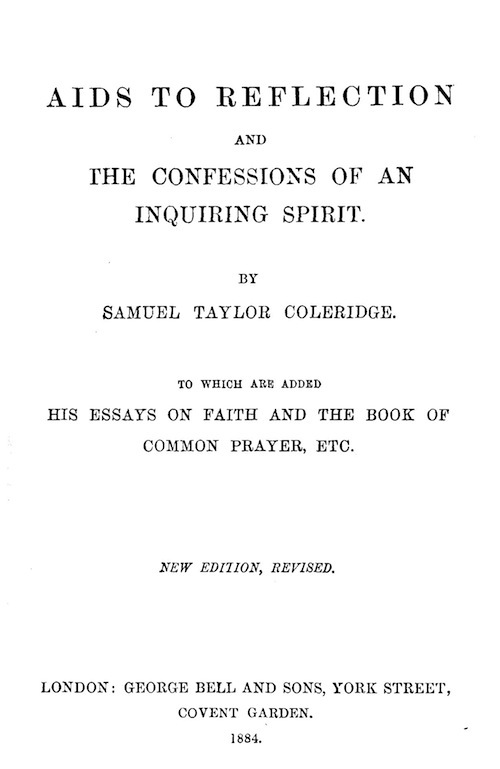
[159] These were the afterwards published 'On the Church and State, according to the Idea of Each,' 1830, and 'Confessions of an Inquiring Spirit,' 1840. The latter we republish in the present volume; see p. 285.—Ed.
[160] Will the reader forgive me if I attempt at once to illustrate and relieve the subject by annexing the first stanza of the poem composed in the same year in which I wrote the Ancient Mariner and the first book of Christabel?
[161] "By moonlight, in a wilderness."—'Poetical Works,' edit. 1863.—Ed.
[162] See p. 40.—Ed.
[163] Such is the conception of body in Des Cartes' own system, body is every where confounded with matter, and might in the Cartesian sense be defined, Space or Extension, with the attribute of Visibility. As Des Cartes at the same time zealously asserted the existence of intelligential beings, the reality and independent Self-subsidence of the soul, Berkeleyanism or Spinosism was the immediate and necessary consequence. Assume a plurality of self-subsisting souls, and we have Berkeleyanism; assume one only (unam et unicam substantiam), and you have Spinosism, that is, the assertion of one infinite self-subsistent, with the two attributes of thinking and appearing. Cogitatio infinita sine centro, et omniformis apparitio. How far the Newtonian vis inertiæ (interpreted any otherwise than as an arbitrary term = x y z, to represent the unknown but necessary supplement or integration of the Cartesian notion of body) has patched up the flaw, I leave for more competent judges to decide. But should any one of my Readers feel an interest in the speculative principles of Natural Philosophy, and should be master of the German language, I warmly recommend for his perusal the earliest known publication of the great founder of the Critical Philosophy (written in the twenty-second year of his age!), on the then eager controversy between the Leibnitzian and the French and English Mathematicians, respecting the living forces—Gedanken von der wahren Schätzung der lebendigen Kräfte: 1747—in which Kant demonstrates the right reasoning to be with the latter; but the Truth of Fact, the evidence of Experience, with the former; and gives the explanation, namely: Body, or Corporeal Nature, is something else and more than geometrical extension, even with the addition of a vis inertiæ. And Leibnitz, with the Bernouillis, erred in the attempt to demonstrate geometrically a problem not susceptible of geometrical construction.—The tract, with the succeeding Himmels-system, may with propriety be placed, after the Principia of Newton, among the striking instances of early Genius; and as the first product of the Dynamic Philosophy in the Physical Sciences, from the time, at least, of Giordano Bruno, whom the idolaters burnt for an Atheist, at Rome, in the year 1600. See the 'Friend,' pp. 151-55. [Or pp. 69 70, Bohn's edition.—Ed.]
[164] For Newton's own doubtfully suggested ether, or most subtle fluid, as the ground and immediate Agent in the phenomena of universal gravitation, was either not adopted or soon abandoned by his disciples; not only as introducing, against his own canons of right reasoning, an ens imaginarium into physical science, a suffiction in the place of a legitimate supposition; but because the substance (assuming it to exist) must itself form part of the problem, it was meant to solve. Meantime Leibnitz's pre-established harmony, which originated in Spinosa, found no acceptance; and, lastly, the notion of a corpuscular substance, with properties put into it, like a pincushion hidden by the pins, could pass with the unthinking only for any thing more than a confession of ignorance, or technical terms expressing a hiatus of scientific insight.
[165] Apul. Metam. 1.—H. N. C.
APPENDIX A.
a synoptical summary of the scheme of the argument to prove the diversity in kind[166] of the reason and the understanding. see p. 143.
The Position to be proved is the difference in kind of the Understanding from the Reason.
The Axiom, on which the Proof rests, is: Subjects, which require essentially different General Definitions, differ in kind and not merely in degree. For difference in degree forms the ground of specific definitions, but not of generic or general.
Now Reason is considered either in relation to the Will and Moral Being, when it is termed the[167] Practical Reason = A: or relatively, to the intellective and Sciential Faculties, when it is termed Theoretic or Speculative Reason = a. In order therefore to be compared with the Reason; the Understanding must in like manner be distinguished into the Understanding as a Principle of Action, in which relation I call it the Adaptive Power, or the faculty of selecting and adapting Means and Medial of proximate ends = B: and the Understanding, as a mode and faculty of thought, when it is called Reflection = b. Accordingly, I give the General Definitions of these four: that is, I describe each severally by its essential characters: and I find, that the definition of A differs toto genere from that of B, and the definition of a from that of b.
Now subjects that require essentially different definitions do themselves differ in kind. But Understanding and Reason require essentially different definitions. Therefore Understanding and Reason differ in kind.
[166] This summary did not appear in the first edition.—Ed.
[167] N. B. The Practical Reason alone is Reason in the full and substantive sense. It is reason in its own sphere of perfect freedom; as the source of IDEAS, which Ideas, in their conversion to the responsible Will, become Ultimate Ends. On the other hand, Theoretic Reason, as the ground of the Universal and Absolute in all logical conclusion is rather the Light of Reason in the Understanding, and known to be such by its contrast with the contingency and particularity which characterize all the proper and indigenous growths of the Understanding.
APPENDIX B.
ON INSTINCT:
By Professor J. H. Green.
[This is the discourse an early report of which was the foundation of Coleridge's remarks upon instinct, &c., which appear at pp. 160-164. It was first added as an Appendix to the "Aids to Reflection," in the edition of 1843; being extracted from an Appendix to Professor Green's "Vital Dynamics"[168] 1840, where it appears at pp. 88-96. It was then given without the Professor's introductory words, which we now add.—Ed.]
The following remarks on the import of instinct are those to which Coleridge refers in the "Aids to Reflection" (p. 177, last edition[169]) as in accordance with his view of the understanding, differing in degree from instinct, and in kind from reason; and whatever merit they possess must have been derived from his instructive conversation. They are here inserted in the hope that they may interest the reader in connexion both with the passages of the preceding discourse, and with the writings of Coleridge on this important subject.
What is Instinct? As I am not quite of Bonnet's opinion "that philosophers will in vain torment themselves to define instinct, until they have spent some time in the head of the animal without actually being that animal," I shall endeavour to explain the use of the term. I shall not think it necessary to controvert the opinions which have been offered on this subject, whether the ancient doctrine of Descartes, who supposed that animals were mere machines; or the modern one of Lamarck, who attributes instincts to habits impressed upon the organs of animals, by the constant efflux of the nervous fluid to these organs, to which it has been determined in their efforts to perform certain actions, to which their necessities have given birth. And it will be here premature to offer any refutation of the opinions of those who contend for the identity of this faculty with reason, and maintain that all the actions of animals are the result of invention and experience;—an opinion maintained with considerable plausibility by Dr. Darwin.
Perhaps the most ready and certain mode of coming to a conclusion in this intricate enquiry will be by the apparently circuitous route of determining first, what we do not mean by the word. Now we certainly do not mean, in the use of the term, any act of the vital power in the production or maintenance of an organ: nobody thinks of saying that the teeth grow by instinct, or that when the muscles are increased in vigour and size in consequence of exercise, it is from such a cause or principle. Neither do we attribute instinct to the direct functions of the organs in providing for the continuance and sustentation of the whole co-organized body. No one talks of the liver secreting bile, or of the heart acting for the propulsion of the blood, by instinct. Some, indeed, have maintained that breathing, even voiding the excrement and urine, are instinctive operations; but surely these, as well as the former, are automatic, or at least are the necessary result of the organization of the parts in and by which the actions are produced. These instances seem to be, if I may so say, below instinct. But again, we do not attribute instinct to any actions preceded by a will conscious of its whole purpose, calculating its effects, and predetermining its consequences, nor to any exercise of the intellectual powers, of which the whole scope, aim, and end are intellectual. In other terms, no man, who values his words, will talk of the instinct of a Howard, or of the instinctive operations of a Newton or Leibnitz, in those sublime efforts, which ennoble and cast a lustre, not less on the individuals than on the whole human race.
To what kind or mode of action shall we then look for the legitimate application of the term? In answer to this query, we may, I think, without fear of the consequences, put the following cases as exemplifying and justifying the use of the term Instinct in an appropriate sense. First: when there appears an action, not included either in the mere functions of life, acting within the sphere of its own organismus; nor yet an action attributable to the intelligent will or reason; yet, at the same time, not referable to any particular organ,—we then declare the presence of an Instinct. We might illustrate this in the instance of a bull-calf butting before he has horns, in which the action can have no reference to its internal economy, to the presence of a particular organ, or to an intelligent will. Secondly, likewise (if it be not indeed included in the first), we attribute Instinct where the organ is present; if only the act is equally anterior to all possible experience on the part of the individual agent, as for instance, when the beaver employs its tail for the construction of its dwelling; the tailor-bird its bill for the formation of its pensile habitation; the spider its spinning organ for fabricating its artfully woven nets, or the viper its poison fang for its defence. And lastly, generally, where there is an act of the whole body as one animal, not referable to a will conscious of its purpose, nor to its mechanism, nor to a habit derived from experience, nor previous frequent use. Here with most satisfaction, and without doubt of the propriety of the word, we declare an Instinct; as examples of which, we may adduce the migratory habits of birds; the social instincts of the bees, the construction of their habitations, composed of cells formed with geometrical precision, adapted in capacity to different orders of the society, and forming storehouses for containing a supply of provisions;—not to mention similar instances in wasps, ants, termites; and the endless contrivances for protecting the future progeny.
But if it be admitted that we have rightly stated the application of the term, what, we may ask, is contained in the examples adduced, or what inferences are we to make as to the nature of Instinct itself, as a source and principle of action? We shall, perhaps, best aid ourselves in the enquiry by an example, and let us take a very familiar one of a caterpillar taking its food. The caterpillar seeks at once the plant which furnishes the appropriate aliment, and this even as soon as it creeps from the ovum; and the food being taken into the stomach, the nutritious part is separated from the innutritious, and is disposed of for the support of the animal. The question then is, what is contained in this instance of instinct? In the first place what does the vital power in the stomach do, if we generalize the account of the process, or express it in its most general terms? Manifestly it selects and applies appropriate means to an immediate end, prescribed by the constitution;—first, of the particular organ, and then of the whole body or organismus. This we have admitted is not instinct. But what does the caterpillar do? Does it not also select and apply appropriate means to an immediate end, prescribed by its particular organization and constitution? But there is something more; it does this according to circumstances;—and this we call Instinct. But may there not be still something more involved? What shall we say of Hüber's humble-bees? A dozen of these were put under a bell glass along with a comb of about ten silken cocoons, so unequal in height as not to be capable of standing steadily. To remedy this, two or three of the humble-bees got upon the comb, stretched themselves over its edge, and with their heads downwards, fixed their forefeet on the table on which the comb stood, and so with their hindfeet kept the comb from falling. When these were weary others took their places. In this constrained and painful posture, fresh bees relieving their comrades at intervals, and each working in its turn, did these affectionate little insects support the comb for nearly three days; at the end of which time they had prepared sufficient wax to build pillars with it. And what is still further curious, the first pillars having got displaced, the bees had again recourse to the same manœuvre. What then is involved in this case? Evidently the same selection and appropriation of means to an immediate end as before; but observe! according to varying circumstances.
And here we are puzzled;—for this becomes Understanding. At least no naturalist, however predetermined to contrast and oppose Instinct to Understanding, but ends at last in facts in which he himself can make out no difference. But are we hence to conclude that the instinct is the same, and identical with the human understanding? Certainly not;—though the difference is not in the essential of the definition, but in an addition to, or modification of, that which is essentially the same in both. In such cases, namely, as that which we have last adduced, in which instinct assumes the semblance of understanding, the act indicative of instinct is not clearly prescribed by the constitution or laws of the animal's peculiar organization, but arises out of the constitution and previous circumstances of the animal, and those habits, wants, and that predetermined sphere of action and operation which belong to the race, and beyond the limits of which it does not pass. If this be the case, I may venture to assert that I have determined an appropriate sense for instinct:—namely, that it is a Power of selecting and applying appropriate means to an immediate end, according to circumstances, and the changes of circumstances, these being variable and varying; but yet so as to be referable to the general habits, arising out of the constitution and previous circumstances of the animal considered not as an individual, but as a race.
We may here, perhaps, most fitly explain the error of those who contend for the identity of Reason and Instinct, and believe that the actions of animals are the result of invention and experience. They have, no doubt, been deceived, in their investigation of Instinct, by an efficient cause simulating a final cause; and the defect in their reasoning has arisen in consequence of observing in the instinctive operations of animals the adaptation of means to a relative end, from the assumption of a deliberate purpose. To this freedom or choice in action and purpose, instinct, in any appropriate sense of the word, cannot apply, and to justify and explain its introduction, we must have recourse to other and higher faculties than any manifested in the operations of instinct. It is evident, namely, in turning our attention to the distinguishing character of human actions, that there is, as in the inferior animals, a selection and appropriation of means to ends—but it is (not only according to circumstances, not only according to varying circumstances, but it is) according to varying Purposes. But this is an attribute of the intelligent will, and no longer even mere understanding.
And here let me observe that the difficulty and delicacy of this investigation are greatly increased by our not considering the understanding (even our own) in itself, and as it would be were it not accompanied with, and modified by, the co-operation of the will, the moral feeling, and that faculty, perhaps best distinguished by the name of Reason, of determining that which is universal and necessary, of fixing laws and principles whether speculative or practical, and of contemplating a final purpose or end. This intelligent will,—having a self-conscious purpose, under the guidance and light of the reason, by which its acts are made to bear as a whole upon some end in and for itself, and to which the understanding is subservient as an organ or the faculty of selecting and appropriating the means—seems best to account for that progressiveness of the human race, which so evidently marks an insurmountable distinction and impassable barrier between man and the inferior animals; but which would be inexplicable were there no other difference than in the degree of their intellectual faculties.
Man doubtless has his instincts, even in common with the inferior animals, and many of these are the germs of some of the best feelings of his nature. What, amongst many, might I present as a better illustration, or more beautiful instance, than the storgè or maternal instinct? But man's instincts are elevated and ennobled by the moral ends and purposes of his being. He is not destined to be the slave of blind impulses, a vessel purposeless, unmeant. He is constituted by his moral and intelligent will, to be the first freed being, the master-work and the end of nature; but this freedom and high office can only co-exist with fealty and devotion to the service of truth and virtue. And though we may even be permitted to use the term Instinct, in order to designate those high impulses, which in the minority of man's rational being, shape his acts unconsciously to ultimate ends, and which in constituting the very character and impress of the humanity reveal the guidance of Providence; yet the convenience of the phrase, and the want of any other distinctive appellation for an influence de supra, working unconsciously in and on the whole human race, should not induce us to forget that the term instinct is only strictly applicable to the Adaptive Power, as the faculty, even in its highest proper form, of selecting and adapting appropriate means to proximate ends according to varying circumstances,—a faculty which however, only differs from human understanding in consequence of the latter being enlightened by reason,—and that the principles which actuate man as ultimate ends, and are designed for his conscious possession and guidance, are best and most properly named Ideas.
[168] 'Vital Dynamics: The Hunterian Oration before the Royal College of Surgeons in London, 14th February, 1840; by Joseph Henry Green, F.R.S., Late Professor of Anatomy to the College: Professor of Anatomy to the Royal Academy: One of the Surgeons to St. Thomas's Hospital.' 8vo. William Pickering, 1840.—Ed.
[169] This must have been the 4th edition, 1839, the latest corrected by the author, and that which supplies our text in the main. Coleridge's reference is at pp. 166-170 of the present edition.—Ed.
CONFESSIONS OF AN INQUIRING SPIRIT.
(Letters on the Inspiration of the Scriptures.)
BY SAMUEL TAYLOR COLERIDGE.
ADVERTISEMENT TO THE FIRST EDITION.
The following Letters on the Inspiration of the Scriptures were left by Mr. Coleridge in MS. at his death. The Reader will find in them a key to most of the Biblical criticism scattered throughout the Author's own writings, and an affectionate, pious, and, as the Editor humbly believes, a profoundly wise attempt to place the study of the Written Word on its only sure foundation,—a deep sense of God's holiness and truth, and a consequent reverence for that Light—the image of Himself—which He has kindled in every one of his rational creatures.—[Henry Nelson Coleridge.]
Lincoln's Inn, September 22, 1840.
Being persuaded of nothing more than of this, that whether it be matter of speculation or of practice, no untruth can possibly avail the patron and defender long, and that things most truly are likewise most behovefully spoken.—Hooker.
Any thing will be pretended rather than admit the necessity of internal evidence, or acknowledge, among the external proofs, the convictions and experiences of Believers, though they should be common to all the faithful in every age of the Church. But in all superstition there is a heart of unbelief; and, vice versâ, where a man's belief is but a superficial acquiescence, credulity is the natural result and accompaniment, if only he be not required to sink into the depths of his being, where the sensual man can no longer draw breath.—[Coleridge's Literary Remains.]
Faith subsists in the synthesis of the Reason and the individual Will. By virtue of the latter, therefore, it must be an energy, and, inasmuch as it relates to the whole moral man, it must be exerted in each and all of his constituents or incidents, faculties and tendencies:—it must be a total, not a partial—a continuous, not a desultory or occasional—energy. And by virtue of the former, that is, Reason, Faith must be a Light, a form of knowing, a beholding of Truth. In the incomparable words of the Evangelist, therefore,—Faith must be a Light originating in the Logos, or the substantial Reason, which is co-eternal and one with the Holy Will, and which Light is at the same time the Life of men. Now, as Life is here the sum or collective of all moral and spiritual acts, in suffering, doing, and being, so is Faith the source and the sum, the energy and the principle of the fidelity of Man to God, by the subordination of his human Will, in all provinces of his nature, to his Reason, as the sum of spiritual Truth, representing and manifesting the Will Divine.—[Coleridge's Essay on Faith: Literary Remains, vol. iv. page 437. We reprint the entire essay at the end of the present volume. See p. 339.—Ed.]
THE PENTAD OF OPERATIVE CHRISTIANITY
| Prothesis | ||
| Christ, the Word. | ||
| Thesis | Mesothesis, | Antithesis |
| or the Indifference, | ||
| The Scriptures. | The Holy Spirit. | The Church. |
| Synthesis | ||
| The Preacher.[170] |
The Scriptures, the Spirit, and the Church, are co-ordinate; the indispensable conditions and the working causes of the perpetuity, and continued renascence and spiritual life of Christ still militant. The Eternal Word, Christ from everlasting, is the Prothesis, or identity;—the Scriptures and the Church are the two poles, or Thesis and Antithesis; and the Preacher in direct line under the Spirit, but likewise the point of junction of the Written Word and the Church, is the Synthesis.
This is God's Hand in the World.
[170] Coleridge gives this same "Pentad" in his "Notes on Donne," "Literary Remains," v. iii. pp. 92-153.—Ed.
Seven Letters to a Friend concerning the bounds between the right, and the superstitious, use and estimation of the Sacred Canon; in which the Writer submissively discloses his own private judgment on the following Questions:—
I. Is it necessary, or expedient, to insist on the belief of the divine origin and authority of all, and every part of the Canonical Books as the Condition, or first principle, of Christian Faith?—
II. Or, may not the due appreciation of the Scriptures collectively be more safely relied on as the result and consequence of the belief in Christ; the gradual increase—in respect of particular passages—of our spiritual discernment of their truth and authority supplying a test and measure of our own growth and progress as individual believers, without the servile fear that prevents or overclouds the free honour which cometh from love? 1 John iv. 18.
LETTERS ON THE INSPIRATION OF THE SCRIPTURES.
LETTER I.
My Dear Friend,
I employed the compelled and most unwelcome leisure of severe indisposition in reading The Confessions of a fair Saint in Mr. Carlyle's recent translation of the Wilhelm Meister, which might, I think, have been better rendered literally The Confessions of a Beautiful Soul.[171] This, acting in conjunction with the concluding sentences of your Letter, threw my thoughts inward on my own religious experience, and gave the immediate occasion to the following Confessions of one, who is neither fair nor saintly, but who—groaning under a deep sense of infirmity and manifold imperfection—feels the want, the necessity, of religious support;—who cannot afford to lose any the smallest buttress, but who not only loves Truth even for itself, and when it reveals itself aloof from all interest, but who loves it with an indescribable awe, which too often withdraws the genial sap of his activity from the columnar trunk, the sheltering leaves, the bright and fragrant flower, and the foodful or medicinal fruitage, to the deep root, ramifying in obscurity and labyrinthine way-winning—
I should, perhaps, be a happier—at all events a more useful—man if my mind were otherwise constituted. But so it is: and even with regard to Christianity itself, like certain plants, I creep towards the light, even though it draw me away from the more nourishing warmth. Yea, I should do so, even if the light had made its way through a rent in the wall of the Temple. Glad, indeed, and grateful am I, that not in the Temple itself, but only in one or two of the side chapels—not essential to the edifice, and probably not coeval with it—have I found the light absent, and that the rent in the wall has but admitted the free light of the Temple itself.
I shall best communicate the state of my faith by taking the creed, or system of credenda, common to all the Fathers of the Reformation—overlooking, as non-essential, the differences between the several Reformed Churches—according to the five main classes or sections into which the aggregate distributes itself to my apprehension. I have then only to state the effect produced on my mind by each, of these, or the quantum of recipiency and coincidence in myself relatively thereto, in order to complete my Confession of Faith.
I. The Absolute; the innominable Αυτοπατωρ et Causa Sui, in whose transcendant I Am, as the Ground, is whatever verily is:—the Triune God, by whose Word and Spirit, as the transcendant Cause, exists whatever substantially exists:—God Almighty—Father, Son, and Holy Ghost, undivided, unconfounded, co-eternal. This class I designate by the word, Στασις.
II. The Eternal Possibilities; the actuality of which hath not its origin in God: Chaos spirituale:—Αποστασις.
III. The Creation and Formation of the heaven and earth by the Redemptive Word:—The Apostasy of Man:—The Redemption of Man:—the Incarnation of the Word in the Son of Man:—the Crucifixion and Resurrection of the Son of Man:—the Descent of the Comforter:—Repentance (μετανοια):—Regeneration:—Faith:—Prayer:— Grace: Communion with the Spirit: Conflict: Self-abasement: Assurance through the righteousness of Christ: Spiritual Growth: Love: Discipline: Perseverance: Hope in death:—Μεταστασις—Αναστασις.
IV. But these offers, gifts, and graces are not for one, or for a few. They are offered to all. Even when the Gospel is preached to a single individual, it is offered to him as to one of a great Household. Not only Man, but, says St. Paul, the whole Creation is included in the consequences of the Fall—της αποστασεως—; so also in those of the Change at the Redemption—της μεταστασεως, και της αναστασεως. We too shall be raised in the Body. Christianity is fact no less than truth. It is spiritual, yet so as to be historical; and between these two poles there must likewise be a midpoint, in which the historical and spiritual meet. Christianity must have its history—a history of itself, and likewise the history of its introduction, its spread, and its outward-becoming; and, as the midpoint above-mentioned, a portion of these facts must be miraculous, that is, phænomena in nature that are beyond nature. Furthermore, the history of all historical nations must in some sense be its history;—in other words, all history must be providential, and this a providence, a preparation, and a looking forward to Christ.
Here, then, we have four out of the five classes. And in all these the sky of my belief is serene, unclouded by a doubt. Would to God that my faith, that faith which works on the whole man, confirming and conforming, were but in just proportion to my belief, to the full acquiescence of my intellect, and the deep consent of my conscience! The very difficulties argue the truth of the whole scheme and system for my understanding, since I see plainly that so must the truth appear, if it be the truth.
V. But there is a Book, of two parts,—each part consisting of several books. The first part—(I speak in the character of an uninterested critic or philologist)—contains the reliques of the literature of the Hebrew people, while the Hebrew was still the living language. The second part comprises the writings, and, with one or two inconsiderable and doubtful exceptions, all the writings of the followers of Christ within the space of ninety years from the date of the Resurrection. I do not myself think that any of these writings were composed as late as A.D. 120; but I wish to preclude all dispute. This Book I resume, as read, and yet unread,—read and familiar to my mind in all parts, but which is yet to be perused as a whole;—or rather, a work, cujus particulas et sententiolas omnes et singulas recogniturus sum, but the component integers of which, and their conspiration, I have yet to study. I take up this work with the purpose to read it for the first time as I should read any other work,—as far at least as I can or dare. For I neither can, nor dare, throw off a strong and awful prepossession in its favour—certain as I am that a large part of the light and life, in and by which I see, love, and embrace the truths and the strengths co-organized into a living body of faith and knowledge in the four preceding classes, has been directly or indirectly derived to me from this sacred volume,—and unable to determine what I do not owe to its influences. But even on this account, and because it has these inalienable claims on my reverence and gratitude, I will not leave it in the power of unbelievers to say, that the Bible is for me only what the Koran is for the deaf Turk, and the Vedas for the feeble and acquiescent Hindoo. No; I will retire up into the mountain, and hold secret commune with my Bible above the contagious blastments of prejudice, and the fog-blight of selfish superstition. For fear hath torment. And what though my reason be to the power and splendour of the Scriptures but as the reflected and secondary shine of the moon compared with the solar radiance:—yet the sun endures the occasional co-presence of the unsteady orb, and leaving it visible seems to sanction the comparison. There is a Light higher than all, even the Word that was in the beginning;—the Light, of which light itself is but the shechinah and cloudy tabernacle;—the Word that is light for every man, and life for as many as give heed to it. If between this Word and the written Letter I shall any where seem to myself to find a discrepance, I will not conclude that such there actually is; nor on the other hand will I fall under the condemnation of them that would lie for God, but seek as I may, be thankful for what I have—and wait.
With such purposes, with such feelings, have I perused the books of the Old and New Testaments,—each book as a whole, and also as an integral part. And need I say that I have met every where more or less copious sources of truth, and power, and purifying impulses;—that I have found words for my inmost thoughts, songs for my joy, utterances for my hidden griefs, and pleadings for my shame and my feebleness? In short whatever finds me, bears witness for itself that it has proceeded from a Holy Spirit, even from the same Spirit, which remaining in itself, yet regenerateth all other powers, and in all ages entering into holy souls maketh them friends of God, and prophets. (Wisd. vii.) And here, perhaps, I might have been content to rest, if I had not learned that, as a Christian, I cannot,—must not—stand alone; or if I had not known that more than this was holden and required by the Fathers of the Reformation, and by the Churches collectively, since the Council of Nice at latest;—the only exceptions being that doubtful one of the corrupt Romish Church implied, though not avowed, in its equalization of the Apocryphal Books with those of the Hebrew Canon,[172] and the irrelevant one of the few and obscure Sects who acknowledge no historical Christianity. This somewhat more, in which Jerome, Augustine, Luther, and Hooker, were of one and the same judgment, and less than which not one of them would have tolerated—would it fall within the scope of my present doubts and objections? I hope it would not. Let only their general expressions be interpreted by their treatment of the Scriptures in detail, and I dare confidently trust that it would not. For I can no more reconcile the Doctrine which startles my belief with the practice and particular declarations of these great men, than with the convictions of my own understanding and conscience. At all events—and I cannot too early or too earnestly guard against any misapprehension of my meaning and purpose—let it be distinctly understood that my arguments and objections apply exclusively to the following Doctrine or Dogma. To the opinions which individual divines have advanced in lieu of this doctrine, my only objection, as far as I object, is—that I do not understand them. The precise enunciation of this doctrine I defer to the commencement of the next Letter. Farewell.
[171] Bekenntnisse einer schönen Seele.—H. N. C.
[172] Si quis—(Esdræ primum et secundum, Tobiam, Judith, Esther, &c.)—pro sacris et canonicis non susceperit, ... anathema sit. Conc. Trid. Decr. Sess. IV.—H. N. C.
LETTER II.
My Dear Friend,
In my last Letter I said that in the Bible there is more that finds me than I have experienced in all other books put together; that the words of the Bible find me at greater depths of my being; and that whatever finds me brings with it an irresistible evidence of its having proceeded from the Holy Spirit. But the Doctrine in question requires me to believe, that not only what finds me, but that all that exists in the sacred volume, and which I am bound to find therein, was—not alone inspired by, that is, composed by, men under the actuating influence of the Holy Spirit, but likewise—dictated by an Infallible Intelligence;—that the writers, each and all, were divinely informed as well as inspired. Now here all evasion, all excuse, is cut off. An Infallible Intelligence extends to all things, physical no less than spiritual. It may convey the truth in any one of the three possible languages,—that of Sense, as objects appear to the beholder on this earth; or that of Science, which supposes the beholder placed in the centre;—or that of Philosophy, which resolves both into a supersensual reality. But whichever be chosen—and it is obvious that the incompatibility exists only between the first and second, both of them being indifferent and of equal value to the third—it must be employed consistently; for an Infallible Intelligence must intend to be intelligible, and not to deceive. And, moreover, whichever of these three languages be chosen, it must be translatable into Truth. For this is the very essence of the Doctrine, that one and the same Intelligence is speaking in the unity of a Person; which unity is no more broken by the diversity of the pipes through which it makes itself audible, than is a tune by the different instruments on which it is played by a consummate musician, equally perfect in all. One instrument may be more capacious than another, but as far as its compass extends, and in what it sounds forth, it will be true to the conception of the master. I can conceive no softening here which would not nullify the Doctrine, and convert it to a cloud for each man's fancy to shift and shape at will. And this Doctrine, I confess, plants the vineyard of the Word with thorns for me, and places snares in its pathways. These may be delusions of an evil spirit; but ere I so harshly question the seeming angel of light—my reason, I mean, and moral sense in conjunction with my clearest knowledge—I must inquire on what authority this Doctrine rests. And what other authority dares a truly catholic Christian admit as coercive in the final decision, but the declarations of the Book itself,—though I should not, without struggles and a trembling reluctance, gainsay even a universal tradition?
I return to the Book. With a full persuasion of soul respecting all the articles of the Christian Faith, as contained in the first four Classes, I receive willingly also the truth of the history, namely, that the Word of the Lord did come to Samuel, to Isaiah, to others;—and that the words which gave utterance to the same are faithfully recorded. But though the origin of the words, even as of the miraculous acts, be supernatural—yet the former once uttered—the latter once having taken their place among the phænomena of the senses, the faithful recording of the same does not of itself imply, or seem to require, any supernatural working, other than as all truth and goodness are such. In the books of Moses, and once or twice in the prophecy of Jeremiah, I find it indeed asserted that not only the words were given, but the recording of the same enjoined by the special command of God, and doubtless executed under the special guidance of the Divine Spirit. As to all such passages, therefore, there can be no dispute; and all others in which the words are by the sacred historian declared to have been the Word of the Lord supernaturally communicated, I receive as such with a degree of confidence proportioned to the confidence required of me by the writer himself, and to the claims he himself makes on my belief.
Let us, therefore, remove all such passages, and take each Book by itself; and I repeat that I believe the writer in whatever he himself relates of his own authority, and of its origin. But I cannot find any such claim, as the Doctrine in question supposes, made by these writers, explicitly or by implication. On the contrary, they refer to other documents, and in all points express themselves as sober minded and veracious writers under ordinary circumstances are known to do. But, perhaps, they bear testimony, the successor to his predecessor?—Or some one of the number has left it on record, that by especial inspiration he was commanded to declare the plenary inspiration of all the rest?—The passages, which can without violence be appealed to as substantiating the latter position, are so few, and these so incidental,[173] —the conclusion drawn from them involving likewise so obviously a petitio principii, namely, the supernatural dictation, word by word, of the book in which the question is found; (for until this is established, the utmost that such a text can prove, is the current belief of the writer's age and country concerning the character of the books, then called the Scriptures;)—that it cannot but seem strange, and assuredly is against all analogy of Gospel Revelation, that such a Doctrine—which, if true, must be an article of faith, and a most important, yea, essential article of faith,—should be left thus faintly, thus obscurely, and, if I may so say, obitaneously, declared and enjoined. The time of the formation and closing of the Canon unknown;—the selectors and compilers unknown, or recorded by known fabulists;—and (more perplexing still,) the belief of the Jewish Church—the belief, I mean, common to the Jews of Palestine and their more cultivated brethren in Alexandria, (no reprehension of which is to be found in the New Testament)—concerning the nature and import of the θεοπνευστια attributed to the precious remains of their Temple Library;—these circumstances are such, especially the last, as in effect to evacuate the Tenet, of which I am speaking, of the only meaning in which it practically means any thing at all, tangible, steadfast, or obligatory. In infallibility there are no degrees. The power of the High and Holy One is one and the same, whether the sphere, which it fills, be larger or smaller;—the area traversed by a comet, or the oracle of the house, the holy place beneath the wings of the Cherubim;—the Pentateuch of the Legislator, who drew near to the thick darkness where God was, and who spake in the cloud whence the thunderings and lightnings came, and whom God answered by a voice;—or but a Letter of thirteen verses from the affectionate Elder to the elect lady and her children, whom he loved in the truth. But at no period was this the judgment of the Jewish Church respecting all the canonical books. To Moses alone—to Moses in the recording no less than in the receiving of the Law—and to all and every part of the five books, called the Books of Moses, the Jewish Doctors of the generation before, and coeval with, the Apostles assigned that unmodified and absolute theopneusty, which our divines, in words at least, attribute to the Canon collectively. In fact it was from the Jewish Rabbis,—who, in opposition to the Christian scheme, contended for a perfection in the Revelation by Moses, which neither required nor endured any addition, and who strained their fancies in expressing the transcendency of the books of Moses in aid of their opinion,—that the founders of the Doctrine borrowed their notions and phrases respecting the Bible throughout. Remove the metaphorical drapery from the doctrine of the Cabbalists, and it will be found to contain the only intelligible and consistent idea of that plenary inspiration, which later divines extend to all the canonical books; as thus:—"The Pentateuch is but one Word, even the Word of God; and the letters and articulate sounds, by which this Word is communicated to our human apprehensions, are likewise divinely communicated."
Now, for 'Pentateuch' substitute 'Old and New Testament,' and then I say that this is the doctrine which I reject as superstitious and unscriptural. And yet as long as the conceptions of the Revealing Word and the Inspiring Spirit are identified and confounded, I assert that whatever says less than this, says little more than nothing. For how can absolute infallibility be blended with fallibility? Where is the infallible criterion? How can infallible truth be infallibly conveyed in defective and fallible expressions? The Jewish teachers confined this miraculous character to the Pentateuch. Between the Mosaic and the Prophetic inspiration they asserted such a difference as amounts to a diversity; and between both the one and the other, and the remaining books comprised under the title of Hagiographa, the interval was still wider, and the inferiority in kind, and not only in degree, was unequivocally expressed. If we take into account the habit, universal with the Hebrew Doctors, of referring all excellent or extraordinary things to the great First Cause, without mention of the proximate and instrumental causes,—a striking illustration of which may be obtained by comparing the narratives of the same event in the Psalms and in the Historical Books; and if we further reflect that the distinction of the Providential and the Miraculous did not enter into their forms of thinking,—at all events not into their mode of conveying their thoughts,—the language of the Jews respecting the Hagiographa will be found to differ little, if at all, from that of religious persons among ourselves, when speaking of an author abounding in gifts, stirred up by the Holy Spirit, writing under the influence of special grace, and the like.
But it forms no part of my present purpose to discuss the point historically, or to speculate on the formation of either Canon. Rather, such inquiries are altogether alien from the great object of my pursuits and studies, which is, to convince myself and others, that the Bible and Christianity are their own sufficient evidence. But it concerns both my character and my peace of mind to satisfy unprejudiced judges, that if my present convictions should in all other respects be found consistent with the faith and feelings of a Christian,—and if in many and those important points they tend to secure that faith and to deepen those feelings—the words of the Apostle,[174] rightly interpreted, do not require their condemnation. Enough, if what has been stated above respecting the general doctrine of the Hebrew Masters, under whom the Apostle was bred, shall remove any misconceptions that might prevent the right interpretation of his words. Farewell.