
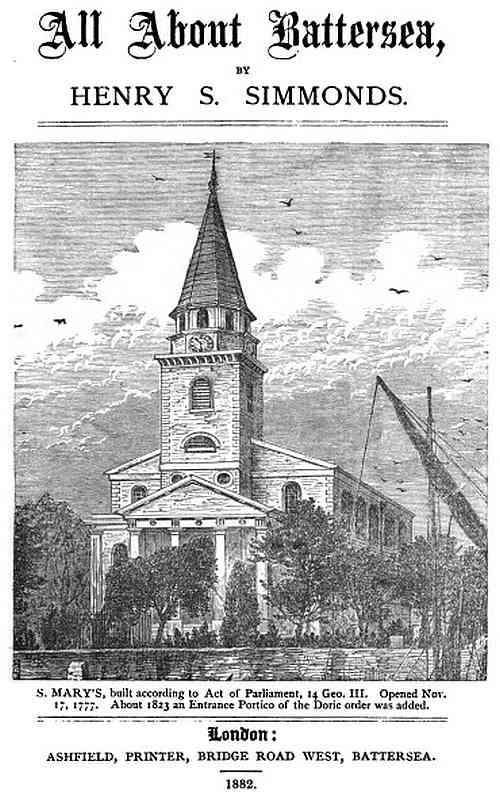
The Project Gutenberg eBook of All about Battersea
Title: All about Battersea
Author: Henry S. Simmonds
Release date: July 4, 2017 [eBook #55045]
Most recently updated: October 23, 2024
Language: English
Credits: Produced by Clare Graham and Marc D'Hooghe at Free
Literature (online soon in an extended version, also linking
to free sources for education worldwide ... MOOC's,
educational materials,...) Images generously made available
by the Internet Archive.
All About Battersea,
BY
HENRY S. SIMMONDS.
London:
ASHFIELD, PRINTER, BRIDGE ROAD WEST, BATTERSEA.
1882.
This small volume
IS MOST
RESPECTFULLY DEDICATED (by permission)
TO
THE REV. JOHN ERSKINE CLARKE, M.A.,
Honorary Canon of Winchester, Vicar of Battersea;
AND TO THE
INHABITANTS IN GENERAL.
INDEX.
| Page. | |
| Introduction. | iv |
| Nine Elms Lane.—The King's Champion. | 3 |
| Thorne's Brewery.—What Battersea has been called. | 4 |
| London and South Western Railway Company's Goods Station and | |
| Locomotive Works. | 4-7 |
| Mill-Pond Bridge.—New Road. | 8 |
| A Royal Sturgeon caught in the wheel of the Mill at Mill-Pond Bridge. | 9 |
| Wallace's Vitriol Works. | 10 |
| Sleaford Street.—Coal. | 11 |
| Street Lighting. | 12-13 |
| London Gas-Light Company's Works and Vauxhall Gardens. | 14-23 |
| On a recently-exposed Section at Battersea. | 23-24 |
| Phillips' Fire Annihilating Machine Factory | |
| Destroyed.—Brayne's Pottery.—The Old Lime | |
| Kilns.—Laver's Cement & Whiting Works. | 25 |
| The Southwark and Vauxhall Water Works. | 26 |
| Water Carriers and Water Companies. | 27-29 |
| The Village of Battersea.—Growth of the Parish. | 30-31 |
| Boundaries.—A Legal Contest between Battersea and | |
| Clapham Parishes. Clapham Common. | 32-33 |
| Lavender Hill.—The Seat of William | |
| Wilberforce.—Eminent Supporters of the | |
| Anti-Slavery Movement.—Frances Elizabeth Leveson | |
| Gower. Mr. Thornton.—Philip Cazenove.—Charles | |
| Curling, Lady George Pollock, and others. | 34-36 |
| Battersea Market Gardens and Gardeners. | 36-37 |
| Stages set out for Battersea from the City.—Annual | |
| Fair.—Inhabitants supplied with Water from | |
| Springs.—The Manor of Battersea before the Conquest. | 38 |
| Battersea and its association with the St. Johns. | 39 |
| Henry St. John Lord Viscount Bolingbroke. | 40-42 |
| A Horizontal Air Mill. | 43 |
| St. Mary's Church. | 44-46 |
| The Indenture. | 47-48 |
| Epitaphs and Sepulchral Monuments. | 49-51 |
| Rectory and Vicarage. | 52 |
| A Petition or Curious Document. | 53 |
| Dr. Thomas Temple.—Dr. Thomas Church. | 54 |
| Cases of Longevity.—The Plague.—The Three | |
| Plague Years.—Deaths in Battersea. | 55-56 |
| Vicars of Battersea from Olden Times. | 56-57 |
| Thomas Lord Stanley.—Lawrence Booth. | 57 |
| York House. | 58 |
| Battersea Enamel Works.—Porcelain.—Jens Wolfe, | |
| Esq.—Sherwood Lodge.—Price's Patent Candle | |
| Factory. | 59-62 |
| Candlemas. | 63-64 |
| The Saw.—Mark Isambard Brunel's Premises at | |
| Battersea.—Establishment for the preservation of | |
| timber from the dry rot burnt down. | 65 |
| History of the Ferry.—The Old Wooden Bridge. | 66-67 |
| Albert Suspension Bridge. | 68-69 |
| Chelsea Suspension Bridge. | 70 |
| The Prince of Wales.—Freeing the Bridges "For Ever." | 71-73 |
| The Stupendous Railway Bridge across the Thames. | 74 |
| The spot where Cæsar and his legions are stated by some | |
| antiquarians to have crossed the river. | 75 |
| A haunted house.—Battersea Fields.—Duel between | |
| the Duke of Wellington and Lord Winchelsea. | 76 |
| The Red House. | 77 |
| "Gyp" the Raven.—Billy the Nutman.—Sports. | 78 |
| "The Old House at Home."—Sabbath Desecration. | 79 |
| Her Majesty's Commissioners empowered by Act of Parliament | |
| to form a Royal Park in Battersea Fields.—Wild | |
| Flowers.—Battersea Park. | 80-84 |
| London, Brighton and South-Coast Railway Company's two | |
| Circular Engine Sheds and West-End Goods Traffic Department. | 85-86 |
| Long-Hedge Farm.—London, Chatham and Dover Railway | |
| Locomotive Works. | 87-90 |
| A Canvas Cathedral. | 91 |
| H.P. Horse Nail Company's Factory. | 94 |
| St. George's Church, its clergy, its graveyard, epitaphs | |
| and inscriptions (St. Andrew's Temporary Iron Church 96). | 95-99 |
| Christ Church, its clergy. | 100 |
| St. John's Church. | 101 |
| St. Paul's Church. | 102 |
| St. Philip's Church. | 103 |
| St. Mark's Church. | 104 |
| St. Luke's Chapel-of-Ease. | 105 |
| St. Saviour's Church. | 106 |
| St. Peter's Church. | 107 |
| Temporary Church of the Ascension.—St. | |
| Michael's Church. | 108 |
| All Saints' Temporary Iron Church.—Rochester Diocesan | |
| Mission, St. James', Nine Elms. | 111 |
| St. Aldwin's Mission Chapel.—The Church of our Lady | |
| of Mount Carmel and St. Joseph. | 112 |
| Church of the Sacred Heart.—The Old Baptist Meeting | |
| House, Revs. Mr. Browne, Joseph Hughes, M.A., (John Foster), | |
| Edmund Clark, Enoch Crook, I. M. Soule, Charles Kirtland. | 113-116 |
| Baptist Temporary Chapel, Surrey Lane. | 116 |
| Battersea Park Temporary Baptist Chapel. | 117 |
| Baptist (Providence) Chapel. | 118 |
| Baptist Chapel, Chatham Road.—Wesleyan Methodist | |
| Mission Room and Sunday School.—United Methodist | |
| Free Church, Church Road, Battersea.—The United | |
| Methodist Free Church, Battersea Park Road. | 119 |
| Primitive Methodist Chapel, New Road. | 119 |
| Primitive Methodist Chapel, Grayshott Road.—Primitive | |
| Methodist Chapel, Plough Lane. | 121 |
| St. George's Mission Hall.—Battersea Congregational | |
| Church, (Independent), Bridge Road. | 122 |
| Stormont Road Congregational Church, Lavender Hill. | 123 |
| Wesleyan Methodism in Battersea. | 124-126 |
| Methodist Chronology. | 127 |
| Wesleyan Chapel, Queen's Road. | 128 |
| Free Christian Church, Queen's Road. | 129 |
| Trinity Mission Hall, Stewart's Lane.—Plymouth | |
| Brethren. | 130 |
| "The Little Tabernacle."—Thomas Blood. | 131 |
| Battersea Priory.—Alien Priories. | 132 |
| Ursulines. | 132-134 |
| Battersea Grammar School, St. John's Hill. | 134 |
| The Southlands Practising Model Schools.—St. Peter's | |
| Schools.—St. Saviour's Infant. | 136 |
| Christ Church National Schools.—St. George's National | |
| Schools.—Voluntary Schools. | 136 |
| London Board Schools. | 137 |
| London School Board, Lambeth Division. | 138 |
| The Elementary Education Acts.—Regulations affecting | |
| Parent and Child. | 139-140 |
| A Coffee Palace.—Latchmere Grove.—Plague | |
| Spots.—The Shaftesbury Park Estate. | 141-142 |
| The Metropolitan Artizans' and Labourers' Dwellings | |
| Association. | 143-144 |
| Latchmere Allotments.—Dove Dale Place.—An Old | |
| Boiler.—Lammas Hall.—The Union Workhouse. | 145 |
| Old Battersea Workhouse.—The "Cage."—The | |
| "Stocks." | 146 |
| The Falcon Tavern.—A Cantata. | 147 |
| Origin of Bottled Ale in England.—"Ye Plough | |
| Inn."—"The Old House."—Stump of an Old Oak Tree. | 148 |
| "Lawn House," Lombard Road.—The Prizes for the Kean's | |
| Sovereigns and the Funny Boat Race.—The Old Swan | |
| Tavern.—Royal Victoria Patriotic Schools. | 149 |
| St. James' Industrial Schools.—Royal Masonic | |
| Institution for Girls. | 150 |
| Clapham Junction.—Battersea Provident Dispensary. | 151 |
| Wandsworth Common Provident Dispensary.—Charity | |
| Organization Society.—The Penny Bank.—No. | |
| 54 Metropolitan Fire Brigade Station.—Origin of | |
| Fire Brigades. | 152 |
| The Metropolitan Police.—Police Stations, | |
| Battersea.—St. John's College of the National Society. | 153 |
| The Vicarage House School.—Various Wharves and | |
| Factories. | 154 |
| Mr. George Chadwin.—T. Gaines.—Tow's Private | |
| Mad House.—The Patent Plumbago Crucible Company's | |
| Works. | 155 |
| Silicated Carbon Filter Company's Works. | 156 |
| Condy's Manufactory.—Citizen Steamboat Company's Works. | 157 |
| Orlando Jones & Co.'s Starch Works. | 157-159 |
| Battersea Laundries.—Spiers and | |
| Pond's.—Propert's Factory.—The London and | |
| Provincial Steam Laundry. | 159-160 |
| St. Mary's (Battersea) Cemetery.—Numerous Epitaphs | |
| and Inscriptions. Scale of Fees, etc. | 161-175 |
| The Battersea Charities. | 175 |
| Parish Officers.—Vestrymen. | 176-178 |
| Battersea Tradesmen's Club.—Temporary Home for Lost | |
| and Starving Dogs. | 179-180 |
| London, Chatham and Dover Railway—Battersea Park | |
| Station—York Road Station (Brighton Line).—West | |
| London Commercial Bank. London and South Western | |
| Bank.—Temperance and Band of Hope | |
| Meetings.—South London Tramways in | |
| Battersea—Fares. | 180-181 |
[Transcriber's Note.—A list of illustrations has been added in below. Some obvious errors in spelling and punctuation have also been silently corrected.]
LIST OF ILLUSTRATIONS.
| Page. | |
| St. Mary's Church. | 44 |
| Price's Patent Candle Company. | 59 |
| St George's Church. | 95 |
| St. John's Church. | 101 |
| St. Mark's Church. | 104 |
| St. Luke's Chapel-of-Ease. | 105 |
| St. Saviour's Church. | 106 |
| Baptist Temporary Chapel, Surrey Lane. | 116 |
| Battersea Park Temporary Baptist Chapel. | 117 |
| The New Baptist Chapel. | 119 |
| Battersea Congregational Church. | 122 |
| Orlando Jones & Co.'s Starch Works. | 157 |
Introduction.
London, after the lapse of centuries, has been compared to an old ship that has been repaired and rebuilt till not one of its original timbers can be found; so marvellous are the changes and transmutations which have come over the "town upon the lake" or, harbour for ships as London was anciently called, that if a Celt, or a Roman, or a Saxon, or a Dane, or a Norman, or a Citizen of Queen Elizabeth's time were to awake from his long slumber of death, he would no more know where he was, and would be as strangely puzzled as an Englishman of the present generation would be, who had never stirred further than the radius of the Metropolis, supposing him to be conveyed by some supernatural agency one night to China, who, on rising the next morning finds himself surrounded by the street-scenery of the city of Pekin. Costumes, manners, language, inhabitants have all changed! Viewed from a geological stand-point, even the soil on which New London stands is not the same as that on which Old London stood. The level of the site of the ancient city was much lower than at present, for there are found indications of Roman highways, and floors of houses, twenty feet below the existing pathways. There are probable grounds for supposing the Surrey side to have been some nineteen hundred years ago a great expanse of water. London so called for several ages past, is a manifest corruption from Tacitus's Londinium which was not however its primitive name this famous place existed before the arrival of Cæsar in the Island, and was the capital of the Trinobantes or Trinouantes, and the seat of their kings. The name of the nation as appears from Baxter's British Glossary, was derived from the three following British words, tri, nou, bant, which signify the 'inhabitants of the new city.' This name it is supposed might have been given them by their neighbours on account of their having newly come from the Continent (Belgium) into Britain and having there founded a city called tri-now or the (new city) the most ancient name of the renowned metropolis of Britain.[1] Some have asserted that a city existed on the spot 1107 years before the birth of Christ, and 354 years before the foundation of Rome. The fables of Geoffrey of Monmouth state that London was founded by Brute (or Brutus) a descendant of the Trojan Æneas the son of Venus and called New Troy, or Troy Novant until the time of Lud, who surrounded it with walls, and gave it the name Caer Lud, or Lud's town etc. Leigh. A certain Lord Mayor when pleading before Henry VI. assumed from this mythological story with a view to establish a claim to London's priority of existence over the city of Rome. The Celts the ancestors of the Britons and modern Welsh were the first inhabitants of Britain. The earliest records of the history of this island are the manuscripts and the poetry of the Cambrians. Britain was called by the Romans Britannia from its Celtic name Prydhain. Camden. We need not tarry to discuss whether Londinium originally was in Cantium or Kent the place fixed by Ptolemy and some other ancient writers of good authority, or whether its original place were Middlesex, or whether situated both north and south of the Tamesis Thames. The Trinobantes occupied Middlesex and Essex, they joined in opposing the invasion of Julius Cæsar 54 B.C.; but were among the first of the British States who submitted to the Romans their new City at that time being too inconsiderable a place for Cæsar to mention. Having revolted from the Roman yoke they joined their beautiful Queen Boadicea and were defeated by Suetonius Paulinus near London A.D. 61. But before reducing the Trinobantes who had the Thames for their southern boundary, it is the opinion of some antiquarians that the Romans probably had a station to secure their conquests on the Surrey side, and the spot fixed upon for the station is St. George's in the Fields a large plot of ground situated between Lambeth and Southwark, where many Roman coins, bricks, chequered pavements and other fragments of antiquity have been found. Three Roman ways from Kent, Surrey and Middlesex intersected each other in this place. It is thought that after the Normans reduced the Trinobantes the place became neglected and that they afterwards settled on the other side of the Thames and the name was transferred to the New City. The author of a work entitled "London in Ancient and Modern times." p.p. 12 and 13 writes.—Let the reader picture to himself the aspect of the place now occupied by the great Metropolis, as the Romans saw it on their first visit. He should imagine the Counties of Kent and Essex, now divided by the Thames, partially overflowed in the vicinity of the river by an arm of the sea, so that a broad estuary comes up as far as Greenwich, and the waters spread on both sides washing the foot of the Kentish uplands to the south, and finding a boundary to the north in the gently rising ground of Essex. The mouth of the river, properly speaking was situated three or four miles from where London Bridge now stands. Instead of being confined between banks as at present, the river overflowed extensive marshes, which lay both right and left beyond London. Sailing up the broad stream, the voyager would find the waters spreading far on either side of him, as he reached the spots now known as Chelsea and Battersea—a fact of which the record is preserved in their very names. A tract of land rises on the north side of the river. It is bounded to the west by a range of country, subject to inundations, consisting of beds of rushes and osiers and boggy grounds and impenetrable thickets, intersected by streams. It is bounded to the north by a large dense forest, rising on the edge of a waste fen or lake, covering the whole district now called Finsbury and stretching away for miles beyond. This tract of land, rising in a broad knoll, formed the site of London.
An old writer says "it is now certain that the spot, (viz. St. George's in the Fields) on which the city was described to have stood, was an extensive marsh or lake, reaching as far as Camberwell hills, until by drains and embankments, the Romans recovered all the lowlands about the parts now called St. George's Fields, Lambeth etc. London never stood on any other spot than the Peninsular, on the northern banks, formed by the Thames in front; by the river Fleet on the west; and by the stream afterwards named Walbrook on the East. An immense forest originally extended to the river side, and, even as late as the reign of Henry II. covered the northern neighbourhood of the city, and was filled with various species of beasts of chase. It was defended naturally by fosses, one formed by the creek which ran along the Fleet ditch, the other by that of Walbrook. The south side was protected by the river Thames, and the north by the adjacent forest."
In the reign of Nero the first notice of Londinium or, Londinum occurs in Tacitus (Ann xiv. 33.) where it is spoken of, not then as honoured with the name Colonia but for the great conflux of Merchants, its extensive commerce, and as a depôt for merchandise. At a later date London appears to have been Colonia under the name Augusta (Amm. Marcell.; xxvii. 8.) how long it possessed this honourable appellation we do not know but after the establishment of the Saxons we find no mention of Augusta. It has received at various times thirteen different names, but most of them having some similarity to the present one. However as it is not a history of England's Metropolis but All about Battersea[2] we write, we will at once commence at Nine Elms.
[1] The inhabitants of ancient Britain derived their origin partly from an original colony of Celtæ, partly from a mixed body of Gauls and Germans. None of them cultivated the ground; they all lived by raising cattle and hunting. Their dress consisted of skins, their habitations were huts of wicker-work covered with rushes. Their Priests the Druids together with the sacred women, exercised a kind of authority over them.
Britain according to Aristotle, was the name which the Romans gave to Modern England and Scotland. This appellation is, perhaps derived from the old word brit, partly coloured, it having been customary with the inhabitants to paint their bodies.
According to the testimony of Pliny and Aristotle, the Island in remotest times bore the name of Albion.
The Sea by which Britain is surrounded, was generally called, the Western, the Atlantic, or Hesperian Ocean. Herodotus informs us that the Phœnicians, Greeks, and Carthaginians, especially the first were acquainted with it from the earliest period and obtained tin there and designated it Tin Island. The name Great Britain was applied to England and Scotland after James I. ascended the English throne in 1603. England and Scotland however had separate Parliaments till 1st of May 1707, when during the reign of Queen Anne the Island was designated by the name of the United Kingdom of Great Britain. The terms at first excited the utmost dissatisfaction; but the progress of time has shown it to be the greatest blessing that either nation could have experienced.