
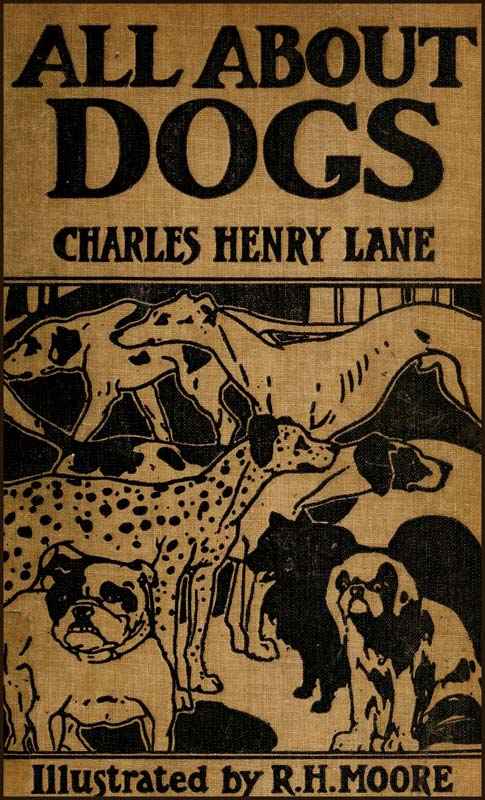
The Project Gutenberg eBook of All About Dogs: A Book for Doggy People
Title: All About Dogs: A Book for Doggy People
Author: Charles Henry Lane
Illustrator: R. H. Moore
Release date: April 14, 2014 [eBook #45377]
Most recently updated: October 24, 2024
Language: English
Credits: Produced by Chris Curnow, monkeyclogs and the Online
Distributed Proofreading Team at http://www.pgdp.net (This
file was produced from images generously made available
by The Internet Archive)
ALL ABOUT DOGS
A Book for Doggy People
BY
CHARLES HENRY LANE
Breeder, Exhibitor, Judge
ALL ABOUT DOGS
A BOOK FOR DOGGY PEOPLE
Breeder, Exhibitor, Judge
WITH EIGHTY-SEVEN
ILLUSTRATIONS OF THE MOST
CELEBRATED CHAMPIONS OF OUR TIME
DRAWN FROM LIFE
JOHN LANE
LONDON AND NEW YORK
1901
Copyright by
JOHN LANE
1900
Riggs Printing Co.
ALBANY, N.Y., U.S.A.
To his fellow lovers
and admirers of Dogs throughout the World,
THIS LITTLE BOOK
is respectfully Dedicated by the Author, in the earnest
hope that it may be the means of stimulating and
increasing their appreciation of the most
faithful, devoted and reliable
FRIEND
of the Human Race.
ILLUSTRATIONS
Frontispiece. Photogravure of the Author.
| Variety. | Name of Animal. | Name of Owner. | Page. |
| Staghound | Ruby | H. M. Queen Victoria | 7-8 |
| Foxhound | Marksman | Pytchley Hunt | 11-12 |
| Harrier | Traveller | Aldenham Kennels | 17-18 |
| Beagle (large) | Ch. Ringwood | F. Warde | 21-22 |
| Beagle (pocket) | Little 'Un | F. B. Lord | 21-22 |
| Bloodhound | Ch. Nestor | Mark Beaufoy, M. P. | 25-26 |
| Otterhound | Ch. Safety | Dumfries. Otter Hunt | 29-30 |
| Great Dane | Ch. Hannibal of Redgrave | Mrs. H. L. Horsfall | 37-38 |
| Pointer | Ch. Devonshire Dan | Miss Reston | 41-42 |
| Setter (Eng.) | Ch. Rock | James Fletcher | 47-48 |
| Setter (Gor.) | Ch. Marquis | Thomas Jacobs | 51-52 |
| Setter (Ir.) | Ch. Garryowen | J. J. Giltrap | 55-56 |
| Retriever (flat ct.) | Ch. Right Away | S. E. Shirley | 59-60 |
| Retriever (curly ct.) | Ch. Tiverton Best Lad | Saml. Darbey | 63-64 |
| Spaniel (Ir. W.) | Ch. Shaun | Col. the Hon. W. le Poer Trench | 67-68 |
| Spaniel (Clumber) | Sandringham Bustler | H. R. H. the Prince of Wales, K. G. | 71-72 |
| Spaniel (Sussex) | Ch. Bridford Giddie | Moses Woolland | 73-74 |
| Spaniel (Black) | Ch. Bridford Brill't | Moses Woolland | 77-78 |
| Spaniel (Cocker) | Ch. Ted Obo | J. Farrow | 83-84 |
| Basset (smooth) | Ch. Louis le Beau | Mrs. M. Tottie | 85-86 |
| Basset (rough) | Beauty | H. R. H. Prince of Wales, K. G. | 89-90 |
| Dachshund | Ch. Wiseacre | E. S. Woodiwiss | 91-92 |
| Greyhound | Ch. Real Jam | S. Woodiwiss | 97-98 |
| Deerhound | Ch. Selwood Dhouran | Robt. Hood Wright | 101-102 |
| Wolfhound (Ir.) | Ch. Sheelah | Capt. Graham | 103-104 |
| Borzois | Ch. Alex | H. R. H. the Princess of Wales | 107-108 |
| Whippet | Ch. Enterprise | H. Vickers | 111-112 |
| Fox Ter (sm old type) | Belgrave Joe | Luke Turner | 115-116 |
| Fox Ter (sm mod type) | Ch. Claude Duval | George Raper | 119-120 |
| Fox Ter (wr old type) | Ch. Lory | Author | 121-122 |
| Fox Ter (wr mod type) | Ch. Roper's Nut-crack | Sir H. de Trafford, Bt. | 123-124 |
| Dandie | Ch. Blacket-House Yet | Mrs. Rayner | 127-128 |
| Skye (drop eared) | Ch. Ballochmy le Bashful | Sir C. Alexander, Bt. | 131-132 |
| Skye (prick eared) | Ch. of Ch. Duchess | Mrs. W. J. Hughes | 135-136 |
| Scottish Ter | Ch. Killdee. | H. J. Ludlow | 137-138 |
| St. Bernard (rough) | Ch. Sir Bedivere | Samuel Smith | 145-146 |
| St. Bernard (smooth) | Ch. Guide | J. F. Smith | 149-150 |
| Newfoundland (black) | Ch. Wolf of Badenoch | Mrs. Ingleton | 151-152 |
| Newfoundland (black and white) | Ch. Kettering Wonder | Lady Tollemache | 153-154 |
| Mastiff | Ch. Beaufort | W. K. Taunton | 157-158 |
| Dalmatian (blk. sptd) | Ch. Berolina | E. T. Parker | 159-160 |
| Dalmatian (liv. sptd) | Ch. Fauntleroy | W. B. Herman | 163-164 |
| Collie (rough) | Lochiel | H. R. H. the Princess of Wales | 167-168 |
| Collie (smooth) | Ch. Lady Nellie | Author | 171-172 |
| Old Eng. Shp. Dog | Ch. Cupid's Dart | F. W. Wilmot | 175-176 |
| Bull Dog (large) | Ch. Blackberry | Saml. Woodiwiss | 181-182 |
| Bull Dog (medium) | Ch. Barney Barnato | G. R. Sims | 185-186 |
| Bull Dog (small) | Ch. Lady Rozelle | Author | 189-190 |
| Bull Terrier | Ch. Sherbourne Q'n | W. J. Pegg | 191-192 |
| Boston Terrier | Turpin | Miss J. Tozier | 195-196 |
| Irish Terrier | Ch. Ted Malone | Mrs. Butcher | 197-198 |
| Airedale Terrier | Ch. Dumbarton Lass | A. E. Jennings | 201-202 |
| Bedlington Terrier | Ch. Clyde Boy | R. H. Smith | 203-204 |
| Welsh Terrier | Ch. Brynhir Burner | W. S. Glynn | 207-208 |
| Black & Tan Terrier | Ch. Starkie Ben | Lt.-Col. C. S. Dean | 209-210 |
| White Eng. Terrier | Ch. Eclipse | J. Walsh | 213-214 |
| Poodle (corded) | Ch. Model | Mad'me Dagois | 221-222 |
| Poodle (curly) | Ch. Rufus | Mrs. Robt. Long | 223-224 |
| Pomeranian (large) | Ch. König of Rozelle | Miss Hamilton | 227-228 |
| Pomeranian (med) | Marco | H. M. Queen Victoria | 229-230 |
| Pomeranian (sm med) | Ch. Brilliant | Jno. Duckworth | 233-234 |
| Pomeranian (toy) | Ch. of Ch. & Pr. Tina | Miss Ada de Pass | 237-238 |
| Pug (fawn) | Ch. York | Mrs. Grelliche | 239-240 |
| Pug (black) | Ch. & Pr. Duke Beira | Miss C. F. A. Jenkinson | 243-244 |
| Schipperke | Ch. Zwarte Piot. | I. N. Woodiwiss | 247-248 |
| King Charles Spaniel | Ch. Laureate | Hon. Mrs. McL. Morrison | 249-250 |
| Blenheim Spaniel | Ch. Rollo | Mrs. Forder | 253-254 |
| Prince Charles Spanl | Ch. Victor Wild | H. Taylor | 255-256 |
| Ruby Spaniel | Ch. Jasper | Mrs. Woodgate | 259-260 |
| Japanese Spaniel | Ch. of Ch. Dai Butzu | Mrs. Addis | 261-262 |
| Sm. Toy Terrier | Ch. Mascotte Model | Mrs. Monk | 265-266 |
| Yorksh. Toy Terrier | Ch. Ashton Queen | Mdes Walton & Beard | 267-268 |
| Maltese Terrier | Ch. Pixie | John Jacobs | 271-272 |
| Griffon Bruxelles | Marquis de Carabas | Count H. de Bylandt | 273-274 |
| Toy Bull Dog | Rabot de Beaubourg | Monsieur Petit | 277-278 |
| Toy Bull Terrier | Lily | Author | 279-280 |
| Italian Greyhound | Ch. Larkfield Leveret | P. Turner | 281-282 |
| Norwegian Elkhound | Jaeger | Lady Cathcart | 287-288 |
| Afghan Greyhound | Shahzada | J. Whitbread | 289-290 |
| Thibet Sheep Dog | Siring | H. R. H. the Prince of Wales, K. G. | 293-294 |
| Esquimaux | Ch. Arctic King | Mrs. H. C. Brooke | 295-296 |
| Chow Chow | Ch. Chow 8th | Mrs. Faber | 299-300 |
| Dingo | Ch. Myall | Mrs. H. C. Brooke | 301-302 |
| Chinese Crested Dog | Chinese Emperor | W. K. Taunton | 305-306 |
| Lapland Sledge Dog | Perla | H. R. H. Prince of Wales, K. G. | 309-310 |
| Dogue de Bordeaux | Ch. Sans Peur | Mrs. H. C. Brooke | ... |
CONTENTS
PART I | |||
| chap. | page | ||
| Preface | iii | ||
| Introduction | v | ||
| I. | A Few Words About Dogs in General | 1 | |
| DOGS USED IN SPORT | |||
| II. | Staghounds, Foxhounds, Harriers, Beagles | 9 | |
| III. | Bloodhounds, Otterhounds, Great Danes | 27 | |
| IV. | Pointers, Setters, Retrievers | 43 | |
| V. | Sporting Spaniels, Basset Hounds, Dachshunds | 69 | |
| VI. | Greyhounds, Scottish Deerhounds, Irish Wolfhounds, Borzois, Whippets | 99 | |
| TERRIERS USED IN SPORT | |||
| VII. | Fox, Dandie Dinmonts, Skyes, Scottish | 117 | |
PART II | |||
| DOGS USED IN WORK | |||
| VIII. | St. Bernards, Newfoundlands, Mastiffs, Dalmatians | 147 | |
| IX. | Sheep Dogs:—Rough Collies, Smooth Collies, Old English | 169 | |
| X. | Bull Dogs, Bull Terriers, Boston Terriers | 179 | |
| XI. | Terriers,—Irish, Airedale, Bedlington, Black and Tan, Old English | 199 | |
PART III | |||
| PERFORMING AND TOY BREEDS | |||
| XII. | Poodles, Pomeranians, Pugs, Schipperkes | 219 | |
| XIII. | Toy Spaniels,—King Charles, Prince Charles, Ruby, Blenheim, Japanese | 245 | |
| XIV. | Terriers,—Toy, Smooth Black and Tan, Yorkshire, Maltese, Griffons Bruxelles | 263 | |
| XV. | Toy Bull Dogs, Toy Bull Terriers, Italian Greyhounds | 275 | |
PART IV | |||
| XVI. | Something About Foreign Dogs | 291 | |
| XVII. | Humours and Vagaries of the Show Rings | 311 | |
| XVIII. to XXIII. | Anecdotes About Dogs, Personal and Selected | 322 | |
| XXIV. | A Few Words About General Management and Some Simple Maladies, to Which Dogs are Subject and Their Treatment | 389 | |
Part I
CONTENTS
PART I | |||
| chap. | page | ||
| Preface | iii | ||
| Introduction | v | ||
| I. | A Few Words About Dogs in General | 1 | |
| DOGS USED IN SPORT | |||
| II. | Staghounds, Foxhounds, Harriers, Beagles | 9 | |
| III. | Bloodhounds, Otterhounds, Great Danes | 27 | |
| IV. | Pointers, Setters, Retrievers | 43 | |
| V. | Sporting Spaniels, Basset Hounds, Dachshunds | 69 | |
| VI. | Greyhounds, Scottish Deerhounds, Irish Wolfhounds, Borzois, Whippets | 99 | |
| TERRIERS USED IN SPORT | |||
| VII. | Fox, Dandie Dinmonts, Skyes, Scottish | 117 | |
PREFACE
I am told, it is indispensable there should be a Preface to this little work; but I am quite at a loss what to put in it. What I had to say on the subject upon which it treats, I have said in the book, and I am not aware of any thing I wish to add or withdraw. I can only hope the perusal of the book may afford as much pleasure to my readers as the writing it has given me, in recalling pleasant memories of many friends, both two and four-footed, some of whom have long since "joined the majority." As recording the impressions of one who has had considerable practical experience with many varieties of the canine race, and been brought into constant contact with the best specimens, I think my book is somewhat out of the usual run of doggy books. While in no wise seeking to produce a scientific treatise, nor yet a natural history, in the ordinary acceptation of the term, my wish has been so to write on the subject as to stir up in the minds of any of my readers, unacquainted with the many charms possessed by dogs, a desire to adopt some kind of dog as a companion and friend, and to confirm the affection and regard of my multitudinous dog-loving friends, so that they may be disposed to extend the borders of their fancy, and possibly be interested and amused by some of the humours and vagaries of the Show Rings or the Doggy Anecdotes. These, when they are not within my personal knowledge, I have endeavoured to verify, so as to avoid the "Fairy Tales" we sometimes read under the title of "Doggy Stories." Before closing these remarks, I must express my deep gratitude, to my friend Mr. R. H. Moore, who has given my book the inestimable advantage of his talented pencil, in portraying so many excellent, and truthful portraits of the "Lights of the Canine World," including more than sixty "Champions," of their respective varieties. I am not aware that such a number of Canine Celebrities has ever before been gathered together in one volume, and they represent some of the best pictures of dogs I have ever seen, even of Mr. Moore's, and, I think most dog lovers will acknowledge that he is particularly happy in hitting off the expressions, and catching the actual likeness of his subjects, most kindly taking up the matter for me, when very much pressed with other commissions, not only giving me the benefit of his valuable advice in the selection of the most distinguished, and typical, specimens for the different varieties procurable, but entered into the work with the utmost ardour, and zeal; I feel therefore more indebted to him than I can express, for enabling me to present to the Public such an interesting and, I hope, instructive Picture Gallery of Dogs of the present day. With these few words I commend my little book to the troublous waters of public favour.
INTRODUCTION
I suppose, if we take the whole of the Animal Kingdom, in any way associated with man, either as companion, or helper, there is none to compare, in popularity, with the subject of these notes; but yet I have often found in conversation, even with lovers of animals, very mistaken notions about dogs, their varieties, characteristics and peculiarities. I think there are more known and acknowledged varieties of dog, than of any other of the animals, we are at all familiar with, and the ways, sizes, appearance and characteristics differ so greatly that it is hardly possible, one would imagine, to find any person to whom some kind of a dog would not appeal. I wish, if possible, to say something to stir up in the minds of some not hitherto keeping a dog, the desire to do so, and whether merely as a guard or companion or with a view to trying to breed some good specimens, and, occasionally, to send to some of the Exhibitions of Dogs, which have so increased in number and quality during the last twenty years, that I have frequently heard it stated, that taking out Saturdays and Sundays, there is a Dog Show being held somewhere or other on every ordinary day in the year!
I would strongly advise the obtaining a well-bred dog, of whatever variety is selected, as, not only is it more satisfactory to have about you the best procurable type of any breed you may fancy, whether dogs or anything else, but if you want to part with either the originals, or any of their progeny, it is usually much easier to find purchasers and at much better prices for what is called "pedigree stock," that is of which the parentage for one or more generations is known, than when no particulars or references can be given.
There are fashions in dogs, the same as in other things, and I can remember a great many "crazes" for different breeds of dog. Fox Terriers, which are smart, lively, game little fellows, well able to adapt themselves to almost any circumstances, have had a long term of favour, and are still largely kept, perhaps as largely as any breed of their size; another element in their favour, is their not having much coat, and so not bringing in much mud upon them, even in dirty weather, if kept in the house. This, of course, has been rather against Skye Terriers, which are otherwise capital dogs for the house, full of life and spirit, but, to be kept in any order, they must be occasionally brushed, or their coats, which should be hard and straight, somewhat of the texture and straightness of a horse's tail, will get matted, and be a disfigurement, instead of an ornament.
A great movement has existed, for sometime, in favour of the Irish Terrier, who should be almost unbroken in reddish-brown colour, I mean with little or no shading, what is called self colour. This is a "good all round" breed, able to follow a horse, a trap, be a good guard or companion, take care of himself in his "walks abroad," or have a turn at anything which comes in his way in the vermin line.
Two more breeds I can strongly recommend to any in doubt as to a suitable dog to take up as household guard or companion. These are the Scottish Terrier, often called the Die-hard, or Aberdeen-Terrier, a rather cobby, short legged breed, with a pointed head, ears standing straight up, short back, and gaily carried tail, colour generally, nearly black, grizzled, or brindled. I believe I brought, in 1868, the first of the breed ever seen in England (at any rate I had not seen one before), from a place called Uig, in the island of Skye, and quite a character he was, and I could give many instances of his great sagacity, and very quaint ways, during the many years he lived with me. I regret to say he has long gone to the "happy hunting grounds." I shall say something more of him amongst the "Anecdotes of Dogs," further on.
The other breed I referred to is the Dandie Dinmont Terrier, immortalized by Sir Walter Scott. For intelligence, pluck, faithfulness, and general adaptability to the ways, and wishes, of his owner, I do not know any breed to surpass it. In many cases, I have known a strain of Dandies kept up for generations, in families, and the affection between the dogs, and their owners, is so great, that no money would bring about a parting, and I have often seen pedigrees and genealogical trees of well known strains of Dandies, taking them back a dozen generations, and prized very highly by their owners or breeders.
Whatever the decision come to by an intending keeper of a dog, if it is to be an inmate of the house, and is one of the smaller breeds, a box or basket should be provided in some place free from draughts, and after sprinkling either a little sawdust impregnated with disinfectant, or the disinfectant itself, put in some straw for a bed, this is better and less likely to harbour insect life, than hay, or any kind of rug, or mat.
But if the dog is to be kept out of doors, obtain one of the improved kennels, with the entrance at the side, which affords a shelter from the wind, rain, and snow, and have a chain constructed with two or, preferably, three swivels in it, that it cannot become twisted up. Many a dog has been injured and even killed by neglect of these little matters.
Of course, if convenience can be found, it is much better not to tie up a dog at all. No dog of mine, (and I have had hundreds during the last twenty-five years, of almost every known breed) ever catches sight of a collar or chain, except at a show, and, contrary to the popular idea which I have often heard expressed by sympathisers with the dogs on the show benches, dogs accustomed to exhibition work delight in it, and the sight of a dog's travelling box or basket, or the rattle of a chain, with the show label on it, is sufficient to cause the wildest excitement amongst my dogs at any time, each dog hoping it may be his good fortune to go to the show, which they look upon as great entertainment.
I will undertake to say, that, if a dozen boxes or baskets are placed in the yard, with the lids open, and as many dogs let out of their kennels, you shall find an occupant in every box, within five minutes, and that each shall choose the box he usually travels in! It is far better to enclose your dog, or dogs, in one of the many forms of loose boxes, or kennels, now procurable of so many firms who cater for dogs' requirements, something in the way of a kennel, or sleeping box, with railed in run attached. One of the neatest and best, at anything like the price, (ninety shillings, if my memory serves me,) I have seen, is made by Mr. William Calway, Sharpness, Gloucestershire, who has made quite a leading article in his trade, of this kind of work.
Another matter to be attended to is, to give the dog plenty of exercise, unless the weather positively prevents it. Many people seem to fancy, if a dog is taken into the air, in a carriage, or other conveyance, that this is sufficient, but, it is not so, and the generality of dogs are all the better, for at least two hours' walking exercise every day, during which time, they will nearly, or quite, double the distance traversed by their master or mistress, and perhaps get a drink, pick up some grass, or otherwise amuse themselves!
As regards water, dogs do not drink so much as many people suppose, and it is better to keep a supply, of course frequently changed, in the yard outside the kennel, or sleeping box. Dogs, as a rule, like a drink when going out or returning from exercise, more than they do in their own quarters, and if it be kept there, particularly when two or more inmates are together, it is almost sure to be upset, and make the place look bad, besides being uncomfortable.
A very important matter is the feeding of the dogs. In these days, when so many firms are producing biscuits, on purpose to cater for the wants of the vast doggy community, there is no difficulty in getting some of them, but, I have found, in a long experience with dogs, that, although almost all breeds will eat dog biscuits—some even take them when given whole, and chop them up like bones, even dry—it is better, in most cases, to break them up, about the size of walnuts, and soak them the day previously to use, in hot water, or broth, or even cold water. If boiled vegetables, potatoes, cabbage, or some such, be mixed with them afterwards, it is not only more palatable, but better for the dogs, than the biscuit alone, and occasionally, say once in a week or ten days, a little flour of brimstone, in the proportion of about a teaspoonful for a fair-sized dog, should be mixed with the food.
We know, ourselves, that whatever our food, the most tempting that money could buy, we should tire of it, if always the same, and it is precisely the same with animals, so that, the more it is varied, the better, even if the change is slight, and all who have had much to do with dogs, will know that some dogs, and even some breeds of dogs, are very fanciful and capricious in their appetites, and not always disposed to do well.
When dogs are "off their feed," a sheep's head, boiled, and then broken up, and the bones, meat, and broth mixed with their ordinary food, will generally "fetch" the most dainty feeder; other dogs are very keen on oatmeal porridge, made as for human beings, but, of course, with no sugar, which I may say should never be given, in any form, to dogs, as it is an unnatural and injurious food for them, although they are usually quite willing to eat a lump of sugar at almost any time, but they are much better without it. Milk (unskimmed, otherwise it is likely to upset their stomachs), is also a capital thing for dogs in low condition, or out of sorts. It is best given cold, or lukewarm, after being boiled, as in its natural state it is thought liable to cause worms, but, of course, this is not always the case. I have also found "bovril" useful as a "pick-me-up," or appetizer, for animals on the sick list or those who are "bad doers."
ALL ABOUT DOGS
CHAPTER I
A Few Words About Dogs in General
In these days of progress, when the tendency of everyone, and everything, seems to be to go ahead and try to outdo all that has been done by everyone else, in fact, as we so often see it termed, "to beat the record," I think I am stating only the actual fact, that, in the history of the world, dogs were never so highly thought of as they are now, nor were they ever so catered for, in a variety of ways, nor so generally popular.
And when we consider the many varieties of the species, differing as much as is possible in the members of one family, and the appearance, habits, dispositions, uses and characteristics, just as various, it is not to be wondered at that they enjoy such an amount of public favour, as it must be a strangely constituted human being to whom no breed of dog is acceptable!
The numerous packs of stag and foxhounds, harriers, beagles, and other hounds, kept throughout the United Kingdom, not only are the means of providing an immense amount of sport for our countrymen, but are, also, directly and indirectly the cause of the great improvements which have been effected in the breed of our horses, particularly those suited for hunters and cover hacks, and, therefore, the cause, also, of the circulation of a vast amount of money in our own country every year, especially amongst farmers, millers, saddlers, hay and corn dealers, trainers, keepers, kennelmen, grooms, helpers and a large number of others, more or less connected with hunting and its surroundings.
To take another branch of the same subject, just consider what a large body of men are interested and employed in the breeding, rearing, and training of the vast number of high class greyhounds, which are kept in some parts of the country, not only for the competitions in the important national events, but, even for private owners, who make a hobby of an occasional trial with their dogs. Then again, the great army of keepers, kennelmen, and gillies, kept throughout the kingdom, to look after and, in some cases, to breed, and break, the deerhounds, pointers, setters, retrievers, and spaniels, which add so much to the pleasure of a true sportsman's daily work amongst game of all kinds, from deer-stalking to shooting black-cock, grouse, partridges, pheasants, etc. (although many persons now-a-days seem to go on the principle of getting a big total of the days, or weeks' "shoot," and care little for the real pleasure of seeing the dogs "work," and do credit, or otherwise, to care and attention devoted to their training), obtain employment, and I have found them, as a rule, a highly respectable class of men, often generations of the same family being in the service of one family, and most jealous of the reputation of the master, his dogs, and covers.
To take some of our other utility dogs, those of my readers who have visited the cattle market of any large sized town or city, cannot have failed to notice the dogs which attend the professional drovers there, many of them rough looking enough, in all conscience, but, as for intelligence, why, they are brimful of it, and willing and able to do wonders with the cattle and sheep in the open, or on the road afterwards, understanding the few words said to them, and eager to carry out their orders, and although sometimes erring through excess of zeal, the reverse is seldom the case, and I am pleased to say (as I have known and conversed with many of the men who are acquainted with my love for animals, and know what numbers I have bred and owned), that the greater part of them value their dogs, and appreciate their services, so much so, that what might be considered really big offers, have frequently been refused by them. One of them said to me, "What good, sir, for me to take a ten pound note for 'Bess,' I couldn't do nothing without she, and 'twould take me a doose of a time to make another larn to do like she can, with the beasts, and that, let alone her being such a 'pal,' and my missus, she do think a deal of Bess, to be sure sir."
I have no doubt, that a great many varieties of dog have been pressed into the service of the many and some highly accomplished troupes of performing dogs, which the great increase of music halls throughout the kingdom as well as the continent have brought forward. I have at different times seen Great Danes, Scotch Deer Hounds, Dalmatians, Poodles, and many members of some of the Terrier and Spaniel families and hosts of undoubted mongrels taking part in these entertainments, as well as occasionally Greyhounds and Collies, but these were, I think, exclusively engaged in jumping competitions, when a sort of steeplechase was arranged. These come under the category of "utility dogs," as they assist their owners in gaining a living, and the same may be said of the blind men's dogs, which are a great multitude, and enjoy freedom from taxation, on the ground of their value to their helpless owners.
Another interesting class of utility dogs are those we see at so many of our railway stations and other public places with a small box hanging under their chins, in which may be placed any donations the charitable are disposed to give to the "Railway Servants' Benevolent Association," or some other charitable object, and from the way the animals run up to passengers, to be noticed, and wait, patiently, while a coin is found, and placed in their boxes, gives one the idea they know what is going on, and that the credit of a "good haul" at the end of the day, will be in some measure reflected on the carrier of the collecting box! I have often been surprised to see mentioned, in the newspapers, the large sums a single dog has been the means of gathering, in this way, for some good object, and, for aught I know, there may have been dogs hard at work, during 1898-9, for "The Prince of Wales's Hospital Fund," or other charitable objects!
One use to which dogs were formerly put, as "Turnspits," and another as beasts of burden, I am pleased to say are no longer allowed by law. I have often, when a child, seen them employed in the latter capacity in the West of England, drawing small, usually two-wheeled carts, with not only the usual market stock and trade utensils, but sometimes the owner, in shape of a burly man or woman seated on the top, and not unfrequently racing along country roads with the owners of similar vehicles, often with two or three dogs to each, harnessed in tandem fashion, the noise and excitement of the cavalcade being very great, and announcing their approach long before their coming in sight. I am very pleased that both these abuses of dogs have been abolished here, although as beasts of burden they are still extensively employed on the continent of Europe, and, I am bound to say, I have not seen them ill treated, badly fed, or seeming neglected.
Of course, we know that in the Arctic regions dogs, as carriers, are actual necessaries, and that locomotion, difficult and dangerous enough there under any circumstances, would be simply impossible without the aid of the Esquimaux dogs, of which I have seen a good deal, and handled many. They have a dense double coat, are very wolf-like in expression and shape of head, with small, pointed ears, oblique, sly-looking eyes, rather long, arched necks, and tails with characteristic curl and carriage. I do not consider them very sociable, but they would, I dare say, be all right with persons they knew well. I fancy they are a breed that has never been "made much of," (particularly in their native lands,) by their owners, but usually get what is popularly known as "more kicks than halfpence," and when "off duty," have often to go on short commons, or do a little cadging on their own account, and being thrown on their own resources, we know (on the authority of the late immortal "Mr. Weller, Senr." evidenced in the case of his well known son "Sam!") has a great tendency to sharpen the wits, and it is the same with the Esquimaux dogs, who always struck me as very suspicious of attentions from strangers, however well intentioned they may be.
CHAPTER II
Dogs Used in Sport
staghounds—foxhounds—harriers—beagles