
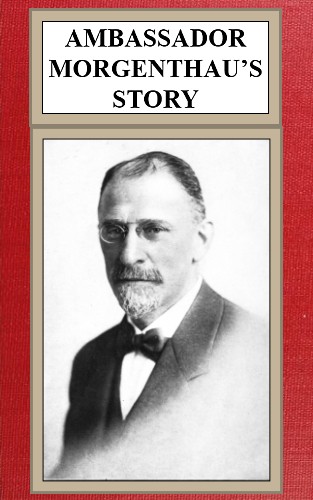
The Project Gutenberg eBook of Ambassador Morgenthau's Story
Title: Ambassador Morgenthau's Story
Author: Henry Morgenthau
Release date: August 11, 2017 [eBook #55343]
Most recently updated: October 23, 2024
Language: English
Credits: Produced by Cindy Horton, Chuck Greif and the Online
Distributed Proofreading Team at http://www.pgdp.net (This
file was produced from images generously made available
by The Internet Archive/Canadian Libraries)
|
List of Illustrations (etext transcriber's note) |
AMBASSADOR
MORGENTHAU’S
STORY
BY
HENRY MORGENTHAU
Formerly American Ambassador to Turkey
ILLUSTRATED
Garden City New York
DOUBLEDAY, PAGE & COMPANY
1919
COPYRIGHT, 1918, BY
DOUBLEDAY, PAGE & COMPANY
ALL RIGHTS RESERVED, INCLUDING THAT OF
TRANSLATION INTO FOREIGN LANGUAGES,
INCLUDING THE SCANDINAVIAN
TO
WOODROW WILSON
OPINION OF THE WORLD, WHICH HAS DECREED THAT
THE RIGHTS OF SMALL NATIONS SHALL BE RESPECTED
AND THAT SUCH CRIMES AS ARE DESCRIBED IN THIS BOOK
SHALL NEVER AGAIN DARKEN THE PAGES OF HISTORY
PREFACE
BY THIS time the American people have probably become convinced that the Germans deliberately planned the conquest of the world. Yet they hesitate to convict on circumstantial evidence and for this reason all eye witnesses to this, the greatest crime in modern history, should volunteer their testimony.
I have therefore laid aside any scruples I had as to the propriety of disclosing to my fellow countrymen the facts which I learned while representing them in Turkey. I acquired this knowledge as the servant of the American people, and it is their property as much as it is mine.
I greatly regret that I have been obliged to omit an account of the splendid activities of the American Missionary and Educational Institutions in Turkey, but to do justice to this subject would require a book by itself. I have had to omit the story of the Jews in Turkey for the same reasons.
My thanks are due to my friend, Mr. Burton J. Hendrick, for the invaluable assistance he has rendered in the preparation of the book.
Henry Morgenthau.
October, 1918.
CONTENTS
| CHAPTER | PAGE | |
| I. | A German superman at Constantinople | 3 |
| II. | The “Boss System” in the Ottoman Empire and how it proved useful to Germany | 20 |
| III. | “The personal representative of the Kaiser.” Wangenheim opposes the sale of American warships to Greece | 41 |
| IV. | Germany mobilizes the Turkish army | 61 |
| V. | Wangenheim smuggles the Goeben and the Breslau through the Dardanelles | 68 |
| VI. | Wangenheim tells the American Ambassador how the Kaiser started the war | 82 |
| VII. | Germany’s plans for new territories, coaling stations, and indemnities | 90 |
| VIII. | A classic instance of German propaganda | 96 |
| IX. | Germany closes the Dardanelles and so separates Russia from her Allies | 105 |
| X. | Turkey’s abrogation of the capitulations. Enver living in a palace, with plenty of money and an imperial bride | 112 |
| XI. | Germany forces Turkey into the war | 123 |
| XII. | The Turks attempt to treat alien enemies decently, but the Germans insist on persecuting them | 130 |
| XIII. | The invasion of the Notre Dame de Sion School | 147 |
| XIV. | Wangenheim and the Bethlehem Steel Company. A “Holy War” that was made in Germany | 157 |
| XV. | Djemal, a troublesome Mark Antony. The first German attempt to get a German peace | 171 |
| XVI. | The Turks prepare to flee from Constantinople and establish a new capital in Asia Minor. The Allied fleet bombarding the Dardanelles | 184 |
| XVII. | Enver as the man who demonstrated “the vulnerability of the British fleet.” Old-fashioned defenses of the Dardanelles | 202 |
| XVIII. | The Allied armada sails away, though on the brink of victory | 217 |
| XIX. | A fight for three thousand civilians | 232 |
| XX. | More adventures of the foreign residents | 253 |
| XXI. | Bulgaria on the auction block | 262 |
| XXII. | The Turk reverts to the ancestral type | 274 |
| XXIII. | The “Revolution” at Van | 293 |
| XXIV. | The murder of a nation | 301 |
| XXV. | Talaat tells why he deports the Armenians | 326 |
| XXVI. | Enver Pasha discusses the Armenians | 343 |
| XXVII. | “I shall do nothing for the Armenians,” says the German Ambassador | 364 |
| XXVIII. | Enver again moves for peace. Farewell to the Sultan and to Turkey | 385 |
| XXIX. | Von Jagow, Zimmermann, and German-Americans | 397 |
LIST OF ILLUSTRATIONS
AMBASSADOR MORGENTHAU’S STORY
CHAPTER I
A GERMAN SUPERMAN AT CONSTANTINOPLE
WHEN I began writing these reminiscences of my ambassadorship, Germany’s schemes in the Turkish Empire and the Near East seemed to have achieved a temporary success. The Central Powers had apparently disintegrated Russia, transformed the Baltic and the Black seas into German lakes, and had obtained a new route to the East by way of the Caucasus. For the time being Germany dominated Serbia, Bulgaria, Rumania, and Turkey, and regarded her aspirations for a new Teutonic Empire, extending from the North Sea to the Persian Gulf, as practically realized. The world now knows, though it did not clearly understand this fact in 1914, that Germany precipitated the war to destroy Serbia, seize control of the Balkan nations, transform Turkey into a vassal state, and thus obtain a huge oriental empire that would form the basis for unlimited world dominion. Did these German aggressions in the East mean that this extensive programme had succeeded?
As I picture to myself a map which would show Germany’s military and diplomatic triumphs, my experiences in Constantinople take on a new meaning. I now see the events of those twenty-six months as part of a connected, definite story. The several individuals that moved upon the scene now appear as players in a carefully staged, superbly managed drama. I see clearly enough now that Germany had made all her plans for world dominion and that the country to which I had been sent as American Ambassador was one of the foundation stones of the Kaiser’s whole political and military structure. Had Germany not acquired control of Constantinople in the early days of the war, it is not unlikely that hostilities would have ended a few months after the Battle of the Marne. It was certainly an amazing fate that landed me in this great headquarters of intrigue at the very moment when the plans of the Kaiser for controlling Turkey, which he had carefully pursued for a quarter of a century, were about to achieve their final success.
For this work of subjugating Turkey, and transforming its army and its territory into instruments of Germany, the Emperor had sent to Constantinople an ambassador who was ideally fitted for the task. The mere fact that the Kaiser had personally chosen Baron Von Wangenheim for this post shows that he had accurately gauged the human qualities needed in this great diplomatic enterprise.
The Kaiser had early detected in Wangenheim an instrument ideally qualified for oriental intrigue; he had more than once summoned him to Corfu for his vacations, and here, we may be sure, the two congenial spirits had passed many days discussing German ambitions in the Near East. At the time when I first met him, Wangenheim was fifty-four years old; he had spent a quarter of a century in the diplomatic corps, he had seen service in such different places as Petrograd, Copenhagen, Madrid, Athens, and Mexico, and he had been chargé at Constantinople, several years afterward coming there as ambassador. He understood completely all countries, including the United States; his first wife had been an American, and Wangenheim, when Minister to Mexico, had intimately studied our country and had then acquired an admiration for our energy and progress. He had a complete technical equipment for a diplomat; he spoke German, English, and French with equal facility, he knew the East thoroughly, and he had the widest acquaintance with public men. Physically he was one of the most imposing persons I have ever known. When I was a boy in Germany, the Fatherland was usually symbolized as a beautiful and powerful woman—a kind of dazzling Valkyrie; when I think of modern Germany, however, the massive, burly figure of Wangenheim naturally presents itself to my mind. He was six feet two inches tall; his huge, solid frame, his Gibraltar-like shoulders, erect and impregnable, his bold, defiant head, his piercing eyes, his whole physical structure constantly pulsating with life and activity—there stands, I would say, not the Germany which I had known, but the Germany whose limitless ambitions had transformed the world into a place of horror. And Wangenheim’s every act and every word typified this new and dreadful portent among the nations. Pan-Germany filled all his waking hours and directed his every action. The deification of his emperor was the only religious instinct which impelled him. That aristocratic and autocratic organization of German society which represents the Prussian system was, in Wangenheim’s eyes, something to be venerated and worshipped; with this as the groundwork, Germany was inevitably destined, he believed, to rule the world. The great land-owning Junker represented the perfection of mankind. “I would despise myself,” his closest associate once told me, and this represented Wangenheim’s attitude as well, “if I had been born in a city.” Wangenheim divided mankind into two classes, the governing and the governed; and he ridiculed the idea that the upper could ever be recruited from the lower. I recall with what unction and enthusiasm he used to describe the Emperor’s caste organization of German estates; how he had made them non-transferable, and had even arranged it so that the possessors, or the prospective possessors, could not marry without the imperial consent. “In this way,” Wangenheim would say, “we keep our governing classes pure, unmixed of blood.” Like all of his social order, Wangenheim worshipped the Prussian military system; his splendid bearing showed that he had himself served in the army, and, in true German fashion, he regarded practically every situation in life from a military standpoint. I had one curious illustration of this when I asked Wangenheim one day why the Kaiser did not visit the United States. “He would like to immensely,” he replied, “but it would be too dangerous. War might break out when he was at sea, and the enemy would capture him.” I suggested that that could hardly happen as the American Government would escort its guest home with warships, and that no nation would care to run the risk of involving the United States as Germany’s ally; but Wangenheim still thought that the military danger would make any such visit impossible.
Upon him, more than almost any diplomatic representative of Germany, depended the success of the Kaiser’s conspiracy for world domination. This German diplomat came to Constantinople with a single purpose. For twenty years the German Government had been cultivating the Turkish Empire. All this time the Kaiser had been preparing for a world war, and in this war it was destined that Turkey should play an almost decisive part. Unless Germany should obtain the Ottoman Empire as its ally, there was little chance that she could succeed in a general European conflict. When France had made her alliance with Russia, the man power of 170,000,000 people was placed on her side, in the event of a war with Germany. For more than twenty years Germany had striven diplomatically to detach Russia from this French alliance, but had failed. There was only one way in which Germany could make valueless the Franco-Russian Alliance; this was by obtaining Turkey as an ally. With Turkey on her side, Germany could close the Dardanelles, the only practical line of communication between Russia and her western allies; this simple act would deprive the Czar’s army of war munitions, destroy Russia economically by stopping her grain exports, her greatest source of wealth, and thus detach Russia from her partners in the World War. Thus Wangenheim’s mission was to make it absolutely certain that Turkey should join Germany in the great contest that was impending.
Wangenheim believed that, should he succeed in accomplishing this task, he would reap the reward which for years had represented his final goal—the chancellorship of the Empire. His skill at establishing friendly personal relations with the Turks gave him a great advantage over his rivals. Wangenheim had precisely that combination of force, persuasiveness, geniality, and brutality which was needed in dealing with the Turkish character. I have emphasized his Prussian qualities; yet Wangenheim was a Prussian not by birth but by development; he was a native of Thüringen, and, together with all the push, ambition, and overbearing traits of the Prussian, he had some of the softer characteristics which we associate with Southern Germany. He had one conspicuous quality which is not Prussian at all—that is, tact; and, as a rule, he succeeded in keeping his less-agreeable tendencies under the surface and showing only his more ingratiating side. He dominated not so much by brute strength as by a mixture of force and amiability; externally he was not a bully; his manner was more insinuating than coercive; he won by persuasiveness, not by the mailed fist, but we who knew him well understood that back of all his gentleness there lurked a terrific, remorseless, and definite ambition. Yet the impression left was not one of brutality, but of excessive animal spirits and good nature. Indeed, Wangenheim had in combination the jovial enthusiasm of a college student, the rapacity of a Prussian official, and the happy-go-lucky qualities of a man of the world. I still recall the picture of this huge figure of a man, sitting at the piano, improvising on some beautiful classic theme—and then suddenly starting to pound out uproarious German drinking songs or popular melodies. I still see him jumping on his horse at the polo grounds, spurring the splendid animal to its speediest efforts—the horse never making sufficient speed, however, to satisfy the ambitious sportsman. Indeed, in all his activities, grave or gay, Wangenheim displayed this same restless spirit of the chase. Whether he was flirting with the Greek ladies at Pera, or
MRS. HENRY MORGENTHAU
(On the right). Wife of the American Ambassador at Constantinople from 1913 to 1916, with Soeur Jeanne (on the left), head of the French Hospital
CONSTANTINOPLE FROM THE AMERICAN EMBASSY
Showing (in the centre of the picture) the buildings of the Ministry of Marine, on the famous Golden Horn, with the city beyond
spending hours over the card table at the Cercle d’Orient, or bending the Turkish officials to his will in the interest of Germany, all life was to him a game, which was to be played more or less recklessly, and in which the chances favoured the man who was bold and audacious and willing to pin success or failure on a single throw. And this greatest game of all—that upon which was staked, as Bernhardi has expressed it, “World empire or downfall”—Wangenheim did not play languidly, as though it had been merely a duty to which he had been assigned; to use the German phrase, he was “fire and flame” for it; he had the consciousness that he was a strong man selected to perform a mighty task. As I write of Wangenheim, I still feel myself affected by the force of his personality, yet I know all the time that, like the government which he served so loyally, he was fundamentally ruthless, shameless, and cruel. But he was content to accept all the consequences of his policy, however hideous these might be. He saw only a single goal, and, with the realism and logic that are so characteristically German, Wangenheim would brush aside all feelings of humanity and decency that might interfere with success. He accepted in full Bismarck’s famous dictum that a German must be ready to sacrifice for Kaiser and Fatherland not only his life but his honour as well.
Just as Wangenheim personified Germany, so did his colleague, Pallavicini, personify Austria. Wangenheim’s essential quality was a brutal egotism, while Pallavicini was a quiet, kind-hearted, delightfully mannered gentleman. Wangenheim was always looking to the future, Pallavicini to the past. Wangenheim represented the mixture of commercialism and medieval lust for conquest which constitute Prussian welt-politik; Pallavicini was a diplomat left over from the days of Metternich. “Germany wants this!” Wangenheim would insist, when an important point had to be decided; “I shall consult my foreign office,” the cautious Pallavicini would say, on a similar occasion. The Austrian, with little upturned gray moustaches, with a rather stiff, even slightly strutting, walk, looked like the old-fashioned Marquis that was once a stock figure on the stage. I might compare Wangenheim with the representative of a great business firm which was lavish in its expenditures and unscrupulous in its methods, while his Austrian colleague represented a house that prided itself on its past achievements and was entirely content with its position. The same delight that Wangenheim took in Pan-German plans, Pallavicini found in all the niceties and obscurities of diplomatic technique. The Austrian had represented his country in Turkey many years, and was the dean of the corps, a dignity of which he was extremely proud. He found his delight in upholding all the honours, of his position; he was expert in arranging the order of precedence at ceremonial dinners, and there was not a single detail of etiquette that he did not have at his fingers’ ends. When it came to affairs of state, however, he was merely a tool of Wangenheim. From the first, indeed, he seemed to accept his position as that of a diplomat who was more or less subject to the will of his more powerful ally. In this way Pallavicini played to his German colleague precisely the same part that his emperor was playing to that of the Kaiser. In the early months of the war the bearing of these two men completely mirrored the respective successes and failures of their countries. As the Germans boasted of victory after victory Wangenheim’s already huge and erect figure seemed to become larger and more upstanding, while Pallavicini, as the Austrians lost battle after battle to the Russians, seemed to become smaller and more shrinking.
The situation in Turkey, in these critical months, seemed almost to have been purposely created to give the fullest opportunities to a man of Wangenheim’s genius. For ten years the Turkish Empire had been undergoing a process of dissolution, and had now reached a state of decrepitude that had left it an easy prey to German diplomacy. In order to understand the situation, we must keep in mind that there was really no orderly, established government in Turkey at that time. For the Young Turks were not a government; they were really an irresponsible party, a kind of secret society, which, by intrigue, intimidation, and assassination, had obtained most of the offices of state. When I describe the Young Turks in these words, perhaps I may be dispelling certain illusions. Before I came to Turkey I had entertained very different ideas of this organization. As far back as 1908 I remember reading news of Turkey that appealed strongly to my democratic sympathies. These reports informed me that a body of young revolutionists had swept from the mountains of Macedonia, had marched upon Constantinople, had deposed the bloody Sultan, Abdul Hamid, and had established a constitutional system. Turkey, these glowing newspaper stories told us, had become a democracy, with a parliament, a responsible ministry, universal suffrage, equality of all citizens before the law, freedom of speech and of the press, and all the other essentials of a free, liberty-loving commonwealth. That a party of Turks had for years been struggling for such reforms I well knew, and that their ambitions had become realities seemed to indicate that, after all, there was such a thing as human progress. The long welter of massacre and disorder in the Turkish Empire had apparently ended; “the great assassin”, Abdul Hamid, had been removed to solitary confinement at Saloniki, and his brother, the gentle Mohammed V, had ascended the throne with a progressive democratic programme. Such had been the promise; but, by the time I reached Constantinople, in 1913, many changes had taken place. Austria had annexed two Turkish provinces, Bosnia and Herzegovina; Italy had wrenched away Tripoli; Turkey had fought a disastrous war with the Balkan states, and had lost all her territories in Europe except Constantinople and a small hinterland. The aims for the regeneration of Turkey that had inspired the revolution had evidently miscarried, and I soon discovered that four years of so-called democratic rule had ended with the nation more degraded, more impoverished, and more dismembered than ever before. Indeed, long before I had arrived, this attempt to establish a Turkish democracy had failed. The failure was probably the most complete and the most disheartening in the whole history of democratic institutions. I need hardly explain in detail the causes of this collapse. Let us not criticize too harshly the Young Turks, for there is no question that, at the beginning, they were sincere. In a speech in Liberty Square, Saloniki, in July, 1908, Enver Pasha, who was popularly regarded as the chivalrous young leader of this insurrection against a century-old tyranny, had eloquently declared that, “To-day arbitrary government has disappeared. We are all brothers. There are no longer in Turkey Bulgarians, Greeks, Servians, Rumanians, Mussulmans, Jews. Under the same blue sky we are all proud to be Ottomans.” That statement represented the Young Turk ideal for the new Turkish state, but it was an ideal which it was evidently beyond their ability to translate into a reality. The races which had been maltreated and massacred for centuries by the Turks could not transform themselves overnight into brothers, and the hatreds, jealousies, and religious prejudices of the past still divided Turkey into a medley of warring clans. Above all, the destructive wars and the loss of great sections of the Turkish Empire had destroyed the prestige of the new democracy. There were plenty of other reasons for the failure, but it is hardly necessary to discuss them at this time.
Thus the Young Turks had disappeared as a positive regenerating force, but they still existed as a political machine. Their leaders, Talaat, Enver, and Djemal, had long since abandoned any expectation of reforming their state, but they had developed an insatiable lust for personal power. Instead of a nation of nearly 20,000,000, developing happily along democratic lines, enjoying suffrage, building up their industry and agriculture, laying the foundations for universal education, sanitation, and general progress, I saw that Turkey consisted of merely so many inarticulate, ignorant, and poverty-ridden slaves, with a small, wicked oligarchy at the top, which was prepared to use them in the way that would best promote its private interests. And these men were practically the same who, a few years before, had made Turkey a constitutional state. A more bewildering fall from the highest idealism to the crassest materialism could not be imagined. Talaat, Enver, and Djemal were the ostensible leaders, yet back of them was the Committee, consisting of about forty men. This committee met secretly, manipulated elections, and filled the offices with its own henchmen. It occupied a building in Constantinople, and had a supreme chief who gave all his time to its affairs and issued orders to his subordinates. This functionary ruled the party and the country something like an American city boss in our most unregenerate days; and the whole organization thus furnished a typical illustration of what we sometimes describe as “invisible government.” This kind of irresponsible control has at times flourished in American cities, mainly because the citizens have devoted all their time to their private affairs and thus neglected the public good. But in Turkey the masses were altogether too ignorant to understand the meaning of democracy, and the bankruptcy and general vicissitudes of the country had left the nation with practically no government and an easy prey to a determined band of adventurers. The Committee of Union and Progress, with Talaat Bey as the most powerful leader, constituted such a band. Besides the forty men in Constantinople, sub-committees were organized in all important cities of the empire. The men whom the Committee placed in power “took orders” and made the appointments submitted to them. No man could hold an office, high or low, who was not indorsed by this committee.
I must admit, however, that I do our corrupt American gangs a great injustice in comparing them with the Turkish Committee of Union and Progress. Talaat, Enver, and Djemal had added to their system a detail that has not figured extensively in American politics—that of assassination and judicial murder. They had wrested power from the other factions by a deed of violence. This coup d’état had taken place on January 26, 1913, not quite a year before my arrival. At that time a political group, headed by the venerable Kiamil Pasha, as Grand Vizier, and Nazim Pasha, as Minister of War, controlled the Government; they represented a faction known as the “Liberal Party,” which was chiefly distinguished for its enmity to the Young Turks. These men had fought the disastrous Balkan War, and, in January, they had felt themselves compelled to accept the advice of the European powers and surrender Adrianople to Bulgaria. The Young Turks had been outside the breastworks for about six months looking for an opportunity to return to power. The proposed surrender of Adrianople apparently furnished them this opportunity. Adrianople was an important Turkish city, and naturally the Turkish people regarded the contemplated surrender as marking still another milestone toward their national doom. Talaat and Enver hastily collected about two hundred followers and marched to the Sublime Porte, where the ministry was then sitting. Nazim, hearing the uproar, stepped out into the hall. He courageously faced the crowd, a cigarette in his mouth and his hands thrust into his pockets.
“Come, boys,” he said, good humouredly, “what’s all this noise about? Don’t you know that it is interfering with our deliberations?”
The words had hardly left his mouth when he fell dead. A bullet had pierced a vital spot.
The mob, led by Talaat and Enver, then forced their way into the council chamber. They forced Kiamil, the Grand Vizier, to resign his post by threatening him with the fate that had overtaken Nazim.
As assassination had been the means by which these chieftains had obtained the supreme power, so assassination continued to be the instrument upon which they depended for maintaining their control. Djemal, in addition to his other duties, became Military Governor of Constantinople, and in this capacity he had control of the police; in this office he developed all the talents of a Fouché, and did his work so successfully that any man who wished to conspire against the Young Turks usually retired for that purpose to Paris or Athens. The few months that preceded my arrival had been a reign of terror. The Young Turks had destroyed Abdul Hamid’s régime only to adopt that Sultan’s favourite methods of quieting opposition. Instead of having one Abdul Hamid, Turkey now discovered that she had several. Men were arrested and deported by the score, and hangings of political offenders—opponents, that is, of the ruling gang—were common occurrences.
The weakness of the Sultan particularly facilitated the ascendancy of this committee. We must remember that Mohammed V was not only Sultan but Caliph—not only the temporal ruler, but also head of the Mohammedan Church. As religious leader he was an object of veneration to millions of devout Moslems, a fact which would have given a strong man in his position great influence in freeing Turkey from its oppressors. I presume that even those who had the most kindly feelings toward the Sultan would not