
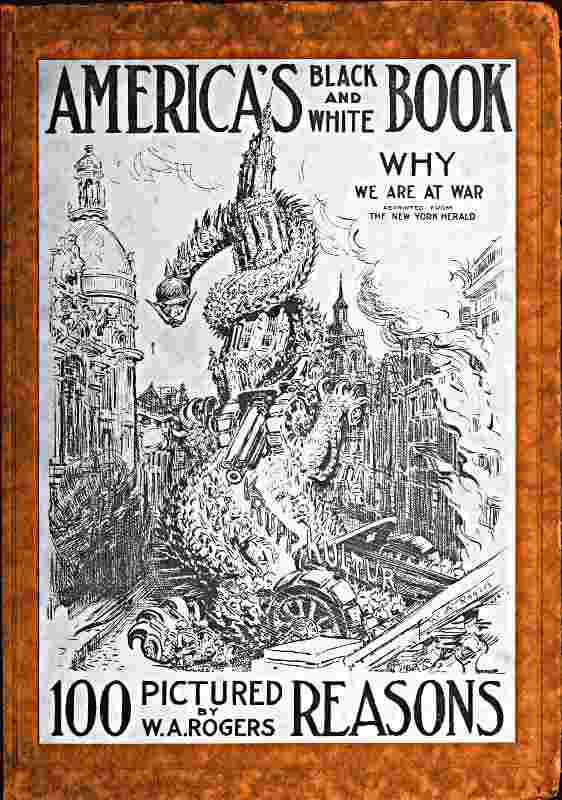
The Project Gutenberg eBook of America's Black and White Book: One Hundred Pictured Reasons Why We Are At War
Title: America's Black and White Book: One Hundred Pictured Reasons Why We Are At War
Author: W. A. Rogers
Release date: November 29, 2014 [eBook #47484]
Most recently updated: October 24, 2024
Language: English
Credits: Produced by Martin Mayer, Greg Bergquist and the Online
Distributed Proofreading Team at http://www.pgdp.net (This
file was produced from images generously made available
by The Internet Archive/American Libraries.)
AMERICA'S
Black and White
BOOK
One Hundred Pictured Reasons
WHY WE ARE AT WAR
CUPPLES & LEON COMPANY
NEW YORK
Copyright, 1917, by
The New York Herald Company
All Rights Reserved
LIST OF CARTOONS
NUMBER
- 1. Verdict—“Carelessness on the part of the deceased.”
- 2. The first great German “U” Boat Victory.
- 3. Modern German Gothic Art.
- 4. The Announcement.
- 5. A SILENT COMPANY—Yet its voice is heard above the roar of Cannon.
- 6. Those “cannon on the forward deck.”
- 7. Here are “the facts.”
- 8. He had expected to find the President alone.
- 9. “We Germans love the Belgians, who were forced into the
war.”
—Dr. Dernberg. - 10. The Crushing of Belgium.
- 11. Invasion of Belgium by the “Uncultured.”
- 12. GERMAN RELIGIOUS ART—Intended for a Cathedral window.
- 13. Christmas Night.
- 14. A moving picture.
- 15. There is no American blood on John Bull's hands.
- 16. Going to “throw a scare” into Uncle Sam.
- 17. “THOSE FLIPPANT AMERICANS, who were drowned on the Lusitania.”—Cologne Gazette.
- 18. “Gott Mit Uns”—and Allah too!
- 19. Swarming.
- 20. “Here's a present from the Kaiser, my pretty maid.”
- 21. “Seized for Military purposes.”
- 22. Those who are decorated.
- 23. It was a glorious Victory.
- 24. One of those touching pictures of a German soldier feeding little Belgium.
- 25. “Don't you see the war is nearly over?—Forget the Lusitania!”
- 26. Activities of a German diplomatist in America.
- 27. Activities of an American diplomatist in Europe.
- 28. A good deal like the “Goose-Step.”
- 29. The sad case of Mr. Dumba.
- 30. Just whose pet snake is this?
- 31. Is God still with us?
- 32. Once more the Olive Branch.
- 33. Assurances by the waste-basket full.
- 34. “Yes, father, I remember you said the war would end in October.”
- 35. Spraddled.
- 36. The Austrians did it.
- 37. Recently on exhibition at Cooper Union.
- 38. The New Intensive Kultur.
- 39. “Watch your step!”
- 40. Whether to get angry or to laugh!
- 41. A message on preparedness—at the psychological moment.
- 42. A little May party interferes with the Christmas spirit.
- 43. The Ambulance Driver.
- 44. “For ways that are dark.”
- 45. “It's got to be uprooted.”
- 46. The Persia Torpedoed.
- 47. The Barbary Pirates:
We cleaned them out 110 years ago, and we may have to do it again. - 48. Yes, of course, “Turkey did it.”
- 49. Washington's most industrious special correspondent.
- 50. A Silent Protest.
- 51. His Private graveyard.
- 52. Safety first.
- 53. Let the decoration fit the crime.
- 54. Like sheep to the slaughter.
- 55. Von Tirpitz.
- 56. On the sinking of a hospital ship.
- 57. “Pirates and Privateers no longer exist.”—Von Jagow.
- 58. “Well, Count, do you claim it?”
- 59. The Kaiser's Colonial Secretary for North America.
- 60. “Please observe, Mr. Ambassador, that you are pretty close to the edge yourself.”
- 61. “From now on we will make no forward movement.”
- 62. “Admiral of the Atlantic.”
- 63. Assorted cargo for the return trip of the Deutschland.
- 64. Triumph of the Hohenzollerns at Verdun.
- 65. Those disappointing German-Americans.
- 66. Preparing a few more answers to our protests.
- 67. Is anybody being fooled by this?
- 68. A Prussian offer of Peace.
- 69. No, this is not Eliza crossing on the ice!
- 70. Maybe somebody wants to buy a little suckling pig, eh?
- 71. Bringing the flag up to date!
- 72. A survival of the dark ages.
- 73. Germany.
- 74. Under their true flag.
- 75. Wrathful waiting.
- 76. THE ONLY ANSWER:
Kaiser: “One day in the week you may go to Falmouth.”
Uncle Sam: “Seven days in the week you may go to ----!” - 77. I'm here, Mr. President, close behind you.
- 78. Another case of wiping hands on the American flag.
- 79. For homeless Belgium.
- 80. “Shame—only American sailors! Not a woman or child in the lot.”
- 81. Something to remember after the War.
- 82. The new recruit.
- 83. It is to laugh.
- 84. Not all is dark.
- 85. “We are now getting the enemy out of their trenches.”—German report.
- 86. “Papa, here comes the light that killed Uncle Nick.”
- 87. The Junker must go.
- 88. “Come avay; our music iss not for Barbarians.”
- 89. The Piffle steams under orders from Wilhelmstrasse.
- 90. THE HONEY-MOON IS OVER.
“He gave me a black eye at Carnegie Hall.” - 91. A good recruiting sergeant for Uncle Sam.
- 92. Will it succeed?
- 93. “Your mother, your wife, your child may be next!”
- 94. Still “luring them on.”
- 95. Mobilized.
- 96. The way to do it.
- 97. Rehearsing their swan song.
- 98. Hold Fast, Everybody!
- 99. This is their emblem.
- 100. To France!
INTRODUCTION
Each government engaged in the European War has issued a White, Green, Blue or Yellow Book, explaining the causes which led to its entry into the great conflict.
These books are all interesting, and are full of valuable documentary information; but, if the busy people of America are to understand the reasons for their own participation in the war, some shorter cut to the desired end must be devised.
We, therefore, offer a BLACK AND WHITE BOOK, in which our nation's reasons for going to war are set forth in pictures, a universal language which can be read at a glance by any one who has eyes to see.
On August 1st, 1914, we were at peace with all the world. We were bound by ties of blood to every race on earth.
Particularly close and intimate were our relations with the German people, whom we welcomed to our shores as among our most desirable citizens.
Then, far away from us, apart from our interests or concerns—like a tragedy being played on the other side of the footlights—broke the frightful war of 1914. We looked on fascinated, but not convinced of the reality of its cruelty.
For a little over eight months we watched it, when, on April 22nd, 1915, there appeared in the New York papers an advertisement stating that the great passenger ship “LUSITANIA” would sail on the 7th of May for Liverpool.
In the next column, in equally conspicuous type, appeared a sinister warning to Americans, telling them to keep off the seas at peril of their lives. This was signed, “IMPERIAL GERMAN EMBASSY, Washington, D. C.”
On May 7th came the fulfilment of the threat, and we awoke to the fact that we were not an audience looking at a tragedy, but the victims of the tragedy itself.
Not until then was it brought home to us that our good German friends, whom we thought we knew so well, had been inoculated with the virus of a Junker madness, and that we were dealing with a people who had cast from them every restraint of fair fighting and had become the outlaw nation of the world.
In the following pictures the Artist has attempted to show “Why we are at war.”
—W. A. ROGERS.
Carelessness on the part of the deceased.
With Junker thoroughness, Dr. Bernhard Dernberg had been sent here to suggest excuses for the brutal assassination of Belgium.
Verdict—“Carelessness on the part of the deceased.”
The first great German “U” boat Victory
The first woman to fall a victim to the “U” boat piracy was a stewardess on an English merchant ship sunk without warning in 1914.
The first great German “U” boat Victory.
Modern German Gothic Art.
The Rheims Cathedral belonged to the world. The product of hundreds of years of consecrated labor, its destruction by a nation devoted to “Kultur” is one of the primary reasons why we are at war.
Modern German Gothic Art.
The Announcement.
The blackest count in the indictment against Germany is foreshadowed in the warning by the Imperial German Embassy at Washington to all Americans, of the crime which was to follow on May 7th, 1915.
The Announcement.
A SILENT COMPANY—Yet its voice is heard above the roar of Cannon.
On May 7th, 1915, by order of the Imperial German Government, a “U” boat torpedoed the great ship Lusitania without warning, drowning over 1,200 passengers. A sea crime unequaled by any pirate known to history.
A SILENT COMPANY—Yet its voice is heard above the roar of Cannon.
Those "cannon on the forward deck."
Immediately after the sinking of the Lusitania, hired perjurers swore that the ship carried guns on her forward deck when she sailed from the port of New York.
Those “cannon on the forward deck.”
Here are "the facts."
Germany with brazen stupidity insisted on being told the facts—facts which she knew in far greater detail than did the Government of the United States.
Here are “the facts.”
He had expected to find the President alone.
A few days after the crime of May 7th, the Count Von Bernstorff requested an audience with the President.
He understood he was to see the President alone.
He had expected to find the President alone.
"We Germans love the Belgians, who were forced into the war." —Dr. Dernberg.
Dr. Bernhard Dernberg became exceedingly tiresome with his hypocritical professions of affection for the Belgians. His propaganda was effective but not in the way he intended.
“We Germans love the Belgians, who were forced into the war.” —Dr. Dernberg.
The Crushing of Belgium.
If the Crown Prince Frederick Wilhelm really said what he is credited with: “This is the most stupid, senseless and unnecessary war of modern times,” he accurately described his father's masterpiece.
The Crushing of Belgium.
Invasion of Belgium by the "Uncultured."
In the early months of the war the plain people of the United States invaded Belgium. This lack of “Kultur” was not criticised by the Belgians.
Invasion of Belgium by the “Uncultured.”
GERMAN RELIGIOUS ART—Intended for a Cathedral window.
In the autumn of 1914 the German Government issued a poster representing a 42 c. m. shell on which was piously inscribed, “Mit Gott fur Konig und Vaterland.”
GERMAN RELIGIOUS ART—Intended for a Cathedral window.
Christmas Night.
It is a singular fact, attested by many photographs, that in the battered interiors of a number of Cathedrals within the war zone, figures of Christ, unharmed, still hold their places.
Christmas Night.
A moving picture.
Official Germany has reported that the busy “U” boat Commander sometimes desists from firing on life boats long enough to reel off a moving picture of his drowning victims.
A moving picture.
There is no American blood on John Bull's hands.
A strong effort was being made in May, 1915, to persuade the United States Government that England was equally guilty with Germany in ignoring our rights at sea.
There is no American blood on John Bull's hands.
Going to “throw a scare” into Uncle Sam.
The German dearly loves a masquerade. Mr. Bartholdt was parading the “German Vote” in Congress in January, 1915, with the idea of “Throwing a scare into Uncle Sam.”
Going to “throw a scare” into Uncle Sam.
“THOSE FLIPPANT AMERICANS, who were drowned on the Lusitania.” —Cologne Gazette.
The semi-official Cologne Gazette added insult to injury when it characterized the one hundred and twenty-five American men, women and children lost on the “Lusitania,” as “Those Flippant Americans.”
“THOSE FLIPPANT AMERICANS, who were drowned on the Lusitania.”—Cologne Gazette.
"Gott Mit Uns"—and Allah too!
The Kaiser invited the “unspeakable Turk” to help subjugate the barbarians of England, France and Italy.
“Gott Mit Uns”—and Allah too!
Swarming.
The United States was swarming with German spies and assassins whose activities seemed to have a center in the German Embassy at Washington.
Swarming.
"Here's a present from the Kaiser, my pretty little maid."
Little children playing on the quiet greens of peaceful English villages seemed to be the favorite targets of the Zeppelin fleet.
“Here's a present from the Kaiser, my pretty little maid.”
"Seized for Military purposes."
The hosts of “Kultur” seemed to take particular delight in the destruction of the monuments of Gothic grandeur in Belgium and France.
“Seized for Military purposes.”
Those who are decorated.
As the war went on, the heroism and devotion of the Red Cross nurse seemed to shine out with a lustre which quite eclipsed the glitter of military decorations.
Those who are decorated.
It was a glorious Victory.
Heroic Belgium, crushed beneath the gross bulk of bloated Junkerdom, still held his sword in hand, ready to strike again for freedom.
It was a glorious Victory.
One of those touching pictures of a German soldier feeding little Belgium.
German soldiers whose hands were red with the blood of Belgian mothers, posed for official photographs to be used for American propaganda, showing them feeding little Belgian children.
One of those touching pictures of a German soldier feeding little Belgium.
"Don't you see the war is nearly over?—Forget the Lusitania!"
After the campaigns of Lemberg and Przemysl, the Kaiser intimated to Washington that the War was about over; and it would be well, in the interests of peace, to FORGET THE “LUSITANIA.”
“Don't you see the war is nearly over?—Forget the Lusitania!”
Activities of a German diplomatist in America.
Count Von Bernstorff continued to “play horse” with Uncle Sam, while Dumba, Von Papen and Boy-Ed looked on with ill-concealed contempt at “the idiotic Yankees.”
Activities of a German diplomatist in America.
Activities of an American diplomatist in Europe.
In contrast to the violation of our hospitality by Counts Von Bernstorff and Dumba in America, Brand Whitlock, our ambassador in Belgium, spent his time in relieving the distress in that distracted country.
Activities of an American diplomatist in Europe.
A good deal like the "Goose-Step."
Mr. Bryan, in the disguise of a pacifist, was consciously or unconsciously playing the role assigned him by the Imperial German Embassy at Washington.
A good deal like the “Goose-Step.”
The sad case of Mr. Dumba.
Ambassador Dumba, having accumulated sufficient rope, hanged himself at last. His hat as well as his passports were handed him by the President.
The sad case of Mr. Dumba.
Just whose pet snake is this?
One bomb plot succeeded another; leaving a slimy trail that always led back to the German Embassy at Washington.
Just whose pet snake is this?
Is God still with us?
Before a wrecked Cathedral window in France, from which the Mother and Child still looked down in silent protest, a young German recruit might well ask, “Is God still with us?”
Is God still with us?
Once more the Olive Branch.
In September, 1915, the Count Von Bernstorff extended the olive branch to the Government of the United States, while Von Tirpitz backed him up with a gun.
Once more the Olive Branch.
Assurances by the waste-basket full.
Von Bethmann-Hollweg was urged by the German Embassy in Washington to patch up any old assurances and send them over as Uncle Sam was becoming extremely restless.
Assurances by the waste-basket full.
"Yes, father, I remember you said the war would end in October."
Certain that Verdun would fall, the Kaiser had predicted that the war would end in October, 1915. As September closed, the Crown Prince's army was being shot to pieces.
“Yes, father, I remember you said the war would end in October.”
Spraddled.
It looked as though the German Army was spread over too much territory—faced too many fronts to be effective!
Spraddled.
The Austrians did it.
The “Ancona” was sunk with great loss of life, and the German Government immediately claimed that an Austrian “U” boat was responsible, their attitude being that any story was good enough for “those idiotic Yankees.”
The Austrians did it.
Recently on exhibition at Cooper Union.
In the autumn of 1915, “The Friends of Peace” hung their white robes over plots of assassination, arson, piracy and the destruction of ships and munition plants.