
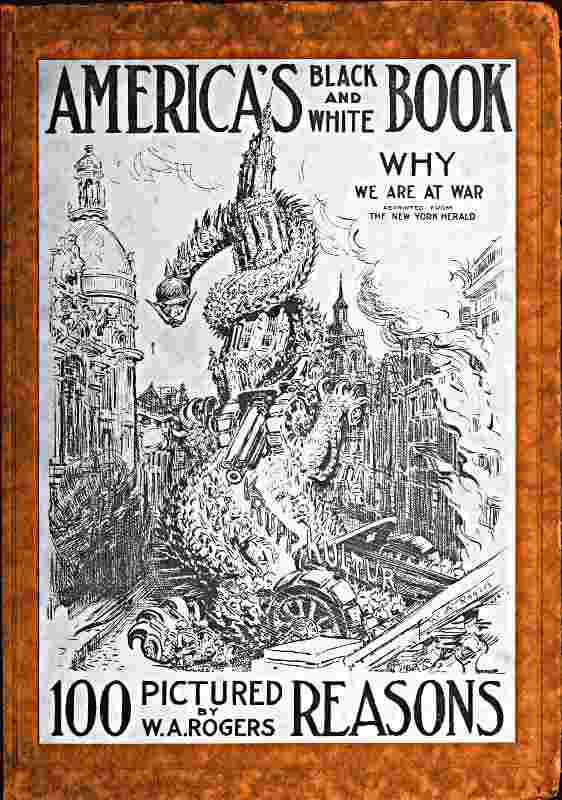
Recently on exhibition at Cooper Union.
The New Intensive Kultur.
Under our feet the Prussian spy system was working day and night. It was hard to take a step in Washington without sticking your foot on a spiked helmet.
The New Intensive Kultur.
"Watch your step!"
The people of the United States were beginning to think we had had enough of German aggression, and it was felt that a strong stand must be made for the national dignity and honor.
“Watch your step!”
Whether to get angry or to laugh!
In November, 1915, Mr. Henry Ford had an idea “wished on him” by an Austrian lady who was lecturing in this country. She succeeded in making a spectacle of him, at which Uncle Sam was uncertain whether to laugh or weep.
Whether to get angry or to laugh!
A message on preparedness—at the psychological moment.
When the country, in December, 1915, was at the height of distraction, with plots against its peace and security being carried out in every direction, President Wilson came out with a message on Preparedness for War.
A message on preparedness—at the psychological moment.
A little May party interferes with the Christmas spirit.
Immediately before Christmas the German Government once more sent us assurances of her high regard and friendship, meanwhile blowing up a few ships at sea and munition plants on land.
A little May party interferes with the Christmas spirit.
The Ambulance Driver.
Many young Americans were at the front, driving their ambulances into the line of fire. Even Christmas night found them abroad on their errands of mercy.
The Ambulance Driver.
"For ways that are dark."
With one hand passing out checks to Von Papen to pay for dynamite, and the other carrying assurances to the White House of Germany's good faith and friendship, Count Von Bernstorff was fairly busy.
"For ways that are dark."
"It's got to be uprooted."
Treasonable plots were becoming more and more unbearable. It was thought that the breaking point was very near.
“It's got to be uprooted.”
The Persia Torpedoed.
The U. S. Consul to Aden, travelling on the business of his government, was the victim of a “U” boat attack in the Mediterranean. This occurred very near the spot where we drove the Barbary pirates from the seas a hundred and ten years ago.
The Persia Torpedoed.
The Barbary Pirates—We cleaned them out 110 years ago and we may have to do it again.
The expedition in which the U. S. Marines distinguished themselves one hundred and ten years ago was brought to mind by the piracy of 1916.
The Barbary Pirates—We cleaned them out 110 years ago and we may have to do it again.
Yes, of course, "Turkey did it."
With characteristic effrontery Germany and Austria disclaimed responsibility for the death of our consul to Aden, blaming it on the Turks.
Yes, of course, “Turkey did it.”
Washington's most industrious special correspondent.
In FeburaryFebruary, 1916, the newspaper offices were being
bombarded with stories from “a source near the German
Embassy.” —“What Mr. Lansing thinks,”
“Washington agrees with Berlin,” “What the President
believes,” etc., etc.
Washington's most industrious special correspondent.
A Silent Protest.
In the Place d'Iéna in Paris stands a statue of Washington. Within sight of this monument an old man and a little child were killed, the only victims of an air raid by German “Taubes.”
A Silent Protest.
His Private graveyard.
Von Bernstorff, hoping that the “Lusitania” was buried forever, was busy with assurances of regret. His principal hope being that she might “Rest in Peace.”
His Private graveyard.
Safety first.
Mr. Bryan, to the disgust of all decent Americans, made a plea to his countrymen to bow to the will of Germany and keep off the seas entirely.
Safety first.
Let the decoration fit the crime.
It was asserted and has never been denied, by the German Government, that the Kaiser decorated the commander of the “U” boat which sank the Lusitania.
Let the decoration fit the crime.
Like sheep to the slaughter.
Verdun had become a slaughter house. To save the tottering prestige of the Crown Prince Frederick Wilhelm, whole German battalions were sacrificed in vain efforts to break down the French defense.
Like sheep to the slaughter.
Von Tirpitz
Von Tirpitz was said to have expressed deep sorrow for the women and children he had been compelled to kill. (As well, perhaps, as for those whom he was to kill on the morrow.)
“My duty's been full sore
And sorrow, like a rising tide,
Drowns all the joys of yore.”
This drowning children by the score;
However droll the sport may seem,
It gets to be a horrid bore.”
Safe on the dismal banks of Kiel;
Weep for the babes who lie so still —
Only a Pirate's heart can feel.”
As he sharpen his knife and tears fall fast,
He would cut your dear throat in a sort of a way
But his heart,—Oh, so tender, Is breaking at last.
Von Tirpitz
On the sinking of a hospital ship.
The Junker Pirates, having filled the sea with little lost children, torpedoed a hospital ship and sent down into the deep a score of Red Cross nurses to keep them company.
On the sinking of a hospital ship.
"Pirates and Privateers no longer exist."—Von Jagow.
In the face of a sea campaign of “Frightfulness,” Von Jagow came out with a statement that “Piracy no longer exists.” But something just as good was “made in Germany.”
“Pirates and Privateers no longer exist.”—Von Jagow.
"Well, Count, do you claim it?"
In a safe of one Von Igel were found documents of the most incriminating nature. Count Von Bernstorff was given opportunity to claim them as official papers if he so desired.
“Well, Count, do you claim it?”
The Kaiser's Colonial Secretary for North America.
Junker impudence in the German Embassy at Washington had reached its highest point. Even Count Von Bernstorff realized that he had gone the very limit with our State Department.
The Kaiser's Colonial Secretary for North America.
"Please observe, Mr. Ambassador, that you are pretty close to the edge yourself."
When the German Ambassador protested against the deportation of his chief lieutenants for their activities in plots against our peace and safety, he was warned that his own position was none too secure.
“Please observe, Mr. Ambassador, that you are pretty close to the edge yourself.”
"From now on we will make no forward movement."
Making a virtue, perhaps, of necessity, the German Government announced, in February, 1916, that “from now on it would make no forward movement.” Events since have proved how well it realized its true condition.
“From now on we will make no forward movement.”
"Admiral of the Atlantic."
In June, 1916, Wilhelm II, peering out from behind Heligoland, where his ships had rusted for two years, declared himself “Admiral of the Atlantic.”
“Admiral of the Atlantic.”
Assorted cargo for the return trip of the Deutschland.
The “Deutschland,” a cargo submersible craft, sent over for reasons best known to the German Admiralty, was extremely mysterious as to her cargo for the return trip.
Assorted cargo for the return trip of the Deutschland.
Triumph of the Hohenzollerns at Verdun.
It was stated in a cable from Amsterdam, that, by the Kaiser's direct personal order, issued about three weeks after the first attack on Verdun, to the Court painter, a great historical painting was to be made, called “The Triumph of the Hohenzollerns.” Accordingly the painter, with costumes, horses, models, and a corps of photographers and assistants, mobilized his forces on an eminence overlooking Verdun.
Triumph of the Hohenzollerns at Verdun.
Those disappointing German-Americans.
Junkerdom could never understand why all German-born American citizens, or American citizens of German blood did not immediately rally to the flag of Germany against the forces fighting for the liberty of the world.
Those disappointing German-Americans.
Preparing a few more answers to our protests.
Germany was ready to talk about restricting “U” boat activity as long as we would listen to her; but the sound of riveting machines in her shipyards was her real answer.
Preparing a few more answers to our protests.
Is anybody being fooled by this?
While Von Bethmann-Hollweg was talking of Germany's desire for peace and a cessation of slaughter, Germany was making every preparation for a renewal, more ruthless than ever, of undersea warfare.
Is anybody being fooled by this?
A Prussian offer of Peace.
While her soldiers were driving Belgian civilians into slavery in Germany, Von Bethmann-Hollweg was issuing such beautiful sentiments as the following: “Conscious of their responsibility before God, before their own nations and before Humanity.”
A Prussian offer of Peace.
No, this is not Eliza crossing on the ice!
An American-German (not a German-American) said in an interview in December, 1916, that Germany's Peace Proposals had broken the ice.
No, this is not Eliza crossing on the ice!
Maybe somebody wants to buy a little suckling pig, eh?
Everybody in the world had heard of the German Peace Proposals, supposed to have been sent out by the Kaiser, but nobody had been allowed to see them.
Maybe somebody wants to buy a little suckling pig, eh?
Bringing the flag up to date!
The Kaiser and Von Tirpitz were much happier in announcing a new campaign of Intensive Frightfulness than when endorsing the hypocritical peace proposals of Von Bethmann-Hollweg.
Bringing the flag up to date!
A survival of the dark ages.
The retreat of the German Army in northeastern France will be remembered as one of the blackest pages in Junker history.
It stirred the indignation of the whole world.
A survival of the dark ages.
Germany.
Blinded by the glitter of fifty years of militarism, the German peasant now finds himself the bearer of a crushing burden.
His case is not helped by the diplomacy which guides him.
Germany.
Under their true flag.
On February 1st the German Admiralty with the utmost deliberation raised the black flag of piracy against the entire world, declaring that all vessels of whatever description would be sunk on sight if they approached European waters.
Under their true flag.
Wrathful waiting.
By the end of February, 1917, the President and the people of the United States were in a state of indignation that could not much longer be controlled.
They had exchanged “watchful” for “wrathful” waiting.
Wrathful waiting.
THE ONLY ANSWER: Kaiser: "One day in the week you may go to Falmouth." Uncle Sam: "Seven days in the week you may go to----!"
Junker impudence finally overreached itself. When the United States was informed that it could send one ship striped like a zebra to Falmouth each week, American patience suddenly came to an end.
THE ONLY ANSWER:
Kaiser: “One day in the
week you may go to Falmouth.”
Uncle Sam: “Seven days
in the week you may go to ----!”
I'm here, Mr. President, close behind you.
The President addressed a request to Congress for power to arm merchant vessels for protection against German piracy.
I'm here, Mr. President, close behind you.
Another case of wiping hands on the American flag.
Two little children, born almost under the shadow of the Hall of Independence in Philadelphia, were murdered at sea in the new campaign of “Frightfulness.”
Another case of wiping hands on the American flag.
For homeless Belgium.
The feeling of America for devasteddevastated
Belgium was shown in the action of the Rocky Mountain Club, which gave
the million dollars collected for a club house in New York, to the
Homeless Belgians.
For homeless Belgium.
"Shame—only American sailors! Not a woman or child in the lot."
An American merchant ship was sunk, carrying down a score of American sailors. Not a single child in the lot. The price of “Frightfulness” seemed wasted.
“Shame—only American sailors! Not a woman or child in the lot.”
Something to remember after the War.
Many things done by the Germans in the heat and frenzy of war will be forgiven, but in the days and years to come the murder of the sick and wounded and the devoted women of the Red Cross on Hospital ships will be beyond human forgiveness.
Something to remember after the War.
The new recruit.
Mr. Carranza showed signs of having fallen under strong German influence.
He seemed inclined to adopt the goose-step at Tampico.
The new recruit.
It is to laugh.
The tension in public feeling was suddenly relieved by the revelations of a plot in which Germany and Mexico were to offer a full partnership to Japan in return for an attack on our southwestern border. It caused a roar of laughter from Washington to Tokio and back.
It is to laugh.
Not all is dark.
Through all the hideousness of war shone the light of the Red Cross. A fund for this great enterprise of humanity of one hundred and fourteen million dollars was raised in the United States in a week.
Not all is dark.
"We are now getting the enemy out of their trenches."—German report.
The Kaiser's plan for “Getting the boys out of the Trenches” in Eastern France was almost as naive as Mr. Henry Ford's plan of two years ago, and much more effective.
“We are now getting the enemy out of their trenches.”—German report.
"Papa, here comes the light that killed Uncle Nick."
The fate of the Romanoffs must have been most disturbing to the peace of mind of the Hohenzollern family. The torch of Liberty arose “Like Thunder”" across the seas.
“Papa, here comes the light that killed Uncle Nick.”
The Junker must go.
England, France, Russia, Italy and the United States recognized that the Junker menace to the world must be thoroughly crushed before Peace could ever return to the world.
The Junker must go.
"Come avay; our music iss not for Barbarians."
Prussia at last realized that the United States could no longer be cajoled. Austria was therefore advised to give up all pretense of friendliness and come out into the open as a foe to America.
“Come avay; our music iss not for Barbarians.”
The Piffle steams under orders from Wilhelmstrasse.
The “pacifists” were bending every endeavor to induce the American Government to bow down in craven acquiescence to the restrictions of Berlin on Ocean travel.
The Piffle steams under orders from Wilhelmstrasse.
THE HONEY-MOON IS OVER. "He gave me a black eye at Carnegie Hall."
It was discovered that German money was paying a great part of the expenses of the Pacifist Party.
The Pacifists were willing to take the money, but objected to being found out.
THE HONEY-MOON IS OVER. “He gave me a black eye at Carnegie Hall”
A good recruiting sergeant for Uncle Sam.
A “U” boat was reported at work off the Port of New York. This proved of considerable value to the recruiting sergeants.
A good recruiting sergeant for Uncle Sam.
Will it succeed?
Germany set a trap beautifully baited with honeyed words for the Russian bear.
It looked for a time as though the Bear would be caught.
Will it succeed?
"Your mother, your wife, your child may be next!"
There seemed to be a lack of realization on the part of many Americans that war was actually coming our way and that in the German programme, “we were next.”
“Your mother, your wife, your child may be next!”
Still "luring them on."
Perhaps Prussia builded better than she knew when she carved out a heroic wooden figure to represent her hero, Von Hindenburg.
The Von Hindenburg Line was constantly nearing Berlin.
Still “luring them on.”
Mobilized.
Uncle Sam took command of one of the most powerful branches of his Industrial Army—the Railroads. They swore allegiance to the Flag.
Mobilized.
The way to do it.
Admiral Fiske advocated going after the submarines with hydro-aeroplanes armed with torpedoes and guns.
Congress was urged to provide a great fleet of the aero craft.
The way to do it.
Rehearsing their swan song.
The Hohenzollern family were beginning to realize that the day of Divine Right was nearing its end. They were gathering at the feet of “Old Fritz” for their swan song.
Rehearsing their swan song.
Hold Fast, Everybody!
When the Russian loosened his hold on the Junker Beast, a situation loomed up that called for all the resolution and resourcefulness of the remaining allies.