
PREFACE
Grateful acknowledgment is due all those who have contributed the fine material from which the plates for this book have been made. They have been most generous in giving and in lending the laces and embroideries and in furnishing facts and details as to the making of them. There is a wealth of material in the country which we are not able to show for want of space. We desire to express our gratitude to the following contributors:
Miss Edith Beach,
Miss Marian Powys,
Miss Esther H. Thompson,
Miss Sarah E. Lakeman,
Miss Helena Knox,
Miss Marianna Townsend,
Miss Clara Ray,
Miss Natalie Lincoln,
Miss Edith Eliot,
Miss Emily Wheeler,
Miss Frances Morris,
The Misses Alice and Edith Kingsbury,
Mrs. Charles B. Curtis,
Mrs. Lewis Marsh,
Mrs. Guy Antrobus (Mary Symonds),
Mrs. William Nelson,
Mrs. Edward W. Preston,
Mrs. Ruth Quincy Powell,
Mrs. Samuel H. Street,
Mrs. Charles W. Follett,
Mrs. Francis H. Blake,
Miss Sophia A. Walker,
Miss Margaret Taylor Johnstone,
Sybil Carter Indian Lace Association, New York City,
Metropolitan Museum of Art, New York City,
American Museum of Natural History, New York City,
New York Public Library,
The Museum of Fine Arts, Boston,
Essex Museum, Salem, Massachusetts,
Litchfield Historical Society, Litchfield, Connecticut.
The few books that have contributed their share to the work deserve mention. They may be consulted by those who wish more data as to the making of lace in general and as to the dates and details of the invention of machine-made lace, the importation into the United States of the machinery with which to make it, and the consequent excitement in both England and New England.
Fine Thread, Lace and Hosiery in Ipswich, by Jesse Fewkes; and Ipswich Mills and Factories, by T. Frank Waters. (Proceedings of the Ipswich Historical Society.) The Salem Press Company.
Point and Pillow Lace, by Mary Sharp. Dutton.
Development of Embroidery in America, by Candace Thurber Wheeler. Harper.
Practical Book of Early American Arts and Crafts, by Harold Donaldson Eberlein and Abbott McClure; with a chapter on early lace by Mabel Foster Bainbridge. Lippincott.
Encyclopædia Britannica, Eleventh Edition. Article on Lace.
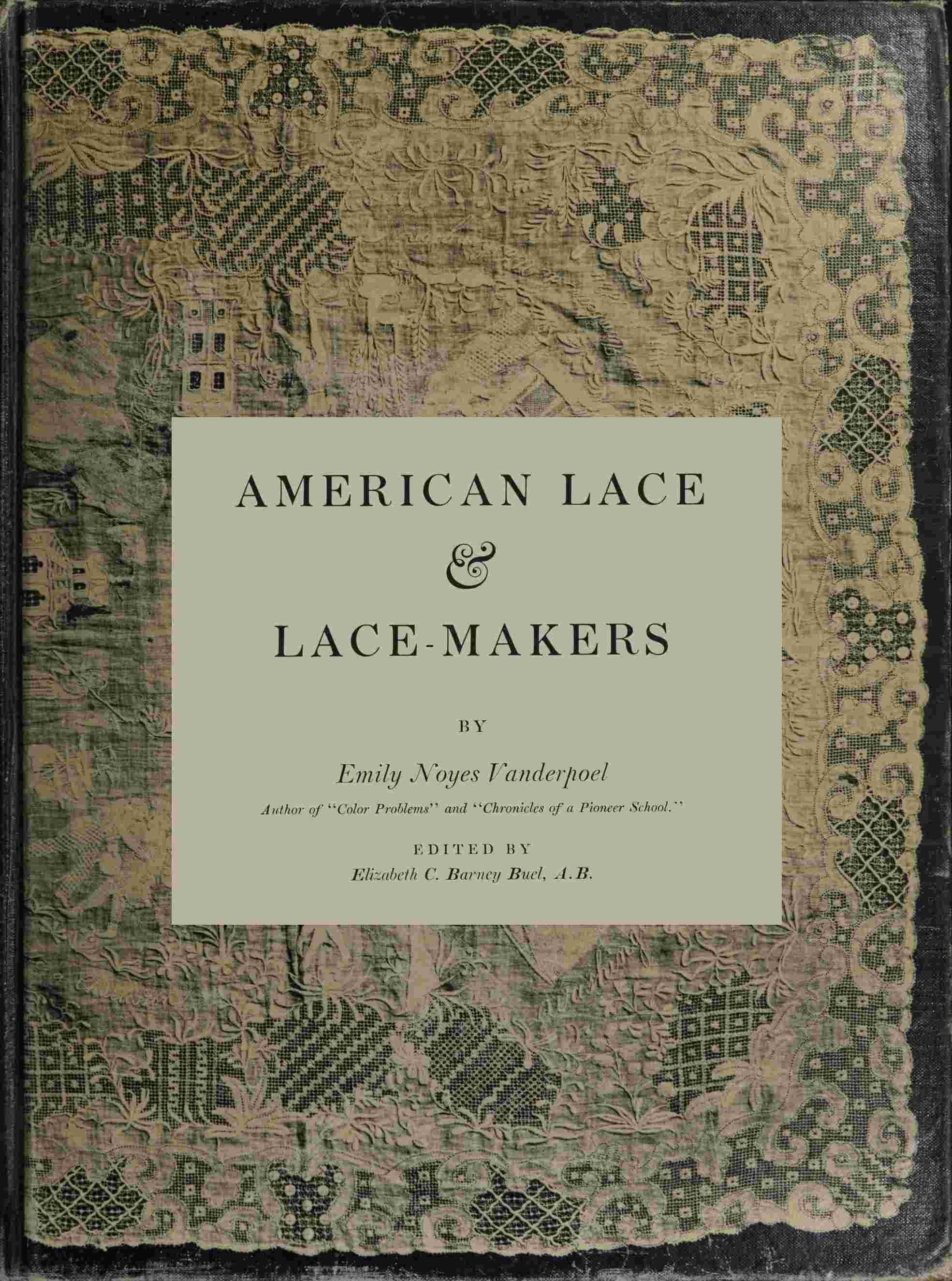
Too late for inclusion in the body of this volume, there came to the author the exquisite Washington-Lafayette handkerchief which has been photographically reproduced as a design for the binding. The original was worked in New Orleans by a French lady—possibly a Creole, for it is known that the Creoles of that city were remarkably expert with the needle. Its conjectural date is 1825–1830: most of the embroidery of its type was done between 1820 and 1840, and it is wholly probable that the direct impetus of this example was nothing other than Lafayette’s famous triumphal visit of 1824. The original is now owned by the Litchfield Historical Society, of Litchfield, Connecticut.