
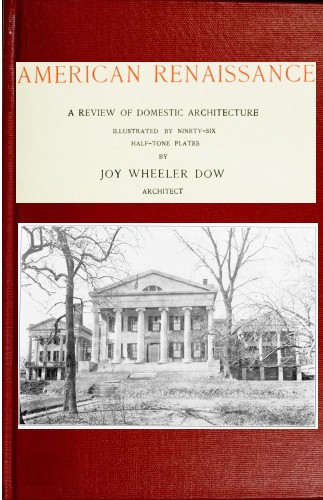
The Project Gutenberg eBook of American renaissance; a review of domestic architecture
Title: American renaissance; a review of domestic architecture
Author: Joy Wheeler Dow
Release date: July 6, 2019 [eBook #59862]
Most recently updated: January 24, 2021
Language: English
Credits: Produced by Chuck Greif and the Online Distributed
Proofreading Team at http://www.pgdp.net (This file was
produced from images available at The Internet Archive)
|
List of Illustrations (etext transcriber's note) |
AMERICAN RENAISSANCE
A REVIEW OF DOMESTIC ARCHITECTURE
ILLUSTRATED BY NINETY-SIX
HALF-TONE PLATES
BY
JOY WHEELER DOW
ARCHITECT
NEW YORK:
WILLIAM T. COMSTOCK
MCMIV
Copyright, 1904, By
Joy Wheeler Dow
Press of J. J. Little & Co.
Astor Place, New York
PREFACE
This review of American Renaissance originally appeared as a series of papers in the “Architects and Builders’ Magazine,” and the interest shown in them as they were brought out and the later inquiry for these numbers of the Magazine have led the publisher to suggest the propriety of putting them in more permanent shape.
With this in view the author has carefully collated the articles, added some new illustrations, and in some cases the plates have been enlarged where the subjects seemed worthy of fuller representation than was possible in the limited space allowed in the Magazine.
The book is intended to be an impartial outline history of American domestic architecture from Colonial times to the present day, and the salutary influence upon it of whatever has been good in past building epochs.
How well the subject has been presented, it remains for the readers of the following pages to judge.
CONTENTS
LIST OF ILLUSTRATIONS
| Frontispiece—Garden Front of Bennett House, New Bedford, Epoch 1840. | ||
| PLATES. | ||
| I— | In an Old Time Renaissance Garden. The Governor Smith House at Wiscasset, Me. | |
| II— | Doorway, Washington Square, North, New York City. | |
| III— | Pickering House, Salem, Mass. Erected A.D. 1649. Cole House, Farmington, Conn. | |
| IV— | If you want atmosphere and plenty of it, go to Salem. Historic Atmosphere in a Modern Dwelling,—Silvergate. | |
| V— | Shirley-on-the-James. American Renaissance Dwelling by an imitator of Richardson. Date about 1890. | |
| VI— | Doorway at Bristol, R. I. | |
| VII— | American Renaissance and Analysis. | |
| VIII— | The Newly Invented Architecture and Analysis. Eastover, Terrace and Peristyle. | |
| IX— | Eastover: Garden Front. | |
| X— | Not every Architect is Able to Give you this Atmosphere. Page House, Danvers, Mass. Money will not buy the Cotton Smith House. | |
| XI— | Victims of Commercialism, Belmont Houses, New York City. Chimney-piece, American Renaissance. Designed by T. Henry Randall. | |
| XII— | Simplicity of Art, Wadsworth House, Middletown, Conn. Efflorescence of Commercialism. | |
| XIII— | Mantelpiece, American Renaissance. Epoch 1806. Orne-Ropes House, Salem. Epoch 1720. Both name and identity of its designer have in all probability been irrevocably mislaid in oblivion, but he was an architect. | |
| XIV— | Doorway, Means House, Amherst, N. H. | |
| XV— | Munro-French House, Bristol, R. I. Epoch 1800. These apprentices essayed no stunts. An Ancient Farm-house at Durham, Conn. | |
| XVI— | So far as teaching architectural art is concerned it must be admitted that our public schools have been a dead failure.—Modern Farm-house. Type of Farm-house. Epoch end of Eighteenth Century. | |
| XVII— | Peristyle to a House in Wyoming, N. J. (1897). American Renaissance, 1899. | |
| XVIII— | Detail, Princessgate, 1896. “A little learning is a dangerous thing,” etc. | |
| XIX— | Wyck, Germantown. Epoch A.D. 1700. | |
| XX— | XX—Doorway, Philadelphia Club. | |
| XXI— | Derby-Ward House, Salem, Mass. Seventeenth Century. Souvenir of Abigail and Deliverance Hobbs, two alleged witches of Topsfield, Mass. | |
| XXII— | Modern Cottage with a Germantown Hood. Modern Cottage with a Dutch Hood. | |
| XXIII— | Germantown Motive Applied to a Modern Cottage. Type of Early Connecticut House, Stratford, Conn. | |
| XXIV— | Type of Early Connecticut House, Middletown, Conn. | |
| XXV— | Johnson House, Germantown, Pa. House at Hackensack, N. J. Eighteenth Century. | |
| XXVI— | House at Bogota, N. J. Eighteenth Century. | |
| XXVII— | Mount Vernon-on-the-Potomac. River front. | |
| XXVIII— | Mount Vernon-on-the-Potomac. West front. | |
| XXIX— | A Salem Gateway, Nichols House. Hoppin House, from the close, Litchfield. | |
| XXX— | House of Captain McPhædris at Portsmouth, N. H. | |
| XXXI— | Doorway at Warren, R. I. Chimney-piece, American Renaissance, 1899. | |
| XXXII— | Morris House, Germantown. Wister House, Germantown. | |
| XXXIII— | Wyck, Germantown. Terrace and Garden Front of a House at Wyoming, N. J., 1899. | |
| XXXIV— | John Cotton Smith House, Sharon, Conn. The Deming House, Litchfield, Conn. | |
| XXXV— | Ford Mansion, Morristown, N. J. Eighteenth Century. Doorway with Hood, Lynn-Regis, 1897. | |
| XXXVI— | Morris House, Philadelphia. | |
| XXXVII— | Winter View of Eastover. Rosewell, Gloucester County, Va. A Ghost of the Grand Epoch. | |
| XXXVIII— | De Wolf-Colt Mansion, Bristol, R. I. Epoch 1810. | |
| XXXIX— | Local Color, Old Philadelphia. | |
| XL— | House with the Eagles, Bristol, R. I. The Norris House, Bristol, R. I. | |
| XLI— | Chestnut Street, Salem. | |
| XLII— | West approach and entrance to De Wolf-Middletown House, Bristol, R. I. Built in 1808. The Back Buildings of Philadelphia. | |
| XLIII— | The Captain White House, Essex Street, Salem. | |
| XLIV— | Doorway, Silvergate. Doorway, Watkinson House, Middletown, Conn. | |
| XLV— | Watkinson House. Epoch 1810. Benefit Street, Providence, R. I. | |
| XLVI— | Modern Chimney-piece. | |
| XLVII— | Grace Church Rectory, New York City. | |
| XLVIII— | No. 23 Bond Street, New York City. Doorway on East Fourth Street, New York City. The Sargent House (Common East), New Haven, Conn. | |
| XLIX— | Sun Dial, Grace Church Rectory. | |
| L— | House of Mrs. Richmond-Dow, Warren, R. I. View from the close, same subject. | |
| LI— | House on High Street, Middletown, Conn. Bennett House, County Street, New Bedford. | |
| LII— | Doorway, New York City. | |
| LIII— | The De Zeng House, Middletown, Conn. The Roberts House, Rittenhouse Square, Philadelphia. | |
| LIV— | No 1 Fifth Avenue, New York City. Waterbury House, Fifth Avenue and Eleventh Street, New York. | |
| LV— | Remaining Half of the Colonnade, New York City. Typical architecture of the transitional period. | |
| LVI— | “And that house with the coopilows his’n.” A Fifth Avenue Mansion during the Reign of Terror. | |
| LVII— | “I think that Dante’s more abstruse ecstatics,” etc. | |
| LVIII— | “There were the sincere radicals——” | |
| LIX— | LIX—“And the Scaramouches.” | |
| LX— | Franco-American Roof. Typical example. Jacobin architecture was at least symmetrical. | |
| LXI— | “I never was so glad to get home in my life.” | |
| LXII— | Ultra-fashionable Queen Anne architecture. Fashionable House, Eastlake School. | |
| LXIII— | Bellwood, Madison, N. J. Epoch 1878. | |
| LXIV— | A Queen Anne House at Short Hills, N. J. Frederick B. White, architect. An Ultra-fashionable Colonial House of the Present Day, 1904. | |
| LXV— | A Country House, San Mateo, Cal. Bruce Price architect, New York. | |
| LXVI— | Doorway at Sharon, Conn. | |
| LXVII— | The Château of Chenonceau. | |
| LXVIII— | Kingdor, Summit, N. J. Canterbury Keys, Wyoming, N. J. | |
| LXIX— | The Louvre, Paris. | |
| LXX— | House of W. K. Vanderbilt, Fifth Avenue and Fifty-second Street, New York City. | |
| LXXI— | Lambton Castle, England. | |
| LXXII— | Haddon Hall, England. | |
| LXXIII— | Charlecote Hall, England. | |
| LXXIV— | Hampton Court, Wolsey Palace. | |
| LXXV— | LXXV—Hampton Court, South Palace. | |
| LXXVI— | Chambord, “The Valois Shooting-box.” | |
| LXXVII— | Azay-le-Rideau. The celebrated coup d’œil of the château. | |
| LXXVIII— | Elevation of a Country House for Mrs. H., at Morristown. | |
| LXXIX— | Kingdor, front elevation. Kingdor, detail. | |
| LXXX— | A Cottage at East Orange, N. J. | |
| LXXXI— | Doorway, Bristol, R. I. | |
| LXXXII— | Mitchell Cottage, East Orange. | |
| LXXXIII— | Detail, Mitchell Cottage, East Orange, N. J. | |
| LXXXIV— | Princessgate. Princessgate, rear. | |
| LXXXV— | Eastover, the west front. | |
| LXXXVI— | Searles Cottage. Exemplifying architectural style. The Modern American Dwelling. Exemplifying fashion. | |
| LXXXVII— | Style and the picture. Middletown, Conn. Detail in South Eighth Street, Philadelphia. | |
| LXXXVIII— | Detail, Silvergate. | |
| LXXXIX— | Miss Simplicity—her house. Detail, Princessgate. | |
| XC— | Green Tree Inn, Germantown. | |
| XCI— | Princessgate (modern) developed from Dutch and English Farm-house Motives. Try to have the rear of your house as attractive as the front. | |
| XCII— | Biltmore, in North Carolina. | |
| XCIII— | House of H. W. Poor, Tuxedo, N. Y. | |
| XCIV— | House of H. W. Poor, Tuxedo, N. Y. Phillips House, Lawrence, L. I. | |
| XCV— | Garden Gate at Wyoming, N. J. Window of a Dining-room, Wyoming, N. J. Edgar House, Newport, R. I. | |
AMERICAN RENAISSANCE
CHAPTER I
ETHICS
The magnificence of this subject, even of a single branch—the domestic phase—is disproportionate to a review in one volume, in the scope of which, I fear, I cannot achieve much more than a respectable introduction. But even an introduction, like the overture to an opera, is better begun at the beginning.
Civilized man, and especially one of Anglo-Saxon descent, is a home-loving creature. To him the dwelling-place stands for his most important institution. The arts, sciences and traditions he pursues, mainly as they are to minister unto it, and its fruition is the goal of life. About this dwelling-place, then, there must be a very great deal to be said, indissolubly associated as it is with everything in life worth having—one’s childhood, parents, children, wife, sweetheart, and next to these one’s own personal comfort—one’s hours of leisure and recreation. Therefore, just so much as domestic architecture departs in an impersonal, artificial way from whatever relates to or reflects these associations, just so much does it err—does it fail. It will be obvious, upon a moment’s consideration, that any cold-blooded practice or discussion of academic formulæ, alone, looking to the development of American domestic architecture, is hopelessly inefficient.
The home one builds must mean something besides artistic and engineering skill. It must presuppose, by subtle architectonic expression, both in itself and in its surroundings, that its owner possessed, once upon a time, two good parents, four grandparents, eight great-grandparents, and so on; had, likely, brothers and sisters, uncles and aunts, all eminently respectable and endeared to him; that bienséance and family order have flourished in his line from time immemorial—there were no black sheep to make him ashamed—and that he has inherited heirlooms, plate, portraits, miniatures,
pictures, rare volumes, diaries, letters and state archives to link him up properly in historical succession and progression. We are covetous of our niche in history. We want to belong somewhere and to something, not to be entirely cut off by ourselves as stray atoms in boundless space either geographical or chronological. The human mind is a dependent thing and so is happiness. We may not, indeed, have inherited the house we live in; the chances are we have not. We may not remember that either of our parents or any of our grandparents before us, ever gloried in the quiet possession of as ideal a homestead as is illustrated in Plate I to convey the atmosphere intended; but for the sake of goodness—for the sake of making the world appear a more decent place to live in—let us pretend that they did, and that it is now ours. Let us pretend that God has been so good to us, and that we have proved worthy of His trust. With this amount of psychological preparation, I believe it is possible for every cultivated American man or woman to approach the subject of American Renaissance architecture—domestic architecture—in the true spirit of understanding.
By American Renaissance I allude to no “American eclectic style.” That term “eclectic style,” which so frequently crops out in treatises upon architecture, were you to follow it up, would be found to signify, as a rule, merely American nonsense and aberration. And I suppose there is no nation which may show such an imposing array of architectural nonsense as the United States during the last fifty years of their independence. Certainly no nation has evolved a national style of architecture, intentionally, as is constantly urged upon American enterprise. Such a thing could have no historic value, while it could not escape being vulgar and monotonous. Characteristic architecture is of very slow development, and although there have been building epochs of remarkable activity, in none is the progress appreciable from year to year. American Renaissance differs from that of other countries only as it has been affected by the local conditions and requirements of America. Good Renaissance—I regret there is a sight of building that is bad—is like good-breeding, pretty much the same the world over, differentiated only by local color or custom.
The predominant local color which distinguishes American Renaissance has been given to it by what has been our great national building commodity, i. e., wood. The Greeks and Romans built of stone when they had the money to pay for it, as does everybody else; otherwise, people in new countries fall back upon a less expensive material. Our less expensive material was wood. Both stone and wood have grain, and have to be used with the same careful regard to it. Whether we build our columns up of stone or wooden sections—latitudinal in the one case, longitudinal in the other—to support a cornice also constructed in sections according to the convenient sizes of commerce for the particular material, makes no difference to the canons of art so long as we are not trying to deceive or to imitate one material with another simply with that end in view. It is extremely doubtful if our American ancestors were ever guilty of premeditated deception. Their material was an honest material; it had to be fashioned in some way, why not after the manner of the Renaissance? In our own day of numerous short-comings in matters architectural it rarely enters the head to deceive upon this point. Notwithstanding the tremendous resources now at command we yet prefer wooden columns to stone ones for dwelling-houses. As national wealth has increased, however, there has been that natural tendency, of course, to carve the Renaissance details of stone, and the white marble porches of Washington square, North (see example, Plate II) may be cited as splendid bits of American Renaissance. But if we go further, and by reason of accumulated affluence erect the entire structure of the new Colonial house in stone—columns, cornices, window and door casings, etc., strange to say we lose an indefinable charm—a certain warmth and personality with which American history has invested wood. Besides, the fashion and style of Renaissance motive and detail is as suitable to wood as it is to stone; and if the first named material is not quite so durable it is much more easily repaired and replaced.
In English Renaissance, local conditions commonly restricted the use of wood to the interiors. In American Renaissance, the plenitude of this material enabled the Colonial builders to use it for the outside as well,
and with great advantage, for it permitted the Colonist to elaborate the elevations of his dwelling, gaining thereby warmth, cheerfulness and grace, and all easily within his means. Without the slightest danger of bankruptcy he could proceed to embellish the curtilage with arched gateways, ornamental fences, terrace rails and summer-houses ad lib. I have selected, to suggest such amplification, the photograph of an old-time Renaissance garden in the rear of the Watkinson house at Middletown, Connecticut (Plate I), also the photograph of an ancient house at Farmington (Plate III). The latter has a beautiful Renaissance gateway which would be an impossibility in stone. I believe it is called the “Cole house,” and that its owner is a cousin of President Roosevelt. It serves my purpose, too, on another count—its color scheme. I am not prepared to say just why two particular shades of common brown paint should be so effective for certain kinds of Colonial houses. Certainly, this one frankly disavows any allegiance to architectural stonework. It fairly proclaims itself to be a wooden building, while all we can say is that those unerring sensibilities within us by which we distinguish right from wrong are satisfied beyond the shadow of doubt, and so we have no great need to question the whys and wherefores upon a purely ethical point. In Salem, Massachusetts, there are numerous examples of brown Colonial houses. Extremely effective in themselves, they make the most beautiful photographs imaginable (see Plate IV). Within the radius of a few squares you may obtain half a dozen equally charming glimpses of Colonial scenery. Indeed, if you want atmosphere, and plenty of it—go to Salem.
Had America been settled and colonized two centuries earlier, under a Tudor king, most likely there would have been a Gothic influence in the early work. It is difficult to know in our day how it could possibly have been exploited in wood, and there is no excuse for our attempting anything of the kind at this time of unlimited resources in the building trade. Battlements, keeps and moats were Feudal protectory measures, and would have been worse than useless constructed of anything inflammable. About the only legitimate Gothic architecture expressed in wood which
has stood the test of time, is represented by the 17th and 18th century châlets of Switzerland, and I doubt if even Yankee ingenuity could have evolved anything half so good. As a matter of fact we have no ancient Gothic exemplars. It is said that the old Pickering house on Broad Street in Salem, built A.D. 1649 (see Plate III), was a replica in wood of a Jacobean tavern in England, namely, the Peacock Inn, Derbyshire. The venerable dwelling at Salem has passed through many vicissitudes, and in 1842, when the influence of John Ruskin was so misused in America, the Pickering house was largely remodeled, so that it is impossible to say, to-day, how successful an adaptation of Jacobean work this was. But even Jacobean architecture is scarcely Gothic architecture since England incorporates it with all the rest of her Renaissance.
Sir Christopher Wren was supreme upon the architectural stage of England when the prosperity of the American colonies was sufficient to warrant the academic study of domestic architecture upon this side of the Atlantic, and Sir Christopher was the very life of the English Renaissance in its stricter sense. During this great history-making epoch, the giant forests of America came into excellent play for following out—if often in a crude and kind of miniature way—whatever the prodigious architect executed in stone. There was no bit of classic detail from either Athens or Rome, transmitted to London through what I may call the “Florentine Clearing-house” presided over by Palladio, Sansovino, Scammozzi and their contemporaries, but what could be carved more readily in wood; and time and history have thrown a glamour over all this wooden development of ours, and established its right of succession with a hall-mark.
But the main point in favor of Renaissance architecture, it must be remembered, was that it lent itself extremely well to the Anglo-Saxon home-feeling. It emanated from a land that had reached the pinnacle of attainment in the arts of peace—Italy—and it was so easy to fashion and make minister to most Anglo-Saxon home requirements. Luckily, the Colonial builders were conservative artificers, neither so clever nor so restless as this generation, or they, certainly, could not have resisted the eloquence of false prophets and knavish architectural promoters and fakirs who came their way. And we should have been deprived of our illustrious inheritance, which, happily, cannot be taken from us now.
Fortunately for American architecture, Sir Christopher Wren was what we would call in our vernacular “all right.” He had a good thing, an inexhaustible mine for supplying ideas for all manner of buildings, and he worked it for the best interests of all concerned. His reputation and success have fired many a modern, would-be Wren to dare to try the experiment of some rival kind of architecture. Such is the aspect we have now of the late H. H. Richardson and his Romanesque style (Plate V).
Trinity Church in Boston was a superb design when it was finished, and continues to be so to-day. But its best influence, I fear, has been perverted forever. A quarter of a century ago Richardson was hailed as an apostle equal with Wren, and America went mad, not in a Romanesque revival, but in a carnival of it, by which I mean to say it was burlesqued. It is sad to reflect that such a genius as the man who designed the church in Boston should have allowed himself to succumb to the wiles of the flatterers enough to be drawn into the disgraceful saturnalia which followed so close upon his brilliant début.
Now the home of the Romanesque was not Florence. It pretended to nothing of the court of Lorenzo the Magnificent, which, if it stood for anything, was elegant living. Mediæval, benighted south of France was the home proper of the Romanesque, and its proper medium of expression—churches, cloisters, and monasteries. What could such a style of architecture contribute to the Anglo-Saxon home? Absolutely nothing. And when Trinity Church was finally completed, Richardson had practically exhausted everything there was in the newly borrowed style. He could have gone on, probably, raising ecclesiastic edifices, designing an occasional library or two in good form, without directly cribbing from his masterpiece; but neither he nor his imitators—and they were legion—cared a fig for the ethics or proprieties of architecture. They appear to have been actuated alone by the same principles of expediency which govern the