
CHAPTER XV
WAR
No army—The family fight—The town fight—The district fight—Procuring volunteers—“Medicine” put on spears—Poison used—No night attacks—Lips of the slain worn by the slayer—Spirit of the slain—Mode of attack—Prisoners—Women a cause of quarrels—War omens—War dance—Spears and flint-lock guns.
One can hardly dignify the quarrels and fights that occur among the Boloki and their neighbours by the name of war. There is no army and no organization, but all the men and lads take part in the fight that affects their family or their town. Their fights may be divided into three classes—the family fight, the town fight, and the district fight. The second and third generally arise out of the first.
The family fight. If a family has a quarrel with another family in the town neither guns, spears, nor knives are used in the fight that follows, but always sticks. I do not mean to say that no man ever draws his knife on another in a town quarrel; but that when two families in the same town deliberately fight each other they use only sticks as their weapons. They have talked until they are tired; it is not a case for the ordeal; and the ordinary methods of judging a case have failed, so they resort to sticks, and the party driven off the “field” by sheer weight of blows is the loser. The losing side then pays up and the affair is ended. The other families in the town scarcely ever take sides, but look on and enjoy the performance.
Huts Built for use during War Time
The Monsembe people for several weeks were threatened by some neighbouring villages with an attack, so they abandoned their houses, and built a number of these huts on the beach, and on the land side erected a strong palisade to protect themselves.
When a family in one town has a fight with the family of another town, then spears, knives, and guns are freely used. If family A of X town goes to fight family B of Z town, then the other families in Z will stand ready armed to assist their neighbours should they not be able to repulse the enemy; and should the other families in Z town help the B family to drive out A family, then the other families in X town will help A family on its next venture into the enemy’s town, and what was originally a family feud becomes a fight between two towns. It may happen that B family has not the sympathy of the other families in Z town, and they will stand by and see that family driven out and their houses raided; or it may also happen that the A family has not the sympathy of the other families in X town, and they will not join forces with it to fight the folk who have repulsed them.
This is put to the test in the following way: The head of the defeated family puts a plantain leaf over his shoulder one evening and walks through the town calling out the reason for the fight, the family against whom he is fighting, and asking that volunteers who are willing to help him will meet next morning outside his house ready armed to accompany him. Very often no one turns up, and the man has to consider whether his own family has any chance of success if it prosecutes the fight alone, or whether some other way cannot be found of settling the affair.
If, however, the head of the family is an important man of known bravery who can command a large following of slaves and relatives, and there is every prospect of success, then a large number of volunteers will turn up the next morning. I have often seen a man going through the town with a plantain leaf across his shoulder calling for supporters. Sometimes they were such unimportant men that they were laughed at for their trouble.
When the families in Z town see A family returning to the assault with so many volunteers they will at once go to the assistance of their hard-pressed neighbour, for the honour and safety of the town are now at stake, and the affair now becomes a town fight.
A town fight. The X town goes en masse to fight the enemy, leaving behind only the women, the children, the aged, and the sick. If X town is driven back by Z town and is unable to defend its position, then the women and children are carried off, the aged and sick are killed, the town raided, everything portable is removed, and the houses burnt to the ground; but if the X folk, although driven back, are able to defend their town they will set sentries for the night; and next day they will send their biggest head-man with a plantain leaf over his shoulder to call up volunteers from the other towns with whom they are friendly, and then it becomes a war between district and district.
When men go to fight distant towns their wives are expected not to commit adultery with such men as are left in the town, or their husbands will receive spear wounds from the enemy. The sisters of the fighters will take every precaution to guard against the unfaithfulness of their brothers’ wives while they are on the expedition.
Some fighters put fetish “medicine” on their spears to give precision of aim; others rub them with a vegetable poison made from the burnt ashes of munsansangu leaves; and others go to the medicine man of the ndemo to render them invisible to the enemy.
It is impossible to keep the arrangements for an attack secret. There are always friends and relatives who will inform their friends, etc., on the other side, and the drums are beaten and the fighters prepare for the attack. The head of the family whose quarrel it is arranges the fight and leads the van with his own slaves, family, etc. If necessary he takes counsel with the heads of the other families helping him.
Photo by: Rev. W. H. Stapleton
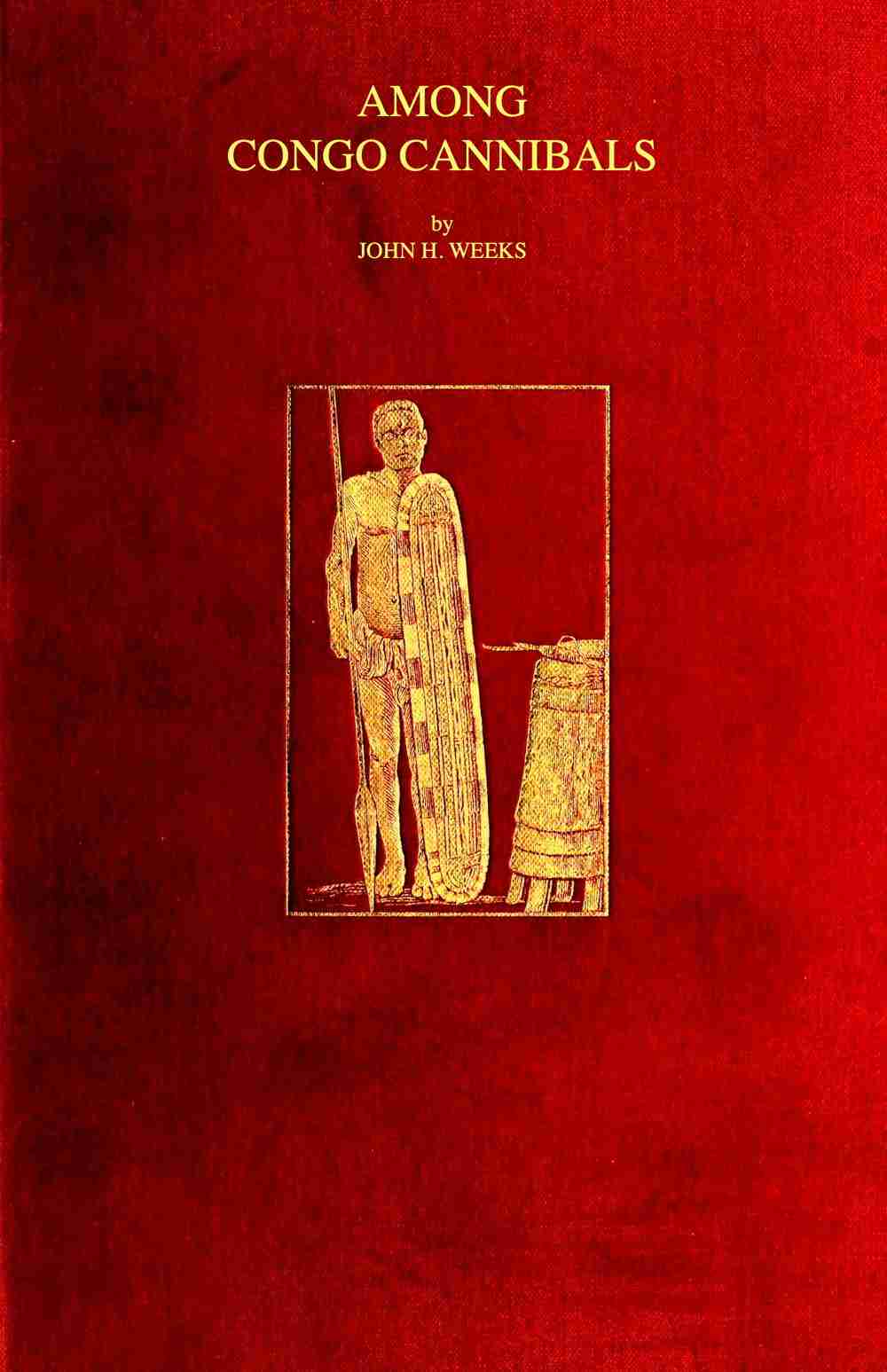
A Boloki Shield
The man is a Monsembe slave of the Mongo tribe. The shield is strongly plaited of dyed grasses and ornamented round the edge with skins. It is used more for deflecting spears than for receiving them. At the back is a wooden plate about half the length and width of the shield, to which the basket-work is laced.
I never knew them to make a night attack. They would often lie in ambush and capture, if possible, those who fell into the trap, and kill those who tried to escape. Attacks were often made in the early morning, soon after three o’clock. No scouts were employed, but when necessary sentries were placed, and when they became sleepy they aroused two of their comrades to take their places. The fighting was not worthy of the name of a battle, but was simply an affray, a mêlée, in which there was no order and no words of command. No truce was allowed, but when one side was tired of the fight, or was getting the worst of it, they sent for a go-between (molekaleku) to arrange a meeting and the terms upon which blood-brotherhood could be made.
A man of conspicuous bravery who kills a man in a fight receives congratulatory presents, and at drinking-bouts the first mug of sugar-cane wine is served to him as long as he retains such pre-eminence, and he has no difficulty in procuring volunteers to aid him in any of his personal quarrels. When a man kills his opponent in a fight he cuts off his head and removes his lips, which latter he thoroughly dries in the sun, and then sticks them over with brass chair nails and wears them as an ornament with as much pride as a decoration is worn by the civilized soldier—it is the man’s medal for bravery. The skull of the slain man is put at the base of a palm, or other tree just outside the victor’s house, and when the victor dies the spirit of the conquered and slain man is called upon to do service to the spirit of the conqueror in longa, or the spirit-world.
The Boloki when attacking a town will often divide into two parties, and while one division attacks the place in front by water, the other makes a detour over land and attacks the rear. When chasing the enemy they throw their light, thin, fighting spears in the air, and these, turning, come down head first and pierce the shoulders, and I have known some to enter the top of the arm and come out at the elbow. For warding off spears they use grass-plaited shields, fine-woven cotton belts wound round and round the waist, and some have cuirasses of hippopotamus hide to cover the back. The cuirass fastens in front, and at the fastening there is generally a dagger in a sheath, which is easily drawn. There are a few flint-lock trade guns among them, but they rely on their light, thin spears and knives of various lengths and shapes. Lads who cannot obtain spears use sticks with sharpened points that have been hardened in the fire, and with these they harass the enemy. When fighting they wear skin hats, more as a protection against cuts than for ornament; and the whole face is blackened with a thick paste of oil and soot, or oil and burnt ground nuts, and the eyes are surrounded with circles of chalk or white clay. This is to disguise them from their enemies. The Boloki, among the Congo people, are acknowledged to be the fiercest and the bravest in a fight, and are greatly feared by the other tribes.
Prisoners taken are held to ransom, and if not ransomed they are retained, sold, or killed, according to the whim of the captor. The first prisoner taken by a man is given, as a first-fruit, to the man’s father, or, failing him, to his nearest relative. Women very often become the wives of their captors. Prisoners captured in war belong to their captors, and the same applies to all kinds of spoils. The bodies of enemies are carried when possible from the “field” and eaten at a general feast. If the prisoners are not redeemed they become slaves, and while the young ones amalgamate with their conquerors, and often become a part of the families of their owners, the elder ones who have their own tribal marks well defined never take other than a servile position in the towns of their masters.
The chief cause of quarrels and fights on the Congo is about women, and although the ostensible reason may be a drunken row or a debt, yet if you push the matter to its real origin you will in nine cases out of ten find a woman at the bottom of it. Directly after blood-brotherhood is made all is friendly so far as seeming outward appearances may show; but I know from experience that the conquered are only awaiting their opportunity of revenge.
A Boloki Method of Beheading
The victim here lies on the ground with a plantain stem under the neck. This plantain stem supports the neck for a clean cut through, but does not damage the edge of the knife.
There are certain omens that demand careful attention during war time. To some, if a snake during war goes in front towards the enemy it is a sign that success will attend their undertaking, but if the snake comes towards them the omen is against them. To others, if the muntontwa (a small active bird with a long beak) flies towards the enemy the omen is in their favour, but if it comes from the direction of the enemy it is not to be disregarded or some calamity will surely overtake them. To most natives it will be a bad sign if a man kicks his foot against anything in the road. Sometimes the stronger-minded ones laugh away the fears of those who are inclined to turn back if the omens are against them; but it more frequently happens that they turn en masse, probably glad to postpone the fight.
After a fight, in which some of the enemy are killed, only the men meet to engage in the bonkani dance. The men dance with their spears and knives, and any goats, sheep, dogs, or fowls that approach the dancers are instantly speared, cooked, and eaten. As a man beats the drum one after another of the dancers advances, and in a solo tells of his exploits during the late fight, which exploits are more often in the imagination than on the field of battle; but they vie with one another in “drawing the long bow” on such occasions.
At times they use the following divination to ascertain the results of a proposed fight: A saucepan of marsh or forest water is procured and some “medicine” is put into it. The saucepan is placed on the fire, to which none but the operators have access, and then, after due time, they say to this likato (saucepan of water with “medicine” in it), “Will they kill us in the fight?” If the water boils up and fills the saucepan, then it is an omen that some of them will be killed, so they abandon the war; but if the water keeps low they ask, “Shall we kill some of them in the fight?” Then if the water rises in the saucepan it is an omen that some of the enemy will be killed, and the war is prosecuted; but if the water does not boil over it indicates that they will not kill any of the enemy, consequently the proposed fight is dropped. This test is applied several times before it is considered satisfactory.
I have seen natives fight both on the Lower and Upper Congo. On the Lower Congo flint-lock guns are used, and do almost as much harm to the firer as to the one fired at. Through being so flimsily made a heavy charge of gunpowder will often cause the old gas-pipe barrels to explode, and a large number of our hospital accidents are from guns bursting in hunting and fighting. The firer holds the butt of his gun against the palm of his right hand, consequently when the gun jerks in firing, the bullet goes anywhere but at the object aimed at unless that object is very near. I have known over two hundred men fire at about thirty for a whole day and only one man was wounded in the ankle by a spent slug. Their guns will not carry far, and they stand at long distances from one another and fire.
On the other hand, the Boloki, relying as he does on his fighting spear, runs in to throw it, and many wounds are inflicted in a very short time. On the Lower Congo a person is seldom killed in a fight with guns; but among the Boloki there is never a fight between town and town without several deaths.