
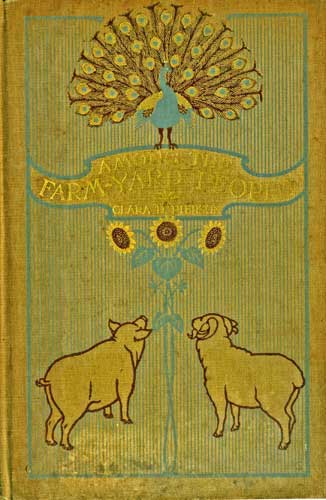
The Project Gutenberg eBook of Among the Farmyard People
Title: Among the Farmyard People
Author: Clara Dillingham Pierson
Illustrator: F. C. Gordon
Release date: September 26, 2006 [eBook #19381]
Language: English
Credits: Produced by David Newman, Chuck Greif, Janet Blenkinship
and the Online Distributed Proofreading Team at
http://www.pgdp.net
Among the Farmyard People
BY
Clara Dillingham Pierson
Author of "Among the Meadow People," and "Forest People"
Illustrated by F. C. GORDON
NEW YORK
Copyright by
E. P. DUTTON AND COMPANY
31 WEST TWENTY-THIRD STREET
1899
TO THE CHILDREN
Dear Little Friends:
I want to introduce the farmyard people to you, and to have you call upon them and become better acquainted as soon as you can. Some of them are working for us, and we surely should know them. Perhaps, too, some of us are working for them, since that is the way in this delightful world of ours, and one of the happiest parts of life is helping and being helped.
It is so in the farmyard, and although there is not much work that the people there can do for each other, there are many kind things to be said, and even the Lame Duckling found that he could make the Blind Horse happy when he tried. It is there as it is everywhere else, and I sometimes think that although the farmyard people do not look like us or talk like us, they are not so very different after all. If you had seen the little Chicken who wouldn't eat gravel when his mother was reproving him, you could not have helped knowing his thoughts even if you did not understand a word of the Chicken language. He was thinking, "I don't care! I don't care a bit! So now!" That was long since, for he was a Chicken when I was a little girl, and both of us grew up some time ago. I think I have always been more sorry for him because when he was learning to eat gravel I was learning to eat some things which I did not like; and so, you see, I knew exactly how he felt. But it was not until afterwards that I found out how his mother felt.
That is one of the stories which I have been keeping a long time for you, and the Chicken was a particular friend of mine. I knew him better than I did some of his neighbors; yet they were all pleasant acquaintances, and if I did not see some of these things happen with my own eyes, it is just because I was not in the farmyard at the right time. There are many other tales I should like to tell you about them, but one mustn't make the book too fat and heavy for your hands to hold, so I will send you these and keep the rest.
Many stories might be told about our neighbors who live out-of-doors, and they are stories that ought to be told, too, for there are still boys and girls who do not know that animals think and talk and work, and love their babies, and help each other when in trouble. I knew one boy who really thought it was not wrong to steal newly built birds'-nests, and I have seen girls—quite large ones, too—who were afraid of Mice! It was only last winter that a Quail came to my front door, during the very cold weather, and snuggled down into the warmest corner he could find. I fed him, and he stayed there for several days, and I know, and you know, perfectly well that although he did not say it in so many words, he came to remind me that I had not yet told you a Quail story. And two of my little neighbors brought ten Polliwogs to spend the day with me, so I promised then and there that the next book should be about pond people and have a Polliwog story in it.
And now, good-bye! Perhaps some of you will write me about your visits to the farmyard. I hope you will enjoy them very much, but be sure you don't wear red dresses or caps when you call on the Turkey Gobbler.
Your friend,
Clara Dillingham Pierson.
Stanton, Michigan,
March 28, 1899.
CONTENTS
| PAGE | |
| THE STORY THAT THE SWALLOW DIDN'T TELL | 1 |
| THE LAMB WITH THE LONGEST TAIL | 12 |
| THE WONDERFUL SHINY EGG | 20 |
| THE DUCKLING WHO DIDN'T KNOW WHAT TO DO | 33 |
| THE FUSSY QUEEN BEE | 47 |
| THE BAY COLT LEARNS TO MIND | 64 |
| THE TWIN LAMBS | 82 |
| THE VERY SHORT STORY OF THE FOOLISH LITTLE MOUSE | 96 |
| THE LONELY LITTLE PIG | 106 |
| THE KITTEN WHO LOST HERSELF | 116 |
| THE CHICKEN WHO WOULDN'T EAT GRAVEL | 136 |
| THE GOOSE WHO WANTED HER OWN WAY | 149 |
| WHY THE SHEEP RAN AWAY | 160 |
| THE FINE YOUNG RAT AND THE TRAP | 172 |
| THE QUICK-TEMPERED TURKEY GOBBLER | 186 |
| THE BRAGGING PEACOCK | 199 |
| THE DISCONTENTED GUINEA HEN | 213 |
| THE OXEN TALK WITH THE CALVES | 232 |
ILLUSTRATIONS
| PAGE | |
| THE SWALLOWS ARE COMING | 2 |
| THE LAMB WITH THE LONGEST TAIL | 16 |
| THEY HAD A GOOD SWIM | 40 |
| HAD A SORE MOUTH FROM JERKING ON THE LINES | 77 |
| FEEDING THE LAMBS | 84 |
| EVERY BROWN PIG RAN OFF | 110 |
| "I AM THE WHITE KITTEN" | 130 |
| THE GRAY GOOSE TRIED TO GO THROUGH | 156 |
| COLLIE AND THE BELL-WETHER | 170 |
| THE BIG GOBBLER CAME PUFFING TOWARD HER. | Frontispiece 194 |
| THE PEACOCK WAS STANDING ON THE FENCE, | 208 |
| THE RED CALF AND THE WHITE CALF | 243 |
THE STORY THAT THE SWALLOW DIDN'T TELL
"Listen!" said the Nigh Ox, "don't you hear some friends coming?"
The Off Ox raised his head from the grass and stopped to brush away a Fly, for you never could hurry either of the brothers. "I don't hear any footfalls," said he.
"You should listen for wings, not feet," said the Nigh Ox, "and for voices, too."
Even as he spoke there floated down from the clear air overhead a soft "tittle-ittle-ittle-ee," as though some bird were laughing for happiness. There was not a cloud in the sky, and the meadow was covered with thousands and thousands of green grass blades, each so small and tender, and yet together making a most beautiful carpet for the feet of the farmyard people, and offering them sweet and juicy food after their winter fare of hay and grain. Truly it was a day to make one laugh aloud for joy. The alder tassels fluttered and danced in the spring breeze, while the smallest and shyest of the willow pussies crept from their little brown houses on the branches to grow in the sunshine.
THE SWALLOWS ARE COMING.
"Tittle-ittle-ittle-ee! Tittle-ittle-ittle-ee!" And this time it was louder and clearer than before.
"The Swallows!" cried the Oxen to each other. Then they straightened their strong necks and bellowed to the Horses, who were drawing the plow in the field beyond, "The Swallows are coming!"
As soon as the Horses reached the end of the furrow and could rest a minute, they tossed their heads and whinnied with delight. Then they looked around at the farmer, and wished that he knew enough of the farmyard language to understand what they wanted to tell him. They knew he would be glad to hear of their friends' return, for had they not seen him pick up a young Swallow one day and put him in a safer place?
"Tittle-ittle-ittle-ee!" and there was a sudden darkening of the sky above their heads, a whirr of many wings, a chattering and laughing of soft voices, and the Swallows had come. Perched on the ridge-pole of the big barn, they rested and visited and heard all the news.
The Doves were there, walking up and down the sloping sides of the roof and cooing to each other about the simple things of every-day life. You know the Doves stay at home all winter, and so it makes a great change when their neighbors, the Swallows, return. They are firm friends in spite of their very different ways of living. There was never a Dove who would be a Swallow if he could, yet the plump, quiet, gray and white Doves dearly love the dashing Swallows, and happy is the Squab who can get a Swallow to tell him stories of the great world.
"Isn't it good to be home, home, home!" sang one Swallow. "I never set my claws on another ridge-pole as comfortable as this."
"I'm going to look at my old nest," said a young Swallow, as she suddenly flew down to the eaves.
"I think I'll go, too," said another young Swallow, springing away from his perch. He was a handsome fellow, with a glistening dark blue head and back, a long forked tail which showed a white stripe on the under side, a rich buff vest, and a deep blue collar, all of the finest feathers. He loved the young Swallow whom he was following, and he wanted to tell her so.
"There is the nest where I was hatched," she said. "Would you think I was ever crowded in there with five brothers and sisters? It was a comfortable nest, too, before the winter winds and snow wore it away. I wonder how it would seem to be a fledgling again?" She snuggled down in the old nest until he could see only her forked tail and her dainty head over the edge. Her vest was quite hidden, and the only light feathers that showed were the reddish-buff ones on throat and face; these were not so bright as his, but still she was beautiful to him. He loved every feather on her body.
"I don't want you to be a fledgling again," he cried. "I want you to help me make a home under the eaves, a lovely little nest of mud and straw, where you can rest as you are now doing, while I bring food to you. Will you?"
"Yes," she cried. "Tittle-ittle-ittle-ee! Oh, tittle-ittle-ittle-ee!" And she flew far up into the blue sky, while he followed her, twittering and singing.
"Where are those young people going?" said an older Swallow. "I should think they had flown far enough for to-day without circling around for the fun of it."
"Don't you remember the days when you were young?" said the Swallow next to him.
"When I was young?" he answered. "My dear, I am young now. I shall always be young in the springtime. I shall never be old except when I am moulting."
Just then a family of Doves came pattering over the roof, swaying their heads at every step. "We are so glad to see you back," said the father. "We had a long, cold winter, and we thought often of you."
"A very cold winter," cooed his plump little wife.
"Tell me a story," said a young Dove, their son.
"Hush, hush," said the Father Dove. "This is our son," he added, "and this is his sister. We think them quite a pair. Our last brood, you know."
"Tell us a story," said the young Dove again.
"Hush, dear. You mustn't tease the Swallow," said his mother. "They are so fond of stories," she cooed, "and they have heard that your family are great travellers."
"But I want him to tell us a story," said the young Dove. "I think he might."
This made the Swallow feel very uncomfortable, for he could see that the children had been badly brought up, and he did not want to tell a story just then.
"Perhaps you would like to hear about our journey south," said he. "Last fall, when the maples began to show red and yellow leaves among the green, we felt like flying away. It was quite warm weather, and the forest birds were still here, but when we feel like flying south we always begin to get ready."
"I never feel like flying south," said the young Dove. "I don't see why you should."
"That is because I am a Swallow and you are a farmyard Dove. We talked about it to each other, and one day we were ready to start. We all had on our new feathers and felt strong and well. We started out together, but the young birds and their mothers could not keep up with the rest, so we went on ahead."
"Ahead of whom?" said the young Dove, who had been preening his feathers when he should have been listening.
"Ahead of the mothers and their fledglings. We flew over farms where there were Doves like you; over rivers where the Wild Ducks were feeding by the shore; and over towns where crowds of boys and girls were going into large buildings, while on top of these buildings were large bells singing, 'Ding dong, ding dong, ding dong.'"
"I don't think that was a very pretty song," said the young Dove.
"Hush," said his mother, "you mustn't interrupt the Swallow."
"And at last we came to a great lake," said the Swallow. "It was so great that when we had flown over it for a little while we could not see land at all, and our eyes would not tell us which way to go. We just went on as birds must in such places, flying as we felt we ought, and not stopping to ask why or to wonder if we were right. Of course we Swallows never stop to eat, for we catch our food as we fly, but we did sometimes stop to rest. Just after we had crossed this great lake we alighted. It was then that a very queer thing happened, and this is really the story that I started to tell."
"Oh!" said the young Dove and his sister. "How very exciting. But wait just a minute while we peep over the edge of the roof and see what the farmer is doing." And before anybody could say a word they had pattered away to look.
The birds who were there say that the Swallow seemed quite disgusted, and surely nobody could blame him if he did.
"You must excuse them," cooed their mother. "They are really hardly more than Squabs yet, and I can't bear to speak severely to them. I'm sure they didn't mean to be rude."
"Certainly, certainly," said the Swallow. "I will excuse them and you must excuse me. I wish to see a few of my old friends before the sun goes down. Good afternoon!" And he darted away.
The young Doves came pattering back, swaying their heads as they walked. "Why, where is the Swallow?" they cried. "What made him go away? Right at the best part of the story, too. We don't see why folks are so disagreeable. People never are as nice to us as they are to the other young Doves."
"Hush," said their mother. "You mustn't talk in that way. Fly off for something to eat, and never mind about the rest of the story."
When they were gone, she said to her husband, "I wonder if they did hurt the Swallow's feelings? But then, they are so young, hardly more than Squabs."
She forgot that even Squabs should be thoughtful of others, and that no Dove ever amounts to anything unless he begins in the right way as a Squab.
THE LAMB WITH THE LONGEST TAIL
The Sheep are a simple and kind-hearted family, and of all the people on the farm there are none who are more loved than they. All summer they wander in the fields, nibbling the fresh, sweet grass, and resting at noon in the shadow of the trees, but when the cold weather comes they are brought up to the farmyard and make their home in the long low Sheep-shed.
That is always a happy time. The Horses breathe deeply and toss their heads for joy, the Cows say to each other, "Glad to have the Sheep come up," and even the Oxen shift their cuds and look long over their shoulders at the woolly newcomers. And this is not because the Sheep can do anything for their neighbors to make them warm or to feed them. It is only because they are a gentle folk and pleasant in all they say; and you know when people are always kind, it makes others happy just to see them and have them near.
Then, when the cold March winds are blowing, the good farmer brings more yellow straw into the Sheep-shed, and sees that it is warm and snug. If there are any boards broken and letting the wind in, he mends them and shuts out the cold. At this time, too, the Horses and Cattle stop often in their eating to listen. Even the Pigs, who do not think much about their neighbors, root in the corners nearest the Sheep-shed and prick up their ears.
Some bleak morning they hear a faint bleating and know that the first Lamb is there. And then from day to day they hear more of the soft voices as the new Lambs come to live with the flock. Such queer little creatures as the Lambs are when they first come—so weak and awkward! They can hardly stand alone, and stagger and wobble around the little rooms or pens where they are with their mothers. You can just imagine how hard it must be to learn to manage four legs all at once!
There is one thing which they do learn very quickly, and that is, to eat. They are hungry little people, and well they may be, for they have much growing to do, and all of the food that is to be made into good stout bodies and fine long wool has to go into their mouths and down their throats to their stomachs. It is very wonderful to think that a Cow eats grass and it is turned into hair to keep her warm, a Goose eats grass and grows feathers, and a Sheep eats grass and grows wool. Still, it is so, and nobody in the world can tell why. It is just one of the things that are, and if you should ask "Why?" nobody could tell you the reason. There are many such things which we cannot understand, but there are many more which we can, so it would be very foolish for us to mind when there is no answer to our "Why?"
Yes, Sheep eat grass, and because they have such tiny mouths they have to take small mouthfuls. The Lambs have different food for a while,—warm milk from their mothers' bodies. When a mother has a Lamb to feed, she eats a great deal, hay, grass, and chopped turnips, and then part of the food that goes into her stomach is turned into milk and stored in two warm bags for the Lamb to take when he is hungry. And how the Lambs do like this milk! It tastes so good that they can hardly stand still while they drink it down, and they give funny little jerks and wave their woolly tails in the air.
THE LAMB WITH THE LONGEST TAIL.
There was one Lamb who had a longer tail than any of the rest, and, sad to say, it made him rather vain. When he first came, he was too busy drinking milk and learning to walk, to think about tails, but as he grew older and stronger he began to know that he had the longest one. Because he was a very young Lamb he was so foolish as to tease the others and call out, "Baa! your tails are snippy ones!"
Then the others would call back, "Baa! Don't care if they are!"
After a while, his mother, who was a sensible Sheep and had seen much of life, said to him: "You must not brag about your tail. It is very rude of you, and very silly too, for you have exactly such a tail as was given to you, and the other Lambs have exactly such tails as were given to them, and when you are older you will know that it did not matter in the least what kind of tail you wore when you were little." She might have told him something else, but she didn't.
The Lamb didn't dare to boast of his tail after this, but when he passed the others, he would look at his mother, and if he thought she wouldn't see, he would wiggle it at them. Of course that was just as bad as talking about it, and the other Lambs knew perfectly well what he meant; still, they pretended not to understand.
One morning, when his mother's back was turned, he was surprised to see that she had only a short and stumpy tail. He had been thinking so much of his own that he had not noticed hers. "Mother," he cried, "why didn't you have a long tail too?"
"I did have once," she answered with a sheepish smile.
"Did it get broken?" he asked in a faint little voice. He was thinking how dreadful it would be if he should break his.
"Not exactly," said his mother. "I will tell you all about it. All little Lambs have long tails——"
"Not so long as mine, though," said he, interrupting.
"No, not so long as yours," she replied, "but so long that if they were left that way always they would make a great deal of trouble. As the wool grows on them, they would catch burrs and sharp, prickly things, which would pull the wool and sting the skin. The farmer knows this, so when the little Lambs are about as old as you are now, he and his men make their tails shorter."
"Oh!" cried the Lamb, curling his tail in as far between his legs as he could, "do you mean that they will shorten my tail, my beautiful long tail?"
"That is just what I mean," said his mother, "and you should be very glad of it. When that is done, you will be ready to go out into the field with me. A lot of trouble we should have if the men did not look after such things for us; but that is what men are for, they say,—to look after us Sheep."
"But won't they laugh at me when my tail is shorter?" asked her son.
"They would laugh at you if you wore it long. No Lamb who pretends to be anybody would be seen in the pasture with a dangling tail. Only wild Sheep wear them long, poor things!"
Now the little Lamb wished that he had not boasted so much. Now, when the others passed him, he did not put on airs. Now he wondered why they couldn't have short tails in the beginning. He asked his uncle, an old Wether Sheep, why this was and his uncle laughed. "Why, what would you have done all these days if things happened in that way? What would you have had to think about? What could you have talked about?" The little Lamb hung his head and asked no more questions.
"What do you think?" he called to a group of Lambs near by. "I'm going to have one of the men shorten my tail. It is such a bother unless one does have it done, and mine is so very long!"
THE WONDERFUL SHINY EGG
"CUT-CUT-CA-DAH-CUT! Cut-cut-cut-ca-dah-cut!" called the Dorking Hen, as she strutted around the poultry-yard. She held her head very high, and paused every few minutes to look around in her jerky way and see whether the other fowls were listening. Once she even stood on her left foot right in the pathway of the Shanghai Cock, and cackled into his very ears.
Everybody pretended not to hear her. The people in the poultry-yard did not like the Dorking Hen very well. They said that she put on airs. Perhaps she did. She certainly talked a great deal of the place from which she and the Dorking Cock came. They had come in a small cage from a large poultry farm, and the Dorking Hen never tired of telling about the wonderful, noisy ride that they took in a dark car drawn by a great, black, snorting creature. She said that this creature's feet grew on to his sides and whirled around as he ran, and that he breathed out of the top of his head. When the fowls first heard of this, they were much interested, but after a while they used to walk away from her, or make believe that they saw Grasshoppers whom they wanted to chase.
When she found that people were not listening to her, she cackled louder than ever, "Cut-cut-ca-dah-cut! Look at the egg—the egg—the egg—the egg that I have laid."
"Is there any particular reason why we should look at the egg—the egg—the egg—the egg that you have laid?" asked the Shanghai Cock, who was the grumpiest fowl in the yard.
Now, usually if the Dorking Hen had been spoken to in this way, she would have ruffled up her head feathers and walked away, but this time she had news to tell and so she kept her temper. "Reason?" she cackled. "Yes indeed! It is the finest egg that was ever laid in this poultry-yard."
"Hear her talk!" said a Bantam Hen. "I think it is in very poor taste to lay such large eggs as most of the Hens do here. Small ones are much more genteel."
"She must forget an egg that I laid a while ago with two yolks," said a Shanghai Hen. "That was the largest egg ever laid here, and I have always wished that I had hatched it. A pair of twin chickens would have been so interesting."
"Well," said the Dorking Hen, who could not keep still any longer, "small eggs may be genteel and large ones may be interesting, but my last one is bee-autiful."
"Perhaps you'd just as soon tell us about it as to brag without telling?" grumbled the Shanghai Cock. "I suppose it is grass color, or sky color, or hay color, or speckled, like a sparrow's egg."
"No," answered the Dorking Hen, "it is white, but it is shiny."
"Shiny!" they exclaimed. "Who ever heard of a shiny egg?"
"Nobody," she replied, "and that is why it is so wonderful."
"Don't believe it," said the Shanghai Cock, as he turned away and began scratching the ground.
Now the Dorking Hen did get angry. "Come to see it, if you don't believe me," she said, as she led the others into the Hen-house.
She flew up to the row of boxes where the Hens had their nests, and picked her way along daintily until she reached the farthest one. "Now look," said she.
One by one the fowls peeped into the box, and sure enough, there it lay, a fine, shiny, white egg. The little Bantam, who was really a jolly, kind-hearted creature, said, "Well, it is a beauty. I should be proud of it myself."
"It is whiter than I fancy," said the Shanghai Cock, "but it certainly does shine."
"I shall hatch it," said the Dorking Hen, very decidedly. "I shall hatch it and have a beautiful Chicken with shining feathers. I shall not hatch all the eggs in the nest, but roll this one away and sit on it."
"Perhaps," said one of her friends, "somebody else may have laid it after all, and not noticed. You know it is not the only one in the nest."
"Pooh!" said the Dorking Hen. "I guess I know! I am sure it was not there when I went to the nest and it was there when I left. I must have laid it."
The fowls went away, and she tried to roll the shiny one away from the other eggs, but it was slippery and very light and would not stay where she put it. Then she got out of patience and rolled all the others out of the nest. Two of them fell to the floor and broke, but she did not care. "They are nothing but common ones, anyway," she said.
When the farmer's wife came to gather the eggs she pecked at her and was very cross. Every day she did this, and at last the woman let her alone. Every-day she told the other fowls what a wonderful Chicken she expected to have. "Of course he will be of my color," said she, "but his feathers will shine brightly. He will be a great flyer, too. I am sure that is what it means when the egg is light." She came off the nest each day just long enough to stroll around and chat with her friends, telling them what wonderful things she expected, and never letting them forget that it was she who had laid the shiny egg. She pecked airily at the food, and seemed to think that a Hen who was hatching such a wonderful Chicken should have the best of everything. Each day she told some new beauty that was to belong to her child, until the Shanghai Cock fairly flapped his wings with impatience.
Day after day passed, and the garden beyond the barn showed rows of sturdy green plants, where before there had been only straight ridges of fine brown earth. The Swallows who were building under the eaves of the great barn, twittered and chattered of the wild flowers in the forest, and four other Hens came off their nests with fine broods of downy Chickens. And still the Dorking Hen sat on her shiny egg and told what a wonderful Chicken she expected to hatch. This was not the only egg in the nest now, but it was the only one of which she spoke.
At last a downy Chicken peeped out of one of the common eggs, and wriggled and twisted to free himself from the shell. His mother did not hurry him or help him. She knew that he must not slip out of it until all the blood from the shell-lining had run into his tender little body. If she had pushed the shell off before he had all of this fine red blood, he would not have been a strong Chicken, and she wanted her children to be strong.
The Dorking Cock walked into the Hen-house and stood around on one foot. He came to see if the shiny egg had hatched, but he wouldn't ask. He thought himself too dignified to show any interest in newly hatched Chickens before a Hen. Still, he saw no harm in standing around on one foot and letting the Dorking Hen talk to him if she wanted to. When she told him it was one of the common eggs that had hatched, he was quite disgusted, and stalked out of doors without a word.
The truth was that he had been rather bragging to the other Cocks, and only a few minutes later he spoke with pride of the time when "our" shiny egg should hatch. "For," he said, "Mrs. Dorking and I have been quite alone here as far as our own people are concerned. It is not strange that we should feel a great pride in the wonderful egg and the Chicken to be hatched from it. A Dorking is a Dorking after all, my friends." And he flapped his wings, stretched his neck, and crowed as loudly as he could.
"Yes," said the Black Spanish Cock afterward, "a Dorking certainly is a Dorking, although I never could see the sense of making such a fuss about it. They are fat and they have an extra toe on each foot. Why should a fowl want extra toes? I have four on each foot, and I can scratch up all the food I want with them."
"Well," said the grumpy old Shanghai Cock, "I am sick and tired of this fuss. Common eggs are good enough for Shanghais and Black Spanish and Bantams, and I should think——"
Just at this minute they heard a loud fluttering and squawking in the Hen-house and the Dorking Hen crying, "Weasel! Weasel!" The Cocks ran to drive the Weasel away, and the Hens followed to see it done. All was noise and hurry, and they saw nothing of the Weasel except the tip of his bushy tail as he drew his slender body through an opening in the fence.
The Dorking Hen was on one of the long perches where the fowls roost at night, the newly hatched Chicken lay shivering in the nest, and on the floor were the pieces of the wonderful shiny egg. The Dorking Hen had knocked it from the nest in her flight.
The Dorking Cock looked very cross. He was not afraid of a Weasel, and he did not see why she should be. "Just like a Hen!" he said.
The Black Spanish Hen turned to him before he could say another word. "Just like a Cock!" she exclaimed. "I never raise Chickens myself. It is not the custom among the Black Spanish Hens. We lay the eggs and somebody else hatches them. But if I had been on the nest as long as Mrs. Dorking has, do you suppose I'd let any fowl speak to me as you spoke to her? I'd—I'd—" and she was so angry that she couldn't say another word, but just strutted up and down and cackled.
A motherly old Shanghai Hen flew up beside Mrs. Dorking. "We are very sorry for you," she said. "I know how I should have felt if I had broken my two-yolked egg just as it was ready to hatch."
The Bantam Hen picked her way to the nest. "What a dear little Chicken!" she cried, in her most comforting tone. "He is so plump and so bright for his age. But, my dear, he is chilly, and I think you should cuddle him under your wings until his down is dry."
The Dorking Hen flew down. "He is a dear," she said, "and yet when he was hatched I didn't care much for him, because I had thought so long about the shiny egg. It serves me right to lose that one, because I have been so foolish. Still, I do not know how I could stand it if it were not for my good neighbors."
While Mrs. Dorking was talking with the Bantam by her nest, the Black Spanish Hen scratched a hole in the earth under the perches, poked the pieces of the shiny egg into it, and covered them up. "I never raise Chickens myself," she said, "but if I did——"
The Shanghai Cock walked away with the Dorking Cock. "I'm sorry for you," he said, "and I am more sorry for Mrs. Dorking. She is too fine a Hen to be spoken to as you spoke to her this morning, and I don't want to hear any more of your fault-finding. Do you understand?" And he ruffled his neck feathers and stuck his face close to that of the Dorking Cock. They stared into each other's eyes for a minute; then the Dorking Cock, who was not so big and strong as the Shanghai, shook his head and answered sweetly, "It was rude of me. I won't do it again."
From that day to this, nobody in the poultry yard has ever spoken of the shiny egg, and the Dorkings are much liked by the other fowls. Yet if it had not been for her trouble, Mrs. Dorking and her neighbors would never have become such good friends. The little Dorkings are fine, fat-breasted Chicks, with the extra toe on each foot of which all that family are so proud.
THE DUCKLING WHO DIDN'T KNOW WHAT TO DO
"Quack! Quack!" called the Duck who had been sitting on her nest so long. "My first egg is cracked, and I can see the broad yellow bill of my eldest child. Ah! Now I can see his downy white head." The Drake heard her and quacked the news to every one around, and flapped his wings, and preened his feathers, for was not this the first Duckling ever hatched on the farm?
The Drake had not been there long himself. It was only a few days before the Duck began sitting that she and her five sisters had come with him to this place. It had not taken them long to become acquainted with the other farmyard people, and all had been kind to them. The Geese had rather put on airs, at first, because they were bigger and had longer legs, but the Ducks and Drake were too wise to notice this in any way, and before long the Geese were as friendly as possible. They would have shown the Ducks the way to the water if it had been necessary, but it was not, for Ducks always know without being told just where to find it. They know, and they do not know why they know. It is one of the things that are.
Now that the first Duckling had chipped the shell, everybody wanted to see him, and there was soon a crowd of fowls around the nest watching him free himself from it. The Drake stood by, as proud as a Peacock. "I think he looks much like his mother," said he.
"Yes, yes," cackled all the Hens. "The same broad yellow bill, the same short yellow legs, and the same webbed feet."
The mother Duck smiled. "He looks more like me now than he will by and by," she said, "for when his feathers grow and cover the down, he will have a stiff little one curled up on his back like the Drake's. And really, except for the curled feather, his father and I look very much alike."
"That is so," said the Black Spanish Cock. "You do look alike; the same white feathers, the same broad breast, the same strong wings, the same pointed tail, the same long neck, the same sweet expression around the bill!" That was just like the Black Spanish Cock. He always said something pleasant about people when he could, and it was much better than saying unpleasant things. Indeed, he was the most polite fowl in the poultry-yard, and the Black Spanish Hen thought his manners quite perfect.
Then the Duckling's five aunts pushed their way through the crowd to the nest under the edge of the strawstack. "Have you noticed what fine large feet he has?" said one of them. "That is like his mother's people. See what a strong web is between the three long toes on each foot! He will be a good swimmer. The one toe that points backward is small, to be sure, but he does not need that in swimming. That is only to make waddling easier."
"Yes, yes," "A fine web," and "Very large feet," cried the fowls around the nest, but most of them didn't care so much about the size of his feet as the Ducks did. Large feet are always useful, you know, yet nobody needs them so badly as Geese and Ducks. The Geese were off swimming, and so could not see the Duckling when first he came out of the shell.
"Tap-tap, tap-tap," sounded inside another shell, and they knew that there would soon be a second damp little Duckling beside the first. The visitors could not stay to see this one come out, and they went away for a time. The eldest Duckling had supposed that this was life, to have people around saying, "How bright he is!" "What fine legs!" or "He has a beautiful bill!" And now that they all walked away and his mother was looking after the Duckling who was just breaking her shell, he didn't like it—he didn't like it at all.
Still, it was much better so. If he had had no brothers and sisters, he would have been a lonely little fellow; besides, he would have had his own way nearly all the time, and that is likely to make any Duckling selfish. Then, too, if all the other fowls had petted him and given him the best of everything, he would have become vain. Truly, it was a good thing for him not to be the only child, and he soon learned to think so.
After there were two Ducklings, a third one came, and a fourth, and a fifth, and so on until, when the broken shells were cleared away and the mother had counted bills, she could call to the Drake and her sisters, "Nine Ducklings hatched, and there were only nine eggs in the nest."
"Then come to the brook," said the Drake, "and let the children have a bath. I have been swimming a great many times to-day, and they have not even set foot in water yet. Why, our eldest son was out of his shell before the Horses were harnessed this morning, and here it is nearly time for their supper."
"I couldn't help it," said the mother Duck. "I couldn't leave the nest to take him swimming until the rest were ready to go. I am doing the best I can."
"I didn't mean to find fault," said the Drake, "and I suppose you couldn't get away, but we know that Ducklings should be taught to bathe often, and there is nothing like beginning in time."
"I might have taken some of them to the brook," said one of the aunts. The mother straightened her neck and held her head very high, while she answered, "You? You are very kind, but what do you know about bringing up Ducklings?"
Now the aunt might have said, "I know just as much as you do," for it was the young mother's first brood, yet she kept still. She thought, "I may hatch Ducklings of my own some day, and then I suppose I shall want to care for them myself."
"Wait," said the Drake, as they reached the brook. "Let us wait and see what the children will do." The words were hardly out of his bill when—flutter—splash—splash!—there were nine yellow-white Ducklings floating on the brook and murmuring happily to each other as though they had never done anything else.
The Dorking Cock stood on the bank. "Who taught them to swim?" said he.
"Nobody," answered their mother proudly. "They knew without being told. That is the way a Duck takes to water." And she gave a dainty lurch and was among her brood.