
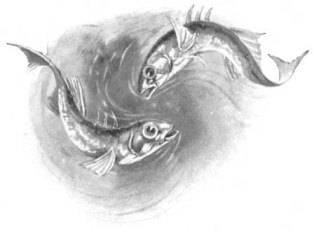
THE DRAGON-FLY CHILDREN AND THE SNAPPING TURTLE
The Dragon-Flies have always lived near the pond. Not the same ones that are there now, of course, but the great-great-great-grandfathers of these. A person would think that, after a family had lived so long in a place, all the neighbors would be fond of them, yet it is not so. The Dragon-Flies may be very good people—and even the Snapping Turtle says that they are—still, they are so peculiar that many of their neighbors do not like them at all. Even when they are only larvæ, or babies, they are not good playmates, for they have such a bad habit of putting everything into their mouths. Indeed, the Stickleback Father once told the little Sticklebacks that they should not stir out of the nest, unless they would promise to keep away from the young Dragon-Flies.
The Stickleback Mothers said that it was all the fault of the Dragon-Fly Mothers. "What can you expect," exclaimed one of them, "when Dragon-Fly eggs are so carelessly laid? I saw a Dragon-Fly Mother laying some only yesterday, and how do you suppose she did it? Just flew around in the sunshine and visited with her friends, and once in a while flew low enough to touch the water and drop one in. It is disgraceful!"
The Minnow Mothers did not think it was so much in the way the eggs were laid, "although," said one, "I always lay mine close together, instead of scattering them over the whole pond." They thought the trouble came from bad bringing up or no bringing up at all. Each egg, you know, when it is laid, drops to the bottom of the pond, and the children are hatched and grow up there, and do not even see their fathers and mothers.
Now most of the larvæ were turning into Nymphs, which are half-grown Dragon Flies. They had been short and plump, and now they were longer and more slender, and there were little bunches on their shoulders where the wings were growing under their skin. They had outgrown their old skins a great many times, and had to wriggle out of them to be at all comfortable. When a Dragon-Fly child became too big for his skin, he hooked the two sharp claws of each of his six feet firmly into something, unfastened his skin down the back, and wriggled out, leaving it to roll around in the water until it became just part of the mud.
Like most growing children, the Dragon-Fly larvæ and Nymphs had to eat a great deal. Their stomachs were as long as their bodies, and they were never really happy unless their stomachs were full. They always ate plain food and plenty of it, and they never ate between meals. They had breakfast from the time they awakened in the morning until the sun was high in the sky, then they had dinner until the sun was low in the sky, and supper from that time until it grew dark and they went to sleep: but never a mouthful between meals, no matter how hungry they might be. They said this was their only rule about eating, and they would keep it.
They were always slow children. You would think that, with six legs apiece and three joints in each leg, they might walk quite fast, yet they never did. When they had to, they hurried in another way by taking a long leap through the water. Of course they breathed water like their neighbors, the fishes and the Tadpoles. They did not breathe it into their mouths, or through gills, but took it in through some openings in the back part of their bodies. When they wanted to hurry, they breathed this water out so suddenly that it sent them quickly ahead.
The Snapping Turtle had called them "bothering bugs" one day when he was cross (and that was the day after he had been cross, and just before the day when he was going to be cross again), and they didn't like him and wanted to get even. They all put their queer little three-cornered heads together, and there was an ugly look in their great staring eyes.
"Horrid old thing!" said one larva. "I wish I could sting him."
"Well, you can't," said a Nymph, turning towards him so suddenly that he leaped. "You haven't any sting, and you never will have, so you just keep still." It was not at all nice in her to speak that way, but she was not well brought up, you know, and that, perhaps, is a reason why one should excuse her for talking so to her little brother. She was often impatient, and said she could never go anywhere without one of the larvæ tagging along.
"I tell you what let's do," said another Nymph. "Let's all go together to the shallow water where he suns himself, and let's all stand close to each other, and then, when he comes along, let's stick out our lips at him!"
"Both lips?" asked the larvæ.
"Well, our lower lips anyway," answered the Nymph. "Our upper lips are so small they don't matter."
"We'll do it," exclaimed all the Dragon-Fly children, and they started together to walk on the pond-bottom to the shallow water. They thought it would scare the Snapping Turtle dreadfully. They knew that whenever they stuck out their lower lips at the small fishes and bugs, they swam away as fast as they could. The Giant Water-Bug (Belostoma), was the only bug who was not afraid of them when they made faces. Indeed, the lower lip of a Dragon-Fly child might well frighten people, for it is fastened on a long, jointed, arm-like thing, and has pincers on it with which it catches and holds its food. Most of the time, the Dragon-Fly child keeps the joint bent, and so holds his lip up to his face like a mask. But sometimes he straightens the joint and holds his lip out before him, and then its pincers catch hold of things. He does this when he is hungry.
When they reached the shallow water, the Dragon-Fly children stood close together, with the larvæ in the middle and the Nymphs all around them. The Snapping Turtle was nowhere to be seen, so they had to wait. "Aren't you scared?" whispered one larva to another.
"Scared? Dah! Who's afraid," answered he.
"Oh, look!" cried a Nymph. "There go some grown-up Dragon-Flies over our heads. Just you wait until I change my skin once more, and then won't I have a good time! I'll dry my wings and then I'll——"
"Sh-h!" said one of the larvæ. "Here comes the Snapping Turtle."
Sure enough, there he came through the shallow water, his wet back-shell partly out of it and shining in the sunlight. He came straight toward the Dragon-Fly children, and they were glad to see that he did not look hungry. They thought he might be going to take a nap after his dinner. Then they all stood even closer together and stuck out their lower lips at him. They thought he might run away when they did this. They felt sure that he would at least be very badly frightened.
The Snapping Turtle did not seem to see them at all. It was queer. He just waddled on and on, coming straight toward them. "Ah-h-h!" said he. "How sleepy I do feel! I will lie down in the sunshine and rest." He took a few more steps, which brought his great body right over the crowd of Dragon-Fly children. "I think I will draw in my head," said he (the Dragon-Fly children looked at each other), "and my tail (here two of the youngest larvæ began to cry) and lie down." He began to draw in his legs very, very slowly, and just as his great hard lower shell touched the mud, the last larva crawled out under his tail. The Nymphs had already gotten away.
"Oh," said the Dragon-Fly children to each other, "Wasn't it awful!"
"Humph," said the Snapping Turtle, talking to himself—he had gotten into the way of doing that because he had so few friends—"How dreadfully they did scare me!" Then he laughed a grim Snapping Turtle laugh, and went to sleep.
THE SNAPPY SNAPPING TURTLE
There was but one Snapping Turtle in the pond, and he was the only person there who had ever been heard to wish for another. He had not always lived there, and could just remember leaving his brothers and sisters when he was young. "I was carried away from my people," he said, "and kept on land for a few days. Then I was brought here and have made it my home ever since."
One could tell by looking at him that he was related to the Mud Turtles. He had upper and lower shells like them, and could draw in his head and legs and tail when he wanted to. His shells were gray, quite the color of a clay-bank, and his head was larger than those of the Mud Turtles. His tail was long and scaly and pointed, and his forelegs were large and warty. There were fine, strong webs between his toes, as there were between the toes of his relatives, the Mud Turtles.
When he first came to live in the pond, people were sorry for him, and tried to make him feel at home. He had a chance to win many friends and have all his neighbors fond of him, but he was too snappy. When the water was just warm enough, and his stomach was full, and he had slept well the night before, and everything was exactly as he wished it to be,—ah, then he was a very agreeable Turtle, and was ready to talk in the most gracious way to his neighbors. That was all very well. Anybody can be good-natured when everything is exactly right and he can have his own way. But the really delightful people, you know, are the ones who are pleasant when things go wrong.
It was a Mud Turtle Father who first spoke to him. "I hope you'll like the pond," said he. "We think it very homelike and comfortable."
"Humph! Shallow little hole!" snapped the one who had just come. "I bump my head on the bottom every time I dive."
"That is too bad," exclaimed the Mud Turtle Father. "I hope you dive where there is a soft bottom."
"Sometimes I do and sometimes I don't," answered the Snapping Turtle. "I can't bother to swim down slowly and try it, and then go back to dive. When I want to dive, I want to dive, and that's all there is to it."
"Yes," said the Mud Turtle Father. "I know how it is when one has the diving feeling. I hope your head will not trouble you much, and that you will soon be used to our waters." He spread his toes and swam strongly away, pushing against the water with his webbed feet.
"Humph!" said the Snapping Turtle to himself. "It is all very well to talk about getting used to these waters, but I never shall. I can hardly see now for the pain in the right side of my head, where I bumped it. Or was it the left side I hit? Queer I can't remember!" Then he swam to shallow water, and drew himself into his shell, and lay there and thought how badly he felt, and how horrid the pond was, and what poor company his neighbors were, and what a disagreeable world this is for Snapping Turtles.
The Mud Turtle Father went home and told his wife all about it. "What a disagreeable fellow!" she said. "But then, he is a bachelor, and bachelors are often queer."
"I never was," said her husband.
"Oh!" said she. And, being a wise wife, she did not say anything else. She knew, however, that Mr. Mud Turtle was a much more agreeable fellow since he had married and learned to think more of somebody else than of himself. It is the people who think too much of themselves you know, who are most unhappy in this world.
The Eels also tried to be friendly, and, when he dove to the bottom, called to him to stay and visit with them. "You must excuse us from making the first call," they said. "We go out so little in the daytime."
"Humph!" said the Snapping Turtle. "Do you good to get away from home more. No wonder your eyes are weak, when you lie around in the mud of the dark pond-bottom all day. Indeed, I'll not stay. You can come to see me like other people."
Then he swam away and told the Clams what he had said, and he acted quite proud of what was really dreadful rudeness. "It'll do them good to hear the truth," said he. "I always speak right out. They are as bad as the Water-Adder. They have no backbone."
The Clams listened politely and said nothing. They never did talk much. The Snapping Turtle was mistaken though, when he said that the Eels and the Water-Adder had no backbone. They really had much more than he, but they wore theirs inside, while his was spread out in the shape of a shell for everybody to see.
He did not even try to keep his temper. He became angry one day because Belostoma, the Giant Water-Bug, ate something which he wanted for himself. His eyes glared and his horny jaws snapped, and he waved his long, pointed, scaly tail in a way which was terrible to see. "You are a good-for-nothing bug," he said. "You do no work, and you eat more than any other person of your size here. Nobody likes you, and there isn't a little fish in the pond who would be seen with you if he could help it. They all hide if they see you coming. I'll be heartily glad when you get your wings and fly away. Don't let any of your friends lay their eggs in this pond. I've seen enough of your family."
Of course this made Belostoma feel very badly. He was not a popular bug, and it is possible that if he could have had his own way, he would have chosen to be a Crayfish or a Stickleback, rather than what he was. As for his not working—there was nothing for him to do, so how could he work? He had to eat, or he would not grow, and since the Snapping Turtle was a hearty eater himself, he should have had the sense to keep still about that. Belostoma told the Mud Turtles what the Snapping Turtle had said, and the Mud Turtle Father spoke of it to the Snapping Turtle.
By that time the Snapping Turtle was feeling better natured and was very gracious. "Belostoma shouldn't remember those things," said he, moving one warty foreleg. "When I am angry, I often say things that I do not mean; but then, I get right over it. I had almost forgotten my little talk with him. I don't see any reason for telling him I am sorry. He is very silly to think so much of it." He lifted his big head quite high, and acted as though it was really a noble thing to be ugly and then forget about it. He might just as sensibly ask people to admire him for not eating when his stomach was full, or for lying still when he was too tired to swim.
When the Mud Turtle Mother heard of this, she was quite out of patience. "All he cares for," said she, "is just Snapping Turtle, Snapping Turtle, Snapping Turtle. When he is good-natured, he thinks everybody else ought to be; and when he is bad-tempered he doesn't care how other people feel. He will never be any more agreeable until he does something kind for somebody, and I don't see any chance of that happening."
There came a day, though, when the pond people were glad that the Snapping Turtle lived there. Two boys were wading in the edge of the pond, splashing the water and scaring all the people who were near them. The Sticklebacks turned pale all over, as they do when they are badly frightened. The Yellow Brown Frog was so scared that he emptied out the water he had saved for wetting his skin in dry weather. He had a great pocket in his body filled with water, for if his skin should get dry he couldn't breathe through it, and unless he carried water with him he could not stay ashore at all.
The boys had even turned the Mud Turtle Father onto his back in the sunshine, where he lay, waving his feet in the air, but not strong enough to get right side up again. The Snapping Turtle was taking a nap in deep water, when the frightened fishes came swimming toward him as fast as their tails would take them. "What is the matter?" said he.
"Boys!" cried they. "Boys! The dreadful, splashing, Turtle-turning kind."
"Humph!" said the Snapping Turtle. "I'll have to see about that. How many are there?"
"Two!" cried the Sticklebacks and Minnows together.
"And there is only one of me," said the Snapping Turtle to himself. "I must have somebody to help me. Oh, Belostoma," he cried, as the Giant Water-Bug swam past. "Help me drive those boys away."
"With pleasure," said Belostoma, who liked nothing better than this kind of work. Off they started for the place where the boys were wading. The Snapping Turtle took long, strong strokes with his webbed feet, and Belostoma could not keep up with him. The Snapping Turtle saw this. "Jump onto my back," cried he. "You are a light fellow. Hang tight."
Belostoma jumped onto the Snapping Turtle's clay-colored shell, and when he found himself slipping off the back end of it, he stuck his claws into the Snapping Turtle's tail and held on in that way. He knew that he was not easily hurt, even if he did make a fuss when he bumped his head. As soon as they got near the boys, the Snapping Turtle spoke over his back-shell to Belostoma. "Slide off now," said he, "and drive away the smaller boy. Don't stop to talk with these Bloodsuckers."
So Belostoma slid off and swam toward the smaller boy, and he ran out his stout little sucking tube and stung him on the leg. Just then the Snapping Turtle brought his horny jaws together on one of the larger boy's feet. There was a great splashing and dashing as the boys ran to the shore, and three Bloodsuckers, who had fastened themselves to the boy's legs, did not have time to drop off, and were carried ashore and never seen again.
Page 117
"There!" said the Snapping Turtle. "That's done. I don't know what the pond people would do, if you and I were not here to look after them, Belostoma."
"I'm glad I happened along," said the Giant Water-Bug quietly, "but you will have to do it all after this. I'm about ready to leave the pond. I think I'll go to-morrow."
"Going to-morrow!" exclaimed the Snapping Turtle. "I'm sorry. Of course I know you can never come back, but send your friends here to lay their eggs. We mustn't be left without some of your family."
"Thank you," said Belostoma, and he did not show that he remembered some quite different things which the Snapping Turtle had said before, about his leaving the pond. And that showed that he was a very wise bug as well as a brave one.
"Humph!" said the Snapping Turtle. "There is the Mud Turtle Father on his back." And he ran to him and pushed him over onto his feet. "Oh, thank you," cried the Mud Turtle Mother. "I was not strong enough to do that."
"Always glad to help my neighbors," said the Snapping Turtle. "Pleasant day, isn't it? I must tell the fishes that the boys are gone. The poor little fellows were almost too scared to swim." And he went away with a really happy look on his face.
"There!" said the Mud Turtle Mother to her husband. "He has begun to help people, and now he likes them, and is contented, I always told you so!"
THE CLEVER WATER-ADDER
None of the pond people were alone more than the Water-Adders. The Snapping Turtle was left to himself a great deal until the day when he and Belostoma drove away the boys. After that his neighbors began to understand him better and he was less grumpy, so that those who wore shells were soon quite fond of him.
Belostoma did not have many friends among the smaller people, and only a few among the larger ones. They said that he was cruel, and that he had a bad habit of using his stout sucking tube to sting with. Still, Belostoma did not care; he said, "A Giant Water-Bug does not always live in the water. I shall have my wings soon, and leave the water and marry. After that, I shall fly away on my wedding trip. Mrs. Belostoma may go with me, if she feels like doing so after laying her eggs here. I shall go anyway. And I shall flutter and sprawl around the light, and sting people who bother me, and have a happy time." That was Belostoma's way. He would sting people who bothered him, but then he always said that they need not have bothered him. And perhaps that was so.
With the Water-Adders it was different. They were good-natured enough, yet the Mud Turtles and Snapping Turtle were the only ones who ever called upon them and found them at home. The small people without shells were afraid of them, and the Clams and Pond Snails never called upon any one. The Minnows said they could not bear the looks of the Adders—they had such ugly mouths and such quick motions. The larger fishes kept away on account of their children, who were small and tender.
One might think that the Sand-Hill Cranes, the Fish Hawks, and the other shore families would have been good friends for them, but when they called, the Adders were always away. People said that the Adders were afraid of them.
The Yellow Brown Frog wished that the Adders could be scared, badly scared, some time: so scared that a chilly feeling would run down their backs from their heads clear to the tips of their tails. "I wish," said he, "that the chilly feeling would be big enough to go way through to their bellies. Their bellies are only the front side of their backs, anyway," he added, "because they are so thin." Of course this was a dreadful wish to make, but people said that one of the Adders had frightened the Yellow Brown Frog so that he never got over it, and this was the reason he felt so.
The Water-Adders were certainly the cleverest people in the pond, and there was one Mother Adder who was so very bright that they called her "the Clever Water-Adder." She could do almost anything, and she knew it. She talked about it, too, and that showed bad taste, and was one reason why she was not liked better. She could swim very fast, could creep, glide, catch hold of things with her tail, hang herself from the branch of a tree, lift her head far into the air, leap, dart, bound, and dive. All her family could do these things, but she could do them a little the best.
One day she was hanging over the pond in a very graceful position, with her tail twisted carelessly around a willow branch. The Snapping Turtle and a Mud Turtle Father were in the shallow water below her. Her slender forked tongue was darting in and out of her open mouth. She was using her tongue in this way most of the time. "It is useful in feeling of things," she said, "and then, I have always thought it quite becoming." She could see herself reflected in the still water below her, and she noticed how prettily the dark brown of her back shaded into the white of her belly. You see she was vain as well as clever.
The Snapping Turtle felt cross to-day, and had come to see if a talk with her would not make him feel better. The Mud Turtle was tired of having the children sprawl around him, and of Mrs. Mud Turtle telling about the trouble she had to get the right kind of food.
The Clever Water-Adder spoke first of the weather. "It must be dreadfully hot for the shore people," she said. "Think of their having to wear the same feathers all the year and fly around in the sunshine to find food for their children."
"Ah yes," said the Mud Turtle. "How they must wish for shells!"
"Humph!" said the Snapping Turtle. "What for? To fly with? Let them come in swimming with their children, if they are warm and tired."
The Water-Adder laughed in her snaky way, and showed her sharp teeth. "I have heard," she said, "that when the Wild Ducks bring their children here to swim, they do not always take so many home as they brought."
The Snapping Turtle became very much interested in his warty right foreleg, and did not seem to hear what she said. The Mud Turtle smiled. "I have heard," she went on, "that when young Ducks dive head first, they are quite sure to come up again, but that when they dive feet first, they never come up."
"What do you mean?" asked the Snapping Turtle, and he was snappy about it.
"Oh, nothing," replied the Water-Adder, swinging her head back and forth and looking at the scales on her body.
"I know what you mean," said the Snapping Turtle, "and you know what you mean, but I have to eat something, and if I am swimming under the water and a Duckling paddles along just above me and sticks his foot into my mouth, I am likely to swallow him before I think."
The Water-Adder saw that he was provoked by what she had said, so she talked about something else. "I think the Ducks spoil their children," said she. "They make such a fuss over them, and they are not nearly so bright as my children. Why, mine hatch as soon as the eggs are laid, and go hunting at once. They are no trouble at all."
"I never worry about mine," said the Mud Turtle, "although their mother thinks it is not safe for them all to sleep at once, as they do on a log in the sunshine."
"It isn't," said the Adder decidedly. "I never close my eyes. None of us Adders do. Nobody can ever say that we close our eyes to danger." They couldn't shut their eyes if they wanted to, because they had no eyelids, but she did not speak of that. "How stupid people are," she said.
"Most of them," remarked the Turtles.
"All of them," she said, "except us Adders and the Turtles. I even think that some of the Turtles are a little queer, don't you?"
"We have thought so," said the Mud Turtle.
"They certainly are," agreed the Snapping Turtle, who was beginning to feel much better natured.
"What did you say?" asked the Adder who, like all her family, was a little deaf.
"Ouch!" exclaimed the Snapping Turtle. "Ouch! Ouch!"
"What is the matter?" asked the Mud Turtle. Then he began to slap the water with his short, stout tail, and say "Ouch!"
Two naughty young Water-Boatmen had swum quietly up on their backs, and stung the Turtles on their tails. Then they swam away, pushing themselves quickly through the water with swift strokes of their hairy oar-legs.
"Ah-h-h!" exclaimed the Snapping Turtle, and he backed into the mud, knowing that fine, soft mud is the best thing in the world for stings.
"Ah-h-h!" exclaimed the Mud Turtle, "if I could only reach my tail with my head, or even with one of my hind feet!"
"Reach your tail with your head?" asked the Water-Adder in her sweetest voice. "Nothing is easier." And she wound herself around the willow branch in another graceful position, and took the tip of her tail daintily between her teeth.
"Humph!" said the Snapping Turtle, and he pulled his tail out of the mud and swam away.
"Ugh!" said the Mud Turtle, and he swam away with the Snapping Turtle.
"What a rude person she is!" they said. "Always trying to show how much more clever she is than other people. We would rather be stupid and polite."
After a while the Snapping Turtle said, "But then, you know, we are not stupid."
"Of course not," replied the Mud Turtle, "not even queer."
THE GOOD LITTLE CRANES WHO WERE BAD
When the Sand-Hill Cranes were married, they began to work for a home of their own. To be sure, they had chosen a place for it beforehand, yet there were other things to think about, and some of their friends told them it would be very foolish to build on the ground. "There are so many accidents to ground nests," these friends said. "There are Snakes, you know, and Rats, and a great many other people whom you would not want to have look in on your children. Besides, something might fall on it."
The young couple talked this all over and decided to build in a tree. "We are not afraid of Snakes and Rats," they said, "but we would fear something falling on the nest." They were talking to quite an old Crane when they said this.
"Do you mean to build in a tree?" said he. "My dear young friends, don't do that. Just think, a high wind might blow the nest down and spoil everything. Do whatever you wish, but don't build in a tree." Then he flew away.
"Dear me!" exclaimed young Mrs. Crane, "one tells me to do this and never to do that. Another tells me to do that and never to do this. I shall just please myself since I cannot please my friends."
"And which place do you choose?" asked her husband, who always liked whatever she did.
"I shall build on the ground," she said decidedly. "If the tree falls, it may hit the nest and it may not, but if we build in the tree and it falls, we are sure to hit the ground."
"How wise you are!" exclaimed her husband. "I believe people get in a way of building just so, and come to think that no other way can be right." Which shows that Mr. Sand-Hill Crane was also wise.
Both worked on the nest, bringing roots and dried grasses with which to build it up. Sometimes they went to dance with their friends, and when they did they bowed most of the time to each other. They did not really care very much about going, because they were so interested in the nest. This they had to build quite high from the ground, on account of their long legs. "If I were a Duck," said Mrs. Sand-Hill Crane, "it would do very well for me to sit on the nest, but with my legs? Never! I would as soon sit on two bare branches as to have them doubled under me." So she tried the nest until it was just as high as her legs were long.
When it was high enough, she laid in it two gray eggs with brown spots. After that she did no more dancing, but stood with a leg on either side of the nest, and her soft body just over the eggs to keep them warm. It was very tiresome work, and sometimes Mr. Crane covered the eggs while she went fishing. The Cranes are always very kind to their wives.
This, you know, was the first time that either had had a nest, and it was all new and wonderful to them. They thought that there never had been such a beautiful home. They often stood on the ground beside it, and poked it this way and that with their bills, and said to each other, "Just look at this fine root that I wove in," or, "Have you noticed how well that tuft of dried grass looks where I put it?" As it came near the time for their eggs to hatch, they could hardly bear to be away long enough to find food.
One day young Mr. Sand-Hill Crane came home much excited. "Our neighbors, the Cranes who live across the pond," said he, "had two children hatched this morning."
"Oh, how glad I am!" cried his wife. "How glad I am! Those eggs were laid just before ours, which must hatch very soon now."
"That is what I thought," said he. "I feel so sorry for them, though, for I saw their children, and they are dreadfully homely,—not at all like their parents, who are quite good-looking."
"I must see them myself," said his wife, "and if you will cover the eggs while I go for food, I will just peep in on them. I will hurry back." She flew steadily across the pond, which was not very wide, and asked to see the babies. She had never seen any Crane children, you know, since she herself was little. She thought them very ugly to look at, and wondered how their mother could seem bright and cheerful with two such disappointing children. She said all the polite things that she honestly could, then got something to eat, and flew home. "They are very, very homely," she said to her husband, "and I think it queer. All their older children are good-looking."
She had hardly said this when she heard a faint tapping sound in the nest. She looked, and there was the tip of a tiny beak showing through the shell of one egg. She stood on one side of the nest, watching, and her husband stood on the other while their oldest child slowly made his way out. They dared not help for fear of hurting him, and besides, all the other Cranes had told them that they must not.
"Oh, look!" cried the young mother. "What a dear little bill!"
"Ah!" said the young father. "Did you ever see such a neck?"
"Look at those legs," cried she. "What a beautiful child he is!"
"He looks just like you," said the father, "and I am glad of it."
"Ah, no," said she. "He is exactly like you." And she began to clear away the broken egg-shell.
Soon the other Crane baby poked her bill out, and again the young parents stood around and admired their child. They could not decide which was the handsomer, but they were sure that both were remarkable babies. They felt more sorry than ever for their neighbors across the pond, who had such homely children. They took turns in covering their own damp little Cranes, and were very, very happy.
Before this, it had been easy to get what food they wanted, for there had been two to work for two. Now there were two to work for four, and that made it much harder. There was no time for dancing, and both father and mother worked steadily, yet they were happier than ever, and neither would have gone back to the careless old days for all the food in the pond or all the dances on the beach.
The little Cranes grew finely. They changed their down for pin-feathers, and then these grew into fine brownish gray feathers, like those which their parents wore. They were good children, too, and very well brought up. They ate whatever food was given to them, and never found fault with it. When they left the nest for the first time, they fluttered and tumbled and had trouble in learning to walk. A Mud Turtle Father who was near, told them that this was because their legs were too long and too few.
"Well," said the brother, as he picked himself up and tried to stand on one leg while he drew the other foot out of the tangled grass, "they may be too long, but I'm sure there are enough of them. When I'm thinking about one, I never can tell what the other will do."
Still, it was not long before they could walk and wade and even fly. Then they met the other pond people, and learned to tell a Stickleback from a Minnow. They did not have many playmates. The saucy little Kingfishers sat on branches over their heads, the Wild Ducks waddled or swam under their very bills, the Fish Hawks floated in air above them, and the Gulls screamed hoarsely to them as they circled over the pond, yet none of them were long-legged and stately. The things that the other birds enjoyed most, they could not do, and sometimes they did not like it very well. One night they were talking about the Gulls, when they should have been asleep, and their father told them to tuck their heads right under their wings and not let him hear another word from them. They did tuck their heads under their wings, but they peeped out between the feathers, and when they were sure their father and mother were asleep, they walked softly away and planned to do something naughty.
"I'm tired of being good," said the brother. "The Gulls never are good. They scream, and snatch, and contradict, and have lots of fun. Let's be bad just for fun."
"All right," said his sister. "What shall we do?"
"That's the trouble," said he. "I can't think of anything naughty that I really care for."
Each stood on one leg and thought for a while. "We might run away," said she.
"Where would we go?" asked he.
"We might go to the meadow," said she. So they started off in the moonlight and went to the meadow, but all the people there were asleep, except the Tree Frog, and he scrambled out of the way as soon as he saw them coming, because he thought they might want a late supper.
"This isn't any fun!" said the brother. "Let's go to the forest."
They went to the forest, and saw the Bats flitting in and out among the trees, and the Bats flew close to the Cranes and scared them. The Great Horned Owl stood on a branch near them, and stared at them with his big round eyes, and said, "Who? Who? Waugh-ho-oo!" Then the brother and sister stood closer together and answered, "If you please, sir, we are the Crane children."
But the Great Horned Owl kept on staring at them and saying "Who? Who? Waugh-ho-oo!" until they were sure he was deaf, and answered louder and louder still.
The Screech Owls came also, and looked at them, and bent their bodies over as if they were laughing, and nodded their heads, and shook themselves. Then the Crane children were sure that they were being made fun of, so they stalked away very stiffly, and when they were out of sight of the Owls, they flew over toward the farmhouse. They were not having any fun at all yet, and they meant to keep on trying, for what was the good of being naughty if they didn't?
They passed Horses and Cows asleep in the fields, and saw the Brown Hog lying in the pen with a great many little Brown Pigs and one White Pig sleeping beside her. Nobody was awake except Collie, the Shepherd Dog, who was sitting in the farmyard with his nose in the air, barking at the moon.
"Go away!" he said to the Crane children, who were walking around the yard. "Go away! I must bark at the moon, and I don't want anybody around." They did not start quite soon enough to please him, so he dashed at them, and ran around them and barked at them, instead of at the moon, until they were glad enough to fly straight home to the place where their father and mother were sleeping with their heads under their wings.
"Are you going to tell them?" asked the brother.
"I don't know," answered the sister. When morning came, they looked tired, and their father and mother seemed so worried about them that they told the whole story.
"We didn't care so very much about what we did," they said, "but we thought it would be fun to be naughty."
The father and mother looked at each other in a very knowing way. "A great many people think that," said the mother gently. "They are mistaken after all. It is really more fun to be good."
"Well, I wish the Gulls wouldn't scream, 'Goody-goody' at us," said the brother.
"What difference does that make?" asked his father. "Why should a Crane care what a Gull says?"
"Why, I—I don't know," stammered the brother. "I guess it doesn't make any difference after all."
The next day when the Crane children were standing in the edge of the pond, a pair of young Gulls flew down near them and screamed out, "Goody-goody!"
Then the Crane brother and sister lifted their heads and necks and opened their long bills, and trumpeted back, "Baddy-baddy!"
"There!" they said to each other. "Now we are even."
THE OLDEST DRAGON-FLY NYMPH
When the Oldest Dragon-Fly Nymph felt that the wings under her skin were large enough, she said good-bye to her water friends, and crawled slowly up the stem of a tall cat-tail. All the other Dragon-Fly Nymphs crowded around her and wished that their wings were more nearly ready, and the larvæ talked about the time when they should become Nymphs. The Oldest Nymph, the one who was going away, told them that if they would be good little larvæ, and eat a great deal of plain food and take care not to break any of their legs, or to hurt either of their short, stiff little feelers, they would some day be fine great Nymphs like her. Then she crawled slowly up the cat-tail stem, and when she drew the tenth and last joint of her body out of the water, her friends turned to each other and said, "She is really gone." They felt so badly about it that they had to eat something at once to keep from crying.
The Oldest Nymph now stopped breathing water and began to breathe air. She waited to look at the pond before she went any farther. She had never seen it from above, and it looked very queer to her. It was beautiful and shining, and, because the sky above it was cloudless, the water was a most wonderful blue. There was no wind stirring, so there were no tiny waves to sparkle and send dancing bits of light here and there. It was one of the very hot and still summer days, which Dragon-Flies like best.
A sad look came into the Nymph's great eyes as she stood there. "The pond is beautiful," she said; "but when one looks at it from above, it does not seem at all homelike." She shook her three-cornered head sadly, and rubbed her eyes with her forelegs. She thought she should miss the happy times in the mud with the other children.
A Virgin Dragon-Fly lighted on the cat-tail next to hers. She knew it was a Virgin Dragon-Fly because he had black wings folded over his back, and there were shimmering green and blue lights all over his body and wings. He was very slender and smaller than she. "Good morning," said he. "Are you just up?"
"Yes," said she, looking bashfully down at her forefeet. She did not know how to behave in the air, it was so different from the water.
"Couldn't have a finer day," said he. "Very glad you've come. Excuse me. There is a friend to whom I must speak." Then he flew away with another Virgin Dragon-Fly.
"Hurry up and get your skin changed," said a voice above her, and there was a fine great fellow floating in the air over her head. "I'll tell you a secret when you do."
Dragon-Flies care a great deal for secrets, so she quickly hooked her twelve sharp claws into the cat-tail stem, and unfastened her old skin down the back, and wriggled and twisted and pulled until she had all her six legs and the upper part of her body out. This made her very tired and she had to rest for a while. The old skin would only open down for a little way by her shoulders, and it was hard to get out through such a small place. Next she folded her legs close to her body, and bent over backward, and swayed this way and that, until she had drawn her long, slender body from its outgrown covering.