
The Project Gutenberg eBook of Amphibians and Reptiles in Captivity
Title: Amphibians and Reptiles in Captivity
Author: Tom R. Johnson
Robert N. Bader
Donald J. Coxwell
Release date: April 24, 2019 [eBook #59342]
Language: English
Credits: Produced by Stephen Hutcheson and the Online Distributed
Proofreading Team at http://www.pgdp.net
AMPHIBIANS
AND
REPTILES
IN
CAPTIVITY
Tom R. Johnson
Robert N. Bader
Donald J. Coxwell
SPECIAL ISSUE NUMBER 2
SEPTEMBER 1975
Cover design, booklet format, and photographs by Tom R. Johnson
EXECUTIVE COMMITTEE
ST. LOUIS HERPETOLOGICAL SOCIETY
Tom R. Johnson, President
2820 Oakland Ave.
St. Louis, Mo. 63143
Craig Petefish, Vice-President
11220 Hi-Tower
St. Ann, Mo. 63074
Diane M. Johnson, Sec.-Treas.
2820 Oakland Ave.
St. Louis, Mo. 63143
Donald J. Coxwell, Editor
11908 San Remo
St. Louis, Mo. 63138
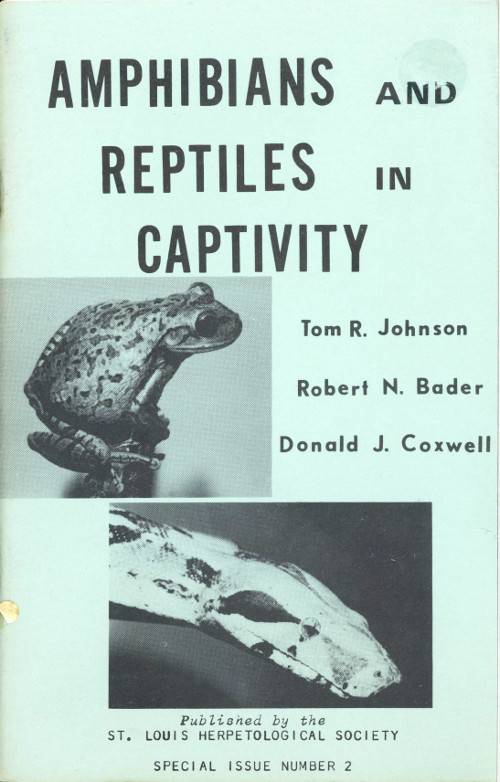
Cover: Cuban treefrog, Hyla septentrionalis, and boa constrictor, Boa c. constrictor
CONTENTS
- Introduction iii
- Salamanders 1
- Toads and Frogs 6
- Turtles and Tortoises 13
- Lizards 20
- Snakes 25
- Bibliography 35
INTRODUCTION
In recent years the number of people interested in keeping amphibians and reptiles in captivity has grown rapidly. All too often, these same people have little knowledge of the proper care needed for their captives, nor do they know where to turn in order to learn the needs of their animals.
Pet stores generally do not have the expertise to give out proper information on the identification and care of amphibians or reptiles. The booklets they sell on the subject are too general and too vague.
It is the intent of the authors of this special issue to offer the proper information needed to successfully keep amphibians and reptiles in captivity. We are by no means THE experts on the subject, nor do we claim to cover all the facts. However, we do hope that enough information is furnished to answer most of the common questions asked by people.
The bibliography has a list of books which go into more detail on amphibians and reptiles: their identification, and natural history, range, and care in captivity. Room did not permit the inclusion of amphibian diseases—thus, the bibliography will be of help there.
Due to the decline in the majority of crocodilians in the world, the authors do not condone their being kept in captivity by amateur herpetologists. We also contend that venomous reptiles, as well, do not belong in a private collection.
Acknowledgments.
A note of thanks goes to the authors listed in the bibliography; for, without their works, this special issue would have been extremely difficult.
Tom R. Johnson
Robert N. Bader
Donald J. Coxwell
SALAMANDERS
(Order Caudata)
Background.
Salamanders have been on earth a very long time; as a matter of fact, the first land vertebrate animal was a type of salamander that evolved from air-breathing fresh water fish—around 300 million years ago (late Devonian period). Today, they range in size from a few inches to over five feet long (the giant salamander of China and Japan reach nearly 5 feet in length).
Salamanders require a moist environment of various degrees—from slightly moist (as with a newt eft stage), to a completely aquatic existence (as with the mudpuppy, hellbender, or adult newt). Nearly all salamanders require water for breeding and egg laying, but there are some varieties which lay their eggs on land, under logs or in leaf litter.
There are approximately 280 species of salamanders in the world—North America, Europe, and Asia sharing the majority of species. Missouri is the home of some two dozen species and subspecies.
Selection of Species to be Kept.
It would be erroneous to say that all species of salamanders can be successfully kept in captivity, because, as with other groups of animals, there are types which are hardy in captivity, and there are types which are extremely delicate. It is recommended that only the more hardy species be considered for keeping in the home.
As far as local species are concerned, the various mole salamanders (genus Ambystoma: the tiger, spotted, and small-mouthed salamanders) seem to do well in captivity. They may live a long time (up to 10 or 12 years for some). They are large (hence, will eat food that is more available), and they do not require a special temperature range.
The central newt, Notophthalmus v. louisianensis, which is locally common, or the red-spotted newt, N. v. viridescens, which is sold in pet stores, are rather hardy, if kept properly. The mudpuppy and hellbender may do well, but they require considerably more space, and should be given a few flat rocks to hide under.
Eastern Tiger Salamander
Ambystoma t. tigrinum
The smaller salamanders of Missouri are on the whole delicate and require cool temperatures. The best one to try to keep for a while in captivity is the slimy salamander, Plethodon g. glutinosus. The rest of the smaller salamanders (genus Plethodon and Eurycea) are usually difficult to maintain. If you do secure some of these, it is recommended that they be kept a short time for observation, and then released in the same area where they were taken.
Remember: several species of Missouri salamanders are protected by the Missouri Conservation Department. If you plan to collect your own specimens, be sure to follow all laws of the Conservation Dept. No animal can be collected in a state or national park, or taken from any cave.
Housing Your Captive Salamanders.
1. Terrestrial (land) species. The first consideration for keeping terrestrial forms is proper moisture. The home terrarium with deep soil and rooted plants is very good for many salamanders, but it affords too many hiding places, and you may never see your specimens.
A 1 to 2 inch layer of soil (⅓ black dirt, ⅓ peat moss, ⅓ fine sand) works very well for most land salamanders (mole salamanders, slimy salamanders, and the California newt). A few flat rocks or slabs of bark, or some dead leaves will furnish hiding places, and a small, shallow water dish should be provided. A 5- or 10-gallon aquarium would be about the right size for keeping several salamanders. Painting the sides and back with black or dark brown paint will furnish them with added security. Never crowd too many salamanders into a small aquarium. In the wild you seldom see more than one or two individuals in any one hiding place.
The soil mixture should be changed every 2 to 3 weeks, because it will tend to sour from your captive’s excrement.
As far as lighting your vivarium, it is not necessary for the salamanders. They are all nocturnal, and shy away from any direct light. Thus, too much light can be harmful, and can also cause the vivarium to heat up. The proper temperature for most land living salamanders is from 65 to 72°F.
Whatever size aquarium you intend to use to house your salamander, be very sure it has a tight screen lid. An all glass lid should not be used because it prevents circulation of air, and allows the humidity to build up to nearly 100%. The soil mixture on the bottom of the vivarium should be slightly damp, not wet or soggy. For best results—a gradient of moisture from nearly dry to damp will furnish your salamanders with an environment in which they can choose their own “dampness”.
2. Aquatic Species. Aquatic salamanders do well in an aquarium with a thin layer of gravel on the bottom, a few rocks, and a few plants. Once again, a 5- or 10-gallon aquarium would be the right size—but be sure that the top is tight—aquatic salamanders can also climb out. The water should be changed as often as necessary to keep it clear and odor free. Use spring water or aged tap water to insure that they are not exposed to any chlorine. The use of an aquarium filter will help keep the salamanders clean.
The water temperature should be kept at between 65 to 72°F. If you wish to illuminate the aquarium, use a fluorescent lamp, not an incandescent lamp. Never expose your salamanders to long periods of light, or very harsh light.
Food and Feeding.
The universal food item that can be fed to most of the salamanders discussed above is the earthworm. Worms are the natural food for many of them, they can be stored alive, they can be collected easily, or purchased at a bait shop. They supply most of the nutritional needs for salamanders, and they come in various sizes. For large salamanders the worms can be fed to them whole. Or for smaller species the worms can be chopped into small pieces and offered to the salamander on the end of a thin wire. Of course, insects of all sorts can be offered to salamanders. You can collect them yourself or purchase crickets or meal worms at a bait shop or pet shop. You may even try feeding small pieces of liver, beef, or even canned dog food, as well as small strips of raw fish. Salamanders, like other amphibians, will do well if fed three times per week. Dusting the food with calcium/phosphorus powder will help to keep your specimens healthy. Salamanders feed on live, moving animals, thus they usually eat best if stimulated by movement. The food can be held with long forceps or on a thin wire, and waved in front of the salamander. Food not eaten should be removed at once.
Salamanders are rather delicate animals, and they do best if they are handled as little as possible. With proper care and attention, salamanders can be very interesting and attractive animals in captivity.
T.R.J.
TOADS AND FROGS
(order Anura)
Background.
The toads and frogs evolved from salamanders some 180 million years ago (Triassic period). They have changed little since they developed the large, jumping-type legs, and have become very successful. Today there are over 2,600 species of toads and frogs, and they live in a variety of environments.
With proper care, most toads and frogs do quite well in captivity. Knowing their natural history can help to furnish the keeper with the information necessary to keep these amphibians in good health.
Selection of Species to be Kept.
The selection of the proper anuran (toads and frogs) for you to keep depends partially on where your interests lie. If you are interested in toads, then the common species in your area may be selected (Missouri common toads include the American and the Fowler’s toad). The very large Marine toad, Bufo marinus, is a species that is quite hardy in captivity, and are not expensive to purchase.
Spadefoot toads (genus Scaphiopus) are rather difficult to collect, except during their breeding season, and they are extremely shy and rather difficult to keep. They do not make a very good study animal because they tend to spend a great deal of time buried at the bottom of their vivarium.
The treefrogs generally do well in captivity, but only the larger species should be considered. The very small varieties should be delicate, and require very small insects to feed on. The gray treefrog (Hyla versicolor) and green treefrog (Hyla cinerea), both are found in Missouri, as well as the barking treefrog and Cuban treefrog (Florida species), are easily kept, provided they are given a variety of live insects to eat.
The majority of true frogs (genus Rana) can be kept with little trouble, but—as with all animals—they should be kept as clean as possible. The leopard frog (Rana pipiens, blaira, and utricularia) will do well, so also will the green and bull frog (Rana clamitans and R. catesbeiana).
Because they are bred in captivity, the clawed frog, Xenopus, of Africa is available in many pet stores at reasonable prices. These completely aquatic frogs can do quite well in captivity. Another tropical frog species that is often sold in pet stores is the South American horned frog, Ceratophrys, which will eat both crickets and baby mice.
Choosing other species not listed in this section will have to be done at the discretion of the person keeping them. You may choose a species that is either too fragile (as with very small toads or treefrogs), or, if exotic species are what you are interested in, their price may be the deciding factor (some Central American frogs can be expensive).
No matter what type of toad or frog you intend to keep, remember that they require live food, and should never be kept in crowded conditions. Thus, keep in mind that insects are difficult to secure in the winter, and, the more specimens you have, the greater the problem will be to feed them. It is recommended that only one or two toads or frogs be kept at one time—get to know the animals, learn from them, and then move on to other species. Release native species in a suitable area—but never release non-native species into a new area ... give them to a zoo or biology teacher.
One last reminder: always wash your hands after having handled your captives. The skin secretions can be very irritating to the eyes.
Housing Your Captive Toad or Frog.
As with salamanders, the toads and frogs can be put into two categories: 1. Aquatic, and 2. Terrestrial (living on land). Both types of amphibians can be successfully kept in aquaria.
American Toad
Bufo a. americanus.
1. Aquatic and semi-aquatic toads and frogs. The truly aquatic toads and frogs that are often kept in captivity by amateur herpetologists are the South American Surinam toad, Pipa pipa, and the African clawed frog, Xenopus laevis. Both forms can be kept in a 10-gallon aquarium with gravel on the bottom, a few rocks, and some aquatic plants. A secure top should always cover the top of the aquarium. The water should be filtered, and a temperature of 70 to 78°F will do nicely for these species. The water level of the aquarium can be from 6 to 10 inches.
Many of the true frogs (genus Rana) can be kept in a semi-aquatic condition. That is, a few inches of water on one end of the aquarium, and some type of land area on the other end. In this way, the frog can either be in the water or out—whatever it wishes. One way to set up this situation would be to use a 10-gallon aquarium with a little gravel on the bottom, and a few large, flat rocks for the frogs to climb onto can be put in. A screen top must be put on the top to keep the frogs inside. If bullfrogs (Rana catesbeiana) are to be kept, a 15 or 20-gallon aquarium would be needed. With this set-up, the water should be changed at least twice per week. To give the amphibians a sense of security, the back and sides of the aquarium should be painted a dark brown or black (paint the outside glass). Try to avoid any bright lights over your toads’ or frogs’ aquarium.
2. Terrestrial and Arboreal Species. All of our native toads are adapted to life on land. In captivity they will do well if given a few inches of soil (⅓ black dirt, ⅓ peat moss, and ⅓ fine sand), a few pieces of bark to hide under, and a small, shallow water dish. A 5 or 10-gallon aquarium will do. The sides and back should be painted a dark brown or black, and a screen top will be needed to keep them inside. The soil mixture should be replaced every few weeks for proper sanitation. If the soil mixture becomes too wet, it should be replaced.
Besides most toads, the South American horned frog, Ceratophrys, the African burrowing frog, Pyxicephalus, and the spadefoot toads, Scaphippus, can be kept in this type vivarium. However, if you notice that the bottom of the toads’ or frogs’ hind feet are becoming raw from too much digging, it may be best to keep them on wet paper towels rather than on any soil.
Treefrogs.
A typical terrarium set-up will work very well for most treefrogs. But, even though you may have the most beautiful terrarium plants—the treefrogs will spend most of their time sticking to the upper corners of the aquarium. Besides plants, a few small branches and a shallow water dish are also required. Spraying the terrarium once-a-day will do the treefrogs and the plants some good.
The temperature for most treefrogs or terrestrial toads and frogs can range from 68 to 75°F. However, tropical species should not fall below 70°F.
Green Frog
Rana clamitans
Food and Feeding.
Becoming familiar with the natural history of your captive amphibian will help you determine what they can be fed. Giving your toad or frog a variety of live insects is a good practice. For the totally aquatic species; earthworms, minnows, goldfish, shrimp, and even small tadpoles, are all eaten by them. If these are not available, try small pieces of raw fish, liver, or beef. Toads and large frogs will eat mice—the size depending on the size of the toad or frog.
Feeding your animals by just dumping in a number of crickets, worms, or flies is a very poor management practice. For one thing, if you have several toads or frogs in one aquarium, the stronger, more alert animal will probably eat more than the others, and one or two will be under fed. Also, if you add live crickets to a well planted terrarium, many of the plants will be eaten by the crickets before they are eaten up themselves. It is thus strongly recommended that all your toads and frogs be fed by hand, using a thin wire or long pair of forceps. Place the cricket or worm on the end of the wire and move it in front of the amphibian. In this way you can be sure all are getting the proper amount of food, and this is also a good way to feed such things as liver or pieces of raw beef.
As a general rule, all your toads and frogs will do well if fed on a regular basis of 2 to 3 times per week. It is good practice to dust the worms or insects once a week with a calcium/phosphorus powder. This will supply your specimens with the much needed minerals.
Tadpoles.
It happens so often that people have seen tadpoles (Toad and frog larvae) in ponds or puddles while out in the country, and have taken them home—only to find out they have no idea how to care for them. The development of these amphibians can be a real learning experience for children, and with proper care, your tadpoles can mature to small toads or frogs.
Overcrowding and lack of proper food are two mistakes made most often by people who try to keep tadpoles. One half to one dozen is more than enough to try to keep. Put them in a shallow pan, with 1 to 3 inches of water in it. The larger the tadpoles, the deeper the water should be. Insert an air stone to keep the water in motion. No rocks or gravel are needed, but some live aquatic plants can be put in with them. KEEP THEM CLEAN. Never allow the water to stand dirty for more than a few hours. Be sure that the clean water is free from chlorine.
To feed your tadpoles, it is essential to give them a variety, and to furnish them with both plant and animal foods. Their staple diet could be boiled lettuce, rabbit chow, and cooked liver. Give them small amounts of food at one time. You can feed them 3 or 4 times a day. When you see the water is becoming dirty—change it. You may want to try and feed them a tropical fish food called “molly flake food”; or you might try some hard boiled egg. Keep the water temperature at 70 to 72°F.
Once the tadpoles begin to lose their tails, grow front legs, and take in air at the surface, they are beginning to turn into a toad or frog. At this stage, they should not be disturbed. When they no longer have any tail, and stay out of the water, they can be fed a variety of small insects, or small pieces of earthworms.
T.R.J.
TURTLES AND TORTOISES
(order Chelonia)
Overview:
Large numbers of hatchling and adult turtles are sold or traded each year in the United States. Unfortunately, from the point of view of the turtles themselves, the majority of them are condemned to death by unintentional maltreatment and few manage to survive a year. The species most often abused is the red-eared slider, Chrysemys scripta elegans. Next most common are the map turtles, Graptemy, and third in abundance are the painted turtles, Chrysemys picta. All are water turtles and require much the same care in captivity. Since the red-eared slider is the most common of all, the general account that follows is based upon the slider group of turtles. This is the largest group of native turtles, including some 16 different kinds. All live in ponds and lakes, and may be given about the same care in captivity. Comparisons with other groups follow the general account, save the tortoises, or dry land turtles, which will be discussed in more detail after the aquatic turtle account.
Aquatic Species:
Description and diet: Water turtles, such as the red-eared slider, vary in color and usually have webbed feet for swimming. These turtles are generally carnivorous (meat eaters), and their primary diet consists of chopped raw beef, horsemeat, fish, worms, and also aquatic greens. Some water turtles will eat bits of green leafy vegetables, such as fresh greens, lettuce, endive, and spinach. All turtles are different, however, and a variety of foods should be offered to determine their likes and dislikes. Food supplements should also be used. Some of these are: cod liver oil, liquid multiple vitamins, and powdered calcium or bone meal. These may be added directly to their food.
Box, wood, and Muhlenberg’s turtles or other semi-aquatic species do well in captivity when a basin of shallow water is provided for soaking. Diamondbacks need brackish or slightly salty water. These also generally eat vegetable matter as well as meat.
Red-Eared Slider
Pseudemys scripta elegans
All weather care: As these turtles are generally kept indoors, an aquarium is the best means of maintaining them. Temperatures may be controlled by the use of a heater, thermostat, and thermometer. The best temperature will range between 72 to 85° F. A filter and pump may be used to keep the water clean. It is advisable to feed the turtles in a separate container, as foods foul the water quickly.
The aquarium and accessories should be kept clean and scrubbed periodically. Water turtles may be kept out of water for some time, if necessary, with no ill effects. However, they cannot eat out of the water. These turtles must also have sunlight in order to grow and maintain a hard shell and sound bones. They should be allowed to sun at least twice a week ... always with a shade of some type over a portion of the container, so they will not become over-heated.
The aquarium itself should be arranged so that the turtles can leave the water at will and dry themselves periodically. A cluster of smooth, flat rocks in the middle, or at one end of the aquarium will permit them to do so.
Dry Land Species:
Description and diet: Tortoise is the term generally used in referring to dry land turtles. They seldom swim or enter the water. Carapace and plastron (upper and lower shell) range from light tan to dark brown in color; The skin is rough appearing and the legs are scaled and elephant-like, with no webbing of the feet. Food consists of vegetables, fruits, grass cuttings, dandelions, petals from various garden flowers, bits of raw meat that is finely chopped, and canned dog food. Foods such as carrots, string beans, and corn are valuable in the diet, and should be ground or scraped. Many of the tortoises are fond of earthworms, so these should also be offered. Food supplements, such as cod liver oil, liquid multiple vitamins, powdered calcium, and bone meal, should also be added to foods periodically. Box, wood, and Muhlenberg’s turtles (as well as other semi-aquatic species) will do well in captivity if a shallow water dish is provided. These species will generally eat meat as well as vegetable matter.
Cold weather care: In the fall, around late October or early November, your tortoise will want to hibernate. It will probably dig its own burrow out of doors, given it is in the correct environment. If the conditions outside are not proper for your tortoise to burrow, he may be placed in a box in a cool, dry area where a constant temperature can be maintained, such as a garage. Cover him with a layer or two of old, shredded newspapers. He is now ready to be “stored” for the winter. If your tortoise is to spend the winter in the house, be sure to keep food and water available. House temperatures do not permit a tortoise to hibernate properly, and starvation is possible if he is not allowed to eat when he stirs about during the winter.
Hot weather care: Hibernation ends some time in spring, usually in March. The tortoise may be a little sluggish at first, but as the weather becomes warmer, interest and appetite improve. Water, food, and shelter from the sun must always be available, and a night shelter is advised.
Illness and treatments: Most turtle owners are familiar with the basic care requirements of their pets; however, there are a few common ailments that may require prompt treatment. The simple remedies here have been found to be successful in many cases.
Respiratory ailments: Turtles and tortoises are usually susceptible to colds and pneumonia. Bubbling of the nose and mouth and “gasping” are symptoms of this. Isolation from the other turtles in a heated box or aquarium is mandatory. A heat lamp may be used several times a day—but always with a shaded corner into which the turtle can crawl when he gets too hot. Cold-remedy salves can also be rubbed on the turtle’s nose to help relieve congestion. The turtle should be kept warm and isolated until all traces of his cold have disappeared. (Injection of an anti-biotic serum into the leg or forelimb, once a day, is sometimes successful, as well as anti-biotic pills given orally; but consult a veterinarian or Society member before attempting this as some drugs are dangerous for turtles.) If caught in its early stages pneumonia can be overcome. The turtle in question should be isolated and kept warm, and the following medicine should be administered with an eye dropper: Dissolve together
½ ounce of water
1 tablet Chlortetracycline
4-5 drops liquid vitamins
Administer daily for two days and then skip a day. Repeat. This formula has proven itself quite effective after 5 or 6 days.
Cracked shell: Immediately place injured turtle in a clean, paper towel-lined box, and bring indoors so that ants and flies will not torment him. If shell is bleeding, gently wash it with a mild solution of boric acid and pat dry. This may have to be done several times before bleeding stops. Put his box in a warm, quiet spot in the house, and leave him completely alone except for offering a shallow bowl of drinking water from time to time. If he survives the first 24 hours, he will probably pull through. (The lungs are under the carapace, and if the broken shell has penetrated the lung area, there is practically nothing that can be done for the turtle.) If the wound is bad or jagged, it may be filled with Canadian Balsam—after bleeding has stopped and then securely tape with electrician’s tape. The tape may be left on for several months if necessary, but it should be checked every six weeks or so, to make sure infection has not set in. Once the turtle has started eating and resumed his normal routine, he is probably well on the road to recovery.
Soft shell, and swollen eyes: This is almost always due to an improper diet and lack of direct sunlight. Add vitamins and ground bone meal to the food; offer raw, lean chopped meat; and see that the turtle is placed in direct sunlight for several hours each day. (When turtles are placed in direct sun, they must have a shaded area into which they can retreat when the temperature goes too high.) Swollen eyes may also be bathed in a dilute solution of boric acid to alleviate swelling and puffiness.
Fungus: This appears as white spots, lumps, or flakes on the skin or shell. Addition of plain table salt to the aquarium water will often cure the condition. Fungus on the shell may be helped by painting the area with 5% iodine or 2% gentian violet solution. Always keep the turtle out of the water for a period of 2 to 4 hours after applying either iodine or gentian violet, so as not to wash the medication from the shell or skin. If the fungus continues after several treatments, allow a week or so before experimenting with another medication, as many times the combination of medications can be detrimental to the turtle.
Ornate Box turtle
Terrapene o. ornata
Parasites: Parasites may be suspected if the turtle suffers a great loss of weight or a loss of appetite without apparent cause, or if he has a ravenous appetite. Parasites may be evident in the stools, but are not always readily seen. If suspected, have a veterinarian diagnose and treat this condition. In addition, shots of vitamins can be administered periodically for maintaining good health. If, however, the turtle is on the proper diet, shots such as these may not be needed.
Conclusion:
Many different kinds of turtles make satisfactory additions for your collection. Actually, every one of our native turtles, at least when small in size, can be acceptable. Larger examples of some species, however, are sometimes unpleasant and even positively dangerous as members of your collection. Below is a list of those turtles that should be avoided by the amateur herpetologist:
Adults:
Common Snapping Turtles
Alligator Snapping Turtle[1]
Soft-shelled Turtles
Very Large Sliders
Musk Turtles
Mud Turtles
The larger species, or large adults of some species, tend to become aggressive and dangerous as they grow older, and many times a finger is mistaken for a morsel of food. Avoid the aforementioned turtles if your interest in these hard-shelled friends is new.
These are some turtles, of course, that can be handled without fear of biting or scratching. Any of the smaller species of sliders can make acceptable additions to your collection. Below is a list of those turtles that are, and may be handled and studied by the amateur:
Young:
Common Snapping Turtle
Soft-shelled Turtles
Sliders
Musk Turtles
Mud Turtles
Diamond Back Terrapin
Although young turtles make safe additions to your collection, land turtles of all kinds are best, seldom if ever bite, feed readily, and survive a long time in captivity. They include: Eastern, Florida, Three-toed, and Ornate Box Turtles, and the Red-Foot Tortoise. None of these are commonly available from commercial dealers, however.
D.J.C.
LIZARDS
(order Squamata) (suborder Lacertilia)
Keeping lizards as “pets” can be a very challenging task, because, it has been found that many species will not thrive in captivity.
When looking for a lizard to buy or catch, keep in mind some of the basic requirements the animal should have while you are choosing a lizard. The lizard should be alert and active. Check its mouth for signs of sores, bad teeth or gums, or other indications of mouth rot. Check the eyes for discharges, make sure the eyes are not sunken into the head. Observe it walking to insure that there is no damage to the limbs. Do not accept a lizard that has a discharge from the nose, this could be a symptom of a respiratory infection.
Lizards vary a great deal in their dietary requirements, therefore, it is very important that you are very sure of the animal’s identification before you purchase or collect it. You cannot always rely on the pet store dealer for an accurate identification. If the lizard is one that you have caught, then you can refer to a field guide for a positive identification.
Some lizards are strictly insect eaters, others eat only fruits and vegetables, some will only eat meat, a few lizards will only eat eggs, and then there are some that will eat nearly anything. Most insectivores will only eat live insects. If it is hard to get live insects, you may be able to get the lizard to accept dead food by offering it on the end of a thin wire. By moving the insect, the lizard will think it is alive, and often will grasp the food. Insectivores require a large amount of food, and the food should be varied: don’t feed all meal worms, or all crickets, but try to offer a variety of insects.
The vegetarians or herbivores need to be fed a mixed variety of fruits and vegetables. Often, color will induce a lizard to eat, so always include some apple or tomato to the diet if the lizard doesn’t seem interested in food. The meat eaters are often the easiest to induce to eat. Canned dog food is usually used as a basic, but whole mice are much more of a balanced diet. Sometimes it is necessary to skin the mouse in order to get the lizard to eat it. Whatever dietary requirements your lizards have, their food should be supplemented with a vitamin and mineral powder. Steamed bone meal is often used. Just sprinkle a small amount on the food, and then mix it in so the lizards will take it in with their food.
Although the size of the cage is usually not critical for lizards, cage props may be essential in order to insure that the animal thrives. If the lizard is a burrower in the wild then it is often necessary that it be able to burrow in captivity. If the animal is normally arboreal, Then you must have a branch for it to climb on. Because of this, it is most important that you know what species of lizard you have; then learn as much as possible about its habits and habitat.
Besides cage decorations, always have clean drinking water in the cage. Many species of lizards do not drink from a water dish. They obtain their water from dew drops or rain drops that they lap with their tongues. It is advisable to spray the lizards’ cage daily with a fine mist of warm water.
Common Iguana
Iguana iguana
An important requirement for lizards is sunlight. Often, a lizard seems to be eating and doing well in captivity, but suddenly dies. This may be due to a lack of sunlight. In many instances the animal may not eat at all. If direct sunlight is not available, it can be substituted by the use of a vita-lite bulb. This bulb, which looks like a fluorescent bulb, can often be purchased from a large plant store or directly from the manufacturer.
Lizards often have a more precise temperature requirement than other reptiles. A daytime temperature range of 85 to 90°F, and dropping to 80°F at night is usually best for the tropical species. Many of the North American desert species also require a high daytime temperature. Adult tegus and monitors can be kept at slightly lower temperatures, usually from 72 to 76°F. As with snakes, the temperature in the lizard cage can be controlled with a light bulb. The size of the cage will determine the size of the bulb needed. As previously stated, temperature can be critical, and many lizards will die if not kept warm enough. Never guess at the cage temperature—always have a small thermometer in the cage, and check it often.
Keeping lizards healthy can be a challenging but also frustrating experience. There is very little information available on lizard diseases. These reptiles are susceptible to many of the diseases that snakes get, and often the symptoms are the same. Lizards can get mouth rot, respiratory infections, parasites (both internal and external), eye infections, and other common reptile diseases. One disease that is common in lizards is impaction of the intestines. This is common in insect eaters that are being fed only meal worms. Often, the impaction is not noticed until after the animal dies. If the lizard is alone, keep track of its food intake and fecal output. If an extended period goes by and the lizard is not making fecal matter, then there could be a physical blockage in the intestine. Put a little mineral oil up the cloaca—this will help to loosen the blockage. The best cure is preventive procedures. Feed a variety of insects if possible, but don’t feed all meal worms.
The other diseases that lizards are susceptible to can be treated by using the same medications used for snakes. Dosages, of course, must be less, for we are usually dealing with a much smaller animal.
Good husbandry along with preventive medicine are the best ways to keep your lizard healthy. Keep the cage clean, feed a proper diet, supply sunlight or artificial light, and most important: know the lizards’ requirements and natural history.
The following is a list of lizards that usually can be kept successfully in captivity:
| Green Iguana: | A lizard from Central and South America, mostly herbivorous, is arboreal, and can grow to 6 feet. |
| Tegu: | A large carnivore from South America, feeds on mice, not tame. |
| Monitors: | Large carnivores from the Old World, most do well. |
| Glass Lizards: | Insectivores from North America, will eat dog food, tail breaks off easily. |
| Tokay Gecko: | Will eat any small animal or insect. Make good pets. |
| Amevias: | Same as tegu. |
Great Plains Skink
Eumeces obsoletus
Most lizards from Missouri should be kept during the summer, then released in early fall where they were collected. Lizards that do not make good pets are: horned lizards, anoles, collared lizards and fence lizards.
As with all animals, there are exceptions to the rule; an iguana may refuse to eat, or a collared lizard may do well for years. Each reptile within a species may act differently from how the whole species may act in captivity. Knowing the lizards’ habitat and habits will be the deciding factor in keeping the animal alive and healthy in captivity.
R.N.B.
SNAKES
(order Squamata) (suborder Serpentes)
There are many species of snakes throughout the world (over 2,700 species). Some of these make very good “pets”, while others never seem to thrive in captivity. Because of the many varieties of snakes, the care of them can vary quite a bit. There are a few basic needs that all snakes, regardless of the species, require in order to do well in captivity.
All snakes are carnivorous. They eat only whole animals. This food may vary from termites to rabbits—with all types of animals in between. This sometimes includes other snakes.
Snakes require clean drinking water, a clean cage to live in, and an all around healthy environment.
The above requirements are easy to meet, but they must not be treated lightly. After the basics are met, there are other requirements that individual species may need.
A common problem with keeping snakes is they often will not eat. Sometimes the reason is simply that they are not satisfied with their environment. Snakes that are arboreal will need a limb in their cage. If they don’t have something to climb on they may refuse to eat. Tropical snakes require a higher cage temperature than what is normal room temperature. This can be accomplished by putting a heat lamp above the cage. Always monitor the temperature with a thermometer and try to maintain it around 85°F. Certain species of snakes spend a great deal of time burrowing, and unless they can burrow in their cage they may not eat. Many of the more nervous species of snakes, like the racers, require a hiding box so that they will feel secure. The hiding box is often a good idea for any snake that may refuse to eat if all other conditions are favorable.