
The Project Gutenberg eBook of An Alphabet of History
Title: An Alphabet of History
Author: Wilbur D. Nesbit
Illustrator: Ellsworth Young
Release date: May 5, 2012 [eBook #39626]
Language: English
Credits: Produced by Chris Curnow, Paul Marshall and the Online
Distributed Proofreading Team at http://www.pgdp.net (This
file was produced from images generously made available
by The Internet Archive)
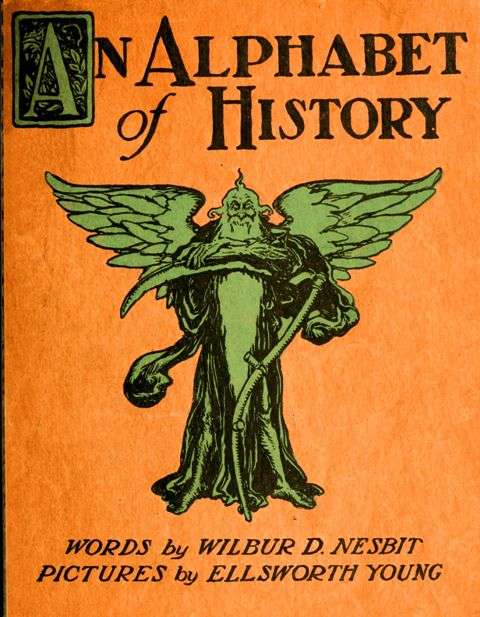
AN ALPHABET
OF HISTORY
The Words by Wilbur D·Nesbit
The Pictures by Ellsworth Young
| Who frets about the mystery Enshrouding all of history On reading this will, maybe, see We've made it plain as A, B, C. |
Paul Elder and Company Publishers,
San Francisco
ACKNOWLEDGMENT
In their original form, the contents of this
book appeared in the Chicago Sunday Tribune,
which newspaper is hereby thanked for
the privilege of reproducing this Alphabet
Copyright, 1905
by Paul Elder and Company
San Francisco
The Tomoye Press
San Francisco
Table of Contents & List of Illustrations
ALEXANDER THE GREAT
BRUTUS
CHRISTOPHER COLUMBUS
DIOGENES
EURIPIDES
FRANKLIN
GALILEI GALILEO
HIPPOCRATES
IAGO
JONSON
KIDD
LUCULLUS
METHUSELAH
NEWTON
OMAR
PEPYS
QUINTILIAN
RALEIGH
SHAKSPEARE
TELL
ULYSSES
VILLON
WATT
XANTIPPE
YVETOT
ZENOBIA
And he sighed there was naught to delight him
When he brandished his sword and defiantly roared
And could not get a country to fight him.
And he clamored for further diversions;
And our history speaks of his grip on the Greeks
And his hammerlock hold on the Persians.
In his palace was labeled a relic,
Though Bucephalus, stuffed, gave him fame, he was huffed—
He was grouchy and grumpy, was Aleck.
Was the fact that he never was able
To conduct a big scrap that a versatile chap
Of a war correspondent would cable.
When he told of the fellows who'd fought him,
As he thought of the lack of the clicking kodak
In the hands of a man to "snapshot" him.
Through his palace—the reason is hinted:
There were not at that time magazines for a dime,
And his articles could not be printed.
We must say in some ways he was hateful;
And in truth, we have heard he went back on his word,
And was not Alexander the Grateful.
There lived great Julius Cæsar
Who wore the crown with haughty frown
And was a frosty geezer.
Called Lupercal, they fetched it
For him to wear, but then and there
He said they should have stretched it.
And frigid as Alaska,
Ambitious, too,—that would not do
For Cassius and Casca.
On having things to suit us.
We think that Jule is much too cool;
Let us conspire with Brutus."
"Shall Cæsar further scoff us?
Next week, they say, he'll have his way
About the Rome postoffice."
You know those times they wore 'em—
They made a muss of Ju-li-us
One morning in the Forum.
(Some claim it's "Et tu, Bru-te";
We mention it both whole and split
As is our bounden duty.)
Talked some,—we shall not quote it;
We've understood 'twas not as good
As when Bill Shakespeare wrote it.
And since his dissolution
He's been accused and much abused
In schools of elocution.
He solved a weighty problem that no one could comprehend—
Perhaps it was the puzzle whose solution clearly showed
The psychologic motives of the hen that crossed the road.
Perhaps cold storage minstrels never might have heard of this
If it hadn't been for Chris.
And went to see that noble man, King Ferdinand of Spain.
Result: He found America—oh, do not idly nod,
For if it hadn't been for this we couldn't go abroad!
Just think of all the travel and the voyages we'd miss
If it hadn't been for Chris.
Nobody ever thought to ask him how he knew its name;
Nobody ever booked him for some lectures to declare
In eloquent assertions how he knew the land was there.
Today we might be savages, unknowing modern bliss,
If it hadn't been for Chris.
That sometime in the future little Cuby shall be free."
His vision was prophetic—far adown the future's track
He saw the dauntless Hobson and the sinking Merrimac.
We might have still been tyros in the ethics of the kiss
If it hadn't been for Chris.
And yet he was so poor that once he thought he'd have to swim
To find this wondrous country, for he was so badly broke;
But Isabella nobly put her watch and ring in soak.
Who knows but Isabella never might have thought of this
If it hadn't been for Chris?
His fellows analyzing;
These words were carved upon his club:
"First Class Philosophizing."
If any question came his way
Involving people's morals,
The things that he felt moved to say
Were sure to start some quarrels.
In fact, his tub became a booth
In which he dealt in wholesale truth.
He knew a lot about it;
When he was told a thing was so
He then began to doubt it.
He seldom left his narrow home—
Not even on a Sunday;
The only time that he would roam
Abroad was on a Monday.
He had to roam then, anyway,
For that, you know, is washing day.
Gave him a paroxysm;
He always spoke in epigram
And thought in aphorism.
One day he took his lantern down
And polished it and lit it—
But first he frowned a peevish frown
And growled: "The wick don't fit it."
And then, with pessimistic scan,
He sought to find an honest man.
His search was not well heeded,
For no historian has said
If ever he succeeded.
But there's this thought for you and me:
It would not be quite pleasant
If on that quest the sage should be
With his fierce light, at present.
For, if he were, one may but think
How much that light would make him blink.
Excelled in things dramatic;
He could sit down and write a piece
Mild tempered or emphatic;
The dramatists of modern days—
No matter how much they write—
Can never equal Rippy's ways,
For he was quite a playwright.
The scenes would flow like magic;
Though humor came at his command
His penchant was the tragic;
He often wrote a little speech
That was extremely pleasant—
His jests were lasting—all and each
Are still used at the present.
He thought he had a mission.
He said, "By writing thus and thus
I'll elevate the Grecian."
However, though he oft produced
His works in manner spurty,
He never wrote a thing to boost
The vogue of ten, twent', thirty.
In goodly style with no girls—
He never used the soubrette maid
Or based his play on show girls;
And, this for old Euripides:
In none of all his dramas
Did he observe the modern pleas
For chorus in pajamas.
Or her Augustus Thomas—
It's really hard to say just which,
But he was full of promise.
It's time that Rippy had his due
And got his share of glory,
For royalties he never knew
And no press agent's story.
A-many years ago—
And yet, how many people now
The reason for it know?
Was it because he wisely wrote
Poor Richard's Almanac
(One of the few, we pause to note,
Which testimonials lack)?
Of his philosophy?
(No mental cure or psychic cult
Or Great Uplift had he.)
Was it because for years and years
He was a diplomat?
Why, no. What person ever hears
About such things as that?
That he should merit fame?
That each edition of "Who's Who"
In bold type puts his name?
He flew his kite; he had the key
His front door to unlock—
Like countless other men, then he
Acquired a sudden shock.
And incandescent light
And buzzing fan which coolness blows
All date from Franklin's kite.
But, what an oversight of Fame!
Ben Franklin's wife—'twas she,
That thoughtful, gentle, kindly dame,
Who let him have the key.
He was happy when inventing, or discussing an appliance;
Pendulums, he found by study, were precise in every wobble—
Showing how old Father Time went in his never-ending hobble.
And informed the gaping public what its figures represented.
"O you foolish Galileo," cried the public, "you shall rue it!
Why get up a thing to tell us we are hot? We always knew it."
And discovered things that made him rather disbelieve his senses;
He would point his telescope up to the sky and then he'd scan it,
Then go in to breakfast smiling, for he'd found another planet.
(That's the sun) and found it spotted on the belt and regions polar;
But he didn't figure out that when the sun was thickly freckled
Then the world with lights and fusses was continually speckled.
But we often read his name and wonder how the man pronounced it.
Maybe when he tried to he was all at sixes and at sevens,
Which is why he turned his studies to the dim and distant heavens.
Possibly some bright librettist will find in this name an omen
That presages fortune for him, and the stage will pay what we owe
To that honest old star gazer, Galilei Galileo.
That but for him the surgeon or the latter-day chirurgeon might never have been tinkering the human running gear.
For when he was seeking practice—long ago—the simple fact is that the Latin tongue was common and was very far from dead.
But old Hip had to endure it, for he knew he couldn't cure it, and that once his hair was falling, why, he had to let it fall.
Plato praised his diagnosis, called him healing's patient Moses, and though facts were hard to gather, found a goodly lot to tell.
(Still, 'twas only second nature to affect that nomenclature), but he never even thought of, much less heard of, any germs.
And the grim appendicitis which today is sure to fright us, was by Dr. Hip considered but a stomach-achic groan.
From New Jersey clear to Joppa not a one would call him "Papa," and his theories and treatments would be greeted with a frown.
He was constantly complaining that in spite of all his training he could never cure his patients of the trait of dodging bills.
And yet he did not work at all as modern villains do;
No one can rise and say that bold Iago hoarsely laughed
When some one demonstrated that his stories were untrue.
He did not swagger on the stage in evening clothes, and mutter,
Nor bite his finger nails in baffled anger now and then;
He never turned and left the stage with nothing else to utter
Except: "Aha! Proud beauty! I shall not be foiled again!"
To hurl the daring hero in the waters of the race;
He never frowned and ground his teeth and burned the hidden will
Or kidnapped any children just to complicate the case.
Iago was not like the villains that we have at present;
He didn't even try to scowl or to look like the part.
Iago as a villain was continually pleasant,
And never gave the notion that he had a stony heart.
But still Iago doesn't seem to get the proper praise;
Othello, as the hero—as all proper heroes should—
Stood calmly in the spotlight and corralled the wreathing bays.
Since then there is no villain of the art of good Iago—
At least we haven't seen an actor who approached him yet;
The villains we have noticed from Galveston to Chicago
Have hissed through black mustaches and have smoked the cigaret.
"To Celia,"
Presager of that later note
,"Bedelia,"
To you, rare Ben, our hat we raise
For all your poems and your plays.
Was taken,
Like copies by a scrawling clerk,
From Bacon;
You would have known of that flimflam
Without a hidden cryptogram.
You labored,
And with brave lords and gentlemen
You neighbored—
You never turned out feeble farce
In sentences that would not parse.
To grovel,
And, Ben, you never called a spade
A shovel—
Where you wrote sentences risqué
We now have costumes very gay.
That lady
To drink, her name you never masked
As "Sadie,"
Nor did you call her "Creole Belle"
Or half the song names we might tell.
Your sighing
Showed you no steins of any size
Were buying.
But from the way the stanzas run,
You, rare Ben Jonson, were well done.
Yo ho, my lads, yo ho!
He sailed the seas in search of gold,
Yo ho, my lads, yo ho!
He sailed on both sides of the line,
The skull and bones he made his sign;
Where he found wealth, he said: "That's mine!"
Three centuries ago.
Three centuries ago,
A very dark repute he had—
Yo ho, my lads, yo ho!
He'd board a ship and take its hoard,
Then: "Walk the plank!" he fiercely roared,
"The ship is all that I can board,"
Yo ho, my lads, yo ho!
Yo ho, my lads, yo ho!
He said: "I'll rob you while you wait"—
Three centuries ago.
He had a long, low, rakish craft
With Long Toms both before and aft,
And wickedly and loud he laughed,
Yo ho, my lads, yo ho!
Yo ho, my lads, yo ho!
He feared no frigate, bark or brig,
Yo ho, my lads, yo ho!
And while his grim flag flapped and tossed
Above the ship that Bill Kidd bossed,
His victims knew just how they lost,
Three centuries ago.
Three centuries ago.
If he should come to life again—
Yo ho, my lads, yo ho!
The chances are that he would just
Go out and organize a trust—
He knew the way to raise the dust
Three centuries ago.
He won the bay and laurel by his prowess in the strife.
He came back home a hero (and no doubt, just as today,
They named a cocktail for him ere they looked the other way).
But when Lucullus noticed he was losing grips on fame,
He struck a happy notion to perpetuate his name.
'Tis said that lots was eaten and a sea of wine was spilt;
That guests might order anything in dishes old or or new
And get the very rarest, and a second order, too!
Quick lunches or course dinners—anything a man could wish
In the line of drinks or dainties; yet he was no nouveau riche.
Yet today we recollect him merely as a lavish host.
It is said that once he ordered quite the richest feast prepared
But no guests came to enjoy it, and the busy chef was scared.
"Is nobody here for dinner?" asked the flustered, pestered chef.
"I am dining with Lucullus!" roared Lucullus. "Are you deaf?"
For the pure, unfading luster of his dinner-eating name,
Is that though Lucullus feasted at a very great expense
And sat down to simple breakfasts where the health foods were immense,
He was gracious to his fellows, was considerate of each,
And he never put his chestnuts in an after-dinner speech.
He was the Old Inhabitant
Those times, but never had a show;
His opportunities were scant.
Although he lived nine centuries
And three-score years and nine beside,
The times he saw were not like these,
A chance to spread he was denied.
And lunch on crackers, cheese and prunes,
And there display his helpful lore
Through mornings and through afternoons;
He could not talk about the days
When folks first saw the telegraph
Or telephone; how their amaze
Made better posted people laugh.
To some tall building, then say: "Here,
An' for a good ways hereabout,
I used to shoot the bear and deer."
Skyscrapers were an unknown thing,
Excepting Babel, in his land,
And Babel only served to bring
Speech that he could not understand.
Anachronistic; as to that
We'll say one pleasant thing was his:
He never had to rent a flat.)
Another joy in his career
Was this: nobody ever told
Methuselah the stated year
When he should be considered old.
From working if he wanted to;
He did not need a union card
His daily labors to pursue;
And when his hair was snowy white
And age his manly form had bent,
Nobody called him young and bright
And ran him for vice-president.
"'Tis gravity! 'Tis gravity!" excitedly he said.
Had you or I been sitting there a-thinking of this earth,
As Newton was, and wondering about its size and girth,
And just when we were figuring a long and heavy sum,
The apple hit us on the mind and made our bald spot numb!
Would there have been much gravity in what we had to say?
An intellect that reaches out to see what it may find.
Perchance an ordinary man in such a circumstance
Would have got up and rubbed his head and done a little dance,
And muttered things that gentle folks should scarcely ever state,
And not concede the apple simply had to gravitate.
Instead of gravity we might have thought of apple pie.
Discover facts which any brain that's common never finds),
You see, when Newton felt the jolt, his science did not stop—
He simply meditated on "What made the apple drop?"
And while in cogitation deep beneath the tree he lay,
He mused: "It's odd that apples never drop the other way."
We might have howled: "Who was it threw that apple and hit me?"
To finish this, however, with becoming gravity,
We'll state that Newton lingered there beneath the apple tree;
With logarithmic tables he discovered that the speed
At which the apple fell was based on whence it fell—indeed,
Had it dropped from the moon, we'll say, it would have grown so hot
That it would have been melted up before to earth it got.
We should, like he did, take the apple up and start to eat.
Yet gave to Verse such Time as he could give;
Whereat the Critics rose and Hurled at Him:
"The Stuff you write is only Tentative."
He kept his Troubles underneath his Hat
Except such Times as when he worked them up
Into an Apt and Pleasing Rubaiyat.
And made a flowing Version; yes, and then
To show that he could keep it up a While,
Translated all the Rubaiyat again.
O. Khayyam's volume resting by "Lucille,"
Bound in Limp Leather, with each Edge uncut,
To show the Literary Sense we feel?
Wherein some Maiden fair don't Elocute
Through Khayyam's easy-speaking poetry,
With Musical Accomp'niment to suit?
Who does not seek through all upon his List
And come back at the last to Khayyam's work
Each time to find New Chances he has missed?
Or a Typewriter one can use, and then
A book of Omar whence to draw the Thought—
Oh, Parodies one will turn out again!
Perchance he also had E. Hubbard Hair—
But anyhow old Khayyam set a Task
To fill all his Successors with despair!
The diary that bears his name
In those far days, now dead and gone,
He never dreamed about his fame.
Yet now, from time to time, it is
Heard from 'most everybody's lips—
That magic, mellow name of his,
The soft and pleasing name of Pepys.
We live anew that ancient time
(The book is one we often quote—
The cheap editions are a dime);
We mark his course through dingy streets
And climb with him the palace steps;
In fancy all of those one meets
Remark: "Why, there goes Mr. Pepys!"
And hearing ear, and what he saw
And what he heard he fain would try
To set down, but evade the law
And that is why in cipher dark
The tale originally creeps—
'Twas thus, also, he made his mark,
This man of truth and trouble, Pepys.
And also had a little fun—
He kept his eye upon his chiefs
And tells the things they might have done
If they had not done what they did.
Ah, if each person now should keep his
Own diary and raise the lid
As did this honest Samuel Pepys!
Whereon the critics sometimes pounce;
It hardly ever sounds the same,
It is so easy to pronounce.
But still, there is an hour or so
Of pleasure for the man who dips
Into his book and comes to know
Good Samuel Pepys, Peps or Pips.