
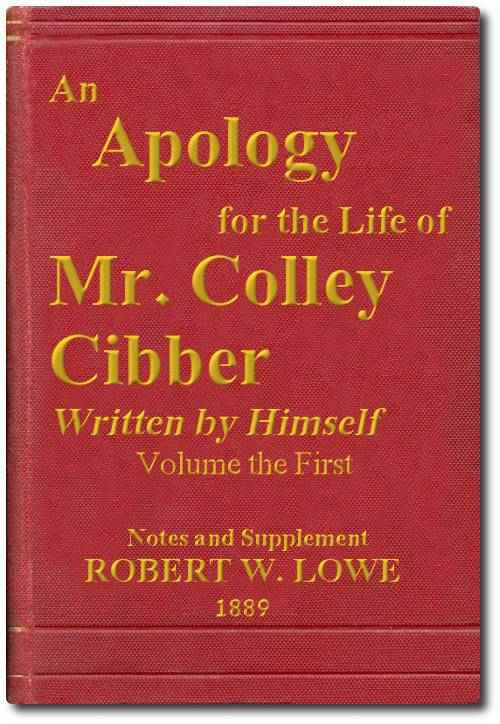
AN APOLOGY FOR THE LIFE OF
MR. COLLEY CIBBER, &c. [4]
CHAPTER I.
The Introduction. The Author's Birth. Various Fortune at School. Not lik'd by those he lov'd there. Why. A Digression upon Raillery. The Use and Abuse of it. The Comforts of Folly. Vanity of Greatness. Laughing, no bad Philosophy.
You know, Sir, I have often told you that one time or other I should give the Publick some Memoirs of my own Life; at which you have never fail'd to laugh, like a Friend, without saying a word to dissuade me from it; concluding, I suppose, that such a wild Thought could not possibly require a serious Answer. But you see I was in earnest. And now you will say the World will find me, under my own Hand, a weaker Man than perhaps I may have pass'd for, even among my Enemies.—With all my Heart! my Enemies will then read me with Pleasure, and you, perhaps, with Envy, when you find that Follies, without the Reproach of Guilt upon them, are not inconsistent with Happiness.—But why make my Follies publick? Why not? I have pass'd my Time very pleasantly with them, and I don't recollect that they have ever been hurtful to any other Man living. Even admitting they were injudiciously chosen, would it not be Vanity in me to take Shame to myself for not being found a Wise Man? Really, Sir, my Appetites were in too much haste to be happy, to throw away my Time in pursuit of a Name I was sure I could never arrive at.
Now the Follies I frankly confess I look upon as in some measure discharged; while those I conceal are still keeping the Account open between me and my Conscience. To me the Fatigue of being upon a continual Guard to hide them is more than the Reputation of being without them can repay. If this be Weakness, defendit numerus, I have such comfortable Numbers on my side, that were all Men to blush that are not Wise, I am afraid, in Ten, Nine Parts of the World ought to be out of Countenance:[5] But since that sort of Modesty is what they don't care to come into, why should I be afraid of being star'd at for not being particular? Or if the Particularity lies in owning my Weakness, will my wisest Reader be so inhuman as not to pardon it? But if there should be such a one, let me at least beg him to shew me that strange Man who is perfect! Is any one more unhappy, more ridiculous, than he who is always labouring to be thought so, or that is impatient when he is not thought so? Having brought myself to be easy under whatever the World may say of my Undertaking, you may still ask me why I give myself all this trouble? Is it for Fame, or Profit to myself,[6] or Use or Delight to others? For all these Considerations I have neither Fondness nor Indifference: If I obtain none of them, the Amusement, at worst, will be a Reward that must constantly go along with the Labour. But behind all this there is something inwardly inciting, which I cannot express in few Words; I must therefore a little make bold with your Patience.
A Man who has pass'd above Forty Years of his Life upon a Theatre, where he has never appear'd to be Himself, may have naturally excited the Curiosity of his Spectators to know what he really was when in no body's Shape but his own; and whether he, who by his Profession had so long been ridiculing his Benefactors, might not, when the Coat of his Profession was off, deserve to be laugh'd at himself; or from his being often seen in the most flagrant and immoral Characters, whether he might not see as great a Rogue when he look'd into the Glass himself as when he held it to others.
It was doubtless from a Supposition that this sort of Curiosity wou'd compensate their Labours that so many hasty Writers have been encourag'd to publish the Lives of the late Mrs. Oldfield, Mr. Wilks, and Mr. Booth, in less time after their Deaths than one could suppose it cost to transcribe them.[7]
Now, Sir, when my Time comes, lest they shou'd think it worth while to handle my Memory with the same Freedom, I am willing to prevent its being so odly besmear'd (or at best but flatly white-wash'd) by taking upon me to give the Publick This, as true a Picture of myself as natural Vanity will permit me to draw: For to promise you that I shall never be vain, were a Promise that, like a Looking-glass too large, might break itself in the making: Nor am I sure I ought wholly to avoid that Imputation, because if Vanity be one of my natural Features, the Portrait wou'd not be like me without it. In a Word, I may palliate and soften as much as I please; but upon an honest Examination of my Heart, I am afraid the same Vanity which makes even homely People employ Painters to preserve a flattering Record of their Persons, has seduced me to print off this Chiaro Oscuro of my Mind.
And when I have done it, you may reasonably ask me of what Importance can the History of my private Life be to the Publick? To this, indeed, I can only make you a ludicrous Answer, which is, That the Publick very well knows my Life has not been a private one; that I have been employ'd in their Service ever since many of their Grandfathers were young Men; And tho' I have voluntarily laid down my Post, they have a sort of Right to enquire into my Conduct (for which they have so well paid me) and to call for the Account of it during my Share of Administration in the State of the Theatre. This Work, therefore, which I hope they will not expect a Man of hasty Head shou'd confine to any regular Method: (For I shall make no scruple of leaving my History when I think a Digression may make it lighter for my Reader's Digestion.) This Work, I say, shall not only contain the various Impressions of my Mind, (as in Louis the Fourteenth his Cabinet you have seen the growing Medals of his Person from Infancy to Old Age,) but shall likewise include with them the Theatrical History of my Own Time, from my first Appearance on the Stage to my last Exit.[8]
If then what I shall advance on that Head may any ways contribute to the Prosperity or Improvement of the Stage in Being, the Publick must of consequence have a Share in its Utility.
This, Sir, is the best Apology I can make for being my own Biographer. Give me leave therefore to open the first Scene of my Life from the very Day I came into it; and tho' (considering my Profession) I have no reason to be asham'd of my Original; yet I am afraid a plain dry Account of it will scarce admit of a better Excuse than what my brother Bays makes for Prince Prettyman in the Rehearsal, viz. I only do it for fear I should be thought to be no body's Son at all;[9] for if I have led a worthless Life, the Weight of my Pedigree will not add an Ounce to my intrinsic Value. But be the Inference what it will, the simple Truth is this.
I was born in London, on the 6th of November 1671,[10] in Southampton-Street, facing Southampton-House.[11]
My Father, Caius Gabriel Cibber,[12] was a Native of Holstein, who came into England some time before the Restoration of King Charles II. to follow his Profession, which was that of a Statuary, &c. The Basso Relievo on the Pedestal of the Great Column in the City, and the two Figures of the Lunaticks, the Raving and the Melancholy, over the Gates of Bethlehem-Hospital,[13] are no ill Monuments of his Fame as an artist. My Mother was the Daughter of William Colley, Esq; of a very ancient Family of Glaiston in Rutlandshire, where she was born. My Mother's Brother, Edward Colley, Esq; (who gave me my Christian Name) being the last Heir Male of it, the Family is now extinct. I shall only add, that in Wright's History of Rutlandshire, publish'd in 1684, the Colley's are recorded as Sheriffs and Members of Parliament from the Reign of Henry VII. to the latter End of Charles I., in whose Cause chiefly Sir Antony Colley, my Mother's Grandfather, sunk his Estate from Three Thousand to about Three Hundred per Annum.[14]
In the Year 1682, at little more than Ten Years of Age, I was sent to the Free-School of Grantham in Lincolnshire, where I staid till I got through it, from the lowest Form to the uppermost. And such Learning as that School could give me is the most I pretend to (which, tho' I have not utterly forgot, I cannot say I have much improv'd by Study) but even there I remember I was the same inconsistent Creature I have been ever since! always in full Spirits, in some small Capacity to do right, but in a more frequent Alacrity to do wrong; and consequently often under a worse Character than I wholly deserv'd: A giddy Negligence always possess'd me, and so much, that I remember I was once whipp'd for my Theme, tho' my Master told me, at the same time, what was good of it was better than any Boy's in the Form. And (whatever Shame it may be to own it) I have observ'd the same odd Fate has frequently attended the course of my later Conduct in Life. The unskilful openness, or in plain Terms, the Indiscretion I have always acted with from my Youth, has drawn more ill-will towards me, than Men of worse Morals and more Wit might have met with. My Ignorance and want of Jealousy of Mankind has been so strong, that it is with Reluctance I even yet believe any Person I am acquainted with can be capable of Envy, Malice, or Ingratitude:[15] And to shew you what a Mortification it was to me, in my very boyish Days, to find myself mistaken, give me leave to tell you a School Story.
A great Boy, near the Head taller than myself, in some wrangle at Play had insulted me; upon which I was fool-hardy enough to give him a Box on the Ear; the Blow was soon return'd with another that brought me under him and at his Mercy. Another Lad, whom I really lov'd and thought a good-natur'd one, cry'd out with some warmth to my Antagonist (while I was down) Beat him, beat him soundly! This so amaz'd me that I lost all my Spirits to resist, and burst into Tears! When the Fray was over I took my Friend aside, and ask'd him, How he came to be so earnestly against me? To which, with some glouting[16] Confusion, he reply'd, Because you are always jeering and making a Jest of me to every Boy in the School. Many a Mischief have I brought upon myself by the same Folly in riper Life. Whatever Reason I had to reproach my Companion's declaring against me, I had none to wonder at it while I was so often hurting him: Thus I deserv'd his Enmity by my not having Sense enough to know I had hurt him; and he hated me because he had not Sense enough to know that I never intended to hurt him.
As this is the first remarkable Error of my Life I can recollect, I cannot pass it by without throwing out some further Reflections upon it; whether flat or spirited, new or common, false or true, right or wrong, they will be still my own, and consequently like me; I will therefore boldly go on; for I am only oblig'd to give you my own, and not a good Picture, to shew as well the Weakness as the Strength of my Understanding. It is not on what I write, but on my Reader's Curiosity I relie to be read through: At worst, tho' the Impartial may be tir'd, the Ill-natur'd (no small number) I know will see the bottom of me.
What I observ'd then, upon my having undesignedly provok'd my School-Friend into an Enemy, is a common Case in Society; Errors of this kind often sour the Blood of Acquaintance into an inconceivable Aversion, where it is little suspected. It is not enough to say of your Raillery that you intended no offence; if the Person you offer it to has either a wrong Head, or wants a Capacity to make that distinction, it may have the same effect as the Intention of the grossest Injury: And in reality, if you know his Parts are too slow to return it in kind, it is a vain and idle Inhumanity, and sometimes draws the Aggressor into difficulties not easily got out of: Or to give the Case more scope, suppose your Friend may have a passive Indulgence for your Mirth, if you find him silent at it; tho' you were as intrepid as Cæsar, there can be no excuse for your not leaving it off. When you are conscious that your Antagonist can give as well as take, then indeed the smarter the Hit the more agreeable the Party: A Man of chearful Sense among Friends will never be grave upon an Attack of this kind, but rather thank you that you have given him a Right to be even with you: There are few Men (tho' they may be Masters of both) that on such occasions had not rather shew their Parts than their Courage, and the Preference is just; a Bull-Dog may have one, and only a Man can have the other. Thus it happens that in the coarse Merriment of common People, when the Jest begins to swell into earnest; for want of this Election you may observe, he that has least wit generally gives the first Blow. Now, as among the Better sort, a readiness of Wit is not always a Sign of intrinsick Merit; so the want of that readiness is no Reproach to a Man of plain Sense and Civility, who therefore (methinks) should never have these lengths of Liberty taken with him. Wit there becomes absurd, if not insolent; ill-natur'd I am sure it is, which Imputation a generous Spirit will always avoid, for the same Reason that a Man of real Honour will never send a Challenge to a Cripple. The inward Wounds that are given by the inconsiderate Insults of Wit to those that want it, are as dangerous as those given by Oppression to Inferiors; as long in healing, and perhaps never forgiven. There is besides (and little worse than this) a mutual Grossness in Raillery that sometimes is more painful to the Hearers that are not concern'd in it than to the Persons engaged. I have seen a couple of these clumsy Combatants drub one another with as little Manners or Mercy as if they had two Flails in their Hands; Children at Play with Case-knives could not give you more Apprehension of their doing one another a Mischief. And yet, when the Contest has been over, the Boobys have look'd round them for Approbation, and upon being told they were admirably well match'd, have sat down (bedawb'd as they were) contented at making it a drawn Battle. After all that I have said, there is no clearer way of giving Rules for Raillery than by Example.
There are two Persons now living, who tho' very different in their manner, are, as far as my Judgment reaches, complete Masters of it; one of a more polite and extensive Imagination, the other of a Knowledge more closely useful to the Business of Life: The one gives you perpetual Pleasure, and seems always to be taking it; the other seems to take none till his Business is over, and then gives you as much as if Pleasure were his only Business. The one enjoys his Fortune, the other thinks it first necessary to make it; though that he will enjoy it then I cannot be positive, because when a Man has once pick'd up more than he wants, he is apt to think it a Weakness to suppose he has enough. But as I don't remember ever to have seen these Gentlemen in the same Company, you must give me leave to take them separately.[17]
The first of them, then, has a Title, and—— no matter what; I am not to speak of the great, but the happy part of his Character, and in this one single light; not of his being an illustrious, but a delightful Companion.
In Conversation he is seldom silent but when he is attentive, nor ever speaks without exciting the Attention of others; and tho' no Man might with less Displeasure to his Hearers engross the Talk of the Company, he has a Patience in his Vivacity that chuses to divide it, and rather gives more Freedom than he takes; his sharpest Replies having a mixture of Politeness that few have the command of; his Expression is easy, short, and clear; a stiff or studied Word never comes from him; it is in a simplicity of Style that he gives the highest Surprize, and his Ideas are always adapted to the Capacity and Taste of the Person he speaks to: Perhaps you will understand me better if I give you a particular Instance of it. A Person at the University, who from being a Man of Wit easily became his Acquaintance there, from that Acquaintance found no difficulty in being made one of his Chaplains: This Person afterwards leading a Life that did no great Honour to his Cloth, obliged his Patron to take some gentle notice of it; but as his Patron knew the Patient was squeamish, he was induced to sweeten the Medicine to his Taste, and therefore with a smile of good humour told him, that if to the many Vices he had already, he would give himself the trouble to add one more, he did not doubt but his Reputation might still be set up again. Sir Crape, who could have no Aversion to so pleasant a Dose, desiring to know what it might be, was answered, Hypocrisy, Doctor, only a little Hypocrisy! This plain Reply can need no Comment; but ex pede Herculem, he is every where proportionable. I think I have heard him since say, the Doctor thought Hypocrisy so detestable a Sin that he dy'd without committing it. In a word, this Gentleman gives Spirit to Society the Moment he comes into it, and whenever he leaves it they who have Business have then leisure to go about it.
Having often had the Honour to be my self the But of his Raillery, I must own I have received more Pleasure from his lively manner of raising the Laugh against me, than I could have felt from the smoothest flattery of a serious Civility. Tho' Wit flows from him with as much ease as common Sense from another, he is so little elated with the Advantage he may have over you, that whenever your good Fortune gives it against him, he seems more pleas'd with it on your side than his own. The only advantage he makes of his Superiority of Rank is, that by always waving it himself, his inferior finds he is under the greater Obligation not to forget it.
When the Conduct of social Wit is under such Regulations, how delightful must those Convivia, those Meals of Conversation be, where such a Member presides; who can with so much ease (as Shakespear phrases it) set the Table in a roar.[18] I am in no pain that these imperfect Out-lines will be apply'd to the Person I mean, because every one who has the Happiness to know him must know how much more in this particular Attitude is wanting to be like him.
The other Gentleman, whose bare Interjections of Laughter have humour in them, is so far from having a Title that he has lost his real name, which some Years ago he suffer'd his Friends to railly him out of; in lieu of which they have equipp'd him with one they thought had a better sound in good Company. He is the first Man of so sociable a Spirit that I ever knew capable of quitting the Allurements of Wit and Pleasure for a strong Application to Business; in his Youth (for there was a Time when he was young) he set out in all the hey-day Expences of a modish Man of Fortune; but finding himself over-weighted with Appetites, he grew restiff, kick'd up in the middle of the Course, and turn'd his back upon his Frolicks abroad, to think of improving his Estate at home: In order to which he clapt Collars upon his Coach-Horses, and that their Mettle might not run over other People, he ty'd a Plough to their Tails, which tho' it might give them a more slovenly Air, would enable him to keep them fatter in a foot pace, with a whistling Peasant beside them, than in a full trot, with a hot-headed Coachman behind them. In these unpolite Amusements he has laugh'd like a Rake and look'd about him like a Farmer for many Years. As his Rank and Station often find him in the best Company, his easy Humour, whenever he is called to it, can still make himself the Fiddle of it.
And tho' some say he looks upon the Follies of the World like too severe a Philosopher, yet he rather chuses to laugh than to grieve at them; to pass his time therefore more easily in it, he often endeavours to conceal himself by assuming the Air and Taste of a Man in fashion; so that his only Uneasiness seems to be, that he cannot quite prevail with his Friends to think him a worse Manager than he really is; for they carry their Raillery to such a height that it sometimes rises to a Charge of downright Avarice against him. Upon which Head it is no easy matter to be more merry upon him than he will be upon himself. Thus while he sets that Infirmity in a pleasant Light, he so disarms your Prejudice, that if he has it not, you can't find in your Heart to wish he were without it. Whenever he is attack'd where he seems to lie so open, if his Wit happens not to be ready for you, he receives you with an assenting Laugh, till he has gain'd time enough to whet it sharp enough for a Reply, which seldom turns out to his disadvantage. If you are too strong for him (which may possibly happen from his being oblig'd to defend the weak side of the Question) his last Resource is to join in the Laugh till he has got himself off by an ironical Applause of your Superiority.
If I were capable of Envy, what I have observ'd of this Gentleman would certainly incline me to it; for sure to get through the necessary Cares of Life with a Train of Pleasures at our Heels in vain calling after us, to give a constant Preference to the Business of the Day, and yet be able to laugh while we are about it, to make even Society the subservient Reward of it, is a State of Happiness which the gravest Precepts of moral Wisdom will not easily teach us to exceed. When I speak of Happiness, I go no higher than that which is contain'd in the World we now tread upon; and when I speak of Laughter, I don't simply mean that which every Oaf is capable of, but that which has its sensible Motive and proper Season, which is not more limited than recommended by that indulgent Philosophy,
Cum ratione insanire.[19]
When I look into my present Self, and afterwards cast my Eye round all my Hopes, I don't see any one Pursuit of them that should so reasonably rouze me out of a Nod in my Great Chair, as a call to those agreeable Parties I have sometimes the Happiness to mix with, where I always assert the equal Liberty of leaving them, when my Spirits have done their best with them.
Now, Sir, as I have been making my way for above Forty Years through a Crowd of Cares, (all which, by the Favour of Providence, I have honestly got rid of) is it a time of Day for me to leave off these Fooleries, and to set up a new Character? Can it be worth my while to waste my Spirits, to bake my Blood, with serious Contemplations, and perhaps impair my Health, in the fruitless Study of advancing myself into the better Opinion of those very—very few Wise Men that are as old as I am? No, the Part I have acted in real Life shall be all of a piece,
I will not go out of my Character by straining to be wiser than I can be, or by being more affectedly pensive than I need be; whatever I am, Men of Sense will know me to be, put on what Disguise I will; I can no more put off my Follies than my Skin; I have often try'd, but they stick too close to me; nor am I sure my Friends are displeased with them; for, besides that in this Light I afford them frequent matter of Mirth, they may possibly be less uneasy at their own Foibles when they have so old a Precedent to keep them in Countenance: Nay, there are some frank enough to confess they envy what they laugh at; and when I have seen others, whose Rank and Fortune have laid a sort of Restraint upon their Liberty of pleasing their Company by pleasing themselves, I have said softly to myself,——Well, there is some Advantage in having neither Rank nor Fortune! Not but there are among them a third Sort, who have the particular Happiness of unbending into the very Wantonness of Good-humour without depreciating their Dignity: He that is not Master of that Freedom, let his Condition be never so exalted, must still want something to come up to the Happiness of his Inferiors who enjoy it. If Socrates cou'd take pleasure in playing at Even or Odd with his Children, or Agesilaus divert himself in riding the Hobby-horse with them, am I oblig'd to be as eminent as either of them before I am as frolicksome? If the Emperor Adrian, near his death, cou'd play with his very Soul, his Animula, &c. and regret that it cou'd be no longer companionable; if Greatness at the same time was not the Delight he was so loth to part with, sure then these chearful Amusements I am contending for must have no inconsiderable share in our Happiness; he that does not chuse to live his own way, suffers others to chuse for him. Give me the Joy I always took in the End of an old Song,
My Mind, my Mind is a Kingdom to me![21]
If I can please myself with my own Follies, have not I a plentiful Provision for Life? If the World thinks me a Trifler, I don't desire to break in upon their Wisdom; let them call me any Fool but an Unchearful one; I live as I write; while my Way amuses me, it's as well as I wish it; when another writes better, I can like him too, tho' he shou'd not like me. Not our great Imitator of Horace himself can have more Pleasure in writing his Verses than I have in reading them, tho' I sometimes find myself there (as Shakespear terms it) dispraisingly[22] spoken of:[23] If he is a little free with me, I am generally in good Company, he is as blunt with my Betters; so that even here I might laugh in my turn. My Superiors, perhaps, may be mended by him; but, for my part, I own myself incorrigible: I look upon my Follies as the best part of my Fortune, and am more concern'd to be a good Husband of Them, than of That; nor do I believe I shall ever be rhim'd out of them. And, if I don't mistake, I am supported in my way of thinking by Horace himself, who, in excuse of a loose Writer, says,
which, to speak of myself as a loose Philosopher, I have thus ventur'd to imitate:
We had once a merry Monarch of our own, who thought chearfulness so valuable a Blessing, that he would have quitted one of his Kingdoms where he cou'd not enjoy it; where, among many other Conditions they had ty'd him to, his sober Subjects wou'd not suffer him to laugh on a Sunday; and tho' this might not be the avow'd Cause of his Elopement,[25] I am not sure, had he had no other, that this alone might not have serv'd his turn; at least, he has my hearty Approbation either way; for had I been under the same Restriction, tho' my staying were to have made me his Successor, I shou'd rather have chosen to follow him.
How far his Subjects might be in the right is not my Affair to determine; perhaps they were wiser than the Frogs in the Fable, and rather chose to have a Log than a Stork for their King; yet I hope it will be no Offence to say that King Log himself must have made but a very simple Figure in History.
The Man who chuses never to laugh, or whose becalm'd Passions know no Motion, seems to me only in the quiet State of a green Tree; he vegetates, 'tis true, but shall we say he lives? Now, Sir, for Amusement—Reader, take heed! for I find a strong impulse to talk impertinently; if therefore you are not as fond of seeing, as I am of shewing myself in all my Lights, you may turn over two Leaves together, and leave what follows to those who have more Curiosity, and less to do with their Time, than you have.—As I was saying then, let us, for Amusement, advance this, or any other Prince, to the most glorious Throne, mark out his Empire in what Clime you please, fix him on the highest Pinnacle of unbounded Power; and in that State let us enquire into his degree of Happiness; make him at once the Terror and the Envy of his Neighbours, send his Ambition out to War, and gratify it with extended Fame and Victories; bring him in triumph home, with great unhappy Captives behind him, through the Acclamations of his People, to repossess his Realms in Peace. Well, when the Dust has been brusht from his Purple, what will he do next? Why, this envy'd Monarch (who we will allow to have a more exalted Mind than to be delighted with the trifling Flatteries of a congratulating Circle) will chuse to retire, I presume, to enjoy in private the Contemplation of his Glory; an Amusement, you will say, that well becomes his Station! But there, in that pleasing Rumination, when he has made up his new Account of Happiness, how much, pray, will be added to the Balance more than as it stood before his last Expedition? From what one Article will the Improvement of it appear? Will it arise from the conscious Pride of having done his weaker Enemy an Injury? Are his Eyes so dazzled with false Glory that he thinks it a less Crime in him to break into the Palace of his Princely Neighbour, because he gave him time to defend it, than for a Subject feloniously to plunder the House of a private Man? Or is the Outrage of Hunger and Necessity more enormous than the Ravage of Ambition? Let us even suppose the wicked Usage of the World as to that Point may keep his Conscience quiet; still, what is he to do with the infinite Spoil that his imperial Rapine has brought home? Is he to sit down and vainly deck himself with the Jewels which he has plunder'd from the Crown of another, whom Self-defence had compell'd to oppose him? No, let us not debase his Glory into so low a Weakness. What Appetite, then, are these shining Treasures food for? Is their vast Value in seeing his vulgar Subjects stare at them, wise Men smile at them, or his Children play with them? Or can the new Extent of his Dominions add a Cubit to his Happiness? Was not his Empire wide enough before to do good in? And can it add to his Delight that now no Monarch has such room to do mischief in? But farther; if even the great Augustus, to whose Reign such Praises are given, cou'd not enjoy his Days of Peace free from the Terrors of repeated Conspiracies, which lost him more Quiet to suppress than his Ambition cost him to provoke them: What human Eminence is secure? In what private Cabinet then must this wondrous Monarch lock up his Happiness that common Eyes are never to behold it? Is it, like his Person, a Prisoner to its own Superiority? Or does he at last poorly place it in the Triumph of his injurious Devastations? One Moment's Search into himself will plainly shew him that real and reasonable Happiness can have no Existence without Innocence and Liberty. What a Mockery is Greatness without them? How lonesome must be the Life of that Monarch who, while he governs only by being fear'd, is restrain'd from letting down his Grandeur sometimes to forget himself and to humanize him into the Benevolence and Joy of Society? To throw off his cumbersome Robe of Majesty, to be a Man without disguise, to have a sensible Taste of Life in its Simplicity, till he confess from the sweet Experience that dulce est desipere in loco[26] was no Fool's Philosophy. Or if the gawdy Charms of Pre-eminence are so strong that they leave him no Sense of a less pompous, tho' a more rational Enjoyment, none sure can envy him but those who are the Dupes of an equally fantastick Ambition.
My Imagination is quite heated and fatigued in dressing up this Phantome of Felicity; but I hope it has not made me so far misunderstood, as not to have allow'd that in all the Dispensations of Providence the Exercise of a great and virtuous Mind is the most elevated State of Happiness: No, Sir, I am not for setting up Gaiety against Wisdom; nor for preferring the Man of Pleasure to the Philosopher; but for shewing that the Wisest or greatest Man is very near an unhappy Man, if the unbending Amusements I am contending for are not sometimes admitted to relieve him.
How far I may have over-rated these Amusements let graver Casuists decide; whether they affirm or reject what I have asserted hurts not my Purpose; which is not to give Laws to others; but to shew by what Laws I govern myself: If I am mis-guided, 'tis Nature's Fault, and I follow her from this Persuasion; That as Nature has distinguish'd our Species from the mute Creation by our Risibility, her Design must have been by that Faculty as evidently to raise our Happiness, as by our Os Sublime[27] (our erected Faces) to lift the Dignity of our Form above them.
Notwithstanding all I have said, I am afraid there is an absolute Power in what is simply call'd our Constitution that will never admit of other Rules for Happiness than her own; from which (be we never so wise or weak) without Divine Assistance we only can receive it; So that all this my Parade and Grimace of Philosophy has been only making a mighty Merit of following my own Inclination. A very natural Vanity! Though it is some sort of Satisfaction to know it does not impose upon me. Vanity again! However, think It what you will that has drawn me into this copious Digression, 'tis now high time to drop it: I shall therefore in my next Chapter return to my School, from whence I fear I have too long been Truant.
CHAPTER II.
He that writes of himself not easily tir'd. Boys may give Men Lessons. The Author's Preferment at School attended with Misfortunes. The Danger of Merit among Equals. Of Satyrists and Backbiters. What effect they have had upon the Author. Stanzas publish'd by himself against himself.
It often makes me smile to think how contentedly I have set myself down to write my own Life; nay, and with less Concern for what may be said of it than I should feel were I to do the same for a deceased Acquaintance. This you will easily account for when you consider that nothing gives a Coxcomb more delight than when you suffer him to talk of himself; which sweet Liberty I here enjoy for a whole Volume together! A Privilege which neither cou'd be allow'd me, nor wou'd become me to take, in the Company I am generally admitted to;[28] but here, when I have all the Talk to myself, and have no body to interrupt or contradict me, sure, to say whatever I have a mind other People shou'd know of me is a Pleasure which none but Authors as vain as myself can conceive.——But to my History.
However little worth notice the Life of a School-boy may be supposed to contain, yet, as the Passions of Men and Children have much the same Motives and differ very little in their Effects, unless where the elder Experience may be able to conceal them: As therefore what arises from the Boy may possibly be a Lesson to the Man, I shall venture to relate a Fact or two that happen'd while I was still at School.
In February, 1684-5, died King Charles II. who being the only King I had ever seen, I remember (young as I was) his Death made a strong Impression upon me, as it drew Tears from the Eyes of Multitudes, who looked no further into him than I did: But it was, then, a sort of School-Doctrine to regard our Monarch as a Deity; as in the former Reign it was to insist he was accountable to this World as well as to that above him. But what, perhaps, gave King Charles II. this peculiar Possession of so many Hearts, was his affable and easy manner in conversing; which is a Quality that goes farther with the greater Part of Mankind than many higher Virtues, which, in a Prince, might more immediately regard the publick Prosperity. Even his indolent Amusement of playing with his Dogs and feeding his Ducks in St. James's Park, (which I have seen him do) made the common People adore him, and consequently overlook in him what, in a Prince of a different Temper, they might have been out of humour at.
I cannot help remembring one more Particular in those Times, tho' it be quite foreign to what will follow. I was carry'd by my Father to the Chapel in Whitehall; where I saw the King and his royal Brother the then Duke of York, with him in the Closet, and present during the whole Divine Service. Such Dispensation, it seems, for his Interest, had that unhappy Prince from his real Religion, to assist at another to which his Heart was so utterly averse.——I now proceed to the Facts I promis'd to speak of.
King Charles his Death was judg'd by our School-master a proper Subject to lead the Form I was in into a higher kind of Exercise; he therefore enjoin'd us severally to make his Funeral Oration: This sort of Task, so entirely new to us all, the Boys receiv'd with Astonishment as a Work above their Capacity; and tho' the Master persisted in his Command, they one and all, except myself, resolved to decline it. But I, Sir, who was ever giddily forward and thoughtless of Consequences, set myself roundly to work, and got through it as well as I could. I remember to this Hour that single Topick of his Affability (which made me mention it before) was the chief Motive that warm'd me into the Undertaking; and to shew how very childish a Notion I had of his Character at that time, I raised his Humanity, and Love of those who serv'd him, to such Height, that I imputed his Death to the Shock he receiv'd from the Lord Arlington's being at the point of Death about a Week before him.[29] This Oration, such as it was, I produc'd the next Morning: All the other Boys pleaded their Inability, which the Master taking rather as a mark of their Modesty than their Idleness, only seem'd to punish by setting me at the Head of the Form: A Preferment dearly bought! Much happier had I been to have sunk my Performance in the general Modesty of declining it. A most uncomfortable Life I led among them for many a Day after! I was so jeer'd, laugh'd at, and hated as a pragmatical Bastard (School-boys Language) who had betray'd the whole Form, that scarce any of 'em wou'd keep me company; and tho' it so far advanc'd me into the Master's Favour that he wou'd often take me from the School to give me an Airing with him on Horseback, while they were left to their Lessons; you may be sure such envy'd Happiness did not encrease their Good-will to me: Notwithstanding which my Stupidity cou'd take no warning from their Treatment. An Accident of the same nature happen'd soon after, that might have frighten'd a Boy of a meek Spirit from attempting any thing above the lowest Capacity. On the 23d of April following, being the Coronation-Day of the new King, the School petition'd the Master for leave to play; to which he agreed, provided any of the Boys would produce an English Ode upon that Occasion.——The very Word, Ode, I know makes you smile already; and so it does me; not only because it still makes so many poor Devils turn Wits upon it, but from a more agreeable Motive; from a Reflection of how little I then thought that, half a Century afterwards, I shou'd be call'd upon twice a year, by my Post,[30] to make the same kind of Oblations to an unexceptionable Prince, the serene Happiness of whose Reign my halting Rhimes are still so unequal to——This, I own, is Vanity without Disguise; but Hæc olim meminisse juvat:[31] The remembrance of the miserable prospect we had then before us, and have since escaped by a Revolution, is now a Pleasure which, without that Remembrance, I could not so heartily have enjoy'd.[32] The Ode I was speaking of fell to my Lot, which in about half an Hour I produc'd. I cannot say it was much above the merry Style of Sing! Sing the Day, and sing the Song, in the Farce: Yet bad as it was, it serv'd to get the School a Play-day, and to make me not a little vain upon it; which last Effect so disgusted my Play-fellows that they left me out of the Party I had most a mind to be of in that Day's Recreation. But their Ingratitude serv'd only to increase my Vanity; for I consider'd them as so many beaten Tits that had just had the Mortification of seeing my Hack of a Pegasus come in before them. This low Passion is so rooted in our Nature that sometimes riper Heads cannot govern it. I have met with much the same silly sort of Coldness, even from my Contemporaries of the Theatre, from having the superfluous Capacity of writing myself the Characters I have acted.
Here, perhaps, I may again seem to be vain; but if all these Facts are true (as true they are) how can I help it? Why am I oblig'd to conceal them? The Merit of the best of them is not so extraordinary as to have warn'd me to be nice upon it; and the Praise due to them is so small a Fish, it was scarce worth while to throw my Line into the Water for it. If I confess my Vanity while a Boy, can it be Vanity, when a Man, to remember it? And if I have a tolerable Feature, will not that as much belong to my Picture as an Imperfection? In a word, from what I have mentioned, I wou'd observe only this; That when we are conscious of the least comparative Merit in ourselves, we shou'd take as much care to conceal the Value we set upon it, as if it were a real Defect: To be elated or vain upon it is shewing your Money before People in want; ten to one but some who may think you to have too much may borrow, or pick your Pocket before you get home. He who assumes Praise to himself, the World will think overpays himself. Even the Suspicion of being vain ought as much to be dreaded as the Guilt itself. Cæsar was of the same Opinion in regard to his Wife's Chastity. Praise, tho' it may be our due, is not like a Bank-Bill, to be paid upon Demand; to be valuable it must be voluntary. When we are dun'd for it, we have a Right and Privilege to refuse it. If Compulsion insists upon it, it can only be paid as Persecution in Points of Faith is, in a counterfeit Coin: And who ever believ'd Occasional Conformity to be sincere? Nero, the most vain Coxcomb of a Tyrant that ever breath'd, cou'd not raise an unfeigned Applause of his Harp by military Execution; even where Praise is deserv'd, Ill-nature and Self-conceit (Passions that poll a majority of Mankind) will with less reluctance part with their Mony than their Approbation. Men of the greatest Merit are forced to stay 'till they die before the World will fairly make up their Account: Then indeed you have a Chance for your full Due, because it is less grudg'd when you are incapable of enjoying it: Then perhaps even Malice shall heap Praises upon your Memory; tho' not for your sake, but that your surviving Competitors may suffer by a Comparison.[33] 'Tis from the same Principle that Satyr shall have a thousand Readers where Panegyric has one. When I therefore find my Name at length in the Satyrical Works of our most celebrated living Author, I never look upon those Lines as Malice meant to me, (for he knows I never provok'd it) but Profit to himself: One of his Points must be, to have many Readers: He considers that my Face and Name are more known than those of many thousands of more consequence in the Kingdom: That therefore, right or wrong, a Lick at the Laureat[34] will always be a sure Bait, ad captandum vulgus, to catch him little Readers: And that to gratify the Unlearned, by now and then interspersing those merry Sacrifices of an old Acquaintance to their Taste, is a piece of quite right Poetical Craft.[35]
But as a little bad Poetry is the greatest Crime he lays to my charge, I am willing to subscribe to his opinion of it.[36] That this sort of Wit is one of the easiest ways too of pleasing the generality of Readers, is evident from the comfortable subsistence which our weekly Retailers of Politicks have been known to pick up, merely by making bold with a Government that had unfortunately neglected to find their Genius a better Employment.
Hence too arises all that flat Poverty of Censure and Invective that so often has a Run in our publick Papers upon the Success of a new Author; when, God knows, there is seldom above one Writer among hundreds in Being at the same time whose Satyr a Man of common Sense ought to be mov'd at. When a Master in the Art is angry, then indeed we ought to be alarm'd! How terrible a Weapon is Satyr in the Hand of a great Genius? Yet even there, how liable is Prejudice to misuse it? How far, when general, it may reform our Morals, or what Cruelties it may inflict by being angrily particular,[37] is perhaps above my reach to determine. I shall therefore only beg leave to interpose what I feel for others whom it may personally have fallen upon. When I read those mortifying Lines of our most eminent Author, in his Character of Atticus[38] (Atticus, whose Genius in Verse and whose Morality in Prose has been so justly admir'd) though I am charm'd with the Poetry, my Imagination is hurt at the Severity of it; and tho' I allow the Satyrist to have had personal Provocation, yet, methinks, for that very Reason he ought not to have troubled the Publick with it: For, as it is observed in the 242d Tatler, "In all Terms of Reproof, when the Sentence appears to arise from Personal Hatred or Passion, it is not then made the Cause of Mankind, but a Misunderstanding between two Persons." But if such kind of Satyr has its incontestable Greatness; if its exemplary Brightness may not mislead inferior Wits into a barbarous Imitation of its Severity, then I have only admir'd the Verses, and expos'd myself by bringing them under so scrupulous a Reflexion: But the Pain which the Acrimony of those Verses gave me is, in some measure, allay'd in finding that this inimitable Writer, as he advances in Years, has since had Candour enough to celebrate the same Person for his visible Merit. Happy Genius! whose Verse, like the Eye of Beauty, can heal the deepest Wounds with the least Glance of Favour.
Since I am got so far into this Subject, you must give me leave to go thro' all I have a mind to say upon it; because I am not sure that in a more proper Place my Memory may be so full of it. I cannot find, therefore, from what Reason Satyr is allow'd more Licence than Comedy, or why either of them (to be admir'd) ought not to be limited by Decency and Justice. Let Juvenal and Aristophanes have taken what Liberties they please, if the Learned have nothing more than their Antiquity to justify their laying about them at that enormous rate, I shall wish they had a better excuse for them! The Personal Ridicule and Scurrility thrown upon Socrates, which Plutarch too condemns; and the Boldness of Juvenal, in writing real Names over guilty Characters, I cannot think are to be pleaded in right of our modern Liberties of the same kind. Facit indignatio versum[39] may be a very spirited Expression, and seems to give a Reader hopes of a lively Entertainment: But I am afraid Reproof is in unequal Hands when Anger is its Executioner; and tho' an outrageous Invective may carry some Truth in it, yet it will never have that natural, easy Credit with us which we give to the laughing Ironies of a cool Head. The Satyr that can smile circum præcordia ludit, and seldom fails to bring the Reader quite over to his Side whenever Ridicule and folly are at variance. But when a Person satyriz'd is us'd with the extreamest Rigour, he may sometimes meet with Compassion instead of Contempt, and throw back the Odium that was designed for him, upon the Author. When I would therefore disarm the Satyrist of this Indignation, I mean little more than that I would take from him all private or personal Prejudice, and wou'd still leave him as much general Vice to scourge as he pleases, and that with as much Fire and Spirit as Art and Nature demand to enliven his Work and keep his Reader awake.
Against all this it may be objected, That these are Laws which none but phlegmatick Writers will observe, and only Men of Eminence should give. I grant it, and therefore only submit them to Writers of better Judgment. I pretend not to restrain others from chusing what I don't like; they are welcome (if they please too) to think I offer these Rules more from an Incapacity to break them than from a moral Humanity. Let it be so! still, That will not weaken the strength of what I have asserted, if my Assertion be true. And though I allow that Provocation is not apt to weigh out its Resentments by Drachms and Scruples, I shall still think that no publick Revenge can be honourable where it is not limited by justice; and if Honour is insatiable in its Revenge it loses what it contends for and sinks itself, if not into Cruelty, at least into Vain-glory.
This so singular Concern which I have shewn for others may naturally lead you to ask me what I feel for myself when I am unfavourably treated by the elaborate Authors of our daily Papers.[40] Shall I be sincere? and own my frailty? Its usual Effect is to make me vain! For I consider if I were quite good for nothing these Pidlers in Wit would not be concern'd to take me to pieces, or (not to be quite so vain) when they moderately charge me with only Ignorance or Dulness, I see nothing in That which an honest Man need be asham'd of:[41] There is many a good Soul who from those sweet Slumbers of the Brain are never awaken'd by the least harmful Thought; and I am sometimes tempted to think those Retailers of Wit may be of the same Class; that what they write proceeds not from Malice, but Industry; and that I ought no more to reproach them than I would a Lawyer that pleads against me for his Fee; that their Detraction, like Dung thrown upon a Meadow, tho' it may seem at first to deform the Prospect, in a little time it will disappear of itself and leave an involuntary Crop of Praise behind it.
When they confine themselves to a sober Criticism upon what I write; if their Censure is just, what answer can I make to it? If it is unjust, why should I suppose that a sensible Reader will not see it, as well as myself? Or, admit I were able to expose them by a laughing Reply, will not that Reply beget a Rejoinder? And though they might be Gainers by having the worst on't in a Paper War, that is no Temptation for me to come into it. Or (to make both sides less considerable) would not my bearing Ill-language from a Chimney-sweeper do me less harm than it would be to box with him, tho' I were sure to beat him? Nor indeed is the little Reputation I have as an Author worth the trouble of a Defence. Then, as no Criticism can possibly make me worse than I really am; so nothing I can say of myself can possibly make me better: When therefore a determin'd Critick comes arm'd with Wit and Outrage to take from me that small Pittance I have, I wou'd no more dispute with him than I wou'd resist a Gentleman of the Road to save a little Pocket-Money.[42] Men that are in want themselves seldom make a Conscience of taking it from others. Whoever thinks I have too much is welcome to what share of it he pleases: Nay, to make him more merciful (as I partly guess the worst he can say of what I now write) I will prevent even the Imputation of his doing me Injustice, and honestly say it myself, viz. That of all the Assurances I was ever guilty of, this of writing my own Life is the most hardy. I beg his Pardon!—--Impudent is what I should have said! That through every Page there runs a Vein of Vanity and Impertinence which no French Ensigns memoires ever came up to; but, as this is a common Error, I presume the Terms of Doating Trifler, Old Fool, or Conceited Coxcomb will carry Contempt enough for an impartial Censor to bestow on me; that my style is unequal, pert, and frothy, patch'd and party-colour'd like the Coat of an Harlequin; low and pompous, cramm'd with Epithets, strew'd with Scraps of second-hand Latin from common Quotations; frequently aiming at Wit, without ever hitting the Mark; a mere Ragoust toss'd up from the offals of other authors: My Subject below all Pens but my own, which, whenever I keep to, is flatly daub'd by one eternal Egotism: That I want nothing but Wit to be as accomplish'd a Coxcomb here as ever I attempted to expose on the Theatre: Nay, that this very Confession is no more a Sign of my Modesty than it is a Proof of my Judgment, that, in short, you may roundly tell me, that——Cinna (or Cibber) vult videri Pauper, et est Pauper.