
The collection called the Cento Novelle Antiche reflects this myth very plainly; for, in the strange tales then told of Frederick and his court, we seem to see these personages already transported to a kind of fairyland, where the laws of earthly life no longer hold good. The scene is unmistakably laid in the Avalon of Arthur and amid his shadowy court.
One of the most striking incidents which marked the long funeral procession of Frederick II. through the southern provinces of Italy was furnished by the grief of a faithful band of Saracens, who, with dishevelled hair and cries of sorrow, accompanied the body of their great benefactor to its last resting-place. It is probable indeed that these people, of whom Frederick had not a few both in Sicily and in various colonies on the mainland, may have joined very heartily with their Christian neighbours in giving currency to the latest application of the Arthurian legend. In all essential features it must already have been familiar to them as a form of myth long known in the East. Even the romance of Nectanebus already noticed had a certain historical basis. In the fourth century before Christ a king called Nekhtneb reigned in Egypt. He was defeated by the Persians, and fled into a distant province of Ethiopia. Thus the ancient national dynasty of the Pharaohs came to an end, but the people long refused to believe that their king was dead. They consulted an oracle, which told them he would return, as a young man, to conquer the enemies of his country. This prophecy was engraved on the base of the royal statue and served long to sustain the national hope. The same dreams appeared in connection with the much more recent Mohammedan power. The Shi’ah and Sunnee sects of Islam held firmly to the idea that the twelfth Imam was not really dead, but would return to earth. This mysterious person was El Mohdy, the last incarnation of the Deity, as they supposed. He was said to dwell in a cave near Bagdad, whence he would one day reappear to oppose Ed Dejal, the Moslem Antichrist, in a time of great trouble, when he would overthrow him and his ally the earth-beast in final conflict near Aleppo. Mohammed himself was said to have retreated with Abu Bekr to a cave, where they lay concealed behind a spider’s web, as the Scottish tale says Bruce did before his decisive appearance and victory. The influence of these myths may be seen even during the lifetime of Frederick II., when the extravagant hopes of his followers led them to use language regarding the Emperor which was applicable only to the Deity. We may see in this an anticipation by hyperbole of the apotheosis granted him by the Ghibellines after his death.[289]
As for Michael Scot himself, it was a very natural progress of the popular imagination which made him play Merlin to the Emperor’s Arthur. That this place in the growing legend was actually his, seems probable from the fact that, in the romance of Maugis (or Merlin) and Vivien,[290] the hero is made to study his art in Toledo, where Scot had notoriously been. Mysterious caves, the refuge of slumbering heroes, were spoken of as existing both near that city and Salamanca. It may be that we here touch on the origin of Scot’s legendary connection with the Eildon Hills in his own borderland. That the Scottish Avalon lay beneath these there can be little doubt. Sir Walter Scott repeats a traditional tale which reminds us unmistakably of those given by Gervase of Tilbury and Caesar von Heisterbach. A countryman of Roxburghshire had sold a horse to an old man of the hills. Payment was appointed to be made at midnight, on Eildon, at a place called the Lucken Howe. When the coin, which was of ancient and forgotten mintage, had been duly handed over, the old man invited the other to view his dwelling. They passed within the hill, where the stranger was surprised to see ranks of steeds ready caparisoned: a silent cavalier in armour standing by the side of each. ‘These will wake for Shirramuir,’ said his guide. In the cave hung a sword and a horn. ‘The sound of this horn,’ the old man told him, ‘will break the spell of their slumber.’ The countryman caught it to his lips and blew a blast. The horses neighed, pawed the ground, and shook their trappings, while the knights stirred, and the place rang again with the sound of their arms. He dropped the horn in fear, and heard a voice which said: ‘Woe to him who does not unsheathe the sword ere he has blown the horn.’ He was then carried back again to the hillside, and could never more discover the entrance to that subterranean realm.[291]
An English form of the same tale has been preserved, and is worth notice as containing what may possibly be a reference to Michael Scot’s prediction regarding Frederick’s death ‘at the iron gates.’ The story says that ‘in the neighbourhood of Macclesfield, on Monk’s Heath, is a small inn known by the designation of ‘The Iron Gates,’ the sign representing a pair of ponderous gates of that metal opening at the bidding of a figure enveloped in a cowl, before whom kneels another, more resembling a modern yeoman than one of the twelfth or thirteenth century, to which period this legend is attributed. Behind this person is a white horse rearing, and in the background a view of Alderley Edge. The story is thus told of the tradition to which the sign relates:
‘A farmer from Mobberly was riding on a white horse over the heath which skirts Alderley Edge. Of the good qualities of his steed he was justly proud, and while stooping down to adjust its mane previously to his offering it for sale at Macclesfield, he was surprised by the sudden starting of the animal. On looking up he perceived a figure of more than common height, enveloped in a cowl, and extending a staff of black wood across his path. The figure addressed him in a commanding voice: told him that he would seek in vain to dispose of his steed for whom a nobler destiny was in store, and bade him meet him when the sun was set, with his horse, at the same place. The farmer, resolving to put the truth of this prediction to the test, hastened on to Macclesfield fair, but no purchaser could be obtained for his horse. In vain he reduced his price to half; many admired, but no one was willing to be the possessor of so promising a steed. Summoning, therefore, all his courage, he determined to brave the worst, and at sunset reached the appointed place. The monk was punctual to his appointment. “Follow me,” said he, and led the way by the Golden Stone, Stormy Point to Saddle Bole. On their arrival at this last-named spot, the neigh of horses seemed to arise from beneath their feet. The stranger waved his wand, the earth opened and disclosed a pair of ponderous iron gates. Terrified at this, the horse plunged and threw his rider, who, kneeling at the feet of his fearful companion, prayed earnestly for mercy. The monk bade him fear nothing, but enter the cavern, on each side of which were horses resembling his own in size and colour. Near these lay soldiers accoutred in ancient armour, and in the chasms of the rock were arms and piles of gold and silver. From one of these the enchanter took the price of the horse in ancient coin, and on the farmer asking the meaning of these subterranean armies, exclaimed: “These are caverned warriors preserved by the good genius of England, until that eventful day when, distracted by intestine broils, England shall be thrice won and lost between sunrise and sunset. Then we, awakening from our sleep, shall rise to turn the fate of Britain. This shall be when George, the son of George, shall reign. When the forests of Delamare shall wave their arms over the slaughtered sons of Albion. Then shall the eagle drink the blood of princes from the headless cross (query, corse?). Now haste thee home, for it is not in thy time these things shall be. A Cestrian shall speak it and be believed.” The farmer left the cavern, the iron gates closed, and though often sought for, the place has never again been found.’[292]
Arthur, the King of Faery, has dropped out of these legends in the course of their transmission to modern times, but in another story, told of the Eildon Hills, his sister, the Fata Morgana, still lives and reigns; for she is no doubt the Faery Queen with whom Thomas Rhymer spent so many years underground ere he returned with the gift of prophetic truth. In the Scottish legend, which makes Michael Scot have much to do in forming these hills to their present shape, we seem to see him occupying his natural place in the myth as that Merlin whose art composed and maintained the magic kingdom of Avalon, where Arthur sleeps with Morgana till the hour of his return.
The fertile fancy of these ages ran to the formation of other points of likeness. Merlin had his Vivien, who betrayed him to his loss of life and power by a spell of his own composing. So Michael was said to have loved a beautiful woman, who, Delilah-like, left him no peace till he told her the poison which alone had power over his charmed life: the broth of a breme sow, of which accordingly he died, taking it confidently from his false leman’s hand.[293] Michael too, like Merlin, had his Book of Might; for the same fancy which materialised Frederick’s heretical tendencies, and made them objective in the supposed work De Tribus Impostoribus, soon did the like by those diabolical arts in which Scot was said to have excelled. It is possible that some reference to this may have been intended in the book which is held by the magician in the S. Maria Novella fresco. The plan of these paintings in the Spanish chapel at Florence was drawn out with great care by Fra Jacopo Passavanti, a learned monk of that convent. He has left a series of Lenten sermons, collected and enlarged by himself, and published under the title of Lo Specchio di vera Penitenza.[294] The last two chapters of this work are devoted to the reproof of magical arts; a subject which the author would seem to have studied closely. He may have been influenced in this direction by S. Augustine’s De Civitate Dei, which he translated into Italian. More than one passage of the Specchio may be cited as illustrating the frescoes of the Spanish Chapel. He tells us, for example, that the devil is said to be able to teach science to his disciples in an incredibly short space of time, however rude and ignorant they may be. For this purpose he has given them a book called the Ars Notoria,[295] the same which is so severely condemned by Aquinas. Now, as Aquinas, with open book of heavenly doctrine, is figured in the chief position on the opposite (north) wall of the chapel, it is no unreasonable conjecture which finds in the magician’s book on the south wall a pictorial representation of the Ars Notoria as it was conceived by Passavanti. Elsewhere in the volume he again returns to the subject of magical works.[296] Zoroaster, he says, first learned the art from demons, and caused it to be written on two columns, one of marble to survive the floods, and one of terra-cotta to resist the fire. This diabolic teaching, thus preserved, flourished among the Egyptians, Chaldeans, Persians, Indians, and other Oriental nations who remained its chief exponents, ‘though perchance,’ adds Passavanti, ‘it may be more studied among ourselves than we are ready to believe.’[297] This passage may serve to show why the artist of the Spanish Chapel was directed to draw his Magus in the fashion of the East, and helps us to understand the prejudice which Michael Scot’s outlandish costume must have raised against him. It is in any case certain that the stories of his supernatural power became both memorable in substance and rich in details by association with the tales of Arthur.
CHAPTER X
THE LEGEND OF MICHAEL SCOT—CONCLUSION
The attachment of Michael Scot to his master, the Emperor Frederick II., may be conceived as acting in a double sense to procure him his mysterious fame. With the Guelfs, who bitterly opposed that great monarch and his followers, it of course became a reason for believing him to have practised the blackest of arts. With the Ghibellines, on the other hand, who formed the imperial party, and saw a very Arthur in their famous leader, it served to confirm his character as a Mage and man of mysterious might.
Commencing then with one of the first, and certainly the most famous of the authors who have spoken of Scot in this romantic and legendary style, the observation just made will enable us to understand without much difficulty the sense of Dante’s reference to the magician. The poet represents himself as reaching the fourth division of the eighth infernal circle, when Virgil draws his attention to one of those who suffer there, and says:
Dante was a Ghibelline, and must therefore be supposed to have known well the tradition of commanding supernatural power woven by his party about the name of Scot. There is, however, a strong element of contempt and reproof in his lines, and this must be explained by a point of view which was peculiar to himself. The Commedia, and especially the Inferno, where this passage occurs, is nothing if not a retrospect of the past. In it Dante calls up the mighty dead and subjects them to review; his principle of judgment being largely, but by no means solely, drawn from political considerations. Even more decidedly was it moral, and thus, while in not a few instances he displays the working of party-spirit, in others he permits himself to part altogether with the current Ghibelline views.
His reference to Michael Scot, then, is undoubtedly a case of the latter kind. As a seer whose attention was fixed on the past he was naturally impatient of those who pretended to unfold the future. Scot, as the author of prophetical verses, seemed to Dante a fair object for censure, as one who had degraded the sacred art of the bard to serve the purpose of a charlatan. He placed him with Amphiareus, with Teiresias and the other diviners, who, because they sought to pry into the future, appeared to the poet with their heads turned backward in punishment of their presumption. An additional proof that this was in fact the reason for Dante’s harsh dealing with Scot may be seen in the Dittamondo of Fazio degli Uberti. This poem, composed towards the end of the fourteenth century, was modelled on the Divine Comedy, and expressly formed to expound it. Here are the lines which correspond in the Dittamondo to those of Dante relating to Michael Scot:
Here the reader will observe that the prophetical writings of Scot are distinctly mentioned, and we are not left, as by Dante, to infer, merely from the company in which we find him, the view that was taken by the poet of his character and fame.
It was to reinforce this unfavourable judgment based on other grounds that Dante adopted the legend already popular regarding Scot’s magical studies. In doing so he gave the matter a turn which widely separated his version of the tale from the prevailing Ghibelline stories, told no doubt with bated breath, but told on the whole to Scot’s credit. In thus dealing with the legend Dante made use of a distinction well known to the Arabs, and now becoming familiar also in the West: that, namely, which divided the art of magic into the real and the illusory; called by Eastern magicians Er Roóhhánee and Es Seémiya.[299] The former was noble magic, and acted in power upon high spirits, subduing them to the magician’s will; being either white or black according to the purpose that was sought by their aid. The latter, on the other hand, produced no real effects whatever on material things, but moved altogether in the sphere of mind. At its highest it gave a mastery, which was perhaps hypnotic, over the senses of those whom the magician sought to delude. At its lowest it was the art of the juggler and his apes, cheating eye and ear by tricks like those which have survived to form our modern conjuring entertainments.[300] Here the apparatus of the higher magic was still used, but so as to be degraded and distorted from its original purpose. The circle now served to secure the mage, not from the assaults of supernatural beings, but from the indiscreet approach of too curious spectators. The brazier with its cloud of dense and stupifying smoke served to affect the senses of the subject; the strange sound of recited spells to impress his imagination; the magic mirror to fix his attention, till he became the wizard’s captive and obedient to his every suggestion. This was the art of glamour, as it used to be called, which, in one sphere, seemed to change a ruinous and cobweb-hung hall into a bower of delight; in another, made visions of distant places and future times appear in mirrors or crystals; in yet another, provided the philtres which provoked love, the ligatures which restrained it, and even dealt in that accursed spell of envoutement which promised to procure for jealousy and hatred all their wicked will.
Such then were the magiche frode of which Dante accuses Scot, and it is easy to see that the sting of the verse lies just here; in the unreality it attributes to this magician’s art, much as if the poet had called him in plain prose, ‘no mage, but a common juggler.’ Resenting Scot’s pose as a prophet, and persuaded of the futility of such dreams in comparison with the splendid and enduring certainties of his own art, Dante used that gift with cruel force to convey a similar accusation regarding the romantic fame of the philosopher, holding him up to the world as no mighty master of mysterious power, but, in this too, a mere impostor.
The anonymous Florentine, in his comment on the Divine Comedy, softens the matter a little, and at the same time imports into it a confusion of thought very difficult to unravel, when he says: ‘This art of magic may be employed in two ways; for either magicians compose by cunning certain bodies, all compact of air, which yet appear substantial, or else they show things having the appearance of reality but not in truth real, and in both these ways of working was Michael a great master.’ There is an attempt here to vindicate for Scot a higher place than that of the mere charlatan, but the commentator’s distinction is one not readily or clearly to be apprehended, and we may greatly doubt if it ever entered his author’s mind.
The hint thus given was speedily acted upon. For to it, no doubt, we owe the numerous tales regarding Michael Scot of which Benvenuto da Imola and the anonymous Florentine speak. Landino gives a specimen, as follows. During the philosopher’s residence in Bologna he used to invite his friends to dinner, but without making any preparation for their entertainment. When the hour struck, and the guests were seated at table, they found it nevertheless covered with the choicest viands. Their host would then explain that one dish came from the royal kitchen at Paris, another from that of the English king, and so on with the rest. Jacopo della Lana repeats the same story, but with certain variations.[301] According to this commentator, Michael Scot always kept the best company, living in all respects as a gentleman and cavalier. In his tricks of the table he did not spare even his own master, but, while choosing his boiled meat from Paris, and his roasts from London, would always procure his entrées from the King of Sicily’s provision. The anonymous Florentine adds another tale to the same purpose, saying that his guests once asked Scot to show them a new marvel. The month was January, yet, in spite of the season, he caused vines with fresh shoots and ripe clusters of grapes to appear on the table. The company were bidden each of them to choose a bunch, but their host warned them not to put forth their hands till he should give the sign. At the word ‘cut,’ lo, the grapes disappeared, and the guests found themselves each with a knife in one hand, and in the other his neighbours sleeve. Francesco da Buti adds the significant note, ‘all this was nothing but a cheat; for they only seemed to feast, and either did not really do so, or else took the dishes for something quite other than they really were.’ This is enough to show that the sense we have given to Dante’s words is one which found favour in early times.
Boccaccio, commencing his lectures on Dante in the Church of San Stefano at Florence in October 1373, proceeded in them no further, unfortunately, than the seventeenth canto of the Inferno, so that we are deprived of his notes on the passage which refers to Michael Scot. In the Decamerone, however, he treats the subject in a passing way; making a citizen of Bologna speak of the magician’s residence in that town.[302] Scot, he said, had performed many prodigies there, to the delight of sundry gentlemen his friends, and at their request had, on his departure, left behind him two scholars, who kept up fairly the traditions of his art. This seems to indicate that Boccaccio had in mind the stories told by the other commentators on Dante, and the tone of his novel supports the conjecture that he agreed with the great poet and with Da Buti, in regarding these prodigies as pertaining to the department of fictitious magic.
More interesting, perhaps, are the tales which involve Michael the magician with the fates of his great master, Frederick II. In the Paradiso degli Alberti,[303] for example, we read how, at the feast given by the Emperor to celebrate his coronation at Rome, which had taken place on November 22, 1220, the company were entertained by a strange event. They were just in the act of washing their hands before sitting down to table in the great hall at Palermo. The pages were still on foot with ewers and basins of perfumed water and embroidered towels, when suddenly Michael Scot appeared with a companion, both of them dressed in Eastern robes, and offered to show the guests a marvel. The weather was oppressively warm, so Frederick asked him to procure them a shower of rain which might bring coolness. This the magicians accordingly did, raising a great storm, which as suddenly vanished again at their pleasure. Being required by the Emperor to name his reward, Scot asked leave to choose one of the company to be the champion of himself and his friend against certain enemies of theirs. This being freely granted, their choice fell on Ulfo, a German baron. As it seemed to Ulfo, they set off at once on their expedition, leaving the coasts of Sicily in two great galleys, and with a mighty following of armed men. They sailed through the Gulf of Lyons, and passed by the Pillars of Hercules, into the unknown and western sea. Here they found smiling coasts, received a welcome from the strange people, and joined themselves to the army of the place; Ulfo taking the supreme command. Two pitched battles and a successful siege formed the incidents of the campaign. Ulfo killed the hostile king, married his lovely daughter, and reigned in his stead; Michael and his companion having left to seek other adventures. Of this marriage sons and daughters were begotten, and twenty years passed like a dream ere the magicians returned, and invited their champion to revisit the Sicilian court. Ulfo went back with them, but what was his amazement, on entering the palace at Palermo, to find everything just as it had been at the moment of their departure so long before; even the pages were still going the rounds with water for the hands of the Emperor’s guests. This prodigy performed, Michael and the other withdrew and were seen no more, but Ulfo, it is said, remained ever inconsolable for the lost land of loveliness and the joys of wedded life he had left behind for ever in a dream not to be repeated. This tale appears also in the Cento Novelle Antiche,[304] but in that collection the place of Michael Scot and his companion is taken by ‘three masters of necromancy.’
In the Pseudo Boccaccio[305] we find another tale, referring to the later and less happy period of the imperial fortunes. The scene is laid in Vittoria, the armed camp which Frederick pitched so long before the walls of rebellious Parma. The Parmigiani had made a successful sally, forced the defences of Vittoria, and were plundering the place. A poor shoemaker of Parma, who made one of this expedition, was lucky enough to come upon the imperial tent itself. Entering, he found a small barrel, which he caught up and carried back to his home. On trial it proved to contain excellent wine, which the shoemaker and his wife drank from day to day, till at last it occurred to them to wonder why the supply never came to an end. They opened the barrel to see, and found within it a small silver figure of an angel with his foot planted on a grape, also of silver, from which flowed constantly the delicious wine they had so long enjoyed. ‘Now, this was made by magic art,’ continues the commentator, ‘and by necromancy, and it was Thales, otherwise called Michael Scot, who contrived it by his skill and power.’ Needless to add that, by this indiscreet curiosity, the charm was broken, and the generous wine flowed no longer to gladden the hearts of the shoemaker and his wife.
We have thus traced the development of the legend as far as the close of the fourteenth century. During the next hundred years no notable addition seems to have been made to it, nor does it appear to have attained any further expression of a remarkable kind in the region of pure literature. But the fifteenth century had by no means forgotten Michael Scot, nor the tales that embodied his mysterious fame. This, in fact, seems to have been the period when most of the magical works attributed to the philosopher’s pen were composed, and commended to the world under the reputation attaching to so great a name. Such are the spell, which exists in writing of this age, in the Laurentian Library of Florence,[306] the Geomantia of the Munich Library,[307] and, perhaps, the Cheiromantia. As, however, a tract on at least one of these latter subjects is attributed to Gerard of Cremona in the Vatican list,[308] it is possible there may here have been only some not unnatural confusion between two authors who were closely associated in much of the literary work they accomplished in Spain.
To the sixteenth century belongs the mock-heroic poem entitled De Gestis Baldi, composed by the famous macaronic writer Teofilo Folengo, who wrote under the assumed name of Merlin Coccajo. A considerable passage in this curious production is devoted to Michael Scot, of whom the poet speaks in the following terms:
Here the legend is not only considerably enriched, but it has recovered much of its original tone. Michael Scot again appears rather as the mighty mage than as the adroit juggler which Dante had represented him to be. One would say Folengo had read the spell of Cordova, where a circle similar to that described by him is actually proposed. The use of magical images too, on which he insists, is the very art which the Arabian author of the Picatrix professes to teach.
These then, or such as these, must have been the ‘old wives’ tales’ spoken of by Dempster, who says that store of them passed current in his day.[310] He was, like Michael Scot himself, a Scotsman long resident in Italy, who taught in the universities of Pisa and Bologna at the commencement of the seventeenth century:[311] an origin and situation very favourable to the knowledge of these stories, both in their Italian and Scottish form. That they had at an early period become part of the romantic heritage of Scotland seems very certain. An anonymous author supplies us with the Italian view of the matter when he says that the great magician taught the Scots his art to such a degree ‘that they will not take a step without some magical practice,’ and adds that he introduced into Scotland the fashion of ‘white hose, and gowns with the sleeves sewed together.’[312]
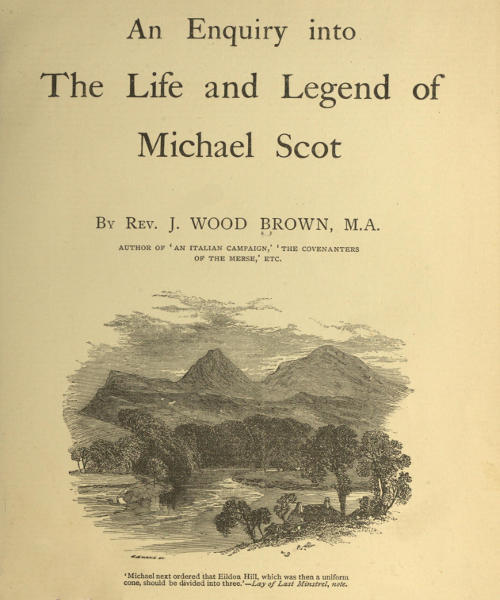
Perhaps the best known of these Scottish tales is that which relates how Michael Scot had a particular spirit as his familiar, and describes the difficulty he felt in discovering new tasks for his supernatural servant. Sir Walter Scott says that this story had made so deep an impression, that in his day any ancient work of unknown origin was ascribed by the country people either to Sir William Wallace, Michael Scot, or the devil himself.[313] But, as commonly told, the legend refers to certain outstanding features of the country which are natural and not artificial; a fact which may possibly account for its persistence and survival in this form and not in the others. Michael is said to have commanded his spirit to divide Eildon Hill into three.[314] The feat was accomplished in a single night, but, the magician’s instructions being very precise, and the spirit finding one of the peaks he had formed greater, and another less than the mean, accommodated the matter very skilfully by transferring what seems like a spadeful of earth, still visible as a distinct prominence on the sky-line of the hill. Next night brought the need for another task, and Michael gave orders that the river Tweed should be bound in its course by a curb of stone. The remarkable basaltic dyke which crosses the bed of the stream near Ednam is said to have been the result of this command. On the third night, finding his familiar still keen for employment, Scot bade him go spin ropes of sand at the river mouth. This task proved so difficult as to relieve the magician from further embarrassment. It is said to be still in progress, and the successive attempts and failures of the spirit are pointed out as every tide casts up, or receding, uncovers, the ever-shifting sands of Berwick bar.
Another Scottish story, borrowed perhaps from the relations between Michael Scot and Frederick II., and possibly suggested by the philosopher’s journey in 1230, speaks of a high commission he once held from the King of Scotland.[315] Some Frenchmen, it is said, had commenced pirates, and had plundered Scottish ships. The King chose Michael as his ambassador, sending him to Paris to demand justice and redress. The magician, however, made none of the ordinary preparations for so considerable a journey, but opened his Book of Might and read a spell therein; whereupon his familiar appeared in the form of a black horse, just as Folengo describes him. In this shape the demon carried his rider through the air with incredible speed. When the channel lay beneath them, he asked Michael what words the old wives in Scotland muttered ere they went to sleep. A less adroit wizard would have simply repeated the Paternoster, and thus furnished the excuse sought by the demon, who would then have hurled his rider into the sea. Michael, however, contented himself by sternly replying; ‘What is that to thee? Mount Diabolus, and fly;’ and, the demon being thus outwitted and compelled, they presently arrived in Paris. Finding the French King unwilling to hear his representations, Scot asked him to delay giving a final refusal till he should have heard the horse stamp three times. At the first hoof-stroke, all the bells in Paris rang. At the second, three towers in the palace fell; and the horse had raised his foot to stamp once more, when the King cried, ‘Hold,’ and yielded him to do as his cousin of Scotland desired.
A more trivial and domestic tale is that which relates how Michael met and overcame the Witch of Falsehope.[316] He was then residing at Oakwood Tower, and, hearing much talk of this woman’s craft, he set forth one day to prove her. The witch was cunning, and denied that she had any skill in the black art, but, when Scot absently laid his staff of power upon the table, she caught it to her and used it upon him with such effect that he became a hare; in which shape he was hotly coursed by his own hounds. Taking refuge in a drain, he had just time to reverse the spell and resume his own form before the hunt reached his hiding-place. Thus Michael returned to Oakwood with a high impression of his neighbour’s skill and malice, and fully resolved to have his revenge at the first opportunity. This occurred next harvest, when, under pretext of sport, he sent his servant to the witch’s house to beg some bread for the hounds. Met with the refusal that was expected, the man acted upon his master’s instructions by privately fixing to the door a scroll containing, amid magical characters, the following rhyme:
Meanwhile the witch-wife had returned to her work; which was that of boiling porridge for the shearers. As soon, however, as Scot’s man had left the door, she began to run round the fire like one crazy, repeating as she ran the words of the spell. In a little the harvesters returned from the field to their dinner, but, as each passed the enchanted door, the spell took him, and he joined the dance within. Meanwhile Michael and his men and dogs stood not far off on the hill, whence they could command a full view of what went on. The last to leave the field was the goodman, who, suspecting something more than common from the attention Scot was paying to his house, was too cautious to enter immediately, as the rest had done. He went to the window, and through it beheld the orgy, now become terrible, and in the midst of all his wife, half dead from compulsion and exhaustion, dragged around the house and through the fire by the bewitched servants. Suspecting how matters stood, he went to Scot, who, relenting, told him how to remove the spell by entering the house backwards, and then taking the scroll down from the door. This he did, and the unearthly dance ceased, but it was long ere those who had taken part in it forgot the power of the magician, or ventured again to provoke his resentment.
The northern tales had much to say of Michael’s Book of Might, from which he learned his art, and of his burial-place, where it lay interred with him. Dempster tells us that, in his boyhood, it used to be said in Scotland that Scot’s magical works were still extant, but might not be touched for fear of the powerful demons that waited on their opening.[317] This form of the legend belongs then to the latter part of the sixteenth century. In the beginning of the next age, and precisely in the year 1629, occurred the traditional visit of Satchells to Burgh-under-Bowness.[318] This author declares that one named Lancelot Scot showed him in that place something taken from the works of the mighty magician:
It will be observed that Satchells hesitates here between the title of knighthood which had been bestowed on Scot for a century past on the authority of Hector Boëce, and the more authentic dignity of Master which was really his. He also antedates the philosopher’s lifetime by more than a hundred years; so that plainly what we have in these verses is legend and tradition rather than history.
This is probably the latest appearance in literature of the old stories concerning Michael Scot told in the old way. Naudè[319] and Schmutzer[320] presently came on the scene, in the late seventeenth and early eighteenth century, with their critical defences of Scot, all too imperfectly informed regarding his real reputation. In our own age the poems of Sir Walter Scott and Rossetti, while serving to show that so great a name has not been forgotten, breathe, it is plain, an entirely different spirit. They are but the romantic and sentimental revival of tales that the poets and their world had already ceased to believe.
Changed habits of thought, reaching and affecting every class of society, make it useless now to seek in Scotland for any new developments of the legend of Michael Scot. This is not so certainly true, however, of the South of Europe; of Italy, Sicily, and Spain, where he was once a familiar figure. There the slow progress of education has left the common people still in possession of much legendary lore, and even of the living faculty by which in past ages such tales have been formed. To ascertain what an Italian story-teller in the present year of grace would make of the name and fame of Michael Scot were clearly a curious and interesting inquiry. It is one which, on actual trial, has yielded two tales differing considerably from any hitherto published.[321] As these are certainly the very latest additions to the legend, they deserve a place here at the close of our collection. Freely rendered into English they run as follows:
‘Mengot was a notable astrologer and magician. Mengot was his true name,[322] but he had many surnames besides; among which was that of Scotto. This name of Scotto was given him by a princess. One night the Prince, her husband, happened to be in a company where the talk turned on the virtue of women, and the Prince said he would put his hand in the fire if his wife were not faithful to him; so sure was he of her virtue. Then spoke up another of the company, who made light of the caresses and compliments with which women use to deceive, and told a tale for the Prince’s warning. “There was once a man,” said he, “who thought as you do, dear Prince; for he took his wife for a pattern of virtue, and would have pledged, not his hand only, but his very life that she was so. It happened, however, that he had a friend who knew of the wizard whom they call Mengot, dwelling without the Croce Gate of Florence, and having his house below the ground, closed by a flat stone of the field so as to be secret. Those who would inquire of him must pass to the place and cry ‘Mengot! Master Mengot! I seek a favour of thee, and, if thou tell me true, I shall not stint thy reward;’ whereupon he doth straightway appear. This then was what the friend of the too confident husband did, for he summoned Mengot, and, in presence of all, said to him: ‘Tell me the truth, and whether the wife of this gentleman deserves his confidence or not.’ After some thought, the wizard replied, ‘Do you wish a true answer, or one made to please? I should be sorry to hurt the husband’s feelings.’ When all desired to have the truth, Mengot told them that the lady in question had gone to a place in the Via Calzaiuoli where disguises were arranged, and that she would be found next day dressed as a servant in the course of carrying on a vulgar intrigue in the Ghetto. Now all this was verified; for the wizard told them even the very house in the Via delle Ceste where she would be found with her lover, and it proved to be exactly as he had said.” When this tale was done, all who heard it cried that Mengot should be summoned again, to see whether the Princess were faithful or not. So they called him, as had been done in the other case, but with the same result; for here also the Prince’s confidence had been misplaced, and that in a high degree. Then said the Princess, between rage and shame, “Hast thou scotched me this time; but next time I will scotch thee.”[323] She straightway sought a witch, said to be more powerful than Mengot himself, and, telling what had happened, promised her gold by handfuls if she would revenge her on the wizard. The woman told her to be easy, for she would arrange the matter. She paid Mengot a visit as if to take his advice, and, stealing his magic rod, struck the ground three times, whereupon Mengot was turned into a hare, and fled from his habitation. Having foreseen, however, by his art that such danger might arise, Mengot had prepared a pool of enchanted water at his door. Into this he now leaped, and by its virtue was able to resume his proper form. The first thing he did was to seek the magic rod, and, finding it still in his house, he struck the witch on the head. She became a skinless[324] cat, and in that form haunted the guilty Princess for her sins; while Mengot was ever afterwards distinguished by the name of Scot.’
The second tale is to this effect:
‘Michael Scotti the wizard was a mighty master of witchcraft. There came to him one day a young lady, richly dressed, and wearing a thick veil. She told him that she wished to become a witch that she might cast a spell upon the child of a man who had forsaken her for another woman, now his wife; for she said that to bewitch this child would be the best revenge she could have. Michael was willing to content her; but we must here remark that wizards and witches gain their power, either at birth or as a legacy from some dying person who has the gift. In either of these cases, when the wizard or witch takes the form of an animal, both body and soul are present wherever the form may appear. If, on the other hand, any one becomes a witch of her own desire, as in the case before us, her spirit may move and act under such a form, but her body lies all the while where she left it. But to our tale.
‘Michael accordingly took his Magic Book, and the skin of a cat, and kindling some hempen fibre[325] in an earthen pot, he commenced to read his spells, which had such effect that the spirit of the young lady entered into the skin of the cat. In the form of that animal she then went about her business, while her body remained still in the chair where she was sitting. At her return the wizard read again in his book, whereupon the spirit of the new-made witch returned to her body as before. Michael gave her a book of this kind, and the skin he had used, and every night she turned herself into a witch, and became so wicked as to cast ill upon many children, and even on an infant brother of her own.
‘Thus the sorceress was hardly entered on her power ere she brought about the death of her rival’s child, and killed many others, but an end was presently put to these ill-doings. Her brother, whom she had bewitched out of jealousy, wasted away, and the parents were in despair, as none of the physicians whom they consulted could understand the case. One morning the child told them he had suffered much during the night from a cat, which leaped upon his bed, howled, and played the most frightful antics. They then began to suspect witchcraft, and resolved that the household should watch during the next night. On the stroke of twelve a cat was seen coming out of their daughter’s room. One of the servants gave chase, and another went into the room, fearing that the young lady had also been bewitched, and saw her lying on the bed as cold as marble. The cry arose that she was killed. The parents, mad with grief, made after the cat to destroy it, but with leaps and bounds, it kept them busy all night as if they had been huntsmen chasing a hare, and all in vain. As the bells began to sound for matins the cat ran into the young lady’s room, and the mother, beating her brow, exclaimed: “she who has bewitched my son is none other than his sister.” Rushing into the room they found her, no longer like a dead body, but all panting from the night-long chase. Her mother searched all the corners, and finding the book and earthen pot, bade throw them into the Arno. They then besought their daughter to undo the mischief she had wrought upon her brother, and so many more, and to promise she would never do the like again; but to nothing of this would she consent. Then they threw her out of window in fear and to the breaking of her bones. The servants came and took her up; laying her on her bed again; telling her to heal her brother. Not even in the last moments of life, however, would she repent. She could not die till Mengot had read for her a spell of loosing, and on him therefore she still lay crying. The servants told this to her parents, who bade put horses to the carriage and fetch the wizard, who was presently with them. First he commanded her to cure her brother, and then he read for her in his Magic Book that she might be loosed, and so she died. But when the skin and earthen pot were cast away, they sank straight underground. Thus the witch, who still came back every night to get the skin, and take the form of a cat, found all her magic art in vain; for Michael Scotti had taken her power away.’
‘Desinit in piscem mulier formosa superne!’ To such vain and trivial conclusions has a reputation, justly renowned in its own day, been reduced in ours. Michael Scot, now become a troglodyte, lifts his head timidly and occasionally from a den in the Florence fields; he who, while alive, filled Europe with his fame, and, by his Averroës, ruled the schools of Padua as late as the seventeenth century. If a remedy is still to be had for this, the fruit of Guelphic rancour, it must be found in the direction we have sought to keep throughout these pages: that of a serious and impartial study of Scot’s life, and of those labours of his in philosophy and science which are so really, though remotely, connected with the intellectual attainments of our own times.
APPENDIX
APPENDIX I
✠ Experimentum Michaelis Scoti nigromantici.[326]
Si volueris per daemones haberi scientem, qui in forma magistri ad te veniet cum tibi placuerit, expedit tibi primo habere quandam cameram fulgentem et nitidam, in qua nunquam mulier non conversetur, nec vir ante inchoationem triginta diebus, computato itaque tempore taliter quod xxxj die fit luna crescens[327] –o– ☿ eius hora, castus per septimanam, rasus totus, ac etiam lotus, necnon vestimentis albis indutus. Solus in ortu solis, in quo, et ipsa hora ☿ habeas quoddam vas in quo sit lignum aloes camphora et cipressum cum igne, ex quibus fiat fumus, et primo te totum suffumiga, scilicet primo faciem, deinde alia, postea etiam totam cameram. Quo facto, habeas oleum bacharum et totum te unge a capite usque ad pedes, hoc facto, volve te primo versus 🜚 ortum, et sic dic, flexis genibus: O admirabilis et ineffabilis et incomprehensibilis, Qui omnia ex nihilo formasti, apud quem nihil impossibile est, te deprecor cum humilitate vehementi ut mihi, famulo tuo tali, tribuas gratiam cognoscendi potentiam tuam, Qui vivis et regnas cum Deo Patre per omnia saecula saeculorum, Amen. Praesta quaesumus mihi tutellam angeli tui, qui me custodiat, protegat, atque defendat, et adjuvet ad huius operis consummationem, et faciat me potentem contra omnes spiritus ut vincam etiam dominer eis, et ipsi adversus me terrendi vel laedendi nullam habeant potestatem, Amen, [here follow verses 25-28 of Psalm 119.] Similiter versus occasum, meridiem, et septentrionem, et debes scire quod, quando vertis te, debes te totum expoliare nudum, deinde dicere has orationes: quo facto, debes te induere dicendo hunc psalmum, [Psalm 76: 1-.] usque quomodo cogitatio hominis, etc. quo dicto, et inducto, dic tu haec verba [Psalm 37: 30.] Quibus dictis habeas unum frustrum panni albi de lana, quae nunquam fuerit in usu, et habeas quandam columbam albam totam vel –o– cuiuscumque coloris sit, et trunca eius collum, et collige eius sanguinem in vase vitreo, et de dicta columba sive –ͨoͦ–ͬ sanguinando dictum cor in 1º. o. Fac cum dicto corde cruentato, in dicto panno, circulum, ut apparet inferius, quo facto, intra circulum cum ense in manu: qui ensis debet esse lucidissimus, cum quo ense avis caput debet truncari ut dictum est, et ipsum tenendo per cuspidem, aspiciendo versus orientem, dic sic: O misericordissime Deus, Creator omnium, et omnium scientiarum Largitor, Qui vis magis peccatorem vivere, ut ad penitentiam valeat pervenire, quam ipsum mori sordidum in peccatis, Te deprecor toto mentis affectu ut cogas et liges istos tres demones, videlicet Appolyin, Maraloch, Berich, ut debeant per virtutem et potentiam tuam mihi obedire, servire, et parere, sine aliquo fraude, malignatione vel furore, in omnibus quae praecipio: Qui vivis et regnas in unitate Spiritus Sancti, Amen. Debet haec enim oratio dici novies versus orientem, deinde debes dicere, Appolyin, Maraloch, Berich, Ego talis vos exorcizo et conjuro ex parte Dei Omnipotentis Qui vos vestra elatione jussit antra subire profundi, ut debeatis mittere quendam spiritum peritum dogmate omnium scientiarum, qui mihi sit benivolus, fidelis, et placidus ad docendum omnem scientiam quam voluero, veniens in formam magistri ut nullam formidinem percipere valeam, fiat, fiat, fiat. Item conjuro vos per Patrem et Filium et Spiritum Sanctum ut per haec sancta nomina quorum virtute ligamen, scilicet Dober, Uriel, Sabaoth, Semonyi, Adonayi, Tetragramaton, Albumayzi, Loch, Morech, Sadabyin, Rodeber, Donnel, Parabyiel, Alatuel, Nominam, et Ysober, quatenus vos tres reges maximi et mihi socii, mihi petenti, unum de subditis vestris mittere laboretis, qui sit magister omnium scientiarum et artium, veniens in forma humana, placibilis aplaudens mihi et erudens me cum amore ita et taliter quod in termino xxxta dierum talem scientiam valeam adipisci, promittens post sumptionem scientiae dare libi licentiam recedendi, ut hoc etiam totiens dici debet. Hac oratione vero dicta, ensem depone et involve in dicto panno, et facto vasiculo, cuba super ipso ut aliquantulum dormias. Post sompnum vero surge et induas te: quia facto vasiculo homo se spoliat et intrat cubiculum ponendo dictum vasiculum super capite. Est autem sciendum quod dictis his conjurationibus somnus acculit virtute divina, in somno autem apparebunt tibi tres maximi reges, cum famulis innumeris militibus peditibus, inter quos est etiam quidam magister apparens, cui ipsi tres reges jubent ad te ipsum venire paratam. Videbis enim tres reges fulgentes mira pulcritudine, qui tibi in dicto sompno viva voce loquentur dicentes, Ecce tibi Domini quod multotiens postulasti, et dicent illi magistro, Sit iste tuus discipulus quem docere tibi jubemus omnem scientiam sive artem quam audire voluerit. Doce illum taliter et erudi ut in termino xxx dierum in qualem scientiam voluerit, ut summus inter alios habeatur:[328] et ipsum audies et videbis eum respondere, dictum mei libentissime faciam quicquid vultis. His dictis reges abibunt et magister solus remanebit, qui tibi dicet, Surge, ecce tuus magister. His vero dictis, excitaberis statim et aperies occulos et videbis quendam magistrum optime indutum, qui tibi dicet, Da mihi ensem quem sub capite tenes. Tu vero dices Ecce discipulus vester paratus est facere quicquid vultis; tamen debes habere pugillarem et scribere omnia quae tibi dicet. Primo debes quaerere, O magister, quod est nomen vestrum: ipse dicet, et tu scribes; secundo, de quo ordine, et similiter scribe: his scriptis, dabis ensem, quo habito, ipse recedet dicens, Expecta me donec veniam: tu nihil dices. Magister vero recedet et secum portabit ensem, post cuius recessu tu solves pannum, ut apparet inferius,[329] etiam scribes in dicto circulo nomen eius scriptum per te, et scribi debet etiam cum supradicto, O, quo scripto involve dictum pannum et bene reconde: his factis debes prandere solo pane et pura aqua, et illa die non egredi cameram et cum pransus fueris accipe pannum et intra circulum versus Appolyim et dic sic, O rex Appolyim magne potens et venerabilis ego famulus tuus in te credens, et omnino confidens, quia tu es fortior, et valens per incomprehensibilem majestatem tuam, ut famulus et subditus tuus talis, magister meus, debeat ad me venire quam citius fieri potest, per virtutem et potentiam tuam quae est magna et maxima in saecula saeculorum, Amen. et similiter dicere versus Maraloth, mutando nomen, et versus Berith similiter, his dictis accipe de dicto sanguine et scribe in circulo nomen tuum cum supradicto corde ut hic apparet inferius. Deinde scribe cum dicto corde in angulis panni illa nomina ut hic apparent. Si autem sanguis unius avis non tibi sufficeret, potes interficere quot tibi placent: quibus omnibus factis, sedebis per totum diem in circulo aspiciens ipsum, nihil loquendo; cum vero sero fuerit, plica dictum pannum spoliato, et intra cubiculum ponendo ipsum sub capite tuo, et cum posueris dici sit plana voce, O Appolyin, Maraloch, Berich, Sathan, Belyal, Belzebuch, Lucifer, supplico vobis ut precipiatis magistro meo, nominando eius nomen, ut ipse debeat venire solus ante eras ad me, et docere me talem scientiam sine aliqua alia fallacia, per Illum Qui venturus est judicare vivos et mortuos et saeculum per ignem, Amen. Cave igitur et praecave ne signum ✠ facias, propter magnum periculum. In sompno scies quia videbis magistrum tota nocte loqui tecum, interrogans a te qualem scientiam vis adiscere, et tu dices, talem. Itaque ut dictus est tota nocte cum eo loqueris. Cum itaque excitatus fueris in ipsa nocte, surge et accende candelam, et accipe dictum pannum et dissolve, et sede in eo, scilicet in circulo, ubi nomen tuum scriptum est, ad tuum commodum, et voca nomen magistri tui, sic dicens, O talis de talis (sic) ordine, in magistrum meum datum per majores reges tuos, te deprecor ut venies in forma benigna ad docendum me in tali scientia, quia sim probīor omnibus mortalibus docens ipsam cum magno gaudio, sine aliquo labore, ac omni tedio derelicto. Veni igitur ex tuorum parte majoris qui regnat per infinita saecula saeculorum, Amen, fiat, fiat, fiat. His itaque dictis, ter aspicias versus occidentem, videbis magistrum venire cum multis discipulis, quem rogabis ut omnes abire jubeat, et statim recedent: quo facto, ipse magister dicet quam scientiam audire desideras; tu dices talem, et tunc incipies, memento enim quia tantum adiscens memoriae commodabis et omnem scientiam quam habere volueris adisces in termino xxx dierum. Et quando ipsum de camera abire volueris, plica pannum et reconde, et statim recedet: et quando ipsum venire volueris, aperi pannum, et subito ibidem apparebit continuando lectiones. Post vero terminum xxx dierum, doctus optime in illa scientia evades, et fac tibi dare ensem tuum, et dic ut vadat, et cum pace recedat. Debes iterum dicere cum pro alia ipsum invocabis habenda scientia, quod tibi dicet ad tuum libitum esse paratum. Finis capituli scientiae. Explicit nicromantiae experimentum illustrissimi doctoris Domini Magistri Michaelis Scoti, qui summus inter alios nominatur Magister, qui fuit Scotus, et servus praeclarissimo Domino suo Domino Philipo Regis Ceciliae coronato; quod destinavit sibi dum esset aegrotus in civitate Cordubae, etc. Finis
APPENDIX II
Fondo Vaticano 4428, ms. perg. in fol. saec. xiii. cum min.