
PREFACE.
The possibility of making cloths of gold, silver, and other metals, by chymical processes, occurred to me in the year 1780: the project being mentioned to Doctor Fulhame, and some friends, was deemed improbable. However, after some time, I had the satisfaction of realizing the idea, in some degree, by experiment.
Animated by this small success, I have, from time to time, ever since, prosecuted the subject as far as pecuniary circumstances would permit.
I imagined in the beginning, that a few experiments would determine the problem; but experience soon convinced me, that a very great number indeed were necessary, before such an art could be brought to any tolerable degree of perfection.
A narration of the numerous experiments, which I made with this view, would far exceed the bounds, I prescribe myself in this essay; I shall therefore present the reader only with a few, selecting such as I judge most interesting, and best adapted to illustrate the subject.
Though I was, after some considerable time, able to make small bits of cloth of gold, and silver, yet I did not think them worthy of public attention; but by persevering, I at length succeeded in making pieces of gold cloth, as large as my finances would admit.
Some time after this period, I found the invention was applicable to painting, and would also contribute to facilitate the study of geography: for I have applied it to some maps, the rivers of which I represented in silver, and the cities in gold. The rivers appearing, as it were, in silver streams, have a most pleasing effect on the sight, and relieve the eye of that painful search for the course, and origin, of rivers, the minutest branches of which can be splendidly represented in this way.
Notwithstanding this further success, I was dubious about the propriety of publishing this Essay; I therefore shewed some specimens of these metallic stuffs to persons, whom I thought qualified to judge of them: some approved of them very much, and were pleased to say, that the invention would make an era in the arts; others thought it a pretty conceit; and others were of opinion, that the stuffs had not that splendour, or burnished appearance, which could entitle them to public notice.
The latter opinion had much weight with me; for it must be allowed, that the specimens, which I shewed them, had not that lustre and polish, necessary for shoulder-knots, lace, spangles, gold muslins, &c.; that some of them had a reddish cast, bordering on the colour of copper, some a purple, mixed with gold; and that some of them were unequal in the die, and seemed stained; which imperfections were owing to a partial reduction of the metal in the fibres of the silk.
But all these imperfections, except the want of that burnished lustre so necessary for gold lace, spangles, &c. I knew I could remedy; and therefore the criticism, as far as it relates to them, had no great influence with me.
I am in possession of some pieces, one of which is about a yard in length, which have scarce any of these imperfections.
Moreover, that high polish of burnished gold, so necessary in spangles, lace, &c., would, in my opinion, be a great imperfection in gold stuffs designed for whole suits; as a person in such a habit, would look like a gilded statue.
I saw a piece of gold stuff made for the late King of Spain, which was of a purple colour, with gold wire shining through it, though rather obscurely; and it was much admired: I was so struck with its beauty, that I attempted to imitate it on a small bit of white silk; and succeeded, having produced a beautiful purple colour, with gold beaming through it.
Therefore, the want of that burnished appearance is no objection to this art; for the paler, and cooler, to a certain degree, the colour of the gold is, the more lovely do these metallic cloths appear.
I made small bits of gold tiffany, which looked exceedingly beautiful; the fineness of the thread contributing much to that effect; and, in my opinion, such webs are inimitable by mechanical means.
Beside, though I am not able to make cloths like burnished gold, others of greater means and abilities may; for we cannot pretend to prescribe any limits to the perfection, at which chymistry, and the arts, may arrive.
However, I must acknowledge, that this unfavourable judgement suspended my intention of publishing this little work, until a celebrated philosopher happening, some time in October 1793, to see some of the same pieces, and indeed, some of the worst, viewed the performance in a very different light.
This illustrious friend of science not only approved of the specimens shewn him, but offered to have a memoir on the subject presented to the Royal Society: but different incidents dissuaded me from that mode of publication, and induced me to adopt the present.
I now no longer hesitated about the propriety of publishing; for, every thing considered, I judged, that though this art could never be established, which is by no means my opinion, yet the experiments themselves, upon which I attempted to found it, as they are new, and seem to throw some light on the theory of combustion, are not unworthy the attention of Chymists.
Those who viewed my performance with a favourable eye, were of opinion, that I should dedicate this Essay to some patron of the arts; or apply for his Majesty’s Royal letters patent, in order to reimburse the expence necessarily incurred in this investigation, an expence so disproportionate to the fortune which supported it, that nothing but a certain fatality, and the hope of reward, could induce me to persevere.
As to patrons, I have heard of such beings on the record of fame; but never saw one: on the contrary, it has been my lot to know of many, whose malignant breath, as far as its deadly influence can extend, never ceases to blast the unsheltered blossoms of science.—And as for a patent, had I even the means, I should perhaps never attempt it; for if we may judge of the future by the past, I can safely affirm, that such an application would be vain.
Thus circumstanced, I publish this Essay in its present imperfect state, in order to prevent the furacious attempts of the prowling plagiary, and the insidious pretender to chymistry, from arrogating to themselves, and assuming my invention, in plundering silence: for there are those, who, if they can not by chymical, never fail by stratagem, and mechanical means, to deprive industry of the fruits, and fame, of her labours.
But the British empire should not forget, that she owes her power and greatness to commerce; that she is, as it were, the hive of the arts, and should not, by the sulphureous vapour of oppression, and neglect, compel her bees to swarm for protection to foreign climes, but rather permit them to roam in their native soil, and allow them, in the winter of life, to sip a little of the honey of their own industry.
The nation, whose evil genius withholds this protection, only sounds the trumpet of emigration; and must erelong lament her cities deserted, her fields brown with desolation, and herself the easy prey, and vile drudge of surrounding greatness.
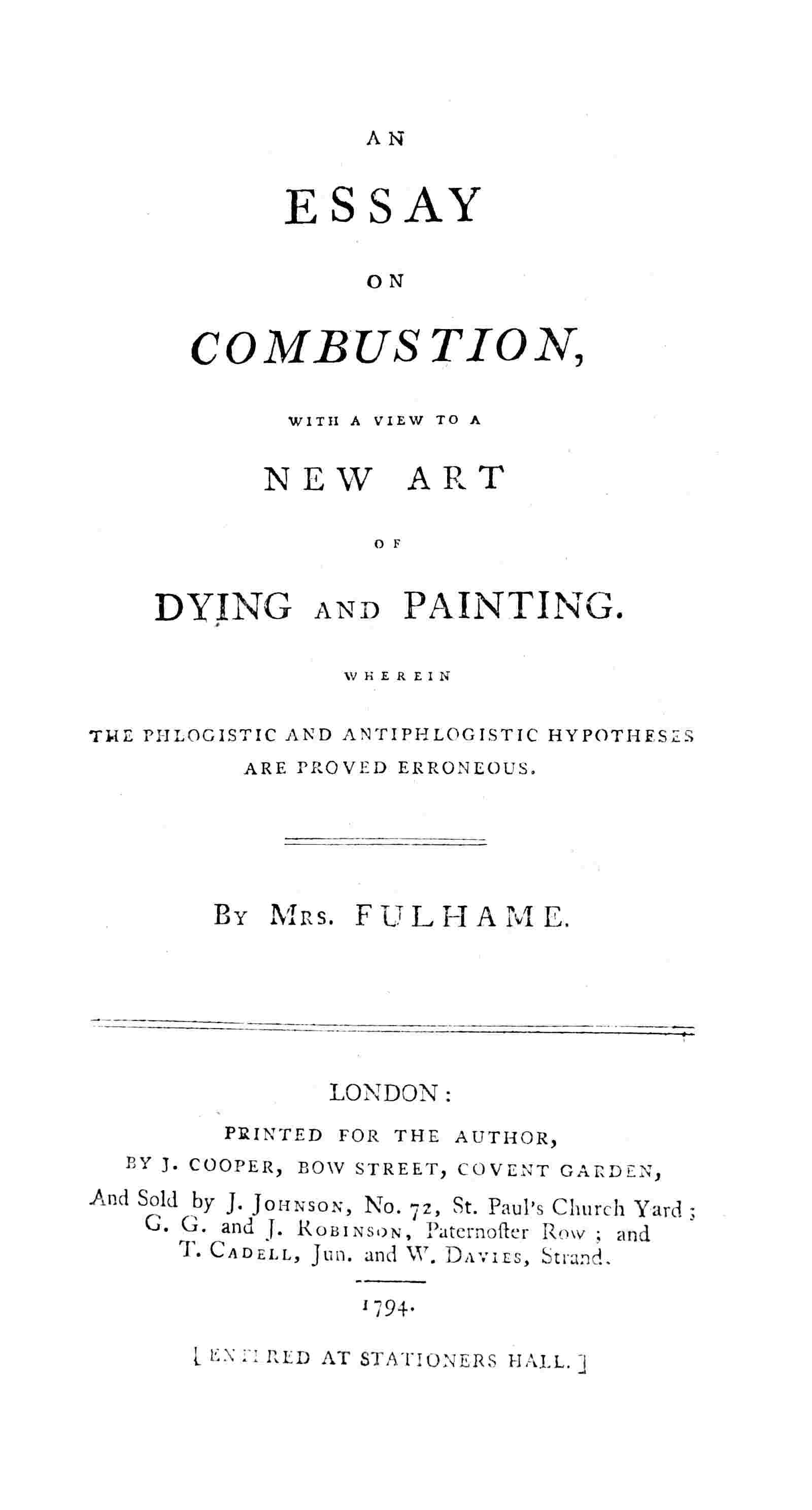
I first imagined, that the proper title of this performance, should be, an Essay on the Art of making Cloths of Gold, Silver, and other Metals, by chymical processes; but reflecting on the imperfect state of the art, and that my experiments related not only to the reduction, but also to the calcination of metals, and other combustible bodies, I determined to entitle it, An Essay on Combustion, with a view to a new Art of Dying and Painting, which includes every thing the experiments can extend to.
As to the style, I have endeavoured to relate the experiments in a plain and simple manner, aiming more at perspicuity, than elegance.
I have adopted the French Nomenclature, as the terms of it are so framed, as to prevent circumlocution, assist the memory, by pointing out the combination, and state of the elements existing in each compound, as far as they are known; advantages to be found in no other Nomenclature.
However, the English reader must regret, that the French chymists have not preferred the terms air, and ammonia, to the less harmonious sounds, gas, and ammoniac. I took the liberty of writing the latter ammonia.
I have not related my experiments in the order, in which they were made, sensible that such a narration would be tedious, and that a short extract from them would answer every purpose at present intended.
The experiments related I have endeavoured to arrange in such a manner, as mutually to illustrate each other, by contrasting the successful with those, that failed, thus pointing out a general principle, which forms a chain through the whole, connects all the experiments, shows their points of coincidence, and disagreement, and by this means furnishes us with data, by which, I hope, the art may be improved.
This arrangement also facilitates the perusal, and relieves the mind of that fatiguing attention, which must necessarily be given to an indigested mass of insulated experiments, that have no clew to connect them, but has, on the other hand, its disadvantages; for it throws a sameness on the work, incompatible with that variety which is often so agreeable.
My apparatus consisted chiefly of a few glass vessels for the solution of metals, and the formation of such elastic fluids, as I used. The cheapest, and the most simple of those described by Dr. Priestley answered my purpose.
Dr. Nooth’s machine for combining carbonic acid with water, is very convenient for making small experiments with some kinds of gas; as the base of that machine serves to contain the materials, from which the gas is obtained; and the middle glass the cloth previously dipped in the metallic solution, on which the experiment is to be made.
The cloth may be suspended in this part of the machine, by means of a thread, and a cork.
As this machine is useful only in experiments on a very small scale, I sometimes used tall glass cylinders, in which I suspended the subject of the experiment, by means of a thread, a cork, and a bit of cement.
This cylinder I placed over a vessel containing the materials, which produced the gas.
It is very convenient to have cylinders of different sizes, proportioned to the scale, on which the experiments are to be made.
But machinery for confining elastic fluids is not always necessary; as most of the experiments may be performed in the open air.
It may appear presuming to some, that I should engage in pursuits of this nature, but averse from indolence, and having much leisure, my mind led me to this mode of amusement, which I found entertaining, and will, I hope, be thought inoffensive by the liberal, and the learned. But censure is perhaps inevitable; for some are so ignorant, that they grow sullen and silent, and are chilled with horror at the sight of any thing, that bears the semblance of learning, in whatever shape it may appear; and should the spectre appear in the shape of woman, the pangs, which they suffer, are truly dismal.
There are others, who suffer the same torture in a still higher degree; but by virtue of an old inspiring tripod, on which ignorance, servility, or chance, has placed them, assume a dictatorship in science, and fancying their rights and prerogatives invaded, swell with rage, and are suddenly seized with a violent and irresistible desire of revenge, manifesting itself by innuendos, nods, whispers, sneers, grins, grimace, satanic smiles, and witticisms uttered sometimes in the acute, and sometimes in the nasal obtuse twang, with an affected hauteur, and contempt of the spectre; shrugs, and a variety of other contortions, attending.
Sometimes the goblin, which thus agitates them, lurks latent, and nothing is perceived but hollow murmurs, portending storms: sometimes the lurking fiend darts with sidelong fury at the devoted object, which, if unarmed, falls a victim to the grisly monster.
But happily for human kind, the magic tripod drags none into its dizzy vortex, but those who are radically stupid, and malicious, who are the beasts of prey destined to hunt down unprotected genius, to stain the page of biography, or to rot unnoted in the grave of oblivion.
Although the surge of deliberate malice be unavoidable, its force is often spent in froth, and bubbles; for this little bark of mine has weathered out full many a storm, and stemmed the boisterous tide; and though the cargo be not rich, the dangers, which may hereafter be pourtrayed on votive tablet, may serve as a beacon to future mariners.
But happen what may, I hope I shall never experience such desertion of mind, as not to hold the helm with becoming fortitude against the storm raised by ignorance, petulant arrogance, and privileged dulness.
However, were I not encouraged by the judgement of some friends, and possessed of specimens, to show the progress made in the art, I should never perhaps venture to publish this Essay; as I am sensible, it labours under many imperfections, which inaccuracy of observation, and the drapery of imagination, must spread over the whole, imperfections perhaps unavoidable in such a discussion.
Finding, the experiments could not be explained on any theory hitherto advanced, I was led to form an opinion different from that of M. Lavoisier, and other great names. Persuaded that we are not to be deterred from the investigation of truth by any authority however great, and that every opinion must stand or fall by its own merits, I venture with diffidence to offer mine to the world, willing to relinquish it, as soon as a more rational appears.
November 5th, 1794.