
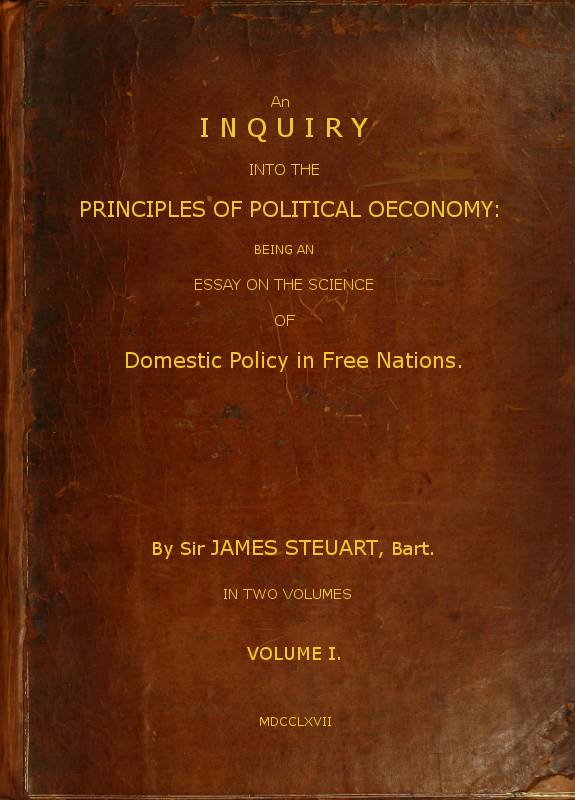
An Inquiry into the Principles of Political Oeconomy (Vol. 1 of 2) / Being an essay on the science of domestic policy in free nations. In which are particularly considered population, agriculture, trade, industry, money, coin, interest, circulation, banks, exchange, public credit, and taxes
Explore more books like this:
About This Book
The essay presents a systematic examination of domestic political economy, analyzing how population, agriculture, trade, and industry interact with money, coinage, interest, circulation, banks, exchange, public credit, and taxation. It combines theoretical principles with practical observations to trace causal links between production, monetary systems, credit institutions, and fiscal arrangements, showing how these elements shape trade, industry, and national resources. Organized as a reasoned inquiry rather than a handbook of institutions, it seeks to reduce complex policy questions to coherent principles and to illustrate the consequences of different economic structures and regulations.
About the Author

More Books by This Author
1 picks
You May Also Like
6 picks
 A Brief History of Panics and Their Periodical Occurrence in the United States
by Clément Juglar
A Brief History of Panics and Their Periodical Occurrence in the United States
by Clément Juglar
 A Contribution to the Critique of Political Economy
by Karl Marx
A Contribution to the Critique of Political Economy
by Karl Marx
 A Critical Examination of Socialism
by W. H. Mallock
A Critical Examination of Socialism
by W. H. Mallock
 A Discourse on Trade, and Other Matters Relative to it
by John Cary
A Discourse on Trade, and Other Matters Relative to it
by John Cary
 A dissolução do regimen capitalista
by Teixeira Bastos
A dissolução do regimen capitalista
by Teixeira Bastos
 A History of Banks for Savings in Great Britain and Ireland
by William Lewins
A History of Banks for Savings in Great Britain and Ireland
by William Lewins