
PART I.
INTRODUCTION.
“Les hommes sont bien malheureux! ils flottent sans cesse entre de fausses esperances et des craintes ridicules; et, au lieu de s’appuyer sur la raison, ils se font des monstres qui les intimident, ou des fantomes qui les seduisent.”
The author of the following pages has been induced to lay before the public the details of an investigation into Atmospheric Contagion, from the following considerations.
1st, That there prevails among the public, and especially among the relatives of the sick, much unnecessary alarm on that subject.
2d, That much injury is inflicted upon the poor patient, who is often made to suffer great and cruel privations, from the neglect and desertion of friends in a state of panic.
3d, That a great obstacle to the progress of Medical Science, is raised up by the belief in the existence of Atmospheric Contagion.
4th, That there exists relative to that subject, much confusion, from the misapplication of terms.
He has thought that these are important grievances, and that a little labour would go far to remove them. He is satisfied, from the investigation that is shortly to be detailed, that Atmospheric Contagion has no existence; that consequently all the apprehension felt upon the subject is groundless, and that the many painful measures which the public adopt, for their security, are totally unnecessary.
On a subject, too, touching such important considerations as the dreadful panic often experienced when pestilence is ravaging; the safety and ease of mind of the public; the discharge of the most sacred offices of kindness and consolation to their sick and dying fellow-men; and the progress of medical science, he has felt that the public must take a deep interest, and that he is warranted in treating it in a style fitted for popular perusal.
It must be granted that the British nation, whose sympathy is not confined among themselves, but exists for the various tribes of the human race, civilized and savage, must willingly lend an ear to an argument, whose object is, to shew that their own safety from pestilence, does not require them to be placed in the painful and cruel position, of withholding their aid from a suffering and helpless fellow-creature; of disregarding the cries and the imploring and eloquent looks of the dying; of forsaking the sick-bed of a father or a brother, denying the tender and unpurchaseable offices of friendship, and of ruthlessly breaking asunder the sacred bonds with which God has wisely and indulgently joined us.
They, whose hearts are open to the appeal of the forlorn slave, must be gratified to hear that they may perform the offices of humanity to their sick relatives and friends, without, as has hitherto been thought, subjecting themselves to the almost certain invasion of disease; that they may watch the last moments of an expiring friend, minister to his latest wants, and have the melancholy gratification of standing by him, when about to make the last and most awful change that can overtake him.
It is expected that it will be shewn, that the sick-room is at all times free of the poison with which it has been believed to be contaminated, and that the atmosphere there, if attention is paid to ventilation, &c. is almost as wholesome as that out of doors.
The air which the sick respire does become impure, but not on ordinary occasions in a manner different, or with a greater virulence, than is observed in the case of air in a small and close apartment, respired by many persons closely huddled together.
The history of sick chambers presents no instance more dreadful than that of the Black Hole of Calcutta, where so many perished of corrupted or vitiated air.
The subject of infectious air touches directly upon the most important interests of mankind, concerns intimately their safety, the duties of man to man, and even the very affections of the heart.
As the subject at present stands, the public is awkwardly situated; believing that they must either endanger their health, even their lives, or allow their friends and relatives to perish unassisted.
The author thinks he is under no obligation to apologize for attempting to shew, that the public may at once perform all the charities of life to the sick, and avoid the action of a virulent poison. There can be none necessary, and he even hopes that his inquiry may tend to obtain for many, who are yet to be the victims of pestilence, that succour from hands they love, which, alas! has been withheld from thousands.
It has not been usual to write speculative medical opinions in a popular style, but the author is of opinion that an inquiry bearing on matters so important, should be made known to those whom it most concerns, certainly, the people; and he is convinced, that in a simple case of evidence such as this, that they are qualified to decide, provided there is a full and impartial leading of facts on both sides, and there be absence of all technical terms and purely professional phrases. The discussion will be conducted on plain and obvious principles, so that the merits of the question may be appreciated, at once, by them and the profession.
The public is already informed of much that relates to the animal economy in health, through the assistance of many admirable works which have been published within the last few years, and it is not unfair to suppose that they may be interested in hearing, and likewise capable of understanding, a case relative to disease.
The community is aware that Medicine is not now the subtle, hidden, affectedly mysterious art, it was at no very remote date; and that its present enlightened professors now seek not the assistance of darkness, of silence, to disguise their ignorance and questionable views, or to heighten the impression of the skill and cunning of their order.
Its study is now conducted openly, and its foundation, happily, is laid upon principles established in nature that are as well known to the unprofessional as to the professional man.
There is no wish to disguise matters from the public, and, were it attempted, it could not possibly succeed.
The utmost care will be observed to lay the evidence impartially down, plainly, and divested of technical phraseology; and, satisfied of the general ability of the public to judge, the author will await their decision with as much anxiety as that of the medical world.
It will afford the writer the return he most values, if, by his means, less anxiety and apprehension are felt in future among the public on occasions of disease; if those acting under a sense of duty are enabled to discharge their humane offices with less feeling of danger; if the patient remain unoppressed with alarm for the dear ministering friends around him; if even one sufferer be spared the anguish of bearing wants unanswered, and if in his last hours he is spared the bitterness of soul he must experience, when deserted by those to whom, through life, he looked for comfort and support.
The author has also been induced to publish his views upon vitiated air, its nature, sources and effects, with directions for its prevention, avoidance, and correction. Vitiated air has been confounded with atmospheric contagion, has performed the greater part of the work of death attributed to that agency, or supposed agency, and it has been it that has been affected and controlled, when both non-professional people and the medical world thought systems of quarantine, isolation, gens des cordons, (contagion police,) and fumigations, were effecting the objects for which they were established.
The immediate objects of these counteracting agents, the destruction of contagion and contagious atmosphere, &c., could not be effected, since, at least, the latter does not exist: but fortunately, though they could not effect the objects immediately proposed, the ultimate ends have been served, by their acting on many occasions upon the efficient causes of disease, viz. vitiated air.
They were useful after the fashion of the medicine and charms in olden times, used for the expulsion of evil spirits, devils, and the like, which, by their natural action upon the functions of the body, corrected derangements which were mistaken for the operations of these imaginary beings. The Author has pointed out other causes of pestilence, and has given some directions for their prevention, and for the preservation of health.
CHAPTER I.
PREVALENCE OF DOCTRINE OF ATMOSPHERIC CONTAGION, INJURY TO PATIENT, ATTENDANTS AND VISITORS.
Atmospheric contagion, to which public attention is directed, has been regarded for many ages as the cause of a great proportion of the pestilence incident to the human race; and, at the present day, most of the diseases which are wont to be widely spread, and to be very mortal, are usually considered as depending on that agent, both by the unprofessional and the medical world: indeed, so extended has been thought its sphere of action, that it is suspected to be operating in almost every case that occurs, of those diseases which usually attack many at the same time; and, in nearly every instance, its existence is positively inferred, where previous cases can be shewn to have been prevailing, though at the distance of several miles.
It is a fact familiar to many, that, on the occasion of the late prevalence of Cholera Morbus in the years 1831 and 1832, that infection, through the medium of the air, was considered the most common cause of the propagation of that scourge; and every mother is taught to regard every case of scarlet fever, common fever, hooping-cough, and many such disorders, as a very centre of infectious air that possesses qualities subversive of the health of her children.
Ordinary conversation, too, marks well the common belief in the positive injury that agent inflicts. In general, it seems a matter quite out of the question to suppose, that the patient may have got his sickness from the operation of other and distinct causes, as is sufficiently evident from such common questions as these, “Had he visited any person ill of the same complaint?”—“Where, and from whom, did he get the infection?” and likewise from the ordinary replies, “He got it from a friend, at whose house he called to inquire after his health,”—“He caught it when passing through a street in which a person lay ill of the same distemper.” Such inquiries and replies are made not only by the public, but by the medical profession also, who are, in general, sufficiently satisfied if such answers and solutions as those above be given. Were it necessary to say more to prove the important position infection holds as a cause of disease, and as the chief instrument of its propagation, references might be made to thousands of instances, narrated, too, on medical authority, where whole visitations of pestilence have been attributed to its operation, and volumes might be filled with the most skilful artifices, devised, and actually carried into execution, to deprive the air of its invisible poison; but these steps are deemed unnecessary here.
The belief in the doctrine of atmospheric contagion is hurtful to the patient by its direct influence on his mind, and the gratification of his wishes.
The patient laid on the bed of sickness, having many wants and occasions for a thousand little offices, but being unable to assist himself, generally desires, and, where apprehension does not cause desertion, obtains the aid of good and gentle friends, whose very presence affords a gratification to the sufferer which none can sufficiently value, who have not, like him, felt its blessings. Their assistance and constant presence is absolutely necessary to supply his several wants, and to render a situation, often painful, and ever irksome, less acutely so.
But not more necessary is such assistance to the mitigation of the sufferings of the body, and the soothing, the calming of a fevered mind, than is it urgently wished for, and longed for by the patient, to whom even the momentary absence of the ministering being from his bedside is frequently the cause of much mental agitation and of pain.
But where, as we have often seen, the patient has still his senses left, and dearly loves the objects around him, what must be the amount of that bitterness of mental struggle going on in his breast, alternately heaving with desire for their presence as his greatest comfort, and with the alarm every amiable being must feel, lest those most dear to him should fall the victims of their tenderness, and be cut down themselves, in their holy endeavours to relieve his sufferings?
The apprehensions of the patient lest those kind and beloved friends ministering to his wants, and nobly incurring on his account all the risk of a dangerous situation, should unhappily derive from him, through the medium of Atmospheric Contagion, the same disease,—are calculated to produce a state of excitement highly injurious and directly opposed to that calm and cheerful state of mind so favourable to his recovery. But these apprehensions are often changed for the dreadful reality, and no little mental suffering has been produced, and no trifling obstacle to the convalescence of a patient has been raised up, by the intimation that a dear friend has caught the pestilence from him, and has in consequence been deprived of life.
The belief in the doctrine of Atmospheric Contagion is hurtful also to the friends and attendants of the patient—by its naturally conveying the impression that he is a centre of a poisonous agent, whose immediate tendency is to propagate the distemper and diffuse itself through the atmosphere, extending to it, its deleterious attributes, to be felt by all who respire it.
The poison is said to diffuse itself in the air of the apartment; hence it is believed, that entering into the apartment is tantamount to destruction, or at least, is nothing less than exposure to an influence of the most virulent and deadly quality.
It does not at the time signify to the attendants, the evidence on which the doctrine rests. It is believed, and that is enough to cause the most baneful effects upon the spirits, to inspire the worst apprehensions, and has also, as is well known, produced those very effects they had feared from its operation, has caused the increase of disease, nay, death itself, and that not on one occasion only, but on many.
The most common causes of Pestilence, Plague, Putrid and low Fevers, and Cholera, are mostly of a depressing nature, and, usually, the more they partake of that character, they are the more effectual in their operation. Famine is chiefly favourable to the sickness which is usually coincident with it, from the depressed and feeble state of body it produces; and an impure atmosphere is deleterious, chiefly from its allowing the body to become less energetic, by withholding that vigour and elasticity which the respiration of pure air imparts to the system at large, and thence to the mind.
These are powerful depressing causes, but not more so than fear, especially that kind that is deep and lasts long. Moral philosophers rank Fear as one of the most depressing passions, and its characteristics with the artist are paleness, contraction of the features, the best and surest indication of a weakened circulation (of blood) and diminution of vital power. The first are well aware of the hurtful influence it imparts to the whole body, and narrate instances, on excellent authority, where death, even immediate death, has been the consequence, where the brain has had its functions impaired, and thus imbecility induced; so that in short, they are accustomed to regard it as one of the most powerful agents, applied both to the mind and body.
The Medical Philosopher, too, has frequent occasion to mark the great depression of the powers of the body, the imperfect discharge of its functions, and the general exhaustion consequent upon the long continued operation of apprehension.
Be the apprehension of whatever nature, it is always detrimental—in a ratio too, proportionate to its intensity, and its other contingent circumstances. In the lesser degrees, it causes indigestion, flatus, loss of appetite, headach, and often general restlessness, with feelings of great discomfort.
It is found operating with great force, whether it arise from apprehension of damnation in respect to a future state, of ruin in a pecuniary point of view, or perhaps from what is most immediate and striking in its effects, of catching the infection of pestilential disease, which is the point with which we have most to do.
We have known many persons much affected with the fear of taking infection, and allowing this to prey upon their spirits, who were among the first attacked with pestilence; and if any weight is to be given to our knowledge of the probable causes of disease, there is great reason for concluding that those persons were the victims of their very fears, more than of any other causes of a prejudicial character. It is often impossible, with complete justice, to say decidedly that any one influence has been the exclusive cause of disease, when there is room to think there are, or may be many ready to operate; but, in many instances, the relation has been so immediate, and so striking between the known presence of depressing apprehension, and the supervention of sickness, that there is no room left to doubt the propriety of placing them in the relation of cause and effect. It must be familiar to many, quite a common occurrence, and one of which we heard constantly during the ravages of Cholera a few years ago, that persons took that disease from mere fright, and of the attack having been very much encouraged by its operation among the attendants, and more especially of those believing in the existence of the infectious nature of the disease.
These facts, it is thought, will prove that the doctrine of Atmospheric Contagion is calculated to excite much apprehension among the attendants and visitors of one sick of pestilence, and to shew in what manner that very apprehension is disposed to produce disease.
The attendant or visitor persuaded of the atmospherically contagious character of the disease, must possess considerable fortitude to venture at all into the presence of the patient, and even when once there, he must possess more than common hardihood, who does not feel more or less depressed with apprehension for that potent, and not the less imposing agent, because invisible, which, like a drawn sword, hangs over him, and threatens his existence.
By the belief in the doctrine of Atmospheric Contagion, the attendant not only becomes, in general, exposed to one of the most common and efficient causes of disease, viz. fear, but his offices are performed more as a duty than as a gratification, which it is to a well disposed mind, where no extraordinary danger is encountered, and he is thus forced to make a sacrifice of his feelings, and the valued assurance of security to a rigid sense of duty; but however much such conduct may agree with morals, it is detrimental to health.
It is hurtful also to the patient, from its influencing so far those, who, by relationship, by previous terms of friendship, and by duty, are bound, by every moral obligation, to assist him, now helpless, sick, and perhaps expiring,—as to forget their most sacred duties as to make them disregard his forlorn situation, and indeed to induce them to fly from and desert him; thus sacrificing every good principle and wholesome consideration, (as they erroneously think) to make their own lives the more secure.
Such contingencies are of frequent occurrence; and the result is, that many unhappy persons are left to perish, their thirst unslaked, their latest requests unheard, and their last moments unwitnessed. Parents have been known to forsake their children, and the offspring their parents, whom, at all hazards, they were bound to serve,—by every holy affection, to assist the more diligently, the more they were pressed with adversity.
But alas! the affections, the instincts of Nature, the dictates of gratitude, have been thrown aside, and every thing fair and holy in the human soul has been foully stained, in the almost universal wreck, attendant on the course of pestilence.
The history of the cholera visitation affords many examples of perishing persons deserted and left to the mercy of a cruel scourge; and we are familiar with many instances which have come under our own charge, where it has been found impossible to procure the attendance of relations, or even the mercenary aid of hirelings, although extraordinary remuneration has been offered.
Last winter, the father and mother of a family were seized with fever, and their sole attendants were their infant children. There were several relatives of the family not far off, but none, not even one, could be persuaded to lend assistance. Their neighbours refused to hold any communication; and, notwithstanding repeated and continued attempts by the Author to induce those who make it their business to wait upon the sick, the family had to struggle on, without the least attention being paid, saving by the almost useless children, to their wants, to cleanliness, and to the administration of the remedies.
It was truly a deplorable scene, such as made the Author reprobate that cowardly desertion, and regret the operation of a doctrine so baneful, and moreover so groundless. Yet we know not whether to blame most the people or the doctrine. Did those see the scenes, the distress and cruelty inflicted through the operation of infectious air, who believe in it, and preach its avoidance; surely, did they possess one spark of humanity, it could not fail to manifest itself, by causing them to institute, or at least to listen to, an inquiry touching its evidence.
The medical attendants are not free from the hurtful operation of this doctrine. If believers in infectious air, they are under a feeling of apprehension which, perhaps with some, may not be strongly felt, on account of the frequency of impunity from exposure; but with many it is strongly felt, and influences their attendance on the sick, their communication with them, and their own comfort and feeling of security.
Many instances are known—they are of very frequent occurrence—where the physician, from apprehension, has failed to pay so many visits as were necessary, or to remain with his patient sufficiently long to ascertain his situation, and watch well the progress of the case. Cases are known where patients have been looked at by their advisers, stationed at the door, where it was impossible to ascertain the expression of the countenance, the condition of the tongue, the state of the skin, not to say any thing of that of the pulse.
We are acquainted with instances in which medical men have so acted under the apprehension of taking infection, and where, too, they have not felt they were doing any thing reprehensible, as was sufficiently evident from the fact, that they themselves were the informants.
These facts prove that injury has been done to the patient from insufficient care; and cases are not wanting, where medical men themselves have taken disease, where the circumstances of the case warranted the belief that fear was the chief, if not the only cause. Many very cunningly-devised plans have been recommended for the adoption of the physicians visiting patients labouring under infectious diseases, such as standing in a current of air passing between windows, or doors and windows,—keeping a handkerchief applied to the mouth and nose, washing the mouth with water, &c. These are sometimes adopted, yet there is room to think that, where a man of merely ordinary fortitude supposes that he inspires an atmosphere holding in solution a very virulent, nay deadly poison, that he will be anxious to make his visit as short as possible, even though the preventives above mentioned be religiously adopted.
Several of the cases of death among medical men, which have been unhesitatingly attributed to infectious air, the Author is convinced, from his knowledge of particular circumstances, and from the known tendency of fear, have arisen from depression, in consequence of that passion.
The prejudicial operation of the doctrine of infectious air has been proved in reference to the patient himself, 1st, From his apprehension for the safety of others ministering to him; 2d, From the neglect and desertion of friends and others; 3d, From the insufficient medical treatment which his case frequently obtains.
It has been proved in reference to friends and attendants, who are often in consequence in a state of apprehension, favouring the invasion of disease; and in relation to the first, who are made to regard one of the most delightful offices as a duty of imminent peril.
It is hurtful both to patient and friend, by forbidding that intercourse which, but for the danger in question, would be so delightful and consoling to both.
It tends to the commission of crimes of no trifling character, the desertion of kindred and of friends, the hardening and debasing of the heart, and the general corruption of the finest sentiments that bind and ornament society.
It has led to deeds not the least dark in the page of human history.
It takes much from the efficiency of medicine, and has been the frequent cause of much evil to its professors.
For all those reasons, it is an important subject, and demands patient investigation.
Surely a case has been made out to shew how important are its effects, and how much evil might be avoided were it proven, as is proposed to be done, that Atmospheric Contagion has no existence. That is all, that is desired to be shewn from what precedes, and we would on no account wish the amount of mischief it inflicts to be thought as put forward as an argument against its entity, which would be absurd.
CHAPTER II.
MEDICINE RETARDED—FORMS OF CONTAGION.
The progress of medical science has been much impeded by the operation of the doctrine of atmospheric contagion. From the earliest periods the practitioners of medicine have been in the habit of attributing a very great proportion of the worst forms of disease to that agent; and the consequence has been that little attention has been paid to the investigation of the most difficult, and not the least important department, that of the efficient and ordinary causes of disease.
It was almost a necessary consequence of the possession of such an instrument, ready on all occasions, to solve the problems offered by the occurrences of disease, that no inquiry would be made into those circumstances by which might be detected those influences that conduce to its production. There was ever at hand an agent whose existence all were alike ready to concede, which was amply sufficient to explain the origin and propagation of pestilence.
That being the case, medical men had no inducement to make investigations, and from one generation to another they have gone on in the old way, attributing much to that agency, and leaving uninquired into, with few exceptions, the actual springs of diseased action.
Until very lately little was known of the relation between disease and such important matters as these,—the state of the atmosphere, the severities of the weather, and its other contingent circumstances, the quality of the food and drink, clothing, habits, climate, and the like.
These most important matters received very little consideration, and although much has lately been done to shew their influence in the origin and propagation of disease; yet they are not regarded as so efficient in that respect as they ought to be, and the reason of it is, that the common application of atmospheric contagion to the explanation of the problem, by the vast majority of medical practitioners, puts a stop to the scrutiny which would detect their relation. The fact undoubtedly is, that, in respect to some diseases, little is known, among those intrusted with their treatment, of their causes. This situation of affairs is dangerous, and were physicians to adopt the extravagant measures, which the doctrine of atmospheric contagion suggests, there is a risk that, armed with weapons of so powerful a nature as our medicines are, and moreover, applied to so delicate and nicely strung a machine as the human body, their interference might become downright tampering, and dangerous in the extreme.
But the blame does not lie so much with the present generation of practitioners. It is more the fault of the science than of its present professors.
That doctrine has been taught them, as on established and well authenticated principle. They have too readily confided in the accuracy of their predecessors, and taken for ascertained, that which was only supposititious. Still the public injury is the same, be that as it may; and would the profession perform efficiently its important duties, and deserve that confidence so necessary for the full operation of the art, they would, without delay, inquire into the merits of this case, and turn to the investigation of the causes of disease, the many facts and principles, revealed by the late rapid progress of the sciences.
For the judicious and efficient treatment of disease, a knowledge of its causes is necessary. The disorders being ascertained, the first consideration in reference to the treatment is the cause or causes, and according as the information partakes of certainty or uncertainty, so the propriety of the measures is sure or doubtful.
Without a knowledge of the causes, sure or probable, our efforts are, in some cases, like random blows made in the dark, they may or may not strike the object. It is in general only when the causes are known, more or less, particularly, that medical treatment can be said to rest on a sure and philosophical basis, and to promise the full amount of benefit the art can afford.
For many years the investigation of Atmospheric Contagion has occupied the Author, anxious only to ascertain its actual merits, and to be guided by the result, free of prejudice or bias.
The result has been, that from the actual, constant, and minute observation of disease, from an enlarged inquiry into the circumstances coincident therewith, of the pestilential character of many agencies, and a careful comparison with every agent or form in nature with which we are acquainted, bearing any resemblance to what Atmospheric Contagion must be, if it have an existence at all; that where other hurtful influences are operating, Atmospheric Contagion is needlessly called in to account for their effects, and that it (i. e. Atmospheric Contagion) has no existence, properly considered, in the light of an atmosphere holding in solution a specific contagious poison.
Before commencing the argument, it is proposed to notice shortly its history, and the opinions held at this day respecting its nature and qualities.
But as these opinions are very various and conflicting, and as, moreover, from the general confusion of terms, the reader will almost unavoidably become perplexed and unable to understand the merits of the case as treated here or by others, the Author proposes to explain, before going further, what is meant or ought to be meant by contagion, and by contagious air. He is not aware that any plain and uniform method or arrangement of the principles in question is in common use, though some physicians, as will appear in the historical sketch that is to follow, have reduced contagion to two or three distinct kinds, and thus divested the subject of much of its perplexing clashing of terms. They have given fixed meanings to some terms formerly used by all, and even at present by most, with too great latitude.
We will consider, 1st, Contagion.
That term is, and with propriety may be, used to denote that property, which matter eliminated in a body suffering under disease, has of producing the same disease when applied to another in a state of health, as the matter of small-pox.
Contagion is also used, and will be employed here, to denote the matter itself which we have just defined.
Thus it appears that contagion is used to signify both the property of the matter and the matter itself. This should be understood, as confusion may lead to great misconception. In the same way, the term “heat” is used to denote caloric itself, and also its property.
Contagion, signifying the matter itself, is said to act in different shapes, but here medical men divide. According to those on whose authority most reliance is to be placed, they are the following—three in number:—
1st, By the direct application to the body of palpable contagious matter.
2dly, By the application to the body of clothes, and the like, impregnated with contagious matter.
3dly, By the application to the body of air holding in solution, contagious matter.
To contagion acting in the first-mentioned manner, has almost universally been applied the title, by distinction, Contagion, or immediate contagion; but in order to promote perspicuity, we shall call it Contactual or Palpable Contagion.
To contagion acting in the second-mentioned manner, has been applied the term Fomites (impregnated clothes), but we shall call it Fomitic Contagion.
To contagion acting in the third-mentioned manner, many terms have been applied indiscriminately, Contagion, Infection, Contagious Miasm, Infectious Air, &c. &c.; but to preserve distinctness, and to shew its relation to the other modes, we shall apply to it the title Atmospheric Contagion.
With Atmospheric Contagion, the third mode in which contagion acts, has been confounded by many, air holding in solution, or having commingled with it, gases or impurities, not producing exclusively one disease, as contagious matter does; but productive of deranged health—or at least hurtful to life.
Air thus tainted, has also been called Contagious, Infectious, &c. &c.; but as it is widely different, for the reason mentioned, they should not be confounded; and in order to prevent any accidental confusion, we shall term it vitiated, or, simply, impure air.
There is yet another pestiferous principle called Marsh Miasm, which has sometimes, but less frequently, been confounded with the third mode in which contagion acts, viz. atmospheric contagion. They are very different: the former is confined to marshy lands, and produces exclusively disease of an intermittent character.
Of the first mode in which contagion is said to act, contactual or palpable contagion, there is the most positive proof. That is a settled point capable of demonstration.
Of the second, viz. fomitic contagion, there seems to be no good room to doubt. It is consistent with our knowledge, on points of a like nature, to admit the possibility of its existence; and there is evidence of pretty good character, that contagion does act in that shape, though we are disposed to think that it is not the cause of pestilence so often as is generally understood.
It is to the third mode, viz. atmospheric contagion, that we object. We question its existence for these reasons, first, That in the whole course of its history, it fails to supply us with sufficient evidence thereof; secondly, That its supposed career is not marked with the same uniformity of effect, and constancy of character, cognisable among other powerful agents, but appears rather to be regulated by no fixed laws; thirdly, That the phenomena of disease do not go to shew that it is dependent on atmospheric contagion, the occurrence and dissemination of which, moreover, it could not explain.
We are further disposed to deny its existence at all, for this reason, that its admission is opposed to the testimony of direct observation and of experiments instituted for the purpose.
CHAPTER III.
HISTORICAL SKETCH.
In the Old Testament, frequent allusion is made to contagion, particularly in Leviticus, where directions are given for the expurgation, from the system, of that principle; for the isolation of persons possessed of it; and the cleansing of garments therewith infected.
The earliest Grecian historians make reference to it, and Thucydides, in his History of the Plague, attributes some occurrences in its career, to the operation of that principle.
Dr Winterbottom[1] writes thus, of an ancient physician—“Aratæus says, that the miserable patients (those ill of Elephantiasis), were banished into deserts, or to the top of mountains, where the kindness of their friends occasionally attended their distresses; though perhaps they were more frequently deserted.”
1. Dr Winterbottom on Sierra Leone.
Cælius Aurelianus, a noted physician, says—“Some advise that a person labouring under this disease, should be turned out of town, if a stranger, or if an inhabitant, be banished to some distant part; others advise the patient to be totally abandoned.”
These expressions relate to contagion generally.
Atmospheric contagion is not specified, though perhaps even then, it may have been thought to exist.
As already said, later physicians thought that contagious diseases were propagated in three different ways, 1st, by actual contact with the matter or virus itself; 2dly, by fomites, or by contact with clothes tainted with it; and, 3dly, by infection, or by air holding it in solution.
But it is to contagion, as diffused through the air, that the observations that are to follow are directed. So we shall, for the present at least, dismiss the other two modes of its action, that by contact, and that by fomites or tainted clothes, with the expression of our belief in their existence, as modes of the propagation of disease.
In 1777, Dr Haygarth, an English physician, began to investigate the laws that regulate the action of contagious poisons, and for the first time they obtained a scientific examination, and became the subject of experiment, if, perhaps, are excepted the labours of Lind, whose observations appeared about the same time.
Dr Haygarth believed in the propagation of disease through the direct application of contagious matter, such, for instance, as that of small-pox; but of this none have expressed any doubt worthy of notice; for the fact is well known, and often witnessed, by inoculation for small-pox and cow-pox.
At the time at which Dr Haygarth wrote, very vague and extravagant notions were held on the subject of contagious poisons diffused in the air—of air holding in solution contagious poison, or, as we have determined to call it—Atmospheric Contagion.
It was believed to extend itself to great distances, and there to develope its powers.
His opinions on the subject were, at the time of their publication, quite original; and as they are such as are usually held, to this day, by most intelligent practitioners, the most important will be transcribed here.
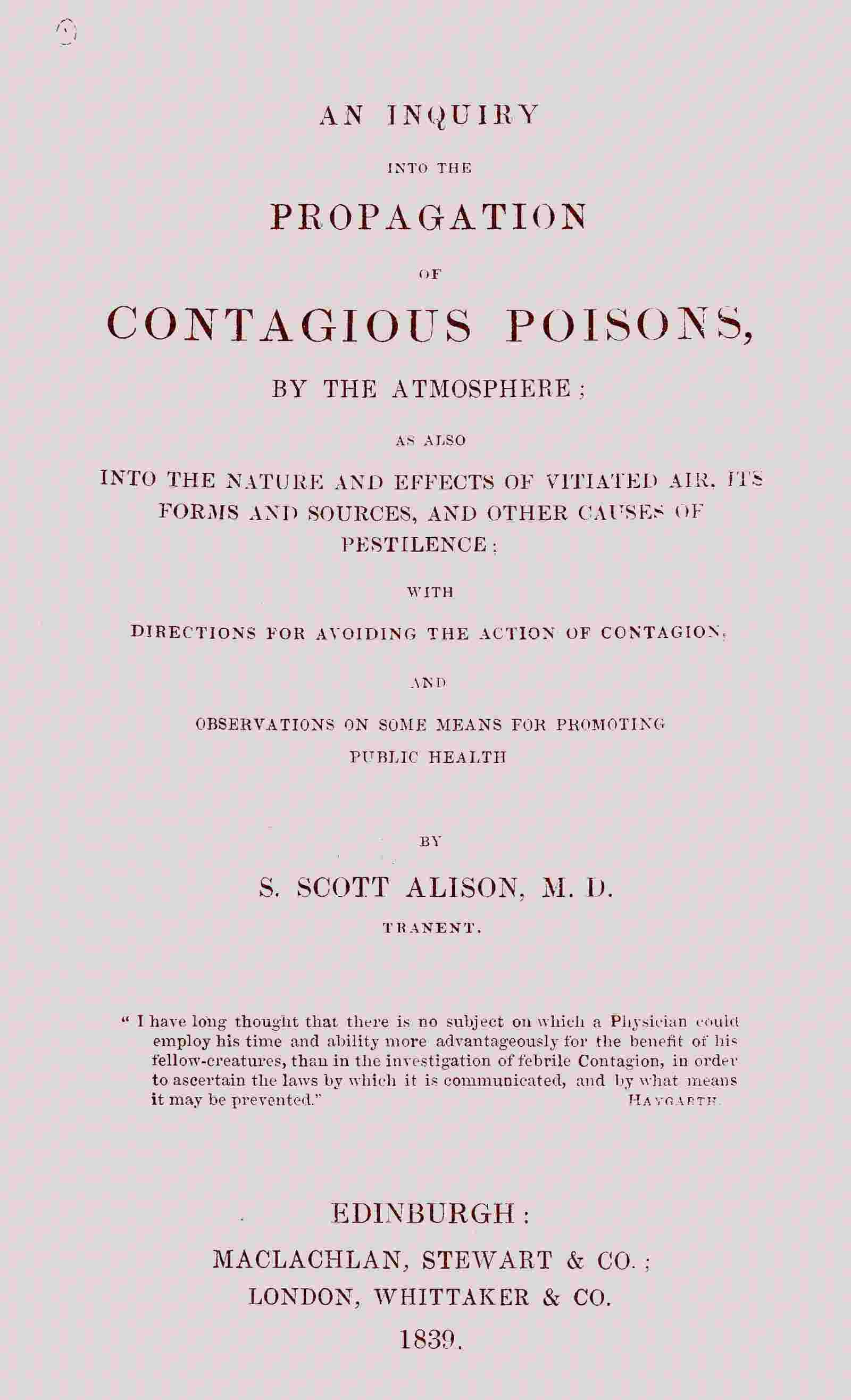
In a letter to Dr Percival, on the prevention of infectious diseases, published in 1801, Dr H. says—“I have long thought that there is no subject on which a physician could employ his time and ability more advantageously for the benefit of his fellow-creatures, than in the investigation of febrile contagion, in order to ascertain the laws by which it is communicated, and by what means it may be prevented. It is well known to be the cause of very extensive destruction in the army, the navy, and in large towns.”
“In 1777 I began to ascertain, by clinical observations, (i. e. observations made at the bedside of a patient,) according to what law the small-pox infection, and, in 1780 and 1781, according to what law the febrile infection, is propagated.”—“I found that the pernicious effects of small-pox miasms (that is, airs or vapours) were limited to a very narrow sphere. In the open air, and in moderate cases, I discovered that the infectious distance does not exceed half a yard.”—“Hence it is probable that, even when the distemper is malignant, the infectious influence extends to but a few yards from the poison.”—“I soon also discovered, that the contagion of fevers was confined to a much narrower sphere.”
“You will recollect, my dear friend, that at this time (1781) my attention was much engaged in the investigation of the nature of the small-pox poison. I was struck with the difference of the periods in those two maladies during which the infection remains in a latent state, that is, the interval of time which elapses between the patient’s exposure to the pestilential influence and the commencement of the fever. In the typhus, this period appeared to be much longer than in small-pox.”
The period between the exposure to what is considered infection, and the period of the manifestation of disease, certainly does vary in different distempers. In those in which palpable contagious poisons are produced, and where they are palpably applied to the system, the interval is known, and seldom varies; but in those where a palpable poison is not recognised, or where it is said to act exclusively through the air, it is found that the interval is sometimes short, sometimes long, and manifests none of that precision almost always observed in reference to the first class of diseases.
Dr Haygarth again says, “When the room of a patient ill of an infectious fever is spacious, airy, and clean, few or none of the most intimate attendants will catch the disease.”
“Among the middle and higher ranks of society in Chester and its neighbourhood, during a period of thirty-one years, I scarcely recollect a single instance of the typhus fever being communicated to a second person, not even during the epidemics of 1783 and 1786, which excited a general alarm in that city, Fresh air and cleanliness were the only means which I employed to prevent infection. Doors and windows were kept open as far as the season, and other circumstances, would permit. Curtains were drawn to exclude the light, but not the free circulation of air. All clothes, utensils, &c. used by the patient were immersed in a vessel of cold water immediately, and, when taken out of it, carefully washed. The floors were kept clean, and vinegar was sometimes, but not always, employed to sprinkle. It was thought to be more easy to remove than to correct the poison.”
Dr Haygarth deserves much credit for his judicious treatment, and by it he had the satisfaction of seeing much public good effected. His principles are yet acted upon with the very best effects; but it will be shewn, at a more advanced part of this work, that the check put to the progress of disease, was rather to be attributed to the removal of an atmosphere loaded with unwholesome emanations, than to any power those steps or measures had, of rendering innocuous, by dilution, a specific contagious poison.
Dr Haygarth continues—“The whole evidence which I have been able to collect, incontestibly leads to this very important conclusion, that febrile infection extends but to a very narrow sphere from the person.
“It appears highly improbable that the typhus infection should ever be communicated in the open air, by the common intercourse of society; because visitors, and even attendants, with very few exceptions, escape the fever, when exposed to it, in even the same chamber, if clean, airy, and spacious.
“The quantity of miasms (unwholesome or poisonous air) respired in the latter, is incomparably more than it can be in the former situation. It is not, however, intended to be asserted that such an event is impossible, if a person on purpose, or by some rare accident, were to breathe the air which immediately issues from a patient, or from clothes fully impregnated with the poison.
“During my long attention to this inquiry, not a single instance ever occurred to prove that persons liable to the small-pox could associate in the same chamber with a patient in the distemper, without receiving the infection.
“We have no certain knowledge in what manner infectious fevers are received into the body. According to the most plausible conjecture they appear to be communicated by poisonous vapours, which issue from the breath, or the insensible perspiration, or the excretions of a patient in the distemper. These miasms are probably taken into the body by the absorbents of the mouth, nostrils, lungs, stomach, or skin.”
Under the able investigation of Dr Haygarth, the doctrine of infection has been deprived of much of its extravagant character. Under his examination it is found losing that widely extended range of action, and that extreme virulence, that had hitherto marked its history.
Dr Bateman, in his excellent work on contagious fever, after alluding to a prevalent opinion, that contagious poison is capable of diffusion in the air, says, “To one acquainted with the evidence which has been adduced relative to the properties of contagion, these opinions, and the terrors connected with them, appear equally unfounded and absurd, as are all creations of an over-excited imagination magnified by prejudice and alarm—for it has been proved, beyond the possibility of a doubt, by the concurrent testimony of a multitude of the ablest practitioners, who have had every opportunity of investigating the fact, and by all the experience which the establishment of fever boards and houses of recovery has afforded the means of accumulating, that no contagion whatever is communicable, even to the distance of a few feet, through the medium of the free and open atmosphere, and consequently that residence in a district where fever prevails is free from all danger. Nay, it has been further proved on the same undeniable evidence, that the house and even the apartment, occupied by the sick, may be rendered perfectly innocuous, the contagion being disarmed of its activity and virulence by dilution with pure air,” &c.
Dr Bateman gives the following facts—
“All the patients admitted into the London House of Recovery are transported in a litter by two others employed by the institution, enveloped in their uncleanly and tainted apparel. Yet the porters who have been daily occupied for the last eighteen months in conveying this double source of contagion, often the distance of two or three miles, and assisting them in and out of the litter, have never received the infection.
“Neither have the washerwomen, employed during the period of my attendance, (sixteen years) on the House of Recovery, occupied almost constantly in washing the apparel brought in by the patient, as well as the bed-linen, often much soiled by their excretions, and the cloths used by the patients in the house, ever been affected with the fever.”
Dr Patrick Russell, whose work on the plague is so well known, is the next writer to whose observations reference will be made. His personal observation of much contagious disease, and his high character, entitle his observations to much weight. They will amply shew, how the question before us has gained with the advancement of medical science. Some are subjoined.
“In the first place, the various and vague application of the term contagion has been the source of confusion. In foreign languages, as well as in English, it has sometimes been used for the plague itself, sometimes as synonimous with infections; sometimes for the virulent effluvia issuing from the sick, or from substances infected, and sometimes as a property common to various diseases.”
He is of the decided opinion, that plague is communicated, by contact of the body, with the poison, which is properly understood by the word contagion. He says—“The second mode of contagion is by the medium of the air. The effluvia arising from the diseased, received into the ambient air, form a pestiferous atmosphere, more or less impregnated with these effluvia, as it recedes from their source. That contagion is thus communicated in the chamber of the sick, appears from persons being infected without touching the diseased body, or any thing in the room that may be supposed to harbour infection.
“To what distance the tainted atmosphere extends is not yet known, but recent facts render it probable that the effluvia, when once transmitted into the air, are soon dispersed, blended with the common mass, or otherwise suffer such alteration as render them innocuous at no great distance from their source. It is probable, also, that those effluvia arise, in an active state, to no great height in the atmosphere.”
He adds, that the contagion by fomites, that is, impregnated clothes, is the most extensive in its operation; and that it spreads disease, not only in all quarters of a town, but also to remote regions. He asserts that the plague is conveyed into different streets, remote from one another, by the Jewish salesmen, and that he has known Armenian washerwomen infected by tainted linen. The infectious air of plague, according to him, when it adheres to substances not exposed to free ventilation, and closely packed, retains its vigour for along time, and in that state is transported to other countries: and he held it as proven that it retains its activity in a three months’ voyage from the coast of Syria to Marseilles.
He is disposed to think that the contagion of plague, rarely remains in the system longer than ten days, and that more danger is to be apprehended from the baggage of passengers who enter into lazarettoes, than from their persons.
To Dr Joseph Adams we are indebted for an excellent treatise on animal poisons, one that is much valued for the information and clear views it contains. The following is an extract from the work in question.
“By contagion I would understand those diseases with the origin of which we are now unacquainted, but which at present can only be propagated by contact with a person, or matter from a person under similar disease. Contagious diseases, which it is now our business to consider, may be divided into chronic and acute, of the former are the itch, and several others. These are for the most part incurable by the unassisted powers of the constitution. The acute of which are the small-pox, and many other exanthemata, (these are those diseases accompanied with fever) marked with a peculiar eruption, and that attack only once, such as measles, and scarlet fever produce a critical fever, which ceases with the disease.
“The chronic may attack a person as often as he is exposed to the exciting cause, the acute, for the most part, leave the constitution no longer susceptible of their operation.”
After pointing out the modes of communication of contagious diseases by contact and by fomites, he says, “Infectious diseases, on the contrary, may be traced in their origin, and do not require for their production matter similar to their effects, but may at any time be generated by crowding together the sick or wounded of any description. Of this kind are the hospital, prison, or ship-fever, camp dysentery, and some peculiarly malignant ulcers. Though these diseases, when formed, may produce their like in others, yet we can always trace their origin to causes different from their effects.”
From the London Cyclopædia the following extract is taken.
“There does not appear to be any distinction commonly made between contagious and infectious diseases.”
This extract proves how much confusion there exists, with the terms infectious and contagious. Here they are said to be used synonimously, and in that of Dr Bateman just quoted, a great distinction is drawn.
Such are a few of the facts connected with the history of contagion, which are most worthy of notice, in a work of this kind.
This sketch will afford some idea of the most rational views which have been, and still are, held on the subject; and of the light in which it is at present regarded by the medical world.
It is feared that the extracts which have been given, may appear too copious, but it has been thought highly proper, that the opinions of those justly considered, the greatest authorities on the subject, should be given: and that they might not be misunderstood, they have been, for the most part, presented verbatim.