
APPENDIX.
ADDITIONAL DISCOVERIES ON THE CRANNOG IN LOCHSPOUTS.
As mentioned at page 182, the selection of the natural basin of Lochspouts as the most suitable site for a reservoir for supplying the town of Maybole with water had been announced shortly after the excavation of the crannog (as far as was then possible without an expensive cutting to reduce the level of the lake) had been completed. In the course of the subsequent negotiations with the proprietor and his agents, which ended in the final adoption of this scheme, we have another proof of the interest taken by Sir James Fergusson, Bart., in these antiquarian researches. The following extract, taken from the contractor's specification for the work to be done within this lake-basin, preparatory to its conversion into the proposed reservoir, requires no explanation:—"After the water in the present loch has been lowered, the bottom of the reservoir, to the extent to be pointed out, to be excavated to a depth of about 3 feet, or to such further depth as the engineer may consider it necessary, to remove the peat and other matters. At the site of the supposed lake-dwelling, the excavations to be so conducted that the structure of the dwelling may be left entire, until such time as it is thoroughly explored by a member or members of the Archæological Society of Ayrshire and Wigtownshire, or such person appointed by them or by Sir James Fergusson, Bart., of Kilkerran, to see this exploration carried out. Any relics that may be found during the excavation to be at once delivered to the party appointed to superintend the exploration, or to such other person as may be in charge in his absence." Just as the proof-sheets of my last chapter had come to hand, I received a note from Mr. William Henderson, C.E., engineer to the Maybole water-works, stating that the outlet at Lochspouts had been cut about 3 feet deeper, that the water was being drained off, and that the contractor was ready to begin the excavations on the site of the lake-dwelling. In anticipation that the result of these operations would furnish a satisfactory solution of some of the problems left undetermined in my previous report, the publication of this volume has been delayed for a few days in order to secure the desired information, and hence I am enabled to give the following short report of the additional discoveries made on this lake-dwelling.
On the receipt of Mr. Henderson's letter, I lost no time in making an appointment to meet him at Lochspouts, where I became more fully acquainted with the nature and extent of the proposed excavations. The débris formerly wheeled from the mound lay in two heaps just beyond the margin of the artificial island, but still within the boundaries of the reservoir. These, therefore, together with a complete section of the island, about 3 feet in thickness, were to be removed entirely beyond the rocky barrier. I understood that in clearing away the contents of this section, the wood-work, especially towards the margin of the crannog, and about the surrounding piles, was to have been left intact for some time, but when I revisited the scene of the operations a few days afterwards, I found that a gang of some forty or fifty men had made such progress that the whole section was completely removed, leaving nothing but small pillars here and there for the purpose of calculating the number of cubic yards excavated. All the horizontal beams and other wood-work were taken away, and nothing left above the base of the section except a few of the encircling uprights on the shore side of the crannog. My regret at this unexpected rapidity of the process of demolition was however considerably allayed when I found that Mr. James Mathewson, the inspector of the works, under whose vigilant eye the operations were conducted, had taken a most intelligent interest in the archæological phase of the remains, and had even taken notes of some of the phenomena which appeared to him most important. It is therefore to him I am chiefly indebted for the following details.
During the former explorations, the conjecture that the paved habitable surface, with its remains of hearths, relics, etc., then reached, was a secondary one superimposed upon the débris of a former habitation, was supported by the following observations, which could not, however, be verified by deeper excavations, owing to the rushing up of water:—
(1.) The level of the log-pavement was considerably higher than the tops of the uprights forming the surrounding circles.
(2.) In various places, when attempting to dig beneath it, ashes, charcoal, bones, hazel-nuts, and sea-shells were turned up. (See page 164.)
The evidence now produced left no doubt that this conjecture was well founded.
On the bank I was shown two heaps of oak beams which had been removed from the excavated débris, and amongst them were some of the ordinary transverses, containing square-cut holes at their extremities. Upon inquiry, I found that some of these, when exposed, were in position in the line of the surrounding stockade, with uprights projecting through the holes. One thick beam was deeply grooved, and resembled one found at Lochlee, figured and described at page 84. A few large flat planks, having a round handle-like projection at one end, some 18 inches long, had only one square-cut hole, sometimes close to this handle, and at other times at the opposite extremity. Another stout oak beam, 6 feet long, contained a series of round holes about an inch in diameter, and from five to six inches apart. The holes, which were on the broad side of the beam, were about 2 inches in depth, but only penetrated half through it, and from one of them portion of a wooden pin was extracted.
This beam was in a fragmentary condition, being, like many others, partially charred.
On examining the surface of the island, as now exposed, I noticed some very large oak beams, prepared like railway sleepers, and in one place, near the centre, there were some stones and clay as if they had formed the base of a fireplace; but the whole area was so muddy that it was difficult to say whether or not this was the exact surface of a former log-pavement.
On looking at the isolated pillars left standing, we noticed that their substance, which consisted of vegetable débris, mixed with brushwood, ashes, and in one place layers of clay, had a more or less stratified arrangement. The depth of the layer removed varied from 21⁄2 to 3 feet, and it appeared to me as if the island had sunk less towards its shore-side than on the far-off side, as the tops of the surrounding piles had become barely visible on the latter, whereas, on the former, not only were the piles exposed for about 18 inches or 2 feet, but some of the transverses were actually found in position lying over them.
At the junction of the gangway and island, a full view of which we now had, the uprights of both structures appeared to be on the same level, but as those of the former approached the shore, they became gradually more elevated, till, as mentioned at page 166, they projected above the grass.
As regards the deeper structures of the island, I was always of opinion, considering the amount of subsidence of its surface that had taken place, that their depth would be correspondingly great. This opinion was now shared by the engineer, contractor, and others, who judged more from the great solidity and firmness presented by the whole mass. In attempting to ascertain some further particulars by digging a hole in its centre, Mr. Mathewson writes as follows:—
"Lochspouts, 2d May 1882.
"Dear Sir,—I have been instructed by the engineer to forward to you, by Wednesday at latest, any information gained by the sinking of the central shaft in the crannog.
"The mode adopted was to open a place about 12 feet square.
"The pump forwarded was only 3 inches diameter, and it was found that three men bailing with buckets were required to enable other two men to dig.
"A large mortised oak beam was found about 18 inches below present surface; still further down a few oak beams were lifted with broken portions of transverse (soft wood) beams adhering to under surface of the oak. This was at a depth of 3 feet 6 inches. A large flat stone, near to which was a compressed mass of grass, some ferns (common bracken), and fragments of moss, was also turned up.—I am, yours faithfully,
"James Mathewson.
"P.S.—5.20 P.M. Men leaving. Found mortised beam (oak) with pin in hole. Beams as far as we can plunge a rod—31⁄2 feet deep."
Writing subsequently, May 11th, Mr. Mathewson says:—"The sinking of the shaft was a failure through want of depth at outlet. Oak beams with cross layers of softer wood and brushwood were found all over the bottom of shaft. Some small jaw-bones were brought up from a depth of 2 feet 6 inches below present surface, as also some compressed ferns and grasses, a small quantity of ashes, and a trace of whitish clay. On Friday evening I turned over some of the formerly unmoved oak beams at a corner of the shaft, put the spade a foot further down and turned up a sandstone which had been used as a whetstone. It was irregularly shaped, 7 inches long and 23⁄4 broad. One flat face and a sloping edge were ground smooth by whetting. It was 1 foot 6 inches below present floor. In the near surroundings of the spot I also found ashes and traces of tough whitish clay and a few bones."
Again, writing on the 16th May, Mr. Mathewson says:—"I sounded shaft to-day, and found hard beams from 3 feet 9 inches to 4 feet 3 inches below present level of excavations. The shaft is rudely 3 feet 6 inches deep. In some crevices the iron bar went down to 6 feet from top of shaft, and again struck wood."
Relics found below Upper Log-Pavement.
But the chief evidence that the section now removed from off the island represented the débris of a former habitation, is derived from the relics found among its contents, which are as follows:—
(1.) Whetstones.—Three of these implements, the most modern-like that I have yet seen, were found to the west of the junction of the gangway with the crannog, and at a depth of 2 feet 6 inches. One is rectangularly-shaped and beautifully polished on all sides. It is made of a hard dark stone, and measures 71⁄4 × 1-3/8 × 7/8 inches; another is a smooth slightly oval-shaped rod, 51⁄2 inches long and about 3⁄4 inch in diameter; the other is about the same length, but of a roughly quadrangular shape.
(2.) Wooden Implements.—A semi-globular piece of soft wood, 7 inches in diameter, and having a shallow cavity cut out of its flat surface, measuring 5 inches in diameter, and a uniform depth of 11⁄2 inch. Another cup-shaped vessel or implement, also of soft wood, was surrounded by a deep groove, across which were seen the remains of small wooden pins, some nine or ten in number, which penetrated through both its rims. The diameter of the central cup was 51⁄2 inches, and that of the whole vessel (including the outer rim, the groove, and the rim of the cup), 81⁄4 inches. A third article of wood consisted of a smooth flat beam of oak, 3 feet 6 inches long, 1 foot broad, and 4 inches thick, having a deep groove at one edge, and a stout pin-like projection from one end, as if it had other attachments. In the centre of this beam there was a round hole over which lay a handle-like elevation cut out of the solid, and having not only a vertical hole corresponding with the one in the lower portion, but also another passing horizontally through it, and immediately between the two former. This handle-like elevation was 2 feet 1 inch long, 41⁄2 inches broad, and rose into a slight arch in the middle, where the horizontal hole passed underneath, and in the line of continuation of the latter there was, on both sides, a slight hollow, as if worn out of the beam by friction. The whole was cut out of one piece of solid oak. These articles were found at a depth of about 2 feet below the former log pavement.
(3.) Bronze Ornament.—A double-spiral ornament of bronze wire, having six twists at one end and three at the other, was found at a depth of 1 foot 6 inches, and near the centre of the island. Its length is 15⁄8 inch (Fig. 260).
Fig. 260.—Bronze Ornament (1⁄1).
(4.) Jet Ring.—This article was found at a depth of 11⁄2 foot. Its diameter is 11⁄8 inch. The inside looks as if worn in one or two places by friction.
Besides the above, some hammer-stones, a quern, and two fragments of very rude pottery were found.
Articles found while removing the Stuff formerly wheeled from off the Mound, i.e. above the Upper Log-Pavement.
Fig. 261.—Outline of Crystal Ornament (1⁄1).
(1.) Rock Crystal.—A conical piece of rock-crystal, evidently ground down to its present shape. The diameter of base is 1⁄16 less than an inch, and the perpendicular height is 3⁄4 of an inch. The base is not quite flat, but slightly convex, as will be seen from the annexed outline (Fig. 261). It scratches glass, but is scratched by a diamond, and depolarises a ray of light. Its specific gravity is 2·64.
(2.) A Leaden Spindle-Whorl.—A small bead-shaped portion of lead perforated with a round hole is supposed to be a spindle-whorl. Its diameter is 3⁄4 of an inch.
(3.) Bronze Ornament.—This consists of a small semi-globular-shaped cup, 3⁄4 of an inch in diameter, to which is attached a triangular-shaped handle-like projection, 3⁄4 of an inch long (Fig. 262).
Fig. 262.—Bronze Ornament (1⁄1).
Fig. 263.—Amber-coloured Glass Bead (1⁄1).
(4.) Glass Bead.—This is a smooth, amber-coloured bead, variegated with a yellowish slag, and measuring 3⁄4 inch in diameter, and 7⁄10 of an inch deep (Fig. 263).
(5.) Bronze Ring.—A small slender ring of bronze, of the size of a finger-ring. It is penannular (but the ends are close, and might have been broken), and is 3⁄4-inch in diameter.
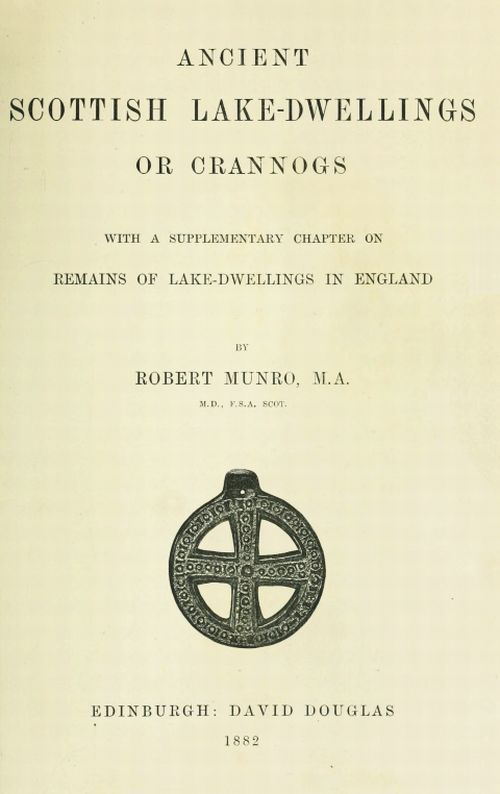
(6.) Jet Pendant.—This is made of a circular piece of polished jet or cannel coal, rather less than 11⁄2 inch in diameter, and 1⁄4 inch thick, which is perforated by four quadrant-like spaces of uniform size and shape, so as to leave the form of a rectangular cross inscribed in a circle. The arms of the cross become a little broader as they approach the circumference, and on one surface they, as well as the circular portion, are ornamented by a row of incised circles, each circle having a small hollow in its centre. An incised line bounds each row of circles on both sides. All these incised lines, circles, and central hollows, were filled by a yellowish kind of enamel. A little projection from the circle, opposite one of the arms of the cross, is perforated transversely to its surface by a small hole for suspension, but it is evident that previous to the making of this hole, it was suspended by means of another hole, which perforated it in an opposite direction, but from which one side was broken off. (Fig. 264.)
Fig. 264.—Jet Ornament (1⁄1).
Dr. Joseph Anderson, to whom I sent this object for inspection, writes thus:—"I have nothing special to say of the jet object sent to-day, except that it seems to be most certainly Christian, and of an early Christian type. It is the first jet thing I have seen, having this Christian relationship, from any of the early inhabited sites in Scotland. The ornament is very peculiar, and the form of the trinket most interesting, as it compares with the form of the cross within a circle found on the stones in Wigtownshire, though it has not the peculiar appendage which marks the Chrisma."[55]
A more complete account of these discoveries will be prepared for the Fourth Volume of the Collections of the Ayrshire and Wigtownshire Archæological Association.
INDEX.
- Abinger, Lord, on a structure of timbers in Loch Torlundie, 52.
- Achilty, Loch of, artificial island in, 32.
- Achray, Loch, 247.
- Aedilfrid, conquers Deira, 257.
- Aeduin, 257.
- Agnew, R. Vans, Esq., 49, 183.
- Agricola, 249, 250, 251.
- Agricultural implements, 119.
- Aidan, king of Scots, 257.
- Aiton, Mr., on trees buried in moss, 265, 266.
- Alclyde, besieged by Olaf the White, 258.
- Allen, J. Romilly, Esq., note on padlocks, 226.
- Alpin invades Galloway, 258.
- Amazons, pile-buildings at mouths of, 4.
- Amber, bead of, 48.
- Anderson, Dr. Joseph, on fylfot, 132.
- —— on jet ornament, 313.
- —— on Lochlee crannog, 69, 71, 136.
- —— on stone discs used as mirrors, 172.
- —— Orkneyinga Saga referred to by, 143.
- Angus, king of Picts, 258.
- Anstruther, Mrs., 207, 271.
- Antiquarian discoveries, scientific value of, 240.
- Antlers, 26, 60, 113.
- Antrim, crannog in county of, 7.
- Anvil, 104.
- Appendix, 305.
- Apples, remains of, in Swiss lake-dwellings, 14.
- Archæological Association of Ayrshire and Wigtownshire, 67.
- Archæology, prehistoric sphere of, 1.
- Ard, Loch, 246.
- Ardakillen, crannog of, 279.
- Ardderyd, battle of, 257.
- Arisaig, stockaded remains in loch at, 51.
- Armlets, 42, 59, 138, 160, 161, 174, 178, 232.
- Arrow-heads, 35, 225.
- Arthur, Loch, canoe found in, 61.
- Artificial islands, composed of stones and earth, 242.
- —— found nearly all over Scotland, 276.
- Artiodactyles, 140.
- Ass, remains of, 294.
- Axe-hammer head of stone, 156.
- Axe-heads, 35, 46, 221.
- Awls, 124, 175, 224.
- Backgammon, game of, 25.
- Balfour, Professor Bayley, on flora of Lochlee crannog, 144.
- Balgone, brass vessels and other remains found in marsh at, 248.
- Ballinderry, crannog of, 9.
- —— comb from, 278.
- Ballynahuish, Castle of, 10.
- Banchory, isle and loch of, 16.
- Barhapple Loch, crannog in, 182.
- Barley, remains of, in Swiss lake-dwellings, 13.
- Barlockhart Loch, 56, 247.
- Barneallzie Loch, 247.
- Barton Mere, pile-structures and osseous remains in, 298.
- Battleknowes, square camp at, 245.
- Baxter, Mr., 161, 163.
- Beads, 42, 48, 137, 178, 232, 312.
- Bell, St. Ternan's, 27.
- Bienne, Lake of, 12, 15.
- Birch, Mr., on remains in Wretham Mere, 290.
- Bischoff, 89.
- Blackberries, in Swiss lake-dwellings, 14.
- Black Loch, or Loch Inch-Cryndil, 57.
- Blackley, J. T., 29.
- Blackwood, Mr. James, 82, 91, 93.
- Blairgowrie, loch at, 247.
- Blake, Mr. Carter, on remains at London Wall, 294.
- —— on genus Bos, 296.
- Boar, remains of, 24, 50, 74, 139, 147, 182, 236, 295, 298.
- Board of wood with markings, 94.
- Boat, flat-bottomed in Loch Leys, 26.
- Boats, clinker-built, 53.
- Bodenmais, vivianites found at, 89.
- Bodkin of horn, 116.
- Bodle, copper, 60.
- Boece, quoted by Maitland, 33.
- Boghall, Loch of, 30.
- Bone objects, 77, 81, 88, 111, 175, 176, 216, 217, 294, 300.
- Borgue, fort at, surrounded by water, 246.
- Borland, Mr. John, 88, 232.
- Borneo, pile-buildings at, 4.
- Borness Cave, 285.
- Bos longifrons, 50, 139, 237, 294, 295, 296, 297, 299.
- —— frontosus, primigenius, and trochoceros, 296.
- Bowls of wood, 117, 221.
- Box, wooden, 43.
- Boynton, Mr. Thos., on remains of lake-dwellings at Holderness, 300.
- Brand, Loch of, 30.
- Brass, articles made of, 28, 31, 125, 129, 177, 228, 248. See Bronze.
- —— vessels at Balgone, 248.
- Bridle bit, 95, 132.
- British lake-dwellings, 289.
- Britons and Scots defeated by Angles of Bernicia, 257.
- Britons of Strathclyde subdued by Angles, 258.
- Broch of Burrian, combs from, 278.
- Bronze, articles made of, 24, 25, 26, 29, 30, 38, 40, 41, 42, 44, 45, 46, 59, 65, 67, 95, 129, 132, 177, 245, 293, 311, 312.
- —— vessels found in canoe, 65.
- —— —— in Loch of Leys, 26.
- Brooch, bronze, 41, 46, 49, 129, 228.
- Brora, Loch of, 247.
- Brown, Mr. James, on discovery of Lochlee crannog, 69.
- Bunbury, Sir Charles, on remains in Wretham Mere, 290.
- Bunodont, 140.
- Burnett, Sir James Horn, 26.
- Burns, the poet, at Lochlee, 68.
- Burton, Captain R. F., on lake-villages, 4.
- Buston crannog, article on, 190.
- —— discovery of, 190.
- —— general view of, 196.
- —— log pavement in, 198.
- Buston crannog, method of excavating, 193.
- —— miscellaneous objects from, 232.
- —— refuse-heap at, 204.
- —— relics found on, description of, 210.
- —— remains of dwelling-house at, 199.
- —— report on osseous remains from, 236.
- —— structure of, 195.
- —— view of eastern portion of, 201.
- —— view of north side, 202.
- —— Loch, increase of silt in, 270.
- Bute, crannogs in, 17.
- Button, object like a, 234.
- —— object of jet like a, 138.
- —— of brass, 228.
- Cæsar on climate of Britain, 264.
- Caldron found in Carlingwark Loch, 29.
- Caledonii and Mæatæ, 252.
- Caliga, at London Wall, 293, 294.
- Cameron, Captain, on lake-villages in Africa, 4.
- Campbell, Farquhard, Esq., 53.
- Camp-kettles, 67, 245.
- Canmor, Loch of, 16, 21.
- Canmore, Malcolm, 20, 21.
- Cannel coal, ring of, 183, 186.
- Canoe, or Canoes, 9, 12, 23, 26, 31, 35, 37, 41, 42, 43, 49, 53, 61, 65, 97, 122, 123, 153, 156, 160, 206, 245, 279.
- —— associated with crannogs, 279.
- Carlingwark Loch, 28, 246.
- Carved wood, 133.
- Cassius, Dion, on climate of Britain, 264.
- Castle Kennedy, 60.
- —— Loch, 247.
- Castletown, 247.
- Castles, wooden, 18.
- Cats, remains of, in Swiss lake-dwellings, 13.
- Causeway to Greenknowe, 31.
- —— zigzag in Loch of Sanquhar, 36.
- —— in Loch Dowalton, 40.
- —— in Kielziebar Loch, 51.
- —— laid upon oak-trees, 53.
- —— in Loch Rannoch, 31.
- —— to crannogs in Wigtownshire, 56.
- —— stone, 18, 20, 29, 60, 65, 245, 247.
- Caves, objects from, 285.
- Celt, polished stone, 77, 105.
- —— stone and bronze, 10.
- Chalmers, George, Esq., 17, 18.
- Chalmers, George, Esq., on colonisation of Galloway, 248.
- —— on Galloway Picts, 257.
- Chambers's Encyclopædia, 19.
- Chisels, 77, 111, 123, 161, 175.
- Chlorus Constantius, 253.
- Christianity introduced into Scotland from two sources, 257.
- Chronological indications derived from relics, 275.
- Circular stone implement, 105.
- Clans, Loch of the, 33.
- Classification of lake-dwellings, 242.
- Cleland, Professor, on osseous remains at Buston, 236.
- Climate, supposed change in, 264.
- Cloonfinlough, crannog of, 279.
- Closeburn Castle, remains at, 245, 280.
- Cloth manufactured in Swiss lake-dwellings, 14.
- Clubs, 113, 117, 176.
- Clunie, Loch of, 246.
- Cochran-Patrick, R. W., Esq., at the investigation of crannog at Barhapple Loch, 183.
- —— on Buston crannog, 193, 231.
- —— on objects found in Loch of Kilbirnie, 65.
- —— on Lochlee crannog, 69, 71, 76, 104.
- —— on Lochspouts crannog, 160, 161.
- Cockle-shells, 34, 295.
- Coin, copper, 60;
- gold, 231;
- silver, 246.
- Coins at London Wall, 293.
- —— in Victoria Cave, 285.
- Collessie, Castle of, 245.
- Combs, 217, 218.
- —— of bone, 278.
- —— double-margined, 59.
- —— from Ireland, 279.
- —— wooden, 55.
- Compass, article supposed to be a, 226.
- Cooke, Dr. M. C., 145.
- Copper, objects made of, 60, 137, 245, 293.
- Corn (winter), absence of, in Swiss lake-dwellings, 14.
- Corncockle, curious wooden structure in moss at, 245.
- Cot, Loch, remains in, 32.
- Coulter, Mr., on crannog in Ballydoolough, 8.
- Counties, lake-dwellings in, 245.
- Craig, Mr. James, 91.
- Craignarget, sculptured stone at, 131.
- Crannog, etymology of, 5.
- —— at Arisaig, 51.
- —— at Barhapple, 182.
- —— Barlockhart, 56.
- —— Buston, 190.
- —— at Friars' Carse, 152.
- —— at Lochlee, 67.
- —— at Tolsta, 60.
- —— in Dhu-Loch, 17.
- —— in Llangorse, 296.
- —— in Loch-an-eilan, 22.
- —— Loch of Forfar, 20.
- —— Lochindorb, 21, 287.
- —— Loch Inch-Cryndil, 59.
- —— Loch Canmor or Kinnord, 21.
- —— Loch of Leys, 26.
- —— Loch of Kilbirnie, 62.
- —— Lochspouts, 158.
- —— Machermore Loch, 56.
- Crannogs in Buteshire, 17.
- —— in Wigtownshire, 55, 182, 247.
- —— of Dunshaughlin, Cloonfinlough, and Strokestown, 9, 127, 279.
- —— Irish, 5.
- —— —— antiquity of, 10.
- —— Scottish, used as places of refuge, 187, 261.
- —— —— Dr. Robertson's views on, 19.
- —— structure of, 259.
- —— —— resembles that of fascine dwellings, 13.
- —— See Lake-dwellings and Lochs.
- Crannough Macknavin, 10.
- Cranokis, 19.
- Croix gammée, 131.
- Cross, Greek form of, 55.
- Croy, parish of, remains of crannog in, 31.
- Crucibles, 45, 138, 235, 277.
- Crystal quartz, 214, 311.
- Crystals of vivianite, 88, 123, 143, 204.
- Cue, or pigtail, 95, 136.
- Culter, parish of, remains of crannog in, 30.
- Cumbria ceded to Scots, 259.
- Cumming, Mr. Alexander, 49.
- Cuninghame, Sir W. J. M., 161.
- Cup-marked stones, 108, 212, 213.
- Daggers, 28, 94, 95, 115, 125, 177, 220.
- Dalrymple, Charles E., Esq., 57.
- —— Hon. Hugh, 183.
- Dalrymple-Hay, Admiral Sir John C., 183.
- Danish and Norwegian pirates, 258.
- Dawkins, Professor Boyd, on relics from Victoria Cave, 285.
- —— on animal remains from Llangorse, 297.
- —— on pile-structures in bronze age, 298.
- Dawstone, 257.
- Deer, red, remains of, 11, 24, 26, 60, 113, 142, 176, 182, 219, 236, 248, 290, 295, 296, 297, 298, 299, 300.
- —— roe, 116, 142, 176, 182, 219, 236, 296, 298, 299.
- —— fallow, 299.
- Dhu-Loch, crannog in, 17.
- Diagram of excavations of Lochlee crannog, 75.
- Dog, remains of, 13, 295, 298, 299.
- Dolay, Loch of, 247.
- Dowalton Loch, crannogs in, 38.
- Drummond, Mr., 127.
- Dumbleton, Rev. Mr., on crannog in Llangorse Lake, 296.
- Dunlop, Mr. Robert, on gold coin, 230.
- Duns, Professor, 32, 127.
- Dunshauglilin, crannog of, 7, 9, 279.
- Eadberct adds Ayrshire to his Galloway possessions, 258.
- Early iron age, 127.
- Earn, Loch, 246.
- Eegfrid, king of Northumbria, 258.
- Edward I. visits Lochindorb, 21.
- Edward III., 21.
- Eglinton, the Earl of, 190, 193, 194.
- Eldrig, Loch, 247.
- Ellan-na-glach, 246.
- Elm, 30, 145, 296.
- Elytra, 139.
- Encyclopædia, Chambers's, 19.
- —— Britannica, 20.
- England, lake-dwellings in, 289.
- English lake-dwellings, Prof. T. Rupert Jones on, 298.
- —— animal remains found in, 299.
- Ephesus, topographical changes at, 270.
- Etive, Loch, 54.
- Evans, J., Esq., on gold coin, 231, 287.
- Ewer lion, found in Kilbirnie Loch, 66.
- Fascine structures, 12, 13.
- Fascine dwellings, structural resemblance between them and Irish and Scottish crannogs, 13.
- Fasnacloich, artificial island at, 245.
- Fauna of Lochlee crannog, 139.
- Federatt, Castle of, 245.
- Fell Loch, 247.
- Fergus Loch, 246.
- Fergusson, Sir Charles Dalrymple, 162.
- —— Sir James, 158, 161, 305.
- Fermanagh, crannogs of, 6.
- Ferrules, 125, 226.
- Fibulæ, 88, 129.
- Files, 226.
- Finger-rings, 132, 228, 312.
- Fir Island, 29.
- Fish, remains of, in Swiss lake-dwellings, 13.
- —— without fins in Loch Lomond, 33.
- Fisher, W. W., Esq., on vivianites, 143.
- Flakes, flint, 35, 52, 109, 214, 299.
- Flemington, Loch of, 35.
- Flint cores, 214, 301.
- —— implements, 35, 52, 88, 108, 174, 214, 299.
- Flora of Lochlee crannog, 144.
- Food, kind of, used by lake-dwellers, 13, 283.
- Ford, paved, 56.
- Fordun, on island in Loch Cannor, 22.
- Forest trees in bogs, 265.
- Forfar, Loch of, crannog in, 20.
- Forge iron, 29.
- Founders of Swiss lake-dwellings, 14.
- Fowl, domestic, absence of, in Swiss lake-dwellings, 14.
- —— unknown to the Greeks till time of Pericles, 14.
- Franks, Mr., on pottery at London Wall, 293.
- Freuchie, Loch, 247.
- Friars' Carse, notes of a crannog at, 152.
- Fringe-like objects, 78, 88, 95, 133, 145.
- Fullah, Loch, 247.
- Funnel-shaped holes in stones, 170.
- Fuschl, Lake of, 13.
- Fylfot, 131.
- Galloway, Picts of, 256.
- Gangway, 18, 87, 99, 165, 183, 263, 308.
- Gas, marsh, 89.
- Geographical distribution of lake-dwellings, 242.
- Gibson, Master Alexander, 49.
- Gillespie, Rev. James, 61.
- Gillon, Captain, discoveries at Lochlee by, 105, 126.
- Glass, 49, 59, 233.
- —— objects made of, 42, 48, 59, 137, 178, 232, 312.
- —— Loch, 247.
- Goats, remains of, 13, 50, 78, 295, 296.
- Gold, dagger plated with, 28.
- —— coin, at Buston, 231.
- —— finger-rings, 228.
- Gordon, Mr. Samuel, 29.
- Gouges, 123, 222.
- Granech, Loch, 247.
- Greek cross, 55.
- Green Knowe, 30.
- Greenwell, Canon, on sepulchral and domestic vessels, 281.
- Grierson, Dr., 36, 153, 156.
- Grigor, Dr., on crannog in Loch of the Clans, 33.
- Grindstone, 211, 301.
- Grose, Antiquities of Scotland, by, 155, 280.
- Gynag, Loch, 246.
- Hadrian, Emperor, visits Britain, 251.
- Hammer-stones, 78, 98, 102, 161, 169, 185, 210, 301, 311.
- Hammers, iron, 41, 47.
- Handles of horn or bone, 113, 116, 123, 175, 176, 220.
- Hare, remains of, 298.
- Hatchet, iron, 95, 127, 293.
- Hay, Mr. Robert, 190.
- Hearths, 75, 78, 155, 165, 184, 200.
- Heating-stones, 103.
- Hemp, absence of, in Swiss lake-dwellings, 14.
- Hemsworth, Mr., 8.
- Henderson, Mr. William, C.E., 306.
- Herodian on natives of North Britain, 264.
- Herodotus on Lake Prasias, 3.
- Heron, Loch, 247.
- Hippocrates on lake-dwellings, 3.
- Historical phenomena associated with the lake-dwelling area, 249.
- Historical statements on climate, 264.
- Hobkirk, Mr., 145.
- Hobnails, 293.
- Hoe, wooden, 117.
- Hoffman, 88.
- Holderness, pile structures at, 300.
- Hone-stone. See Whetstones.
- Hopson, Mr., 161.
- Horn, objects made of, 60, 74, 78, 81, 113, 123, 161, 167, 219.
- Horse eaten by Pagans, 297.
- —— remains of, 13, 142, 294, 296, 297, 298.
- Hunter-Weston, Col., 161.
- —— on fylfot, 131.
- Huts, kind of, in Swiss lake-dwellings, 14.
- Hypothesis on origin of Scottish lake-dwellings, 302.
- Ibex of the Pyrenees, 296.
- Inch-Cryndil, Loch of, 57.
- Increase of lake silt at Buston and Lochlee, 270.
- Innes, Cosmo, on destruction of ancient forests, 268.
- Insect cases, 139.
- Iona burned by Norsemen, 258.
- Irish crannogs, articles found on, 9.
- —— —— and fascine structures, 13.
- Iron, articles made of, 29, 30, 35, 41, 46, 47, 87, 88, 95, 96, 123, 126, 177, 293.
- —— age, 127.
- —— slag, 41, 48, 214.
- Island, floating, in Loch Lomond, 33.
- Islands in Highland lakes, 242.
- Isle of Loch of Banchory, 16, 26.
- —— of Loch Canmor, 16.
- Jamieson, Dr., 21.
- Jardine, Sir W., 38.
- Jars, handles of, 157.
- Jet or lignite, objects made of, 138, 174, 185, 186, 232, 311, 312.
- Jones, Prof. T. Rupert, on English lake-dwellings, 298.
- —— Rev. Harry, on remains at Barton Mere, 298.
- Keller, Dr. Ferdinand, on Swiss lake-dwellings, 11, 14, 15.
- Kennedy, Mr. Thomas, 91.
- Kenneth MʽAlpine, 258.
- Key (bronze) from Lochspouts crannog, 177.
- Keys in York Museum, 178.
- Kielziebar Loch, island in, 50.
- Kilbirnie, Loch of, crannog in, 62.
- Kilchoman, island in loch at, 245.
- Kilmarnock, Town Council of, 91.
- —— Philosophical Society of, donation from, 91.
- Kilwinning, Monastery of, 30.
- Kinahan, G. H., Esq., on Irish crannogs, 8, 10.
- Kinder, Loch of, artificial island in, 28.
- Kinellan, Loch of, artificial island in, 32.
- King, Captain C. Cooper, 299.
- Kinnaird, Loch of, 247.
- Kinord, Loch of, 21.
- Kitchen-middens at London Wall, 294.
- Knife, flint, 214.
- Knives, metal, 77, 96, 123, 222, 236, 293.
- Knob of pottery, 235.
- Knobs of bone, 216.
- Knocking-stones, 60.
- Knowe Green, 30.
- —— Saverough, comb from, 278.
- —— Swan, at Buston, 190.
- Knox, James, Esq., 17, 18.
- Kyloe, Highland, 50.
- Ladles, 117, 185.
- Laggan, Loch, 246.
- Lake Fuschl, 13.
- —— Ledaig and Lochnell, 53.
- —— of Bienne, 15.
- —— of Neuchâtel, 15.
- —— of Rothiemurchus, 246.
- —— of Zürich, 11.
- Lake-dwellings at Singapore, 4.
- —— classification of, 242.
- —— collateral phenomena that help to determine age of, 241.
- —— Continental, 11.
- —— —— chronological range of, 14.
- —— in Africa, 4.
- —— in South America, 4.
- —— in England, 289.
- —— —— concluding remarks on, 302.
- —— on shores of Gulf of Maracaibo, 3.
- —— plan of structure in Switzerland, 12.
- —— Scottish, geographical distribution of, 242.
- Lake-dwellings, Scottish, historical and traditional phenomena associated with their area of distribution, 249.
- —— peculiar to Celtic districts, 248.
- —— relative distribution among the four ancient kingdoms of Scotland, 248.
- —— relics from, do not point to a Saxon but to a Celtic origin, 277.
- —— —— similar to those from other Celtic antiquities, 278.
- —— subsidence of, 272.
- —— topographical changes in area of, 264.
- Landsborough, Rev. David, 152.
- —— discovers vivianites in bones, 88.
- Lane Fox, General, on pile-buildings at London Wall, 291.
- Late Celtic period, 127.
- Lawrie, Mr., views of Buston crannog by, 196, 201, 202.
- Lawson, Mr. J., 162.
- Lead, knob of, 133.
- —— spindle whorl of, 312.
- Leather, objects of, 14, 49, 94, 136, 233, 293, 297.
- —— implement for dressing, 293.
- Ledaig, lake-dwelling at, 53.
- Lee, J. E., Esq., F.G.S., 141.
- Leys, Loch of, 25.
- Liddle, Peter, Esq., on crannog at Tolsta, 60.
- Lignite. See Jet.
- Limerick, Bishop of, on fylfot, 131.
- Lindenschmit, Prof., on bone skates, 294.
- Lion ewer, from Kilbirnie Loch, 66.
- Llangorse Lake, crannog in, 296.
- Lochs, artificial remains found in:—
- Loch Achray, 247.
- —— Loch-an-eilan, 22.
- —— Ard, 246.
- —— Arthur, 61.
- —— Banchory, 16.
- —— Barlockhart, 247.
- —— Barean, 37.
- —— Barneallzie, 247.
- —— Black, 57.
- —— Brand or Boghall, 30.
- —— Brora, 247.
- —— Canmor, 16, 21.
- —— Carlingwark, 28, 246.
- —— Castle, 247.
- —— Cluny, 246.
- —— Cot, 32.
- —— Dolay, 247.
- —— Doon, canoes found in, and castle in, 245.
- —— Dowalton, 38.
- —— Earn, 246.
- —— Eldrig, 247.
- —— Etive, 54.
- —— Fell, 247.
- —— Fergus, 246.
- —— Freuchie, 247.
- —— Fullah, 247.
- —— Glass, 247.
- —— Granech, 247.
- —— Gynag, 246.
- —— in Blairgowrie, 247.
- —— Heron, 247.
- —— Inch-Cryndil, 57.
- —— Kielziebar, 50.
- —— Kinder, 28.
- —— Kinnaird, 247.
- —— Laggan, 246.
- —— Loch in Dunty, 35.
- —— Lochmaben, 32.
- —— Lochy, 32.
- —— Lomond, 33.
- —— Lotus or Arthur, 61.
- —— Machermore, 247.
- —— Mochrum, 247.
- —— Morall, 246.
- —— Na Mial, 53.
- —— of Achilty, 32.
- —— of Boghall, 30.
- —— of the Clans, 33.
- —— of Flemington, 35.
- —— of Kilbirnie, 62.
- —— of Kinellan, 32.
- —— of Leys, 25.
- —— of Monivaird, 267.
- —— of Moy, 246.
- —— of Rescobie, 246.
- —— Orr, 245.
- —— Owel, 9.
- —— Quien, 18.
- —— Rannoch, 31.
- —— Sanquhar, 36.
- —— Shin, 247.
- —— Spinie, 30, 246.
- —— Sunonness, 247.
- —— Tay, 247.
- —— Torlundie, 52.
- —— Tummell, 246.
- —— Vennachar, 247.
- —— Winnoch, castle in, and canoes found in, 245.
- —— Yetholm, 247.
- —— See Tabular Statement, page 245.
- Lochlee crannog, article on, 68.
- —— character of wood-work, 147.
- —— composition of silt in bed of lake, 151.
- —— concluding remarks on, 146.
- —— discovery of, 68.
- —— excavations of, 71.
- —— fauna of, 139.
- —— flora of, 144.
- —— gangway, 99.
- —— hearths, 75, 77, 79.
- —— increase of silt in Loch, 271.
- —— level of Loch of, 168.
- —— log-pavement of, 82.
- —— position of relics and composition of relic bed, 78.
- —— relics from, 101.
- —— —— deposited in Burns's Museum, Kilmarnock, 151.
- —— structure of island, 97.
- Lochindorb, crannog of, 21.
- Lochy, crannog in Loch, 32.
- Lochmaben, remains in, 32.
- Lochnell, lake-dwelling at, 53.
- Lochrutton, island in, 28.
- Lochspouts crannog, article on, 158.
- —— area of, 162.
- —— articles found in stuff formerly removed off mound, 311.
- —— beams found below log-pavement, 307.
- —— composition of mound, 166.
- —— deeper structures of island, 308.
- —— gangway, 165, 308.
- —— hearths, 165.
- —— investigations of, 161.
- —— log-pavement of, 163.
- —— organic remains at, 181.
- —— outlet of loch at, deepened, 306.
- —— relics from, 168.
- —— —— found below upper log-pavement, 309.
- —— report of additional discoveries at, 305.
- Lochspouts crannog, subsidence of, 167.
- Lock, bolt of, from drained loch in parish of Croy, 31.
- —— —— from Buston crannog, 226.
- Lockwood, Castle of, 245.
- Log pavement, 62, 82, 153, 163, 186, 198, 205.
- Lomond, crannog in Loch, 33.
- London Wall, pile structures at, 291.
- Lotus, Loch of, 61.
- Lough at Friars' Carse, 155.
- Lough Nahineb, 11.
- —— Rea, crannogs of, 8, 10.
- Lovaine, Lord, on crannogs in Dowalton Loch, 38.
- Love, Robert, Esq., on crannog in Loch of Kilbirnie, 62.
- Lubbock, Sir John, on Swiss lake-dwellings, 15.
- Macdonald, Dr., 71, 79, 161.
- MacFadzean, Mr. James, on lake-dwellings in Lochspouts, 159.
- Machermore, Loch of, 56, 247.
- Mackinlay, Mr. John, on crannogs in Buteshire, 17.
- Macknavin, crannough of, 10.
- MacMahon, country of, 10.
- Mæatæ and Caledonii, 252.
- Malacca, Straits of, 4.
- Mallet, iron, in Carlingwark Loch, 29.
- —— wooden, 117.
- Mapleton, Rev. R. J., on artificial island in Loch Kielziebar, 50.
- —— —— on loch at Arisaig, 51.
- Maracaibo, Gulf of, 3.
- Margaret, Queen, Inch of, 20.
- Mathewson, Mr. James, notes on Lochspouts crannog, 306.
- Maxwell, Sir Herbert E., 183.
- —— Sir William, 39, 43.
- MʽCulloch, James, 187.
- MʽNaught, Mr. D., on the discovery of Buston crannog, 190.
- MʽPherson on coble-built boats, 23.
- Mirrors, 172, 293.
- Mitchell, Dr. Arthur, 287, 313.
- Mohrya, lake-villages in, 4.
- Mondsee, Austria, 13.
- Monivaird, Loch of, 247.
- Mons Grampius, battle of, 251.
- Montelius, M. Oscar, on croix gammée, 131.
- Morall, Loch of, 246.
- Morton, canoe and copper vessels found at, 245.
- —— old castle at, 245.
- Moulin, castle and causeway at, 247.
- Mountblairy, Castle of, 246.
- Moy, Loch of, 246.
- Mull, artificial island of, 53.
- Museum, Belfast, 230.
- —— Dublin, Royal Irish Academy, 5, 9, 11, 127, 223, 230.
- —— Edinburgh National, 26, 30, 43, 49, 57, 59, 105, 126, 131, 248.
- —— Kilmarnock, Burns's, 127, 151.
- —— Oxford, 143, 151.
- —— York, 127, 178.
- —— Zürich, 70.
- Mussel-shells, 60, 294, 295.
- Nahineb, Lough of, 11.
- Nails, iron, 7, 64, 124, 226.
- Na Mial, Loch of, 53.
- Nathusius, 140.
- Nature's method of counting time, 270.
- Needles, 112, 216.
- Nelson, Thomas, Esq., 154.
- Neuchâtel, Lake of, 15.
- Neville, Hon. R. Cornwallis, 227.
- New Guinea, pile-buildings of, 4.
- Newton Stone, inscription on, 131.
- Nicholson, Cornelius, 132.
- North Britain, four kingdoms of, 256.
- —— Britons, manners of, 250, 251, 252, 264, 286.
- Norwegian and Danish pirates, 258.
- Nuts, hazel, 14, 52, 78, 146, 167, 283, 301, 307.
- Oar, 48, 96, 123, 156, 210.
- Ober Meilen, 11.
- Ogham, characters of, 132,
- Orinoco, pile-buildings at mouths of, 4.
- Orkneyinga Saga, 143.
- Ornamentation on Combs, 218.
- Orr Loch, 245.
- Osseous remains at Buston, 236.
- —— at Dowalton, 50.
- —— at Holderness, 300.
- —— at Llangorse, 297.
- —— at Lochlee, 139.
- —— at Lochspouts, 181.
- Osseous remains at London Wall, 295.
- —— from crannogs, inferences from, 283.
- Oval stone implements, 56, 173.
- Owel, Loch, canoe found in, 9.
- Owen, Prof., on osseous remains at Dowalton, 50.
- —— —— at London Wall, 294, 295.
- Ox, remains of, 13, 24, 50, 139, 182, 237, 294-299.
- Oyster-shells, 294, 295.
- Paddle. See Oar.
- Padlock, bolt of, 225.
- Palmer, Dr. S., 299.
- Pan, brass, 28.
- —— bronze, 40, 41.
- Patella, Roman, 45.
- Pears, remains of, 14.
- Pebbles, 74, 171.
- Peel Bog, wooden castle in, 245.
- Percy, Lord, 39, 42.
- Periwinkle, 295.
- Phasis, people of, 3.
- Philosophical Society of Kilmarnock, 91.
- Pick of deer-horn, 176.
- Pick-axe, iron, 129.
- Picts, kingdom of, 257.
- Picts of Galloway, 256.
- Pig, remains of, 13, 24, 50, 74, 139, 182, 236, 295-299.
- Pigments, 139.
- Pigtail or cue, 95, 134.
- Pile structures at Holderness, 299.
- —— at London Wall, 291.
- —— at Southwark, 296.
- —— in Barton Mere, 298.
- Pins of bone, 175, 215.
- —— of bronze, 130, 228, 293.
- —— of copper, 293.
- —— wooden, 117, 206.
- Plates, 117.
- Platforms, 54, 58, 72, 86, 183.
- —— structure of, in Swiss lake-dwellings, 12.
- Plums, remains of, 14.
- Polished stone discs, 172.
- —— disc of pyrites, 293.
- Polishers, of stone, 158, 169, 210.
- Portland, his Grace the Duke of, 69, 91.
- Pots, bronze, 24, 25, 38, 45, 67.
- —— of bronze or brass, 248, 249.
- Potteries, pieces of, found in drained lake in parish of Croy, 31.
- Pottery at Buston, 233, 236.
- —— at Lochlee, 138.
- —— at Lochspouts, 178.
- —— at London Wall, 293.
- —— bit of, from Loch of the Clans, 34.
- —— British, 301.
- —— glazed, 296.
- —— in Barton Mere, 298.
- —— in crannogs, inferences from, 280.
- —— in Llangorse crannog, 297.
- —— in Wigtownshire, 189.
- —— knob of, 234.
- —— Romano-British, 280.
- —— sepulchral, different from domestic vessels, 281.
- Prasias, dwellers in Lake, 3.
- Prehistoric Annals of Scotland, 67, 229.
- —— Times, 15.
- Preservation of antiquarian objects due to exceptional causes, 2.
- Primeval forests in prehistoric times, 268.
- —— existed when crannogs were constructed, 269.
- Prison Island, description of, 22.
- Pugio or dagger plated with gold, 28.
- Punch of iron, 124, 224.
- Queen Margaret's Inch, 20.
- Querns, 32, 49, 56, 74, 81, 106, 171, 193, 213, 311.
- Quien Loch, remains in, 18.
- Rannoch, Loch, remains in, 31.
- Raspberries, in Swiss lake-dwellings, 14.
- Rea, Lough, 8, 10.
- Reeves, Dr., on crannogs in Antrim, 7.
- Refuse-heaps, 88, 194, 204, 294.
- Reid, Mr. Charles, 91, 148.
- Reindeer, remains of, 117, 142, 299.
- Relic-bed at Lochlee crannog, 77.
- Relics from Buston, 210-236.
- —— from Dowalton, 43, 50.
- —— from Inch-Cryndil, 59.
- —— from Lochlee, 101-139.
- —— from Lochspouts, 168-182, 309-313.
- —— from Scottish lake-dwellings compared with those on Irish crannogs, 277.
- —— —— not of a warlike character, 282.
- Relics from Scottish lake-dwellings, their discovery almost confined to the counties of Ayr and Wigtown, 276.
- —— —— similar to those in Romano-British towns, 277.
- —— found in Loch of Kilbirnie, 65.
- —— from Wigtownshire crannogs, 56.
- Rescobie, Loch of, 246.
- Reservoir at Lochspouts, 182, 305.
- Ring pin, 131.
- Rings of bronze, 45, 46, 236, 312.
- —— of brass, 31.
- —— of gold, 228, 229, 230.
- —— of horn or bone, 116, 137.
- —— of iron, 126.
- —— jet, cannel coal or lignite, 99, 138, 174, 185, 311.
- —— vitreous paste or glass, 48.
- Robert I., King, 27.
- Robertson, Dr. Joseph, on Scottish crannogs, 16, 19.
- Rock-crystal, ornament of, 311.
- Roe-deer, remains of, 116, 142, 176, 219, 236, 296, 298, 299.
- —— horn implements made of, 116, 177.
- Rolleston, Professor, on osseous remains from Lochlee crannog, 117, 139.
- —— —— —— from Llangorse crannog, 297.
- Roman camp-kettles, 67.
- —— soldiers withdrawn from Britain, 255.
- Ronnecht, 27.
- Ropes in Swiss lake-dwellings, 14.
- Rose, C. B., F.G.S., on remains in English lakes, 299.
- Rothiemurchus, Lake of, 246.
- Saga, Orkneyinga, 143.
- Samian ware, 138, 178, 280, 293, 295.
- Sandals at London Wall, 293.
- Sandhurst, flints found at, 299.
- Sanquhar, remains in Loch of, 36.
- Saucepan from Dowalton, 41.
- Saw, iron, 87, 126.
- Saxon element not indicated by relics from Scottish crannogs, 277.
- Scharley, mine of, 89.
- Schliemann, quoted, on Swastika, 131.
- —— on gold rings at Mycenæ, 230.
- Scots, kingdom of, 257.
- Scottish crannogs, comparison with fascine structures on Continent, 13.
- Scraper, wooden, 119.
- Scrapers of flint, 109, 174, 214.
- Seaforth, family of, 32.
- Semple Castle, 245.
- Severus, Emperor, enters North Britain, 253.
- Sharpening-stones. See Whetstones.
- Shears, 126, 293.
- Sheep, remains of, 13, 50, 60, 78, 141, 238, 299.
- Shells, 60, 139, 164.
- Shin, Loch, 247.
- Shirley, Mr., on Irish crannogs, 10.
- Shoes, 49, 136, 293, 295.
- —— horse, 28.
- Shore Island, 10.
- Silt, increase of, in lochs at Buston and Lochlee, 270.
- Singapore, pile structures at, 4.
- Skates of bone, 294.
- Skeleton of sheep or goat, 78, 79.
- Skene, W. F., Esq., quoted, 252, 253, 255.
- —— on Chalmers's statement as to colonisation of Galloway by Irish in eighth century, 257.
- Skulls, human, at London Wall, 296.
- —— sheep, 78, 79.
- Slag, 41, 48, 200, 214.
- Sling-stones, 103, 211.
- Sloes, remains of, 14.
- Smith, Dr. Angus, on lake-dwellings at Ledaig and Lochnell, 53, 55.
- —— Dr. J. Alexander, quoted, 143.
- Southwark Street, pile structures at, 296.
- Spatula, 131, 175.
- Spear-heads, 94, 116, 125, 176, 224, 294, 298.
- Spindle-whorls, 56, 77, 109, 172, 193, 213, 312.
- Spinie, Loch, remains in, 30.
- Spiral objects, 226.
- Spoons, 34, 112, 185.
- Squirrels, 146, 301.
- St. Columba, apostle of the northern Picts, 257.
- St. Ninian founds a church at Candida Casa, 257.
- St. Ternan, Archbishop of the Picts, 27.
- Stags' heads found in Carlingwark Loch, 28.
- Stair, Earl of, 59, 183.
- —— Field-Marshal the Earl of, 60.
- Stewart, Mr. J. Leveson, 183.
- Stoddart, J. H., Esq., 183.
- Stone, objects made of, 102, 169.
- —— hammer, 25.
- —— implements, with central hollows, 56, 173.
- Stonehouse, farm of, 50.
- Stonykirk, 57.
- Stravithy, fortalice on bog at, 245.
- Strokestown, crannog of, 9.
- Structure of wooden islands, 259.
- Stuart, Dr., on Scottish crannogs, 16, 32, 52, 67, 259.
- —— on crannogs in Loch Dowalton, 38.
- —— on crannog in Loch of Forfar, 20.
- Stylus at London Wall, 293.
- Subsidence of Scottish lake-dwellings, 148, 156, 167, 191, 272.
- Suidæ, 140.
- Summary of observations on Buston crannog, 204.
- Sunonness Loch, remains in, 247.
- Sus. See Pig.
- Suttie, Sir George Grant, 248.
- Swastika, 131.
- Swine, prehistoric, 141.
- Sword, bronze, 30.
- Tabular statement of Scottish lake-dwellings, 244.
- —— value of, 248.
- Tacitus on North Britain, 250, 264.
- Tay, Loch, islands in, 247.
- Theodosius, 255.
- Thomson, Mr. J., F.G.S., 169.
- Three-pronged iron implement, 128.
- Tile, Roman, 293.
- Tines. See Deer.
- Tolsta, crannog of, 60.
- Topographical changes in lake-dwelling area, 264.
- —— —— at Buston since the construction of crannog, 269.
- —— nomenclature of Britain, 287.
- Torlundie, Loch, 52.
- Town-Council of Kilmarnock, 91.
- Trestle-work at Lochlee crannog, 94.
- Tripods of bronze, 24, 245, 248, 249.
- Trough, wooden, 93.
- Troy, 131.
- Tummel, Loch of, 246.
- Turner, F. J., Esq., F.S.A. Scot., 69, 70, 71, 90.
- —— Mr. J. H., 69, 71.
- Tusk, implement made of, 139.
- Tusks. See Boar.
- Tweezers at London Wall, 293.
- Ulpius Marcellus, 252.
- Upchurch pottery at London Wall, 293.
- Urbicus Lollius, 251.
- Uriconium, bone comb from, 279.
- Urn, found near Loch Cot, 32.
- Urns, remains of, 298.
- Vennachar, Loch, 247.
- Vernon, the Hon. G. R., 193.
- Vessels of bronze, 24, 29, 38, 44, 59, 66, 245, 248, 249, 293.
- —— of wood, 74, 80, 81, 88, 93, 118, 177, 185, 221, 310.
- Victoria Cave, 285.
- Vitreous paste, objects of, 48, 232.
- Vivian, Mr., Cornwall, 89.
- —— J. P., Esq., M.P., 183.
- Vivianite, crystals of, 88, 123, 143, 204.
- Wakefield, island of, 10.
- Wakeman, W. F., Esq., quoted, 6.
- —— on pottery of crannogs, 9.
- Walkmill at Lochspouts, 160.
- Wattie, Rev. James, on crannogs in Loch Canmor, 22.
- Wheat found in Swiss lake-dwellings, 13.
- Wheel used in making crannog pottery, 281.
- Whetstones or hones, 35, 44, 49, 104, 127, 170, 185, 211, 310.
- Whorls. See Spindle-whorls.
- Wilde, Sir W. R., quoted, 6, 7, 11.
- —— on antiquity of Irish crannogs, 10.
- —— on crannog at Lagore, 5.
- —— on submergence of Irish crannogs, 275.
- Wilson, Rev. George, on crannogs in Wigtownshire, 55, 183, 247.
- Wilson's Prehistoric Annals of Scotland, 67, 229.
- Wood, objects made of, 43, 74, 80, 81, 88, 93, 117, 133, 177, 185, 206, 221, 310.
- Wooden islands, structure of, 259, 261.
- —— —— period of, 243.
- Wretham Mere, remains in, 290.
- Wyllie, W. M., Esq., F.S.A., 299.
- Yetholm, Loch of, 247.
- York, Museum at, 127, 178.
- Zürich, remains from lake-dwellings at, 11.