
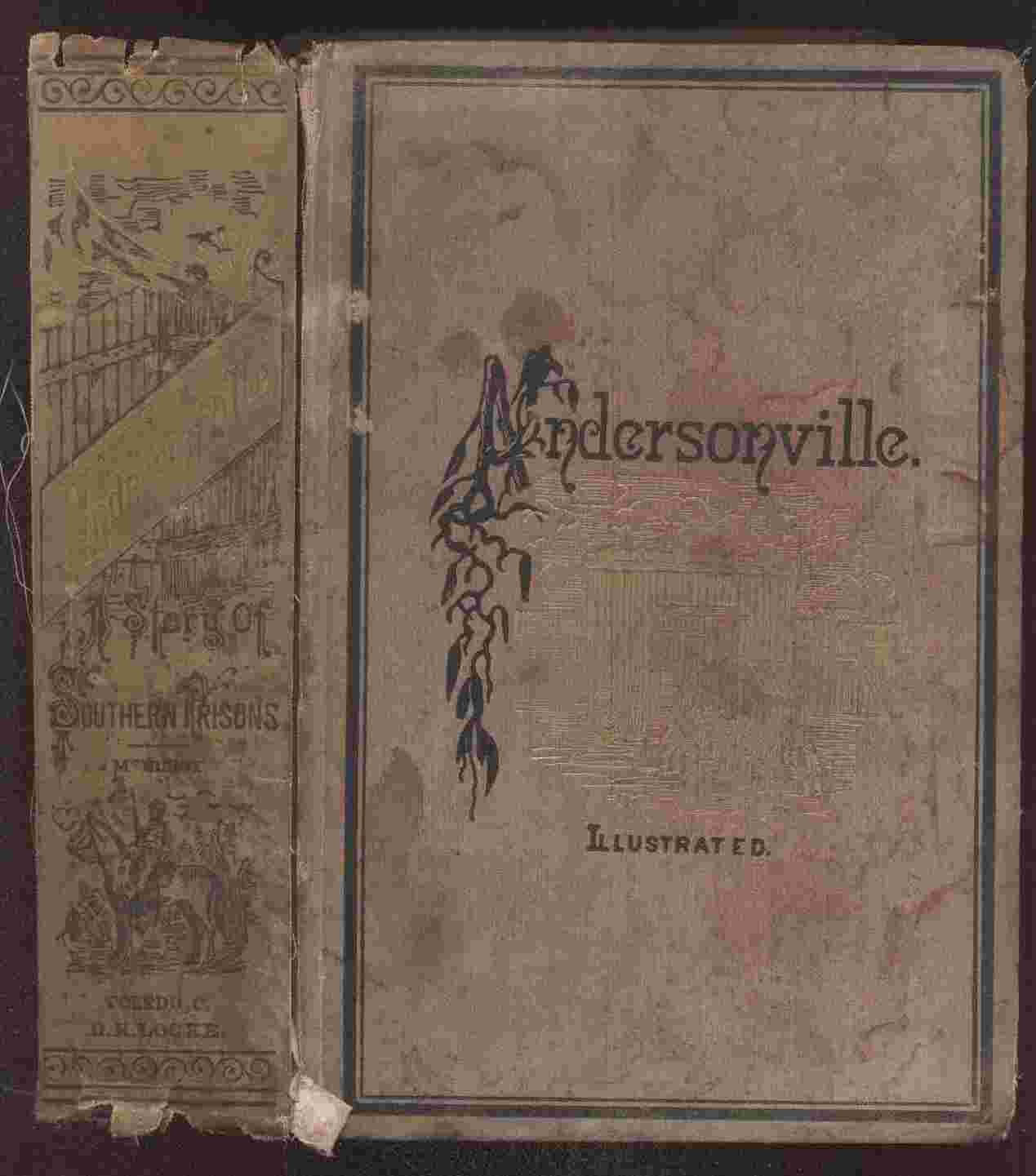
The Project Gutenberg eBook of Andersonville: A Story of Rebel Military Prisons — Volume 1
Title: Andersonville: A Story of Rebel Military Prisons — Volume 1
Author: John McElroy
Release date: June 1, 2004 [eBook #4257]
Most recently updated: December 27, 2020
Language: English
Credits: Produced by David Widger
ANDERSONVILLE
A STORY OF REBEL MILITARY PRISONS
FIFTEEN MONTHS A GUEST OF THE SO-CALLED
SOUTHERN CONFEDERACY
A PRIVATE SOLDIERS EXPERIENCE
IN
RICHMOND, ANDERSONVILLE, SAVANNAH, MILLEN
BLACKSHEAR AND FLORENCE
BY JOHN McELROY
Late of Co. L. 16th Ill Cav.
1879
Volume 1.
TO THE HONORABLE
NOAH H. SWAYNE.
JUSTICE OF THE SUPREME COURT OF THE UNITED STATES,
A JURIST OF DISTINGUISHED TALENTS AND EXALTED CHARACTER;
ONE OF THE LAST OF THAT
ADMIRABLE ARRAY OF PURE PATRIOTS AND SAGACIOUS COUNSELORS,
WHO, IN
THE YEARS OF THE NATION'S TRIAL,
FAITHFULLY SURROUNDED THE GREAT PRESIDENT,
AND, WITH HIM, BORE THE BURDEN
OF
THOSE MOMENTOUS DAYS;
AND WHOSE WISDOM AND FAIRNESS HAVE DONE SO MUCH SINCE
TO
CONSERVE WHAT WAS THEN WON,
THIS BOOK IS DEDICATED WITH RESPECT AND APPRECIATION,
BY THE AUTHOR.
CONTENTS:
INTRODUCTION
AUTHOR'S PREFACE
LIST OF ILLUSTRATIONS
CHAPTER I.
A STRANGE LAND—THE HEART OF THE APPALACHIANS—THE GATEWAY OF AN EMPIRE —A SEQUESTERED VALE, AND A PRIMITIVE, ARCADIAN, NON-PROGRESSIVE PEOPLE.
CHAPTER II.
SCARCITY OF FOOD FOR THE ARMY—RAID FOR FORAGE—ENCOUNTER WIT THE REBELS —SHARP CAVALRY FIGHT—DEFEAT OF THE "JOHNNIES"—POWELL'S VALLEY OPENED UP.
CHAPTER III.
LIVING OFF THE ENEMY—REVELING IN THE FATNESS OF THE COUNTRY—SOLDIERLY PURVEYING AND CAMP COOKERY—SUSCEPTIBLE TEAMSTERS AND THEIR TENDENCY TO FLIGHTINESS—MAKING SOLDIER'S BED.
CHAPTER IV.
A BITTER COLD MORNING AND A WARM AWAKENING—TROUBLE ALL ALONG THE LINE —FIERCE CONFLICTS, ASSAULTS AND DEFENSE—PROLONGED AND DESPERATE STRUGGLE ENDING WITH A SURRENDER.
CHAPTER V.
THE REACTION—DEPRESSION—BITTING COLD—SHARP HUNGER AND SAD REFLEXION.
CHAPTER VI.
"ON TO RICHMOND!"—MARCHING ON FOOT OVER THE MOUNTAINS—MY HORSE HAS A NEW RIDER—UNSOPHISTICATED MOUNTAIN GIRLS—DISCUSSING THE ISSUES OF THE WAR—PARTING WITH "HIATOGA
CHAPTER VII.
ENTERING RICHMOND—DISAPPOINTMENT AT ITS APPEARANCE—EVERYBODY IN UNIFORM—CURLED DARLINGS OF THE CAPITAL—THE REBEL FLAG—LIBBY PRISON —DICK TURNER—SEARCHING THE NEW COMERS.
CHAPTER VIII.
INTRODUCTION TO PRISON LIFE—THE PEMBERTON BUILDING AND ITS OCCUPANTS —NEAT SAILORS—ROLL CALL—RATIONS AND CLOTHING—CHIVALRIC "CONFISCATION."
CHAPTER IX.
BRANS OR PEAS—INSUFFICIENCY OF DARKY TESTIMONY—A GUARD KILLS A PRISONER—PRISONERS TEAZE THE GUARDS—DESPERATE OUTBREAK.
CHAPTER X.
THE EXCHANGE AND THE CAUSE OF ITS INTERRUPTION—BRIEF RESUME OF THE DIFFERENT CARTELS, AND THE DIFFICULTIES THAT LED TO THEIR SUSPENSION.
CHAPTER XI.
PUTTING IN THE TIME—RATIONS—COOKING UTENSILS—"FIAT SOUP—"SPOONING" —AFRICAN NEWSPAPER VENDERS—TRADING GREENBACKS FOR CONFEDERATE MONEY— VISIT FROM JOHN MORGAN.
CHAPTER XII.
REMARKS AS TO NOMENCLATURE—VACC1NATION AND ITS EFFECTS—"N'YAARKER'S," —THEIR CHARACTERISTICS AND THEIR METHODS OF OPERATING.
CHAPTER XIII.
BELLE ISLE—TERRIBLE SUFFERING FROM COLD AND HUNGER—FATE OF LIEUTENANT BOISSEUX'S DOG—OUR COMPANY MYSTERY—TERMINATION OF ALL HOPES OF ITS SOLUTION.
CHAPTER XIV.
HOPING FOR EXCHANGE—AN EXPOSITION OF THE DOCTRINE OF CHANCES —OFF FOR ANDERSONVILLE—UNCERTAINTY AS TO OUR DESTINATION—ARRIVAL AT ANDERSONVILLE.
CHAPTER XV.
GEORGIA—A LEAN AND HUNGRY LAND—DIFFERENCE BETWEEN UPPER AND LOWER GEORGIA—THE PILLAGE OF ANDERSONVILLE.
CHAPTER XVI.
WAKING UP IN ANDERSONVILLE—SOME DESCRIPTION OF THE PLACE—OUR FIRST MAIL—BUILDING SHELTER—GEN. WINDER—HIMSELF AND LINEAGE.
CHAPTER XVII.
THE PLANTATION NEGROS—NOT STUPID TO BE LOYAL—THEIR DITHYRAMBIC MUSIC —COPPERHEAD OPINION OF LONGFELLOW.
CHAPTER XVIII.
SCHEMES AND PLANS TO ESCAPE—SCALING THE STOCKADE—ESTABLISHING
THE DEAD LINE—THE FIRST MAN KILLED.
CHAPTER XIX.
CAPT. HENRI WIRZ—SOME DESCRIPTION OF A SMALL-MINDED PERSONAGE, WHO GAINED GREAT NOTORIETY—FIRST EXPERIENCE WITH HIS DISCIPLINARY METHOD.
CHAPTER XX.
PRIZE-FIGHT AMONG THE N'YAARKERS—A GREAT MANY FORMALITIES, AND
LITTLE BLOOD SPILT—A FUTILE ATTEMPT TO RECOVER A WATCH—DEFEAT
OF THE LAW AND ORDER PARTY.
LIST OF ILLUSTRATIONS
(The Skipped Numbers were drawings unsuitable for copying.)
1. Frontpiece
2. "War"
8. Cumberland Gap, Looking Eastward
4. A Cavalry Squad
5. The 'Rebels Marching Through Jonesville
6. 'Leven Yards Killing the Rebel
7. A Scared Mule Driver
8. Bugler Sounding "Taps"
9. Company L Gathering to Meet the Rebel Attack
10. The Major Refuses to Surrender
11. Ned Johnson Trying to Kill the Rebel Colonel
12. Girls Astonished at the Jacket Tabs
14. An East Tennesseean
15. A Rebel Dandy
18. Barnacle backs Discouraging a Visit from a Soldier
19. Ross Calling the Roll
20. An Evening's Amusement with the Guards
21. Prisoners' Culinary Outfit
23. Skimming, the Bugs From My Soup
23. "Spooning"
24. A Richmond News Boy
25. "Say, Guard: Do You Want to Buy Some Greenbacks?"
26. A "N'Yaarker"
27. Decoying Boisseux's Dog to Its Death
28. The Dead Scotchman
29. Map of Georgia, South Carolina and part of North Carolina
30. Cooking Rations
31. General John W. Winder
32. A Field hand
33. Scaling the Stockade
34. Captain llenri Wirz
35. The Prize-fight for the Skillet
INTRODUCTION.
The fifth part of a century almost has sped with the flight of time since the outbreak of the Slaveholder's Rebellion against the United States. The young men of to-day were then babes in their cradles, or, if more than that, too young to be appalled by the terror of the times. Those now graduating from our schools of learning to be teachers of youth and leaders of public thought, if they are ever prepared to teach the history of the war for the Union so as to render adequate honor to its martyrs and heroes, and at the same time impress the obvious moral to be drawn from it, must derive their knowledge from authors who can each one say of the thrilling story he is spared to tell: "All of which I saw, and part of which I was."
The writer is honored with the privilege of introducing to the reader a volume written by an author who was an actor and a sufferer in the scenes he has so vividly and faithfully described, and sent forth to the public by a publisher whose literary contributions in support of the loyal cause entitle him to the highest appreciation. Both author and publisher have had an honorable and efficient part in the great struggle, and are therefore worthy to hand down to the future a record of the perils encountered and the sufferings endured by patriotic soldiers in the prisons of the enemy. The publisher, at the beginning of the war, entered, with zeal and ardor upon the work of raising a company of men, intending to lead them to the field. Prevented from carrying out this design, his energies were directed to a more effective service. His famous "Nasby Letters" exposed the absurd and sophistical argumentations of rebels and their sympathisers, in such broad, attractive and admirable burlesque, as to direct against them the "loud, long laughter of a world!" The unique and telling satire of these papers became a power and inspiration to our armies in the field and to their anxious friends at home, more than equal to the might of whole battalions poured in upon the enemy. An athlete in logic may lay an error writhing at his feet, and after all it may recover to do great mischief. But the sharp wit of the humorist drives it before the world's derision into shame and everlasting contempt. These letters were read and shouted over gleefully at every camp-fire in the Union Army, and eagerly devoured by crowds of listeners when mails were opened at country post-offices. Other humorists were content when they simply amused the reader, but "Nasby's" jests were arguments—they had a meaningthey were suggested by the necessities and emergencies of the Nation's peril, and written to support, with all earnestness, a most sacred cause.
The author, when very young, engaged in journalistic work, until the drum of the recruiting officer called him to join the ranks of his country's defenders. As the reader is told, he was made a prisoner. He took with him into the terrible prison enclosure not only a brave, vigorous, youthful spirit, but invaluable habits of mind and thought for storing up the incidents and experiences of his prison life. As a journalist he had acquired the habit of noticing and memorizing every striking or thrilling incident, and the experiences of his prison life were adapted to enstamp themselves indelibly on both feeling and memory. He speaks from personal experience and from the stand-paint of tender and complete sympathy with those of his comrades who suffered more than he did himself. Of his qualifications, the writer of these introductory words need not speak. The sketches themselves testify to his ability with such force that no commendation is required.
This work is needed. A generation is arising who do not know what the preservation of our free government cost in blood and suffering. Even the men of the passing generation begin to be forgetful, if we may judge from the recklessness or carelessness of their political action. The soldier is not always remembered nor honored as he should be. But, what to the future of the great Republic is more important, there is great danger of our people under-estimating the bitter animus and terrible malignity to the Union and its defenders cherished by those who made war upon it. This is a point we can not afford to be mistaken about. And yet, right at this point this volume will meet its severest criticism, and at this point its testimony is most vital and necessary.
Many will be slow to believe all that is here told most truthfully of the tyranny and cruelty of the captors of our brave boys in blue. There are no parallels to the cruelties and malignities here described in Northern society. The system of slavery, maintained for over two hundred years at the South, had performed a most perverting, morally desolating, and we might say, demonizing work on the dominant race, which people bred under our free civilization can not at once understand, nor scarcely believe when it is declared unto them. This reluctance to believe unwelcome truths has been the snare of our national life. We have not been willing to believe how hardened, despotic, and cruel the wielders of irresponsible power may become.
When the anti-slavery reformers of thirty years ago set forth the cruelties of the slave system, they were met with a storm of indignant denial, villification and rebuke. When Theodore D. Weld issued his "Testimony of a Thousand Witnesses," to the cruelty of slavery, he introduced it with a few words, pregnant with sound philosophy, which can be applied to the work now introduced, and may help the reader better to accept and appreciate its statements. Mr. Weld said:
"Suppose I should seize you, rob you of your liberty, drive you into the field, and make you work without pay as long as you lived. Would that be justice? Would it be kindness? Or would it be monstrous injustice and cruelty? Now, is the man who robs you every day too tender-hearted ever to cuff or kick you? He can empty your pockets without remorse, but if your stomach is empty, it cuts him to the quick. He can make you work a life-time without pay, but loves you too well to let you go hungry. He fleeces you of your rights with a relish, but is shocked if you work bare-headed in summer, or without warm stockings in winter. He can make you go without your liberty, but never without a shirt. He can crush in you all hope of bettering your condition by vowing that you shall die his slave, but though he can thus cruelly torture your feelings, he will never lacerate your back—he can break your heart, but is very tender of your skin. He can strip you of all protection of law, and all comfort in religion, and thus expose you to all outrages, but if you are exposed to the weather, half-clad and half-sheltered, how yearn his tender bowels! What! talk of a man treating you well while robbing you of all you get, and as fast as you get it? And robbing you of yourself, too, your hands and feet, your muscles, limbs and senses, your body and mind, your liberty and earnings, your free speech and rights of conscience, your right to acquire knowledge, property and reputation, and yet you are content to believe without question that men who do all this by their slaves have soft hearts oozing out so lovingly toward their human chattles that they always keep them well housed and well clad, never push them too hard in the field, never make their dear backs smart, nor let their dear stomachs get empty!"
In like manner we may ask, are not the cruelties and oppressions described in the following pages what we should legitimately expect from men who, all their lives, have used whip and thumb-screw, shot-gun and bloodhound, to keep human beings subservient to their will? Are we to expect nothing but chivalric tenderness and compassion from men who made war on a tolerant government to make more secure their barbaric system of oppression?
These things are written because they are true. Duty to the brave dead, to the heroic living, who have endured the pangs of a hundred deaths for their country's sake; duty to the government which depends on the wisdom and constancy of its good citizens for its support and perpetuity, calls for this "round, unvarnished tale" of suffering endured for freedom's sake.
The publisher of this work urged his friend and associate in journalism to write and send forth these sketches because the times demanded just such an expose of the inner hell of the Southern prisons. The tender mercies of oppressors are cruel. We must accept the truth and act in view of it. Acting wisely on the warnings of the past, we shall be able to prevent treason, with all its fearful concomitants, from being again the scourge and terror of our beloved land.
ROBERT
McCUNE.
AUTHOR'S PREFACE
Fifteen months ago—and one month before it was begun—I had no more idea of writing this book than I have now of taking up my residence in China.
While I have always been deeply impressed with the idea that the public should know much more of the history of Andersonville and other Southern prisons than it does, it had never occurred to me that I was in any way charged with the duty of increasing that enlightenment.
No affected deprecation of my own abilities had any part is this. I certainly knew enough of the matter, as did every other boy who had even a month's experience in those terrible places, but the very magnitude of that knowledge overpowered me, by showing me the vast requirements of the subject-requirements that seemed to make it presumption for any but the greatest pens in our literature to attempt the work. One day at Andersonville or Florence would be task enough for the genius of Carlyle or Hugo; lesser than they would fail preposterously to rise to the level of the theme. No writer ever described such a deluge of woes as swept over the unfortunates confined in Rebel prisons in the last year-and-a-half of the Confederacy's life. No man was ever called upon to describe the spectacle and the process of seventy thousand young, strong, able-bodied men, starving and rotting to death. Such a gigantic tragedy as this stuns the mind and benumbs the imagination.
I no more felt myself competent to the task than to accomplish one of Michael Angelo's grand creations in sculpture or painting.
Study of the subject since confirms me in this view, and my only claim for this book is that it is a contribution—a record of individual observation and experience—which will add something to the material which the historian of the future will find available for his work.
The work was begun at the suggestion of Mr. D. R. Locke, (Petroleum V. Nasby), the eminent political satirist. At first it was only intended to write a few short serial sketches of prison life for the columns of the TOLEDO BLADE. The exceeding favor with which the first of the series was received induced a great widening of their scope, until finally they took the range they now have.
I know that what is contained herein will be bitterly denied. I am prepared for this. In my boyhood I witnessed the savagery of the Slavery agitation—in my youth I felt the fierceness of the hatred directed against all those who stood by the Nation. I know that hell hath no fury like the vindictiveness of those who are hurt by the truth being told of them. I apprehend being assailed by a sirocco of contradiction and calumny. But I solemnly affirm in advance the entire and absolute truth of every material fact, statement and description. I assert that, so far from there being any exaggeration in any particular, that in no instance has the half of the truth been told, nor could it be, save by an inspired pen. I am ready to demonstrate this by any test that the deniers of this may require, and I am fortified in my position by unsolicited letters from over 3,000 surviving prisoners, warmly indorsing the account as thoroughly accurate in every respect.
It has been charged that hatred of the South is the animus of this work. Nothing can be farther from the truth. No one has a deeper love for every part of our common country than I, and no one to-day will make more efforts and sacrifices to bring the South to the same plane of social and material development with the rest of the Nation than I will. If I could see that the sufferings at Andersonville and elsewhere contributed in any considerable degree to that end, and I should not regret that they had been. Blood and tears mark every step in the progress of the race, and human misery seems unavoidable in securing human advancement. But I am naturally embittered by the fruitlessness, as well as the uselessness of the misery of Andersonville. There was never the least military or other reason for inflicting all that wretchedness upon men, and, as far as mortal eye can discern, no earthly good resulted from the martyrdom of those tens of thousands. I wish I could see some hope that their wantonly shed blood has sown seeds that will one day blossom, and bear a rich fruitage of benefit to mankind, but it saddens me beyond expression that I can not.
The years 1864-5 were a season of desperate battles, but in that time many more Union soldiers were slain behind the Rebel armies, by starvation and exposure, than were killed in front of them by cannon and rifle. The country has heard much of the heroism and sacrifices of those loyal youths who fell on the field of battle; but it has heard little of the still greater number who died in prison pen. It knows full well how grandly her sons met death in front of the serried ranks of treason, and but little of the sublime firmness with which they endured unto the death, all that the ingenious cruelty of their foes could inflict upon them while in captivity.
It is to help supply this deficiency that this book is written. It is a mite contributed to the better remembrance by their countrymen of those who in this way endured and died that the Nation might live. It is an offering of testimony to future generations of the measureless cost of the expiation of a national sin, and of the preservation of our national unity.
This is all. I know I speak for all those still living comrades who went with me through the scenes that I have attempted to describe, when I say that we have no revenges to satisfy, no hatreds to appease. We do not ask that anyone shall be punished. We only desire that the Nation shall recognize and remember the grand fidelity of our dead comrades, and take abundant care that they shall not have died in vain.
For the great mass of Southern people we have only the kindliest feeling. We but hate a vicious social system, the lingering shadow of a darker age, to which they yield, and which, by elevating bad men to power, has proved their own and their country's bane.
The following story does not claim to be in any sense a history of Southern prisons. It is simply a record of the experience of one individual—one boy—who staid all the time with his comrades inside the prison, and had no better opportunities for gaining information than any other of his 60,000 companions.
The majority of the illustrations in this work are from the skilled pencil of Captain O. J. Hopkins, of Toledo, who served through the war in the ranks of the Forty-second Ohio. His army experience has been of peculiar value to the work, as it has enabled him to furnish a series of illustrations whose life-like fidelity of action, pose and detail are admirable.
Some thirty of the pictures, including the frontispiece, and the allegorical illustrations of War and Peace, are from the atelier of Mr. O. Reich, Cincinnati, O.
A word as to the spelling: Having always been an ardent believer in the
reformation of our present preposterous system—or rather, no system—of
orthography, I am anxious to do whatever lies in my power to promote it.
In the following pages the spelling is simplified to the last degree
allowed by Webster. I hope that the time is near when even that advanced
spelling reformer will be left far in the rear by the progress of a people
thoroughly weary of longer slavery to the orthographical absurdities
handed down to us from a remote and grossly unlearned ancestry.
Toledo, O., Dec. 10, 1879.
|
We wait beneath the furnace blast The pangs of transformation; Not painlessly doth God recast And mold anew the nation. Hot burns the fire Where wrongs expire; Nor spares the hand That from the land
Uproots the ancient evil. The hand-breadth cloud the sages feared Its bloody rain is dropping; The poison plant the fathers spared All else is overtopping. East, West, South, North, It curses the earth; All justice dies, And fraud and lies
Live only in its shadow. Then let the selfish lip be dumb And hushed the breath of sighing; Before the joy of peace must come The pains of purifying. God give us grace Each in his place To bear his lot, And, murmuring not, Endure and wait and labor! WHITTIER |
ANDERSONVILLE
A STORY OF REBEL MILITARY PRISONS
CHAPTER I.
A STRANGE LAND—THE HEART OF THE APPALACHIANS—THE GATEWAY OF AN EMPIRE —A SEQUESTERED VALE, AND A PRIMITIVE, ARCADIAN, NON-PROGRESSIVE PEOPLE.
A low, square, plainly-hewn stone, set near the summit of the eastern approach to the formidable natural fortress of Cumberland Gap, indicates the boundaries of—the three great States of Virginia, Kentucky and Tennessee. It is such a place as, remembering the old Greek and Roman myths and superstitions, one would recognize as fitting to mark the confines of the territories of great masses of strong, aggressive, and frequently conflicting peoples. There the god Terminus should have had one of his chief temples, where his shrine would be shadowed by barriers rising above the clouds, and his sacred solitude guarded from the rude invasion of armed hosts by range on range of battlemented rocks, crowning almost inaccessible mountains, interposed across every approach from the usual haunts of men.
Roundabout the land is full of strangeness and mystery. The throes of some great convulsion of Nature are written on the face of the four thousand square miles of territory, of which Cumberland Gap is the central point. Miles of granite mountains are thrust up like giant walls, hundreds of feet high, and as smooth and regular as the side of a monument.
Huge, fantastically-shaped rocks abound everywhere—sometimes rising into pinnacles on lofty summits—sometimes hanging over the verge of beetling cliffs, as if placed there in waiting for a time when they could be hurled down upon the path of an advancing army, and sweep it away.
Large streams of water burst out in the most unexpected planes, frequently far up mountain sides, and fall in silver veils upon stones beaten round by the ceaseless dash for ages. Caves, rich in quaintly formed stalactites and stalagmites, and their recesses filled with metallic salts of the most powerful and diverse natures; break the mountain sides at frequent intervals. Everywhere one is met by surprises and anomalies. Even the rank vegetation is eccentric, and as prone to develop into bizarre forms as are the rocks and mountains.
The dreaded panther ranges through the primeval, rarely trodden forests; every crevice in the rocks has for tenants rattlesnakes or stealthy copperheads, while long, wonderfully swift "blue racers" haunt the edges of the woods, and linger around the fields to chill his blood who catches a glimpse of their upreared heads, with their great, balefully bright eyes, and "white-collar" encircled throats.
The human events happening here have been in harmony with the natural ones. It has always been a land of conflict. In 1540—339 years ago —De Soto, in that energetic but fruitless search for gold which occupied his later years, penetrated to this region, and found it the fastness of the Xualans, a bold, aggressive race, continually warring with its neighbors. When next the white man reached the country—a century and a half later—he found the Xualans had been swept away by the conquering Cherokees, and he witnessed there the most sanguinary contest between Indians of which our annals give any account—a pitched battle two days in duration, between the invading Shawnees, who lorded it over what is now Kentucky, Ohio and Indiana—and the Cherokees, who dominated the country the southeast of the Cumberland range. Again the Cherokees were victorious, and the discomfited Shawnees retired north of the Gap.
Then the white man delivered battle for the possession the land, and bought it with the lives of many gallant adventurers. Half a century later Boone and his hardy companion followed, and forced their way into Kentucky.
Another half century saw the Gap the favorite haunt of the greatest of American bandits—the noted John A. Murrell—and his gang. They infested the country for years, now waylaying the trader or drover threading his toilsome way over the lone mountains, now descending upon some little town, to plunder its stores and houses.
At length Murrell and his band were driven out, and sought a new field of operations on the Lower Mississippi. They left germs behind them, however, that developed into horse thieve counterfeiters, and later into guerrillas and bushwhackers.
When the Rebellion broke out the region at once became the theater of military operations. Twice Cumberland Gap was seized by the Rebels, and twice was it wrested away from them. In 1861 it was the point whence Zollicoffer launched out with his legions to "liberate Kentucky," and it was whither they fled, beaten and shattered, after the disasters of Wild Cat and Mill Springs. In 1862 Kirby Smith led his army through the Gap on his way to overrun Kentucky and invade the North. Three months later his beaten forces sought refuge from their pursuers behind its impregnable fortifications. Another year saw Burnside burst through the Gap with a conquering force and redeem loyal East Tennessee from its Rebel oppressors.
Had the South ever been able to separate from the North the boundary would have been established along this line.
Between the main ridge upon which Cumberland Gap is situated, and the next
range on the southeast which runs parallel with it, is a narrow, long,
very fruitful valley, walled in on either side for a hundred miles by tall
mountains as a City street is by high buildings. It is called Powell's
Valley. In it dwell a simple, primitive people, shut out from the world
almost as much as if they lived in New Zealand, and with the speech,
manners and ideas that their fathers brought into the Valley when they
settled it a century ago. There has been but little change since then. The
young men who have annually driven cattle to the distant markets in
Kentucky, Tennessee and Virginia, have brought back occasional stray bits
of finery for the "women folks," and the latest improved fire-arms for
themselves, but this is about all the innovations the progress of the
world has been allowed to make. Wheeled vehicles are almost unknown; men
and women travel on horseback as they did a century ago, the clothing is
the product of the farm and the busy looms of the women, and life is as
rural and Arcadian as any ever described in a pastoral. The people are
rich in cattle, hogs, horses, sheep and the products of the field. The fat
soil brings forth the substantials of life in opulent plenty. Having this
there seems to be little care for more. Ambition nor avarice, nor yet
craving after luxury, disturb their contented souls or drag them away from
the non-progressive round of simple life bequeathed them by their fathers.
CHAPTER II.
SCARCITY OF FOOD FOR THE ARMY—RAID FOR FORAGE—ENCOUNTER WIT THE REBELS —SHARP CAVALRY FIGHT—DEFEAT OF THE "JOHNNIES"—POWELL'S VALLEY OPENED UP.
As the Autumn of 1863 advanced towards Winter the difficulty of supplying the forces concentrated around Cumberland Gap—as well as the rest of Burnside's army in East Tennessee—became greater and greater. The base of supplies was at Camp Nelson, near Lexington, Ky., one hundred and eighty miles from the Gap, and all that the Army used had to be hauled that distance by mule teams over roads that, in their best state were wretched, and which the copious rains and heavy traffic had rendered well-nigh impassable. All the country to our possession had been drained of its stock of whatever would contribute to the support of man or beast. That portion of Powell's Valley extending from the Gap into Virginia was still in the hands of the Rebels; its stock of products was as yet almost exempt from military contributions. Consequently a raid was projected to reduce the Valley to our possession, and secure its much needed stores. It was guarded by the Sixty-fourth Virginia, a mounted regiment, made up of the young men of the locality, who had then been in the service about two years.
Maj. C. H. Beer's third Battalion, Sixteenth Illinois Cavalry—four companies, each about 75 strong—was sent on the errand of driving out the Rebels and opening up the Valley for our foraging teams. The writer was invited to attend the excursion. As he held the honorable, but not very lucrative position of "high, private" in Company L, of the Battalion, and the invitation came from his Captain, he did not feel at liberty to decline. He went, as private soldiers have been in the habit of doing ever since the days of the old Centurion, who said with the characteristic boastfulness of one of the lower grades of commissioned officers when he happens to be a snob:
For I am also a man set under authority, having under me soldiers, and I say unto one, Go; and he goeth; and to another, Come, and he cometh; and to my servant, Do this, and he doeth it.
Rather "airy" talk that for a man who nowadays would take rank with
Captains of infantry.