
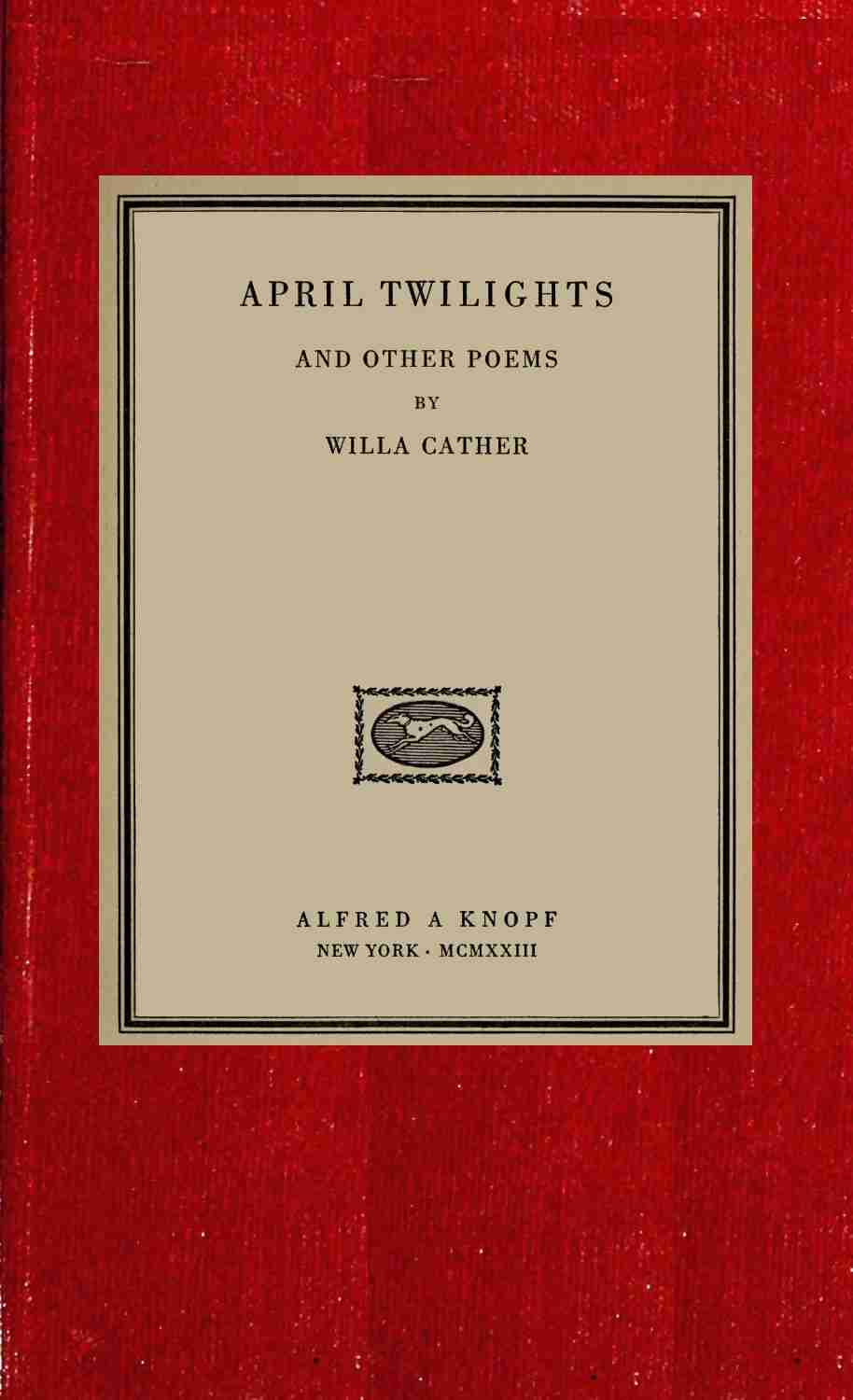
The Project Gutenberg eBook of April twilights, and other poems
Title: April twilights, and other poems
Author: Willa Cather
Release date: January 17, 2021 [eBook #64318]
Most recently updated: October 18, 2024
Language: English
Credits: Charlene Taylor, Chuck Greif and the Online Distributed Proofreading Team at https://www.pgdp.net (This file was produced from images generously made available by The Internet Archive/American Libraries.)
APRIL TWILIGHTS
AND OTHER POEMS
BOOKS BY WILLA CATHER
ALEXANDER’S BRIDGE
O PIONEERS
THE SONG OF THE LARK
MY ANTONIA
YOUTH AND THE BRIGHT MEDUSA
ONE OF OURS
A LOST LADY
(in preparation)
APRIL TWILIGHTS
AND OTHER POEMS
BY
WILLA CATHER
ALFRED A KNOPF
NEW YORK · MCMXXIII
COPYRIGHT, 1923
BY ALFRED A. KNOPF, Inc.
Published, April, 1923
MANUFACTURED IN THE UNITED STATES OF AMERICA
To my Father
for a Valentine
THE verses in Part I of this volume are reprinted from an early volume, April Twilights, published in 1903. Those in Part II are of later composition, and for permission to republish them I am indebted to the editors of Scribner’s Magazine, McClure’s Magazine, and the Century Magazine.
Willa Cather
CONTENTS
PART I
APRIL TWILIGHTS
AND OTHER POEMS
“GRANDMITHER, THINK NOT I FORGET”
An’ wander the old ways again an’ tread them up an’ down.
I never smell the clover bloom, nor see the swallows pass,
Without I mind how good ye were unto a little lass.
I never hear the winter rain a-pelting all night through,
Without I think and mind me of how cold it falls on you.
And if I come not often to your bed beneath the thyme,
Mayhap ’t is that I’d change wi’ ye, and gie my bed for thine,
Would like to sleep in thine.
Without I wonder why it was ye loved the lassie so.
Ye gave me cakes and lollipops and pretty toys a score,—
I never thought I should come back and ask ye now for more.
Grandmither, gie me your still, white hands, that lie upon your breast,
For mine do beat the dark all night and never find me rest;
They grope among the shadows an’ they beat the cold black air,
They go seekin’ in the darkness, an’ they never find him there,
An’ they never find him there.
His own a-burnin’ full o’ love that must not shine for me.
Grandmither, gie me your peaceful lips, white as the kirkyard snow,
For mine be red wi’ burnin’ thirst, an’ he must never know.
Grandmither, gie me your clay-stopped ears, that I may never hear
My lad a-singin’ in the night when I am sick wi’ fear;
A-singin’ when the moonlight over a’ the land is white—
Aw God! I’ll up an’ go to him a-singin’ in the night,
A-callin’ in the night.
For mine be fire within my breast and yet it cannot break.
It beats an’ throbs forever for the things that must not be,—
An’ can ye not let me creep in an’ rest awhile by ye?
A little lass afeard o’ dark slept by ye years agone—
Ah, she has found what night can hold ’twixt sunset an’ the dawn!
So when I plant the rose an’ rue above your grave for ye,
Ye’ll know it’s under rue an’ rose that I would like to be,
That I would like to be.
FIDES, SPES
Everywhere;
Pink to the peach and pink to the apple,
White to the pear.
Stars are come to the dogwood,
Astral, pale;
Mists are pink on the red-bud,
Veil after veil.
Flutes for the feathery locusts,
Soft as spray;
Tongues of lovers for chestnuts, poplars,
Babbling May.
Yellow plumes for the willows’
Wind-blown hair;
Oak trees and sycamores only
Comfortless, bare.
Sore from steel and the watching,
Somber and old,
(Wooing robes for the beeches, larches,
Splashed with gold,
Breath of love from the lilacs,
Warm with noon,)
Great hearts cold when the little
Beat mad so soon.
What is their faith to bear it
Till it come,
Waiting with rain-cloud and swallow,
Frozen, dumb?
THE TAVERN
Many a one has sat before,
Drunk red wine and sung a stave,
And, departing, come no more.
When the night was cold without,
And the ravens croaked of storm,
They have sat them at my hearth,
Telling me my house was warm.
They have rhymed me well in lay;—
When the hunt was on at morn,
Each, departing, went his way.
On the walls, in compliment,
Some would scrawl a verse or two,
Some have hung a willow branch,
Or a wreath of corn-flowers blue.
THE HAWTHORN TREE
Ah, when he came to me!
In the spring-time,
In the night-time,
In the starlight,
Beneath the hawthorn tree.
Ah, when he climbed to me!
To my white bower,
To my sweet rest,
To my warm breast,
Beneath the hawthorn tree.
THE POOR MINSTREL
Than mine arms more tenderly?
Do the angels God hath put
There to guard thy lonely sleep—
One at head and one at foot—
Watch more fond and constant keep?
When the black-bird sings in May,
And the spring is in the wood,
Would you never trudge the way
Over hill-tops, if you could?
Was my harp so hard a load
Even on the sunny morns
When the plumèd huntsmen rode
To the music of their horns?
Hath the love that lit the stars,
Fills the sea and moulds the flowers,
Whose completeness nothing mars,
Made forgot what once was ours?
Christ hath perfect rest to give—
Stillness and perpetual peace;
You, who found it hard to live,
Sleep and sleep, without surcease.
Silence after fevered song;—
I had but a minstrel’s torch
And the way was wet and long.
Sleep. No more on winter nights,
Harping at some castle gate,
Thou must see the revel lights
Stream upon our cold estate.
Bitter was the bread of song
While you tarried in my tent,
And the jeering of the throng
Hurt you, as it came and went.
When you slept upon my breast
Grief had wed me long ago:
Christ hath his perpetual rest
For thy weariness. But oh!
When I sleep beside the road,
Thanking God thou liest not so,
Brother to the owl and toad,
Could’st thou, Dear, but let me know,
Does the darkness cradle thee
Than mine arms more tenderly?
ANTINOUS
Hermes, Osiris, but were never wise
To lift the level, frowning brow of him
Or dull the mortal misery in his eyes,
The scornful weariness of every limb,
The dust-begotten doubt that never dies,
Antinous, beneath thy lids, though dim,
The curling smoke of altars rose to thee,
Conjuring thee to comfort and content.
An emperor sent his galleys wide and far
To seek thy healing for thee. Yea, and spent
Honour and treasure and red fruits of war
To lift thy heaviness, lest thou should’st mar
The head that was an empire’s glory, bent
A little, as the heavy poppies are.
Did the perfection of thy beauty pain
Thy limbs to bear it? Did it ache to be,
As song hath ached in men, or passion vain?
Or lay it like some heavy robe on thee?
Was thy sick soul drawn from thee like the rain,
Or drunk up as the dead are drunk each hour
To feed the colour of some tulip flower?
LONDON ROSES
Slattern girls in Trafalgar, eager to sell you.
Roses, roses, red in the Kensington sun,
Holland Road, High Street, Bayswater, see you and smell you—
Roses of London town, red till the summer is done.
West End, East End, wondrously budding and blooming
Out of the black earth, rubbed in a million hands,
Foot-trod, sweat-sour over and under, entombing
Highways of darkness, deep gutted with iron bands.
WINTER AT DELPHI
Wild is the tempest crying,
Fast through the velvet dark
Little white flakes are flying.
Still is the House of Song.
But the fire on the hearth is burning;
And the lamps are trimmed, and the cup
Is full for his day of returning.
His watchers are fallen asleep,
They wait but his call to follow,
Ay, to the ends of the earth—
But Apollo, the god, Apollo?
Mine eyes are blinded with weeping;
The god who never comes back,
The watch that forever is keeping.
Service of gods is hard;
Deep lies the snow on my pillow.
For him the laurel and song,
Weeping for me and the willow:
Empty my arms and cold
As the nest forgot of the swallow;
Birds will come back with the spring,—
But Apollo, the god, Apollo?
Joy with the lark’s returning;
Love must awake betimes,
When crocus buds are a-burning.
Hawthorns will follow the snow,
The robin his tryst be keeping;
Winds will blow in the May,
Waking the pulses a-sleeping.
Snowdrops will whiten the hills,
Violets hide in the hollow:
Pan will be drunken and rage—
But Apollo, the god, Apollo?
PARADOX
Which is of youth a sea-bound seigniory:
Misshapen Caliban, so seeming vile,
And Ariel, proud prince of minstrelsy,
Who did forsake the sunset for my tower
And like a star above my slumber burned.
The night was held in silver chains by power
Of melody, in which all longings yearned—
Star-grasping youth in one wild strain expressed,
Tender as dawn, insistent as the tide;
The heart of night and summer stood confessed.
I rose aglow and flung the lattice wide—
Ah, jest of art, what mockery and pang!
Alack, it was poor Caliban who sang.
IN MEDIA VITA
Winds of the May that blow,
Birds from the Southland winging,
Buds in the grasses below.
Clouds that speed hurrying over,
And the climbing rose by the wall,
Singing of bees in the clover,
And the dead, under all!
In the cleft of the windy hill;
Hearts that are hushed of their sighing,
Lips that are tender and still.
Stars in the purple gloaming,
Flowers that suffuse and fall,
Twitter of bird-mates homing,
And the dead, under all!
EVENING SONG
Is ever worth one thought from you or me,
Save only Love,
Save only Love?
The world so wide, so deep and dark the sea,
So dark the sea;
Beyond their light—Ah! dear, who knows how far,
Who knows how far?
The heart within me knows, and tells it you,
And tells it you.
LAMENT FOR MARSYAS
Maidens, by the city gate,
Till he come to plunder gold
Of the daffodils you hold,
Or your branches white with may;
He is whiter gone than they.
He will startle you no more
When along the river shore
Damsels beat the linen clean.
Nor when maidens play at ball
Will he catch it where it fall:
Though ye wait for him and call,
He will answer not, I ween.
Still and satisfied and low,
Giving him his will—ah, more
Than a woman could before!
Still forever holding up
To his parted lips the cup
Which hath eased him, when to bless
All who loved were powerless.
Ah! for that too-lovely head,
Low among the laureled dead,
Many a rose earth oweth yet;
Many a yellow jonquil brim,
Many a hyacinth dewy-dim,
For the singing breath of him—
Sweeter than the violet.
“I SOUGHT THE WOOD IN WINTER”
When every twig was green;
The rudest boughs were tender,
And buds were pink between.
Light-fingered aspens trembled
In fitful sun and shade,
And daffodils were golden
In every starry glade.
The brook sang like a robin—
My hand could check him where
The lissome maiden willows
Shook out their yellow hair.
I said, “when every breath
She gives the vagrant summer
But swifter woos her death.
For this the star dust troubles,
For this have ages rolled:
To deck the wood for bridal
And slay her with the cold.”
When every leaf was dead;
Behind the wind-whipped branches
The winter sun set red.
The coldest star was rising
To greet that bitter air,
The oaks were writhen giants;
Nor bud nor bloom was there.
The birches, white and slender,
In deathless marble stood,
The brook, a white immortal,
Slept silent in the wood.
I cried. “No bolt can slay,
No wave nor shock despoil her,
No ravishers dismay.
Her warriors are the angels
That cherish from afar,
Her warders people Heaven
And watch from every star.
The granite hills are slighter,
The sea more like to fail;
Behind the rose the planet,
The Law behind the veil.”
“SLEEP, MINSTREL, SLEEP”
And yellow April’s buried deep and cold.
The wood is black, and songful things forsake
The haunted forest when the year is old.
Above the drifted snow the aspens quake,
The scourging clouds a shrunken moon enfold,
Denying all that nights of summer spake
And swearing false the summer’s globe of gold.
Thine azure song would seek the stars in vain;
Thy rose and roundelay the winter’s spite
Would scarcely spare—O never wake again!
These leaden skies do not thy masques invite,
Thy sunny breath would warm not their disdain;
How should’st thou sing to boughs with winter dight,
Or gather marigolds in winter rain?
Your cloak was thin, your wound was wet and deep;
More bitter breath there was than winter wind,
And hotter tears than now thy lovers weep.
Upon the world-old breast of comfort find
How gentle Darkness thee will gently keep.
Thou wert the summer’s, and thy joy declined
When winter winds awoke. Sleep, minstrel, sleep.
IN ROSE-TIME
That it blows,
And goes.
Spring-time stays but one;
Yellow blow the rye-fields
When the rose is done.
Pines are clad at Yuletide
When the birch is bare,
And the holly’s greenest
In the frosty air.
Builded grim and gray;
Pleasure hath a straw thatch
Hung with lanterns gay.
On her petty savings
Niggard Prudence thrives,
Passion, ere the moonset,
Bleeds a thousand lives.
Folly’s dead and drowned;
Friendship hath her own when
Love is underground.
Ah! for me the madness
Of the spendthrift flower,
Burning myriad sunsets
In a single hour.
POPPIES ON LUDLOW CASTLE
And hold of vanished power,
And crypt of faith forgotten,
I came to Ludlow tower.
Of crypt, and donjon cell,
Of council hall, and chamber,
Of wall, and ditch, and well,
Where clinging ivies run,
A thousand scarlet poppies
Enticed the rising sun,
With death and damp below,—
Three hundred years of spoilage,—
The crimson poppies grow.
These hills that knew him brave,
The gentlest English singer
That fills an English grave.
So cruel gay and red,
When beauty so hath perished
And valour so hath sped?
And captains true asleep,
And singing lips are dust-stopped
Six English earth-feet deep?
How much hath gone for naught,
What wretched ghost remaineth
Of all that flesh hath wrought;
Of adventure and play,
Of art and comely building,
Of faith and form and fray—