
LIST OF PLATES IN VOL. I.
INTRODUCTION.
As regards its Bird-life the Neotropical Region, which, according to the arrangement usually adopted, consists of America south of the Isthmus of Tehuantepec together with the West Indies1, may be most conveniently divided into six Subregions. These are:—
1. The Transpanamic Subregion, embracing the great Central-American Isthmus from Tehuantepec down to Panama.
2. The Antillean Subregion, containing the West-India Islands.
3. The Colombian Subregion, containing the South-American littoral and the adjacent Andean ranges in Venezuela, Colombia, Ecuador, Peru, and Bolivia.
4. The Amazonian Subregion, containing Guiana and the valleys of the Orinoco and Amazons and their confluents.
5. The Brazilian Subregion, containing the great wooded and campos districts of Southern Brazil and Paraguay.
6. The Patagonian Subregion, consisting of Antarctic America up to the Brazilian wood-districts and the highlands of Bolivia on the eastern side of the Andes, and apparently extending as far as the Gulf of Guayaquil on the west.
It is, of course, impossible to draw a precise line between these six Subregions, and any boundaries assigned to them can only be regarded as approximative; but it is obvious that nearly, if not quite, the whole of the Argentine Republic, the Avifauna of which we are now considering, comes within the limits of the Patagonian Subregion. It is possible that the birds of the Territory of Misiones and of some parts of Northern Corrientes may be more nearly akin to those of Brazil, but we may say generally that the Argentine Republic belongs to the Patagonian Subregion.
As shown in the succeeding pages, the number of species of Birds as yet ascertained to be found within the Argentine Republic2 is about 430. We will now take the leading groups of the Neotropical Ornis, one after another, and consider the rôle they play in the Argentine Avifauna, so as to get some general ideas as to its peculiarities.
The subjoined Table contains in the first column the number of Neotropical species assigned to each of the 20 different Orders of Birds in the ‘Nomenclator Avium Neotropicalium.’ In the second column is given the corresponding number of Argentine species of each order according to the present work. The total number of Neotropical species will be seen to be about eight times as many as those of the Argentine Avifauna; so that where this average is exceeded in the individual orders the particular group may be considered to be over-represented, and where it is not reached to be under-represented in the Argentine Avifauna. This is of course a very rough-and-ready mode of calculation, because it assumes that every species has an equal area of distribution, which is not ordinarily the case; but it will serve to give us some general ideas on the subject. We will now proceed to consider the principal groups one after another, and to point out their comparative importance in the Argentine Avifauna.
The known Argentine Passeres, according to the present work, are 229 in number; those of the Neotropical Region, according to the ‘Nomenclator,’ are 1976; so that the species of Argentine Passeres, according to the ratio which we have adopted, would be very little short of the average numbers. If, however, we divide the Passeres up into the three suborders of Oscines, Oligomyodæ, and Tracheophonæ, we shall find that the Oligomyodæ are rather in excess of the estimated average, while the species of the two other groups are deficient. This arises mainly from the large number of Tyrannidæ belonging to the Argentine Ornis. Not less than 63 species of this group have been already discovered within its limits. Besides Tyrants, other prevailing families of Passeres in the Argentine Avifauna are the Finches (Fringillidæ) and the Wood-hewers (Dendrocolaptidæ), both of which have 46 representatives in the Argentine Republic. Both these families are, however, well represented all over the Neotropical Region. But the Tapacolas (Pteroptochidæ) and the Plant-cutters (Phytotomidæ) are both of them families specially characteristic of the Patagonian Avifauna, and both of them are represented in the Argentine Republic. One other Passerine form is also worthy of special mention. The Dippers (Cinclidæ) are essentially an Arctic group diffused all over the Palæarctic and the Arctic Regions. It is singular, however, that this form should reoccur at higher elevations in the Neotropical Region. A Cinclus is found in the mountains of Colombia, another in the Andes of Peru, and a third has lately been discovered in the northern sierras of the Argentine Republic. As regards Passerine birds, therefore, which great order makes up more than one half of the Argentine Ornis, we may say that Finches, Tyrants, and Wood-hewers are remarkable for their abundance, Plant-cutters and Tapacolas for peculiarity of type, and Dippers as an instance of the occurrence of an Arctic form in Antarctic latitudes.
| I. No. of Neotropical Species. |
II. No. of Argentine Species. |
III. Proportion. |
||
|---|---|---|---|---|
| I. | Passeres. | |||
| Oscines | 1049 | 108 | – | |
| Oligomyodæ | 445 | 67 | + | |
| Tracheophonæ | 482 | 54 | – | |
| II. | Macrochires | 444 | 18 | – – |
| III. | Pici | 116 | 13 | – |
| IV. | Coccyges | 214 | 15 | – |
| V. | Psittaci | 142 | 10 | – |
| VI. | Striges | 37 | 6 | + |
| VII. | Accipitres | 114 | 22 | + |
| VIII. | Steganopodes | 17 | 1 | – |
| IX. | Herodiones | 44 | 19 | + |
| X. | Anseres | 64 | 23 | ++ |
| XI. | Columbæ | 66 | 8 | = |
| XII. | Gallinæ | 90 | 4 | – |
| XIII. | Opisthocomi | 1 | 0 | |
| XIV. | Geranomorphæ | 57 | 16 | ++ |
| XV. | Limicolæ | 73 | 25 | ++ |
| XVI. | Gaviæ | 53 | 9 | + |
| XVII. | Pygopodes | 9 | 5 | + |
| XVIII. | Impennes | 9 | 1 | = |
| XIX. | Crypturi | 36 | 8 | + |
| XX. | Struthiones | 3 | 2 | + |
| 3565 | 434 | |||
As regards the second order, Macrochires, the Argentine Avifauna is notably deficient on account of the comparative scarcity of Humming-birds. Although eleven species of this remarkable group have been met with within our limits, the great mass of the Trochilidæ, which are now known to number some 400 species, belong to the Tropics. The Swifts are also scantily represented by a single species. The Caprimulgidæ are comparatively more abundant, but slightly below the average in number of species.
The Argentine Woodpeckers enumerated in the present work are thirteen in number, but several of those are somewhat doubtful species, and others only occur in the extreme northern limits of the Republic. On the whole we may say that the Pici are decidedly deficient in Argentina.
Nine families of the fourth order, Coccyges, are included in the Neotropical Avifauna, but of these only five are represented in the Argentine Ornis—the Motmots, Todies, Jacamars, and Barbets being entirely wanting. The Trogons, Puff-birds, and Toucans are also essentially Tropical forms, and have but one or two representatives on the northern outskirts of the Republic; so that the Cuckoos and Kingfishers are the only two families of Coccyges which play any material rôle in the Argentine Ornis.
Of the order of Parrots it will be seen from our Table that 142 species are known as belonging to the Neotropical Region, and that only ten of these have been met with within our limits. Of these ten, moreover, several are either doubtful, or only occur on the northern outskirts of Argentina, so that Parrots must be held to be deficient in the Argentine Ornis. As is well known Parrots are mostly inhabitants of the Tropics, and it is quite an exception to the rule that several of these warmth-loving birds should extend into the cold latitudes of Patagonia and Chili. This, however, is paralleled in the Old World by the existence of Parrots in some of the Antarctic Islands south of New Zealand.
Of the Birds of Prey of the Argentine Republic, Diurnal and Nocturnal, it is not necessary to say much; both of these orders are rather in excess as regards the average number of species, the Accipitres especially so. The wide open pampas offer a fine field for Kites and Buzzards and their kind, and they are as numerous in individuals as in species in such favoured haunts.
In the next order, Steganopodes, the Argentine Ornis seems to be very deficient. Out of the five families of this group which occur in the Neotropical Region, one only is yet known to us to be represented in the Argentine Ornis, and that by a single species. But when the sea-birds of the Argentine coast-land come to be better known, there is no doubt that several additions will be made to the list.
The next following order, Herodiones, is of much more importance in Argentine Ornithology, not less than 19 species of this group being already known to exist within our limits, out of a total of 44 Neotropical species. And amongst these we can pick out the little Variegated Bittern (Ardetta involucris) and the four species of Ibises as being highly characteristic members of the Argentine Ornis.
The tenth order, that of Anseres, or Waterfowl, commonly so-called, is also largely in excess as regards the number of species. Out of a total of 64 Anseres belonging to the Neotropical Regions, 23 are met with in the Argentine Republic. Moreover, the greater number of these are exclusively Antarctic species, restricted to the Patagonian Subregion. Amongst them we may specially call attention to the Black-necked Swan (Cygnus nigricollis), the Chiloe Wigeon (Mareca sibilatrix), and the Rosy-billed Duck (Metopiana peposaca) as highly characteristic and ornamental species.
Proceeding to the next order, that of the Pigeons (Columbæ), we find the number of Argentine species to be slightly below the average. Several fine Pigeons and Doves are well-known inhabitants of the Republic, but the Columbine order is not a prominent one within our limits.
The Gallinaceous birds of the Neotropical Region are about ninety in number, the greater part of these belonging to the Curassows, Cracidæ, a family specially adapted for habitation in the extensive forests of the New World. Four species of Cracidæ have been met with in the forest-region of Northern Argentina; but the Gallinaceous group as a whole must be held to be deficient in this part of South America, the place in Nature which these birds fill in other regions being occupied here by the more lowly organized Tinamous, of which we shall speak further on.
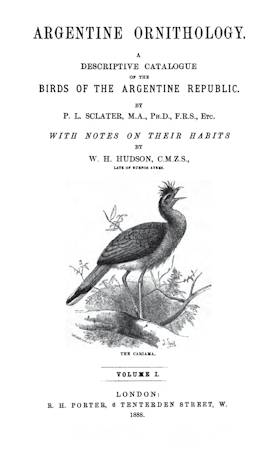
The Geranomorphæ of the Argentine Republic are much in excess as regards the number of species. This arises mainly from the abundant supply of Rails and Crakes which Nature has provided for the more swampy districts of the pampas, and to the presence of no less than three distinct species of Coots (Fulica), which appear to be generally abundant on the lakes and pools. Nor must we forget to mention as of special interest the two Cariamas which belong to this order, and which are the only representatives of a family of very peculiar structure. One of the two Cariamas is, so far as we know, absolutely confined to the Northern provinces of the Argentine Republic; the second is a bird of the campos of Southern Brazil, which only just comes within our limits.
The Snipes and Plovers and their allies, constituting the Order Limicolæ, are again in excess in the Argentine Avifauna, not less than 25 out of a known total of 73 Neotropical species having been already met with within our limits. A large proportion, however, of these birds are merely winter visitors, and breed only in the far north. On the other hand, the Slender-billed Plover (Oreophilus ruficollis) and the Winter Plover (Eudromias modesta) are species highly characteristic of the Patagonian subregion, and come to the neighbourhood of Buenos Ayres from a contrary direction. Another especially characteristic Patagonian family of this order is the Thinocoridæ or Seed-Snipes, of which two species occur within our limits.
Of the Gaviæ, or Gulls and Terns, of the Argentine Republic, nine species are already known out of a total of 53 Neotropical members of the group, and additions no doubt will be made to the list when the coast-birds of La Plata come to be better known.
The seventeenth order of Birds, Pygopodes, is represented in the Argentine Ornis by five species of Grebes. Two of these are widely diffused over all America, the remaining three are Antarctic species belonging to the Patagonian subregion. As only nine species of this groups are known to occur in the whole Neotropical Region, the Pygopodes are highly in excess in the Argentine Avifauna.
The Impennes, or Penguins, which form the eighteenth order of birds, according to the arrangement of the ‘Nomenclator,’ are a group specially characteristic of high Antarctic latitudes. Nine species of Penguins occur on the coasts of Antarctic America, but one of these only is as yet known to reach so far north as our limits.
We now come to the Crypturi or Tinamous, an order of birds commonly supposed to be Gallinaceous, and generally confounded with “Partridges” and “Pheasants” in the vernacular. They are, however, in some points of essential structure more nearly allied to the Struthiones, although they doubtless fill the same place in the economy of Neotropical Nature as the true Gallinaceous birds in other lands. The Tinamous are spread all over the Neotropical Region and number about 36 species. Eight of these occur within the Argentine Republic; and amongst them we may pick out the Martineta Tinamou (Calodromas elegans) and the three species of the genus Nothura as being specially characteristic Patagonian types.
Lastly, we come to the final order of the Neotropical Ornis in the shape of the Rheas, or the American representatives of the Ostrich-type of bird-life. The Rhea is, above all other birds, a most characteristic representative of the Avifauna of the Patagonian subregion. It is true that it ranges far north throughout the campos of Inner Brazil, where the outlying members have become developed into an almost distinct species or subspecies, Rhea americana macrorhyncha. But south of the Rio Negro of Patagonia another very distinct type of Rhea, almost subgenerically different, is met with and extends thence to the Straits of Magellan. Rhea has also been lately ascertained to occur on the western side of the Andes in the Chilian province of Tarapaco; so that this fine form of bird-life is diffused nearly over the entire Patagonian subregion, and is well entitled to be termed one of the most characteristic features of the Patagonian Avifauna.
In conclusion, therefore, we may sum up our present knowledge of the Argentine Avifauna somewhat as follows:—
The Argentine Avifauna comprises 434 species of birds, referable to 54 families and genera.
All the twenty Orders of the Neotropical Avifauna have representatives within its boundaries, except the Opisthocomi or Hoatzins, which are restricted to the Amazonian subregion.
The most numerous families of the Argentine Avifauna are, among the Passeres, the Finches with 46 species, the Tyrants with 63 species, and the Wood-hewers with 46 species. Among the remaining Orders, the Diurnal Birds of Prey with 19 species, the Waterfowl with 22 species, the Rails with 13 species, the Snipes with 15 species, and the Tinamous with 8 species, are likewise well represented.
Genera characteristic and proportionately numerous in species in the Argentine Avifauna are Poospiza and Phrygilus among the Finches, Tænioptera and Cnipolegus among the Tyrants, Synallaxis among the Wood-hewers, Fulica among the Rails, and Nothura among the Tinamous. Less numerous in species, but highly characteristic forms of the Argentine Ornis, are Thinocorus, Rhynchotis, and Rhea.
The following ten genera, mostly monotypic, are, so far as we know at present, restricted to the limits of the Argentine Avifauna or its immediate confines:—Donacospiza and Saltatricula (Fringillidæ); Coryphistera, Anumbius, Limnornis, and Drymornis (Dendrocolaptidæ); Rhinocrypta, with two species (Pteroptochidæ); Spiziapteryx (Falconidæ); Chunga (Cariamidæ); and Calodromas (Tinamidæ).
1 Cf. Sclater, Journ. Linn. Soc., Zool. ii. p. 143 (1857).
2 We have not included within the scope of the present work the territory of Santa Cruz and Tierra del Fuego, which are politically part of the Argentine Republic, but only Northern Patagonia down to the Rio Negro.
ARGENTINE ORNITHOLOGY.
Order I. PASSERES.
Suborder I. OSCINES.
Fam. I. TURDIDÆ, or THRUSHES.
Eight species of the almost cosmopolitan Thrush-family are known to occur in the Argentine Republic. Of these, five belong to the widely-spread genus Turdus, and are closely similar in structure to our European Thrushes. The remaining three are Mock-birds (Miminæ)—a group restricted to the New World, and sometimes considered more nearly allied to the Wrens. They are remarkable as splendid songsters. Burmeister includes in his list a fourth species of Mimus (M. thenca), as found in the Mendoza district; but there may be some error in this, as M. thenca is only known to us from Chili west of the Andes.
1. TURDUS LEUCOMELAS, Vieill.
(DUSKY THRUSH.)
Turdus leucomelas, Scl. et Salv. Nomencl. p. 1; Hudson, P. Z. S. 1870, p. 798 (Buenos Ayres); Durnford, Ibis, 1877, p. 166 (Buenos Ayres); White, P. Z. S. 1882, p. 592 (Misiones and Corrientes); Barrows, Bull. Nutt. Orn. Cl. viii. p. 85 (Concepcion); Seebohm, Cat. Birds, v. p. 213. Turdus crotopezus, Burm. La-Plata Reise, ii. p. 474 (Mendoza).
Description.—Above olive-grey, tinged with brown on the head and neck; beneath pale grey, throat white, more or less striped with brown; middle of belly and crissum white; under wing-coverts and inner margins of wing-feathers fulvous; bill yellow; feet hazel: total length 9·0 inches, wing 4·5, tail 3·7. Female similar.
Hab. Eastern South America, from Cayenne to Buenos Ayres.
The Dusky Thrush is widely distributed in South America, and ranges as far south as Buenos Ayres, where it is quite common in the woods along the Plata river. It is a shy forest-bird; a fruit- and insect-eater; abrupt in its motions; runs rapidly on the ground with beak elevated, and at intervals pauses and shakes its tail; pugnacious in temper; strong on the wing, its flight not being over the trees, but masked by their shadows. It can always be easily distinguished, even at a distance, from other species by its peculiar short, metallic chirp—a melodious sound indicating alarm or curiosity, and uttered before flight—in contrast to the harsh screams and chuckling notes of other Thrushes in this district.
Whether it is a fine singer or not within the tropics I am unable to say, its vocal powers having received no attention from the naturalists who have observed it. With us in the temperate climate of Buenos Ayres, where it commences to sing in September, it has the finest song of any bird I know, excepting only Mimus triurus. Like the English Song-Thrush, but unlike its near neighbours the Red-bellied Thrush and the Magellanic Thrush, it perches on the summit of a tree to sing. Its song is, however, utterly unlike that of the English bird, which is so fragmentary, and, as Mr. Barrows describes it, made up of “vocal attitudes and poses.” The two birds differ also in voice as much as in manner. The strains of the Dusky Thrush are poured forth in a continuous stream, with all the hurry and freedom of the Sky-Lark’s song; but though so rapidly uttered, every note is distinct and clear, and the voice singularly sweet and far-reaching. At intervals in the song there recurs a two-syllabled note twice repeated, unlike in sound any other bird-music I have heard, for it is purely metallic, and its joyous bell-like “te-ling te-ling” always comes like a delightful surprise to the listener, being in strange contrast with the prevailing tone.
The song is altogether a very fine one, its peculiar charm being that it seems to combine two opposite qualities of bird-music, plaintiveness and joyousness, in some indefinable manner.
I have never heard this species sing in a cage or anywhere near a human habitation; and it is probably owing to its recluse habits that its excellent song has not been hitherto noticed. Azara perhaps mistook the song of this species for that of Turdus rufiventris, a very inferior vocalist.
The nest is made in the centre of a thick bush or tree six or eight feet above the ground, and is a deep elaborate structure, plastered inside with mud, and lined with soft dry grass. The eggs are four in number, oblong; the ground-colour light blue, abundantly marked with reddish-brown spots.
This Thrush has, I believe, a partial migration in Buenos Ayres. In the autumn and winter I have frequently observed it in localities where it is never seen in summer.
2. TURDUS RUFIVENTRIS, Vieill.
(RED-BELLIED THRUSH.)
Turdus rufiventris, Scl. et Salv. Nomencl. p. 2; Burm. La-Plata Reise, ii. p. 474; Hudson, P. Z. S. 1870, p. 89 (Buenos Ayres); Durnford, Ibis, 1877, p. 167, 1880, p. 417 (Buenos Ayres); White, P. Z. S. 1882, p. 592 (Salta); Barrows, Bull. Nutt. Orn. Cl. viii. p. 85 (Concepcion). Turdus rufiventer, Seebohm, Cat. B. v. p. 222.
Description.—Entire upper parts olive-grey; throat white, striped with dark brown, the striped portion extending to the chest; rest of under surface, also under wing-coverts, rufous-red, deepest on the belly; bill brownish yellow; feet brown: total length 9·0 inches, wing 4·6, tail 3·6. Female similar.
Hab. S.E. Brazil, Paraguay, Uruguay, and La Plata.
The Red-bellied Thrush, distinguished from the species just described by its larger size and the bright rufous colour of its under plumage, is common everywhere in the Plata region, and does not appear to be migratory. It is a noisy, strong-winged, quarrelsome bird, closely resembling the Dusky Thrush in its manners. It inhabits forests, runs on the ground in search of food, and when approached darts away with loud chuckling notes, flying close to the ground. These birds are also often seen pursuing each other through the trees with loud harsh screams.
The song has a faint resemblance to that of the English Song-Thrush, being composed of a variety of notes uttered in the same disconnected manner, with frequent pauses; but it is, both in sweetness and strength, inferior to that of the English bird. As a rule this Thrush sings concealed in a thick bush or tree.
The nest is deep, well made, plastered inside with mud, and concealed in the centre of a large bush or low tree. The eggs are four, pale blue in colour, and thickly spotted with brown.
3. TURDUS MAGELLANICUS, King.
(MAGELLANIC THRUSH.)
Turdus magellanicus, Seebohm, Cat. B. v. p. 223, pl. xiv. Turdus falklandicus, Scl. et Salv. Nomencl. p. 2; Hudson, P. Z. S. 1872, p. 548 (Rio Negro); Döring, Exp. al Rio Negro, Zool. p. 36 (R. Colorado and R. Negro).
Description.—Head, wings, and tail brownish black; the remaining portions of upper surface brownish olive; under surface pale rufous, obscure on the breast; throat white, striped with black; bill and feet dull yellow: total length 10·5 inches, wing 7·5, tail 4·0. Female similar.
Hab. Patagonia and Chili.
This Thrush, which I met with on the Rio Negro of Patagonia, so closely approximates to T. rufiventris in colour, language, and habits, that the casual observer finds it difficult to distinguish one from the other. Its nest and eggs are also precisely like those of its northern representative. The song is, however, much poorer, and reminds one of the first attempts of a young bird. That a member of so melodious a family should have so inferior a song I attribute to the fact that Thrushes (unlike the songsters of other genera) sing only in the warm season and when the air is calm. In the southern portion of the South-American continent violent winds prevail in summer, so that this southern Thrush sings perhaps less frequently than any other song-bird, and appears to be losing the faculty of song altogether.
4. TURDUS FUSCATER, d’Orb. et Lafr.
(ARGENTINE BLACKBIRD.)
Turdus fuscater, Scl. et Salv. Nomencl. p. 2; White, P. Z. S. 1882, p. 593 (Catamarca); Burm. La-Plata Reise, ii. p. 474 (Mendoza, Cordova, and Tucuman). Merula fuscatra, Seebohm, Cat. B. v. p. 243.
Description.—Uniform brownish black; bill and feet yellow: total length 11·5 inches, wing 5·3, tail 4·5. Female similar.
Hab. Bolivia and Northern La Plata.
“I have noticed this bird in the provinces of Mendoza, San Juan, San Luis, Cordova, and Catamarca, where it is much esteemed as a cage-bird on account of its beautiful whistle. In Mendoza it goes by the name of ‘Zorsal,’ in Catamarca and Cordova by that of ‘Merlo,’ and in Andalgala (Catamarca province) ‘Chocoyno.’”—White, l. s. c.
“Very common at Mendoza, Cordova, and Tucuman, and met with among the shady trees of the promenades: has a better song than our Blackbird, which is heard at a distance, especially in the evening. Called ‘Crispin’ in Tucuman.”—Burm. l. s. c.
5. TURDUS NIGRICEPS, Cab.
(BLACK-HEADED THRUSH.)
Turdus nigriceps, Cab. J. f. O. 1878, p. 195.
Description.—Above slaty grey, head black; below paler, chin white, striped with black; middle of belly and crissum white; bill and feet pale yellow: total length 7·6 inches, wing 4·4, tail 3·5. Female olive-brown, paler below, chin pale ochraceous; middle of belly and crissum white; bill brown, feet yellowish.
Hab. Peru, Bolivia, and Northern La Plata.
Met with by Dr. A. Döring and Herr Schulz on the Sierra of Cordova.
6. MIMUS MODULATOR, Gould.
(CALANDRIA MOCKING-BIRD.)
Mimus modulator, Sharpe, Cat. B. vi. p. 347. Mimus calandria, Burm. La-Plata Reise, ii. p. 475; Scl. et Salv. Nomencl. p. 3; Hudson, P. Z. S. 1870, p. 89 (Buenos Ayres); Durnford, Ibis, 1877, p. 167 (Buenos Ayres); White, P. Z. S. 1883, p. 37 (Cordova); Barrows, Bull. Nutt. Orn. Cl. viii. p. 85 (Concepcion).
Description.—Above dark grey, faintly mottled with pale grey; rump tinged with brown; wings nearly black, the feathers edged with brownish white; tail black, the feathers, except the two middle ones, broadly tipped with white; under surface dirty white; bill and legs black; eye olive-green: total length 11·0 inches, wing 4·5, tail 4·9. Female similar.
Hab. Paraguay, Uruguay, and Argentine Republic.
Azara has not failed to remark that it would be well to find a more appropriate name for this species, which was absurdly called “Calandria” (i. e. Sky-Lark) by the early colonists of the Plata. Use is, however, too strong to be easily set aside, and the name is now familiar to everyone in the Argentine Province. Moreover, by a curious irony of fate, the Spanish naturalist himself, by employing this unsuitable name in his ‘Apuntamientos,’ even while protesting against it, has been the cause of its introduction into scientific nomenclature.
It would be impossible to improve on the account Azara gives of the bird’s appearance and manners. The prevailing colour of the plumage is grey, the irides are deep green, the beak black, slender, and curved. The tail is long, jerked and elevated when the bird is at rest, spread open and depressed in flight. The Calandria’s movements are measured and dignified, its flight low and never extends far, the bird usually passing from one tree to another in a long graceful curve. It goes alone or with its mate only; feeds chiefly on the ground; does not penetrate into deep forests, nor is it seen on the treeless plains. It frequents the borders of woods and open grounds abounding in isolated shrubs and trees; is fond of coming about houses, and invariably perches itself on the most conspicuous places. It sings chiefly in spring, and its really wonderful vocal powers have made it one of our best-known and most-admired songsters. To sing it usually places itself on the summit of a bush or tree, and occasionally, as if carried away by excitement, it darts upwards three or four yards into the air, and then drops back on to its perch. So varied are its notes, and so frequently suggestive of the language of other species, that the listener finds himself continually asking whether the Calandria is really an original singer or merely a cunning plagiarist, able to steal scraps of fifty different melodies and to blend them in some sort into one complete composition. As a whole the song is in character utterly unlike that of any other bird (birds of the Mimus genus, of course, excepted), for the same notes are never repeated twice in the same order; and though the Calandria has many favourite notes, he is able to vary every one of them a hundred ways. Sometimes the whole song seems to be made up of imitations of other singers, with slight variations—and not of singers only, for now there will be clear flute-like notes, only to be succeeded by others reedy and querulous as the hunger-calls of a young Finch; then there will be pretty flourishes or Thrush-like phrases, and afterwards screams, as of a frightened Swallow hurrying through the sky to announce the approach of a Falcon; or perhaps piteous outcries, as of a chicken in the clutches of a Kite.
Nevertheless Azara says truly that the Calandria does not mock or mimic the songs of other birds; for though the style and intonation of a score of different singers, chatterers, and screamers are reproduced by him, one can never catch a song, or even a portion of a song, of which he is able to say that it is absolutely like that of any other species. This much, however, can be said of the Calandria: he has a passion for endless variety in singing, a capacity for varying his tones to almost any extent, and a facility for catching the notes of other birds, which, in the Virginian Mocking-bird of North, and in the White-banded Mocking-bird of South America, has been developed into that marvellous faculty these two species possess of faithfully imitating the songs of all other birds. The two species I have just named, while mockers of the songs of other birds, also retain their own original music—their “natural song,” as an American ornithologist calls it.
The Calandria makes its nest in the middle of a large bush or low thorn-tree standing by itself; it is deep, like the nest of a Thrush in form, built of sticks, thorns, and grass, and lined with thistle-down or some other soft material. The eggs are four or five, pale blue, and thickly marked with reddish-brown spots.
When the nest is approached the parent birds demonstrate their anxiety by uttering loud harsh angry notes.
It is generally believed that the Calandria will not live in captivity. I have, however, seen a few individuals in cages, but they never sang.
7. MIMUS PATACHONICUS (d’Orb. et Lafr.).
(PATAGONIAN MOCKING-BIRD.)
Mimus patachonicus, Scl. et Salv. Nomencl. p. 3; Hudson, P. Z. S. 1872, p. 538 (Rio Negro); Durnford, Ibis, 1877, p. 31 (Chupat); Döring, Exp. al Rio Negro, Zool. p. 36 (R. Colorado); Sharpe, Cat. B. vi. p. 352. Mimus thenca, Burm. La-Plata Reise, ii. p. 475 (Mendoza)?
Description.—Above and beneath grey, paler on the under surface, and tinged with rufous on the belly; throat and mark over the eye white; wings black, the outer webs of the feathers edged with white and grey; tail black, tipped with white; bill and feet black; eye olive-green: total length 9·2 inches, wing 4·2, tail 4·0. Female similar, but smaller in size and lighter in colour.
Hab. Northern Patagonia.
The Patagonian Mocking-bird, which I met with during my sojourn on the Rio Negro of Patagonia in 1871, closely resembles the species just described, but is smaller, the plumage is of a darker grey, and the irides are also of a darker green. It is a common bird, resident, lives alone or with its mate, feeds on insects and berries, and in its manner of flight and habits is like Mimus modulator. The nest is made in the centre of a bush of thorns and sticks, and lined with dry grass, cow-hair, or other soft material; and the eggs are four in number, bluntly pointed, and thickly marked with dark flesh-coloured spots. When the nest is approached the parent birds come close to the intruder, often perching within a yard of his head, but without uttering any sound, differing in this respect from M. modulator.
The song of the Patagonian bird is in character like that of the northern species, the variety of its notes being apparently infinite; there are, however, some differences worth mentioning. The singing of the Patagonian species is perhaps inferior, his voice being less powerful, while his mellow and clear notes are constantly mingled with shrill ones, resembling the cries of some of the Dendrocolaptine birds. While incapable of notes so loud or so harsh as those of the northern bird, or of changes so wild and sudden, he possesses even a greater variety of soft notes. Day after day for many months I have heard them singing, yet never once listened to them for any length of time without hearing some note or phrase I had never heard before. The remarks I have made concerning the Calandria’s mocking-faculties also apply to this bird: but though he does not actually repeat the notes and songs of other species, he certainly does mock the notes of individuals of his own species; for it must be borne in mind that no two individuals sing quite alike, and that the same bird constantly introduces new notes into his song, and never repeats his notes in the same order. I have often observed that when a bird, while singing, emits a few of these new notes, he seems surprised and delighted with them; for, after a silent pause, he repeats them again and again a vast number of times, as if to impress them on his memory. When he once more resumes his varied singing, for hours, and sometimes for days, the expression he has discovered is still a favourite one, and recurs with the greatest frequency. But this is not all. If the new note or phrase happens to be a very striking one, it immediately takes the fancy of all the other birds within hearing, and often in a small thicket there will be a dozen or twenty birds near together, each sitting perched on the summit of his own bush. After the new wonderful note has been sounded they all become silent and attentive, reminding one in their manner of a caged Parrot listening to a sound it is trying to learn. Presently they learn it, and are as pleased with its acquisition as if they had discovered it themselves, repeating it incessantly. I noticed this curious habit of the bird many times, and on one occasion I found that for three entire days all the birds in a small thicket I used to visit every day did nothing but repeat incessantly two or three singular notes which they had borrowed from one of their number. The constant repetition of this one sound had a strongly irritating effect on me; but a day or two later they had apparently got tired of it themselves, and had resumed their usual varied singing.
This bird usually sits still upon the summit of a bush when singing, and its music is heard in all seasons and in all weathers from dawn till after dark: as a rule it sings in a leisurely unexcited manner, remaining silent for some time after every five or six or a dozen notes, and apparently listening to his brother-performers. These snatches of melody often seem like a prelude or promise of something better coming; there is often in them such exquisite sweetness and so much variety that the hearer is ever wishing for a fuller measure, and still the bird opens his bill to delight and disappoint him, as if not yet ready to display his whole power.