
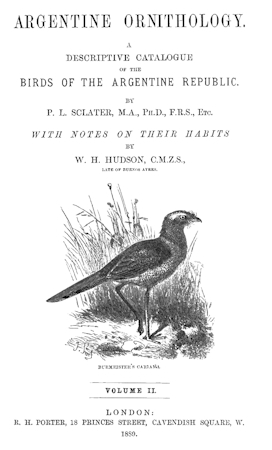
Amblypterus anomalus, Gould, Icon. Av. pl. 11. Heleothreptus anomalus, Scl. et Salv. Nomencl. p. 97; Durnford, Ibis, 1878, p. 62 (Buenos Ayres); Pelz. Orn. Bras. p. 12.
Description.—Greyish brown, irregularly dashed and spotted with black; long superciliaries and faint nuchal collar pale fawn-colour; wing-coverts and secondaries like the back, but with pale fawn-coloured spots; primaries black, with the basal portion reddish fawn-colour and tips white, the first six nearly equal in length, and curved inwards; tail fawn-colour, irregularly barred with blackish, two centre feathers like the back: beneath, throat and breast blackish brown, with slight fawn-coloured shaft-spots; abdomen pale fawn-colour, with irregular blackish cross bands; tarsi long, naked: whole length 7·0 inches, wing 5·2, tail 3·5. Female similar, but wings banded with rufous, and without the white tips.
Hab. South Brazil and Argentina.
Mr. Durnford obtained a single female of this rare and anomalous Caprimulgine form on the 31st of March, 1877, near Quilmes in the province of Buenos Ayres. It was flushed from a clump of thistles, and its stomach was full of insect-remains.
Order III. PICI.
Fam. XXIII. PICIDÆ, or WOODPECKERS.
The Woodpeckers are distributed all over the world except Australia and the adjacent islands (up to Flores and Celebes) and Madagascar. They are very abundant in the Neotropical and Oriental Regions, where great forests predominate. From South and Central America about 120 species, mostly belonging to peculiar genera, have been recorded. In Argentina, as might have been expected from the vast extent of the pampas districts, Woodpeckers are not so plentiful as in the densely wooded countries of Amazonia and Colombia. But four Woodpeckers are met with in the riverain woods of Buenos Ayres, and a fifth, a curiously modified form, is peculiar to the Pampas, while eight others are known with more or less certainty from the northern provinces of the Republic.
248. CAMPEPHILUS BOIÆI (Wagl.).
(BOIE’S WOODPECKER.)
Campephilus boiæi, Scl. et Salv. Nomencl. p. 98; Durnford, Ibis, 1877, p. 185 (Buenos Ayres); Salvin, Ibis, 1880, p. 360 (Salta); White, P. Z. S. 1882, p. 617 (Catamarca, Salta); Barrows, Auk, 1884, p. 25 (Entrerios).
Description.—Above and beneath black; crested head and neck scarlet, ear-coverts black, with a white line below; upper back and interscapulium pale tawny white; bend of wing cinnamomeous; inner webs of primaries pale chestnut; bill white, feet black: whole length 12·0 inches, wing 7·4, tail 4·2. Female similar, but head black, except the sides of the back of the head and the under portion of the crest, which are scarlet.
Hab. Bolivia and Northern Argentina.
Durnford found this fine Woodpecker “resident and common” to the north of Buenos Ayres, and on the banks of the Paraná. It is likewise met with in the more northern provinces of the Republic. White obtained specimens in Catamarca and Salta, and Durnford, during his last expedition, in the latter locality. Mr. Barrows speaks of its occurrence in Entrerios as follows:—
“A part of the last week in April 1880 was spent in a considerable tract of forest bordering a stream known as the ‘Arroyo Gualeguaychú’ at a point about twenty miles west of Concepcion. The wood borders the stream to a depth of a mile or more on each side and stretches up and down stream indefinitely. It had suffered comparatively little from the axe of the charcoal-burner, and many birds, not elsewhere seen, were met with here. Among these was the present beautiful Woodpecker, of which, however, only a single pair was observed, and the male alone taken. It is said to occur sparingly in all the large forests.”
249. CAMPEPHILUS SCHULZI (Cab.).
(SCHULZ’S WOODPECKER.)
Phloeotomus schulzi, Cab. Journ. f. Orn. 1883, p. 102. Dryocopus atriventris, Burm. La-Plata Reise, ii. p. 444 (?).
Under this title Dr. Cabanis has shortly described a Woodpecker procured in Central Argentina by Herr Schulz. It is a diminutive form of C. pileatus of North America; and differs from that species in colour only in the following points:—The red crest is comparatively more developed and more pointed; the general colour is more intensely black; the white markings of C. pileatus are present in C. schulzi, but the extent of the white on the underside of the wings and on the carpal joint is much less in the latter species. No dimensions are given.
Dr. Cabanis is of opinion that the bird from Mendoza described by Dr. Burmeister as the young of C. boiæi is referable to this new species.
250. DRYOCOPUS ERYTHROPS (Val.).
(RED-FACED WOODPECKER.)
Dryocopus erythrops, Scl. et Salv. Nomencl. p. 99; White, P. Z. S. 1882, p. 617 (Misiones).
Description.—Above black; crested head scarlet; broad line from front beneath the eye and down the neck white; malar patch scarlet: beneath, throat white, with black striations; breast black; belly white, transversely barred with black; under surface of wings white; bill plumbeous; feet black: whole length 13·0 inches, wing 7·5, tail 5·0. Female similar, but anterior half of head black, and no scarlet malar patch.
Hab. Brazil.
White states that he “observed” a few specimens of this Brazilian species in the dense forests of Misiones; but its occurrence so far south requires confirmation. A more likely species of this genus to occur there would be D. lineatus, which has been found in Paraguay (cf. Berlepsch, J. f. O. 1887, p. 20).
251. PICUS MIXTUS, Bodd.
(VARIED WOODPECKER.)
Picus mixtus, Scl. et Salv. Nomencl. p. 99; Durnford, Ibis, 1878, p. 62 (Buenos Ayres); White, P. Z. S. 1882, p. 617 (Catamarca); Barrows, Auk, 1884, p. 25 (Entrerios); Withington, Ibis, 1888, p. 467 (Lomas de Zamora).
Description.—Above black, with regular white cross bars; head black, with narrow yellowish shaft-spots; a large patch behind the ear on each side of the neck white; feathers of the nape slightly pointed with rosy red: beneath white, with longitudinal black stripes; under surface of wings white, with black cross bars: whole length 6·0 inches, wing 3·5, tail 2·2. Female similar, but head uniform black, and no red on the nape.
Hab. South Brazil and Argentina.
In the district of Buenos Ayres this little Woodpecker, the smallest of the Argentine species of the family, is usually called Come-palo (Wood-eater) in the vernacular. It has all the habits characteristic of the true Woodpeckers, inhabiting the woods and perching vertically on the trees, where it is heard vigorously striking the bark to dislodge the lurking insects with its sharp beak. When disturbed it flits away with a shrill querulous cry, passing to the nearest tree with a rapid undulating flight, and conceals itself by running round the bole to the opposite side. It excavates a straight hole in a rotten or decaying branch to breed in, and a common species of Synallaxis (Leptasthenura ægithaloides) frequently makes use of its forsaken breeding-holes. The entire plumage in both sexes is very dark, nearly black, densely and evenly marked with oblong white spots. The loose feathers of the crown are black tipped with scarlet, but in the female the one spot of bright colour is scarcely if at all perceptible.
White met with this Woodpecker near Cordova and in Catamarca, and Mr. Barrows in Entrerios, where, however, though resident, it does not appear to be common.
252. PICUS CACTORUM, d’Orb. et Lafr.
(CACTUS WOODPECKER.)
Picus cactorum, Scl. et Salv. Nomencl. p. 99; Salvin, Ibis, 1880, p. 361 (Salta); White, P. Z. S. 1882, p. 617 (Catamarca); Barrows, Auk, 1884, p. 25 (Gualeguaychú). Dendrobates cactorum, Burm. La-Plata Reise, ii. p. 445 (Catamarca).
Description.—Above black; large blotch on the front and another on the nape dull white; small coronal spot scarlet; wings and tail black, with white cross bands; rump white, spotted with black: beneath buffy white, throat strongly tinged with orange; bill and feet black: whole length 6·8 inches, wing 4·1, tail 2·3. Female similar, but without the red spot on the crown.
Hab. Bolivia and Northern Argentina.
Prof. Burmeister met with three specimens of this Woodpecker at Capellán, south-west of Catamarca. White obtained examples of both sexes in Catamarca, and found it tolerably abundant in that province. “Three or four are usually observed together on a large cactus, but on being disturbed either take to another cactus or to the lofty branches of algaroba-trees.”
In Entrerios Mr. Barrows tells us this species is more common than P. mixtus, but abundant only on the Gualeguaychú, about twenty miles west of Concepcion.
253. CHLORONERPES AFFINIS (Wagl.).
(ALLIED WOODPECKER.)
Chloronerpes affinis, Scl. et Salv. Nomencl. p. 99; White, P. Z. S. 1882, p. 617 (Salta).
Description.—Above dull olive-green, with fine yellowish shaft-spots; wings and tail black, spotted with white; head black, bordered behind by a yellow nuchal collar, front of head with white shaft-spots, hinder half with scarlet ends to the feathers: beneath greyish white, with narrow black cross bands; under surface of wings white, barred with black: whole length 6·5 inches, wing 3·7, tail 2·4. Female similar, but without any red on the nape.
Hab. Brazil.
White identified a pair of birds obtained at Campo Santo, in Salta, as belonging to this species, but his determination requires confirmation, as there are several forms of this genus nearly alike which require accurate discrimination.
254. CHLORONERPES FRONTALIS, Cab.
(RED-FRONTED WOODPECKER.)
Chloronerpes (Campias) frontalis, Cab. Journ. f. Orn. 1883, p. 110.
Description.—Like C. maculifrons (Spix), but larger; red of head darker and broader, and without any golden-yellow border; beneath darker and more thickly cross-banded, with the bright bands narrower.
Hab. Tucuman.
This little-known species is one of Herr Fritz Schulz’s discoveries in the mountain-forests of Tucuman.
255. CHLORONERPES AURULENTUS (Licht.).
(GOLD-BACKED WOODPECKER.)
Chloronerpes aurulentus, Scl. et Salv. Nomencl. p. 99; White, P. Z. S. 1882, p. 617 (Misiones).
Description.—Above olive-green, crown and malar stripe scarlet; sides of head slaty, with a yellowish line above and beneath; wings black, with transverse bars of rusty red; tail black: beneath greyish white, regularly barred across with black, throat yellow: whole length 8·0 inches, wing 4·8, tail 2·2. Female similar, but only the nape scarlet, rest of cap like the back.
Hab. Brazil.
The occurrence of this Woodpecker in Argentina also rests upon White’s authority. But as it is found in Paraguay (cf. Berlepsch, J. f. O. 1887, p. 120), it is very likely to extend into Misiones. White states that it is common in San Javier, and usually “seen singly in dead high trees.”
256. CHLORONERPES TUCUMANUS, Cab.
(TUCUMAN WOODPECKER.)
Chloronerpes tucumanus, Cab. Journ. f. Orn. 1883, p. 103.
Description.—Like C. rubiginosus, and principally distinguishable by its rather larger size and darker under surface, in which the yellowish hue is wanting.
Hab. Tucuman.
This is another discovery of Herr Fritz Schulz in Tucuman, which has been shortly described by Dr. Cabanis.
257. CHRYSOPTILUS CRISTATUS (Vieill.).
(RED-CRESTED WOODPECKER.)
Chrysoptilus melanochlorus, Burm. La-Plata Reise, ii. p. 445 (Paraná, Cordova, Tucuman). Chrysoptilus chlorozostus, Scl. et Salv. P. Z. S. 1868, p. 143 (Conchitas). Chrysoptilus cristatus, Scl. et Salv. Nomencl. p. 100; Gibson, Ibis, 1880, p. 11 (Buenos Ayres); White, P. Z. S. 1882, p. 618 (Catamarca); Barrows, Auk, 1884, p. 25 (Entrerios); Withington, Ibis, 1888, p. 468 (Lomas de Zamora). Colaptes leucofrenatus, Leybola, Leopoldina, Heft viii. p. 53 (1873).
Description.—Above black, barred across with white; rump white, with black spots; top of head black, nape scarlet; sides of head white, bordered beneath by black, which carries a scarlet malar stripe: beneath white, on the neck yellowish, thickly covered with round black spots; throat white, striped with black; under surface of wings white, tinged with yellow; tail black, lateral rectrices slightly barred with yellowish; bill and feet black: whole length 10·5 inches, wing 5·8, tail 4·0. Female similar, but without the scarlet malar patch.
Hab. Paraguay and Argentina.
This Woodpecker ranges as far south as the vicinity of Buenos Ayres, and is not uncommon there in the few localities which possess wild forests. It is the handsomest of our Woodpeckers, having brighter tints than its congener of the plains, Colaptes agricola. Like that bird, though not to the same extent, it has diverged from the typical Picidæ in its habits, alighting sometimes on the ground to feed, and also frequently perching crosswise on branches of trees. It has a powerful, clear, abrupt, and oft-repeated note, and a rapid undulating flight.
The following interesting account of its breeding-habits appears in one of Mr. Gibson’s papers:—“The excavation for the nest is begun as early as September; but the eggs are only laid during the first half of October. The hole is generally commenced where some branch has decayed away; but care is taken that the remainder of the tree is sound. It opens at a height of from six to nine feet from the ground, and is excavated to a depth of nearly a foot. Occasionally it is sufficiently wide to admit of one’s hand, but such is not always the case. No preparation is made for the eggs beyond the usual lining of some chips of wood.
“The pair which frequented the garden excavated a hole in a paradise-tree, and bred there for two consecutive years. The tree stood near one of the walks, and on any one passing the sitting bird immediately showed its head at the aperture, like a jack-in-the-box, and then flew away. Last year this pair actually bred in one of the posts of the horse-corral, notwithstanding the noise and bustle incident to such a locality. While waiting there, at sunrise, for the herd of horses to be shut in I used often to knock at the post, in order to make the Woodpecker leave its nest, but the bird seemed indifferent to such a mild attack, and would even sit still while a hundred horses and mares rushed about the corral or hurled themselves against the sides of it. In another case I had worked with hammer and chisel for half-an-hour, cutting a hole on a level with the bottom of a nest, when the female first demonstrated her presence by flying out almost into my face. This last nest contained four (considerably incubated) eggs, which I took. Happening to pass the spot a fortnight after, I inspected the hole and was surprised to find that it had been deepened and other five eggs laid, while the entrance I had cut was the one now used by the birds. The nest was again resorted to the following year and a brood hatched out, but since then a pair of Wrens have occupied the place to the exclusion of the rightful owners.”
The eggs are white, four or five in number, pear-shaped, and with polished shells.
White obtained specimens of this Woodpecker in Catamarca, and Mr. Barrows found it resident in Entrerios. The latter tells us it is “abundant in the woods everywhere, and conspicuous for its activity, bright colours, and large size.”
258. LEUCONERPES CANDIDUS (Otto).
(WHITE-BELLIED WOODPECKER.)
Leuconerpes candidus, Burm. La-Plata Reise, ii. p. 445 (Paraná, Cordova); Scl. et Salv. Nomencl. p. 100; Salvin, Ibis, 1880, p. 361 (Salta); White, P. Z. S. 1882, p. 618 (Misiones); Barrows, Auk, 1884, p. 25 (Entrerios).
Description.—Above white; wings and upper back, with a line on each side running up to the eye, black; nape tinged with yellow: beneath white; tail black, with white cross bands: whole length 11·0 inches, wing 5·5, tail 4·5. Female similar, but without the yellow on the nape.
Hab. S. Brazil, Bolivia, Paraguay, and Northern Argentina.
Prof. Burmeister met with this peculiarly coloured Woodpecker near Paraná, and Mr. Barrows found it resident in Entrerios, though not very abundant.
White speaks of this species as follows:—“These noisy birds, abundant in various parts of Misiones as well as in the rest of the north of the Republic, go about in flocks of eight or ten, and settle on the same tree, which they proceed to ascend very comically in a spiral or corkscrew fashion, each head touching the preceding tail. They are not seen in dense forests, but only out in the open, on some old, usually dead, tree, and I think I observed them as far south as the sierras of Cordoba.”
259. COLAPTES LONGIROSTRIS, Cab.
(LONG-BILLED WOODPECKER.)
Colaptes longirostris, Cabanis, Journ. f. Orn. 1883, p. 97.
Description.—Similar to C. rupicola, d’Orb., but with the bill much longer.
Hab. Tucuman.
This is a southern form of the Brazilian C. rupicola, which has been recently described by Dr. Cabanis. Herr Schulz obtained a single male example of this species in Tucuman. Like C. rupicola it has red moustaches, but no red nape-band, whereas the more northern C. pura of Peru shows a red nape-band in both sexes.
260. COLAPTES AGRICOLA (Malh.).
(PAMPAS WOODPECKER.)
Colaptes agricola, Scl. et Salv. Nomencl. p. 101; Hudson, P. Z. S. 1872, p. 549 (Rio Negro); Barrows, Auk, 1884, p. 25 (Entrerios); Withington, Ibis, 1888, p. 468 (Lomas de Zamora). Colaptes australis, Burm. La-Plata Reise, ii. p. 445 (Paraná). Colaptes campestris, White, P. Z. S. 1882, p. 618 (Misiones).
Description.—Above greyish white, transversely barred with blackish; wings black, with golden-yellow shafts, and white bars on the outer webs; rump white, with smaller black cross bars; crested head black; sides of head and whole neck in front yellow; malar stripe red; abdomen white, with regular transverse black bars; under wing-coverts yellowish white; bill and feet black: whole length 13·0 inches, wing 6·8, tail 4·9. Female similar, but no red malar stripe.
Hab. Argentina and Patagonia.
The species commonly called Carpintero in the Argentine country, and ranging south to Patagonia, is one of a group of the Picidæ of South America which diverge considerably in habits from the typical Woodpeckers. On trees they usually perch horizontally and crosswise, like ordinary birds, and only occasionally cling vertically to trunks of trees, using the tail as a support. They also seek their food more on the ground than on trees, in some cases not at all on trees, and they also breed oftener in holes in banks or cliffs than in the trunks of trees. As Darwin remarks in ‘The Origin of Species,’ in his chapter on Instinct, these birds have, to some slight extent, been modified structurally in accordance with their less arboreal habits, the beak being weaker, the rectrices less stiff, and the legs longer than in other Woodpeckers. In South Brazil and Bolivia the Colaptes campestris represents this group, in Chili C. pitius, and in the Argentine country C. agricola.
Azara’s description, under the heading El Campestre, probably refers to the Brazilian species, but agrees so well in every particular with the pampas Woodpecker that I cannot do better than to quote it in full.
“Though this name (Campestre) seems inappropriate for any Woodpecker, no other better describes the present species, since it never enters forests, nor climbs on trunks to seek for insects under the bark, but finds its aliment on the open plain, running with ease on the ground, for its legs are longer than in the others. There it forcibly strikes its beak into the matted turf, where worms or insects lie concealed, and when the ant-hills are moist it breaks into them to feed on the ants or their larvæ. It also perches on trees, large or small, on the trunks or branches, whether horizontal or upright, sometimes in a clinging position and sometimes crosswise in the manner common to birds. Its voice is powerful, and its cry uttered frequently both when flying and perching. It goes with its mate or family, and is the most common species in all these countries. It lays two to four eggs, with white and highly polished shells, and breeds in holes which it excavates in old walls of mud or of unbaked brick, also in the banks of streams; and the eggs are laid on the bare floor without any lining.”
In Patagonia, where I have found this bird breeding in the cliffs of the Rio Negro, its habits are precisely as Azara says; but on the pampas of Buenos Ayres, where the conditions are different, there being no cliffs or old mud-walls suitable for breeding-places, the bird resorts to the big solitary ombú tree (Pircunia dioica), which has a very soft wood, and excavates a hole 7 to 9 inches deep, inclining upwards near the end, and terminating in a round chamber.
This reversion to an ancestral habit, which (considering the modified structure of the bird) must have been lost at a very remote period in its history, is exceedingly curious. Formerly this Woodpecker was quite common on the pampas. I remember that when I was a small boy quite a colony lived in the ombú trees growing about my home; now it is nearly extinct, and one may spend years on the plains without meeting with a single example.
Mr. Barrows speaks as follows of this species:—“Abundant and breeding at all points visited. At Concepcion, where it is resident, it is by far the commonest Woodpecker. The ordinary note very much resembles the reiterated alarm-note of the Greater Yellow-legs (Totanus melanoleucus), but so loud as to be almost painful when close at hand, and easily heard a mile or more away. They spend much time on the ground, and I often found the bills of those shot quite muddy. They are very tough and hard to kill, and a wounded one shows about as many sharp points as a Hawk. A nest found near Concepcion, November 6, 1880, was in the hollow trunk of a tree, the entrance being through an enlarged crack at a height of some three feet from the ground. The five white eggs were laid on the rubbish at the bottom of the cavity, perhaps a foot above the ground. In the treeless region about the Sierra de la Ventana we saw this bird about holes on the banks of the streams, where it doubtless had nests.”
Order IV. COCCYGES.
Fam. XXIV. ALCEDINIDÆ, or KINGFISHERS.
The Kingfishers, which form the subject of an excellent illustrated Monograph by Mr. Sharpe1, are but feebly represented in the New World. Out of the many varied generic forms which make up the family, only a single genus, with about eight species, is met with in the whole of the American Continent. This genus (Ceryle) is of wide diffusion, having also representatives in Africa and Asia. There is thus a great contrast with the Old World, where at least 120 species of Kingfishers are met with.
1 A Monograph of the Alcedinidæ, or Family of Kingfishers. By R. B. Sharpe. London, 1868-71.
261. CERYLE TORQUATA (Linn.).
(RINGED KINGFISHER.)
Ceryle torquata, Scl. et Salv. Nomencl. p. 103; Barrows, Auk 1884, p. 26 (Entrerios); Sharpe, Mon. Alc. pl. xxii. p. 73; Withington, Ibis, 1888, p. 468 (Lomas de Zamora). Megaceryle torquata, Burm. La-Plata Reise, ii. p. 446 (Paraná).
Description.—Above bluish grey, with narrow black shaft-stripes and some small round spots of white; wings black, with a large portion of the inner webs towards the base white, coverts like the back; tail black, crossed by white bars, central rectrices edged with bluish grey: beneath chestnut-red; throat, centre of belly, and crissum white: whole length 15·0 inches, wings 7·7, tail 5·5. Female similar, but with a broad bluish-grey pectoral band.
Hab. Central and South America.
This beautiful bird, the largest of the American Kingfishers, is found throughout the greater portion of South and Central America. In the Argentine Republic it is somewhat rare, though widely distributed, and ranging as far south as Buenos Ayres. Dr. Döring mentions Ceryle torquata amongst the species collected by him on the Rio Negro, in Patagonia; but it is possible that the closely allied C. stellata is meant, as this form represents the larger and more brightly-coloured bird in the Magellanic district.
Notwithstanding its wide distribution and great beauty, little has been recorded of the habits of this species. In Amazonia, Bartlett says:—“It breeds in company with Ceryle amazona. The nest, however, is placed very much deeper in the bank than in the case of the last-named bird, the hole being from 4 to 6 feet in depth, with a chamber at the end sufficiently large for the young birds when nearly full-grown.”
262. CERYLE AMAZONA (Lath.).
(AMAZONIAN KINGFISHER.)
Ceryle amazona, Scl. et Salv. Nomencl. p. 103; White, P. Z. S. 1883, p. 40 (Cordova); Barrows, Auk, 1884, p. 26 (Entrerios); Sharpe, Mon. Alc. pl. xxiv. p. 83. Chloroceryle amazona, Burm. La-Plata Reise, ii. p. 446 (Paraná).
Description.—Above dark green, with a white neck-band: beneath white, with a broad chestnut pectoral band; flanks striped with green; under surface of wings white; tail beneath slaty, with white bars on the inner webs: whole length 11·0 inches, wing 5·3, tail 3·4. Female without the red pectoral band, which is incompletely replaced by dark green.
Hab. South America.
This Kingfisher was found by White at Cosquin, where it is usually met with along the acequias, or canals made for the purpose of irrigating the cultivated lands. These canals are in places bordered with brushwood and trees, and are tolerably deep, with a swiftly flowing current, and abound in small fishes, so that this bird seems to prefer them as hunting-grounds to the rocky river-bed.
In Entrerios Mr. Barrows tells us this Kingfisher is not uncommon along the Lower Uruguay, and sometimes ascends the smaller streams a short distance. It is much more easily approached than C. torquata.
C. amazona is also found as far south as Buenos Ayres, where I have always seen them singly or in pairs. Its usual cry is exceedingly loud, hard, and abrupt, and so rapidly reiterated as to give it a sound resembling that of a policeman’s rattle. But this is not its only language, and I was greatly surprised one day at hearing one warbling long clear notes, somewhat flute-like in quality, as it flew from tree to tree along the borders of a stream. It seems very strange that there should be a melodious Kingfisher; but Mr. Barrows also heard the allied Ceryle americana sing, much to his surprise. My belief is, that the birds of this group possess a singing faculty, but very rarely exercise it; with C. americana I am well acquainted, yet I never heard it utter any note except its hard, rattling cry, resembling that of C. amazona, but less powerful.
263. CERYLE AMERICANA (Gm.).
(LITTLE KINGFISHER.)
Ceryle americana, Scl. et Salv. Nomencl. p. 103; Durnford, Ibis, 1877, p. 185 (Buenos Ayres); Salvin, Ibis, 1880, p. 361 (Salta); Barrows, Auk, 1884, p. 26 (Entrerios); Sharpe, Mon. Alc. pl. xxvi. p. 89. Chloroceryle americana, Burm. La-Plata Reise, ii. p. 447 (Paraná).
Description.—Above bronzy green; line along sides of head and neck-collar white; wings spotted with white; tail above green, beneath blackish, barred with white on the inner webs; throat white; breast chestnut-red; belly and crissum white, flanks with bronzy-green spots; bill and feet black: whole length 7·0 inches, wing 3·1, tail 2·5. Female similar, but no chestnut on the breast, which is crossed by a bronzy-green band.
Hab. South America.
This is the smallest of our three Kingfishers, and nearly resembles C. amazona in plumage. Durnford found it “not uncommon” about the creeks and streams at the mouth of the Paraná, and also obtained specimens in the north of the Republic near Salta, during his last journey. Prof. Burmeister met with it at Paraná and Tucuman.
Mr. Barrows gives us the following notes on this Kingfisher:—
“Resident through the year at Concepcion, but especially abundant in winter, when it haunts the main river, the island-shores, and all the streams, big and little. It is not in the least shy, and one once perched in some willows directly over my boat and not 10 feet away, while he swallowed a tiny fish he had just captured; after which he twitted such a hearty little song that I really felt as if his proper place must be among the Oscines, in spite of all anatomical defects. On the Pampas, we found this a rather common bird on the small streams, and its presence on some streams whose waters are entirely absorbed by the desert before they can reach either sea or lake, first called my attention to the presence, even in these streams, of numbers of a small fish which is found in many of the pools as well all over the Pampas. Although both this and the preceding species must nest about Concepcion, I did not succeed of learning anything of the nest or eggs.”
Fam. XXV. TROGONIDÆ, or TROGONS.
The Trogons, a family peculiar among all zygodactyle birds for having the inner toe instead of the outer toe reversed in position, are found in the Old World as well as in the New. But they are much more abundant in the Tropics of America, where they number some thirty species, and attain an astonishing development of ornamental plumage in the celebrated Quézal (Pharomacrus) of Guatemala. In Argentina two stray species only have, as yet, been recorded as met with in the northern provinces.
The Trogons are purely arboreal in habits, and frequent the larger trees of the denser forests, feeding mainly on insects.
264. TROGON VARIEGATUS, Spix.
(PURPLE-BREASTED TROGON.)
Trogon variegatus, Scl. et Salv. Nomencl. p. 104; White, P. Z. S. 1882, p. 618 (Salta); Gould, Mon. Trog. ed. 2, pl. xix.
Description.—Above shining bronzy green; head purplish; wings blackish; coverts grey, finely vermiculated with black; tail—two middle feathers like the back, but tipped with black, next two pairs black, edged with green; three outer pairs white with broad black bars and white tips: beneath, breast dark purple, separated from the rosy-red abdomen by a narrow white band: whole length 9·0 inches, wing 5·0, tail 5·0. Female: above dark grey; wing-coverts and secondaries with transverse bars of black and white; tail, blackish, two middle feathers grey tipped with black, three outer pairs broadly edged externally and tipped with white: beneath, breast dark grey, separated from the rosy-red abdomen by a white band.
Hab. Brazil and N. Argentina.
White obtained examples of this Trogon at Campo Colorado, near Oran, where it frequents the topmost branches of the loftiest forest-trees, and is very difficult to discover. It is said to have a peculiar mournful cry.
265. TROGON SURUCURA, Vieill.
(AZARA’S TROGON.)
Trogon surucura, Scl. et Salv. Nomencl. p. 104; White, P. Z. S. 1882, p. 619 (Misiones); Gould, Mon. Trog. ed. 2, pl. xxv.
Description.—Above bronzy green, head purplish; wings black, coverts and outer secondaries grey, finely vermiculated with black; tail—two middle feathers like the back, but tipped with black; others black, but three outer pairs with most of the outer webs and broad tips white: beneath, breast purple, abdomen red: whole length 11·0 inches, wing 5·3, tail 5·7. Female: grey; belly rosy red; wing-coverts and outer secondaries black, with white bars.
Hab. S. Brazil, Paraguay, and N. E. Argentina.
This is the only Trogon included by Azara in his Birds of Paraguay. He calls it “Surucuá,” and states that it is confined to the larger forests of that country.
White obtained a single example of this species in the forests of Misiones, near Concepcion, in June 1881.
Fam. XXVI. BUCCONIDÆ, or PUFF-BIRDS.
The Bucconidæ, or Puff-birds, are entirely restricted to the Neotropical Region, and are most numerous in the great forests of Amazonia and Colombia, where most of the 43 known species have been met with. These birds seem to pass their lives sitting upon the topmost or outermost branches of the larger trees, looking out for insects, which are captured flying and constitute their only food. Southwards of the great forest-districts of South America, Puff-birds become very scarce. One species only is as yet known to occur in Paraguay, and some uncertainty prevails as to the single member of this family stated to be found near Tucuman.
266. BUCCO MACULATUS (Gm.).
(SPOTTED PUFF-BIRD.)
Bucco maculatus, Scl. Jamacars and Puff-birds, p. 99, pl. xxxii.; Scl. et Salv. Nomencl. p. 106. Capito maculatus, Burm. La-Plata Reise, ii. p. 446.
Description.—Above blackish, spotted with brown; lores, superciliaries, and neck-collar pale cinnamomeous white: beneath white, fore neck clear reddish cinnamon; breast and belly covered with round black spots; chin and middle of belly whitish; tail black, with transverse bars of pale brown; under wing-coverts and under surface of wings white; bill red, with the culmen and base blackish; feet plumbeous: whole length 8·0 inches, wing 3·2, tail 2·8. Female similar.
Hab. S.E. Brazil.
Dr. Burmeister records the occurrence of this species of Puff-bird near Tucuman, and it must therefore be placed in our list on his authority. But it is possible that the species which he met with may have been the nearly allied B. striatipectus of the Bolivian frontier of Brazil, which is more likely to extend into Northern Argentina than the true B. maculatus. B. striatipectus (figured and described in Sclater’s ‘Monograph of the Jacamars and Puff-birds,’ pl. xxxiii. p. 101) is very similar to B. maculatus, but has the spots on the belly elongated into long striations.
It is again possible that the Bucco of Tucuman may be the Paraguayan B. chacuru of Vieillot, founded upon the “Chacuru” of Azara, which is another species not remotely allied to B. maculatus.
Fam. XXVII. CUCULIDÆ, or CUCKOOS.
The Cuckoos form an extensive and rather varied family of zygodactyle birds with a somewhat wide distribution, being found in all parts of the world except in the extreme north, where their insect-food would not be abundantly met with. The true Cuculi, so remarkable for their parasitic habits, are not found in the New World, but several genera of arboreal Cuckoos (Coccyzus, Piaya, &c.), and others of terrestrial habits (Crotophaga, Geococcyx, and Saurothera), are met with, chiefly in the Neotropical Region, and number altogether some thirty species. Of these, eight are known to occur within the confines of the Argentine Republic.
267. CROTOPHAGA ANI, Linn.
(BLACK ANI.)
Crotophaga ani, Scl. et Salv. Nomencl. p. 107; White, P. Z. S. 1882, p. 619 (Salta).
Description.—Black, glossed with bronzy and purplish; bill and feet black; bill with the culmen much elevated, compressed and cultrate: whole length 13·0 inches, wing 5·5, tail 7·0. Female similar.
Hab. Veragua and South America down to Northern Argentina.
This strange Cuckoo, with the plumage and some of the habits of a Crow, is of a nearly uniform black, glossed with bronze, dark green, and purple. Its most peculiar feature is the beak, which is greater in depth than in length, and resembles an immense Roman nose, occupying the whole face, and with the bridge bulging up above the top of the head. The Ani is found only in the northern portion of the Argentine territory. According to Azara it is very common in Paraguay, and goes in flocks, associating with the Guira Cuckoo, which it resembles in its manner of flight, in being gregarious, in feeding on the ground, and in coming a great deal about houses; in all which things these two species differ widely from most Cuckoos. He also says that it has a loud disagreeable voice, follows the cattle about in the pastures like the Cow-bird, and builds a large nest of sticks lined with leaves, in which as many as twenty or thirty eggs are frequently deposited, several females laying together in one nest. His account of these strange and disorderly breeding-habits has been confirmed by independent observers in other parts of the continent. The eggs are oval and outwardly white, being covered with a soft white cretaceous deposit; but this can be easily scraped off, and under it is found a smooth hard shell of a clear beautiful blue colour.
268. GUIRA PIRIRIGUA (Vieill.).
(GUIRA CUCKOO.)
Guira piririgua, Scl. et Salv. Nomencl. p. 107; Durnford, Ibis, 1877, p. 185 (Buenos Ayres); Gibson, Ibis, 1880, p. 8 (Buenos Ayres); White, P. Z. S. 1882, p. 619 (Buenos Ayres); Barrows, Auk, 1884, p. 26 (Entrerios); Withington, Ibis, 1888, p. 468 (Lomas de Zamora). Ptiloleptis guira, Burm. La-Plata Reise, ii. p. 443.
Description.—Above dark brown, with white shaft-stripes; head brown; wings reddish brown, passing into blackish brown on the outer secondaries; rump white; tail white, at the base ochraceous, crossed by a very broad black band, except the two central feathers, which are uniform brown: beneath sordid white, throat and upper breast with long linear black shaft-stripes; bill and feet yellow: whole length 15·0 inches, wing 7·0, tail 8·0. Female similar.
Hab. Brazil, Paraguay, and Argentina.
“Piririgua,” the specific term adopted by naturalists for this bird, is, according to Azara, the vernacular name of the species in Paraguay. He says that in that country it is abundant, but scarce in the Plata district. No doubt it has greatly increased and extended its range southwards during the hundred years which have elapsed since his time, as it is now very common in Buenos Ayres, where its vernacular name is Urraca (Magpie). In the last-named country it is not yet quite in harmony with its environment. Everywhere its habit is to feed exclusively on the ground, in spite of possessing feet formed for climbing; but its very scanty plumage, slow laborious flight, and long square tail, so unsuitable in cold boisterous weather, show that the species is a still unmodified intruder from the region of perpetual summer many degrees nearer to the equator.
The Guira Cuckoo is about sixteen inches long, has red eyes and blue feet, and an orange-red beak. The crown of the head is deep rufous, and the loose hair-like feathers are lengthened into a pointed crest. The back and rump are white, the wings and other upper parts very dark fuscous, marked with white and pale brown. Under surface dull white, with hair-like black marks on the throat and breast. The tail is square, 9 to 10 inches long; the two middle feathers dark brown, the others three-coloured—yellow at the base, the middle portion dark glossy green, the ends white; and when the bird is flying the tail, spread out like a fan, forms a conspicuous and beautiful object.
During the inclement winter of Buenos Ayres the Guira Cuckoo is a miserable bird, and appears to suffer more than any other creature from cold. In the evening the flock, usually composed of from a dozen to twenty individuals, gathers on the thick horizontal branch of a tree sheltered from the wind, the birds crowding close together for warmth, and some of them roosting perched on the backs of their fellows. I have frequently seen them roosting three deep, one or two birds at the top to crown the pyramid; but with all their huddling together a severe frost is sure to prove fatal to one or more birds in the flock; and sometimes several birds that have dropped from the branch stiff with cold are found under the trees in the morning. If the morning is fair the flock betakes itself to some large tree, on which the sun shines, to settle on the outermost twigs on the northern side, each bird with its wings drooping, and its back turned towards the sun. In this spiritless attitude they spend an hour or two warming their blood and drying the dew from their scanty dress. During the day they bask much in the sun, and towards evening may be again seen on the sunny side of a hedge or tree warming their backs in the last rays. It is owing, no doubt, to fecundity, and to an abundance of food that the Guira Cuckoo is able to maintain its existence so far south in spite of its terrible enemy the cold.
With the return of warm weather this species becomes active, noisy, and the gayest of birds; the flock constantly wanders about from place to place, the birds flying in a scattered desultory manner one behind the other, and incessantly uttering while on the wing a long complaining cry. At intervals during the day they also utter a kind of song, composed of a series of long modulated whistling notes, two-syllabled, the first powerful and vehement, and becoming at each repetition lower and shorter, then ending in a succession of hoarse internal sounds like the stertorous breathing of a sleeping man. When approached all the birds break out into a chorus of alarm, with notes so annoyingly loud and sustained, that the intruder, be it man or beast, is generally glad to hurry out of ear-shot. As the breeding-season approaches they are heard, probably the males, to utter a variety of soft low chattering notes, sounding sometimes like a person laughing and crying together: the flock then breaks up into pairs, the birds becoming silent and very circumspect in their movements. The nest is usually built in a thorn-tree, of rather large sticks, a rough large structure, the inside often lined with green leaves plucked from the trees. The eggs are large for the bird, and usually six or seven in number; but the number varies greatly, and I have known one bird lay as many as fourteen. They are elliptical in form and beautiful beyond comparison, being of an exquisite turquoise-blue, the whole shell roughly spattered with white. The white spots are composed of a soft calcareous substance, apparently deposited on the surface of the shell after its complete formation: they are raised, and look like snow-flakes, and when the egg is fresh laid may be easily washed off with cold water, and are so extremely delicate that their purity is lost on the egg being taken into the hand. The young birds hatched from these lovely eggs are proverbial for their ugliness, Pichon de Urraca being a term of contempt commonly applied to a person remarkable for want of comeliness. They are as unclean as they are ugly, so that the nest, usually containing six or seven young, is pleasant neither to sight nor smell. There is something ludicrous in the notes of these young birds, resembling, as they do, the shrill half-hysterical laughter of a female exhausted by over-indulgence in mirth. One summer there was a large brood in a tree close to my home, and every time we heard the parent bird hastening to her nest with food in her beak, and uttering her plaintive cries, we used to run to the door to hear them. As soon as the old bird reached the nest they would burst forth into such wild extravagant peals and continue them so long, that we could not but think it a rare amusement to listen to them.
According to Azara the Guira Cuckoo in Paraguay has very friendly relations with the Ani (Crotophaga ani), the birds consorting together in one flock, and even laying their eggs in one nest; and he affirms that he has seen nests containing eggs of both species. These nests were probably brought to him by his Indian collectors, who were in the habit of deceiving him, and it is more than probable that in this matter they were practising on his credulity; though it is certain that birds of different species do sometimes lay in one nest, as I have found—the Common Teal and the Tinamou for instance. I also doubt very much that the bird is ever polygamous, as Azara suspected; but it frequently wastes eggs, and its procreant habits are sometimes very irregular and confusing, as the following case will show:—
A flock numbering about sixteen individuals passed the winter in the trees about my home, and in spring scattered about the plantation, screaming and chattering in their usual manner when about to breed. I watched them, and found that after a time the flock broke up into small parties of three or four, and not into couples, and I could not detect them building. At length I discovered three broken eggs on the ground, and on examining the tree overhead found an incipient nest composed of about a dozen sticks laid crossways and out of which the eggs had been dropped. This was in October, and for a long time no other attempt at a nest was made; but wasted eggs were dropped in abundance on the ground, and I continued finding them for about four months. Early in January another incipient nest was found, and on the ground beneath it six broken eggs. At the end of that month two large nests were made, each nest by one pair of birds, and in the two fourteen or fifteen young birds were reared.
When taken young the Guira Cuckoos become very tame, and make bold, noisy, mischievous pets, fond of climbing over and tugging at the clothes, buttons, and hair of their master or mistress. They appear to be more intelligent than most birds, and in a domestic state resemble the Magpie. I knew one tame that would carry off and jealously conceal bits of bright-coloured ribbon, thread, or cloth. In a wild state their food consists largely of insects, which they sometimes pursue running and flying along the ground. They also prey on mice and small reptiles, and carry off the fledglings from the nests of Sparrows and other small birds, and in spring they are frequently seen following the plough to pick up worms.