
Zapornia notata, Gould, Zool. Voy. Beagle, iii. p. 132, pl. xlviii. (La Plata). Porzana notata, Scl. et Salv. Nomencl. p. 140; iid. P. Z. S. 1868, p. 456; Sclater, P. Z. S. 1876, p. 255.
Description.—Above dark olive-brown, with small white spots: beneath black, barred across with white: whole length 5·5 inches, wing 3·0, tail 1·3.
Hab. Argentina and Patagonia.
The type specimen of this little Crake was obtained during the voyage of the ‘Beagle,’ on board the ship, when in the Rio Plata. Another specimen was captured off the coast of Uruguay and brought alive to England in 1876. An example of the same species in the Paris Museum was procured by d’Orbigny in Patagonia.
377. PORPHYRIOPS MELANOPS (Vieill.).
(LITTLE WATERHEN.)
Ortygometra melanops, Burm. La-Plata Reise, ii. p. 505 (R. Uruguay). Porphyriops melanops, Scl. et Salv. Nomencl. p. 140; iid. P. Z. S. 1868, p. 461, et 1869, p. 634 (Buenos Ayres); Durnford, Ibis, 1877, p. 195 (Buenos Ayres).
Description.—Above olivaceous; head darker; wings brown; wing-coverts tinged with chestnut; outer secondaries more or less distinctly margined with white: beneath cinereous; middle of belly and crissum white; flanks olivaceous, spotted with white; bill dark olive, with the tip yellowish; feet hazel: whole length 9·0 inches, wing 5·0, tail 2·0. Female similar.
Hab. South America.
In the southern part of the Argentine country the Little Waterhen is a summer visitant, and very abundant in the marshes along the Plata. In language and habits it is like the Coots: it is not often seen on land, and feeds principally as it swims about in a jerky manner among the floating weeds. It appears in October, migrating exclusively, I think, by night; and after the autumnal departure an individual is rarely seen. By day they are shy and retiring, but scatter abroad in the evening, frequently uttering their hollow mysterious cry, called the witch laugh by superstitious people, and resembling a sudden burst of hysterical laughter, the notes beginning loud and long, becoming brief and hurried as they die away.
378. GALLINULA GALEATA (Licht.).
(AMERICAN WATERHEN.)
Gallinula galeata, Burm. La-Plata Reise, ii. p. 505 (Rio Paraná); Scl. et Salv. Nomencl. p. 140; iid. P. Z. S. 1868, p. 462; White, P. Z. S. 1882, p. 627 (Buenos Ayres); Barrows, Auk, 1884, p. 277 (Entrerios).
Description.—Above grey; middle of back and wings olivaceous brown: beneath grey, whitish on the middle of the belly; bend of the wing, stripes on the flanks, and sides of crissum pure white; middle of crissum and tail black; frontal shield and bill red, the latter tipped with yellow; feet olive varied with yellow; naked portion of shank scarlet: whole length 15·0 inches, wing 7·5, tail 5·5. Female similar.
Hab. North and South America.
The American representative of our familiar Waterhen extends into the western provinces of the Argentine Republic. Mr. Barrows tells us it is abundant on the Lower Uruguay, and Dr. Burmeister met with it on the Paraná.
379. FULICA ARMILLATA, Vieill.
(RED-GARTERED COOT.)
Fulica armillata, Burm. La-Plata Reise, ii. p. 505 (Mendoza, Paraná); Scl. et Salv. Nomencl. p. 140; iid. P. Z. S. 1868, p. 145 (Buenos Ayres); iid. Ex. Orn. pl. lviii. p. 115; Durnford, Ibis, 1877, p. 195 (Buenos Ayres), et 1878, p. 401 (Centr. Patagonia); Barrows, Auk, 1884, p. 277 (Entrerios); Withington, Ibis, 1888, p. 471 (Lomas de Zamora).
Description.—Dark slaty; whole head blackish; bend of wing and outer margin of external primary white; crissum white, with a black median patch; bill yellow, with red basal spots; frontal shield large, oval, yellow, margined with red; feet large, yellowish olive; front of them and naked portion of tibiæ red: whole length 16·0 inches, wing 7·8, tail 2·0. Female similar.
Hab. South Brazil, Paraguay, Argentina, Chili, and Patagonia.
This is the largest of the three Coots found within our limits, and further distinguishable by the great size of the feet and the bright red markings at the base of the yellow bill. It seems to be generally distributed over the lagoons of the Pampas. Dr. Burmeister obtained specimens at Mendoza and Paraná, Durnford near Buenos Ayres and in Chupat, and Mr. Barrows in Entrerios, where he says it is not uncommon in the cold weather. In general plumage this Coot closely resembles the Yellow-billed Coot, but differs in the base of the upper mandible being of a deep orange-red, this colour extending to the middle of the frontal shield, and in the absence of white on the secondaries. The naked part of the leg above the foot is also of a bright red, hence Azara’s appropriate name of “Red-gartered Coot.”
Durnford received the eggs of this Coot from a correspondent living to the south of Buenos Ayres, where it was said to be “quite common.” He describes the eggs as being readily distinguishable from those of the two other species by their larger size.
380. FULICA LEUCOPYGA, Hartl.
(RED-FRONTED COOT.)
Fulica leucopyga, Scl. et Salv. Nomencl. p. 140; iid. P. Z. S. 1868, p. 467; iid. Ex. Orn. p. 120; Durnford, Ibis, 1877, p. 42 (Chupat), et 1878, p. 66 (Buenos Ayres) et p. 402 (Centr. Patagonia); Withington, Ibis, 1888, p. 471 (Lomas de Zamora).
Description.—Dark cinereous; head and neck black; crissum white, with a black median patch; bill and frontal shield scarlet; tip of bill yellow; feet olivaceous: whole length 15·0 inches, wing 6·8, tail 2·0. Female similar.
Hab. Uruguay, Argentina, Chili, and Patagonia.
The want of the white margin to the outer primary and the smaller and pointed head-shield distinguish this Coot from the preceding species. From F. leucoptera it may be at once known by the absence of the white tips to the secondaries.
Durnford found the Red-fronted Coot common, and breeding in the lagoons north of Buenos Ayres. The nests of this bird and of F. leucoptera, he tells us, are much alike, but those of the present species are perhaps rather the smaller. “They are formed of reeds, and placed in clumps of the same, the bottom just above the water. The eggs vary in number from six to eight, and also differ a good deal in colour. Their ground-colour is dark greyish brown, finely mottled and streaked with rufous and darker brown, some of the spots being of a considerable size.”
381. FULICA LEUCOPTERA, Vieill.
(YELLOW-BILLED COOT.)
Fulica leucoptera, Burm. La-Plata Reise, ii. p. 505 (Paraná); Scl. et Salv. Nomencl. p. 140; iid. P. Z. S. 1868, p. 468; iid. Ex. Orn. pl. lx. p. 119; Durnford, Ibis, 1877, p. 195 (Buenos Ayres); White, P. Z. S. 1883, p. 42 (Cordova); Barrows, Auk, 1884, p. 277 (Carhué, Pampas); Withington, Ibis, 1888, p. 472 (Lomas de Zamora).
Description.—Dark slaty; head and neck black; crissum white, with a black median patch; bend of wing and outer margin of external primary, also the tips of some of the secondaries, white; bill yellow; head-shield rounded behind; feet olivaceous: whole length 15·0 inches, wing 7·8, tail 2·0. Female similar.
Hab. Paraguay, Uruguay, Argentina, and Bolivia.
This is perhaps the most abundant species of Fulica in the Plata region, and certainly congregates in the largest numbers. The colour of the beak and shield is of a very delicate yellow; the legs and feet dull green; the head, neck, and part of the back velvet-black; all the rest of the plumage dark slate-colour, except the under coverts of the tail, which are white, and render the bird very conspicuous when it is swimming away with the tail raised vertically.
On the pampas, in large marshy lagoons, this Coot is sometimes seen in immense numbers; thousands of birds uniting in one flock, and spreading over the low shores to feed, they look like a great concourse of Rooks. But they are exceedingly timid, and at the sight of a bird of prey or other enemy they all scuttle back to the water, tumbling over each other in their haste to reach it. They rise in a peculiar manner, rapidly striking the surface of the water with their great lobed feet, often for a distance of twenty or thirty yards before they are fully launched in the air. They are loquacious birds, and when swimming about concealed among the thick rushes are heard answering each other in a variety of curious tones, some of their loud, hollow-sounding, reiterated cries resembling peals of laughter.
The nest is a slovenly structure of rushes lying on the water, with a very slight depression for the eggs, which are ten or twelve in number. These are long, pointed at one end, dull cream-colour, marked over the whole surface with small blackish and purple spots.
Fam. XLIV. ARAMIDÆ, or COURLANS.
The Courlans are a peculiar American family, intermediate between the Cranes and the Rails. Of the two known species, which are nearly allied, one occurs in the Argentine Republic.
382. ARAMUS SCOLOPACEUS (Gm.).
(SOUTHERN COURLAN.)
Aramus scolopaceus, Burm. La-Plata Reise, ii. p. 504 (Paraná); Scl. et Salv. Nomencl. p. 141; iid. P. Z. S. 1869, p. 160; Hudson, P. Z. S. 1876, p. 102 (Buenos Ayres); Durnford, Ibis, 1877, p. 196 (Buenos Ayres); Gibson, Ibis, 1880, p. 160 (Buenos Ayres); Barrows, Auk, 1884, p. 277 (Entrerios).
Description.—Above brown; forehead, lores, and chin greyish white; neck striped with white: beneath similar; bill brown; legs greenish grey: whole length 24·0 inches, wing 13·0, tail 5·0. Female similar.
Hab. South America.
This curious bird has a blackish-brown plumage, glossed with bronze on the upper parts; its total length is about two feet and a half, and the wings, when spread, measure nearly four feet from tip to tip. It has been called “an abnormal relative of the Rails at most,” and in its peculiar flight and many of its habits certainly differs very widely from the Rails.
The beak of this bird is nearly 5 inches long, straight, and of an iron hardness; the tip is slightly bent to one side, the lower mandible somewhat more than the upper. The tongue extends to the extremity of the beak; at the end it is of a horny toughness, and frayed or split into filaments. This beak is a most effective instrument in opening shells; for where mollusks abound the Courlan subsists exclusively on them, so that the margins of the streams which this bird frequents are strewn with innumerable shells lying open and emptied of their contents.
Every shell has an angular piece, half an inch long, broken from the edge of one valve. Mussels and clams close their shells so tightly that it would perhaps be impossible for a bird to insert his beak, however knife-like in shape and hardness, between the valves in order to force them open; therefore I believe the Courlan first feels the shell with his foot whilst wading, then with quick dexterity strikes his beak into it before it closes, and so conveys it to the shore. Otherwise it would be most difficult for the bird to lift the closed shell from the water and to carry it to land; but supposing it could do this, and afterwards succeed in drilling a hole through it with its beak, the hole thus made would have jagged edges and be irregular in shape. But the hole is, as I have said, angular and with a clean edge, showing that the bird had just thrust his beak half an inch or an inch between the valves, then forced them open, breaking the piece out during the process, and probably keeping the shell steady by pressing on it with its feet.
By day the Courlan is a dull bird, concealing itself in dense reed-beds in streams and marshes. When driven up he rises laboriously, the legs dangling down, and mounts vertically to a considerable height. He flies high, the wings curved upward and violently flapped at irregular intervals; descending, he drops suddenly to the earth, the wings motionless, pointing up, and the body swaying from side to side, so that the bird presents the appearance of a falling parachute. On smooth ground he walks faster than a man, striking out his feet in a stately manner and jerking the tail, and runs rapidly ten or twelve yards before rising. At the approach of night he becomes active, uttering long clear piercing cries many times repeated, and heard distinctly two miles away. These cries are most melancholy, and, together with its mourning plumage and recluse habits, have won for the Courlan several pretty vernacular names. He is called the “Lamenting Bird” and the “Crazy Widow,” but is more familiarly known as the “Carau.”
Near sunset the Caraus leave the reed-beds and begin to ascend the streams to visit their favourite fishing-grounds. They are very active at night, retiring again at the approach of morning, and sometimes pass the day perched on trees, but more frequently concealed in dense reed-beds.
As the breeding-season draws near they become exceedingly clamorous, making the marshes resound day and night with their long wailing cries. The nest is built among the rushes, and contains ten or twelve eggs as large as Turkey’s, slightly elliptical, sparsely marked with blotches of pale brown and purple on a dull white ground, the whole egg having a powdered or floury appearance. When the nest is approached the parent birds utter sharp angry notes as they walk about at a distance. The young and old birds live in one flock until the following spring.
The Carau is more nocturnal than the true Rails, and, having a far more powerful flight, takes to wing more readily; in its gestures and motions on the ground it resembles them, but differs strikingly from all Ralline birds in the habit it possesses of flying when disturbed to some open place, where it walks about conspicuously, watching the intruder.
Fam. XLV. CARIAMIDÆ or CARIAMAS.
The Cariamas are another purely Neotropical family of which but two species are known. These peculiar birds, remarkable for their long legs and harsh voices, have been regarded by some authors as allied to the Cranes, and by others as akin to the Secretary-Vulture (Serpentarius), to which they have certainly considerable superficial resemblance. Dr. Burmeister, who has carefully investigated the osteology and anatomy of Cariama cristata, has come to the conclusion that the true place of this somewhat isolated form is near the Storks. But Huxley (P. Z. S. 1867, p. 457) has placed it along with the Cranes, though somewhat doubtful whether it should not rather form an Order apart; and we prefer to follow his decision.
383. CARIAMA CRISTATA (Linn.).
(CRESTED CARIAMA.)
La Saria, Azara, Apunt. iii. p. 101 (Paraguay). Dicholophus cristatus, Burm. Syst. Ueb. Vög. Brasil. iii. p. 401; id. Abh. nat. Ges. Halle, i. p. 11 (1854). Cariama cristata, Scl. et Salv. Nomencl. p. 141.
Description.—Plumage yellowish grey, with numerous narrow darker and lighter cross bands; lower belly not banded; wings and tail blackish brown, with broad white cross bands; breast with pale shaft-stripes: front crested; bill and feet reddish: whole length 32·0 inches, wing 14·0, tail 14·0. Female similar, but more yellowish.
Hab. Campos of S.E. Brazil and Paraguay.
The Crested Cariama is a native of the Campos of the interior of Brazil, where it is well known as the “Seriema.” Hence it extends into the open districts of Paraguay, and, it is said, into the adjoining parts of the Argentine Republic, though we are not able at present to give any exact authority for this statement.
The Cariama lives on the ground among the high grasses of the Campos, where the traveller frequently hears its loud screaming cry as he rides along the tracks. It feeds principally upon insects and caterpillars, but also eats berries and fleshy fruits, and, it is said, snakes and other reptiles. It breeds in low bushes; and lays two roundish, spotted eggs, which in colour somewhat resemble those of the Crakes and Rails.
This bird is often brought alive to Europe, and examples may always be seen in the Gardens of the Zoological Society of London. Here they have paired and nested on more than one occasion, but have not succeeded in rearing their young. The frontispiece to the first volume of this work, which represents the Crested Cariama, is taken from one of these captive birds.
384. CHUNGA BURMEISTERI (Hartl.).
(BURMEISTER’S CARIAMA.)
Dicholophus burmeisteri, Hartl. P. Z. S. 1860, p. 335; Burm. La-Plata Reise, ii. p. 506 (Rioja, Catamarca, Tucuman). Chunga burmeisteri, Scl. P. Z. S. 1870, p. 666, pl. xxxvi.; Scl. et Salv. Nomencl. p. 141. Cariama burmeisteri, Salvin, Ibis, 1880, p. 364 (Tucuman).
Description.—A very slight frontal crest; plumage cinereous, the feathers crossed by very narrow bands of whitish and black; lores and long superciliary stripe white: beneath paler on the chest; lower belly and crissum fulvous white; wings brownish black, beneath with broad blackish bars; tail like the back, but with two broad black subterminal cross bands, except on the two middle rectrices; bill and feet black: whole length 28·0 inches, wing 12·0, tail 14·0. Female similar.
Hab. Northern Argentina.
This Cariama, which much resembles the Crested Cariama in general appearance though smaller in size, and distinguished by several structural characters, is one of the many discoveries of the distinguished naturalist whose name it appropriately bears. Dr. Burmeister first met with the “Chuñia,” as this bird is called by the natives, in the province of Tucuman during his travels in the northern parts of the Argentine Republic in 1859.
The Chuñia, he tells us, is naturally friendly to mankind, and is often kept tame in the courtyards of houses along with the domestic fowls, amongst which it stalks about, eating remnants of flesh and large insects, especially grasshoppers. At night it roosts upon the roofs of the corridors.
In a free state the Chuñia lives in the forests, running about in the bush in the daytime, and roosting in the summit of the large trees. The nest is placed in bushes, not very high, and the young birds are often taken when half-fledged and become quickly accustomed to captivity.
Dr. Burmeister first met with this bird at La Invernada between Tucuman and Catamarca10, but tells us that it inhabits besides these two provinces the adjoining districts of La Rioja and Santiago del Estero. It is always easier to hear it than to see it, for its loud screaming voice may be recognized at a distance, but when approached in the bush it keeps a discreet silence.
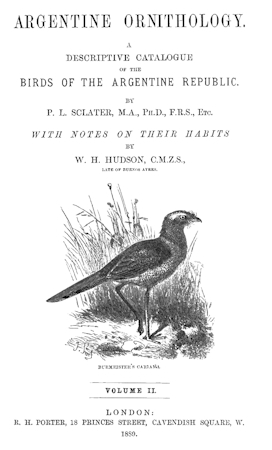
Several examples of Burmeister’s Cariama have been received alive in the Gardens of the Zoological Society of London, from one of which an excellent figure has been taken by Mr. Smit (see P. Z. S. 1870, plate xxxvi.). The frontispiece of the present volume is a reduction of that figure by the same artist.
Order XV. LIMICOLÆ.
Fam. XLVI. PARRIDÆ, or JACANAS.
The Jacanas are a tropical group of birds with a somewhat general resemblance to the Rails, but with their toes enormously elongated, so as to enable them to move with facility over water-plants on the surface of lakes and ponds. In essential structure, however, they are now ascertained to be most nearly allied to the Plovers.
One genus of Jacanas (Parra) is peculiar to America, and a single species of this genus occurs in the Argentine Republic.
385. PARRA JACANA (Linn.).
(COMMON JACANA.)
Parra jacana, Burm. La-Plata Reise, ii. p. 506 (Tucuman); Scl. et Salv. Nomencl. p. 142; iid. P. Z. S. 1868, p. 145 (Buenos Ayres); Durnford, Ibis, 1877, p. 196 (Buenos Ayres); White, P. Z. S. 1882, p. 627 (Buenos Ayres); Barrows, Auk, 1864, p. 277 (Entrerios).
Description.—Head and neck purplish black; back and wings bright chestnut; primaries and secondaries pale greenish yellow tipped with brown; flanks dark chestnut; breast dark black; abdomen purplish; tail chestnut tipped with black; wattles on head and base of bill red, rest of bill yellow; feet olive: whole length 10·5 inches, wing 5·8, tail 2·2. Female similar.
Hab. South America from Venezuela down to Buenos Ayres.
The beautiful Jacana or Jassana, sometimes called Alas-amarillas in the vernacular, differs very widely from all the other members of the Limicoline Order in its appearance, which is most singular—the toes being enormously long, the head ornamented with red lobes, and the wings armed with spurs, these and the beak being of a bright yellow. The colouring of the plumage heightens the novelty of its appearance; the head, neck, and underparts being black; the shoulders, back, and wing-coverts chestnut; while the quills, which have a bright satiny lustre, are apple-green in colour, and in some lights appear golden yellow.
In the southern part of the Plata district the Jacana is migratory, arriving from the north in Buenos Ayres early in October, either singly or in small parties. In their migration they appear to follow the course of the Plata; and, though some individuals are found breeding inland, they are for the most part confined to the littoral marshes.
The Jacanas journey by very easy stages, frequently alighting to rest by the way; for they are so incapable of sustained flight that boys on the pampas occasionally take them, pursuing them on horseback till the birds drop down exhausted. I believe the migratory Rails travel in the same way—a matter not easily determined, as they migrate by night; but they are feeble-winged creatures, and when driven to rise flutter away as if wounded. I have observed the Jacanas migrating by day, but would not for this reason affirm that they do not journey by night, since the Bartram’s Sandpiper and other species journey both day and night.
The Jacana flies swiftly, in a straight line and close to the surface: the wings flutter rapidly; and there are frequent intervals of gliding. When rising it presents a most novel appearance, as the lovely pale green of the wings is quite concealed when the bird is at rest; the beauty of its flight is thus greatly enhanced by the sudden display of a hue so rare and delicate. At a distance from the beholder, and in a strong sunshine, the wings appear of a shining golden yellow. Not only when flying does the Jacana make a display of its beautiful wings; without rising it has a way of exhibiting them, appearing to delight as much in them as the Cockatoo does in its crest or the Peacock in its train. When several of these birds live in company, occasionally they all in one moment leave their feeding, and with quick excited notes, and clustering together in a close group, go through a singular and pretty performance, all together holding their wings outstretched and agitated, some with a rapid fluttering, others with a slow-moving leisurely motion like that of a butterfly sunning itself. The performance over, the birds peaceably scatter again. I have never observed Jacanas fighting.
Shortly after arriving they pair, and build a simple nest with few materials, usually on the floating weeds. The eggs are four, in shape like Snipe’s eggs, and have deep-brown spots on a pale yellowish-brown ground. During incubation the male keeps guard at some distance from the nest, and utters a warning cry at the approach of an intruder; the female instantly flies from the nest, but in rising renders herself very conspicuous. When the nest is approached the parent birds hover about, occasionally fluttering as if wounded, all the time keeping up a clamour of hurried angry notes somewhat resembling the barking cries of the Black-collared Stilt.
Fam. XLVII. CHARADRIIDÆ, or PLOVERS.
Plovers are found all over the world’s surface and in every degree of latitude, and some of the species have an almost cosmopolitan distribution. In the Neotropical Region about twenty Plovers are known, of which seven are found within our limits. Three of these are Antarctic species that visit Argentina during the winter, one arrives in the opposite season from the north, and the other three are more or less abundant residents.
386. VANELLUS CAYENNENSIS (Gm.).
(CAYENNE LAPWING.)
Vanellus cayennensis, Burm. La-Plata Reise, ii. p. 502; Scl. et Salv. Nomencl. p. 142; iid. P. Z. S. 1868, p. 144 (Buenos Ayres); Durnford, Ibis, 1877, p. 42 (Chupat), p. 196; (Buenos Ayres), et 1878, p. 402 (Centr. Patagonia); Gibson, Ibis, 1880, p. 161 (Buenos Ayres); Barrows, Auk, 1884, p. 278 (Entrerios, Pampas); Seebohm, Plovers, p. 216. Philomachus cayanus, Darwin, Zool. Voy. ‘Beagle,’ iii. p. 127.
Description.—Wings with a large yellow spine. Above grey; broad front and thin vertical crest black; a patch on the scapulars bronzy purplish; upper tail-coverts white; primaries purplish black; greater coverts pure white, passing into greyish on the secondaries; lesser wing-coverts bronzy green; tail—basal half white, apical half purplish black tipped with white: beneath, chin, line down the middle of the throat and breast shining black; sides of neck grey, passing into white on the face; abdomen and under wing-coverts pure white; bill red, with black tip; feet flesh-colour: whole length 13·0 inches, wing 8·2, tail 4·2, tarsus 3·1. Female similar.
(Seebohm’s ‘Plovers,’ p. 216.)
Hab. Eastern South America.
The Lapwing of La Plata is considerably larger than the well-known Lapwing of the Old World, but closely resembles that bird in the general colour of the plumage, in the long, slender, black crest, and in general appearance. Throughout the Argentine country it is called Téru-téru, from its ever-repeated dissyllabic cry; west of the Andes the vernacular name is Queltregue, also in imitation of its notes. It has red legs, crimson irides, a rosy beak tipped with black, and coral-red wing-spurs; and these spots of bright colour add to its bold striking appearance. In size, beauty, and spirit it is a king among the Plovers, while its jealous aggressive disposition gives it the character of a tyrant amongst birds in general. On the pastoral pampas (the district from which the giant grasses have disappeared) it is excessively abundant; and it is there resident, although, as with most strong-winged resident species, some individuals do certainly migrate, small parties being occasionally seen in spring and autumn flying steadily at a great height, apparently performing a long journey. As a rule the birds pair for life, and remain always on the spot where they breed. They may be persecuted with guns, their eggs taken year after year, even the ground turned up with the plough, but they still refuse to be driven out. In regions having a broken surface—hills, woods, and sheltered hollows—birds naturally get attached to one spot, for each locality possesses its own features, and individuals frequenting it acquire a knowledge of its advantages. The vast pampas have a uniform level surface, and produce the same kinds of food in the same quantities. They are parched with droughts and flooded by rains alternately, and swept by dust-storms in summer and cold gales in winter—violent enough, one would imagine, to drive every winged creature away and obliterate all marks of home. Again, the powerful flight of this species would enable it to take long journeys, and, if unaffected by atmospheric changes, scarcity of food and water might be a temptation to seek new regions. But through all vicissitudes the Téru-téru clings to its chosen spot of ground.
In defence of its territory it wages perpetual war against most living creatures, the objects of its special abhorrence being men, dogs, rheas, and birds of prey generally. Its noisy cry and irascible temper are spoken of by most travellers and naturalists; for no person riding across the pampas could possibly overlook the bird, with its screaming protests against all trespassers perpetually ringing in his ears; but they have all omitted to mention the singular habit which this bird has of associating in sets of three for the purpose of amusement or play. Each couple, as I have said, live always together on their own pretty-well-defined plot of ground, which they jealously guard from intrusion. Yet if one watches a pair of them for a while he presently sees another—one of a neighbouring couple—rise up and fly to them, leaving his own mate to take care of home; and, instead of resenting this visit as an intrusion, they welcome it with notes and signs of manifest pleasure. Advancing to the visitor, they place themselves behind it, and then all three, keeping step, begin a rapid march, uttering loud drumming and rhythmical notes in time with their movements, the notes of the birds behind coming in a rapid stream, while the leading bird utters loud single notes at regular intervals. The march ceases, the leader stretches out his wings, still emitting loud notes, while the other two, with puffed-out plumage, standing exactly abreast, stoop forward until the tips of their beaks touch the ground, and, sinking their voices to a murmur, remain for some time in this singular posture. The performance is then over; the birds all resume their natural attitudes, and the visitor takes his leave. It is quite certain that this display has no connection with the sexual feeling, for it is indulged in all the year round, at all hours of the day, and also during moonlight nights. It is simply the bird’s manner of expressing its joyous spirits; for most living creatures—birds especially—have more or less well-defined methods of playing; and playday with the Téru is every day, and at very brief intervals. And yet the grave pompous air of the birds, and the military precision of their movements, might easily lead an observer to attribute these displays to some more important motive. Play is not only indulged in with neighbours; there are many solitary Térus continually wandering about from place to place—probably young birds not yet settled in life—and when one of these vagrants passes near a pair he is immediately invited to join them, and, when he alights, all go through the performance together with great zest. In this case, however, as soon as it is over, the strange bird is attacked with great spirit and chased away; and if by chance he comes down again near them, they hasten to drive him up with increased fury.
While watching their antics, which the Gauchos call the Téru’s quadrilles, a curious subject of inquiry suggested itself to my mind. It appeared to me that its manner of playing has had a reflex effect strong enough to mark the bird’s whole character—language, bearing, and habits being coloured by it, and even the domestic relations interfered with. And with regard to the latter point, though it is the rule that each cock bird has only one hen, I have known several instances of a cock with two hens, the two females laying their eggs in one nest and taking turns in sitting on them. I have also found instances of two males to one female; and in one case, where I watched the birds, I noticed that when the female was on the nest the males stood over her, one on each side.
I once had my attention drawn to a large concourse of Térus by the strange behaviour of two individuals amongst them, and I stayed to watch their proceedings. It was in the dry hot weather, and a great many birds had congregated to drink at a lagoon. Some hundreds of them were standing about, quietly preening their feathers, and in the middle of the flock two birds were conspicuously marching about, stiff and upright as a couple of soldiers engaged in some military exercise, and uttering loud notes full of authority. Every few minutes a fresh bird would arrive and alight at some distance from the water, on which the two noisy birds would bustle up, and, ranging themselves behind it, run it with loud drumming notes to the margin; then, standing close together, they would wait till its thirst was quenched, after which they would run it away to some distance from the water, of which they seemed to have made themselves dispensers. For over an hour I continued watching them, and every bird that arrived was conducted to and from the water in this ceremonious manner.
Occasionally several couples unite and soar about in a compact flock; they divide into sets of three birds each, then hover for some time, all waving their wings exactly in time and screaming their notes in unison, and these movements seem like an imitation in the air of the usual marching and drumming performance on the ground.
The breeding-season of the Térus begins as early as the month of June in favourable seasons; severe cold, drought, or other causes sometimes delays it to August. The nest is a shallow circular hollow made by the bird on the level plain, and lined with broken grass-stems and small fragments of thistle-stalks; the eggs are four, rather sharply pointed at one end, and have an olive-green ground-colour spotted with black. The eggs in different nests vary greatly in size, ground-colour, and in the amount of black they are marked with, no two birds laying eggs exactly alike.
While the female is on the nest the male keeps watch at a distance of twenty or thirty yards, and utters a low warning cry in case of danger. The female leaves the nest sometimes by running, but oftener flies from it, and by marking the spot she rises from, it is easy to find the nest on the open level pampas. In the course of a morning’s ride I have picked up as many as sixty-four eggs. During incubation the birds are excessively watchful and jealous, their irritability increasing with the growth of the chick in the shell; and at that time they will attack any bird of prey approaching the nest with amazing virulence. When approached by a human being they fly to meet him when he is still far from them, and hovering, with loud screams, over him, dash down at intervals, threatening to strike with their wing-spurs, coming very close to his head. Unable to intimidate the enemy with this show of violence, the bird changes its tactics, and, alighting at some distance, counterfeits the action of a bird seeking its nest. With well-acted caution and secrecy in its manner, it runs silently along, stooping low, and having found a slight nest-like depression on the surface, sits on it, half opens its wings, and begins gathering all the small sticks or straws within its reach and carefully arranges them about it, as most ground-breeding birds do when incubating. Sometimes also, like many other species, it tries to lead one away from the nest by feigning lameness; but the former instinct of seeking and sitting on an imaginary nest, which I have not observed in any other bird, seems far more complex and admirable.
When sheep in a flock pass over the nest, the bird stands on it to defend its eggs; and then its loud cries and outspread wings often serve to bring the sheep, from motives of curiosity, about it. Even with a dozen sheep clustered round it the bird stands undaunted, beating their faces with its wings; but, unhappily for it, if the shepherd is following, the loud cries of the bird bring him to the spot, and the eggs so bravely defended are taken.
387. CHARADRIUS DOMINICUS, Müller.
(AMERICAN GOLDEN PLOVER.)
Charadrius virginianus, Burm. La-Plata Reise, ii. p. 501. Charadrius virginicus, Scl. et Salv. Nomencl. p. 142; Durnford, Ibis, 1877, p. 197 (Buenos Ayres); White, P. Z. S. 1882, p. 628 (Buenos Ayres); Barrows, Auk, 1884, p. 313 (Bahia Blanca); Withington, Ibis, 1888, p. 472 (Lomas de Zamora). Charadrius dominicus, Baird, Brew., et Ridgw. Water-B. N. A. i. p. 139. Charadrius fulvus americanus, Seebohm, Plovers, p. 100.
Description.—Above brownish black, with numerous irregular spots of yellow; forehead, superciliary stripe, and sides of neck white: beneath black; crissum whitish; axillaries smoky grey; bill black; feet dark grey: whole length 10·5 inches, wing 7·0, tail 2·8. Female similar. Young: beneath dirty white, with greyish freckles.
Hab. America.
This closely allied representative of the Golden Plover of Europe, from which it is distinguishable mainly by its rather larger size and smoky-grey axillaries, visits South America in autumn.
The American Golden Plover is abundant and well known to everyone by its native name Chorlo throughout Southern Argentina. Its wild clear notes are first heard about the last week in August; and among the first comers many individuals are seen still wearing the nuptial dress. After their long journey from the Arctic regions they are lean and not worth shooting; two months later they become excessively fat, and are then much appreciated by gourmets. But although so regular in their arrival they do not regularly visit the same localities every season; the bird may be abundant in a place one year and scarce or absent altogether the next. During the spring, from September to December, they prefer open plains with short grass and in the neighbourhood of wet or marshy ground; at the end of December, when the giant thistle (Carduus mariana), which often covers large areas of country, has been burnt up by the sun and blown to the ground, they scatter about a great deal in flocks of from one to four or five hundred. At noon, however, they all resort to a lagoon or marshy place containing water, congregating day after day in such numbers that they blacken the ground over an area of several acres in extent; and at a distance of a quarter of a mile the din of their united voices resembles the roar of a cataract. As population increases on the pampas these stupendous gatherings are becoming more and more rare. Twenty-five years ago it was an exceptional thing for a man to possess a gun, or to use one when he had it; and if Chorlos were wanted, a Gaucho boy, with a string a yard long with a ball of lead attached to each end, could knock down as many as he liked. I have killed them in this way myself, also with the bola perdida—a ball at the end of a long string thrown at random into a cloud of birds.
The habits, flight, and language of the Golden Plover need not be spoken of here, as this bird has been so often and exhaustively described by North-American ornithologists. The only peculiarity it possesses which I have not seen mentioned, is its faculty of producing a loud sound, as of a horn, when a few passing birds, catching sight of others of their kind on the ground below, descend violently and almost vertically to the earth with unmoving wings. This feat is, however, rarely witnessed; and on the first occasion when I heard the sound high above me, and looked up to see half a dozen Chorlos rushing down from the sky, the sight almost took my breath away with astonishment.
The Golden Plover appears to be most abundant on the pampas between the thirty-fourth and thirty-sixth parallels of latitude, but how far south its range extends has not yet been ascertained. The return migration begins early in March, and yet Mr. Barrows met with it in the neighbourhood of Bahia Blanca and on the Sierra de la Ventana from February 8 to March 19. During most of this time he says it was abundant in flocks of from twenty to two hundred birds, which appeared to be moving uniformly south or south-west.
388. EUDROMIAS MODESTA (Licht.).
(WINTER PLOVER.)
Vanellus modestus, Burm. La-Plata Reise, ii. p. 502 (Pampas). Eudromias modesta, Scl. et Salv. Nomencl. p. 143; iid. P. Z. S. 1868, p. 144 (Buenos Ayres); Durnford, Ibis, 1877, p. 197 (Buenos Ayres), et 1878, p. 402 (Centr. Patagonia); Barrows, Auk, 1884, p. 313 (Entrerios); Withington, Ibis, 1888, p. 472 (Lomas de Zamora). Charadrius modestus, Seebohm, Plovers, p. 105.
Description.—Above brownish cinereous; frontal band and superciliary stripe white; wings and central tail-feathers blackish; lateral tail-feathers white, the inner ones with an imperfect black subterminal band: beneath, throat cinereous, breast bright chestnut with a black band below; belly white; bill black, base of lower mandible yellowish; feet brown: whole length 7·5 inches, wing 5·3, tail 2·4. Female similar. Young without the rufous chest.
(Seebohm’s ‘Plovers,’ p. 105.)
Hab. Antarctic America.
This species in its gait, flight, and general appearance closely resembles the American Golden Plover, but is smaller than that bird, and its sober upper plumage is unrelieved with flecks of golden colour. It breeds in South Patagonia and the Falklands, and migrates north in autumn, appearing on the pampas in April, and being met with there throughout the winter; hence the vernacular name Chorlito de invierno (Little Winter Plover). In its winter dress the upper plumage is greyish drab colour; the breast dark brown; the belly white. It is shy and active in disposition, has a very rapid flight, and is seen in flocks varying greatly in number, from a dozen to two or three hundred individuals. When feeding the birds scatter very widely, running swiftly over the ground in all directions. When on the wing it frequently utters its cry, which has not the mellow tone of the Golden Plover’s note, but it is wonderfully clear and far-reaching, and impresses the listener with its wildness and melancholy.
Their return migration takes place in August.
389. ÆGIALITIS FALKLANDICA (Lath.).
(PATAGONIAN SAND-PLOVER.)
Ægialitis falklandica, Scl. et Salv. Nomencl. p. 143; iid. P. Z. S. 1868, p. 144 (Buenos Ayres), et 1872, p. 549 (Rio Negro); Durnford, Ibis, 1878, p. 402 (Centr. Patagonia); Gibson, Ibis, 1880, p. 163 (Buenos Ayres); Barrows, Auk, 1884, p. 313 (Entrerios). Charadrius falklandicus, Seebohm, Plovers, p. 155.