
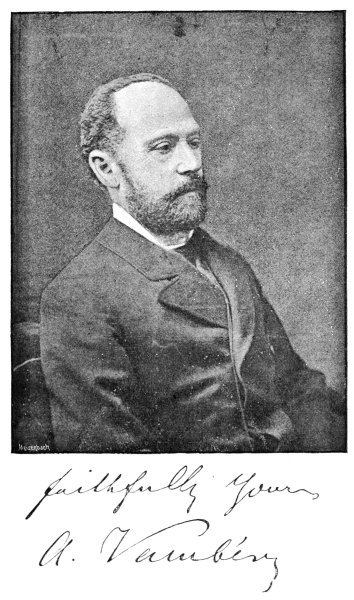
V.
FROM ERZERUM TO THE PERSIAN FRONTIER.
I arrived in Erzerum on the 28th of May. In entering this town I was, at once, aware that I was now in the interior of Asia. The houses are here already built in the Eastern fashion; the walls, built of stone or mud, are clumsy and running irregularly in a zigzag line, with windows looking out into the yard rather than the street; secret entrances, and other like things characteristic of Eastern houses.
At Erzerum I was staying at the house of the Circassian, Hussein Daim Pasha, the commanding officer of the place, with whom I had been already acquainted at Constantinople. I had instructed his son in French, and in European sciences. When I told him of my Bokhara plan he was very much surprised, and at first tried to dissuade me from it, but promised me, afterwards, to furnish me with letters of recommendation to some of the prominent Sheikhs of the Turkestan capital. I met amongst the other governmental officers, at Erzerum, some whom I had known in Stambul, and I called upon them at their offices. I shall never forget the appearance of the offices of the Turkish government. The entrance was nearly barricaded by a promiscuous heap of shoes, sticks, weapons and a troop of dogs lying everywhere about. The interior corresponded with the outside. On a couple of dirty, ragged divans were seated several officials; in one part of the room a group of women were quarrelling, in another a humorous individual was entertaining the officers, and in another, again, some one gave vent to his complaints, interspersed with oaths.
Evidences of the poverty of the inhabitants of Erzerum meet the eye in whatever direction one may look. The dirt, the squalor and the underground dwellings are unbearable. The smell of their food, which they cook by the fire made of a fuel called tezek (cattle dung), is especially loathsome.
I was almost glad when I left this place on the 29th of May, about dusk, in company of my Armenian fellow-traveller. It might have been about midnight when we heard the loud barking of dogs, an indication of the propinquity of human habitations. I rode ahead, over ditches and bushes, towards the lights twinkling from the scattered houses. Everybody in the place was sunk in sleep, and it was only owing to my Effendi way of talking that I succeeded in procuring, for myself and my companion, quarters for the night. The name of the village was Kurudjuk, and the house where we happened to obtain accommodation belonged to the Kizil or chieftain of the place. The dwellings hereabouts consist, usually, of only one room, in which both men and domestic animals live promiscuously together. The cattle are tied on to the crib running along two sides of the spacious room, and the human beings occupy the saku, a species of elevated platform. It may be justly said that people, here, are living in stables. One may imagine what an agreeable thing it is to pass the night in the society of from forty to fifty buffaloes, and a couple of calves and a horse. Add to it that there is not a solitary window to this barn. More squalid and miserable dwellings there cannot perhaps be met with in the whole of Asia, than those in the environs of Erzerum. One may then appreciate the feeling of pleasure with which the traveller exchanges the foul air of his night quarters for the sweet morning air of the spring.
After a ride of nearly four hours we reached Hassankale, a place situated on a promontory. It is fortified against the attacks of the marauding Kurds, living in the country. They hardly dare, it is true, to make a raid upon the villages nowadays, but smaller caravans and the solitary traveller are still exposed to the fury of their marauding propensities. For the sake of safety we had with us two kavasses (mounted policemen). I myself had, indeed, nothing to fear from attack, but, out of regard for my Armenian companions, who had about them valuable trinkets which they had brought with them from Europe, I made use, on their behalf, of the firman given to me, as an Effendi, by the governor of Erzerum.
THE FRONTIER OF KURDISTAN.Upon crossing the Araxes river, we arrived ere long at the frontier of Kurdistan proper, whose inhabitants had already enjoyed, in the age of Herodotus, the unenviable reputation of being thieves and robbers of the worst kind. We noticed on our march a lofty rock—and one of our guides told us that the renowned Korouglu had lived on the top of it. He is the most celebrated hero-adventurer of Mohammedan popular poetry; his miraculous feats are told in song, at feasts and on the battlefield, alike by the Turks on the Oxus, the Anatolians near the Mediterranean, and the Roumelians by the waves of the Danube.
As we were passing through a narrow mountain defile my Armenian companions set to loading their guns and pistols, saying: "We shall meet henceforth no more Osmanlis; only Kurds and Armenians are living here." Letters of recommendation and polite requests have no effect upon the Kurds; if you wish to keep them in awe you must meet them well armed.
At a Kurdistan village, called Eshek-Eliasz, we hired two men to accompany us, and we started on our way at the dawn of morning. It was a murky gloomy morning, the tops of the distant mountains were clouded by the fog. We sent the loaded animals ahead, and sat down at the foot of the mountain to make our tea. In the damp and chilly hours of the early dawn tea is a most refreshing beverage, and after having taken a cup or two we remounted our horses in order to overtake our beasts of burden. We overtook them after half an hour's trot, and saw them peaceably advancing along the ridge of the mountain. ATTACKED BY ROBBERS.The rays of the sun had now scattered the fog, and looking about me, admiring the beautiful mountain scenery, I happened to observe that one of our Kurdistan followers was glancing now at the luggage-carriers, now at his companion, betraying great uneasiness. "What is it, what is it?" I asked. Instead of any reply he merely pointed in the direction where the servants of my Armenian companions and a couple of mule drivers were marching on. We looked and saw armed Kurds, on horseback and on foot, rushing in upon us from the right and the left, making straight for the animals laden with precious and valuable goods. "Robbers! Robbers!" shouted the Armenian Karabegoff, who had been in Europe. Quickly seizing his revolver, he rushed forward, followed by his friend and myself, but, although I urged on my horse in every conceivable manner, I was the third and last to arrive upon the scene of action. I still wore, at that time, a brass plate on my fez, in token of my dignity, as an Effendi. The Kurds had scarcely caught sight of me, when they suddenly stopped within a few steps from the badly frightened group of people. "What do you want here?" I asked them in a voice of thunder. An old, one-eyed man, armed with a shield, lance, rifle and sword, now stepped forward, and said: "Bey Effendi, our oxen have strayed from us, and we have been looking for them all night. Hast thou not met with them somewhere on thy way?"
"And is it customary to look for oxen, armed as thou art?" said I. "Shame on thee! Has thy beard turned grey to be soiled by thieving and robbery? If I did not regard thy old age I should take thee at once before the Kaimakam of Bayazid, thou insolent waylayer!"
My words and the explanations of my Kurd followers caused the band of marauders, consisting of eight men, very soon to understand with whom they had to deal. They are not much afraid of Armenians and Persians as a usual thing, but they do not deem it advisable to attack an officer of the Sultan. I still added a few threats to my former severe reprimands, and we had soon the satisfaction of seeing the robbers disband and quit us. We too continued our march, during which the Armenians never tired of expressing their gratitude to me. If it had not been for me, they said, all the valuables brought with them from London would have fallen into the hands of the Kurds. I especially remarked, during the affray, the dismay and pallor of several Persian merchants who had joined us the day before. These men brought me, as we were about to retire to rest, various sweetmeats, as an acknowledgment of my services. I could not help admitting that, in the eyes of the Kurds, the dignity of an Effendi carried considerable weight.
We came in the evening to a village called Mollah Suleiman, inhabited, chiefly, by Armenians. At the sight of my Kurdistan followers, our landlord took me aside and said to me in a whisper: "Effendi, thou mayest well deem thyself fortunate for having escaped unhurt. Thy followers are known, far and wide, as the most desperate robbers; they have never before escorted any one across the Dagar mountain but some ill befell him." In an instant the whole adventure became clear to me. These two Kurd fellows were in league with the robbers, and but for my friend's revolver and my Effendi headgear the day might have proved fatal to all of us. Such occurrences are by no means rare in this region. The people and the authorities are well aware of the frequent cases of brigandage; they know who the brigands are; but, nevertheless, everybody is left to his own bravery to defend himself.
TALES OF ROBBERS.Our Armenian host, who had received his fellows in faith and myself with great cordiality, had a sumptuous supper prepared for us; the priest, clergyman and the judge of the village too, came to pay their respects, and there was no end to tales of robbery. In the autumn before, we were told, a caravan, consisting of forty beasts of burden and fifteen men, amongst whom there was an Englishman, was attacked by a robber chief and twelve men. No sooner had the Kurds, with their customary cry of "Lululu!" come upon them, than the Persians and Turks took to their heels, and allowed the brigands to freely rummage in the luggage, without molesting them. They had already driven away a couple of animals, when the Englishman, who had hitherto coolly stood by and watched the doings of the miscreants, raised his revolver without being observed, took deliberate aim at the chief and levelled him to the ground. The Kurds stood for a moment dumbfounded with fright, but they soon recovered and made a simultaneous rush upon the Englishman. The latter, who did not for an instant lose his presence of mind, shot dead another and then again another man, crying out to them fiercely: "Do not come near me or I will kill every one of you." This had its effect; one by one the remaining Kurds slunk away. The family of the dead chief instituted a suit for damages against the Englishman, claiming that the chief had been out hunting, and not robbing, when he was killed. The Turks treated the claim quite seriously, and, in all probability, would have mulcted the brave Englishman in damages but for the intercession of the British Consul.
The rain was pouring down violently when we left our hospitable host next day, and at night we had to put up at an Armenian village, containing about ten houses; for it was too late for us to reach on that day Diadin, the next place on our journey. The inhabitants of that village are leading a strange life. Man and beast, food and fuel are all stowed away under one roof, and whilst one part of the inhabitants are sleeping the others mount guard, on the roofs, with their arms in readiness. I asked several of them why they did not ask assistance of the governor of Erzerum, and was told, in reply: "That the governor was himself at the head of the thieves. God alone, and his representative on earth, the Russian Tzar, can help us." And the poor people were certainly right in this.
We forded through the Euphrates river and reached, before long, a monastery, the inmates of which were Armenian friars who were held in high respect by all the inhabitants of the surrounding country, both Christian and Mohammedan. It is a strikingly characteristic feature of all Eastern nations, that with them friars, monks, wizards, and fortune-tellers are indiscriminately, without regard to their religion, the objects of deep veneration. The supernatural, the mysterious excite the humility of the Eastern man, and the Kurds go far away, to distant countries, in pursuit of their predatory ventures, leaving this solitary and unprotected settlement unmolested.
Towards evening we arrived at the border place, Diadin. After considerable inquiry we succeeded in finding the house of the judge, at whose hands we desired to procure accommodation for the night. On looking round there, I saw, sitting in a corner of the barn, an American minister, with his wife and children and his sister. They had been living in Urumia (in Persia) for several years, and were now on their way home, to Philadelphia. Urumia and Philadelphia, what a distance! But the members of the missionary society know no distance.
The Kurdistan Kizil, i.e., chieftain, received me very kindly, and upon my asking him for a night's quarters, he replied: "Effendi, thou art welcome, but I can give thee no accommodation, unless thou desirest to share with a soldier-pasha the only spare room in my house."
"Soldier-pasha, or anybody else in the wide world," I replied. "Just show me into the room. A ride of ten hours will tame a very Satan. Besides, I think, the stranger and I will very well agree together."
The Kurd, holding a small oil-lamp in his hand, preceded me, and took me to a place looking like a lumber-room. AN OLD FRIEND.The soldier-pasha was squatting in one corner. In approaching him, to introduce myself, I recognized in the stranger, to my great surprise, General Kolmann, otherwise called Fejzi Pasha, one of my dearest friends. "Well, this is a wonderful meeting," he said, after our greetings were over, and we had settled ourselves, opposite to one another, near the fire. General Kolmann, a distinguished member of the Hungarian emigration, had always befriended me in the most zealous manner, during the whole of my stay in Turkey. He knew of my plans for travelling, and was overjoyed, beyond all measure, to have an opportunity of saying "Good-bye" to me here, at the frontier of Turkey, where he had been detailed by the government to superintend the building of border barracks. We whiled away the time with chatting until late into the night, and it was with a heavy heart that I took leave next morning of my countryman and of that country to which, for the time being, I belonged.
VI.
FROM THE PERSIAN BORDER TO TEBRIZ.
Kizil-dize is the name of the first village on Persian soil. Leaving it we came to the base of Ararat. Mount Ararat, whose tapering head is covered with snow even in summer, was at that season clad in its wintry garb to more than half its height. The inhabitants of the surrounding country all insist that the remains of Noah's Ark may still be seen on its top, and many a vartabet (priest), rich in grace, boasts of having seen with his own eyes the precious relics of the holy Ark in the waters, clear as crystal, of a lake on the top of the mountain. Others, again, produce chips from the remains of the Ark, and recommend it highly against pain in the stomach, sore eyes, and other maladies; and woe to him who would dare to cast the slightest doubt upon the existence, to this day, of at least two planks and a couple of masts of Noah's Ark on mount Ararat. During my travels in Asia I came across four other places, of which sacred tradition tells that Noah's Ark had rested there, and at least four other places, again, where people have discovered the unmistakable traces of the scriptural Paradise.
MOUNT ARARAT.
After we crossed the Turco-Persian border line the country became visibly more and more beautiful, as if Nature meant to support the haughty presumptuousness of the Persians. The most modest and reserved of my Persian fellow-travellers kept on saying during the whole journey, "Iran is a land very different from thine, Effendi! Look out, thou shalt see wonders." The faces of the Persians beamed with indescribable joy from the moment they had set their eyes upon the first Persian village, for the poor fellows had a great deal to suffer, all the way from Erzerum, in the numerous Armenian villages. According to the rigid Shi-ite law, not only is the Christian impure, but he defiles everything he touches, and the pious Shi-ite will rather starve than eat of any food a Christian had come in contact with.
ON PERSIAN SOIL.We slept for the first time on Persian soil, in Ovadjik. Here, in Iran, I thought it advisable to part with my dignity of Effendi, for in the country of the Shi-ites, everything that approaches, in the least, the Sunnite faith of the Turks, is hated and despised, although both sects are professors of Islam.
We started early in the morning, on the 5th of June, and as our way was to lead us, on that day, through the Karaayne mountains, which did not enjoy the best reputation for safety, my Armenian companions thought it proper to provide themselves with the escort of a small number of mounted armed men. Fortunately nothing unpleasant happened. We came to Karaayne early in the afternoon, and I was delighted to hear issuing, from the house opposite to our quarters, sounds of music, the report of firearms, and shouts of merriment. They were celebrating a wedding, and, upon my question, if the wedding folks would have any objection to my going over and looking at them, I was taken there, at once, by the son of my host. A numerous troop of groomsmen had just arrived when we entered, in order to conduct the bride from the paternal house to her husband. They gave notice of their arrival outside by the report of firearms, then entered, wrapped a red-coloured veil round the bride, led her out into the street, and two of the groomsmen assisted her to mount her horse. Although her wide dress, falling down in many folds, impeded her movements, she sat quite firmly in the saddle. The bride was then surrounded by the women, singing in chorus a very curious song, the burden of which, repeated at the end of each stanza, was: "Let friend remain friend, and the enemy turn blind, O Allah!" At last, the procession started for the house of the bridegroom. I, too, mixed with the crowd, accompanying them, and was afterwards invited to take a prominent seat at the table. Wedding gifts were collected of the guests during the meal. The marriage rites agreed in every particular with those used by the Turcomans.
We had proceeded about two hours on the road leading from Karaayne to Tchuruk, our nearest station, when we were startled by a peculiar kind of barking and howling, coming from the depths of the mountains before us. We had just reached an eminence on the road. Our little company of travellers halted at once, and our Persian escort, bending their eyes anxiously upon the entrance of the deep road, prepared their arms for action. The howling grew louder and louder, and suddenly a magnificent stag burst upon our sight, hotly pursued by two wolves. The Persians, who are very fond of the chase, were electrified by this sight, and two of them springing forward advanced in a run towards the animal—one of the two, although running, took such excellent aim at it, that upon his firing the beautiful deer fell lifeless to the ground. The wolves were scared by the shooting and ran away. One of the wolves however, as soon as everything became quiet again, either pushed by hunger, or feeling sore at the loss of his prey, soon reappeared to our great surprise. The hunters allowed him to approach, unmolested, within a few paces from the lifeless stag, and then fired at him, killing him on the spot. Every member of our small company was delighted with the adventure. We dismounted, stripped off the skin of the deer, cut him up and set to work at once to roast the best parts on the spit, leaving the rest of the carcass and the wolf behind us.
THE BAZAAR AT KHOY.The first place of note the traveller from the west comes to, in Persia, is called Khoy. I was particularly struck by its bazaar. The life and commotion in it was marked by that primitive quaintness and splendour of ancient times which are, to a great extent, wanting in the Stambul bazaars, owing to the influence of the Europeans. Any one who has witnessed in Khoy, during the hours of the forenoon, the stir and bustle in the cool and narrow streets, watched the gesticulations of buyers and sellers, seen the variety of splendid fabrics and arms, and the food offered for sale, and observed the behaviour of the thronging and screaming crowd, must own that in the matter of Oriental characteristics, at least, the bazaar of Constantinople is inferior to that of Khoy.
The first impression was a truly bewildering and bewitching one, I could hardly tear myself away from the strange spectacle; the peculiar sounds, the strange din and noise, the seething life everywhere, were things I had never witnessed before. As I was entering a place, topped by a cupola, where about thirty braziers were striking away, with a will, each at a kettle or pan, I was struck with astonishment upon seeing that, in the midst of this infernal din, there were, in an unoccupied portion of the building, two schools in full blast. There sat the school-master—amongst the children who were ranged round him in the shape of a half moon—armed with a long stick probably in order to enable him to reach the children sitting on the hind-most forms. I went quite near them and listened with the utmost attention, but could not catch a solitary word, although both teacher and pupils were screaming at the top of their lungs. The exertion told on them, too, for with their inflated red faces and starting veins they looked like so many infuriated turkeys. They pretend, nevertheless, that an improper stress laid upon any Arabic word in the Koran, by any children, is immediately observed and duly rebuked by the master.
I was surprised, even more agreeably, by the neat little caravansary which we entered. The traveller meets everywhere in Arabia and Turkey with dirty khans only; but here, in Persia, where, from ancient times, much care has been bestowed upon the comfort and facilities of intercourse, the caravansaries will be found to be inns which—I am speaking, of course, of Eastern pretensions—leave nothing to be desired. These inns stand mostly in the due centre of the bazaar, and generally form a square building, each side of which is divided off into a certain number of cells. A half circular opening, doing service both as a door and window, leads to a terrace-like elevation running round the building. Beneath it are placed the stables, so that a traveller, living on the first floor, can be ostler to his own horse, on the ground floor. This terrace is from four to six feet high, and leads to what is in reality the yard, in the centre of which there is a well, often surrounded by a small flower-garden. The cells offer a cool and pleasant retreat during the day, and a place of safety, for travellers, during the night. The dalundar (door-keeper), who is stationed at the cupola-shaped entrance-door, is charged with maintaining order. This person is quick in discerning the rank and station of a traveller, by his horse and saddle-gear, and he provides him with corresponding accommodation. Sentinels are stationed on the flat roofs during the night, who are scaring away with their monotonous cries all evil-doers, and it is a rare thing for theft or robbery to be committed at the caravansaries.
THE SEIDS.We left Khoy towards evening, on the 8th of June, for fear of being interrupted in our journey, on account of the feast of Kuram Bairam (the month of merry-making after the fast), and stopped at the village of Hadji Aga, inhabited altogether by Seids, that is, descendants of the prophet. These men are the most pretentious men in all Persia in their pride of descent, but they are especially arrogant in their behaviour towards strangers, and indeed one must have Job's patience to bear their impertinences meekly. No matter how rich they are, they will beg wherever they see a chance of getting something. Indeed they do not ask for any alms, but they impose a tax, due to them as the descendants of the head of Islam. They commit capital crimes, under the plea of sanctity, and the people rarely dare to call them to account. The authorities seem to be less indulgent, for I was told that the governor of Tebriz, to the horror of the whole world, condemned a Seid who had committed robbery to death by fire. The Mollahs fell to protesting, but the governor gave them the following reply: "If he is a true Seid he will not be touched by the flames," and caused the culprit to be cast into the blazing pile.
VII.
IN TEBRIZ.
Tebriz is a town of remote antiquity, and is said to have been built by the wife of Harun el Rashid. But of the ancient greatness and splendour in which Tebriz was said to have once vied with the city of Raghes, very little is now to be seen. Its commerce, however, is quite as flourishing to-day as it was reputed to have been in ancient times. The grand life of the bazaar had surprised me already at Khoy, but compared to that of Tebriz, it was only a picture in miniature. Here the din and noise, the stir and bustle, the pushing and elbowing, the stifling crowds are magnified a hundredfold. At the recommendation of several persons I put up at the Emir Caravansary, which, however, it took me over an hour to find. Not being used to this deafening noise, and to pushing through such dense crowds of people and mules without number, which seemed perilous to both life and limb, I was apprehensive lest I might at any moment ride over somebody with my horse. In recalling how the dervishes were dancing onward ahead of me through this dire confusion, uttering their unearthly screams, brandishing high, and casting up, into the air their sharp axes, seizing them again by their handles upon coming down, I wonder, to this day, how I ever got safely to the Emir Caravansary.
CITY OF TEBRIZ.
My Armenian companions ordered a modest cell for me, and, as they had already reached their place of destination, they parted, with the promise of returning the next day and installing themselves as my guides through their native city. I sat down at the door of my narrow little room and remained there until late in the evening, partly to take some rest after my previous fatigues, partly to watch the life stirring about me. Very soon, true to the custom of their country, a curious crowd gathered around me; by some I was taken to be a merchant and was offered goods by them, by others a money changer and was asked if I had any Imperiales or Kopeks which I wished to exchange; others, again, offered me their services, judging me by my attire to be a member of the embassy of Teheran. It is wearisome work for a newly-arrived stranger at a caravansary, this being catechised from all sides.
STUDY OF THE SHI-ITE SECT.I passed two entire weeks in Tebriz; I desired to rest after the fatigues of my long journey, making, at the same time, excellent use of my leisure in studying the peculiarities of the Shi-ite sect, a study which revealed to me a great deal that was novel and interesting. I did so with all the more pleasure as my uninterrupted stay, for many years, among all the Sunnite circles, my perfect knowledge of their modes of life, customs, and dispositions, had especially fitted me for instituting relevant comparisons.
I had been often told that the Shi-ites were the Protestants of Islam, and their superior intelligence and industry led me to at one time share this supposition. I was therefore quite astonished to find, on the very day of my arrival, wherever I turned, instances of a fanaticism far more savage, and of a sanctimoniousness far more glaring, than I had ever met with in Turkey. First of all I was disagreeably impressed with the reserve and spirit of exclusiveness shown by the Persians towards Europeans. They are commanded by their law, for instance, in case the hem of a European's garment but happens to touch the dress of a Persian, that the Persian immediately becomes nedjiz, that is, unclean, and must forthwith resort to a bath to regain his purity. My faith in their cleanliness, of which they were so fond of boasting, very soon received a rude shock, in witnessing the following scene. HOLY WATER.In the centre of the yard of the caravansary, as everywhere else, is placed a basin full of water, originally intended for the performance of ritual lavations, but, as I was watching their proceedings at the basin, I saw that whilst at one side of the reservoir some were washing their dirty things, others placing half-tanned skins into the same water for soaking, and a third was cleansing his baby, there were standing men on the opposite side of the basin, gravely performing their religious washings with the identical water, and one of them, who must have been very thirsty indeed, crouched down and eagerly drank of the dark green fluid. I could not repress at the sight a manifestation of loathing. A Persian, standing near, immediately confronted me and reproved me for my ignorance. He asked me if I did not know that according to the Sheriat (the holy law) a quantity of water, in excess of a hundred and twenty pints, turns blind, that is, it cannot become soiled or unclean.
In mentioning their fanaticism I cannot omit citing a remarkable instance of it in the person of one of their wonderful dervishes. This man happened to pass just then through Tebriz, and was an object of general admiration at the bazaar. He was thoroughly convinced that the divinity of the Caliphate, after the death of Mohammed, ought, by right, to have devolved upon Ali, Mohammed's son-in-law, and not upon Abubekr, the prophet's brother-in-law. Acting upon this conviction, he had solemnly vowed, more than thirty years before, that he would never employ his organs of speech otherwise but in uttering, everlastingly, the name of his favourite, Ali! Ali! He thus wished to signify to the world that he was the most devoted partisan of that Ali who had been defunct more than a thousand years. In his own home, speaking with his wife, children and friends, no other word but "Ali!" ever passed his lips. If he wanted food or drink, or anything else, he expressed his wants still by repeating "Ali!" Begging or buying at the bazaar it was always "Ali!" Treated ill or generously, he would still harp on his monotonous "Ali!" Latterly his zeal assumed such tremendous proportions that, like a madman, he would race, the whole day, up and down the streets of the town, throwing his stick high up into the air, and shriek out, all the while, at the top of his voice, "Ali!" This dervish was venerated by everybody as a saint, and received everywhere with great distinction. The wealthiest man of a town presented him once with a magnificent steed, saddle, bridle and all. He immediately vaulted into the saddle and sped along the streets uttering his customary fierce cry. The colour of his dress was either white or green, and the staff he carried corresponded in colour with the dress he wore. When he came to the front of the Emir Caravansary, he stopped and lifted his voice, midst the frightful din of the bazaar, with such tremendous power, shouting "Ali! Ali!" that the veins on his head and neck started out like strings.
After passing a few days at Tebriz, it dawned upon me that this, indeed, was genuine Eastern life, and that distant Stambul, the gaudily painted curtain of the Eastern world, presented but a tame and lifeless and somewhat Europified picture of the Orient. True, after the first excitement at the great variety of wonderful sights was over, my mind immediately reverted to the sweets of Western life, and right glad was I, therefore, to meet, at the caravansary, with two Swiss gentlemen of culture, Mr. Würth and Mr. Hanhardt. They at once insisted upon my moving my quarters to their lodgings, but I declined with thanks, availing myself, however, at times, of their cordial invitation to take my meals with them. Through them I became acquainted with other Europeans residing here, and it was to me a source of great delight to change about, and after having passed with Europeans a considerable time discussing Western ideas and conversing in a Western tongue, all of a sudden to become an Effendi again in some Persian society. My fancy was tickled by this almost theatrical transition from the East to the West and back again; I used to indulge in this pastime with great pleasure while in Stambul.
The Persian world rather wondered at my intimacy with the Europeans, but refrained from making any comments upon it to me, knowing that the Sunnites, to whom I was supposed to belong, were far less rigorous than the Shi-ites in their intercourse with persons differing from them in faith. If my European friends communicated to me their views of certain local institutions and customs, I did not accept them unconditionally; I looked at them, again, in the light shed upon them by the observations and feelings of the natives on the subject. Should some kind reader wish to rebuke me for my seeming double-facedness, I have only to say that I shall meekly submit to it, but that, at the same time, I am indebted to the acting of this double part for the satisfaction I had in obtaining a proper insight into native life, and being able to gather many and varied experiences about the nations of the East, from the Bosphorus to Samarkand.
It was here, in the Caravansary Emir, that I met with a rather curious adventure, which I must relate. One afternoon, whilst the heat was rather unbearably strong, I sat at the door of my cell, and engaged myself, as is usual with dervishes, in delivering my linen of certain animals which intrude upon the poor traveller in the East in spite of all his efforts after cleanliness. AN OLD ACQUAINTANCE.Two Englishmen, whom I recognized by their Indian hats, and who were strolling in the caravansary, stopped suddenly before me, and after admiring for a while my patient and untasteful occupation, the younger one said to the older, "Look at the hunting zeal of this fellow!" I raised my eyes and said in English, "Will you join, sir?" Amazed, nay bewildered, one of them immediately asked me, "How did you learn English, and what countryman are you?" From reasons formerly explained, I abstained from a further conversation, and notwithstanding all the exertions, I did not utter another English word, nay, withdrew altogether to the interior of my cell.
Years passed, and after returning to Europe I happened to be at an evening party in the house of an English nobleman at Whitehall. Whilst at dinner I recognized in one of the guests present my interlocutor of Tebriz, but unsure of my discovery I did not address him. After dinner, however, the lady of the house asked me to relate something of my perilous adventures, and seeking courage, I asked her to introduce me to the man in whom I supposed a former acquaintance. "Oh, that is Lord R——," said the lady. "Well, I don't know his name, but I have seen him," was my answer. Lord R—— received me politely, but denied the fact of a former acquaintance. Upon my saying, "My lord, you have been to Tebriz, and you do not remember the dervish who addressed you in English?" The extraordinary surprise of Lord R—— was indescribable; he recognized me at once, and related the whole adventure to the highly amused company.
The days I spent in Tebriz passed quickly and pleasantly owing to my intercourse being partly with Europeans and not being exclusively confined to Asiatics. While I was there, an interesting festival took place, to which I succeeded in obtaining admission. A ROYAL INVESTITURE.The solemn investiture of the recently nominated Veli Ahd (heir apparent to the throne) gave me an opportunity of gazing upon the pageant and pomp of the Orient in all its splendour. Muzaffar-ed-din Mirza, the son of the king, now nine years old, but who, according to the custom of the country, had been elected, in his childhood, successor to the throne, was to be publicly invested with the Khalat, the royal parade robe. The whole town was on the alert. The festival lasted several days, and when, on its first day, I entered through the gate of the Ala Konak (the royal residence), which was surrounded by a dense crowd of people, into the interior court, my curiosity rose to the highest pitch. What a strange contrast of squalor and splendour, of pomp and misery! There, in the covered hall, opposite the gate, were seated the grandees of the land, and amongst them the prince with the principal officers of his household. Every face wore a solemnly grave expression, and the bearing of their manly forms, wrapped in flowing garments, the dignified motion of their arms, the proud carriage of their heads, everything indicated that they were well versed in the art of exhibiting a public pageant. Around the interior of the court were ranged two lines of serbasses (soldiers), sad-looking fellows, in European uniforms and with Persian fur caps on their heads, looking as uncomfortable and awkward as possible in their foreign clothes. The most comical things about them were their cravats, some tied in front, others at the back, and others again anywhere between those two points.
One of the sides of the garden was entirely occupied by loaves of sugar and various Persian cakes and sweetmeats, which it is the custom to place upon huge wooden platters, and without which any festive occasion in Persia would be considered incomplete.
In the centre rose the throne, upon which the young boy-prince, looking feeble and pale, took his seat, surrounded by his splendid retinue. When he was seated, the loud booming of cannon was heard, the military band struck up a martial march, and immediately afterwards appeared the royal envoy bearing the robe of honour, which he placed upon the shoulders of the young prince in token of his new dignity. The envoy then produced the insignia of the diamond order of Shir-ú-Khurshid, fastened it upon the breast of the princely heir apparent, concluding the ceremony by suddenly removing a costly carpet which had concealed the portrait of the king, painted in oil upon canvas. At this moment the whole company rose to their feet; the young prince rushed forward and imprinted a kiss upon the portrait, which was then immediately covered up again with the carpet. Upon the prince returning to his seat from the ceremony of osculation, the deafening roar of cannon and the swelling sounds of music were heard again. A high priest came forward and invoked a blessing upon the prince, the royal order was loudly proclaimed, and finally a young poet stepped forward, and, taking a seat opposite to the prince, recited to his glorification a Kascide (glorifying song). The proceedings of the young poet were quite new to me, and struck me even more than the bombastic tenor of his poetical effusion. He compared the prince to a tender rose, to the brilliant sun, and finally to a precious pearl fished out of the sea of the royal family, and destined to become now the most precious ornament in the crown of Iran. Then he called him a powerful hero, who with a single blow of his sword destroys whole armies, at whose glance the mountains tremble, and the flame of whose eyes makes the rivers run dry.
The prince then joined the great lords, who were in the background, and the sweetmeats were removed from the enormous platters and divided amongst the guests present, the master of ceremonies expressing to each of them, besides, his thanks for their appearance. And, now, the pageant was over.
These festivities were followed by the reception of Cerutti, the Italian ambassador, who, at the head of an embassy consisting of twenty-five members, was passing through Tebriz, on his way to Teheran. Their arrival caused a great ferment both amongst the members of the native government and the European colony. The former, the Persian officials with the viceregent Serdar-Aziz-Khan, at their head, were delighted to have an opportunity afforded them to indulge in their passionate fondness for display, and the latter were gratified to set their eyes upon the representatives of the new Italian kingdom. I joined the latter in order to be present at the reception. In the early morning of a sultry day in June we rode out of the town, a distance of about two hours, to meet them, and when we came up to them they were just changing their dresses. They wished to appear before the Persians in full parade, and it took considerable time for twenty-five Europeans, diplomatists, military men, merchants, and men of science, to accomplish the task of donning their best attire. It was not far from noon, the heat being intolerable, when these gentlemen entered the gates of the town, in their highly ornamental uniforms and costumes, their breasts resplendent with the insignia of the various orders, in plumed helmets and magnificent swords. Of course the sight was to us Europeans a very attractive one, but wishing to hear the opinion of the natives, I left my company and mixed with the crowd. During the whole procession I heard nothing but ironical remarks, the Persians looking upon things considered by us splendid, as ridiculous. According to their notions, our short coats, fitting the body, are the most indecorous things, without any taste, and everything plain, tightfitting, and unassuming in dress looks to them mean and insignificant. Their idea of the beautiful in dress consists in what is ample, flowing in rich folds and showy. Their prudery and mock modesty make them regard as indecent any mode of dressing which sharply defines the limbs and outlines of the human body, whilst Europeans affect that style, and thereby rouse the displeasure of the Asiatics. They also criticise the stiff carriage of the Europeans on horseback, and in this they are not far from wrong, for the European with his protruding chest looks like a caricature besides one who sits with easy grace, yet proudly, on his steed.
AN OVERWORKED EMBASSY.The Embassy, on the day of their arrival, were worked very hard indeed. For two hours they were dragged through the town, in every possible direction, in order to gratify the curiosity of the populace. When they got at last to the place assigned to them for their residence, they were far from being allowed to rest. For three whole days they were besieged by a host of polite visitors, each of them attended by a troop of servants who were to bring back to their master's house, in return, the ampler and more valuable presents which they expected to receive from the Embassy.
The roads leading from Tebriz into the interior of Persia were fairly swarming with caravans and troops of travellers. I, therefore, deemed the roads sufficiently safe, and resolved to continue alone my journey to the capital of the country, accompanied only by a tcharvador, a man who lets horses and animals of burden for hire. I hired from him a rather sorry-looking nag, corresponding to the modest sum I paid for its use, placed my scanty baggage on it, and said good-bye to Tebriz.
VIII.
IN ZENDJAN.
Two days after leaving Tebriz, I arrived at a village called Turkmantchay, and passed the night there. This village is celebrated for being the place where the Treaty of Peace, which put an end to the Perso-Russian war of 1826-28, was concluded. Nothing particular happened on my way from here to Miane, except a slight intermezzo, occurring during my noon's rest at a solitary caravansary. I had been asked before by Shi-ites, here and there, in my capacity of a Sunnite, to give them some kind of nuskha (talisman). A Shi-ite Seid came to me there on the same errand, and I readily granted his request by writing one or two passages of the Koran on a slip of paper. He was not satisfied with this, but begged of me, in addition, tobacco for his pipe, some of the strong kind my friends in Tebriz had presented me with. "Seid," I said, "I give it to thee willingly, but thou art used to the mild tobacco of Kurdistan, and I am afraid this will make thee sick." As he kept on insisting, I was obliged to let him have some. He filled his pipe lighted it, but hardly had he taken a few puffs at it when he was, seized by a violent attack of dizziness, became dreadfully pale and had a fit of vomiting. The Seid rushed, screaming, into the yard and shouted: "Help, help, Shi-ites; the Sunnite has poisoned me." I ran after him as fast as I could, and when I overtook him I found him lying on his back surrounded by a small group of Persians. If my eloquence had not been equal to the task of persuading the bystanders of my innocence, I should have fared badly.
A PERSIAN MEDICO.While yet at a distance of several hours from Zendjan I was joined by a Persian man, who, judging by his appearance, seemed to belong to the learned class. He addressed me, to my surprise, at once as Effendi, although I had never set my eyes on him before. He was very talkative, like most Persians, and discoursed about a thousand things in the course of half an hour. He introduced himself to me as a physician who was just returning from his visits to his patients in the neighbourhood. Very soon he was overtaken by his servant leading a mule so heavily laden that it well-nigh sank beneath the weight of its load. The poor beast was carrying the fees collected in kind by the physician, such as dried fruit, corn and so forth. This loquacious disciple of Æsculap dwelt, during the whole time, upon the miraculous cures he had accomplished, and gave vent to his unbounded astonishment at the impudence of the Frengis (Europeans) who dared to appear as physicians in the home of Ali Ben Sina (Avicenna). He unceasingly dilated upon the efficiency of his amulets and talismans, and how he had driven devils out of his patients, made the dumb speak, the blind see and the deaf hear. When we reached the town my head fairly ached with the man's incessant flow of speech.
Along the road leading to the caravansary I observed a great many black flags hoisted upon tall poles. We were in the first ten days of the month of Moharrem, during which period the Islamite world abstains from every kind of merry-making. But the Shi-ites begin the doleful feast one month sooner; everybody arrays himself in mourning, fasts, and employs his time in the recital of elegies and in visiting the Tazies. The black flags marked the places where the performances were to take place. At that time, a celebrated singer was everywhere spoken of, who had won great distinction in the part of Ali Ekber, and who was to perform on that very day in the Tazie of the governor. I was burning with impatience to witness a Tazie, and I had hardly arrived at the caravansary when I determined to start at once. I joined the populace, and was carried by the stream of people into the court of the governor. There in the centre stood an elevated platform, a little above two yards high, around which, upon poles of considerable height, were suspended tiger and panther skins, black flags, shields of steel and skin, and bare swords, interspersed with here and there a lamp, to light up the evening performance. This was the stage. The women were seated on the right side of the court, and the men were gathering on the opposite side. The governor himself (who had the Tazie performed) and his family, surrounded by the prominent men of the town, looked at the spectacle from the second story. Everything was wrapped in deep mourning, every face wore an expression of indescribable sadness and dejection.
The Tazie represents the tragic history of Hussein, of which a short outline will be here in place. After the death of Mohammed, he having designated no one as his successor, the faithful divided into two camps. The larger portion thought Abubekr, the oldest companion and follower of the Prophet, most worthy of the succession, whilst the minority endeavoured to place Ali upon the throne, guided by the strength of those words uttered by Mohammed: "Even as I am lord, so is Ali lord, too." But Ali's party was vanquished. After Abubekr came Osman, and the latter was succeeded by Omar. Ali's partisans, however, did not despair of their cause; they made several attempts to seat him on the throne, and after the death of Omar, Ali actually became Caliph. His reign was of short duration; his enemies, at whose head the Prophet's widow herself stood, had him assassinated. His sad vicissitudes, cruel sufferings and tragic end only increased the number of his followers; he was mourned as a martyr and almost deified. He had nine wives, but of these mention is made only of Fatima, the Prophet's most beloved daughter, who bore Ali two sons, Hassan and Hussein. The right of succession was claimed by Hussein. The latter, upon one occasion, was going from Mecca to the town of Kuffa, at the invitation of its inhabitants, who were his partisans. He was accompanied by those of his followers who expatriated themselves from Mecca. On the banks of the Tigris, in the middle of the desert, they were suddenly attacked by hostile bands, sent against them by Yezid, and every one of them cruelly massacred. This catastrophe is commemorated, in Persia, by numberless mournful and plaintive songs and theatrical exhibitions, called Tazies.
A PERSIAN MIRACLE-PLAY.Just before the Tazie commenced, a ragged and, from excessive indulgence in opium, rather rickety-looking dervish stepped upon the platform, crying: "Ya Muminin!" (Oh! you true believers), and in an instant the utmost stillness prevailed. He now engaged in a long prayer, lauding the perfections and brave deeds of the Shi-ite great, and then enumerating in exaggerated language the sins and wickedness of the Sunnites, and in mentioning the names of some distinguished Sunnite men, he exclaimed, with a fury bordering on madness: "Brethren, ought we not to curse them, ought we not to call down damnation upon their heads? I tell you, a curse upon the three dogs, the three usurpers, Abubekr, Omar and Osman!" There he paused, waiting for the effect of his words on the assembled multitude. The whole multitude expressed their approval of his curses and anathemas by loud cries of "Bishbad, bishbad!" (More even than that, more even than that!) The dervish went on cursing Ayesha, the Prophet's wife, Moavie, Yezid and all the distinguished foes to Shi-itism, pausing at the name of each, and the audience roared out every time "Bishbad!" A speech by the same person, glorifying the Shah, the present Ulemas of Persia and the Governor, followed the cursing, at the end of which he descended from the platform and hurried amongst the audience to gather in a substantial reward for the zeal he had shown. This was the prologue. Shortly afterwards several persons clad in ample flowing robes made their appearance on the stage, singing elegies now in solos, now in chorus, in order to move the hearts of the hearers and prepare their minds for the coming play. Imam Hussein comes now upon the stage; he is on his way to Kuffa, in the very heart of the desert, and accompanied by his family and a small band of faithful followers. They are all horribly suffering from want of water, and Hussein is endeavouring to assuage the woes of his family, caused by their tantalizing thirst, by words of comfort and encouragement. Meanwhile a throne is rising in the background, the throne of Yezid, Hussein's enemy, seated upon which is Yezid herself, in all the pride of pomp, distributing orders of the most cruel nature against Hussein and his friends amongst her mailed and warlike followers. Ali Ekber, the youngest child of Hussein, is so moved at the sight of the sad plight in which his parents and sisters and brothers are, that he determines to fetch them water from the Tigris, although he well knows that the enemy is lurking everywhere. His parents and their friends dissuade him from this enterprise, in the tenderest language, their voices attuned to the emotions of love and anxiety for his safety. TRAGEDY APPRECIATED.There was something really affecting in the beseeching tones of the weeping mother and in the prayers of the father, and the sobs of Hussein and his little band could hardly be heard on account of the sympathizing howling round about. The women, in particular, wept so bitterly that I could catch, at rare intervals, only here and there a word of the beautiful and deeply affecting dialogue.
But Ali Ekber remains firm in his resolve; his mother swoons away but soon recovers; she wishes to see her son become a hero and utters prayers for his safety. His own father girds on his sword, and he mounts his steed on the spot, and rides around the stage a couple of times. He is immediately pursued by one of Yezid's band, a powerful warrior, who, in pursuit, is not sparing of the most violent outbreaks against the persecuted youth. The struggle grows heated, the scene interesting, and the interest more and more intense. The brave youth is at last overtaken, blow falls after blow, and Ali Ekber's blood is flowing from numerous wounds. Groans and shrieks of despair from Ali Ekber's family and followers, who, watching the event of the fight with bated breath, perceive the awful finale. He sinks to the ground and is carried, half dead, to the front of the stage. At this moment, when father, mother, sisters and brothers with loud wailings precipitate themselves upon the yawning wounds of the unhappy youth, shedding into them their tears instead of balm, the moaning, groaning and shrieks of spectators rise to the highest pitch. Women beat their breasts, and everybody, as a mark of sorrow, strews dust and chopped straw, instead of ashes, upon his head. The spectators are indeed so carried away with the play, that I doubt if there be anywhere in Europe a tragedian capable of producing a similar effect upon his audience. At the sight of his dying son, Hussein's wrath knows no bounds, and vowing vengeance, he, too, vaults into the saddle, but is hotly pressed by Shamr, one of Yezid's knights, and killed. His dead body is brought forward, and at the sight of it the multitude break out afresh into never-ending lamentations and weeping. They place him beside his son, and they are covered with black mourning shawls. At last a general massacre ensues, and every member of Hussein's family is killed. There they all lie stark dead, stretched out on the floor, and the pious spectators are so filled with holy horror that they dare not lift their eyes to look at the appalling spectacle on the stage—the performers leave the stage, and there is an end to the tragedy.
The other piece which followed represented a biblical scene—Abraham being about to sacrifice his son Isaac. This, too, was acted with considerable fidelity. After the old patriarch has patiently listened to God's command to the end, he seizes his child, kisses him, hugs him to his breast and finally ties him and lays him upon the altar. He then draws his sword, places the edge of his sword upon the child's bare throat, and just as he is about to cut the boy's throat, an angel of the Lord appears with two lambs. Isaac starts up from the altar and Abraham kills, in his place, the two lambs, which afford afterwards a succulent supper to the comedians. I was particularly struck with the grave demeanour and cleverness of the child-performers. There were some amongst them not above six years old, who knew their parts, amounting to a couple of hundred lines, perfectly well by heart. Their mimic acting and gestures were quite unexceptionable, too. The parts are always sung by the performers, and there were some actors who sang, especially the mournful parts, with such true expression and skill that the most delicate ear and the severest artistic sensibility would be gratified in hearing them.
Such and similar are the subjects of the Tazie. The performance and its getting up, of course, vary very much, according to the person at whose expense it takes place. The finest Tazies I saw were those performed at the court of Teheran, to which, however, usually, no strangers, except the members of the Turkish Embassy, are invited. As their guest I had an opportunity to go and see it with them, and the splendour displayed there is something not easily to be forgotten. All the actors were wrapped in shawls of the most costly quality; their arms were studded with genuine diamonds and precious stones, and the handles of their swords were either gilded or made of solid silver. The acting and the scenery were perfect; one could almost imagine Yezid, in person, to be before one's eyes. There is one thing, however, which detracts a great deal from the illusion of the representation; the female parts must be assumed by men, as the law of Islam rigidly forbids women to appear in public places.