
CHAPTER LV.
A LAYER OF WAFFLES.
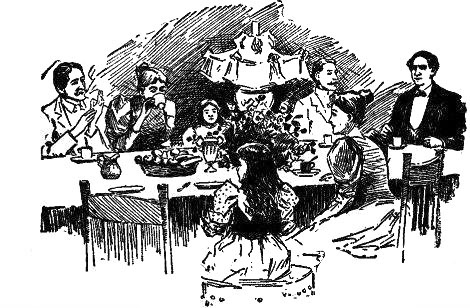
Several months had passed along since we had enjoyed the society of Governor Wiseman, Doctor Heavyasbricks and Fred Quizzle. At our especial call they had come again.
The evening air was redolent with waffles baked in irons that had given them the square imprint which has come down through the ages as the only orthodox pattern.
No sooner had our friends seated themselves at the tea-table than—
Quizzle began: I see, Governor Wiseman, that the races have just come off in England. What do you think of horse-racing?
Wiseman.—That has become a very important question for every moralist to answer. I see that last week England took carriage and horses and went out to Epsom Downs to see the Derby races. The race was won by Sir George Frederick; that is the name of the successful horse. All the particulars come by telegraph. There is much now being done for the turf in this country as well as in England, and these horses are improved year by year. I wonder if the race of men who frequent these entertainments are as much improved as the horses? I like horses very much, but I like men better. So far as we can judge, the horses are getting the best part of these exercises, for they never bet, and always come home sober. If the horses continue to come up as much as they have, and our sporting friends continue to go down in the same ratio, by an inevitable law of progression we shall after a while have two men going round the course neck and neck, while Dexter and Sir George Frederick are on the judges' stand deciding which man is the winner.
Quizzle.—But do you not, Governor Wiseman, believe in out-door sports and recreations?
Yes, said the governor, but it ought to be something that helps a man as well as the brute. I prefer those recreations that are good both for a man's body and soul. We want our entire nature developed.
Two thousand people one morning waited at the depot in Albany for the arrival of the remains of the great pugilist, Heenan. Then they covered the coffin with immortelles. No wonder they felt badly. The poor fellow's work was done. He had broken the last nose. He had knocked out the last tooth. He had bunged up the last eye. He had at last himself thrown up the sponge. The dead hero belonged to the aristocracy of hard-hitters. If I remember rightly, he drew the first blood in the conflict with one who afterward became one of the rulers of the nation—the Honorable John Morrissey, member of Congress of the United States and chief gambler at Saratoga.
There is just now an attempt at the glorification of muscle. The man who can row the swiftest, or strike a ball the farthest, or drop the strongest wrestler is coming to be of more importance. Strong muscle is a grand thing to have, but everything depends on how you use it. If Heenan had become a Christian, he would have made a capital professor in Polemic Theology. If the Harvard or Yale student shall come in from the boat-race and apply his athletic strength to rowing the world out of the breakers, we say "All hail!" to him. The more physical force a man has, the better; but if Samson finds nothing more useful to do than carrying of gate-posts, his strong muscle is only a nuisance.
By all means let us culture physical energy. Let there be more gymnasiums in our colleges and theological seminaries. Let the student know how to wield oar and bat, and in good boyish wrestle see who is the strongest. The health of mental and spiritual work often depends on physical health. If I were not opposed to betting, I would lay a wager that I can tell from the book column in any of the newspapers or magazines of the land the condition of each critic's liver and spleen at the time of his writing.
A very prominent literary man apologized to me the other day for his merciless attack on one of my books, saying that he felt miserable that morning and must pitch into something; and my book being the first one on the table, he pitched into that. Our health decides our style of work. If this world is to be taken for God, we want more sanctified muscle. The man who comes to his Christian work having had sound sleep the night before, and the result of roast beef rare in his organism, can do almost anything. Luther was not obliged to nurse his appetite with any plantation bitters, but was ready for the coarsest diet, even the "Diet of Worms."
But while I advocate all sports, and exercises, and modes of life that improve the physical organism, I have no respect for bone, and nerve, and muscle in the abstract. Health is a fine harp, but I want to know what tune you are going to play on it. I have not one daisy to put on the grave of a dead pugilist or mere boat-racer, but all the garlands I can twist for the tomb of the man who serves God, though he be as physically weak as Richard Baxter, whose ailments were almost as many as his books, and they numbered forty.
At this last sentence the company at the table, forgetful of the presence of Doctor Heavyasbricks, showed some disposition at good humor, when the doctor's brows lifted in surprise, and he observed that he thought a man with forty ailments was a painful spectacle, and ought to be calculated to depress a tea-table rather than exhilarate it.
"But, Governor Wiseman," said Quizzle, "do you not think that it is possible to combine physical, mental and spiritual recreations?"
Oh yes, replied the governor; I like this new mode of mingling religion with summer pleasures. Soon the Methodists will be shaking out their tents and packing their lunch-baskets and buying their railroad and steamboat tickets for the camp-meeting grounds. Martha's Vineyard, Round Lake, Ocean Grove and Sea Cliff will soon mingle psalms and prayers with the voice of surf and forest. Rev. Doctor J.H. Vincent, the silver trumpet of Sabbath-schoolism, is marshaling a meeting for the banks of Chautauqua Lake which will probably be the grandest religious picnic ever held since the five thousand sat down on the grass and had a surplus of provision to take home to those who were too stupid to go. From the arrangement being made for that meeting in August, I judge there will be so much consecrated enthusiasm that there may be danger that some morning, as the sun strikes gloriously through the ascending mist of Chautauqua Lake, our friends may all go up in a chariot of fire, leaving our Sunday-schools in a bereft condition. If they do go up in that way, may their mantle or their straw hat fall this way!
Why not have all our churches and denominations take a summer airing? The breath of the pine woods or a wrestle with the waters would put an end to everything like morbid religion. One reason why the apostles had such healthy theology is that they went-a-fishing. We would like to see the day when we will have Presbyterian camp-meetings, and Episcopalian camp-meetings, and Baptist camp-meetings, and Congregational camp-meetings, or, what would be still better, when, forgetful of all minor distinctions, we could have a church universal camp-meeting. I would like to help plant the tent-pole for such a convocation.
Quizzle.—Do you not think, governor, that there are inexpensive modes of recreation which are quite as good as those that absorb large means?
Yes, said the governor; we need to cut the coat according to our cloth. When I see that the Prince of Wales is three hundred thousand dollars in debt, notwithstanding his enormous income, I am forcibly reminded that it is not the amount of money a man gets that makes him well off, but the margin between the income and the outgo. The young man who while he makes a dollar spends a dollar and one cent is on the sure road either to bankruptcy or the penitentiary.
Next to the evil of living beyond one's means is that of spending all one's income. There are multitudes who are sailing so near shore that a slight wind in the wrong direction founders them. They get on well while the times are usual and the wages promptly paid; but a panic or a short period of sickness, and they drop helpless. Many a father has gone with his family in a fine carriage drawn by a spanking team till he came up to his grave; then he lay down, and his children have got out of the carriage, and not only been compelled to walk, but to go barefoot. Against parsimony and niggardliness I proclaim war; but with the same sentence I condemn those who make a grand splash while they live, leaving their families in destitution when they die.
Quizzle.—Where, governor, do you expect to recreate this coming summer?
Wiseman.—Have not yet made up my mind. The question is coming up in all our households as to the best mode of vacation. We shall all need rest. The first thing to do is to measure the length of your purse; you cannot make a short purse reach around Saratoga and the White Mountains. There may be as much health, good cheer and recuperation in a country farmhouse where the cows come up every night and yield milk without any chalk in it.
What the people of our cities need is quiet. What the people of the country need is sightseeing. Let the mountains come to New York and New York go to the mountains. The nearest I ever get to heaven in this world is lying flat down on my back under a tree, looking up through the branches, five miles off from a post-office or a telegraph station. But this would be torture to others.
Independent of what others do or say, let us in the selection of summer recreations study our own temperament and finances. It does not pay to spend so much money in July and August that you have to go pinched and half mad the rest of the year. The healthiest recreations do not cost much. In boyhood, with a string and a crooked pin attached to it, I fished up more fun from the mill-pond than last summer with a five-dollar apparatus I caught among the Franconia Mountains.
There is a great area of enjoyment within the circumference of one dollar if you only know how to make the circuit. More depends upon ourselves than upon the affluence of our surroundings. If you are compelled to stay home all summer, you may be as happy as though you went away. The enjoyment of the first of July, when I go off, is surpassed by nothing but the first of September, when I come home.
There being a slight pause in the conversation, Doctor Heavyasbricks woke gradually up and began to move his lips and to show strong symptoms of intention to ask for himself a question. He said: I have been attending the anniversaries in New York, and find that they are about dead. Wiseman, can you tell me what killed them?
Governor Wiseman replied: It is a great pity that the anniversaries are dead. They once lived a robust life, but began some fifteen years ago to languish, and have finally expired. To the appropriate question, What killed them? I answer, Peregrination was one of the causes. There never has been any such place for the anniversaries as the Broadway Tabernacle. It was large and social and central. When that place was torn down, the anniversaries began their travels. Going some morning out of the warm sunshine into some cathedral-looking place, they got the chills, and under the dark stained glass everything looked blue. In the afternoon they would enter some great square hall where everything was formal.
It is almost impossible to have a genial and successful meeting in a square hall. When in former days the country pastor said to his congregation, "Meet me at the New York anniversaries," they all knew where to go; but after the old Broadway Tabernacle went down, the aforesaid congregation might have looked in five or six places and not found their minister. The New York anniversaries died on the street between the old Tabernacle and St. Paul's Methodist Cathedral.
Prolix reports also helped to kill the patient. Nothing which was not in its nature immortal could have survived these. The secretary would read till he got out of wind, and would then say that the remainder of the report would be found in the printed copies in the pews. The speakers following had the burden of galvanizing an exhausted meeting, and the Christian man who attended the anniversary on retiring that evening had the nightmare in the shape of a portly secretary sitting astride his chest reading from a huge scroll of documents.
Diluted Christian oratory also helped to kill the anniversaries. The men whom we heard in our boyhood on the Broadway platform believed in a whole Bible, and felt that if the gospel did not save the world nothing ever would; consequently, they spoke in blood-red earnestness and made the place quake with their enthusiasm. There came afterward a weak-kneed stock of ministers who thought that part of the Bible was true, if they were not very much mistaken, and that, on the whole, religion was a good thing for most people, certainly if they had weak constitutions, and that man could be easily saved if we could get the phrenologist to fix up his head, and the gymnasium to develop his muscle, and the minister to coax him out of his indiscretions. Well, the anniversaries could not live on pap and confectionery, and so they died for lack of strong meat.
But the day of resurrection will come. Mark that! The tide of Bible evangelism will come up again. We may be dead, but our children will see it. New York will be thronged with men and women who will come up once a year to count the sheaves of harvest, and in some great building thronged from the platform to the vestibule an aroused Christian audience will applaud the news, just received by telegraph, of a nation born in a day, and sing with more power than when Thomas Hastings used to act as precentor:
Quizzle.—You speak, governor, of the ruinous effect of prolixity in religious service. How long ought a public service continue?
Wiseman.—There is much discussion in the papers as to how long or short sermons and prayers ought to be. Some say a discourse ought to last thirty minutes, and others forty, and others an hour, and prayers should be three minutes long, or five, or fifteen. You might as well discuss how long a frock-coat ought to be, or how many ounces of food a man ought to eat. In the one case, everything depends upon the man's size; in the other, everything on the capacity of his stomach. A sermon or a prayer ought to go on as long as it is of any profit. If it is doing no good, the sermon is half an hour too long, though it take only thirty minutes. If the audience cough, or fidget, or shuffle their feet, you had better stop praying. There is no excuse, for a man's talking or praying too long if he have good eyesight and hearing.
But suppose a man have his sermon written and before him. You say he must go through with it? Oh no. Let him skip a few leaves. Better sacrifice three or four sheets of sermon-paper than sacrifice the interest of your hearers. But it is a silly thing for a man in a prayer-meeting or pulpit to stop merely because a certain number of minutes have expired while the interest is deepening—absurd as a hunter on the track of a roebuck, and within two minutes of bringing down its antlers, stopping because his wife said that at six o'clock precisely he must be home to supper. Keep on hunting till your ammunition gives out.
Still, we must all admit that the danger is on the side of prolixity. The most interesting prayers we ever hear are by new converts, who say everything they have to say and break down in one minute. There are men who, from the way they begin their supplications, indicate a long siege. They first pray you into a good frame, and then pray you out. They take literally what Paul meant to be figurative: "Pray without ceasing."
Quizzle.—I see there was no lack of interest when the brewers' convention met the other day in Boston, and that in their longest session the attention did not flag.
Wiseman.—Yes; I see that speeches were made on the beneficial use of fermented liquors. The announcement was made that during the year 8,910,823 barrels of the precious stuff had been manufactured. I suppose that while the convention was there Boston must have smelt like one great ale-pitcher. The delegates were invited to visit the suburbs of the city. Strange that nobody thought of inviting them to visit the cemeteries and graveyards, especially the potter's field, where thousands of their victims are buried. Perhaps you are in sympathy with these brewers, and say that if people would take beer instead of alcohol drunkenness would cease. But for the vast majority who drink, beer is only introductory to something stronger. It is only one carriage in the same funeral. Do not spell it b-e-e-r, but spell it b-i-e-r. May the lightnings of heaven strike and consume all the breweries from river Penobscot to the Golden Horn!
Quizzle.—I see, governor, that you were last week in Washington. How do things look there?
Wiseman.—Very well. The general appearance of our national capital never changes. It is always just as far from the Senate-chamber to the White House; indeed, so far that many of our great men have never been able to travel it. There are the usual number of petitioners for governmental patronage hanging around the hotels and the congressional lobbies. They are willing to take almost anything they can get, from minister to Spain to village postmaster. They come in with the same kind of carpet-bags, look stupid and anxious for several days, and having borrowed money enough from the member from their district to pay their fare, take the cars for home, denouncing the administration and the ungratefulness of republics.
I think that the two houses of Congress are the best and most capable of any almost ever assembled. Of course there is a dearth of great men. Only here and there a Senator or Representative you ever before heard of. Indeed, the nuisances of our national council in other days were the great men who took, in making great speeches, the time that ought to have been spent in attending to business. We all know that it was eight or ten "honorable" bloats of the last thirty years who made our chief international troubles.
Our Congress is made up mostly of practical every-day men. They have no speeches to make, and no past political reputation to nurse, and no national fame to achieve. I like the new crop of statesmen better than the old, although it is a shorter crop. They do not drink so much rum, and not so large a proportion of them will die of delirium tremens. They may not have such resounding names as some of their predecessors, but I prefer a Congress of ordinary men to a group of Senators and Representatives overawed and led about by five or six overgrown, political Brobdingnagians.
While in Washington we had a startling occurrence. A young man in high society shot another young man, who fell dead instantly.
I wonder that there is not more havoc with human life in this day, when it is getting so popular to carry firearms. Most of our young men, and many of our boys, do not feel themselves in tune unless they have a pistol accompaniment. Men are locked up or fined if found with daggers or slung-shot upon their persons, but revolvers go free. There is not half so much danger from knife as pistol. The former may let the victim escape minus a good large slice, but the latter is apt to drop him dead. On the frontiers, or engaged in police duty, firearms may be necessary; but in the ordinary walk of life pistols are, to say the least, a superfluity. Better empty your pockets of these dangerous weapons, and see that your sons do not carry them. In all the ordinary walks of life an honest countenance and orderly behavior are sufficient defence. You had better stop going into society where you must always be ready to shoot somebody.
But do not think, my dear Fred, that I am opposed to everything because I have this evening spoken against so many different things. I cannot take the part of those who pride themselves in hurling a stout No against everything.
A friend called my attention to the fact that Sanballat wanted to hold consultation with Nehemiah in the plain of O-no. That is the place where more people stay, to-day, than in any other. They are always protesting, throwing doubt on grand undertakings; and while you are in the mountain of O-yes, they spend their time on the plain of O-no. In the harness of society they are breeching-straps, good for nothing but to hold back.
You propose to call a minister. All the indications are that he is the right man. Nine-tenths of the congregation are united in his favor. The matter is put to vote. The vast majority say "Ay!" the handful of opponents responded "O no!"
You propose to build a new church. About the site, the choice of architect, the upholstery, the plumbing and the day of dedication there is almost a unanimity. You hope that the crooked sticks will all lie still, and that the congregation will move in solid phalanx. But not so. Sanballat sends for Nehemiah, proposing to meet him in the plain of O-no.
Some men were born backward, and have been going that way ever since. Opposition to everything has become chronic. The only way they feel comfortable is when harnessed with the face toward the whiffletree and their back to the end of the shafts. They may set down their name in the hotel register as living in Boston, Chicago, Savannah or Brooklyn, but they really have been spending all their lives on the plain of O-no. There let them be buried with their face toward the west, for in that way they will lie more comfortably, as other people are buried with their face to the east. Do not impose upon them by putting them in the majority. O-no!
We rejoice that there seems more liberality among good men, and that they have made up their minds to let each one work in his own way. The scalping-knives are being dulled.
The cheerfulness and good humor which have this year characterized our church courts is remarkable and in strong contrast with the old-time ecclesiastical fights which shook synods and conferences. Religious controversies always have been the most bitter of all controversies; and when ministers do fight, they fight like vengeance. Once a church court visiting a place would not only spend much of their own time in sharp contention, but would leave the religious community to continue the quarrel after adjournment. Now they have a time of good cheer while in convention, and leave only one dispute behind them among the families, and that arising from the fact that each one claims it had the best ministers and elders at their house. Contention is a child of the darkness, peace the daughter of the light. The only help for a cow's hollow horn is a gimlet-hole bored through it, and the best way to cure religious combatants is to let more gospel light through their antlers.
As we sat at the head of the table interested in all that was going on, and saw Governor Wiseman with his honorable name, and Quizzle and Heavyasbricks with their unattractive titles, we thought of the affliction of an awkward or ill-omened name.
When there are so many pleasant names by which children may be called, what right has a parent to place on his child's head a disadvantage at the start? Worse than the gauntlet of measles and whooping-cough and mumps which the little ones have to run is this parental outrage.
What a struggle in life that child will have who has been baptized Jedekiah or Mehitabel! If a child is "called after" some one living, let that one be past mid-life and of such temperament that there shall be no danger of his becoming an absconder and a cheat. As far as possible let the name given be short, so that in the course of a lifetime there be not too many weeks or months taken up in the mere act of signature. The burdens of life are heavy enough without putting upon any one the extra weight of too much nomenclature. It is a sad thing when an infant has two bachelor uncles, both rich and with outrageous names, for the baby will have to take both titles, and that is enough to make a case of infant mortality.
Quizzle.—You seem to me, governor, to be more sprightly at every interview.
Well, that is so, but I do not know how long it will last; stout people like myself often go the quickest.
There is a constant sympathy expressed by robust people for those of slight physical constitution. I think the sympathy ought to turn in the opposite direction. It is the delicate people who escape the most fearful disorders, and in three cases out of four live the longest. These gigantic structures are almost always reckless of health. They say, "Nothing hurts me," and so they stand in draughts, and go out into the night air to cool off, and eat crabs at midnight, and doff their flannels in April, and carelessly get their feet wet.
But the delicate people are shy of peril. They know that disease has been fishing for them for twenty years, and they keep away from the hook. No trout can be caught if he sees the shadow of the sportsman on the brook. These people whom everybody expects to die, live on most tenaciously.
I know of a young lady who evidently married a very wealthy man of eighty-five years on the ground he was very delicate, and with reference to her one-third. But the aged invalid is so careful of his health, and the young wife so reckless of hers, that it is now uncertain whether she will inherit his store-houses or he inherit her wedding-rings.
Health and longevity depend more upon caution and intelligent management of one's self than upon original physical outfit. Paul's advice to the sheriff is appropriate to people in all occupations: "Do thyself no harm!"
Besides that, said the governor, I have moved and settled in very comfortable quarters since I was at this table before. The house I have moved in is not a better house, but somehow I feel more contented.
Most of our households are quieted after the great annual upsetting. The last carpet is tacked down. The strings that were scattered along the floor have been rolled up in a ball. We begin to know the turns in the stairway. Things are settling down, and we shall soon feel at home in our new residence. If it is a better house than we had, do not let us be too proud of the door-plate, nor worship too ardently the fine cornice, nor have any idea that superb surroundings are going to make us any happier than we were in the old house.
Set not your affections on luxurious upholstery and spacious drawing-room. Be grateful and be humble.
If the house is not as large nor in as good neighborhood as the one you formerly occupied, make the best of it. It is astonishing what a good time you may have in a small room. Your present neighbors are just as kind as those you left, if you only knew them. Do not go around your house sticking up your nose at the small pantry, and the ugly mantel-pieces, and the low ceiling. It is a better place than your divine Master occupied, and to say the least you are no better than He. If you are a Christian, you are on your way to a King's mansion, and you are now only stopping a little in the porter's lodge at the gate. Go down in the dark lanes of the city and see how much poorer off many of your fellow-citizens are. If the heart be right, the home will be right.
CHAPTER LVI.
FRIDAY EVENING.
Our friend Churchill was a great man for religious meetings. As he shoved back from our tea-table he said, "I must be off to church."
Then he yawned as though he expected to have a dull time, and asked me why it was that religious meetings were often so very insipid and that many people went to them merely as a matter of duty. Without waiting for me to give my opinion, he said he thought that there was a sombre hue given to such meetings that was killing and in a sort of soliloquy continued:
There is one thing Satan does well. He is good at stating the discouraging side. He knows how to fish for obstacles, and every time brings up his net full. Do not let us help him in his work. If you have anything to say in prayer-meeting that is disheartening, may you forget your speech! Tell us something on the bright side.
I know a Christian man who did something outrageously wrong. Some one said to me: "Why do you not expose him?" I replied: "That is the devil's work and it will be thoroughly done. If there is anything good about him, we would rather speak of that."
Give us no sermons or newspaper articles that are depressing. We know all that before you start; amid the greatest disheartenments there are hopeful things that may be said. While the Mediterranean corn-ship was going to smash, Paul told the crew to "Be of good cheer." We like apple trees because, though they are not handsome, they have bright blossoms and good fruit, but we despise weeping willows because they never do anything but cry.
On a dark day do not go around closing the window-shutters. The world is dark enough without your making it more so. Is there anybody in the room who has a match? Please then strike it. There is only one kind of champagne that we temperance folks can take, and that is encouraging remark. It is a stimulus, and what makes it better than all other kinds of champagne is it leaves no headache.
I said to him, I think religious meetings have been improved in the last few years. One of the grandest results of the Fulton street prayer-meeting is the fact that all the devotional services of the country have been revolutionized. The tap of the bell of that historical prayer-meeting has shortened the prayers and exhortations of the church universal.
But since it has become the custom to throw open the meetings for remark and exhortation, there has been a jubilee among the religious bores who wander around pestering the churches. We have two or three outsiders who come about once in six weeks into our prayer-meeting; and if they can get a chance to speak, they damage all the interest. They talk long and loud in proportion as they have nothing to say. They empty on us several bushels of "ohs" and "ahs." But they seldom get a chance, for we never throw the meeting open when we see they are there. We make such a close hedge of hymns and prayers that they cannot break into the garden.
One of them we are free of because, one night, seeing him wiggle-waggle in his seat as if about to rise, we sent an elder to him to say that his remarks were not acceptable. The elder blushed and halted a little when we gave him the mission, but setting his teeth together he started for the offensive brother, leaned over the back of the pew and discharged the duty. We have never seen that brother since, but once in the street, and then he was looking the other way.
By what right such men go about in ecclesiastical vagabondism to spoil the peace of devotional meetings it is impossible to tell. Either that nuisance must be abated or we must cease to "throw open" our prayer-meetings for exhortation.
A few words about the uses of a week-night service. Many Christians do not appreciate it; indeed, it is a great waste of time, unless there be some positive advantage gained.
The French nation at one time tried having a Sabbath only once in ten days. The intelligent Christian finds he needs a Sabbath every three or four days, and so builds a brief one on the shore of a week-day in the shape of an extra religious service. He gets grace on Sabbath to bridge the chasm of worldliness between that and the next Sabbath, but finds the arch of the bridge very great, and so runs up a pier midway to help sustain the pressure.
There are one hundred and sixty-eight hours in a week, and but two hours of public religious service on Sabbath. What chance have two hours in a battle with one hundred and sixty-eight?
A week-night meeting allows church membership utterance. A minister cannot know how to preach unless in a conference meeting he finds the religious state of the people. He must feel the pulse before giving the medicine, otherwise he will not know whether it ought to be an anodyne or a stimulant. Every Christian ought to have something to say. Every man is a walking eternity. The plainest man has Omnipotence to defend him, Omniscience to watch him, infinite Goodness to provide for him. The tamest religious experience has in it poems, tragedies, histories, Iliads, Paradise Lost and Paradise Regained. Ought not such a one have something to say?
If you were ever in the army you know what it is to see an officer on horseback dash swiftly past carrying a dispatch. You wondered as he went what the news was. Was the army to advance, or was an enemy coming?
So every Christian carries a dispatch from God to the world. Let him ride swiftly to deliver it. The army is to advance and the enemy is coming. Go out and fulfill your mission. You may have had a letter committed to your care, and after some days you find it in one of your pockets, you forgot to deliver it. Great was your chagrin when you found that it pertained to some sickness or trouble. God gives every man a letter of warning or invitation to carry, and what will be your chagrin in the judgment to find that you nave forgotten it!
A week-night meeting widens the pulpit till all the people can stand on it. Such a service tests one's piety. No credit for going to church on Sabbath. Places of amusement are all closed, and there is no money to be made. But week-nights every kind of temptation and opportunity spreads before a man, and if he goes to the praying circle he must give up these things. The man who goes to the weekly service regularly through moonlight and pitch darkness, through good walking and slush ankle-deep, will in the book of judgment find it set down to his credit. He will have a better seat in heaven than the man who went only when the walking was good, and the weather comfortable, and the services attractive, and his health perfect. That service which costs nothing God accounts as nothing.
A week-night service thrusts religion in the secularities of the week. It is as much as to say, "This is God's Wednesday, or God's Thursday, or God's Friday, or God's week." You would not give much for a property the possession of which you could have only one-seventh of the time, and God does not want that man whose services he can have only on Sabbath. If you paid full wages to a man and found out that six-sevenths of the time he was serving a rival house, you would be indignant; and the man who takes God's goodness and gives six-sevenths of his time to the world, the flesh and the devil is an abomination to the Lord. The whole week ought to be a temple of seven rooms dedicated to God. You may, if you will, make one room the holy of holies, but let all the temple be consecrate.
The week-night service gives additional opportunity of religious culture, and we find it so difficult to do right and be right that we cannot afford to miss any opportunity. Such a service is a lunch between the Sabbath meals, and if we do not take it we get weak and faint. A truth coming to us then ought to be especially effective.
If you are on a railroad train, and stop at the depot, and a boy comes in with a telegram, all the passengers lean forward and wonder if it is for them. It may be news from home. It must be urgent or it would not be brought there. Now, if while we are rushing on in the whirl of every-day excitement, a message of God meets us, it must be an urgent and important message. If God speaks to us in a meeting mid-week, it is because there is something that needs to be said before next Sunday.
SABBATH EVENING TEA-TABLE.
CHAPTER LVII.
THE SABBATH EVENING TEA-TABLE.
When this evening comes we do not have any less on our table because it is a sacred day, but a little more. On other evenings we have in our dining-hall three of the gas-burners lighted, but on Sabbath evening we have four. We try to have the conversation cheerfully religious.
After the children are sleepy we do not keep them up to recite the "Larger Catechism." During summer vacation, when we have no evening service to attend at church, we sometimes have a few chapters of a Christian book read or a column of a Christian newspaper, or if any one has an essay on any religious theme, we hear that.
We tarry long after the tea has got cold. We do not care if the things are not cleared off till next morning. If any one has a perplexing passage of Scripture to explain, we gather all the lights possible on that subject. We send up stairs for concordance and Bible dictionary. It may be ten o'clock at night before the group is dispersed from the Sabbath evening tea-table.
Some of the chapters following may be considered as conversations condensed or as paragraphs read. You will sometimes ascribe them to the host, at other times to the hostess, at other times to the strangers within the gates.
Old Dominie Scattergood often came in on Sabbath evenings. He was too old to preach, and so had much leisure. Now, an old minister is a great joy to us, especially if life has put sugar rather than vinegar in his disposition. Dominie Scattergood had in his face and temper the smiles of all the weddings he had ever solemnized, and in his hand-shaking all the hearty congratulations that had ever been offered him.
His hair was as white as any snow-bank through which he had waded to meet his appointments. He sympathized with every one, could swing from mood to mood very easily, and found the bridge between laughter and tears a short one and soon crossed. He was like an orchard in October after some of the frosts, the fruit so ripe and mellow that the least breeze would fill the laps of the children. He ate scarcely anything at the tea-table, for you do not want to put much fuel in an engine when it has nearly reached the depot. Old Dominie Scattergood gave his entire time to religious discourse when he sat with us at the close of the Lord's day.
How calm and bright and restful the light that falls on the Sabbath evening tea-table! Blessed be its memories for ever and ever! and Jessie, and De Witt, and May, and Edith, and Frank, and the baby, and all the visitors, old and young, thick-haired and bald-headed, say Amen!
CHAPTER LVIII.
THE WARM HEART OF CHRIST.
The first night that old Dominie Scattergood sat at our tea-table, we asked him whether he could make his religion work in the insignificant affairs of life, or whether he was accustomed to apply his religion on a larger scale. The Dominie turned upon us like a day-dawn, and addressed us as follows:
There is no warmer Bible phrase than this: "Touched with the feeling of our infirmities." The Divine nature is so vast, and the human so small, that we are apt to think that they do not touch each other at any point. We might have ever so many mishaps, the government at Washington would not hear of them, and there are multitudes in Britain whose troubles Victoria never knows; but there is a throne against which strike our most insignificant perplexities. What touches us, touches Christ. What annoys us, annoys Christ. What robs us, robs Christ. He is the great nerve-centre to which thrill all sensations which touch us who are his members.
He is touched with our physical infirmities. I do not mean that he merely sympathizes with a patient in collapse of cholera, or in the delirium of a yellow fever, or in the anguish of a broken back, or in all those annoyances that come from a disordered nervous condition. In our excited American life sound nerves are a rarity. Human sympathy in the case I mention amounts to nothing. Your friends laugh at you and say you have "the blues," or "the high strikes," or "the dumps," or "the fidgets." But Christ never laughs at the whims, the notions, the conceits, the weaknesses, of the nervously disordered. Christ probably suffered in something like this way, for He had lack of sleep, lack of rest, lack of right food, lack of shelter, and His temperament was finely strung.
Chronic complaints, the rheumatism, the neuralgia, the dyspepsia, after a while cease to excite human sympathy, but with Christ they never become an old story. He is as sympathetic as when you felt the first twinge of inflamed muscle or the first pang of indigestion. When you cannot sleep, Christ keeps awake with you. All the pains you ever had in your head are not equal to the pains Christ had in His head. All the acute suffering you ever had in your feet is not equal to the acute suffering Christ had in His feet. By His own hand He fashioned your every bone, strung every nerve, grew every eyelash, set every tooth in its socket, and your every physical disorder is patent to Him, and touches His sympathies.
He is also touched with the infirmities of our prayers. Nothing bothers the Christian more than the imperfections of his prayers. His getting down on his knees seems to be the signal for his thoughts to fly every whither. While praying about one thing he is thinking about another. Could you ever keep your mind ten minutes on one supplication? I never could. While you are praying, your store comes in, your kitchen comes in, your losses and gains come in. The minister spreads his hands for prayer, and you put your head on the back of the pew in front, and travel round the world in five minutes.
A brother rises in prayer-meeting to lead in supplication. After he has begun, the door slams, and you peep through your fingers to see who is coming in. You say to yourself, "What a finely expressed prayer, or what a blundering specimen! But how long he keeps on! Wish he would stop! He prays for the world's conversion. I wonder how much he gives toward it? There! I don't think I turned the gas down in the parlor! Wonder if Bridget has got home yet? Wonder if they have thought to take that cake out of the oven? Oh what a fool I was to put my name on the back of that note! Ought to have sold those goods for cash and not on credit!" And so you go on tumbling over one thing after another until the gentleman closes his prayer with Amen! and you lift up your head, saying, "There! I haven't prayed one bit. I am not a Christian!" Yes, you are, if you have resisted the tendency. Christ knows how much you have resisted, and how thoroughly we are disordered of sin, and He will pick out the one earnest petition from the rubbish and answer it. To the very depth of His nature He sympathizes with the infirmity of our prayers.
He is touched with the infirmity of our temper.
There are some who, notwithstanding all that is said or done to them can smile back. But many of you are so constructed that if a man insults you, you either knock him down or wish you could. While with all resolution and prayer you resist this, remember that Christ knows how much you have been lied about, and misrepresented, and trod on. He knows that though you said something that was hot, you kept back something that was ten times hotter. He takes into account your explosive temperament. He knows that it requires more skill to drive a fiery span than a tame roadster. He knows how hard you have put down the "brakes" and is touched with the feeling of your infirmity.
Christ also sympathizes with our poor efforts at doing good.
Our work does not seem to amount to much. We teach a class, or distribute a bundle of tracts, or preach a sermon, and we say, "Oh, if I had done it some other way!" Christ will make no record of our bungling way, if we did the best we could. He will make record of our intention and the earnestness of our attempt. We cannot get the attention of our class, or we break down in our exhortation, or our sermon falls dead, and we go home disgusted, and sorry we tried to speak, and feel Christ is afar off. Why, He is nearer than if we had succeeded, for He knows that we need sympathy, and is touched with our infirmity.
It is comforting to know that it is not the learned and the great and the eloquent that Christ seems to stand closest by. The "Swamp-angel" was a big gun, and made a stunning noise, but it burst before it accomplished anything, while many an humble rifle helped decide the contest. Christ made salve out of spittle to cure a blind man, and the humblest instrumentality may, under God, cure the blindness of the soul. Blessed be God for the comfort of His gospel!