
CHAPTER LIX.
SACRIFICING EVERYTHING.
Ourselves.—Dominie Scattergood, why did Christ tell the man inquiring about his soul to sell all he had and give everything to the poor? Is it necessary for one to impoverish himself in order to be a Christian?
The Dominie.—You mistake the purport of Christ's remark. He was not here teaching the importance of benevolence, but the duty of self-conquest. That young man had an all absorbing love of wealth. Money was his god, and Christ is not willing to occupy the throne conjointly with any other deity. This was a case for what the doctors call heroic treatment. If a physician meet a case of unimportant sickness, he prescribes a mild curative, but sometimes he comes to a room where the case is almost desperate; ordinary medicine would not touch it. It is "kill or cure," and he treats accordingly. This young man that Christ was medicating was such a case. There did not seem much prospect, and He gives him this powerful dose, "Sell all that thou hast and give to the poor!"
It does not follow that we must all do the same, any more than because belladonna or arsenic is administered in one case of illness we should therefore all go to taking belladonna or arsenic. Because one man in the hospital must have his arm amputated all the patients need not expect amputation. The silliest thing that business-men could do would be to give all their property away and turn their families into the street. The most Christian thing for you to do is to invest your money in the best way possible, and out of your business, industriously carried on, to contribute the largest possible percentage to the kingdom of God.
Still, we must admire the manner in which the Great Physician took the diagnosis of this man's case and grappled it. We all need heroic spiritual treatment. We do not get well of sin because we do not realize what a dire disease it is, and that we cannot cure it with a spiritual panacea, a gentle antidote, a few grains of spiritual morphine, a mild moral corrective or a few drops of peppermint on white sugar.
We want our pride killed, and we read an essay on that sweet grace of humility, and we go on as proud as ever. The pleasant lozenge does not do the work. Rather let us set ourselves to do that for Christ which is most oppugnant to our natural feelings. You do not take part in prayer-meeting because you cannot pray like Edward Payson, or exhort like John Summerfield. If you want to crush your pride, get up anyhow, though your knees knock together, and your tongue catches fast, and you see some godless hearer in prayer-meeting laughing as though she would burst.
Deal with your avarice in the same heroic style. Having heard the charitable cause presented, at the first right impulse thrust your hand in your pocket where the money is, and pull it out though it half kills you. Pull till it comes. Put it on the plate with an emphasis, and turn your face away before you are tempted to take it back again. All your sweet contemplation about benevolence will not touch your case. Heroic treatment or nothing!
In the same way destroy the vindictiveness of your nature. Treatises on Christian brotherhood are not what you need. Select the man most disagreeable to you, and the one who has said the hardest things about you. Go up and shake hands with him, and ask him how his family is, and how his soul prospers. All your enmities will fly like a flock of quails at the bang of a rifle.
We treat our sins too politely. We ought to call them by their right names. Hatred to our neighbor should not be called hard thoughts, but murder: "whoso hateth his brother is a murderer!" Sin is abominable. It has tusks and claws, and venom in its bite, and death in its stroke. Mild treatment will not do. It is loathsome, filthy and disgusting. If we bid a dog in gentle words to go out of the house, he will lie down under the table. It wants a sharp voice and a determined manner to make him clear out, and so sin is a vile cur that cannot be ejected by any conservative policy. It must be kicked out!
Alas for the young man of the text! He refused Christ's word and went away to die, and there are now those who cannot submit to Christ's command, and after fooling their time away with moral elixirs suddenly relapse and perish. They might have been cured, but would not take the medicine.
CHAPTER LX.
THE YOUNGSTERS HAVE LEFT.
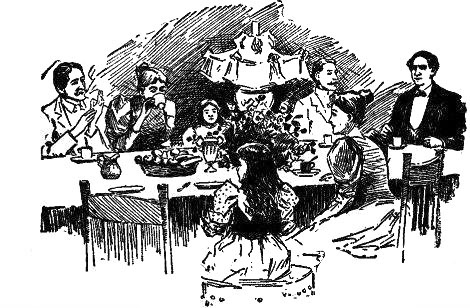
The children after quitting the tea-table were too noisy for Sabbath night, and some things were said at the table critical of their behavior, when old Dominie Scattergood dawned upon the subject and said:
We expect too much of our children when they become Christians. Do not let us measure their qualifications by our own bushel. We ought not to look for a gravity and deep appreciation of eternal things such as we find in grown persons. We have seen old sheep in the pasture-field look anxious and troubled because the lambs would frisk.
No doubt the children that were lifted by their mothers in Christ's arms, and got His blessing, five minutes after He set them down were as full of romp as before they came to Him. The boy that because he has become a Christian is disgusted with ball-playing, the little girl who because she has given her heart to God has lost her interest in her waxen-doll, are morbid and unhealthy. You ought not to set the life of a vivacious child to the tune of Old Hundred.
When the little ones come before you and apply for church membership, do not puzzle them with big words, and expect large "experiences." It is now in the church as when the disciples of old told the mothers not to bother Christ with their babes. As in some households the grown people eat first, and the children have to wait till the second table, so there are persons who talk as though God would have the grown people first sit down at His banquet; and if there is anything over the little ones may come in for a share.
No, no! If the supply at the Lord's table were limited, He would let the children come in first and the older ones go without, as a punishment for not having come in while they themselves were children. If the wind is from the northeast, and the air is full of frost and snow, and part of the flock must be left out on the mountains, let it be the old sheep, for they can stand it better than the lambs. O Shepherd of Israel, crowd them all in before the coming of the tempest!
Myself.—Dominie Scattergood, what do yow think of this discussion in the papers on the subject of liturgies?
Scattergood.—I know there has been much talk of late about liturgies in the churches, and whether or not audiences should take audible part in religious service. While others are discussing that point, let me say that all the service of the Church ought to be responsive if not with audible "Amen," and unanimous "Good Lord, deliver us," then with hearty outburst of soul.
Let not the prayer of him that conducts public service go up solitary and alone, but accompanied by the heartfelt ejaculation of all the auditory. We sit down on a soft cushion, in a pew by architectural skill arranged to fit the shape of our back, and are tempted to fall into unprofitable reveries. Let the effort be on the part of every minister to make the prayer and the Scripture-reading and the giving out of the hymn so emphatic that the audience cannot help but respond with all the soul.
Let the minister, before going into the pulpit, look over the whole field and recall what are the styles of bereavement in the congregation—whether they be widowhood, orphanage or childlessness; what are the kinds of temporal loss his people may recently have suffered—whether in health, in reputation or estate; and then get both his shoulders under these troubles, and in his prayer give one earnest and tremendous lift, and there will be no dullness, no indifference, no lack of multitudinous response.
The reason that congregations have their heads bobbing about in prayer-time is because the officiating clergyman is apt to petition in the abstract. He who calls the troubles of his people by their right names, and tenderly lays hold of the cancers of the souls before him, will not lack in getting immediate heartfelt, if not audible, response.
While we have not as much interest in the agitated question of liturgies as would make us say ten words about it, we are interested more than we can tell in the question, How shall the officiating ministers, in all the churches, give so much point, and adaptedness, and vigor and blood-red earnestness of soul to their public devotions as shall make all the people in church feel that it is the struggle for their immortal life in which the pastor is engaged? Whether it be in tones that strike the ear, or with a spiritual emphasis heard only in the silent corridor of the heart, let all the people say Amen!
Myself.—What do you think, Dominie, about all this talk about sensationalism in the pulpit?
Scattergood.—As far as I can understand, it seems to be a war between stagnation and sensationalism, and I dislike both.
I do not know which word is the worst. It is the national habit in literature and religion to call that sensationalism which we ourselves cannot do. If an author write a book that will not sell, he is apt to charge the books of the day which do succeed as being sensational. There are a great many men who, in the world and the Church, are dead failures, who spend their time in letting the public know that they are not sensationalists. The fact is that they never made any stir while living, nor will they in dying, save as they rob the undertaker of his fees, they not leaving enough to pay their dismission expenses.
I hate sensationalism in the pulpit so far as that word means the preaching of everything but the gospel, but the simple fact is that whenever and wherever faith and repentance and heaven and hell are proclaimed with emphasis there will be a sensation. The people in our great cities are hungry for the old gospel of Christ. If our young men in the ministry want large audiences, let them quit philosophizing, and hair-splitting, and botanizing, and without gloves take hold of men's sins and troubles, and there will be no lack of hearers. Stagnation is worse than sensationalism.
I have always noticed that just in proportion as a man cannot get along himself he is fearful of some one else making an excitement. Last week a mud-turtle down by the brook opened its shell and discoursed to a horse that was coming down to drink. The mud-turtle said to the horse: "Just as I get sound asleep you are sure to come past and wake me up. We always used to have a good quiet time down here in the swamp till you got in the habit of thumping along this way. I am conservative and like to keep in my shell. I have been pastor of thirteen other mud-turtles, and we always had peace until you came, and next week at our semi-annual meeting of mud-turtles we shall either have you voted a nuisance or will talk it over in private, eight, or ten of us, which will probably be the more prudent way." Then the mud-turtle's shell went shut with a snap, at which the horse kicked up his heels as he turned to go up to the barn to be harnessed to a load of corn that was ready for the market.
Let us all wake up and go to work. There are in the private membership of our churches and in the ministry a great many men who are dead, but have never had the common decency to get buried. With the harvest white and "lodging" for lack of a sickle, instead of lying under the trees criticising the sweating reapers who are at work, let us throw off our own coat and go out to see how good a swathe we can cut.
Myself.—You seem, Dominie Scattergood, though you have been preaching a great while, to be very healthy and to have a sound throat.
Scattergood.—Yes; I don't know any reason why ministers should not be as well as other persons. I have never had the ministers' sore throat, but have avoided it by the observance of two or three rules which I commend to you of less experience. The drug stores are full of troches, lozenges and compounds for speakers and singers. All these medicines have an important mission, but how much better would it be to avoid the ills than to spend one's time in trying to cure them!
1. Speak naturally. Let not incompetent elocutionists or the barbarisms of custom give you tones or enunciations at war with those that God implanted. Study the vocal instrument and then play the best tune on it possible, but do not try to make a flute sound like a trumpet, or a bagpipe do the work of a violin.
2. Remember that the throat and lungs were no more intended to speak with than the whole body. If the vocal organs get red hot during a religious service, while the rest of the body does not sympathize with them, there will be inflammation, irritation and decay. But if the man shall, by appreciation of some great theme of time and eternity, go into it with all his body and soul, there will be an equalization of the whole physical organism, and bronchitis will not know whether to attack the speaker in his throat, right knee or left ankle, and while it is deciding at what point to make assault the speaker will go scot-free. The man who besieges an audience only with his throat attempts to take a castle with one gun, but he who comes at them with head, eyes, hand, heart, feet, unlimbers against it a whole park of artillery. Then Sebastopol is sure to be taken.
Myself.—I notice, Dominie, that your handwriting is not as good as your health. Your letter in reply to my invitation to be here was so indistinct that I could not tell whether it was an acceptance or a declinature.
Scattergood.—Well, I have not taken much care of my autograph. I know that the attempt has been made to reduce handwriting to a science. Many persons have been busy in gathering the signatures of celebrated men and women. A Scotchman, by the name of Watson, has paid seventy-five thousand dollars for rare autographs. Rev. Dr. Sprague, of Albany, has a collection marvelous for interest.
After we read an interesting book we want to see the author's face and his autograph. But there is almost always a surprise or disappointment felt when for the first time we come upon the handwriting of persons of whom we have heard or read much. We often find that the bold, dashing nature sometimes wields a trembling pen, and that some man eminent for weakness has a defiant penmanship that looks as if he wrote with a splinter of thunderbolt.
I admit that there are instances in which the character of the man decides the style of his penmanship. Lord Byron's autograph was as reckless as its author. George Washington's signature was a reflection of his dignity. The handwriting of Samuel Rogers was as smooth as his own nature. Robespierre's fierce-looking autograph seems to have been written with the dagger of a French revolution.
On the contrary, one's handwriting is often the antipodes of his character. An unreasonable schoolmaster has often, by false instruction, cramped or ruined the pupil's chirography for ever. If people only knew how a brutal pedagogue in the academy used to pull my ears while learning to write, I should not be so often censured for my own miserable scribble. I defy any boy to learn successfully to make "hooks and trammels" in his copy-book, or ever after learn to trace a graceful calligraphy, if he had "old Talyor" bawling over him. I hope never to meet that man this side of heaven, lest my memory of the long-ago past be too much for the sense of ministerial propriety.
There are great varieties of circumstances that influence and decide the autograph. I have no faith in the science of chirography. I could, from a pack of letters in one pigeon-hole, put to rout the whole theory. I have come to the conclusion that he who judges of a man's character by his penmanship makes a very poor guess. The boldest specimen of chirography I ever received was from a man whose wife keeps him in perpetual tremor, he surrendering every time she looks toward the broomstick.
Myself.—What do you think, Dominie, of the fact that laymen have begun to preach? and what is your opinion of the work they are doing in Scotland?
For the first time in many a day the old Dominie grew sarcastic, and said:
What are we coming to? Get out your fire-engines. There is a conflagration. What work Messrs. Moody, Sankey, Phillips, Bliss, Jacobs, Burnell, Durant and fifty other laymen have done. Wherever they go they have large concourses of people, and powerful revivals of religion follow. Had we not better appoint a meeting of conference or presbytery to overhaul these men who are saving souls without license? No! What we want is ten thousand men just like them, coming up from among the people, with no professional garb, and hearts hot with religious fervor, and bound by no conventionalities or stereotyped notions about the way things ought to be done.
I have a sly suspicion that the layman who has for seven years given the most of his time to the study of the truth is better prepared to preach the gospel than a man who has given that length of time in theological seminaries to the study of what other people say about the Bible. In other words, we like water just dipped from the spring, though handed in a gourd, rather than water that has been standing a week in a silver pitcher.
After Calvin has twisted us one way, and Arminius has twisted us another, and we get our head full of the old Andover and New Haven theological fights, and the difference between Ante-Nicene Trinitarianism and Post-Nicene Trinitarianism, it is a luxury to meet some evangelist who can tell us in our common mother-tongue of Him who came to seek and to save that which was lost.
I say let our learned institutions push theological education to its highest excellency, preparing men for spheres which none but the cultured and scholarly are fit for, but somehow let us beat the drum and gather a battalion of lay-workers. We have enough wise men to tell us about fishes, about birds, about rocks, about stars—enough Leyden jars, enough telescopes, enough electric batteries; but we have not more than one man where we ought to have a hundred to tell the story of Christ and the soul.
Some cry out, "It is dangerous to have laymen take such prominent positions in the Church." Dangerous to what? Our dignity, our prerogatives, our clerical rights? It is the same old story. If we have a mill on the stream, we do not want some one else to build a mill on the same stream. It will take the water off our wheel. But, blessed be God! the river of salvation is deep and strong enough to grind corn for all nations.
If a pulpit is so weak that the wave of religious zeal on the part of the laity submerges it, then let it go under. We cannot expect all other shipping to forsake the sea lest they run down our craft. We want more watchmen on the wall, more sentinels at the gate, more recruits for the field. Forward the whole Christian laity! Throw up no barrier to their advancement. Do not hang the Church until dead by the neck with "red-tape."
I laughed outright, though I ought to have cried, when I read in one of our papers a statement of the work of Moody and Sankey in Edinburgh, which statement closed with the luscious remark that "Probably the Lord is blessing their work." I never saw a word put in more awkward and forced and pitiable predicament than that word probably. While heaven and earth and hell have recognized the stupendous work now going on in Scotland under God and through the instrumentality of these American evangelists, a correspondent thinks that probably something has happened.
Oh how hard it is to acknowledge that men are doing good if they do not work in our way and by our methods! One's heart must have got awfully twisted and near being damned who can look on a great outpouring of the Holy Ghost and have any use for probabilities. The tendency is even among Christians to depreciate that which goes on independent of themselves and in a way oppugnant to their personal taste. People do not like those who do a thing which they themselves have not been able to accomplish.
The first cry is, "The people converted are the lower population, and not the educated." We wonder if five hundred souls brought to Christ from the "Cowgate" and "Coalhole," and made kings and priests unto God, and at last seated on thrones so high they will not be able to reach down with their foot to the crown of an earthly monarch, is not worth some consideration?
Then the cry is, "They will not hold out." Time only will show that. They are doing all they can. You cannot expect them to hold out ten years in six weeks. The most faithful Christians we have ever known were brought in through revivals, and the meanest, stingiest, dullest, hardest-to-get-on-with Christians have joined when the church was dead.
When a candidate for admission comes before session in revival times, I ask him only seven or eight questions; but when he comes during a cold state of religion, I ask him twenty questions, and get the elders to ask him as many more. In other words, I have more faith in conversions under special religious influence than under ordinary.
The best luck I ever had in fishing was when I dropped the net in the bay and brought up at one haul twenty bluefish, with only three or four moss-bunkers, and the poorest luck I ever had was when, after standing two hours in the soggy meadow with one hook on the line, I felt I had a bite, and began to pull, more and more persuaded of the great size of the captive, until I flung to the shore a snapping-turtle. As a gospel fisherman I would rather run the risk of a large haul than of a solitary angling. I can soon sort out and throw overboard the few moss-bunkers.
Oh for great awakenings all over Christendom!
We have had a drought so long we can stand a freshet. Let the Hudson and the Thames and the Susquehanna rise and overflow the lowlands, and the earth be full of the knowledge of God as the waters fill the seas. That time is hastening, probably!
CHAPTER LXI.
FAMILY PRAYERS.
Take first the statement that unless our children are saved in early life they probably never will be. They who go over the twentieth year without Christ are apt to go all the way without Him. Grace, like flower-seed, needs to be sown in spring. The first fifteen years of life, and often the first six, decide the eternal destiny.
The first thing to do with a lamb is to put it in the arms of the Great Shepherd. Of course we must observe natural laws. Give a child excessive meat diet, and it will grow up sensual, and catechism three times a day, and sixty grains in each dose, won't prevent it. Talk much in your child's presence about the fashions, and it will be fond of dress, notwithstanding all your lectures on humility. Fill your house with gossip, and your children will tattle. Culture them as much as you will, but give them plenty of money to spend, and they will go to destruction.
But while we are to use common sense in every direction respecting a child, the first thing is to strive for its conversion, and there is nothing more potent than family prayers. No child ever gets over having heard parents pray for him. I had many sound threshings when I was a boy (not as many as I ought to have had, for I was the last child and my parents let me off), but the most memorable scene in my childhood was father and mother at morning and evening prayers. I cannot forget it, for I used often to be squirming around on the floor and looking at them while they were praying. Your son may go to the ends of the earth, and run through the whole catalogue of transgression, but he will remember the family altar, and it will be a check, and a call, and perhaps his redemption.
Family prayers are often of no use. Perhaps they are too hurried. We have so much before us of the day's work that we must hustle the children together. We get half through the chapter before the family are seated. We read as if we were reading for a wager. We drop on our knees, are in the second or third sentence before they all get down. It is an express train, with amen for the first depot. We rush for the hat and overcoat, and are on the way to the store, leaving the impression that family prayers are a necessary nuisance, and we had better not have had any gathering of the family at all. Better have given them a kiss all around; it would have taken less time and would have been more acceptable to God and them.
Family prayers often fail in adaptedness. Do not read for the morning lesson a genealogical chapter, or about Samson setting the foxes' tails on fire, or the prophecy about the horses, black and red, and speckled, unless you explain why they were speckled. For all the good your children get from such reading, you might as well have read a Chinese almanac. Rather give the story of Jesus, and the children climbing into his arms, or the lad with the loaves and fishes, or the Sea of Galilee dropping to sleep under Christ's lullaby.
Stop and ask questions. Make the exercise so interesting that little Johnny will stop playing with his shoe-strings, and Jenny will quit rubbing the cat's fur the wrong way. Let the prayer be pointed and made up of small words, and no wise information to the Lord about things He knows without your telling Him. Let the children feel they are prayed for. Have a hymn if any of you can sing. Let the season be spirited, appropriate and gladly solemn.
Family prayer also fails when the whole day is not in harmony with it. A family prayer, to be worth anything, ought to be twenty-four hours long. It ought to give the pitch to all the day's work and behavior. The day when we get thoroughly mad upsets the morning devotion. The life must be in the same key with the devotion.
Family prayer is infinitely important. If you are a parent, and are not a professor of religion, and do not feel able to compose a prayer, get some one of the many books that have been written, put it down before you, and read prayers for the household. God has said that He will "pour out His fury upon the family that call not upon His name."
Prayer for our children will be answered. My grandmother was a praying woman. My father's name was David. One day, he and other members of the family started for a gay party. Grandmother said: "Go, David, and enjoy yourself; but all the time you and your brothers and sisters are there, I will be praying for you." They went, but did not have a very good time, knowing that their mother was praying for them.
The next morning, grandmother heard loud weeping in the room below. She went down and found her daughter crying violently. What was the matter? She was in anxiety about her soul—an anxiety that found no relief short of the cross. Word came that David was at the barn in great agony. Grandmother went and found him on the barn floor, praying for the life of his soul.
The news spread to the neighboring houses, and other parents became anxious about their children, and the influence spread to the village of Somerville, and there was a great turning unto God; and over two hundred souls, in one day, stood up in the village church to profess faith in Christ. And it all started from my grandmother's prayer for her sons and daughters. May God turn the hearts of the fathers to the children, and the hearts of the children to their fathers, lest He come and smite the earth with a curse!
CHAPTER LXII.
CALL TO SAILORS.
One of the children asked us at the tea-table if we had ever preached at sea. We answered, No! but we talked one Sabbath, mid-Atlantic, to the officers, crew and passengers of the steamship "China." By the way, I have it as it was taken down at the time and afterward appeared in a newspaper, and here is the extract:
No persons bound from New York to Liverpool ever had more cause for thanksgiving to God than we. The sea so smooth, the ship so staunch, the companionship so agreeable, all the circumstances so favorable. O Thou who holdest the winds in Thy fist, blessed be Thy glorious name for ever!
Englishmen, Costa Ricans, Germans, Spaniards, Japanese, Irishmen, Americans—gathered, never to meet again till the throne of judgment is lifted—let us join hands to-day around the cross of Jesus and calculate our prospect for eternity. A few moments ago we all had our sea-glasses up watching the vessel that went by. "What is her name?" we all asked, and "Whither is she bound?"
We pass each other on the ocean of life to-day. We only catch a glimpse of each other. The question is, "Whither are we bound? For harbor of light or realm of darkness?" As we decide these questions, we decide everything.
No man gets to heaven by accident. If we arrive there, it will be because we turn the helm, set the sail, watch the compass and stand on the "lookout" with reference to that destination. There are many ways of being lost—only one way of being saved; Jesus Christ is the way. He comes across the sea to-day, His feet on the glass of the wave, as on Galilee, His arm as strong, His voice as soothing, His heart as warm. Whosoever will may have His comfort, His pardon, His heaven.
Officers and crew of this ship, have you not often felt the need of divine help? In the hour of storm and shipwreck, far away from your homes, have you not called for heavenly rescue? The God who then heard thy prayer will hear thee now. Risk not your soul in the great future without compass, or chart, or anchor, or helmsman. You will soon have furled your last sail, and run up the last ratline, and weathered the last gale, and made the last voyage. What next? Where then will be your home, who your companions, what your occupation?
Let us all thank God for this Sabbath which has come to us on the sea. How beautifully it bridges the Atlantic! It hovers above every barque and brig and steamer, it speaks of a Jesus risen, a grave conquered, a heaven open. It is the same old Sabbath that blessed our early days. It is tropical in its luxuriance, but all its leaves are prayers, and all its blossoms praise. Sabbath on the sea! How solemn! How suggestive! Let all its hours, on deck, in cabin, in forecastle, be sacred.
Some of the old tunes that these sailors heard in boyhood times would sound well to-day floating among the rigging. Try "Jesus, lover of my soul," or "Come, ye sinners, poor and needy," or "There is a fountain filled with blood." As soon as they try those old hymns, the memory of loved ones would come back again, and the familiar group of their childhood would gather, and father would be there, and mother who gave them such good advice when they came to sea, and sisters and brothers long since scattered and gone.
Some of you have been pursued by benedictions for many years. I care not how many knots an hour you may glide along, the prayers once offered up for your welfare still keep up with you. I care not on what shore you land, those benedictions stand there to greet you. They will capture you yet for heaven. The prodigal after a while gets tired of the swine-herd and starts for home, and the father comes out to greet him, and the old homestead rings with clapping cymbals, and quick feet, and the clatter of a banquet. If the God of thy childhood days should accost thee with forgiving mercy, this ship would be a Bethel, and your hammock to-night would be the foot of the ladder down which the angels of God's love would come trooping.
Now, may the blessing of God come down upon officers and crew and passengers! Whatever our partings, our losses, our mistakes, our disasters in life, let none of us miss heaven. On that shore may we land amid the welcome of those who have gone before. They have long been waiting our arrival, and are now ready to conduct us to the foot of the throne. Look, all ye voyagers for eternity! Land ahead! Weeping may endure for a night, but joy cometh in the morning.
What Paul said to the crew and passengers on the corn-ship of the Mediterranean is appropriate here: "Now I exhort you to be of good cheer!" God fit us for the day when the archangel, with one foot on the sea and the other on the land, shall swear by Him that liveth for ever and ever that time shall be no longer!
CHAPTER LXIII.
JEHOSHAPHAT'S SHIPPING.
Your attention is called to a Bible incident that you may not have noticed. Jehoshaphat was unfortunate with his shipping. He was about to start another vessel. The wicked men of Ahaziah wanted to go aboard that vessel as sailors. Jehoshaphat refused to allow them to go, for the reason that he did not want his own men to mingle with those vicious people.
In other words, he knew what you and I know very well, that it is never safe to go in the same boat with the wicked. But there are various applications of that idea. We too often forget it, and are not as wise as Jehoshaphat was when he refused to allow his men to be in companionship in the same boat with the wicked men of Ahaziah.
The principle I stated is appropriate to the formation, in the first place, of all domestic alliances. I have often known women who married men for the purpose of reforming them from dissipated habits. I never knew one successful in the undertaking. Instead of the woman lifting the man up, the man drags her down. This is inevitably the case. The greatest risk that one ever undertakes is attempting the voyage of life in a boat in which the wicked sail; this remark being most appropriate to the young persons who are in my presence. It is never safe to sail with the sons of Ahaziah. The aged men around me will bear out the statement that I have made. There is no exception to it.
The principle is just as true in regard to all business alliances. I know it is often the case that men have not the choice of their worldly associations, but there are instances where they may make their choice, and in that case I wish them to understand that it is never safe to go in the same boat with the vicious. No man can afford to stand in associations where Christ is maligned and scoffed at, or the things of eternity caricatured. Instead of your Christianizing them, they will heathenize you. While you propose to lift them up, they will drag you down. It is a sad thing when a man is obliged to stand in a business circle where men are deriding the religion of the Lord Jesus Christ. For instance, rather than to be associated in business circles with Frothinghamite infidelity, give me a first-class Mohammedan, or an unconverted Chinese, or an unmixed Hottentot. There is no danger that they will draw me down to their religion.
If, therefore, you have a choice when you go out in the world as to whether you will be associated in business circles with men who love God, or those who are hostile to the Christian religion, you might better sacrifice some of your financial interests and go among the people of God than risk the interests of your immortal soul.
Jehoshaphat knew it was unsafe for his men to go in one boat with the men of Ahaziah, and you cannot afford to have business associations with those who despise God, and heed not His commandments. I admit the fact that a great many men are forced into associations they despise, and there are business circles in which we are compelled to go which we do not like, but if you have a choice, see that you make an intelligent and safe one.
This principle is just as true in regard to social connections. Let no young man or woman go in a social circle where the influences are vicious or hostile to the Christian religion. You will begin by reproving their faults, and end by copying them. Sin is contagious. You go among those who are profane, and you will be profane. You go among those who use impure language, and you will use impure language. Go among those who are given to strong drink, and you will inevitably become an inebriate. There is no exception to the rule. A man is no better than the company he continually keeps.
It is always best to keep ourselves under Christian influences. It is not possible, if you mingle in associations that are positively Christian, not to be made better men or women. The Christian people with whom you associate may not be always talking their religion, but there is something in the moral atmosphere that will be life to your soul. You choose out for your most intimate associates eight or ten Christian people. You mingle in that association; you take their counsel; you are guided by their example, and you live a useful life, and die a happy death, and go to a blessed eternity. There is no possibility of mistaking it; there is not an exception in all the universe or ages—not one.
For this reason I wish that Christians engage in more religious conversation. I do not really think that Christian talk is of so high a type as it used to be. Some of you can look back to your very early days and remember how the neighbors used to come in and talk by the hour about Christ and heaven and their hopes of the eternal world. There has a great deal of that gone out of fashion.
I suppose that if ten or fifteen of us should happen to come into a circle to spend the evening, we would talk about the late presidential election, or the recent flurry in Wall street, and about five hundred other things, and perhaps we would not talk any about Jesus Christ and our hopes of heaven. That is not Christianity; that is heathenism. Indeed, I have sometimes been amazed to find Christian people actually lacking in subjects of conversation, while the two persons knew each of the other that he was a Christian.
You take two Christian people of this modern day and place them in the same room (I suppose the two men may have no worldly subjects in common). What are they talking about? There being no worldly subject common to them, they are in great stress for a subject, and after a long pause Mr. A remarks: "It is a pleasant evening."
Again there is a long pause. These two men, both redeemed by the blood of the Lord Jesus Christ, heaven above them, hell beneath them, eternity before them, the glorious history of the Church of Jesus Christ behind them, certainly after a while they will converse on the subject of religion. A few minutes have passed and Mr. B remarks: "Fine autumn we are having."
Again there is a profound quiet. Now, you suppose that their religious feelings have really been dammed back for a little while; the men have been postponing the things of God and eternity that they may approach the subject with more deliberation, and you wonder what useful thing Mr. B will say to Mr. A in conversation.
It is the third time, and perhaps it is the last that these two Christian men will ever meet until they come face to face before the throne of God. They know it. The third attempt is now made. Mr. A says to Mr. B: "Feels like snow!"
My opinion is, it must have felt more like ice. Oh, how little real, practical religious conversation there is in this day! I would to God that we might get back to the old-time Christianity, when men and women came into associations, and felt, "Here I must use all the influence I can for Christ upon that soul, and get all the good I can. This may be the last opportunity I shall have in this world of interviewing that immortal spirit."
But there are Christian associations where men and women do talk out their religion; and my advice to you is to seek out all those things, and remember that just in proportion as you seek such society will you be elevated and blessed. After all, the gospel boat is the only safe boat to sail in. The ships of Jehoshaphat went all to pieces at Eziongeber.
Come aboard this gospel craft, made in the dry-dock of heaven and launched nineteen hundred years ago in Bethlehem amid the shouting of the angels. Christ is the captain, and the children of God are the crew. The cargo is made up of the hopes and joys of all the ransomed. It is a ship bound heavenward, and all the batteries of God will boom a greeting as we sail in and drop anchor in the still waters. Come aboard that ship; it is a safe craft! The fare is cheap! It is a certain harbor!
The men of Ahaziah were forbidden to come aboard the ships of Jehoshaphat, but all the world is invited to board this gospel craft. The vessel of Jehoshaphat went to pieces, but this craft shall drop anchor within the harbor, and mountains shall depart, and hills shall be removed, and seas shall dry up, and time itself shall perish, but the mercy of the Lord is from everlasting to everlasting upon them that fear Him.
CHAPTER LXIV.
ALL ABOUT MERCY.
Benedict XIII. decreed that when the German: Catholics met each other, they should always give the following salutation, the one first speaking saying, "Praised be Jesus Christ," the other responding, "For ever, amen," a salutation fit for Protestants whenever they come together.
The word "mercy" is used in the Bible two hundred and fourteen times; it seems to be the favorite word of all the Scriptures. Sometimes it glances feebly upon us like dew in the starlight; then with bolder hand it seems to build an arched bridge from one storm-cloud of trouble to another; and then again it trickles like a fountain upon the thirst of the traveler.
The finest roads I ever saw are in Switzerland. They are built by the government, and at very short intervals you come across water pouring out of the rocks. The government provides cups for men and troughs for the animals to drink out of. And our King has so arranged it that on the highway we are traveling toward heaven, ever and anon there shall dash upon us the clear, sweet water that flows from the eternal Rock. I propose to tell you some things about God's mercy.
First, think of His pardoning mercy. The gospel finds us shipwrecked; the wave beneath ready to swallow us, the storm above pelting us, our good works foundered, there is no such thing as getting ashore unhelped. The gospel finds us incarcerated; of all those who have been in thick dungeon darkness, not one soul ever escaped by his own power. If a soul is delivered at all, it is because some one on the outside shall shove the bolt and swing open the door, and let the prisoner come out free.
The sin of the soul is not, as some would seem to think, just a little dust on the knee or elbow that you can strike off in a moment and without any especial damage to you. Sin has utterly discomfited us; it has ransacked our entire nature; it has ruined us so completely that no human power can ever reconstruct us; but through the darkness of our prison gloom and through the storm there comes a voice from heaven, saying, "I will abundantly pardon."
Then think of His restraining mercy. I do not believe that it is possible for any man to tell his capacity for crime until he has been tested. There have been men who denounced all kinds of frauds, who scorned all mean transactions, who would have had you believe that it was impossible for them ever to be tempted to dishonesty, and yet they may be owning to-day the chief part of the stock in the Credit Mobilier.
There are men who once said they never could be tempted to intemperance. They had no mercy on the drunkard. They despised any man who became a victim of strong drink. Time passed on, and now they are the victims of the bottle, so far gone in their dissipation that it is almost impossible that they ever should be rescued.
So there have been those who were very hard on all kinds of impurity, and who scoffed at unchastity, and who said that it was impossible that they should ever be led astray; but to-night they are in the house whose gates are the gates of hell! It is a very dangerous thing for a man to make a boast and say, "Such and such a sin I never could be tempted to commit."
There are ten thousand hands of mercy holding us up; there are ten thousand hands of mercy holding us back, or we would long ago have gone over the precipice, and instead of sitting to-night in a Christian sanctuary, amid the respected and the good, our song would have been that of the drunkard, or we would be "hail fellows well met" with the renegade and the profligate. Oh, the restraining mercy of God! Have you never celebrated it? Have you never rejoiced in it?
Think also of His guiding mercy. You have sometimes been on a journey, and come to where there were three roads—one ahead of you, one to the right and one to the left. It was a lonely place, and you had no one of whom to ask advice. You took the left-hand road, thinking that was the right one, but before night you found out your mistake, and yet your horse was too exhausted and you were too tired to retrace your steps, and the mistake you made was an irretrievable mistake.
You come on in life, many a time, and find there are three or four or fifty roads, and which one of the fifty to take you do not know. Let me say that there are forty-nine chances out of fifty that you will take the wrong one, unless God directs you, since it is a great deal easier to do that which is wrong than that which is right, our nature being corrupt and depraved.
Blessed be God, we have a directory! As a man lost on the mountains takes out his map and sees the right road marked down, and makes up his mind what to do, so the Lord, in His gospel map, has said: "This is the way, walk ye in it." Blessed be God for His guiding mercy!
Think also of the comforting mercy of God. In the days when men lived five or six or seven hundred years, I suppose that troubles and misfortunes came to them at very great intervals. Life did not go so fast. There were not so many vicissitudes; there was not so much jostling. I suppose that now a man in forty years will have as many vexations and annoyances and hardships and trials and temptations as those antediluvians had in four hundred years.
No one escapes. If you are not wounded in this side, you must be wounded in that. There are foes all around about you. There is no one who has come up to this moment without having been cleft of misfortunes, without having been disappointed and vexed and outraged and trampled on.
The world comes and tries to solace us, but I think the most impotent thing on earth is human comfort when there is no gospel mixed with it. It is a sham and an insult to a wounded spirit—all the comfort that this world can offer a man; but in his time of darkness and perplexity and bereavement and persecution and affliction, Christ comes to him with the solace of His Spirit, and He says: "Oh, thou tempted one, thou shalt not be tempted above that thou art able." He tells the invalid, "There is a land where the inhabitants never say, 'I am sick.'" He says to the assaulted one, "You are no better than I am; they maltreated me, and the servant ought not to expect to have it easier than his Lord."
He comes to the bereaved one and says: "I am the resurrection and the life; he that believeth in me, though he were dead, yet shall he live." And if the trouble be intricate, if there be so many prongs to it, so many horns to it, so many hoofs to it, that he cannot take any of the other promises and comforts of God's word to his soul, he can take that other promise made for a man in the last emergency and when everything else fails: "All things work together for good to those that love God." Oh, have you never sung of the comforting mercy of God?
Think also of His enthroning mercy. Notwithstanding there are so many comforts in Christ's gospel, I do not think that we could stand the assault and rebuff of the world for ever. We all were so weary of the last war. It seemed as if those four years were as long as any fifteen or twenty years of our life. But how could we endure one hundred years, or five hundred years, or a thousand years, of earthly assault? Methinks the spirit would wear down under the constant chafing and the assault of the world.
Blessed be God, this story of grief and trouble and perplexity will come to an end! There are twelve gates to heaven, and they are all gates of mercy. There are paths coming into all those gates, and they are all paths of mercy. There are bells that ring in the eternal towers, and they are all chimes of mercy. There are mansions prepared for us in this good land when we have done with the toils of earth, and all those mansions are mansions of mercy. Can you not now strike upon your soul, saying, "Bless the Lord, O my soul, for thy pardoning mercy, for thy restraining mercy, for thy guiding mercy, for thy comforting mercy, for thy enthroning mercy!"