
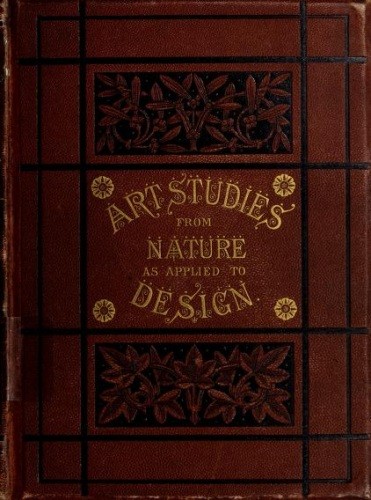
The Project Gutenberg eBook of Art-Studies from Nature, as Applied to Design
Title: Art-Studies from Nature, as Applied to Design
Author: F. Edward Hulme
James Glaisher
Robert Hunt
active 1851-1872 Samuel Joseph Mackie
Release date: November 28, 2016 [eBook #53624]
Most recently updated: October 23, 2024
Language: English
Credits: Produced by Chuck Greif and the Online Distributed
Proofreading Team at http://www.pgdp.net (This file was
produced from images available at The Internet Archive)
|
(In certain versions of this etext [in certain browsers] clicking on the image will bring up a larger version.) (etext transcriber's note) |
ART-STUDIES FROM NATURE,
As applied to Design:
FOR THE USE OF
ARCHITECTS, DESIGNERS, AND MANUFACTURERS.
COMPRISED IN FOUR PAPERS BY
| F. E. HULME, F.L.S., F.S.A.; J. GLAISHER, F.R.S.; |
S. J. MACKIE, F.G.S., F.S.A.; ROBERT HUNT, F.R.S. |
Reprinted from the Art-Journal.
WITH NUMEROUS ILLUSTRATIONS ON WOOD.
LONDON:
VIRTUE & CO., 26, IVY LANE, PATERNOSTER ROW.
1872.
LONDON:
PRINTED BY VIRTUE AND CO.,
CITY ROAD.
PREFACE.
ATURE may be studied in many aspects; her wealth of service and beauty is freely open to all who seek; and while the man of science, by patient study and assiduous toil, may learn something of her mystery, and gather from her not unwilling hands rich treasure of knowledge for the benefit of humanity (for without the midnight watch and the elaborate calculation of the astronomer navigation would yet be in its infancy; without the enthusiasm of the botanist as he toils in the tropic forest the virtues of many a healing plant would be unknown; without the keen perception of the geologist the miner’s task would be in vain), so the man of art in no less degree may find in her study richest elements of beauty, loveliest suggestions of colour, forms of infinite grace. A delight in the study of Nature, a desire to realise something of its grandeur, is a source of unbounded pleasure to its possessor, for to him no walk can be a weariness, no season of the year dreary, no soil so sterile as to be barren of interest:—
The simplest note that swells the gale,
The common sun, the air, the skies,
To him are opening Paradise.”
The lichen on the rock, the wayside grass, the many-coloured fungi, are no less full of beauty than the forms that more ordinarily attract attention, and are no less worthy of study. “The works of the Lord are great, sought out of all them that have pleasure therein;” and Nature has ever to the devout mind, from its own inherent beauty and its testimony to Him its creator and sustainer, been a study of the deepest interest. Some who glance over these opening remarks before entering upon the search for such material in the body of the book as may seem available for their immediate purpose, may consider that this view of the subject is unpractical; but we would remind such that all art, pictorial, sculptural, decorative, or what not, is only noble and worthy of the name so far as it affords food for thought in the spectator, and testifies to thought in the artist, and that the nobility of the work is in direct proportion to such evidence of inner life. Art that is æsthetic and sensuous, though pleasing to the eye, must ever in the nature of things hold a subordinate place to that art which is symbolic, to those forms in which an inner meaning may be traced; and though one work of art may perhaps necessarily contain less of this reflected thought than another, yet this proposition we think will hold good, that no work of art that does not in some way testify to this can be altogether satisfactory, for while pleasing for a time to the eye, it yet leaves the mind unsatisfied: the reverse will equally hold good, and we may safely repeat that in proportion to the thought bestowed and expressed by the artist will be the enjoyment and profit to be derived by others from it. The true artist will not consider with how small expenditure of trouble he may attain his end; he will, on the contrary, have a heart full of sympathy with all that is beautiful. This will become a wealth of knowledge, will prove a precious possession to himself, and the result must be visible in his work, and stamp it with Promethean fire. To the artist then who is worthy of the name, nothing can be too petty for regard, nothing that the Creator has pronounced “very good” too insignificant for notice; for in Nature beauty is scattered with a lavish hand, and the fungus that passes through all the stages of its existence during a summer’s night, and the snow-flake still more transient in its duration—
Made so fairily well,
So exquisitely minute,
A miracle of design”—
have a charm of their own no less than the higher forms, while to give but one other example from the many that present themselves, the Foraminifera—animal remains met with in chalk cliffs—though only visible with high microscopic power, have the curves of their shells as graceful, designs as varied, markings as intricate, as perhaps any other natural objects whatsoever. We therefore appreciate the quaint fancy, the studied thought of the designer who in some old glass that we have noticed at Ockham Church, in Surrey, while making some of his quarry designs of columbine, rose, and other lovely forms, chose for one of them a little fungus surrounded by cup moss, and springing from the turf; frail creatures of a day, meet emblems—like the withering grass, the fading flower—of the short estate of man, the transience of all his glory.
In the endeavour to suggest something of these humbler types of beauty to the artist, the designer, the architect, and the manufacturer, the following papers have been collected from the pages of the Art-Journal, the periodical in which they originally appeared, and after careful revision by their several writers, have been published in this detached form, in order that they may be still more commonly accessible.
The first article is an endeavour on the part of the author to indicate something of the profusion of beautiful form that may be met with in our hedges and skirting our roadsides, to point out the source from whence the mediæval artists gathered their inspiration, and to plead for its greater use by their successors, that by a like loving appreciation we too may create like forms of beauty.
The second essay deals with marine forms of vegetable life, and dwells on the immense variety of form that may be met with in the sea-weeds that surround our shores, and the applicability of many of the species to the varied purposes of the designer. It is curious that these wonderful forms should not have been employed more largely in the decorative work of any people. With the exception of the singularly waved and bossed foliage seen in the stone carving and metal-work of the later years of the Decorated period of Gothic, and which may possibly have been originally suggested by the Fucus vesiculosus, one of our commonest shore weeds, we know of no instance of their introduction into ornamental art. Hence here at once a wide field is open to the designer, and this essay cannot fail to be full of valuable material.
As the first and second articles have striven to illustrate the beautiful forms that inhabit the land and the sea respectively, so the third article, leaving
With green and purple sea-weeds strewn,”
and the more familiar forms of earth, deals with those delicate forms of the air, the flakes of falling snow, and points out the immense variety of graceful forms afforded by their crystals.
Symmetry and geometry are both so commonly met with in ornamental art, and are also so conspicuously present in the forms of snow crystals, that the application of those forms to design cannot fail to follow when once their beauties are brought under the notice of the designer and manufacturer.
Symmetry shows itself in a general beauty of proportion, and balance of masses in a composition; or, in the more limited sense in which we now use the word, in the likeness of one half or part to another in the unit of design. We speak of a design being bi-symmetrical or tri-symmetrical, or if it goes beyond this, as in snow crystals and in many other cases where the ornament may be bounded by a circle, it is termed multi-symmetrical. Bi-symmetrical arrangements will be found most appropriate for the decoration of upright surfaces, as wall-papers or curtains, which will always be seen one way, while multi-symmetrical star-like forms are more suitable for floor-cloth or carpet patterns, because a star-like pattern on the floor looks equally well from all parts of the room; while a design having its halves merely alike can only be viewed to advantage from one point. It is curious to observe that in Nature the rule seems to be that the lower forms shall be multi-symmetrical, made up of several similar parts, while the higher forms of life are bi-symmetrical: thus in the first class we get snow crystals, sea-anemones, star-fishes; and in the second, the more advanced forms of animal life—insects, birds, quadrupeds, and man himself. There are numerous exceptions, however, to this: thus we have flowers multi-symmetrical, and their leaves only alike in their halves, though undoubtedly the flower, in view of its functions in vegetable physiology, and also from the ornamentist’s stand-point, cannot be considered lower in the scale of creation than the leaf. The charm produced by the mere repetition of parts may be well seen in the kaleidoscope, where a series of irregular pieces of glass develop into various ornamental forms, owing to their symmetrical arrangement and radiation from one centre—an effect still more clearly and beautifully seen in the crystals of snow, where the unit is itself of pleasing form.
The influence of geometry upon design has in almost all periods of art been very marked—in some styles, as the Early English Gothic, and the Italian of the thirteenth century, much more so than in others; but in no style is it altogether ignored. Whether we study the examples of decorative art produced in our midst, the result of modern skill; or turn to the remains of Egyptian and Assyrian ornament, the brain-work and handiwork of men who toiled thousands of years ago, or whether we contrast the delicacy of much of our English work with the rude carving or pottery of the South Sea Islander, we still cannot fail to notice that amidst much that is very marked and distinctive in comparing one period with another, or the handiwork of one race or nation with another, this one great principle of the adaptation of geometry to ornament is exhibited more or less prominently in all. Where a sense of flatness is desirable, as in designs for floor-coverings—as mosaic, tile-work, carpeting, &c.—the use of geometrical forms appears especially appropriate, since the feeling of flatness is easily obtainable, and yet, accompanying this essential feature, almost any degree of complexity and richness of effect. These remarks upon the use of geometry must, however, be considered to apply more especially to the simpler kinds of design, to those intended to fill but a subordinate place. As we rise higher, geometry, though still valuable in the setting out and defining of leading lines and masses, gives place to higher forms, those based on animal or vegetable life. In a fourteenth-century diaper the part we admire is not the geometric basis of the design, but the delicate filling in of oak or maple, buttercup or ivy, though we unconsciously admire this the more on account of the enclosing straight lines—lines that we should at once miss if they were removed as superfluous.
The fourth essay of our series deals with the suggestive ornamental forms so freely met with in organic remains. As in the previous essay we found in the clouds above forms of beauty well adapted for our needs as ornamentists, so in this one we delve beneath the surface of our earth, and again have the lesson impressed upon us, that in every situation forms of beauty abound, that the world is full of suggestive material for the student of ornamental art, and that in what at first sight appears a barren and profitless waste, fresh proof is given of the universal reign of law, order, and beauty throughout the whole range of creation. These four essays, then, should prove a welcome addition to the ornamentist’s store of material, since (though no book-work can take the place of actual observation) they may at least suggest to him other forms, and cause him to turn his attention in fresh directions. With this hope, then, we conclude, trusting that our efforts thus to illustrate in some degree the wealth of Nature may not have been altogether in vain.
F. E. H.
| CONTENTS. | |
|---|---|
| I | |
| PAGE | |
| THE ADAPTABILITY OF OUR NATIVE PLANTS TO THE PURPOSES OF ORNAMENTAL ART. By F. Edward Hulme, F.L.S., F.S.A. | 1 |
| II | |
| SEA-WEEDS AS OBJECTS OF DESIGN. By S. J. Mackie, F.G.S., F.S.A. | 91 |
| III | |
| THE CRYSTALS OF SNOW AS APPLIED TO THE PURPOSES OF DESIGN. By James Glaisher, F.R.S. | 133 |
| IV | |
| THE SYMMETRICAL AND ORNAMENTAL FORMS OF ORGANIC REMAINS. By Robert Hunt, F.R.S. | 177 |
I.
THE ADAPTABILITY OF OUR NATIVE PLANTS TO THE PURPOSES OF ORNAMENTAL ART.
By EDWARD HULME, F.L.S., F.S.A.
N this series of papers it will be our desire to direct the attention of the architect, manufacturer, and designer, to some of the beautiful forms of nature, which, though easily accessible, seem to have scarcely received the consideration they deserve; to give a brief account of the habits, peculiarities, and localities of the plants as they come before us; to cite from time to time examples, either English or foreign, of their use in the ornament of the past; and generally to add such details as may directly or indirectly tend to create an interest in the plant in question. We find, on looking back at the past history and practice of ornamental art, in the midst of many marked differences of style, one principle very generally observed—the use in the ornament of any given country of the plants familiar to the people. Hence, the Egyptians exclusively used in their ornament the plants of their own land; we see the palm branch, the papyrus, and the beautiful lily of the Nile constantly recurring. We find the Greeks and Romans employing the acanthus, olive, and vine; the Japanese, the light and graceful bamboo; and in our own Gothic styles and those of the Continent—French, German, or Spanish—we meet with more or less conventionalised representations in the carvings, paintings, illuminations, fabrics for dress, hangings, &c., of the familiar forms of our hedgerows, streams, and meadows, such as the wild rose, oak, maple, iris, buttercup, and many others. It is then with the desire to awaken our decorators to the fact, that beautiful as the Greek anthemion and other allied forms are, they by no means represent the limit available in ornamental art, that the following papers have been prepared, since we are persuaded that if once the inexhaustible riches of nature were sought after by our architects, and their beauties brought before the eyes of the people in their work, architecture would thus be taking one long step nearer to the sympathies and appreciation of many to whom it is now a matter of indifference. The works of a few of our leading architects owe at least some of their beauty to their recognition of this truth; and we would desire, while acknowledging the services rendered to architecture by such men as Pugin, Collings, Street, and Gilbert Scott, to add our mite to the revival going on around us.
Botany, or the study of plants (Gr. botane, a plant), is capable of many subdivisions: thus we have one department which, from its dealing with the vital functions of the plant, we term physiology (Gr. physis, nature—logos, science); another which, from its more especially dealing with the organization and structure of the plant, is called organography, or structural botany; while a third great division, systematic botany, derives its name from its teaching how the multifarious forms of vegetable life may yet be classified into genera, and these again into orders and species from certain points of resemblance in the plants thus classed together. Botany, in itself a science in the ordinary use of the term, may, however, render valuable service to art; and it is this phase of the subject which we more especially propose to develop, treating only of the more exclusively scientific points so far as we find them necessary for our present purpose; and in this we think we are fully justified, for though numbers of excellent works are accessible to the student who desires to study botany as a science, but few fully recognise its importance in a modified form to the art-student, and more especially to the designer. To the ornamentist a knowledge of the laws of plant growth is of really the same importance as the study of anatomy to the figure-painter or sculptor, and the absence of this knowledge is to the initiated, in either case, as readily detected. Many who are now content to forego this precise knowledge are no doubt partly debarred by the technicalities which meet them at every sentence in ordinary botanical works. Bearing in mind, therefore, the special requirements of our readers, we shall endeavour to avoid as far as possible the use of terms which, though scientifically valuable, and in fact essential to correct and true description, are not such as we may reasonably assume our readers, without special botanical study, to be familiar with. A knowledge of these terms is, however, very desirable, since their conciseness renders them valuable, and more especially, also, because many excellent works, which it will be of advantage to the student to consult, largely employ them. We trust that in the few cases where such terms are in the present work introduced, a clear explanation of their force and utility will be found to accompany them; we shall also, as a further assistance, add the source from whence the term is derived, wherever the introduction will tend to throw additional light on the meaning of the word.
As we cannot hope, in the limited space at our command, to supply every requirement, give every detail, or bring forward more than a few of the more common plants, the present work must be considered rather as a suggestive list of the more striking plants which, from their ornamental characteristics, will, we trust, be found of service to designers, than an exhaustive catalogue. It is very far indeed from being a complete list.
To render the work as practically useful as possible, we add to each plant mentioned the names of some standard books in which reliable drawings of the plant in question may be found; for though nature should always, if possible, be consulted, it may not at all times be within the power of the student to do so, owing to press of work, the season of the year, and many other disturbing causes.
The following books are thus referred to, the illustrations in them being of a trustworthy character. After the name of each book is the abbreviation used in the present work when it is necessary to quote it:—
The first five on this list have coloured plates. To these we may be allowed to add Plant Form (P. F.), a work prepared by the author for the especial use of designers.
The plants described in the following pages are, to facilitate reference, arranged in regular alphabetical sequence, according to their English names, since most of my readers will more readily recognise a plant by its familiar title than by its botanical appellation. Thousands are familiar with the little daisy who would never recognise it in any description headed Bellis perennis. At the same time, we in every case give the scientific nomenclature as well, since in most works you may desire to consult, that will be of greater prominence than the one used colloquially. A difficulty here arises from the fact that several of our English flowers have numerous synonyms given to them; we have, however, chosen the name which we believe to be most commonly used, referring also to the others in the course of our remarks on the plant.
In the introduction of vegetable growth into any ornamental composition, we must be careful to remember that what is wanted is not so much a direct imitation of nature, which after all can only be faulty at the best, as a due adaptation of the natural form to the purpose of our design—a recognition of the impossibility of a close copy of nature, together with a feeling of its undesirableness even if it could be accomplished. Our representations must therefore be more or less conventional: in a flower-painting we naturally expect to see a direct transcript of nature, while in decorative art a direct transcript offends us.
“In the multitude of counsellors there is safety;” we will, therefore, here quote some few passages from the works of those whom we think we can all agree are entitled to speak with authority and to be heard with respect. Ruskin, in speaking on this subject, says,—“All noble ornamentation is the expression of man’s delight in God’s work;” and again, “Ornamentation should be natural, that is to say, should in some degree express or adopt the beauty of natural objects; it does not hence follow that it should be an exact imitation of, or endeavour to supersede, God’s work; it may consist only in a partial adoption of, and compliance with, the usual forms of natural things, without at all going to the point of imitation, and it is possible that the point of imitation may be closely reached by ornaments which nevertheless are entirely unfit for their place, and are the signs only of a degraded ambition and an ignorant dexterity. Bad decorators err as easily on the side of imitating nature as of forgetting her, and the question of the exact degree in which imitation should be attempted under given circumstances is one of the most subtle and difficult in the whole range of criticism.” Wornum thus defines the difference between naturalism and conventionalism: “A natural treatment implies natural imitation and arrangement, but an ornamental treatment does not necessarily exclude imitation in the parts, as, for instance, a scroll may be composed of strictly natural parts, but as no plant would grow in an exactly spiral direction, the scroll form constitutes the ornamental or conventional arrangement; we may, however, have conventionalism of details as well as conventionalism of arrangement.” Hudson says,—“There is a great difference between the terms applied and adapted; they, in fact, express the wrong and the right use of vegetable forms. All natural forms require certain modifications to adapt them for other than their own natural situations, and it is the neglect of this, and the simple application of these forms without adapting them, which constitute a false principle.” Dresser thus illustrates the difference: “Mere imitation is not ornamentation, and is no more art in the higher sense of the term than writing is itself literature. Vegetable nature treated conventionally will not be found to be far removed from truth, but will be merely a natural form, or a series of natural forms, neither marred by blights nor disturbed by winds, adapted to the fulfilment of a special purpose, and suited to a particular position—for the most perfect examples of what is usually termed conventionalised nature are those which express the intention of nature, if we may thus speak, or are manifestations of natural objects as undisturbed by surrounding influences and unmarred by casualties.” In the same way we might bring forward passages from the works of Owen Jones, Sir Gardiner Wilkinson, and many others, in illustration of our remarks; enough, however, has, we trust, been brought forward to confirm the position taken up.
We will now, without further prelude, proceed to the brief consideration of the few representative plants we have selected for our remarks.
The Agrimony. This plant, the Agrimonia Eupatoria of botanists, and the Agremoine of old writers, is ordinarily met with in hedgerows and waste places by the roadside. The flowers are bright yellow, and are arranged in what is termed botanically a spike (Lat. spica, an ear of corn; when the flowers grow in succession direct from a central stem). The leaves are very ornamental in character, the central line giving off large side leaflets, and the intermediate spaces being filled by smaller ones. The edges of all the leaves are deeply serrate (Lat. serra, a saw; notched like the teeth of a saw). Very suitable and suggestive for lace or wall-papers, where a somewhat delicate form with a decidedly upright mode of growth is desirable. Drawings of the plant may be seen in S. B. 126; E. B. 417; F. L. vol. v. 32; and M. B. 258. The natural plant will be found in flower during July and August.
The White or Wood Anemone (Anemone nemorosa), or, as it is often termed in old botanical works, the Wind-flower. This older name refers to the same fact alluded to in its generic name, Anemone, the fragility and delicacy of the flowers, and their exposure to the bleak and boisterous winds that sweep through the almost leafless woods in early spring, or, as others believe, from an old fancy that the flowers will not open until buffeted by the gales of March, anemone being derived from the Greek word, anemos, the wind. The second name, nemorosa, signifies woody, and bears obvious reference to the localities most favourable to
the growth of the anemone. The plant may be found in flower during the months of March, April, and May, the blossoms being pure white, with a bright yellow centre, and the outer surface of the sepals of a delicate purple tinge. It abounds in moist woods throughout the country, generally in such profusion as to cover large tracts of ground with a snowy whiteness; and the plant being perennial, we shall, when it is once established in any spot, find it regularly recurring as each spring-time comes round. The manner of growth of the anemone is very distinct and characteristic, and not being subject to any variation, cannot well be modified in the employment of the plant in ornamental art without destroying its individuality, as from the single stem thrown up from the ground three equal-sized leaves, identical in form, are produced from a point about six inches from the soil, and the stalk is then continued for about the same distance again before bearing at its summit its single flower; each and every plant, therefore, consists of a central stem, a terminal flower, and about midway up the stem a group of three leaves. This rigid law, though extremely beautiful in itself, and admirably adapted for treatment for some ornamental purposes, may, perhaps, somewhat restrict its use in decorative art. We are not aware of any examples of its employment in past art. In our illustration, the plan of the plant, the view with which we are most familiar, as we see it in its natural position, is shown, having the single central flower, and below it the three leaves radiating from the stem. It will be found that this strong individuality of growth more especially adapts itself to the trefoil, or any other form based on the figure three.[A] The garden-anemone (A. coronaria) is an allied species of the same family, modified by cultivation: in its wild state it is a native of the South of Europe.
The Arrow-head (Sagittaria sagittifolia), one of our most beautiful aquatic plants, must be so well known to our readers that any lengthened description of it will be superfluous. Its generic, specific, and English names all alike point out its leading characteristic, the beautiful arrow-headed shape of its leaves;—sagitta, Lat., an arrow. The calyx and corolla are each composed of three parts, the petals being a brilliant white, with a pale pink irregular blotch at their bases. The forms of the flowers, fruit, and leaves are all equally adapted for decorative purposes, though it does not appear to have received in the past the attention which its merits might very fairly claim, the only instances of its application in ornamental art with which we are acquainted being in a running band of ornament round a tomb, fourteenth century, in the cloisters, Burgos. The flowers are incorrectly represented in that example as having four petals, but the general effect is, nevertheless, very good. See E. B. 1436 and P. F. 72 for drawings of the natural plant.
The Arum (Arum maculatum) is a plant of very common occurrence throughout England, though rarely to be found either in Scotland or Ireland. It may be met with in shady groves and thickets, and nestled among the long grass and other herbage upon our hedge-banks. The plant will be found in flower during April and May; but from the mode of growth, and also from the pale green colour of the spathe surrounding the central organs, it is by no means conspicuous among the surrounding foliage. The upper portion of the central body or spadix—that part of it which is seen in our illustration—is generally of a dark crimson colour. The plant is far more likely to attract attention in the autumn and winter than during its season of flowering, as towards the close of the year the leaves of the arum die away, and the hedgerows also being stripped of the greater part of their
foliage, we notice the brilliant scarlet berries of the present plant rising in a dense mass to the height of some three or four inches from the ground. If the fresh root of the plant be tasted, it excites a burning and pricking sensation in the mouth that will remain for several hours; and if sliced and applied to the skin, it will frequently produce blisters. This virulence, however, like the acrimonious principle met with in the leaves, yields to the influence of heat, and in former times an excellent starch was prepared from the root. In the writings of the old medical authors and poets we meet with the wild arum under a great variety of names, many of them, through the lapse of time and from disuse, being now meaningless to us; such, for example, as abron, janus, barba-aron, calf’s-foot, ramp, and wake-robin. A very common name for the plant at the present day with country children is lords-and-ladies; and an equally familiar name, both with children and also in descriptions of the plant in botanical works, is the cuckoo-pint: this may possibly allude to the slight resemblance of the enclosing spathe to a measure for liquids. Another old name for the plant is the starchwort, in obvious allusion to its domestic use. Like most other plants, it was held by the medical practitioners of the Middle Ages to possess very considerable and valuable remedial qualities. A small portion of the leaf, either dried or in the green state, was esteemed a sure remedy for the plague or any poison. “The water wherein the root hath been boiled, dropped into the eyes, cleanseth them from any film or mists which begin to hinder the sight,” or under circumstances to which the writer delicately hints, “when, by some chance, they become black and blue.” Though the bold, simple forms of the flower and bud and the rich arrow-headed shape of the leaves appear, in an especial manner, to fit it for valuable service in ornamental art, it has been but very rarely thus employed. Illustrations of the natural growth of the plant will be found in F. L. vol. ii. 63; S. C. 22; and P. F. 41.
The Avens (Geum urbanum), belonging to the same natural order, Rosaceæ, as the tormentil and wood-strawberry, possesses also the same peculiarity of flower, the petals being five in number, while the calyx is composed of five large segments, alternating with five others of a much smaller size. The root is very astringent in its nature, and of sufficient value to be included in the Materia Medica. The avens may be generally found growing in hedges and woods, flowering during June and July, and attaining to a height of from one to two feet. The leaves are very ornamental in character, and will, equally with the flowers, prove of valuable service to the designer. For illustrations of the growth of the plant refer to F. L. vol. ii. 36, and P. F. 81.
Bedstraw (Galium verum). This is also known as cheese rennet, gallion, and maid-hair. The word bedstraw is in allusion to the former use of the dried plant as a cheap material in forming beds. The name cheese-rennet is derived from a bygone employment of the plant for curdling milk: we see this same use of the plant referred to in the generic term Galium, that name being derived from the Greek word for milk. Gallion is evidently a herbalist’s corruption of Galium, while the fourth name, maid-hair, has obvious reference to the lightness and delicacy of the plant. The minute yellow flowers grow in dense heads of blossom, while the leaves are in whorls, that is to say, several starting from the same level, and thus growing in a succession of rings round the stems. The number of the leaves in a ring is very variable; from eight to twelve is, however, the usual number. Dry banks are the ordinary habitat of the plant. It will be found in flower throughout June, July, and August. Its lightness and graceful mode of growth admirably fit it for the purposes of the designer. For illustrations of the bedstraw refer to E. B. 648, or F. L. vol. vi. 13. The old herb-doctors, ever ready to find or make a medicinal use, speak in high commendation of the present plant for its reputed efficacy in relieving pains from burns, inward wounds, &c., while “a decoction of the herb is good to bathe the feet of travellers and lacquies, whose long running causeth weariness and stiffness in their sinews.”
The Bindweed, botanically known as the Calystegia sepium, is one of our most familiar plants; large surfaces of our hedgerows (Lat. sepe, a hedge) being covered by its graceful leaves and tubular flowers. It is a curious fact that, though abundant throughout England and Ireland, it is very local in Scotland. The so-called convolvulus major of the garden is the Ipomæa purpurea, a species very widely spread over the tropical and temperate regions of the earth. Many of the family possess active medicinal qualities, and preparations from them are found in the Pharmacopœia. The English species also were at one time thus employed; but Gerarde, the great medical botanist of Queen Elizabeth’s reign, will not admit that they possess any virtue at all, but rather the contrary. “They are not fit for medicine, and unprofitable weeds, and hurtful to each thing that groweth next them, and were only administered by runnegate physick-mongers, quacksalvers, old women leeches, abusers of physick, and deceivers of people.” For study of the natural appearance of the flower we would refer you, if you are unable to meet with the plant itself, to E. B. 924; S. C. 2; T. N. O. 97; G. O. 99; and P. F. 76.
Bitter-sweet. The Bitter-sweet (Solanum Dulcamara) is so called from the bitter flavour of the stems when first tasted, a flavour which is speedily followed by a peculiar sweetness somewhat resembling liquorice root. In not only the familiar English name, but the specific botanical appellation as well, we see this peculiarity of the plant referred to, Dulcamara having the same meaning as bitter-sweet. The continental names have also this curious reference in them, the plant in France being called Douce-amère; in Italy, Dulcamara; in Spain, Amaradulcis; and in Germany, Bittersusstangel. The plant is frequently called woody nightshade, while the old herbalists, in addition to the names already given, call it felonwort. Solanum is derived from solamen, in reference to the soothing effect of some species of the Solanaceæ. The bitter-sweet has small flowers of a deep purple colour, the petals being very much reflexed. The berries are of a deep red when ripe, but change considerably in their colour before reaching maturity; thus on the same bunch we may frequently see green, yellow, orange, and crimson fruit. Thirty of these berries administered to a large dog killed it in less than three hours. Refer to E. B. 930; F. L. vol. i. 14; M. B. 33; S. C. 17; T. N. O. 100; and P. F. 19, for illustrations of the natural growth of the plant. This shrub is frequently confounded with the deadly nightshade, from the slight similarity of name; but there is no other point of resemblance. The two plants are totally distinct. The woody nightshade, though common in most parts of England, is comparatively scarce in Scotland and Ireland. It is a hedgerow plant, flowering during June, July, and August. A variety with white flowers is sometimes met with.
The Black-thorn or Sloe (Prunus spinosa) is curious and suggestive from an ornamentist’s point of view, from the flowers, unlike most other plants, appearing in profusion before the leaves are developed. We see a plant strongly resembling the black-thorn very largely used in their ornament by the Japanese, a plant with numerous spreading branches, leafless, but thickly clustered with flowers. The black-thorn may commonly be met with in coppices and hedgerows, the blossoms appearing in March or April, and the rich purple fruit in August. The name sloe is derived from the Anglo-Saxon sla, and refers to the extreme acidity of the tempting-looking fruit. The natural growth may be seen on reference to E. B. 408, or M. B. 84. The black-thorn possesses a certain value ornamentally, as being, like the primrose and snowdrop, a characteristic flower of the spring.
Still wait on earth, and added beauties lend;
Around the smiling Spring a lovely throng
With eager rivalry her steps attend;
Others with Summer’s brighter glories blend;
Some grace mild Autumn’s more majestic mien;
While some few lingering blooms the brow befriend
Of hoary Winter, and with grace serene
Enwreath the king of storms with mercy’s tender sheen.”
Barton.