
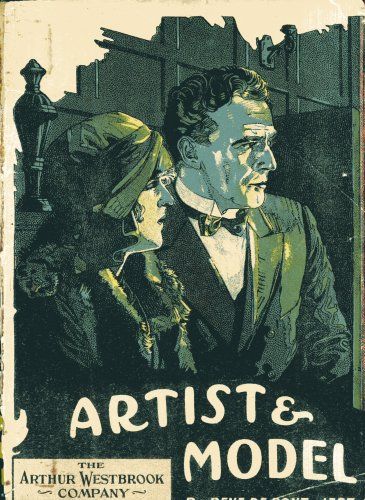
Paul had seized her hands and was covering them with kisses.
Then there happened a strange and fatal thing between the two beings drawn one to the other by every passion. After tearing away her hands from his grasp, Lise Olsdorf, falling back a pace, grew deathly pale and staggered. Her eyes gleamed, her lips were parted, a guttural cry, passionate and almost savage, broke from them, and she fell into the arms of Paul, who had sprung forward to support her.
With a savage movement he crushed her in his arms, gluing his lips to hers.
Under the gloomy shades of the great alleys of Pampeln was no longer an irreproachable wife, or a Princess Olsdorf proud of her name. There was only a yielding woman conquered by desires until then unsatiated.
The other was the conqueror. The beast killed the soul.
CHAPTER IV.
GENERAL PODOI.
If I were a writer of the naturalistic school—that is, if I were without care for modesty or the choice of words—I should need here to summon physiology to my aid to paint in all its brutality the love that the Princess Olsdorf and Paul Meyrin felt for each other; and the lines that I should devote to this study, and the scenes that it would involve, would give their distinctive note to the book. They would probably make it successful, thanks to the unhealthy curiosity by which even the freshest readers are tainted nowadays, for we live in a strange age, when cynicism reigns alike in letters, art, business, and politics. Cynicism is indeed the only sovereign that our pseudo-republic is willing to accept.
In truth, license has never been so unbridled; never has mediocrity gone so far, impudence mounted so high, or indifferent work, dramatic and literary, had so much success, if cleverly launched. Our country, formerly known for its gallantry and good taste, has become the kingdom of what is common and vulgar.
This new state of things is due to many causes—the abandon of religion, the scandalous rapidity with which fortunes have been won, the eager desire to enjoy everything, and also—it is needful that one should dare to say it—the invasion of those numberless Southerners who have carried everything with a high hand, and brought with them into the society they have gained a footing in, the vanity, the extravagance, and the boastfulness inherent in their natures. A Gasçon or a Provençal may, of course, be an upright, worthy, and intelligent man, a devoted friend—I have known many with these qualities, but too often they are lacking. One might suppose they were incompatible with the terrible accent of these men, their epileptic gestures, their rage for loud talking, for calling people by their names, and for talking of their own affairs to everybody. And if the Southerner is a Jew, too, the case is worse than ever, for then no place or reward is safe from his greed.
To put against the few men of wit, the occasional writers of the first order, the two or three poets that the South has given us, what noisy, insolent, troublesome parvenus Paris owes to it! It would seem that everything is these people's, of right. They slip in everywhere, shamelessly, jostling one another, greedy of place and honor rather than avaricious. Such of them as are not poets or musicians are hair-dressers, or croupiers at gambling-tables, or statesmen.
This calamitous invasion has come upon us chiefly from the right bank of the Garonne, and the sea-coast; for further inland, toward the mountainous country, these Southerners are of another kind—almost a different race. First they have a less marked accent, and, second, some indisputable qualities are theirs.
One class of these new-comers are of no particular country. They come from everywhere—from South America as well as from the banks of the Nile; from the Gulf of Mexico as well as from the far East; and the sore that eats into our very marrow is owing to the enthusiastic welcome Paris gives to their high-sounding names and suspicious fortunes. Lacking all the good points of the Southerners, whose faults usually spring from exuberant vigor and fancifulness, these foreigners take Paris for a kind of modern Capua. They are the dealers in commonplace, the readers of obscene works, the originators of every debauchery.
The result is seen in voice and gesture, in a freedom of bearing and a frivolity which, in great part, are the cause of our social fall, and, as a consequence, of the success achieved by erotic books, written in a language scarcely intelligible, and by unhealthy volumes which, stinking at one and the same time of the sewer and of opoponax, might have been printed at Lesbos.
Now, as I have no ambition to write one of these books, I will only say what is needful to make myself understood of the passion which had brought Lise Olsdorf and Paul Meyrin together. What I wish to sketch is the moral depths into which a woman quickly sinks when, yielding to her animal desires alone, she throws herself blindly and recklessly into the arms of a man who is of neither her world, race, nor education.
Love, in the pure acceptation of the word, even when it is not legitimate, must occasion an exchange of lofty sentiments, sacrifices, and devotion between those who feel it for one another. It outlives all trials; in the pride of its abnegation it will provoke them on occasion. Passion, on the contrary, when the soul is a stranger to it, is made up of egotism and material gratifications.
In such a case, in the hands of a man who knows he is more desired than loved, the woman is no longer an adorable companion in life who encourages and consoles, a faithful friend whose joy doubles our joys. She becomes an instrument of pleasure, whose jealous owner would have not only all her moments of abandon, but all her smiles and her most trifling thoughts. She must live for him alone, please him only, be beautiful before him alone. Destroying the aspirations of the woman who has thus rashly given herself up to him, her master soon makes of her a slave, whose heart, stifled by its surroundings, ere long ceases to beat. And when the day of satiety and abandon comes, there remains of the ideal creature of God nothing but a worthless woman, soiled in her own eyes, and fated thenceforward to lead a life of weariness and disgust.
But Lise Olsdorf, abandoning herself to the fierce passion that had seized upon her, could not imagine that perhaps such a future loomed before her. The many hunting excursions of the prince left her practically at full liberty, for when the male guests of Pampeln were away hunting, there remained at the château scarcely any one but middle-aged, placid people, who retired early, and who, for that matter, on account of the very reputation of the princess, did not dream of spying upon her.
Moreover, there was an excellent excuse for the lovers being for hours at a time together. The day after that which had settled their fate, the painter had begun the portrait of the mistress of Pampeln, and everybody—Pierre Olsdorf more than any one else—was interested in this work, which promised to be noteworthy.
Under the empire of his passion for her, Paul Meyrin had at first wished to paint the princess as Diana the Huntress, her hair in a Grecian knot, her shoulders bare, her bust scarcely veiled; but, on seeing a sketch of the future picture, Lise Olsdorf was alarmed. It seemed to her that everything in it betrayed at once the painter's love for her, and she begged him not to go on with the work. Paul consented, but on condition that his model, re-enacting for him the shamelessness of the Italian princess for Canova, would let him some day secretly, for themselves alone, reproduce on canvas the splendor of all her beauty. And Lise, having promised in a passionate embrace, Paul Meyrin, going from one extreme to the other, painted her in a riding-habit, severely chaste.
Within a fortnight the portrait was nearly finished, and the prince, who naturally suspected nothing of his conjugal misfortunes, thanked Paul Meyrin, and authorized him to take the portrait to Paris for hanging in the next exhibition.
At each hour passed with Paul, the princess's love increased. It was in some sort purified by the admiration she felt for the artist at his work.
While the sittings lasted, at liberty to see him for a long time every day, she loved him better and less wantonly; but, wishful as the painter was to linger with his work, prudence obliged him at last to admit that he had finished, and consequently to put an end to the daily interviews in private. Then Lise's passion retook its first fierce form.
Deprived of the interviews in the course of which, satisfied and glutted, she could gather a store of calmness for the rest of the day, she became jealous, troubled, rash. Soon she was so little mistress of herself that General Podoi's wife, helped by her own experience in like affairs, guessed at a part, at least, of what was going on.
Alarmed—not in her virtue, but in her affection, which was wholly of pride—for her daughter, as to the consequences that might follow upon such an intrigue, the ex-Countess Barineff watched the princess more closely. It was soon impossible to have any doubt of her relations with the handsome foreigner, for one evening her mother caught them almost in each other's arms in the great alley of Pampeln, which had been the scene of the declaration of their love.
The general's wife was, as we have said, a woman of energy. The next morning, before breakfast, wasting no time in beating about the bush, she appeared in Paul Meyrin's room, without having her visit announced beforehand.
Astonished, to begin with, by her appearance, the artist was very soon still more so by her speech, for without preamble or oratorical devices she said:
"Monsieur, I come to ask you to bid adieu to the other guests this very day, and to leave Pampeln. You will write to the prince, who is away and will not be back before night, that you have had letters from Paris summoning you to return at once."
"I do not understand you, madame," stammered the young man.
"You had better, however, without forcing me to explain further. I introduced you to Prince Olsdorf, and I am therefore in some degree answerable for your behavior under his roof. This responsibility is already too great, and I desire not to be any longer under it."
"But, madame, were the prince to believe the excuse I should make, following your advice, for my sudden leave-taking, there are others who perhaps would be less credulous."
"That is no concern of mine. You may tell them what you like. The best way would be to say nothing—to anybody; but you must go. Give me your promise."
"Must?"
"You know well that I have the right—that it is my duty—to speak thus."
"And if I refuse to obey?"
"If you refuse, in ten minutes' time two of General Podoi's friends will wait on you with a challenge—discreet friends who will find reasons for a duel that will compromise nobody but myself. The shame of fighting with an old man will be yours, and then you can not stay here."
That good fellow Podoi had little idea that the woman who bore his name was at that moment disposing of his life so calmly. Still, she knew that there was no need to consult her husband in any event, and that in a delicate case of the kind she would find him, as he always was, ready to obey any wish of hers.
Much embarrassed, and knowing not how to get himself out of this downright trap, Paul Meyrin was silent. He was sure that he had to do with a woman that would not give way.
"Come, now," the ex-Countess Barineff went on, dryly, "will you or will you not go?"
"I will go," replied the painter, bowing.
"This evening?"
"You will surely grant me a respite of twenty-four hours. I promise I will start to-morrow morning."
"No, you must go to-day, before the prince returns. There are horses and a carriage at your disposal to take you to Mittau. You will do well to go thence straight to Paris. If your stay in Russia were heard of here, after your sudden departure from Pampeln, it might give rise to questions. I want to avoid that."
The tone she had spoken these words in did not suffer Paul to hesitate.
"Very well, then, madame," he said, "I will leave this evening."
"Without seeing—you know whom?" said Lise's mother.
"No; I won't promise that! If I did not pay my respects to all whom they are due to before I quit the château, in the first place I should be set down as a boor, and besides, your end would not be granted, for everybody would try to find out the cause of such singular conduct."
"You pretend not to understand me. I will speak more plainly, much as it costs me to do so. You shall not see the princess again in private."
"I can promise you one thing alone, that I will not provoke an explanation between Madame la Princess and myself. You must admit that if she honors me by demanding one I could not refuse her it."
"She will not try to see you."
"She may do so."
"I hope otherwise."
"In that case, madame, we are agreed. All shall be done as you wish. I will write now to the prince explaining my departure."
Content with having got this promise, she left him and went at once to her daughter's room.
The princess was at her toilet when her mother came into the room.
"Send away the maid," she said; "I have something to say to you."
Rather surprised, Lise Olsdorf obeyed. Then turning to her mother, she asked, with a smile:
"What have you to tell me that is so mysterious?"
"I have just requested Monsieur Paul Meyrin to leave Pampeln to-day," replied the ex-Countess Barineff.
The princess understood all, and anger flushed her face with blood; but not losing self-command, she replied calmly:
"Why do you tell me this? I presume you have the prince's authority for taking such a step in respect to one of his guests."
"I have consulted nobody. Monsieur Meyrin's longer stay here might at any hour be the occasion for a scandalous scene. My duty was to do what I have done."
"Has this young man bowed to your orders without protesting or defending himself?"
"He is going away this evening."
"Very good. I will see him directly."
"It would be far better to rather avoid any interview with him."
"Why, pray? I wish to know what means you have employed to obtain from Monsieur Paul Meyrin so ready and blind a submission."
"What does that matter to you?"
"It matters this, that if Monsieur Meyrin is the man I take him for, he will not leave before having heard me."
"You must be responsible then for what may happen."
"Why, what will happen?"
"You will see."
"Come, mother, don't let us talk in enigmas. What are you imagining? By what right do you interfere in what concerns me alone?"
"What I imagine, or rather what I am certain of, I will not say, out of respect to you. My interference is a fulfillment of my duty. After rearing you with a view to create for you a future according to my ambition, after having made a princess of you, I will not suffer you to ruin everything on account of a ridiculous caprice."
Lise Olsdorf could not master a thrill of anger and pain. The glitter in her great eyes told her mother that she had overshot the mark. A ridiculous caprice, this ungovernable passion that had thrown her into Paul Meyrin's arms!
She recovered herself somewhat, however, and replied bitterly:
"Yes, that is true. You have made a princess of me, and, as you say—to satisfy your ambition. You would have acted more wisely if you had made me a happy woman. You forced me to marry a man who did not love me, and whom I did not and could not love. Is it my fault if the blood of an artiste runs in my veins?"
"Well—of an artiste?" said Mme. Podoi, haughtily.
"Bah! As if these tastes and these aspirations were not derived from yourself!"
The ex-comédienne at these words started indignantly.
The past that she had long since forgotten and wished never to recall, her daughter reminded her of. How came she to know so much? Did she not know still more?
Possessed by this thought, she said, more gently:
"It is no question of tastes or aspirations but of your honor and that of the prince, and you repay poorly my care for your peace of mind in trying to offend me. It would be better, I think, for both of us not to prolong the interview. I have spoken to you and to Monsieur Paul Meyrin, as it was my duty to speak. His going will seem quite natural when he has excused it as I have advised him to do. He will write to the prince, as I have suggested, and at least any scandal will be avoided. The day will come when you will thank me."
Lise's only reply to these last words was an ironical smile. As soon as her mother was gone, she quickly finished her toilet and went down to the dining-room, where most of the guests were already gathered.
Paul Meyrin entered the room a few moments later. He was so pale and so evidently preoccupied that several persons asked him if he were not unwell.
"No," he replied, "but I have had bad news from Paris, and must leave Pampeln to-day."
At that moment the princess signed to him to come to her, and when he had done so she said, in a low, rapid voice:
"I know what has passed between my mother and you. I will wait for you in my room after luncheon."
Mme. Podoi, who had only come into the room leaning on the general's arm at that moment, did not notice what was going on. Besides, she had made up her mind not to interfere between her daughter and the painter, to avoid an outburst. M. Paul Meyrin was going away; that was the main thing in her eyes.
They sat down to table, but Lise Olsdorf soon excused herself from keeping her guests company any longer. An hour later, while the visitors to Pampeln were making for their rooms or strolling over the park, Paul, going by a roundabout way familiar to him through the principal rooms of the château, stole into the princess's private apartments.
She was there impatiently and feverishly awaiting him.
"You don't love me any longer, then," she cried, springing to him, "as you have submitted so easily to my mother's orders."
"Your mother has not told you, has she, what she threatened me with if I did not go?" he asked, reassuring his mistress with a thousand kisses.
"No, but I believe she would do anything to gain her end."
"She told me simply that if I did not leave Pampeln to-day, her husband would challenge me to a duel."
"That is the fact, and the thing has been cunningly thought out, for it is certain that if I were to fight the general I could not remain here afterward."
"But she would have to supply my step-father with some reason for a challenge."
"Oh, your mother is clever enough to find a reason."
"And he would obey her blindly, at the risk of being run through the body. He is simpleton enough for that. I know the influence his wife has over him."
"You see, I must needs go—not for my own sake, but for yours."
The princess grew somber and fierce. Reclining on a couch, she fixed her flashing eyes on her lover kneeling before her.
"So be it then," she said, after a moment of silence, winding her arms about Paul's neck. "So be it—go; but soon to meet again. It is my mother herself who will be to blame for it."
"Why, what do you mean?" asked the painter, pressing Lise to his heart.
"I mean that before winter is upon us I shall be in Paris. She sends you away, does she—she separates us? Well, I will go to you."
The artist gave a cry of joy; and mad, intoxicated, careless of danger, they forgot all else but their love and their dreams of the future.
That evening Paul Meyrin left Pampeln, after writing to the prince in the sense agreed on with Mme. Podoi. At the same time he made his excuses for being unable to await the prince's return, thank him in person for his hospitality, and take formal leave of him.
It was the middle of September, and the stay in Courland, according to the ordinary custom, would last until the early part of October. Lise had mapped out her course, and was so completely master of herself that her mother soon came to think that she had exaggerated the danger, and that her daughter had almost forgotten Paul Meyrin.
Two months later she saw her mistake, when the prince himself told her in St. Petersburg that his wife was going to Paris for medical advice as to the state of her health, about which she was uneasy.
At this quite unlooked-for news the general's wife had almost betrayed the anger and indignation she felt. Happily she restrained herself, and hurried to her daughter.
She found her preparing for the departure. At the first glance to the trunks that the maids were packing, she could see the absence was meant to be a long one.
"So," she said, after leading her daughter to another room, "you are going to Paris? Why did you say nothing to me of this journey?"
"I do not start until to-morrow. I was coming to say good-bye this evening."
"And this journey is taken on account of your health?"
"Undoubtedly."
"You can imagine that I don't believe that?"
"Then it would be useless to question me, as, if what you suppose be true, I can not, and ought not, to confess it to you."
What the princess could not and would not tell her mother was that she was enceinte by Paul Meyrin, and that this, more even than her love for him, compelled her to leave her husband at once.
"Do you imagine that your husband will always be ignorant of what is going on?" said Mme. Podoi, after a moment's silence.
"I don't know what you mean," said Lise, shrugging her shoulders.
"Suppose I were to warn the prince?"
"Warn him? About what? It is either too late or too soon. If it is too late, nothing shall hinder me pursuing my aims; and, thanks to you, there will be a scandalous rupture between Pierre and me. If, on the contrary, it is too soon, you will do a bad action for the sake of doing it, for the prince has perfect confidence in me. He would not believe you, and I should start on my journey all the same. Come, mother, I advise you not to mix yourself up with my affair. I am married—that is, I have to render account of my conduct to my husband alone. When the day to do so shall come—if unhappily it should come ever—I shall know how to defend myself; I won't ask for your help. If you are willing you need say and stick to but one thing—that I am very far from well, and that as Doctor Psaroff, clever as he is, can do nothing for me, I am going to Paris to take the advice of more eminent men."
"Does the doctor believe you are unwell?"
"Can not women always be as ill as they wish to be, in spite of the keenest-sighted doctors?"
"Lise, there will be a bad ending to all this!"
"Fools alone make bad endings. Besides, I trust in Providence."
The dry, cutting, cynical tone of the princess in meeting each of her mother's objections left no room for insistence. Lise Olsdorf could be wounded on one point alone—her maternal love; but Mme. Podoi had omitted to speak of her son, whom she must leave in Russia. What she dreaded was that her daughter would lose the high position she had won for her. Her pride being touched, to begin with, she had not given a thought to the only weapon which she could have used with effect.
"Then, adieu," said she, rising; and without so much as kissing her daughter, she left the room.
The princess did not try to keep her, but went back to her packing.
She had made up her mind to take no servant with her, not even a lady's-maid, because to do so would be to risk exposure some day or other as to her condition.
To the affectionate concern of the prince as to her loneliness she replied that it seemed to her far better to engage a maid and a footman when once she was at her journey's end, for the few weeks she meant to remain in France, than to be troubled by servants that were strange to Paris and its manners and could therefore be only useless.
The prince gave way, and next morning his wife set out for Paris.
Forty-eight hours after, Paul Meyrin had a telegram from Konigsberg, which he had been eagerly awaiting, to announce the coming of his mistress to Paris.
CHAPTER V.
PRINCESS AND MODEL.
Of course the Princess Olsdorf was not unknown to Paul Meyrin's relatives. On his return from Russia, being questioned by his family on the incidents of his journey, the painter was forced to speak of the Olsdorfs and the hospitality he had enjoyed at Pampeln. He must needs show them the portrait of the princess, too, as it was to be shown at the coming exhibition.
We must therefore introduce the Meyrin family to our readers, amid whom some of the chief scenes of the story will happen.
Some ten years before the time of which we are speaking, the family had left Bucharest to come and live in Paris. Frantz Meyrin, Paul's elder brother, had some skill as a violinist. He was a member of an orchestra imported into Austria and Germany, where the concerts they gave were much appreciated. The Roumanian artiste had accepted the offer of the Barnum who exhibited his and his companions' talents in this country, and that with the sole idea of settling wheresoever he saw a chance of making his fortune, or at any rate of establishing himself well. After playing in most of the chief towns of Europe, he came to Paris, where the success he won determined him to stay. When he came to depend upon himself alone, the struggle at first was a hard one, but Frantz was energetic and laborious. Things soon improved. Before a year had passed he had pupils enough to make him easy about the future.
Then he sent for those of his family that he had left behind in Roumania—his old mother; his wife, Barbe; his daughter, Nadeje, a child of five; and his young brother Paul, who had just turned fifteen.
The little girl was clever, and she was to be trained as a musician, and Paul, who also showed aptitude, was to be a painter.
At first they all lived together in the Rue Nollet, at Batignolles; afterward, Frantz's success as a teacher and an executant having made its mark, they were able to take more comfortable rooms in the Rue de Douai.
Six or eight years later Nadeje was entered as a pupil at the Conservatoire, and Paul, under the tuition of Bouguereau, exhibited at the Salon a portrait of a child which won an honorable mention and made him known.
Paul had grown up into a handsome young fellow, well built and strong. With his dark complexion, fine black eyes, and silky beard in its first growth, it was easy to guess that he would be successful among the women. But under this outward show of strength the young painter had a character lacking in energy and originality. Lazy and effeminate, he was entirely under the rule of his mother, and above all, of his sister-in-law, Mme. Frantz Meyrin. She was the autocrat of the household. She governed them all, her husband—a good fellow, who was untiring in his work as a teacher and player—as well as Paul, whose rare and feeble attempts at self-emancipation she repressed. The violinist's wife was proud and weak about her daughter alone, in favor of whose future everything had to give way.
Through a psychological phenomenon which, becoming commoner from day to day, is a mark of our practical epoch, all in this family of artistes, for Mme. Meyrin herself was an excellent musician—was tradesman-like and prosaic—manners, dispositions, tastes, aspirations. Success was only success with them when it brought in plenty of money. It mattered nothing to Mme. Meyrin whether her husband had executed a piece of music in a masterly manner, or Paul had drawn with skill a child's head. How much had been paid for them? That was the only question, as well too, unhappily, for Frantz and his brother as for the mistress of the household.
While devoting themselves to their work at the time of doing it, the musician and the painter did not linger long in these regions of high art after they had laid aside the one his violin, the other his brush. They did not work without taste, but they worked in the most prosaic acceptation of the word, hastening in a sense to finish the task that the material wants of life put upon them.
Their mode of life had its natural results in the matter of friendships and acquaintances. Though justice was done to his talents and modesty and tact, Frantz got no higher than being a paid musician at the houses where he played. As much from economy as through her indifference to society, Mme. Meyrin held few receptions. She gave in the course of a winter three or four musical matinées, to show off her husband's pupils, and especially her daughter.
As for the friends of the family, they numbered a dozen at most—some countrymen of theirs, a few musicians, Armand Dumesnil, an old actor at the Odéon, and a young woman, Mme. Daubrel, the heroine of a very painful story.
Married when quite young to a man in a large way of business as an export agent, an honest fellow, Marthe Daubrel, who was of a romantic turn of mind and was often left alone by her husband, had listened to the madrigals of a third-class writer. Thanks to her romantic imagination and her inexperience, she had yielded to him, was about to become a mother, and had confessed everything to her husband, who, instead of taking a violent revenge, appealed to the law, a judicial separation being decreed on his petition. He returned her dowry to his adulterous wife, and emigrated, taking with him the son she had borne to him before her fall.
Within three months' time Mme. Daubrel was delivered of a daughter, who lived but a few weeks. Her illusions dispelled, she broke off all intercourse with her seducer, returned to her mother, and, gentle and resigned, speaking of her husband only with the greatest respect, determined to expiate the past by conduct irreproachable at all points. She lived isolated, and saw scarcely anybody but the Meyrins. She had been one of the first pupils of Mme. Frantz when she, on first coming to Paris, had to give lessons on the pianoforte to increase the resources of the family. With an indulgence one would scarcely have looked for in her, Mme. Meyrin excused, pitied the poor woman, and liked her very much.
As for Paul, his natural idleness, his want of backbone, the surroundings he lived amid, all had a bad influence on his talents. It was to be feared that he would never rise to higher work than that which had at first occupied him; that he would remain a painter, in a pleasing fashion, of women and children, and faithful to his blue and pink colors.
However, he made headway, and chiefly in the Russian colony.
Orders followed upon orders, and he began to be paid very fairly, to the joy of Mme. Meyrin, who was his self-appointed steward and cashier. Indeed, when five-and-twenty Paul was not thoroughly out of leading-strings. He had his studio on the Boulevard de Clichy, at a short distance from the Rue de Douai, but he still lived with his family. His sister-in-law would not have suffered any other arrangement, for his removal would have deprived the Meyrin household of a notable part of its income. Mme. Frantz seemed to think that no change would ever come.
The rule he was under, from which he dared make no effort to free himself, determined Paul to lend an ear to the propositions to Count Barewski one fine day. He had painted a full-length portrait of the Countess Barewski which was not without merit, and her husband had persuaded him that if he would accompany him to St. Petersburg he would be received by the Russian aristocracy after a fashion that would result in a rich harvest.
The painter lost no time in telling his family of the plan. At first his sister-in-law Barbe had declared against it, but when Paul had explained what he hoped would be the outcome in money of his journey she consented to his going. Thereupon Paul had set off to Russia in company with Count Barewski.
In an earlier chapter we have seen what a flattering reception the young artist had at the hands of a goodly number of the Russian nobility, and notably on the part of Prince Olsdorf; and we know what were the consequences, for the honor of Lise Barineff's husband, of the hospitality which he so graciously offered to Paul Meyrin in Courland.
Let us anticipate by some days the arrival of the Princess Olsdorf in Paris, where Paul, in spite of her promise to him, had not looked to see her so soon.
From the day after their separation the lovers had written to each other regularly, but they could not say by post all that they thought. Made acquainted by his mistress of the customs and practices of the Russian Government, the painter knew that all letters, going or coming, were stopped and read at the frontier by clerks whose discretion was more than doubtful. They had both been forced, therefore, to write with great care, and apt as their love made them to read between the lines of their guardedly affectionate letters, the correspondence instead of calming had given a sharper edge to their passion.
Two or three times the princess, it is true, had used the good offices of one or other of her women friends to intrust them with letters in which she could give herself rein, but Paul had found no way of answering in the like strain; and Lise worse off than her lover, had often tormented herself with the question whether she was still passionately loved.
It is certain she would have doubted it somewhat could she have known in all its details the life the artist led at Paris. In fact, though he adored the princess, Paul had nevertheless taken up the course of his old life; nor did he think himself unfaithful to his love in renewing on his return the intrigues he had had at the time of his departure for Russia.
Amid the former sweethearts of the young man was one who had played a more important part than the others. She was one Sarah Lamber, very pretty, a ballet-girl at the theaters of burlesque, and a well-known model in the studios. After posing for Paul five or six times she had taken a great fancy to him, and the painter had made her his mistress, supposing that it would be with her as it had been with others who had gone before her; that is, that he would rid himself of her easily when it pleased him so to do.
He was mistaken. Sarah, a handsome bohemian, like so many others of her class in Paris, in spite of the change which has come about of late in the manners of the shady world—Sarah cared little about having everything she might take a fancy to. What she did want, and for the first time perhaps, was to be loved as she herself loved. Thanks to the want of grit in Paul's character she had gained such an ascendency over him that he had to steal away unknown to her when he left Paris.
He wrote to her from St. Petersburg to explain the reasons for his journey, and as he did not foresee that he was about to be the hero of the adventure with which our readers have been made acquainted, he had not failed to promise Sarah that he would always love her and would return soon.
The young woman had made up her mind to bear his absence, but she had forgotten him so little that within twenty-four hours of his return to Paris she was in his arms. The artist tried to resist her; but to have repulsed Sarah he would have had to say that he loved another. He did not dare. Besides, he was young, ardent; and the model was a superb creature, full of fire, reminding him, though a brunette, of the Princess Olsdorf. He kept silence, yielded; and their old relations were begun anew.
From time to time—for instance, when a letter from Lise reached him—Paul felt some remorse; but he dared not break off with Sarah now; besides which, he did not think the princess would ever be able to keep her promise of rejoining him in France.
This was the state of things when he got the telegram which told him that in two days she would be in Paris.
At the news the painter lost his head for the moment. No doubt Lise's coming, reawakening all his desires, gave him very great joy, but he asked himself with terror what he was to do with Sarah. The princess would be sure to wish to see his studio, she would make long stays there, and as it would be practically impossible for him to shut out the model altogether, the two women would before long be face to face. It was easy to foresee what would happen then. Lise was not the woman to give way; he knew by experience how little she cared about compromising herself; on the other hand, Sarah was not a girl to complacently make room for a rival, especially when she saw that the struggle would be against a woman of fashion.
Paul was so troubled at the anticipation of this conflict that he could think of nothing else to do than to tell the facts to his brother. It was like consulting a blind man on a question of colors. Frantz knew nothing of the A B C of passion, and consequently could not see that difficulties of the kind submitted to him were real. He could find only a single remedy for the evil. It was a simpleton's. The artist must forbid the princess to come to his studio, on the plea that she would be exposed to meet there too often people not of her world. Meanwhile Paul would have leisure to break off gently with Sarah.
Charmed with the idea, and himself imagining none better, Frantz's brother adopted the plan, and on the following day, scarcely at all uneasy in his mind, he met the princess at the Great Northern Station.
We know that Lise Olsdorf had traveled alone, bringing with her no servants, not even a lady's-maid. She wanted to be free from the moment of her departure. On seeing Paul she sprung into his arms without care for the onlookers, or for her countrymen who had come by the same train.
Greatly moved, the painter almost carried her to the carriage he had waiting, and for some moments, forgetful of everything, they remained pressed against each other, exchanging only broken words and warm caresses.
However, they must needs return to reality and look after the luggage. Paul wished to go alone to claim it, but the young woman would not leave him for a moment, and there they were presently, both of them, mixed up with the other travelers. So they passed half an hour, not impatient, because they were with one another. At last the princess's trunks were delivered to them and put upon an omnibus, Paul giving the address of the Baden Hotel to the driver. Lise Olsdorf had telegraphed thither for rooms.
Twenty minutes later they were at table, and the great Russian lady was telling her lover how she had won her husband's consent that she should leave St. Petersburg. When she ended by telling him that she was about to become a mother, and that she wished to bring into the world while near him this child, whose father he was, there was a renewal of fervid tenderness between them.
They determined what their mode of life should be thenceforward, beginning with the next day. Every evening they would dine together, and when they did not remain at the hotel they would go to the theater.
Lise Olsdorf knew nothing of Paris but what she had heard from her countrymen. She was eager to see it, leaning on Paul's arm. Then she would keep him company in his studio, for he must work and grow famous. And, then, he had to paint this portrait of her which she had refused to pose for at St. Petersburg, and the idea made her thrill voluptuously.
What had seemed impossible to her in Russia was quite simple in France. At Paris was not she his alone and entirely? What did she care now for the world! What had she to fear? Who could say whether she would ever return to the banks of the Neva! He must introduce her, too, to his family. She wanted to be loved by all whom Paul loved. Oh, trust her to charm the ladies of his family. She knew how to win a mother's heart, she said, with an air of profound conviction; it was through her children. Now she would only give his little niece a week to be desperately in love with her.
Paul, who had listened to these plans with as much pride as joy, had not the courage to protest against the long visits the princess meant to pay him; so that next day, when she came to him in the Boulevard Clichy at the hour she had appointed, he was all the time in a state of alarm. He had, indeed, told Sarah that he expected some strangers, and that he would be glad if she would not come as usual, but, all the same, he dreaded the curiosity of the young girl, who, perhaps, would not guess how compromising her presence there might be.
However, Sarah did not come this day, and the princess, untroubled by an appearance that would assuredly have aroused her suspicions, could examine at her ease the studio which the painter had spent pains in adorning. Unhappily, the artistic things it contained were not many. Here and there were a few indifferent pictures, presents from friends, some sketches, some plaster casts, and, in the middle of the room, on an easel with dark-colored drapery, the portrait of the mistress of Pampeln.
It was what Lise Olsdorf's eyes first fell on. Full of gratitude and love she sunk into her lover's arms, saying, passionately:
"You were waiting, were you not, to paint the other?"
"The other" was the portrait that the painter had sketched at the château, and the princess had not dared to let him finish.
What most struck the artist's mistress, however, was the want of elegance in the studio.
She took, as it were, a detailed note of what was lacking, and next day Paul saw delivered at his rooms a superb selection of fanciful Japanese silks.
They were accompanied by a note in these words only:
"The Princess Olsdorf to her painter in ordinary."
For a moment or two the young painter thought of refusing this present, but he was afraid of rebuffing Lise too cruelly. As it was early and he did not expect her before the afternoon, he sent for a neighboring upholsterer and set to work with him.
In less than an hour the studio was transformed. The walls, distempered in a dull gray, were hidden under brilliant hangings, artistically draped; a thick carpet covered and made more level the rough wooden floor, while the large sofa had assumed quite an Oriental look, with its ample drapery of many-colored cashmere.
Paul was quite vain of his work, and was eying it proudly, scarcely thinking of the sources of his riches, when the door opened suddenly and admitted Sarah, whom he had forgotten altogether.
"The deuce!" she exclaimed, stopping on the threshold of the studio, "how grand we are here. One might be at Carolus's. Have you become a millionaire in this last twenty-four hours? Was it to give me this surprise that you forbade me to come? That was very nice of you."
The young girl had flung her arms about Paul's neck, and he, though he did not repulse her, could find nothing to say. But he had grown so red and was so plainly ill at ease that the model added, quickly:
"I seem to be in the way."
"No," stammered the artist, "how can you be so foolish?—but—"
"But what? Come, speak out. Ah! this portrait. Whose is it?"
Up to this time the portrait had lain at Frantz Meyrin's. Out of prudence Paul had left it there. He had brought it to the studio only the day before.
"It is the Princess Olsdorf," he said, "a great Russian lady whose husband was most kind to me in St. Petersburg."
"You never told me about it. Why? Where was this picture?"
"In Russia. It came yesterday, that I might have time to work at it before the exhibition."
"She is a pretty woman."
"Yes; not bad."
"No doubt it was with the price of this portrait that you bought all these fine things."
"I painted five or six pictures over there, which I was well paid for."
At this moment he heard the wheels of a carriage stopping before the house.
Going to the window he saw it was the princess's carriage.
Returning quickly to the young girl, who was looking with a frown, as if feeling a jealous presentiment, at the portrait of the stranger, he said to her:
"My little Sarah, if you are a dear, good little thing, you will go now. Here are visitors, and they had better not see so pretty a girl as you here."
"Why so?" replied the model, coldly. "Do Carolus and Henner send me away when visitors come?"
"I am not sending you away. I only ask you simply—"
It was too late.
There was a knock at the door, and, without waiting for an answer, the person came in.
It was the Princess Olsdorf.
At first she did not see Sarah, and was on the point of running to Paul, but, catching sight of this young girl, whose great black eyes were fixed on her with a strange look, Lise at once felt instinctively that she was in presence of a rival.
A complete change came over her face. The mistress was lost in the great lady as she said in a patronizing and ironical tone of voice.
"A thousand pardons, Monsieur Meyrin. I thought you were alone."
"Why, madame," the artist stammered, scarcely knowing what he said, and wishing himself buried a hundred feet deep in the ground, "it is much the same thing as if I were. Mademoiselle is not a stranger. She is a charming model, whom women of the best society often find in my studio, and in those of my most eminent brother artists."
"Mademoiselle is indeed a very beautiful person, well fitted to give inspiration to a painter," said the princess, with a smile, which stung Sarah so deeply that she said, quickly, in a hot tone:
"Monsieur Meyrin might have added that his friends as well as himself show regard for me."
Paul saw that things would soon be in a mess if he did not do something to regulate them; but being little used to this sort of encounters, he would certainly have made some new blunder, when the princess, no doubt taking pity on him, said, going toward the door:
"My dear sir, I would not hinder you in your work. You are having a sitting probably; I will go. I shall see you this evening. You have not forgotten that we dine together and go to the opera afterward."
"Madame," said Paul, with a movement to hinder her going.
"No, no; it will be better so. This evening."
Without another look she went out quickly.
A few moments later the sound of the carriage wheels proved that she had driven off.
"Why could not you hold your tongue?" said the painter to Sarah. "In another moment you would have told the Princess Olsdorf that you are my mistress."
"So I ought to have done," the young girl said, angrily, "since you are her lover."
"Her lover—you are mad."
"If I am mad, I am not so blind nor such a fool as you think. I would bet it is this fine lady that has given you all these things. That is becoming, isn't it?"
"You don't know what you are talking about. If you are going to make these scenes with me you had better not come here any more."
"That is it—you are turning me off. Come, swear that you are not the lover of this woman."
Her eyes glittering, her voice threatening, she had seized the painter's hands.
"You worry me," he said, pulling them away roughly.
"So I have guessed right," exclaimed the model. "Well, I will have my revenge on her and on you, too. Ah, women of good society take our lovers from us; they buy them. We shall see. This princess has a husband somewhere or other."
"You are mistaken; she is a widow."
"You lie. In your letters you often mentioned Prince Olsdorf. No doubt he is in Russia while his wife deceives him here; the idiot."
"Come, what can you do, when all is said? I can surely live as I like. After all, I am free."
"Why did you take up with me again on your return? You ought to have told me the truth."
"I had nothing to tell you. It was you who came back. I did not go to seek you."
"And what about your letters from Russia, in which you said you loved me still?"
Not knowing how to make an end of the scene, Paul became brutal.
"See now, Sarah, we have had enough of this," he said. "We loved one another; we don't love one another any longer. It happens every day. Instead of getting angry, let us remain good friends. We could not always have gone on as we were doing, could we? Besides—I should have had to tell you very soon—I am going to marry."
"You marry!" said Sarah, shrugging her shoulders, and not believing this fresh lie. "You marry! The princess, perhaps. You are a scoundrel. By heavens, your fine lady shall hear more of me. Good-bye."
And flinging open the door of the studio, the young girl rushed out.
"Ouf!" sighed the artist, flinging himself on the sofa. "That is over; so much the better."
He sprung up again with a frown, and muttered:
"But the other one! What shall I tell her this evening? Bah, I shall find some way of calming her."
The princess herself was to save her lover the trouble of finding this way, for when he joined her at dinner and was very embarrassed, fearing some reproach, she said, tenderly:
"One word only, dear, about the meeting I had in your studio this morning. Swear that this girl is nothing to you—that you will never receive or see her again; it is all I require of you."
"I swear it," said the painter, glad to get off so cheaply.
"Don't you feel," continued the young woman, "as I do, that there must not be the shadow of a cloud between us, not the faintest suspicion? Your past does not concern me; but your present is mine—wholly mine, is not it?"
"Wholly," repeated he, drawing her to his heart.
Two hours later the artist, having the princess on his arm, was mounting the grand staircase at the opera and taking his seat in their box.
Sarah had plainly not wasted the afternoon, for at once twenty opera-glasses were leveled at them; the name of the great Russian lady was whispered from stall to stall; and next day two or three of the morning papers recorded in their notices of the theaters that among the leaders of fashion present at the opera on the previous evening had been noticed the beautiful Princess Olsdorf, accompanied by her painter in ordinary, Paul Meyrin.
But these notices, between the lines of which it was so easy to read, did not trouble the noble stranger an instant. Determined to make no concession to public opinion, infatuated by her passion, she began with him she loved the life apart that she had dreamed of.
Meanwhile, having full confidence in her, Prince Olsdorf, who had gone back to Pampeln, was hunting the wolf and the boar, stopping occasionally at Elva, the home of his tenant Soublaieff, the father of the pretty Vera.
CHAPTER VI.
PARIS AND ST. PETERSBURG.
The first care of the princess was to leave the Baden Hotel where she dreaded not being free to live according to her fantasy. She had found very comfortable furnished rooms in the Rue Lafitte, a few yards from the boulevard where she had taken up her residence after hiring the necessary servants, a cook, a lady's-maid, and a steward.
She next hired from one of the livery places in the Champs Elysées a well-appointed and well-horsed carriage, together with coachman and footman; and, having done this, she said to Paul one morning:
"Now, dear, that my life is arranged as I wished it to be, you must present me to your family. They already know me by name, so that it will be quite simple."
"Certainly," said the painter, who also thought this wish of his mistress a very natural one.
"Mesdames Meyrin must not know what I am toward you."
"My brother rather suspects the truth."
"Your brother? Well, what does it matter? When shall the introduction take place?"
"The best way, I think, would be for me to bring Frantz and present him to you."
"Yes. Well on what day? Ah, there is a good chance for us to make acquaintance. The Countess Waranzoff will be giving almost immediately a musical matinée for the benefit of the wounded in the last campaign in the Caucasus. I will see her this evening, and ask her to send for your brother to help her."
"Excellent. That will put you at once into my sister-in-law's good books."
On the next day but one, in fact, after having received and accepted the proposition of the Countess Waranzoff, Frantz came with his wife to thank Lise Olsdorf, whose greeting of them was so gracious that they returned home charmed with the great Russian lady.
Two days later the adroit princess returned the visit, and, as she had promised Paul, she won his sister-in-law's heart completely by paying her a thousand compliments about Nadeje. A few days afterward she took the child in her carriage to the Bois and brought her back home loaded with toys and having a pretty gold necklet about her throat. Then she invited the Meyrins to dinner, took them to her box at the opera, and a week had not passed before the conquest of the family was made.
An excellent pianist, Lise Olsdorf begged Frantz to come and play with her twice a week, and she presented him in the Russian colony, where concerts were often given at which the executants were paid on a high scale.
All this flattered the Meyrins, and was profitable to them besides. Therefore Mme. Frantz was careful not to seek to know more than she was told of the relations between the princess and her brother-in-law. Lise Olsdorf's end was gained.
In acting thus the daughter of the Countess Barineff only yielded to the feeling which moves most devoted and truly loving women to become intimate with the family of the man dear to them. It seems to them that in not remaining strangers to the ordinary life of their lover, or his business, or his work, they are something better and more than his mistress. It is a sort of consecration or rehabilitation for them. They feel less degraded, less alone, and armed so to speak, with a right.
Their affection grows the more inasmuch as they can thus, as legitimate companions, share the sorrows and joys of the man who esteems them so far as not to make of them mere instruments of pleasure. They become in a sense morganatic wives, lacking only the name, and often not deserving less respect than if they had it.
It soon came to pass that not a week went by without the princess receiving the Meyrins or being invited by them. She always came with hands full, seizing the slightest occasions, saints' days or anniversaries, to make presents to all the members of the family.
As for Paul, she saw him every day: to begin with, in his studio, where she posed for the picture in which she was painted half naked, as Diana the huntress—a picture which promised to be one of the artist's best, though the sittings were often suddenly interrupted and put off to the following day.
In the evening the two lovers dined together and went to the theater, leaving it arm in arm, without caring for the opinion of the public, which the writers of gossip for the newspapers had left in no doubt on the nature of their relations. It was a nine days' wonder, and then, as happens with these things at Paris, no more was said about it.
Still, notwithstanding all the indiscretions she was guilty of, the Princess Olsdorf was received as usual in the exclusive Russian set and the best Parisian drawing-rooms, where so plenary an indulgence reigns in matters of morality. This lasted a part of the winter, up to the time when it was no longer possible for her to hide the state she was in.
She was then obliged to give up going into society, and as a consequence she was more and more at the Meyrins', where she had made the acquaintance of the charming Mme. Daubrel, whose whole life Paul had told her.
Mme. Daubrel did not doubt that between the princess and the painter there was a closer tie than the Mmes. Meyrin affected to suppose; but as she recalled the time when she, too, an adulterous wife, had had so much to dread, she felt a deep sympathy for the noble foreigner, who, in return, showed her sincere affection.
It was this affection, as well as the lonely life that her state forced her to live, that led Lise Olsdorf to tell all to the young woman, who replied, after hearing the tale:
"Alas, I have not the right to blame you. My past forbids me; but may God spare you the punishment I have suffered for my fault. A judicial separation has branded me—that was only just; but, more than that, I shall never see my son again, and I am abandoned by the man who made me forget my duty. As for that, I should have left him, for, living with him, I learned too late how worthy my husband was of my love. If I had not had my mother to devote myself to, I should have killed myself or gone into a convent."
"Ah, you did not love as I love," Lise said, interrupting her, "you were not loved as I am. I know your story. Your seducer was a dreamer, as it were—a man without genius or future. You fell through inexperience, curiosity of the soul, rather than through love. You were little more than a child. I was a woman when I gave myself to Paul. My heart and my senses awaited him in the solitude, in the blank that my husband made about me—a cold, austere, and passionless man, who had never been able to understand or love me."
"But the future—the future!"
"It will be what circumstances may make it; like yours, perhaps, save for the abandon of the man I love. I shall make a great artist of Paul. He will owe everything to me—his reputation, his genius, his success."
"One day or other your husband will require you to return to Russia. You will be forced then to separate from Monsieur Meyrin."
"No, never!"
"What reason will you give for prolonging your stay in Paris?"
"I don't know. I shall say the doctors dread the effect of the Russian climate on my health. The prince will believe me. Meantime he will be hunting, and will trouble himself very little about me. When I have been confined we shall see."
Mme. Daubrel dared not add, "And your child—do you not think of him?" She knew that that was the only vulnerable point of the princess, who, in spite of her mad love for Paul, never spoke of her son except with tenderness, tears filling her eyes. When the passion infusing all her being let her think of anything else, she could not pardon herself for leaving him.
In consequence of this interchange of confidences, the friendship between Lise Olsdorf and Mme. Marthe Daubrel became closer, day by day, and very soon the princess—an adulterous wife—happy in her sin, had as her most devoted friend this little woman of the people, parted from her husband and repentant.
The tender, loving heart of Marthe had found a very feeble echo in Mme. Meyrin's, a woman of cold and reserved temperament; while the affection of her mother, who had not pardoned her for the past, could not satisfy all her longings. She therefore conceived the liveliest affection for this stranger, whose situation one day might be so like her own. Mme. Daubrel would have done anything to turn aside the danger that threatened Lise Olsdorf. She would even have declared herself the mother of the expected babe, but that before she could make this proposition to her, the princess had determined on a course from which there was no turning.
After hesitating long on what her conduct toward the prince should be, after deliberating with herself whether or not she should conceal her state from him, Lise Olsdorf felt that if she hid it she would be drawn into a chain of lies and condemned to a life as dangerous as it would be difficult. She therefore wrote to her husband shortly after her arrival in Paris to tell him that she was enceinte.
The prince, whose confidence in her was absolute, replied that he was happy at the event, and that, as she was in France, it would be best that she should remain there until after her confinement. Besides, in each of his succeeding letters, while affectionately recommending the greatest prudence, he had added that he would not fail to come to Paris for her accouchement.
This promise was a thunder-bolt for Lise Olsdorf, and from that moment she had made up her mind to lie on the point, for if the prince were with her she could not stir out-of-doors, it would be a separation from her lover, and that she would not suffer at any cost. She therefore wrote to her husband that she did not expect to be confined before the end of April, whereas she was almost certain that she would be again a mother some weeks earlier.
Meanwhile, as she could not decently show herself in public with Paul Meyrin in the state she was in, the princess went out scarcely at all, except on her visits to her lover's family, whose mother and sister-in-law always gave her a warm welcome. Of course the Mmes. Meyrin understood everything, but they pretended to see nothing out of the common in what was happening. The Princess Olsdorf, a married woman, had come to Paris to be confined; what could be more natural? If they had allowed it to be supposed that they knew anything more they would have had to break with this charming and generous woman. Both hypocrisy and interest closed their eyes. They were blind.
As for Paul he never missed a day in going to see the princess, and he was full of cares and attention for her but sometimes he shortened his visits. If, through her state of health, Lise Olsdorf had become less passionate and more tender; if her love was, so to speak, purified in the maternity that absorbed it, Paul's, who had not the same reason to change, grew colder, incapable as he was of ideal tenderness and immaterial satisfaction. For her lover Lise Olsdorf ceased temporarily to be the lascivious, unsatiated, delirious mistress; for the artiste she was no longer the Diana whose sculptural form he had reproduced.
She was a suffering woman in a difficult situation, in the throes of an event which might occasion both of them grave annoyance. The painter paid little heed to the child about to be born, the sense of paternity being wholly wanting in him. He would not of course disown it and would no doubt love it, but he awaited it without impatience, very uneasy about what would result from all this, and preoccupied at the near arrival of Prince Olsdorf, in whose presence he was not at all eager to find himself. Thenceforward he looked about for something to distract his thoughts; he visited his brother artists more than ever, and one day fate brought him face to face in one of their studios with Sarah Lamber whom he had not seen since their rupture.
Nonplused for the moment, the artist wanted then to carry off the thing easily. With a smile, offering his hand, he said:
"'Pon my word, Sarah, here is a bit of luck I was not looking for."
And as the model had fallen back a step, he added:
"Bah! We are angry then, are we? How silly you are!"
"Very likely," said Sarah; "but I have a good memory. You shall have a proof of it one of these days, sooner than you think for. If you fancy I have given up the thought of revenging myself on you and your princess Olsdorf—you see I remember her name—you are wrong. It seems she is going to make a father of you, this princess. My compliments to you—and to her husband."
Happily the friend at whose place the scene began interrupted the young woman at this point, for Paul Meyrin was at a loss what to say, being troubled on Lise's account that her story should be so well known to everybody and therefore in danger of being indiscreetly spoken of. He cut short the visit to his friend and returned home much concerned. He knew that Sarah was a girl likely to keep her word. Besides he could not hide from himself that his intrigue with the Princess Olsdorf was now common property. It was a wonder that her husband had not been told of it long ago.
As it might easily chance that the prince hastening his journey, might appear suddenly any day, Paul Meyrin began to long for Lise's confinement. It did not take place for six weeks. At last, toward the end of March, as she had reckoned, attended by the eminent Dr. de Soyre, and affectionately cared for by Mme. Daubrel, the princess was delivered of a little girl whose birth was registered next day at the Russian legation, in the name of Catherine Tekla, legitimate daughter of the Prince and Princess Olsdorf.
Then, twenty-four hours later, Lise telegraphed to her husband to inform him of the event which she said had happened sooner than she had expected. She added that her confinement had been so easy that she hoped to be about again in a few days. Happy as she would be to see him, it was useless for him to make the long journey from St. Petersburg to Paris, as she meant to return to Russia in a few weeks, when her health permitted.
Notwithstanding this interested advice that she gave to the prince, and the hope she had that it would be followed, Lise was not quite easy until she had received a reply from her husband in full conformity with her wishes.