
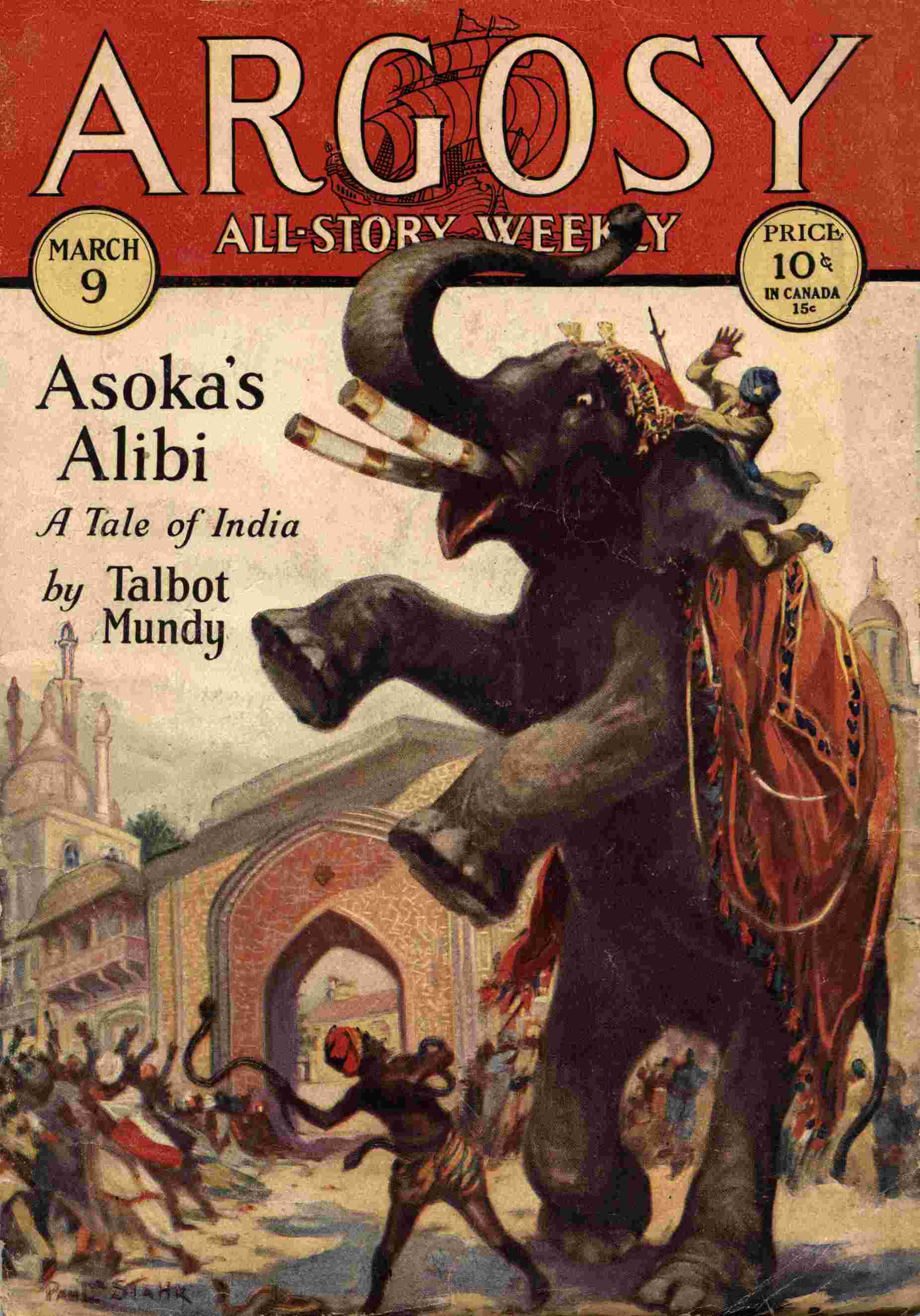
CHAPTER VII.
ASOKA IN HIDING.
The outcast's lot is not a happy one, but there are compensations. The Chandala are regarded as so untouchable that even sweepers will have nothing to do with them. They are not allowed in cities. Such villages as they have are in the jungle, where they are neither taxed nor troubled by the census taker. If they die, they die; and if they rot, they rot; it is nobody's business.
So they are as free as any sort of human being can be, and the proof that they are actually human is that they crave what they have not got—servitude.
They ignorantly ache for a red-hot religion and rules and a boss to deprive them of liberty—a fact which had made it very easy for Maraj to pose among them as a being from another world.
Quorn had merely taken pity on them and employed them to cut grass for his elephants. He had made a number of journeys into the jungle to show them what kind of grass he wanted, and on one of these expeditions he had found a ruined building, roofless but otherwise serviceable. It had been full of trash and brambles when he first discovered it, but he had made use of the elephants to clean it out, and he was using it now as a place in which to hide Asoka from the machinations of the Brahmins.
He could with fair confidence count on the Chandala not to give away the hiding place because of their ingrained, justified and lively mistrust of any one asking questions or even trespassing into their part of the jungle. It was not very far from Narada—at any rate, not more than twenty miles—and he reached it on Blake's skewbald errand pony not long after daybreak. He was rather surprised that there were no Chandala, lean and dirty-looking, perching on the walls like vultures to stare at Asoka.
He turned the pony into a roofless room beside a heap of hay and limped into Asoka's chamber, where a glance told him that nothing whatever was wrong. Asoka greeted him, gathered him up in his trunk, hoisted him up on his head, and the two went down to the creek for the morning drink and a mud bath.
That took time, because the mud had to be washed off afterward, which meant a long swim and a lot of fooling, so the sun was well up over the trees when Quorn rode back along the jungle glade and reëntered the ruin. He could see, at a bend in the glade, the broken branches that Rana Raj Singh had thrown down to mark and at the same time to conceal the trail down which he and his men had ridden to hide in the nullah not far away. It was probable that one man, or perhaps two, were in the trees on the alert, but it would need second-sight to discover a Rajput scout, even if you knew exactly where to look.
Quorn proposed to himself to get some sleep, although it was a poor place for it because the flies were awful. However, he gathered green leaves with which to cover himself, shook the hay to make sure there were no snakes in it, and lay down, near enough to Asoka to be awakened if the monster should grow restless.
He was watching, through a chink between the leaves, the great body swaying to the rhythm of the spheres, or whatever it is that elephants are conscious of, when Bamjee came cantering down the glade and, after turning his pony into the same inclosure with Quorn's, broke in on Quorn's peace.
"Oh!" said Bamjee. "I am glad to to see you!"
"Can't return the compliment," said Quorn, sitting up and brushing hay out of his hair. "You're a buzzard of ill-omen. Any time you show up there's grief around the corner. What's eating you? You didn't run me down for nothing?"
"Nothing? What is nothing? If everything is nothing, as the Yogis say, then nothing is everything. Everything is enough. I have every reason. Shall I name one?"
Quorn sighed and filled his pipe. "You look like the wreck o' the Hesperus. Indecent, you, a father of a family, sporting around in a turban and cotton gee-string. I'm ashamed of the elephant seeing you."
"Nevertheless," said Bamjee, "I am the person who will cause you to become a Sirdar. Sirdar Benjamin Quorn: how will that look on the envelope? I know now what the Brahmins intend to do. You shall defeat them with my help. You shall have all the credit, but you must promise to pay me half of the big bonus that the Ranee will undoubtedly give you."
"Nix," Quorn answered. "Getting's keepings. Play your own hand. You wouldn't offer to deal me in unless you wanted me so damn bad you're fair busting. So shoot."
"Well, I could easily go to the Ranee with my story."
"You can soap yourself and slide to hell with it. I ain't particular."
"If I should tell you what I have ascertained, will you promise to recommend me also for a bonus?"
"No. You make enough off the gum you lick off postage stamps to pay my salary twice over. When I make promises, I know why. And when I don't make 'em I know why. You're why. Get me?"
"Well, if I should take you into my confidence—"
"You mean get me to trust you? Can't be done."
"If I should tell you what I know, and you should use that information, and by using it should not only save the Ranee's life, but also catch the Brahmins in their own trap, would you see that I get credit for it?"
"Mebbe."
"Is that your best bid? Listen, Mr. Quorn. The Ranee appointed you her agent to hunt down Maraj and to connect him with the Brahmins. You may order everybody—troops, police, palace servants, Prince Rana Raj Singh, even myself. I have information, and I am willing to tell you how to solve the riddle—how to give the necessary orders and so snatch fame and reward in the very face of destiny. What will you do for me?"
"You mean if you ain't lying? If you really have that information? I'll hold you underneath that elephant while he does a Charleston on your belly—unless you tell me dam-quick every word you know. Sit down there. Spill it. Satan's high hat! You, as naked as a nigger, coming here to try and sell me something that might save her life? Act your age, Bamjee. Say all you know, and say it quick."
Even his enemies, of whom he has several, say this of Bamjee: that he knows when to capitulate, and that he does it with a good grace. He ignored Quorn's rudeness, threw all stipulation to the winds, and plunged into his story, relating in minute detail what had happened in the Brahmin temple.
"And I tell you, Mr. Quorn, that they are tired of Maraj, even though they do not say so in plain words. They are afraid of him. They are almost as anxious to see the end of him as of you and the Ranee. I think it likely they will snap him in the same trap in which they hope to catch you. All you need to do is ride into the trap and have Prince Rana Raj Singh lie in ambush; each of his men will have a Brahmin on his lance before the day is over.
"But if you tell the Ranee before-hand she will give neither you nor me the credit. And if you tell Prince Rana Raj Singh, it will be the same story—"
A shadow fell between them. Then a hollow voice:
"And if you tell Maraj? What if you should tell Maraj?"
Bamjee almost fainted. Maraj had climbed over the wall and approached from behind them. His maniac eyes looked burned by lack of sleep, and his movement was almost simian, but an intelligence, mocking and masterful, glowed beneath the surface. However dry his eyes might seem, they looked indomitable. He lifted Bamjee by the neck with one hand and dumped him beside Quorn.
Then he sat and faced them both. Quorn noticed that Asoka was beginning to grow nervous.
"Snap Maraj in a trap! That is funny!"
"Hell!" said Quorn. "Of course they couldn't catch you in a trap."
"But I will catch them!"
"Sure you will. O' course you will. That's a part o' the bargain you made with me."
Genius has nothing whatever to do with education. It is a gift for recognizing the essence of things and what to do about it. Quorn knew nothing about maniacs, just as he had known nothing about elephants until he came to Narada. He could not have explained his method; it would certainly not have occurred to him to say there was something simple about a man whose manhood had been lost in a maze of egotism and murderous cunning.
He did not think about it. He acted, simply.
"Would you break our bargain?"
But Maraj was suspicious. "There is new horse-dung on the track. Whose horses?"
"Mine. Bamjee's."
"Many horses. Whose?"
"Rana Raj Singh and his men. Rana Raj Singh quarreled with the Ranee—pulled his freight. Off in a huff. Nobody knows where he's going, and nobody cares."
Something in the maniac's eyes altered. Cunning beneath cunning readjusted purpose beneath purpose. Quorn noticed a sudden blaze of anger that was instantly suppressed and hidden under too much suavity; but he had no means of knowing that Maraj had listened through Blake's window to the whole of the Ranee's conversation.
"He is after Maraj," said the maniac.
He was being so subtle now that subtlety oozed from his lips in a conceited smile, defeating its own end. Simultaneously Quorn and Bamjee recognized that his conceit could be his own undoing.
"What do you care?" Quorn asked. "Ain't you a match for him?"
"Yes, and for the Brahmins also." He fixed his eyes on Bamjee's. "You did not know, did you, that I was listening behind the wall? I heard you say the Brahmins mean to snap me in the same trap with the Ranee. So they shall. I will be the bait. I will draw the Brahmins, too, into their own trap. Rana Raj Singh shall find them in it, and destroy them. But, first, they shall destroy the Ranee, so that he shall have the impulse to destroy them. Ho, but we will feed death! And though they close me in a trap without an outlet, can they keep me in it?"
He grinned, glaring again into Quorn's eyes. "Afterward, you and I will keep that tryst—when you have no elephant to think about—nothing to think about except me, your master."
Maraj got up and stared at Asoka, having glanced first at the ropes that held the monster's hind feet. He was well out of reach of his trunk. He said nothing—did nothing—only stared. But the elephant, already nervous, suddenly grew panic-stricken, screamed, tried to reach him and kill him. He did his best to burst the heel ropes.
Quorn's fingers were on a piece of broken masonry; the intention to crush the maniac's skull with it burned in his brain and his veins, but the stone was too heavy to lift. Maraj turned to him and grinned:
"Soon—soon now you shall learn what it means to be all-passionate, and at the same time helpless. That is agony—exquisite, exquisite agony; dew on the flowers of death. So fragrant! So delicious! Wait and see."
He sprang to the wall in three strides then, vaulted it, and vanished. Quorn went to Asoka and spent a whole hour coaxing him back to calmness.
"Did a bogy scare him? Daddy's big boy! Never mind, we'll show 'em. Nex' time, maybe, we won't have no heel ropes on—and then what?"
Suddenly Quorn turned on Bamjee: "Get a move on, you. Time enough to take it easy when you're dead. Go find the Ranee and tell her every word of what's took place. Don't you leave one word out. And if them Brahmins have already been to her with their demands, you tell her from me to give out that she'll ride Asoka to that there hermitage to-morrow morning. I'll have him saddled and ready and at the palace door.
"She'd better order about half the troops to march behind her, but remember: them guys aren't dependable against the Brahmins, so they'd better start late and come along slow; they're jes' for appearances. I'll see the Prince. And say, see Mr. Blake. Tell him if he wants to see sport and maybe be a bit useful, he'd better ride Asoka with the Ranee. That's all. Get your pony and get out o' here."
When Bamjee had departed, Quorn took Asoka for another mud bath and a swim.
"Lord," he muttered as he rode out of the ruined building, "do you suppose that maniac heard what I jus' said to Bamjee? Well—who cares? I'm betting on the Prince and twenty Rajputs. There'll be a picnic." Then he went on talking to Asoka: "Trouble you make, don't you? Never mind, though, you ain't guilty this time. Use your big bean, or they'll execute you day after to-morrow at sunrise.
"What you're needing is a first-class working alibi, and durn me if I know one. You killed a guy. You've got to offset that somehow. Maybe alibi's the wrong word—I ain't no lawyer. Anyhow you use your bean, you sucker, and I'll use mine, and we'll get you a verdict o' not guilty somehow—somehow. Self-defense? Extreme provocation? No evidence? Hell—none o' them won't do. We got to get an alibi or bust!"