
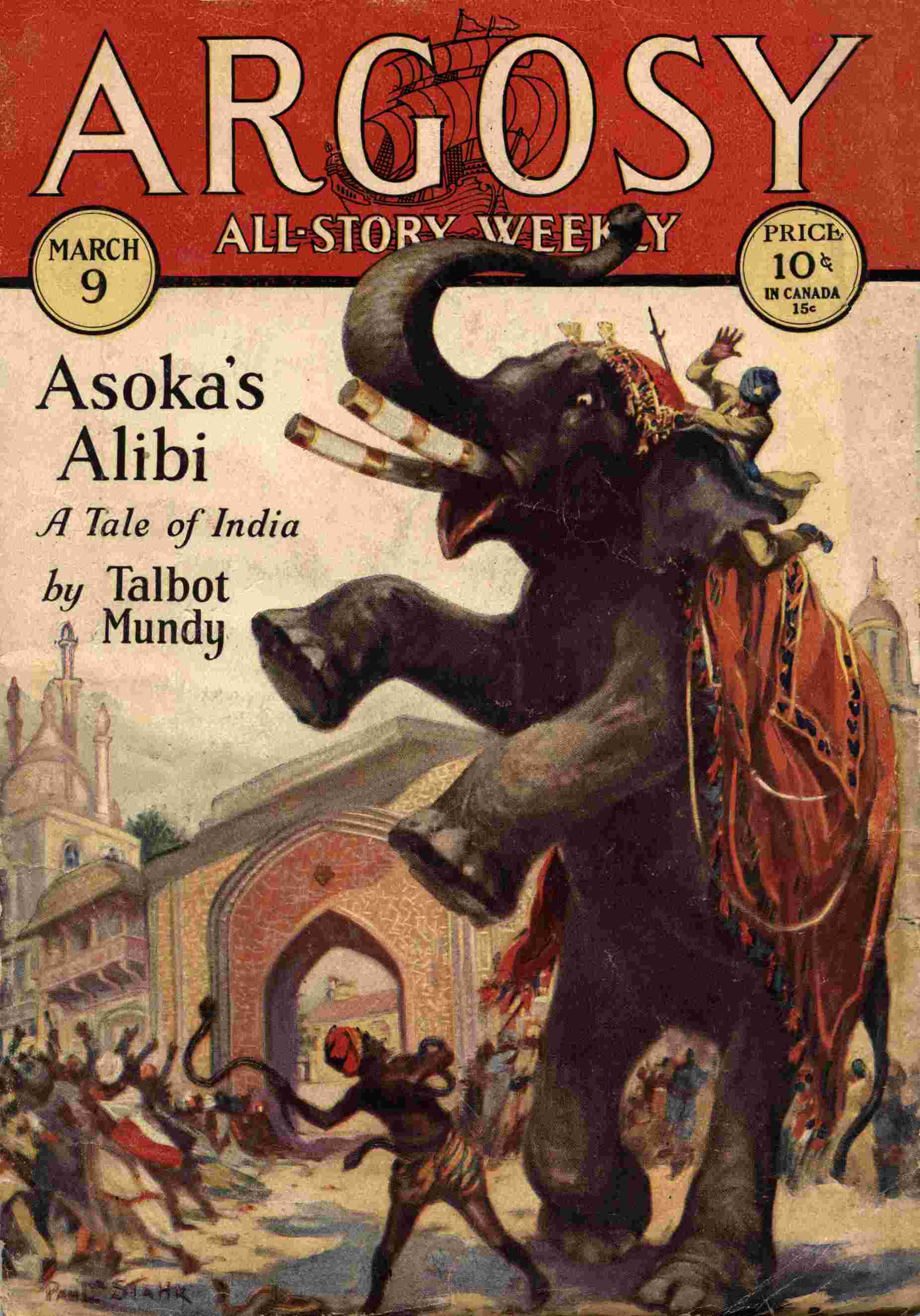
CHAPTER I.
THE MASTER OF ELEPHANTS.
"Reckon maybe I'm nutty," said Quorn to himself. "Hell, supposing I am! So is Narada. Elephants is the only sane folk hereabouts."
To comfort himself he looked up at Asoka, the tallest elephant in captivity, whom only he could manage at the best of times. At other times Quorn had to ride him as a fury rides a typhoon.
"You, you big stiff, if it weren't for you I'd pull my freight for Philadelphia and drive a taxicab again. If I might take you along I'd join a circus. This here circus gives me the willies."
He was referring to all Narada, not merely the elephant lines. Narada is close enough to Rajputana to be soaked with a sense of worn-out history. Treaties and its mountains have kept railroads at a distance, and the news comes dim, diluted, and distressing, by mail and word of mouth, so that people are only aware that the world is changing, without knowing why, or how, or what the changes mean.
They feel backward, and resent it, but they keep up the ancient customs for lack of intelligible new ones. Accordingly, for eleven months of every year Narada is piously miserable; during the twelfth month it is impiously mad and happy—more or less—always with a feeling that happiness has to be paid for, and, though the gods are kindly, there are as many vengeful and resentful devils as there are gods.
The carnival falls at the craziest season—April, when the heat is almost intolerable and nobody has too much money, having paid the taxes and the money-lenders' interest, so there is a fine feeling of equality, with common enemies to execrate.
There is also a yearning in common to cut loose and thumb rebellious noses at authority, so the underpaid and not too numerous police receive a lesson in self-restraint; a policeman's head, struck by a long stick, cracks as easily as any one's; the police station is of wood and would make a lovely bonfire. So the police stand by, while Narada eats, drinks, dances, sees the sights, marries and gives in marriage, is irreverent, sings naughty songs, quarrels and makes it up again, wears out its finery before some of it is paid for, and does all those things that good books say should not be done—because next month it must begin all over again working for the landlord and the money-lender.
The sun beats down on that exuberant emotion and ferments it, under the eyes of Brahmin priests, who understand a little of the law of give and take. The more impertinences now, the more abject the reaction presently; the little money fines and penitential gifts will mount up to a huge sum in the aggregate. Meanwhile even the lousy sacred monkeys feel the will to be amused and steal with twice their normal impudence, acquiring wondrous and enduring bellyache from plundered sweetmeats.
Passion of all sorts blossoms, and there are more sorts of it than most men guess. Scores of species of holy mendicants arrive from all the ends of India; so do the astrologers, clairvoyants, ordinary fortune tellers, conjurers, snake charmers, acrobats, sellers of love philters, preachers, teachers of how to get rich quick and gamblers to show how swiftly to get poor again, owners of fighting quails and fighting bantams, story tellers and proprietors of peep shows. Each sort makes its own noise, and the din adds madness to emotion.
Murder stalks abroad. Why shouldn't it? Life and death are one, admits Narada. Death must have its innings. We might even see a murder, and get excited about it, and help to confuse the police, if we are lucky. Hot? Yes, horribly. Dusty? Whew! We sweat, and dry dust sticks to us. But let's go and see the sights, the free ones first.
Since the legendary Gunga sahib reincarnated and became Ben Quorn, and the Ranee made him superintendent of her elephants, the royal elephant lines have been the finest circus in the world. So Quorn had thousands of visitors all day long; and because he was homesick for the gray fogs of Philadelphia he was more than usually kindly. His strange, agate-colored eyes had frightened people in Philadelphia; but here, under a light blue turban, they suggested rebirth from the storied past, so that it was no wonder that people who believe implicitly in reincarnation should insist he was a national hero come to life again.
Was he not exactly like the image of the Gunga sahib on the old wall of the market place? Had he not miraculously tamed the terrible Asoka when Asoka ran mad through the city? And was Asoka not the name of the sacred elephant the Gunga sahib rode in the ancient legend? And wasn't it fun to know how mad the temple Brahmins were, since they had had to bow to public clamor and admit that the Gunga sahib truly had come to life in the body of Quorn from Philadelphia?
Some one—nobody knew who, but some one—had explained that Philadelphia means the City of Brotherly Love.
Could the Gunga sahib come from any better place than that?
So Quorn answered questions and wiped sweat from his face until his throat was dry and he was so weary that he had to sit down on the upturned packing case beside Asoka. There he could watch all of his four and thirty elephants, each under its own enormous tree, within a compound wall that was carved from end to end with legends of gods and men.
Since Quorn came, every one of the elephants had learned new tricks; and he was generous, he staged a fresh performance every hour or so. The Ranee was generous, too, or else Quorn had persuaded her; there was free lemonade in such amazing quantities that the mystery was where all the lemons came from; and the lemonade was pink, which was a miracle, but it made Quorn feel less homesick.
He had always loved a circus—always had loved elephants, although he never knew why and had never had dealings with them until he came to Narada as caretaker of some abandoned mission buildings. Accident, according to his view of it, or destiny, according to local conviction, had caused him to climb on Asoka's neck one day when he was idly curious.
Asoka had chosen that moment to go into one of his panics, had burst his picket-ring and had run amuck through the city. Quorn had stuck to him because there was nothing else to do; and when the elephant had stunned himself at last against a wall, it was Quorn who gave him water and a cool bath in a garden pond—Quorn who coaxed him back to sanity.
It was in response to popular clamor, and only incidentally as a political move against the temple Brahmins that Quorn had been promptly put in charge of all the elephants. Nobody expected him to make good; not even Quorn had expected it. Miracle of miracles, his love of elephants had proved to be a film that overlay his natural genius for training them.
And Quorn loved his job. But he was lonely.
There was only Bamjee with whom to be intimate—Bamjee, the ex-telegraphist babu, who had sat at his instrument and learned so many secrets, of so many important people, that he had finally been appointed to the lucrative post of royal purchasing agent as an inducement to hold his tongue.
The only other man to talk with now and then was Blake the British resident, a gentleman so far above Quorn's social standing that, in spite of mutual respect, anything like intimacy was out of the question. Actually, at times, Blake and Quorn were suspicious of each other.
Secretly, Blake was determined, at all costs, even at the risk of his official career, to keep the Ranee on her throne and to support her modernizing efforts. Openly, Quorn was her stanch and loyal servant, cheerfully willing to run all risks and to defy temple Brahmins or any one else in her behalf. But Blake's official position as resident agent of the British-Indian government obliged him to seem critical and sometimes even threatening, so that the two men did not always understand each other.
As for the Ranee, there was no understanding her at all. Like Alexander the Great, Cleopatra, Queen Elizabeth and Napoleon, she had blossomed at the age of nineteen and burst suddenly into full maturity of intellect and statecraft. The last of her royal race, she resembled a marvelous flower on a dying vine, whose whole strength had gone into this last effort.
Raised within the customary purdah that prevented contact with the outer world, she had contrived, with the aid of Bamjee, who would do anything for money, to import books and to learn three languages. She knew everything that has been printed about Napoleon, Frederick the Great, George Washington, Lincoln and Grant. She had read modern novels, and was more familiar with modern views than many people are who see newspapers every morning. And she had unbelievable courage. She had broken purdah and defied the temple Brahmins.
If she had been ugly it might not have mattered so much, but a beautiful young girl arouses comment, and when she rode through the streets in breeches with no women in attendance, even those who benefited by her modern views were scandalized.
She opened hospitals. She superintended sanitary improvements. She pulled down rat-infested tenements and built new houses for the poor. And—deadliest offense—she defied the Brahmins' wrath by refusing to do penance for having broken the rigid laws of caste.
In consequence, her throne was rather less secure than if it had been raised on powder barrels. The temple Brahmins were doing their utmost to produce anarchy, so that the British-Indian government would have to intervene and either reduce her to the status of a puppet queen or, possibly, depose her altogether. Everybody knew that. Quorn, in particular, knew it. That was why he staged the daily circus. They were her elephants; they should help to make her popular.
"Not that them Brahmins won't get her," he reflected. "If not one way, then another. Poison." He shuddered. He, too, had to guard against poison. "Snakes. Knives in the dark. Accident. Them Brahmins only has to drop a hint or two and some crazed ijjit sticks a knife in some one else. And if she goes, I go—same way probably."
He looked up at the elephant again. "I'd start for Philadelphia to-morrow, but for her and you, you lump! Do you know what they'd do to you if I should up and leave you? They'd order out the troops and the machine gun."
That was absolutely true. Nobody but Quorn could manage the tremendous beast. And Quorn knew that the Brahmins were trying to stir public opinion to demand the summary execution of Asoka as too dangerous to live. They hoped by that means to be rid of Quorn; he might go home to Philadelphia if his beloved elephant were dead.
Quorn's perfect understanding of that phase of the situation was another reason for his taking so much pains with the daily circus; he hoped to make Asoka as well as the Ranee more popular. But he kept constantly close to Asoka, because Bamjee had warned him that an effort might be made to poison the great elephant with something deadly inserted in a tempting piece of fruit or sugar cane.
Fortunately, Bamjee also was anathema to the temple Brahmins. As the Ranee's purchasing agent it was he who had suggested buying tons of liquid disinfectant and a spray, with which even the sacred temple precincts had been drenched for the protection of the crowds who came in carnival month.
To say that the Brahmins were annoyed with Bamjee is to understate it altogether. They were in a state of fanatical mental constipation on account of him. Nothing could restore their equanimity as long as Bamjee was alive and at liberty to pocket ten per cent commissions for inflicting what they considered outrageous sacrilege. And as long as Bamjee could pocket ten per cent commission, he would commit anything under the sun.
So it was obviously Bamjee's cue to keep Quorn posted as to developments. They quarreled very frequently about the quality and price of the corn and sugar cane supplied to the elephant lines, and Quorn had repeatedly earned Bamjee's contempt by refusing to accept a percentage of Bamjee's commission. But hardly a day passed without Bamjee visiting the elephant compound and pausing for a chat with Quorn. He came now. And, as usual, although he would have hated to have to admit it, Quorn was glad to see him.
"Maraj is in town," said Bamjee.
"The hell you say! Tell the police."
Bamjee was a pleasant-looking little man, in a gray silk suit and a turban of the same color, blinking through platinum-rimmed spectacles. But he could look as contemptuous as the devil himself. The first part of his answer was drowned by the noise of a snake-charmer's bagpipe and the drums of itinerant troupes of acrobats, but presently he came closer to Asoka and sat on a box beside Quorn.
"The police would resign in a body," he said, "if they were told to capture Maraj. Self also. Am get-rich-quick exponent of materialistic fallacy of me first—fallacy because of risks incurred in course of same. Like any other speculator, might go broke. Like any other egotist, might tread on toes of wrong rival and be disemboweled with a dagger—funeral to-morrow afternoon, and nobody, not even you, to pity me, because I took too many chances. But there is one chance that I do not take. I do not monkey with Maraj."
"Hell," Quorn answered. "One mean murderer, without caste or backing—who's afraid o' that man?" He knew better, but he wanted to draw Bamjee. "I've heard say Maraj is one o' them Chandala people—folk that are reckoned worse than hyenas—ain't allowed in cities—lower than sweepers—insect-eaters—bums—filthy, no account savages too skeered to look at you excep' sideways."
"They are," said Bamjee. "They are worse than that. It may be true that Maraj is one of them. But have you heard of Thuggee?"
"Thugs?" said Quorn. "Who hasn't? They were stamped out. They were the guys who used to wander about the country killing total strangers with a handkerchief—just for the love o' killing. Am I right?"
"Yes, but they were not stamped out. They invented another way of killing, that is all. Death by suicide. There is humor in that. It is better than murder. He who is murdered is not guilty of his own death, but whoever commits suicide is doomed to wander endlessly in total darkness, earth-bound on the lowest layer of the astral plane. All religions seem to be agreed on that. Even I, who have no religion, nevertheless believe it. This new form of Thuggee, therefore, dooms its victim to almost endless misery in an astral madhouse. Maraj invented it, or so they say. His allies are the Chandala, who are allowed to rob the bodies and who cover up his tracks and run his errands. You can guess who his employers are, can't you?"
"Do you mean them temple Brahmins pay him?"
"I am not so crazy. And they are so far from being crazy that they pay for nothing. A hint—that is enough. Not even such a cunning devil as Maraj could last long unless he had protection. Nothing for nothing. How does he pay for protection? He acts on hints. He overhears two Brahmins saying so-and-so is an undesirable. There is another suicide. Nobody guilty—nobody caught—only a whisper, and the name Maraj is more dreaded than ever."
"Do you mean he kills 'em and makes it look like suicide?"
"Not so. If he is forced to kill he makes it look like accidental death. Almost always he succeeds in making them kill themselves, and there is no possible doubt about its being suicide. All sorts of ways—clever ways. Bullets. Hanging. Poison."
"Ye-e-e-s. Maybe. But that ain't suicide if they don't know what they're doing."
"But they do know. Mr. Quorn, they do know. That is his ingenuity—his creed—his purpose—his religion. It is not enough for him to kill their bodies; he must doom their spirits also."
"That guy seems to be fixing up a lonely future for himself. Even in hell there won't be many o' his kind. Well, it's pretty near time for my act. But what's the point of all this? You aren't skeered, are you, that he'll suicide me?"
"There is no knowing," Bamjee answered. "Don't say I didn't warn you. The temple Brahmins are your enemies. Maraj is in town; and Maraj is more cunning than chemicals that make no noise but work in the dark and change something into something else."
"Mind yourself," said Quorn. "I'm going to unhitch this critter."
The crowd divided down the midst, making a lane along which Asoka moved with ponderous dignity until he reached the circular roped arena in the center of the compound.
Asoka's mood seemed perfect. He knew that the crowd wondered at him, and he enjoyed it. He quickened his pace as he neared the arena, as if he liked doing his tricks, and he commenced the first one before Quorn ordered it, limping around the arena on three legs.
According to Quorn, he was the only elephant in the world who could turn a somersault; he did it three times. Then he walked on his hind legs; he walked on his fore legs; he played the drum; he lay on Quorn without crushing him; he picked him up and swung him, as if his trunk were a trapeze; he sat and begged for biscuits as a dog does.
He caused roars of laughter by opening an umbrella and sauntering around the ring, holding it at the proper angle to the sun, with a two-foot dummy cigar dangling from the corner of his mouth. He was so well behaved that he ignored the oranges the children threw to him until Quorn told him he might pick them up.
And last of all—his most hair-raising trick—he pretended to get angry with Quorn and chased him until he caught him, swung him in the air as if about to hurl him to the ground, but placed him on his neck instead and started leisurely back toward his picket under the neem-tree.
"Not so bad, you sucker. If you make yourself all that popular," said Quorn, wiping the sweat from his face, "they're liable to forget some o' your peccadillos, such as smashing up the market place and what not else. Hey—steady now! Don't spoil it!"
But a naked fanatic whose type of holiness was dancing with a dozen snakes twined on his arms and neck had forced himself into the lane between the thronging crowd and blocked the way, giving a technically perfect exhibition of the dance of death. The crowd watched spellbound, making no room on either side of him.
Asoka began to gurgle. There is no truth in the tale that elephants fear mice, but some of them fear snakes, like a man in delirium tremens. Asoka hated them; they made him hysterical. Quorn shouted to the fanatic to get out of the way, but the ash-smeared, naked seeker of salvation only danced the harder, making his snakes weave themselves in writhing patterns. He even began to dance toward Asoka.
Quorn shouted to the crowd to make the fool go somewhere else, although he knew they would rate it sacrilege to interfere with any one so holy. He even yelled for Bamjee, knowing that Bamjee had no fear of sacrilege; Bamjee might have courage enough to whip the fakir off the lot. But Bamjee had vanished.
Quorn tried to turn Asoka back to the arena, but the crowd had closed in behind and on either flank; there was no room to turn quickly. And suddenly the fanatic flung his snakes straight at Asoka's face. He might better have pulled the lanyard that fires a cannon. He stood still, waiting for results, perhaps for half a second.
It appeared to Quorn—and Bamjee afterward confirmed it—that during that half second some one shouted in a strange tongue to the fanatic, who glanced, as if toward the voice, exactly at the moment when Asoka launched his charge.
Asoka may have meant to kill him, or he may have been merely hysterical and in a five-ton hurry to get home to his snakeless, comfortable picket by the neem-tree. It made no difference. The fanatic was in the way. He became a crimson mess that writhed as his snakes had done, crushed flat where Asoka trampled him in passing.
Quorn heard mocking laughter and knew he was meant to hear it, since it was pitched above the din the crowd made, but he did not dare to look to right or left; he had one purpose now—to keep his elephant from trampling the crowd that was milling in mob hysteria.
There were only fifty yards to go, and he discovered that he could guide Asoka easily. The elephant responded to the least touch. He was not in one of his tantrums.
"All right," said Quorn, between his teeth, "that guy committed suicide and you, you're not guilty o' murder. But who's to prove it? They'll get the Maxim out and shoot you full o' holes, you sucker! Hell, no—home's no use to you—keep going! Keep on going! You for the tall timber!"
There is nothing on four legs faster than an elephant for half a mile. Bamjee was by the back gate; it was he who opened it. Asoka charged through like a gun going into action and Quorn heard Bamjee shout to him something about Maraj. But his ear only caught the one word, because behind him the compound was full of the din of the crowd and Asoka, too, was not moving his tonnage in silence.
Beyond, lay the open road, dusty and winding between ancient trees that were the fringe of a forest, and Asoka seemed to know he must run for his life; but to make sure Quorn emphasized the information with the goad, the iron ankus.
"Give her the gun now! Step on it! You great big bone-head, think up your own alibi while you run! And then tell me where to hide you! Jumping gee whiz, who can hide an elephant?"