
However anxious the wife of Senator Parks had been to impress herself upon New York society, she experienced a delightful sense of relief when the winter of her novitiate was ended. Furling her banners of tactful triumph, she left town immediately after Easter, thereby doing the correct thing and following her own mood, a combination of rare accomplishment.
Many times during the season she had thought of the Lawtons and missed Brooke sorely from the circle of bright young women in their “third and fourth winters,” whom she had the good sense as well as the attraction to draw about her; but the swirl of the pool had been so insistent that she had done little more than to send Brooke one or two cordial, if inconsiderate, notes of invitation to visit her, which of course had not been accepted.
Now that she had moved to the famous Smythers place at Gordon, and found her early passion for outdoor life and her developed taste for luxury at once sufficiently satisfied by its beauty and stimulated by its possibilities, she desired the companionship of some one of taste, a friend and not a timeserver, with whom she could discuss her plans. Immediately her mind reverted to Brooke Lawton, and knowing from Lucy Dean that Gilead was within driving distance from Gordon, she set out in her victoria one exquisite afternoon toward the end of May to locate Brooke. Visiting Mrs. Parks was an elderly New York matron, Mrs. Van Kleek, of particular social importance, who was anxious to run over to her own cottage, recently built in Stonebridge and not yet open for the season, in consequence of which this drive, having a double mission, began immediately after luncheon.
Both coachman and footman, being new importations to the hill country, knew even less about the upper and lower turnpike and maze of cross-roads than did their employer, who had a general idea of the region. It seemed an easy matter to keep the river in sight, and yet the constant desire of the ladies to follow up each pretty lane, with its delicate fringe of wild flowers or drapery of catkins, kept luring them away from it at right angles; so that five o’clock in the afternoon found the sweating horses, as yet unused to anything longer than the drive through the park to Claremont and return, toiling wearily uphill on the upper pike just above Gilead, facing the way in which they desired not to go, but had accomplished by looping about in a figure eight.
The coachman was growing momentarily more anxious lest the horses should break down; the footman was bored and cramped with long sitting; both ladies were weary, quite talked out, and longing for their afternoon tea; while Mrs. Parks was also exasperated at the failure of the excursion.
“Stop a moment, Benson, and let Johnson ask that man in the field yonder if we are on the right road to Stonebridge, and if there is any place near where we can rest,” she said finally. Benson pulled up as well as he could on the incline; Johnson dismounted and interviewed the farmer and, returning with a disgusted expression, said, “Stonebridge is six miles downhill, the way we’ve come up, mum, and if you please Gilead is that village a mile and a half back, mum, we passed a bit ago. This ’ere is the hupper road, the one in the dip below follows the river easy from Gordon to Stonebridge, and he says we’d best get on that.”
Mrs. Parks demurred a moment, and while she did so Benson, whose word was law in all matters concerning the Parkses’ horseflesh, turned on the box and, touching his hat, said in a tone that was not to be contradicted, “Mrs. Parks, mum, we must keep on the way we are going, facin’ with the wind until we can get to a flat spot where I can blanket my horses and rest them a bit. I’d not take the risk of turning them against that chill river breeze in their present sweat.”
Both ladies understood stable ethics, and the moods of husbands when these same are disregarded, too well to object, and so a drive that would not have been abandoned for anything else was reversed by the mere blowing of the wind.
Reaching the beginning of the plateau by the West homestead, Benson had the tact to choose a spot for blanketing the horses where the cross-road opened Brooke’s favourite river vista to the ladies in the carriage.
“How beautiful!” mumbled Mrs. Van Kleek, drowsily, her dry tongue cleaving to the roof of her mouth.
“It would be if we could only have our tea,” sighed Mrs. Parks. “I declare I must have an outfit of some kind adjusted to this carriage, for I’m devoted to driving, and every one says that it is the great feature of this hill country, and of course there isn’t a place around here where they know what tea is.”
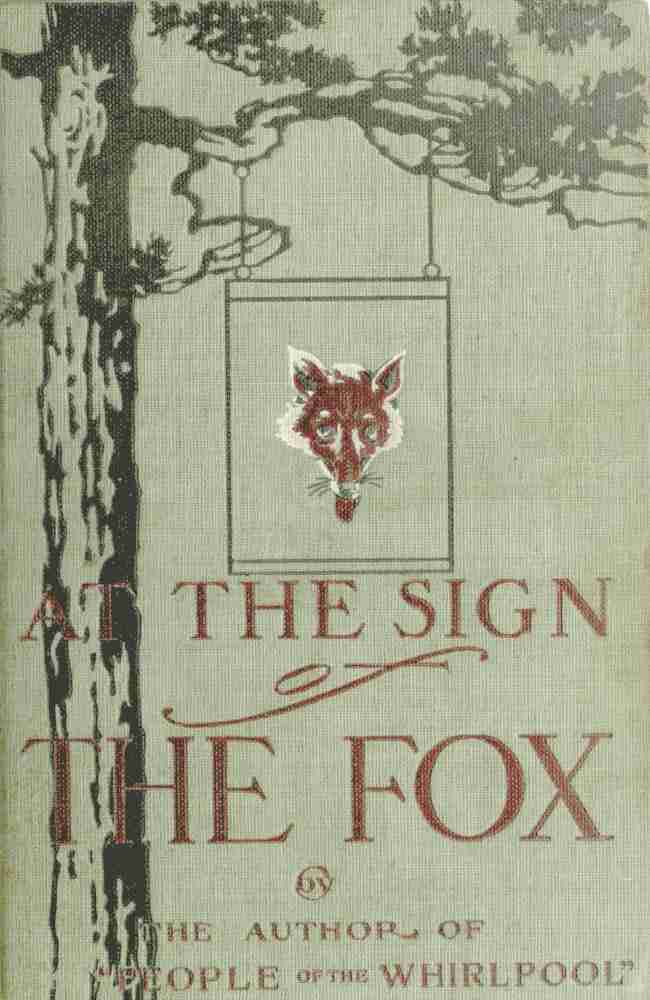
Johnson, who had been reconnoitring with an eye to a well, returned at that moment. “Hup yonder, mum, there’s a neat house, mum, and a sign of a fox hangs by the gate, mum, quite like the old country, only it says ‘TEA’ instead of hale, mum.”
“Tea on a sign-board here in the backwoods! Lead the horses a little farther up, Benson, and Johnson, do you go in and ask what we can have,”—turning to Mrs. Van Kleek, “I don’t suppose the tea will be any good, herbs or old hay, but at least it will be wet, and perhaps hot, and I’m beginning to feel the evening chill in the wind. I wonder why no one has the sense to have a good tea place hereabouts, like the English tea-gardens, where they would put up sandwiches for fishing and touring parties and all that. They could make a fortune in the season, I’m sure.”
“Here’s the bill of fare, mum,” said Johnson, returning and presenting the card; “a most genteel place, mum, though they’ve no license for spirits. Everything made fresh to order, mum, and in fifteen minutes. Besides what’s there, mum, there’s ginger hale and club sody, and will you ’ave it ’ere or go on the porch, mum?”
“Mrs. Van Kleek, will you look at this!” ejaculated Mrs. Parks, laying the card upon that lady’s lap as if she had suddenly been presented with a patent of nobility.
“Printing, get-up, prices, quite like Tokay’s! We will decide quickly, lest the thing prove an illusion and vanish as we near it, Cheshire-cat fashion. Johnson, we will have a pot of tea for two, with cream, and half—no, a dozen lettuce and chicken sandwiches, served out here. Also you may get ginger ale and cheese sandwiches for Benson and yourself,” for Mrs. Parks owed much of her social success, as well as happiness in life, to the fact that she recognized the equal primal necessities of all classes, and she argued that if Mrs. Van Kleek and herself, seated at ease in the carriage, were thirsty beyond endurance, Benson and Johnson on the box must be doubly so.
In due course the man returned, and turning up the flap seat in front of the ladies, placed the tray, with its dainty array, upon it.
“Damask napkins, instead of paper!” gasped Mrs. Van Kleek.
“Real cream!” said Mrs. Parks, “and domino sugar!”
“English breakfast tea, smell the aroma! a pot with an inside strainer, and porcelain cups and saucers!” continued Mrs. Van Kleek, proceeding to pour the tea, after which the remarks of the two women turned into a veritable patter song of praise, punctuated by sipping and munching.
“Really, this is most extraordinary! I wish I could tell of what those plates remind me; I seem to have seen the pattern before. Ferns, and no two bits quite alike,—it’s not at all like the usual commercial china,” said Mrs. Van Kleek, sinking comfortably back among the cushions, after finishing two cups of tea, together with five of the delicate sandwiches, and still looking meditatively at the sixth, murmuring, “Tokay could not outdo this, they are of the best—and the tea—simply unique!”
“Johnson,” called Mrs. Parks, for the two men were eagerly regaling themselves at a respectful distance, “take back the tray and see if they can change this bill—and Johnson, was there a waiter or any one there who should have a tip?”
“I should jedge, mum, there was one elderish party who should; she was rather snappy, mum, and charged me not to break the ware; but the others are gentlefolks, mum, quite through, and said as of course I’d be careful, which of a certain I would, mum, and me bein’ in service, mum, where I’d always known real china from Liverpool, and plate from pewter, which they ’ad the eye to see, mum,” and Johnson walked off, bearing the tray as carefully as if it held family plate.
“Wait a minute,” Mrs. Parks called after him; “ask if they can put me up fifty sandwiches, some of each kind, for ten o’clock to-morrow, and pack them in a box, and if they know where a family named Lawton live hereabouts,—the Adam Lawtons.” Then to Mrs. Van Kleek, “The Senator is going to take those four old California chums of his, that come to-night, trout fishing somewhere up this way to-morrow, to a place called Muzzle Guzzle, or some such name. I wished to send a nice luncheon out in the bus with the camping stove and the under cook to have it hot for them, but no, the Senator has ordered sandwiches—plenty of sandwiches, with Scotch and soda. They are to be driven only to the foot of the hills, and then walk for the rest of the day. He says they want to forget who and where they are for once,—be boys and all that sort of thing, you know,—so if I could get the soda and sandwiches here it would be quite delightful.
“How long he stays! I believe I will go in myself and see to the matter, for my curiosity is quite piqued. Will you come? No—very well, I’ll not be gone a moment,” and Mrs. Parks, her delicate robes trailing behind her, crossed the dandelion-studded sward toward the house, with a swish and swirl of skirts, and a step as elastic as that of a young girl. Laugh, as has been the foolish fashion, at those women who come out of the West to receive the chill of eastern polish; yet they bring us a better gift than they take, that of buoyancy of heel, head, and heart that we greatly need.
Mrs. Van Kleek meantime adjusted her head, heavy with comfortable sleep, and gratefully entered the Land of Forty Winks, evidently for a protracted visit.
Hesitating as to whether front or side door was the legitimate entrance for wayfarers, and deciding upon the latter, Mrs. Parks, rounding the corner hurriedly, came face to face with Brooke, who was coming up from the garden bearing a great bunch of lilies-of-the-valley, while Tatters trotted beside her carrying a basket that held still more.
“Brooke Lawton at last!” and Mrs. Parks put out her arms and, to Johnson’s amazement, clasped Brooke, flowers and all, in a hug of spontaneous pleasure, that made the girl’s heart beat quick for many a day, as she thought of it.
“Is this quaint, delightful place an inn as well, and are you stopping here?” queried Mrs. Parks, holding Brooke off at arm’s length, first looking at her and then sweeping the surroundings with a comprehensive glance.
“No, it isn’t an inn exactly,” replied Brooke, mischief lurking at the corners of her eyes and mouth, “though I’m staying here. I am the Sign of the Fox, and this is my home! Now that you are here, pray come in and see mother, while I make you a bouquet from my very own garden in remembrance of the hothouse lilies you sent us when father was first ill.”
“The Sign of the Fox!—you! how do you mean?” ejaculated Mrs. Parks, knitting her brows as if some one had asked her to guess a conundrum. “Ah, yes, then that was your mother’s fern china and her brand of tea that we all used to rave over! Mrs. Van Kleek was recalling it only an hour ago—by the way she’s out in the carriage (go tell her, Johnson, that Miss Lawton lives here and ask her to come in). But I do not yet quite understand.”
“It is this way,” explained Brooke, with an admirable self-possession, in which diffidence and independence were equally blended. “We had the farm and a bit of money, but not quite enough to keep us; the life agrees with father, and may cure him. If Adam and I went away to earn more money, mother could not stay alone. Then I tried to think what I could do or sell here. People drive a great deal hereabouts; the hill country makes people hungry; therefore why not make and sell good tea and good sandwiches? And I think that you must have found them so,” she added archly, looking at the empty plate upon the tray that Johnson had left on the serving table in the screened porch.
“Good! superlatively so! but why didn’t you write me of your plan and let me exploit it and interest our own set? for you know that they are scattered all over these parts at some time of the year, either for the entire season, or between times, and before and after Newport and Europe. I would have done it with a will, I assure you, as I shall now with a megaphone voice, in spite of you!”
“I know that you would have, Mrs. Parks, and Lucy Dean wished to also; but what has happened, I think you must acknowledge, is best. I wanted people to find out for themselves, as you have done, and if they bought my wares, to do so because they are good and they need them, not because I sell them and desire their money. Otherwise the sun would very soon set on the Sign of the Fox, instead of apparently beginning to rise. You know that it is the way of the world!
“But tell me; how did you come upon us? merely by chance? This must be a lucky ‘red letter day,’ for Lucy herself is coming to visit me to-night; Adam has already driven down to Gilead for her.”
“Partly that, but chiefly because of the way the wind blew. You see we started for Stonebridge and circled about, not finding our mistake until we began to climb the hill below. By that time the horses were quite spent, and Benson would not turn back in the teeth of the river wind.”
“It’s no use, mum,” said Johnson, returning, “Mrs. Van Kleek is sleepin’ that ’eavy and ’appy it would take a brass band to wake her, mum,” so the two women passed indoors, the fragrance of the lilies-of-the-valley lingering in the air.
When Mrs. Parks left, her arms full of flowers, a half-hour had sped by; but Mrs. Van Kleek, awaking with a jerk, was none the wiser for it, for one of Mrs. Parks’s maxims was that it is always a mistake to apologize, save at the pistol’s point, because it usually provokes irritation by calling attention to things that, ten to one, would otherwise pass unnoticed. As the victoria, following Brooke’s advice, turned the corner toward the lower road, they met, coming up, a fat-stomached country horse dragging a rockaway, that pulled to the side of the narrow cross-road to let them pass. In it, beside Adam, sat Lucy Dean, while the rear seat was heaped with hand-baggage; she waved gayly to Mrs. Parks, who would have stopped then and there for a gossip about the afternoon’s events, but Benson, intent on making the home stretch, all deaf to her exclamation, kept his horses up to the bit, and soon the river road echoed their hoof-beats.
As to Mrs. Lawton, the visit, brief as it had been, did her untold good, besides giving her no feeling save of pleasure, thus bringing her for the second time naturally in contact with old acquaintances, without in the least destroying her peace of mind or making her doubt the wisdom of having broken away from the old life.
Brooke and Lucy always met with enthusiasm; indeed, one of the reasons for the stanch friendship of the two being the way in which they supplemented each other, thus allowing the character of both complete scope, without forcing either into the lead, except in matters conversational.
“I was so surprised and pleased when I knew that you would come, for the very evening after I wrote I saw in the Daily Forum that you were starting with your father on his car party to California. How did it happen that you changed your mind?” asked Brooke, leading the way to the little room next hers, for which Lucy had begged, instead of the formal and unused best room over Mr. and Mrs. Lawton’s, which some day was to be beautified, but at present harboured the dreadful black walnut furniture moved from below, in addition to smelling of wood soot and wasps.
Lucy threw herself into the arms of a fat rocking-chair that was covered with a cheerful bird-of-paradise chintz, and rumpled her hair back from her forehead before she answered. So long was she about it that Brooke looked toward her apprehensively, fearing that the trip might have given her a headache; then she noticed that Lucy really looked tired, and that there was a lack of colour in her cheeks for which car soot could not wholly account.
“I did expect to go, and had planned out a delightful group of people for the trip, which, aside from pleasure as a side issue, was to explore and exploit a new bit of country that father thinks needs a railroad, and help convince his friends of that fact.
“The Forum offered to send Tom Brownell as the newspaper man of the trip, besides which two or three others we had chosen are always excellent fun, and Mrs. Parks was to be chaperon, at which she is a perfect success. She has the knack of always being on the spot, in case any one needs to prove or disprove an alibi, yet at the same time is totally oblivious; so Mrs. Grundy never has a chance to say a word, and every one is happy.”
“Did you turn your back on such attractions to come to us?” said Brooke, deeply touched. Her feeling showed plainly in the look she gave Lucy, as after unpacking her friend’s toilet things, she had dipped a sponge in warm water, and kneeling by her, began to bathe her forehead and eyes as gently as if Lucy had been a tired little child.
Lucy closed her eyes and gave a sigh of content at the touch of Brooke’s fingers, but in a second opened them again, and looking straight at Brooke, replied: “No, I won’t let you quite think that, though you know that I love to be with you and your mother. Some of the party turned their backs on me; first, Tom Brownell had himself replaced (I made sure through Charlie that it was his own doing) by a young westerner who, he said, ‘knew the local ropes’ better, and would be of greater advantage to the prospectors. Next Mrs. Parks decided that as the baby was teething she could not leave him for so long, in spite of having a separate maid for his head, hands, and feet, besides a trained nurse in perpetual residence.
“Then father suggested that little Mrs. Morton be invited in Mrs. Parks’s place. You must remember her,—the Hendersons’ cousin, a pretty, subdued little widow of about thirty, who puts people’s houses in order and sees to the curtains and other interior decorations. She always looks as if she’d been cut out for a good time, but fate has been rough to her, and though she is working hard to get used to it, a merry devil will look out of her eyes in spite of herself.”
“Oh, yes, I remember. She redecorated your house as a surprise for you the season we were abroad, I believe,” said Brooke, sudden illumination coming to her, for it had been openly whispered, early in the season, that Mr. Dean was ardently, if maturely, in love with Mrs. Morton, but that the little lady’s peace-loving nature and hardly won independence, coupled with a fear of Lucy and her sharp tongue, stood firmly in the way of a very comfortable and suitable match.
“Yes, and father wished it done over again this winter, but I absolutely refused to be routed out in cold weather. Now I’d heard, as I know you have by your face, Miss Simplicity, that father was supposed to wish to marry the lady long ago, but that she was afraid of me. At first it pleased me to have her afraid; I revelled in it, also I thought that the idea would wear off with father.
“Lately I’ve changed my mind, and I think life is too good to live it alone, and that everybody ought to marry any one they wish to, provided the person does not have fits or inherit consumption. Then I went to father and told him so, and he was so pleased that he nearly made me cry, for though he always said that I was everything to him, it wasn’t quite true it seems; and he said that some day I would find out that he was not quite everything to me, and oh, Brooke, I really think I should like to!”
Brooke, who was still kneeling by Lucy, put her arms around her, and the two women, each having felt the mysterious throb of the woman heart that made them kin, rested a moment cheek to cheek.
Lucy recovered first, and shaking off the tender mood, tossed her head, the usual bravado returning to eye and lip as she said: “Next, I went to see Mrs. Morton and told her that so far as I was concerned the coast was clear, that I bore no malice, and that I hoped she and father would have a jolly old age (she is only six years older than I); but that I simply could not go on the car trip with them, though I would thank her not to announce it until after the start.
“She—well, she is a good sort, and I guess we understand each other, for she looked me straight in the face and said she hoped she’d have a chance some day to stand by me in return, and she didn’t slop over or call me ‘dear daughter,’ or say she’d be a mother to me, for any grown woman knows that there is only one who can be that.
“Consequently society and Charlie Ashton think that I’m speeding to California, while in reality I’ve flown to you for protection against the blues, and I want to stay a month if you will let me cook and do everything as you do—it is what I need. Who knows but I might turn farmer, or try love in a cottage myself some day.”
“A month, Lucy! oh, how good!” cried Brooke. “Yes, you shall do as we do,—you’ll really have to if business rushes as it has since we began,—but I’m afraid you will find it very dull, unless your fate dashes up in an automobile.”
“Dull! not a bit of it! Why, if I feel my flirting ability growing rusty, I can practise on the Cub’s elderly paragon, Mr. Stead, or try archaic sentiment on your big farmer man to console him for the sweetheart who has not yet materialized. From your ardent written descriptions of the landscapes about here, and the important places he always fills in them, it seems to me that he must be at least a straying Walther or a prince in disguise, seeking to be loved for himself alone.”
“Mr. Stead will probably be down to-night, so that you need lose no time in beginning,” Brooke made answer, flushing hotly. “We four have been playing whist a good deal, lately, and as I am not passionately fond of it, you shall take my hand. I think that you and he will prove pretty evenly matched in most things. As to my farmer, as you absurdly call him, you had better leave him alone,—it’s not worth while,—he might misunderstand, take you in earnest, and embarrass you.” Whereupon, after making the most cutting speech that Lucy had ever heard from her tongue, she turned about and went quietly downstairs, saying something about hurrying supper, as Lucy must be hungry as well as tired.
A new idea came to Lucy, born of her own teasing words, spoken wholly at random and in jest, and of Brooke’s flushing. She had always thought Brooke wholly an idealist in affairs of the heart, and that whatever emotion she had ever been able to detect had been brought out by the artist Lorenz during their Paris sojourn. When it had apparently ended in naught she had been both disappointed and glad, the latter especially after Adam Lawton’s failure, for after this she had desired Brooke, through matrimony, again to have the luxury and chance to enjoy her art that she thought her friend deserved.
When Charlie Ashton had drawn her attention to the resemblance to Brooke in the picture, “Eucharistia,” she had expected developments, but now that nearly six months had passed she regarded the thing as a mere artistic coincidence, the lingering in the man’s memory, perhaps, of a face for which he doubtless had a passing fancy.
Now a tangible possibility in the shape of Stead came into the foreground. Though Lucy had not seen the man, the Cub had given him a glowing recommendation. As to his age,—Lucy was a woman of experience,—fifty might mean many things, fatherly or otherwise, and the life of leisure he led implied that he had some independent property. Was he not always much at the house, and were not his books and various offerings scattered about everywhere, even at her first visit? Brooke had written of horseback rides in his company. Surely he did not come alone out of respect for Mrs. Lawton or anxiety about the Cub’s lessons. Why had Brooke blushed and been so resentful?
Lucy sprang up, and seizing a brush, began to work at her hair with a will, until the colour returned to her cheeks and the glossy dark locks wreathed her crown in a way to add a fascinating air of maturity to her arch face. Then, picking out the most dashing waist she had brought, having merely chosen her plainest clothing, she adjusted it over a long, flowing skirt and stood surveying herself for a moment, saying half aloud, “I will look at Milor Stead, widower; if he is a good possession for little Brooke, so be it, I stand aside; if not, I interfere!” and then a softened expression followed the one that Brooke’s semi-challenge had called forth, and she added, with a sigh, “How I wish Brooke could have some one’s whole, first, fresh love, be he rich or poor! She would keep it and live and die for it, and not mar it with a selfish thought. I wonder if Charlie is right and that Tom Brownell is trying to avoid me? Bah! but it is really a handicap for a woman to have a rich father; the money lures those she dislikes, and gives the others blind staggers, and they bolt in the wrong direction.”
Two minutes later, Lucy, wholly radiant, was pushing Adam Lawton’s chair in to supper, and insisting that she was sure that he recognized her, even though he could not speak her name, while the Cub changed seats so as to be next her at table, and Pam insisted upon sharing the somewhat narrow chair by wedging herself between Lucy and the straight, high back.