
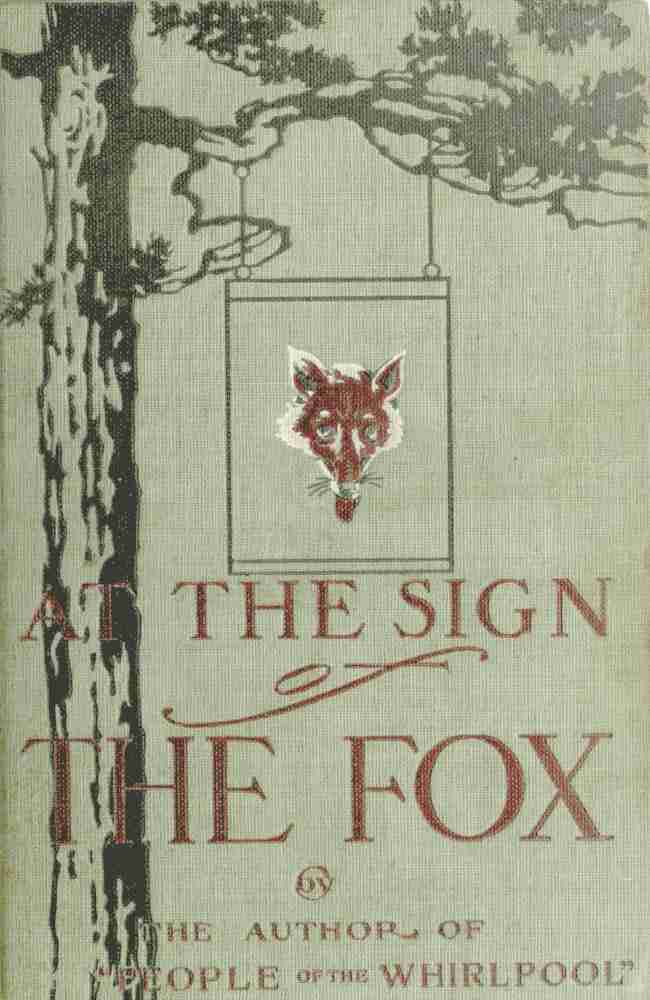
Ten days passed, and June was urging the growth of flower and leaf with ardent breath. Even in the hill country, with its cool nights and winds that rush down the river valley, the days were sultry, and August lent her younger sister electric batteries for her relief; and almost every afternoon the soft, rounded summer clouds that seemed to flock about Windy Hill, like pasturing sheep, were put to flight by the dun-edged thunder scud with its whips of lightning.
Robert Stead had now gone his way to the north-west at his friend’s request, the work indoors and out had settled with an even and soothing monotony over the West farm, while the Sign of the Fox and its fame were already relieving Brooke’s anxiety as to the immediate future.
As Lucy paced to and fro along the neatly gravelled walks of the old-fashioned garden, where the Cub was engaged in “brushing” the long line of sweet peas, a vocation requiring a knack that he did not possess, it seemed to her that two months, instead of two weeks, had passed since her coming. Not that she was in any way bored or discontented, rather did it seem as if she had always been a part of the household and living her normal life, while the revelation, indoors and out, of work done by personal service, instead of by money proxy, had given her active brain much food for thought of a new though baffling order.
In many other ways also did Lucy feel herself baffled. Upon Robert Stead she had failed to make the slightest impression, either during the half-dozen calls he had made at the farm, or upon a ride she had taken in his company to his lodge on Windy Hill, when he had invited Mrs. Lawton and Brooke to see his garden and some prints of old masters that they had been discussing. The Cub being busy, Brooke had driven her mother in the buggy with old Billy, and Stead, who had ridden down with an extra saddle-horse in tow, had accompanied Lucy back.
Not that he was discourteous; quite the contrary. He was the polished man of the world, always polite, with a pretty compliment, too well-rounded for spontaneity, upon his lips and plenty of intelligent conversation, as well as chink-filling small talk that prevented dangerous pauses, yet withal he was inscrutable.
Hardly less so did Lucy find Brooke herself; perfectly free and frank in their daily intercourse, yet she neither offered nor asked special confidence. She brightened with all the charm of a born hostess when Stead came, and he gravitated toward her as naturally; yet when he left, even for six weeks’ stay, she exhibited no sign of loneliness and threw herself into her play, which she called the few hours she seized for painting, with fresh vigour, either working in the old carpenter’s shop, that by opening a trap door above had a fine north light, or going into the open fields to use Enoch Fenton’s colts, sheep, or oxen as studies.
It was not strange, however, that Lucy could not fathom the mind of either maid or man, for did they really know themselves? Stead was experiencing the conscious coming of a second youth, even before he was more than in the full vigour of middle life. The period of torpor through which he had passed was much like the indifference and languid, brooding time of adolescence before the bite of motive and passion awakens body and brain and clears the vision; and it was Brooke who blamelessly had brought all this to pass, Brooke, with her heroism of womanhood that was none the less subtle and acute because of its elusiveness.
Robert Stead loved her as a man loves but once, no matter how often he may marry, but this second passion was so different in its elements from the first that he did not recognize it as such, and consequently, unchecked, it doubled its hold, even while Lucy was unable to put two and two together, and piece a single palpable symptom.
In a state of rebellion bordering on disgust, Lucy, who heretofore had been the sort of woman that had usually obtained anything for which she had cared to try, and much for which she had not striven, turned her attention to the farmer-on-shares,—Walther, as she called him, who was undoubtedly a most filling and picturesque figure in the perfect series of pictures that grouped themselves between the homestead and the Moosatuk,—to find him not only difficult but impossible of approach, and try as she might, she had not yet succeeded in exchanging a word with him. At the same time many of his doings puzzled her, for though he was entirely his own master, by the very nature of the half-and-half agreement, and had nothing to do with the home garden or aught else about the place, his whole desire seemed to be of use and to serve its occupants, though unobtrusively.
It had been only a few mornings after her arrival that Lucy, just at dawn, looking out of one of her windows (which overlooked the back of the house, Brooke’s having wholly a river view), discovered the big fellow setting out a quantity of seedling asters, a task that Brooke had begun the afternoon before, and darkness had stopped when half accomplished. Did Brooke know of it, she wondered.
Again, at the same hour, she saw him, hands encased in great leather mittens, uprooting the vigorous poison ivy and tearing it from the pasture fences, and at once she remembered that Brooke bore the crusty burn of contact with it on one hand.
The Cub now and again remarked that Maarten was a brick and helped him out of lots of tight corners, without even a hint being given, and Lucy wondered if Brooke saw or understood; apparently she did neither, and yet the very day after the Cub had thrown down his armful of pea-brush in disgust at the tottering, inebriate line that rewarded his best efforts, the brush appeared all set in place, standing like an evenly trimmed hedge, attractive in its neatness, aside from the crop of fragrant promise that already was beginning to finger the support clingingly with its tendrils.
But how was it with Brooke herself? If it is true that filial love or work in sufficiency can fill life to the brim, then hers was full to overflowing; yet this is not all,—work, to be the heaven it may be at its best, demands that the heart be satisfied.
Lorenz she had known less as a man than as an idealist, and it was this side of his nature that she loved, together with his respectful yet truth-speaking attitude. Then came the mystic picture, bringing with it to fan the naturally kindled flame the knowledge that he remembered! No further word had come from him since the verse of Sisyphus that she had answered merely by a spray of arbutus blossom, the New England flower of spring hope, shining through melting snow. Could he interpret it? Perhaps not.
Sometimes a sense of the unreality of it all and the dream stuff it was made of came over Brooke, and she wondered if the spell would hold or if the separation was not more sweet than the reality; but this mood never lasted long.
Of the patient service of the farmer-on-shares she could no longer be ignorant, nor of the fact that he drew her eyes toward the landscape of which he had come to be an inseparable part. Unwittingly she found herself watching him day by day, though usually as a mere speck in the distance. At such times she was bewildered, and trembled at herself. Was it the poise of his head, and an occasional gesture as he stepped back to look at something that he had done, that reminded her of Lorenz and confused the two identities for the moment, or had the strain of the long winter of struggling warped her brain?
Brooke was no analyst who had made the mental dissipation of the dissection of motives take the place of natural emotion. The ideal of her nature had its outlet; why not then the real? It was the natural man in Maarten that drew her, something beneath the surface, obliterating the bands of caste and the social grades that divided their normal positions, though for that, except for her father’s disastrous city career, she was equally born a child of the soil and its heredities.
She avoided the hay-fields, now swept by the June snow-storm of daisies, and in spite of success and her friend’s companionship, was truly miserable for the first time, for she could neither understand nor throw off the spell she felt upon her. Self-respect is not oblivion, and is but a chilly comforter for youth.
The frequent thunder-showers had forced a new necessity upon the Sign of the Fox. An open shed at least must be had to protect vehicles that needed cover, while their occupants were sheltered by either screened porch or welcomed in the neat kitchen itself; so that an old lumber room in the cow barn had been cleared, and furnished with rings for tying up, the drivers upon the upper road being chiefly of horses; for the chauffeur avoided the steep, uneven hills, which jarred the constitution of the car of Juggernaut unpleasantly, even in the downward trip.
It chanced a little before this time that a party of young fellows, headed by Charlie Ashton, in his big Mercedes touring car, built for long-distance runs, had started for Gordon, where they were in demand for a tennis tournament. Ashton’s chauffeur turning ill and unfit at the last moment, they had beat about, and discussed the possibility of substituting one of their number for the professional, as they all had more or less experience; and the lot had fallen to Tom Brownell, who had joined the party for a brief vacation, at the end of which he was to take the position of city editor of the Daily Forum, a well-earned promotion for which his gift of discerning the true from the merely sensational peculiarly fitted him.
Brownell knew from Ashton that the Lawtons were located somewhere on the route they were to take, and ever since his first maladroit interview with Brooke he had desired to be of some service to her, that should atone for his blunder.
The pair of keys on which he had stepped that day in leaving the apartment had always remained, as it were, before his eyes, and after learning all possible details of the Lawton failure from many sources, he felt doubly convinced that, if these keys were placed, they might solve at least one of the many questions unanswered because of Mr. Lawton’s illness. He had therefore asked Lucy Dean to get them if possible—which she had done.
Two months of following the faint trail furnished by two thin keys merely bearing numbers but not even the initials of their makers, had at last brought about a certain result which might or might not be satisfactory, but at least warranted him in seeing Brooke, and telling her of his progress; and this was one of his many motives of touring to Gordon.
He knew, from Lucy herself, that the Lawtons were located in the vicinity of Gilead, and inquired the nearest way to the homestead, when they reached the village late in the afternoon. On learning that it was on the hill road, and as the machine he was driving had had two temper fits within the hour, Brownell side-tracked it in a pleasant spot on the lower road, and leaving his companions to spend an hour with their pipes and the liquid remains of their luncheon, he started afoot up the cross-road.
There had been many people stopping for tea at the Sign of the Fox that afternoon; in fact, the last trap was only leaving as Brownell turned the corner, being that of Mrs. Parks, who dined at eight on purpose to have the sunset hours for driving,—a performance that the Senator could not understand.
Brownell hesitated a moment, as many others had done, as to which door, front or side, was the more direct entrance, and deciding upon the latter, turned the corner of the house and took the cobbled path that ran between the prim box bushes toward the kitchen door. As he passed under the window of the little library, the sound of a voice inside made him stop as abruptly as if a detaining hand had been laid on his shoulder. “They are at Coronado,—the engagement is announced,—they are to be married immediately, and instead of coming home with the party go on to Vancouver and Alaska. Father can no longer be my all in all, yet there is no one to take his place!” were the words the voice uttered deliberately, with an accent half mocking, yet with an undercurrent of sadness to one who understood.
Standing on tiptoe for one brief moment, Brownell saw Lucy Dean’s clear-cut face through the shielding vines; it was turned away from the window, and she continued speaking to some one whom he could not see, but easily divined was Brooke herself.
Recovering his power of motion as quickly as he had lost it, Brownell darted down the lane toward the barn, and opening the door of the first outbuilding that he reached, sprang in, closing it quickly behind him with a heedless bang, in all the guilty trepidation of some peeping Tom in fear of justice. In reality the being that Brownell most feared at that moment was himself, as rendered illogical, helpless, and oblivious of even the carefully planned work of his life, when in close proximity to Lucy Dean. If she turned and saw him, he knew himself lost, so that immediate flight was the only hope left.
From the moment he had first met her Brownell had admired her stanch friendship for Brooke, while her buoyant and frank audacity had soon fairly swept him off his feet. He had gone to the Dean house many times, it is true, half because not to do so would have been brutally rude, half fluttering, moth-in-the-candle fashion and courting a singeing, until in the close companionship of the six weeks’ journey that had been proposed, he saw that he would not only be at bay, but completely at the mercy of that most uncertain of quantities, the motherless daughter of an influential and wealthy man.
As an institution he had no quarrel with matrimony,—simply it had no place at present in his somewhat altruistic plan of work. He did not wish either to love or to marry; to see Lucy had cast him into the former state, and caused matrimony to fill the entire vista.
What had he to offer—that is, financially? Even with his promotion he could little more than compete with her father’s chef. Of himself he had but an indifferent opinion, which was unwise, merely his ambitions were so far ahead of his achievements that he measured his shortcomings by the discrepancy.
That Lucy delighted to compete with him in a sort of game that Brooke had called “truth telling” he knew, also that in some way he seemed to stimulate her wit; but that there was a grain of sentiment in her practical, and what people thought somewhat hard, nature, he never for a moment dreamed. Therefore, knowing that if he saw her often the moment would come when from his own standpoint he must become ridiculous in her eyes, he had escaped from the overland trip, as he now sought to escape the sudden and unexpected meeting by flight.
It would soon be dusk, and he could slip back to his companions unseen, make some easy excuse for not having called, and tell Brooke of his partial discovery by letter. This flashed through his mind as the door closed. At the same time he looked about the building that he had entered, to see if it had another exit, and discovered it to be a poultry house, the well-white-washed perches of which were crowded by mature, experienced hens, each wing-capped for the night. In the uncertain light he made a misstep on the uneven ground, compounded of ashes and broken lime, that formed the floor, which sent him reeling into the midst of the feathered multitude, and as he grasped a perch to save himself from rolling in the dust, he shook off the portly sleepers. A perfect babel of hen alarm arose as the frightened ladies flew in his face and lodged on his arms and shoulders in their useless flight.
“Be still,” he called in a husky voice; “for heaven’s sake don’t raise such a devil of a row—they will take me for a rat or a weasel at the very least, and set the dogs on me,” and then he laughed when he realized upon what unintelligent scatterbrains his words had fallen. The windows, all too small for retreat, were also netted. There was but one door, so finally, getting his bearings, he made a dive for that, only to find it firmly fastened by Miss Keith’s anti-chicken-thief spring lock! They say love laughs at locksmiths, but bitter satire! when before had the device of one of the craft imprisoned a man flying love, in a fowl house?
Folding his arms, with shoulders squared and jaw set, Brownell waited. Already he heard the barking of a dog, women’s voices, and steps upon the porch of the house. Could any position be more preposterous?
Lucy had finished reading her letter, and stood in the porch, watching a catbird’s fantastic wooing as it paused in the midst of an impassioned song to jeer, expostulate, coax, and protest all in a breath, now raising itself tiptoe on an ecstatic high note, and then languishing until it seemed to melt into the bushes. Every other bird loses self-consciousness and pours his heart out in the love time, the catbird never; and yet its compelling fascination lies in that it is always itself.
Lucy laughed softly as she watched the feathered pair, and said to Tatters, who stood beside her, “Do you know, old fellow, I think if any one wooes me, he will have to do it all in a breath, and after hypnotizing me by his rattling, like that bird yonder, secure my hand and heart before I wake. How I wish I were that lady bird this very minute, having all this fuss made for me, and sitting perfectly composed in a bush without a thought to spare for my trousseau!”
Tatters’ answer was a low growl, and then a series of quick barks as the hubbub in the hennery began.
“I think something is stirring up your poultry; shall I go and see?” Lucy called, going around under Brooke’s window, for the latter had gone up to rest a few moments after a tiresome afternoon.
“I guess the hens have only fallen off their perches, and are frightened,” Brooke answered, coming to the window; “they often do, the sillies. It cannot be rats or weasels, for that is not Tatters’ animal bark,—that tone means a man, and no one would be so foolish as to come prowling before dark.”
Lucy continued to watch the catbird, but on the noise recommencing, Tatters growled again, and leaving the porch, nose to ground, skirted the library window, went to the gate, returned, stood under the window for a second with bristling hair, and then, leading straight to the fowl house, began tearing at the door.
Interested in his tactics, and thinking the intruder nothing worse than a prowling cat, Lucy threw the skirt of her flowered dimity over her arm and crossed the garden to the lane.
“Quiet, Tatters, quiet!” she cautioned, patting his head; “you must let me attend to this; dogs are not allowed in fowl houses, they have been known to produce heart disease in susceptible young pullets. Sit down and watch out!”
Touching the spring, she released the latch, and opening the door cautiously, lest any fowls escape, she peered in, thus coming instantly face to face with the caged man! The shock for a moment made her lose her poise, and she almost tottered as she cried, “Tom Brownell!”
At the same time Tatters, seeing the strange man, sprang forward, and to keep him back Lucy stepped inside the sill-less door; his weight as he sprung closed it with a snap, making her in turn a prisoner.
“I thought you were in New York! What are you doing here?” she flashed, regaining her poise and colour at the same time.
“And I thought that you were in California,” retorted Brownell, carelessly, hands in pockets, holding sentiment down hard.
“Then you did not come here to see me?”
“On the contrary, I came to see Miss Lawton! Are you usually to be found in chicken houses?”
“Ah, she is, then? Suppose, as we must put up with each other’s society until Tatters leads Brooke to our rescue, that we play the truth game to kill time,—you know that truth can be trusted to kill almost anything nowadays; I will ask the first question. Did you give up the California trip because you wished to avoid me?”
“Yes, but not in exactly the way—Yes, I did,” this with an emphatic nod.
“It is my turn. Why did you not go to California?”
“Because—because—” and the eloquent Lucy became suddenly tongue-tied.
“Because of a prospective stepmother, was it not?” assisted Brownell, feeling an instant warmth about his heart, as her defiance relaxed.
“No, it was because you were not going—that is, because my feelings, my pride, were hurt,” and again she raised her head with a defiant glance, adding hastily, “Now my turn. Why did you wish to see Brooke, and if you came to see her, why are you found hiding in the fowl house?”
“I came because I have learned something about those mysterious keys. They belong to a box in a little-known safe deposit company in Brooklyn, and the name of the lessee is not Lawton; further, they would not tell me, nor can I go on without some aid from the family. Does this errand meet with your approval?”
“Then the keys do belong to something! Come quick, Brooke, let us out and hear the news!” called Lucy, pounding on the door; but no response came,—only a growl, not from Tatters, but from the unseen thunder-shower that was, as usual, making its way over Windy Hill.
“As to your last question,” continued Brownell, without heeding the interruption, “I was passing a window on the way to the side door when I heard a familiar voice reading a letter. One look confirmed my suspicion, and, like a wise brute in danger, I made for the nearest cover, not expecting to be made a prisoner, but to get off unseen!”
“Why do you avoid me? What have I done to make you hate me so?” Lucy almost whispered, a little break creeping into her voice that made Brownell start forward.
“Why? Because a sane man usually avoids a danger of which he has had many warnings. Don’t look at me like that, Lucy, and for God’s sake take your hand off my shoulder, or you’ll make me forget my self-respect and let myself go, only to be mocked by a woman!”
But Lucy did not move her eyes or her hand, while its mate stole to his other shoulder.
“Talking of self-respect,” she said slowly, but with an indescribable tender archness of accent, “why do you wish to make me lose mine by forcing me to throw myself into your arms? See, I am braver than you, I do not fear to be mocked by a man!”
“Lucy!”
“Tom!”
Those were the only two intelligible words of the rush that followed, but even the catbird in the syringa bush, had his eye and ear been turned that way, might have taken a lesson in rapid and complete wooing and winning.
A patter of rain on the roof, another growl, and a flash caused Brooke to hasten out to the porch to look for her friend, while Tatters still barked and clawed at the door of the poultry house. Opening the door, she spied Lucy, who, for the moment, had pushed Brownell into the darkness behind her.
“So you looked for cats and weasels, and the door slammed on you!” she cried, dragging Lucy out by the wrist, and brushing away the whitewash that powdered her dark hair. “Hurry back to the house, for you know that neither one of us has a love of thunder-storms!”
“You were right, Brooke, it was not Tatters’ animal bark,—it was a man that frightened the fowls,” answered Lucy, still holding back.
“A man! Then why do you stay out here in the dusk? Who was it? You are laughing,—it must have been Adam playing a trick on us!”
“Adam! Oh, no, it is the man I am going to marry! Brooke Lawton—Tom Brownell! I believe, by the way, you have never before been properly introduced!” and the next flash saw three figures, followed by a joyous dog, scudding toward the house under a burst of rain.
While the storm raged it was impossible either for Brownell to regain his companions or to communicate with them in any way, while the probabilities pointed to the chance of their having returned to Bisbee’s stable for shelter at the first signs of the storm.
At the supper table Lucy’s radiance was so dazzling that no one could pretend to ignore it. The Cub, to whom Brownell was of course a stranger, was inclined to be resentful and clumsily sarcastic, but as the elder man had both tact and magnetism, he speedily concluded that it was better to have a new friend than an unnecessary enemy. Mrs. Lawton and Miss Keith were made partakers of the news by mere inference before the formal words were spoken, and Brownell at once became a friend of the family, even before the matter of the keys and his diligence in their interest came up. Brownell took the bits of metal from his pocket and laid them on the table beside him, as he told of his idea that, being paired and of the type that is used by safety-vault companies, they might in some way be connected with the personal belongings of Mrs. Lawton and Brooke; how that by chance he had seen keys of a similar pattern in the pocket of a friend, but, in locating the company, had found the name given by the man renting the box to be West and not Lawton!
“That was grandmother’s maiden name, and this is the West homestead,” said Brooke, in a tense whisper. “The keys must have something to do with father and all of us, if we can only fathom how!”
“If West is a family name, the rest must unravel in time,” said Brownell, looking eagerly toward Adam Lawton, who, sitting as usual in his wheel-chair at the foot of the table, had turned slightly toward the young man, idly fingering the keys, his eyes fixed on the distance.
The circular storm, that had veered off for a time, now returned with renewed fury. Pam jumped into Lucy’s lap and hid her head under the table-cloth. Miss Keith fled to her room and bounced into the middle of her feather-bed, to “keep her feet off the floor,” as she said. Lucy held Tom tightly by the hand, while even Mrs. Lawton and Brooke grew pale and the Cub feigned an indifference that he was far from feeling, for the effect of the air charged with electricity was palpable and not to be ignored.
There came a moment when a series of explosions followed one another like pistol shots, next a scathing flash and a deafening report, and at the same instant a sound of ripping and tearing in front of the house, while a sulphurous odour filled the room.
Tatters, who was huddled close to Brooke, raised his head and gave a weird howl, and for a moment no one had either power of speech or motion.
Brownell was the first to recover, and going quickly to the front door, he threw it open and looked out The giant button-ball inside the fence was split from crown to trunk, and great twisted splinters littered the short grass; but the old pine, holding the Sign of the Fox upon one of its gnarled arms, stood safe and intact like a good omen.
“Look at father!” were Brooke’s first words, spoken as Brownell returned, and the entire group about the table watched him in wonder.
At the flash his eyes had closed and a tremor passed over him, but when he opened them again, a new intelligence was there. Slowly he looked about; then, noticing the keys, that had remained between his fingers, he clasped them tightly with an exclamation of satisfaction, and, turning toward his wife, who had drawn close to his chair, said slowly, with perfect articulation, yet hesitatingly, as if each word suggested its neighbour: “Mela, here are those keys of the new box that I hired to-day to hold your little belongings. I—seem—to—have—dreamed—that I—lost—them! I may have a business ordeal—to go through—and what little belongs to you—and—daughter must be put apart—in—safety. I took—this—in the name—of Adam West, and to-morrow Brooke must go—also—to be recognized—Where am I? how—did I come here at the old home?” Slipping from her chair, Brooke went to her mother, and gently, each holding a hand, they wheeled the chair back to the familiar bedroom, so that neither place nor people should cause the return of memory to rush too swiftly and overtax itself. Brooke left her father and mother together there, and going to the library, wrote a brief note to Dr. Russell, asking his guidance in this new crisis that might mean so much or so little.