
The Project Gutenberg eBook of Atta Troll
Title: Atta Troll
Author: Heinrich Heine
Author of introduction, etc.: Oscar Levy
Illustrator: Willy Pogány
Translator: Herman George Scheffauer
Release date: February 17, 2010 [eBook #31305]
Language: English
Credits: Produced by Meredith Bach, Chuck Greif and the Online
Distributed Proofreading Team at http://www.pgdp.net (This
file was produced from images generously made available
by The Internet Archive/American Libraries.)
CONTENTS
| page | |
| INTRODUCTION An Interpretation of Heinrich Heine's "Atta Troll," by Dr. Oscar Levy | 3 |
| PREFACE By Heine | 25 |
| ATTA TROLL | 35 |
| NOTES By Dr. Oscar Levy | 165 |
ILLUSTRATIONS
| page | |
| FRONTISPIECE | ii |
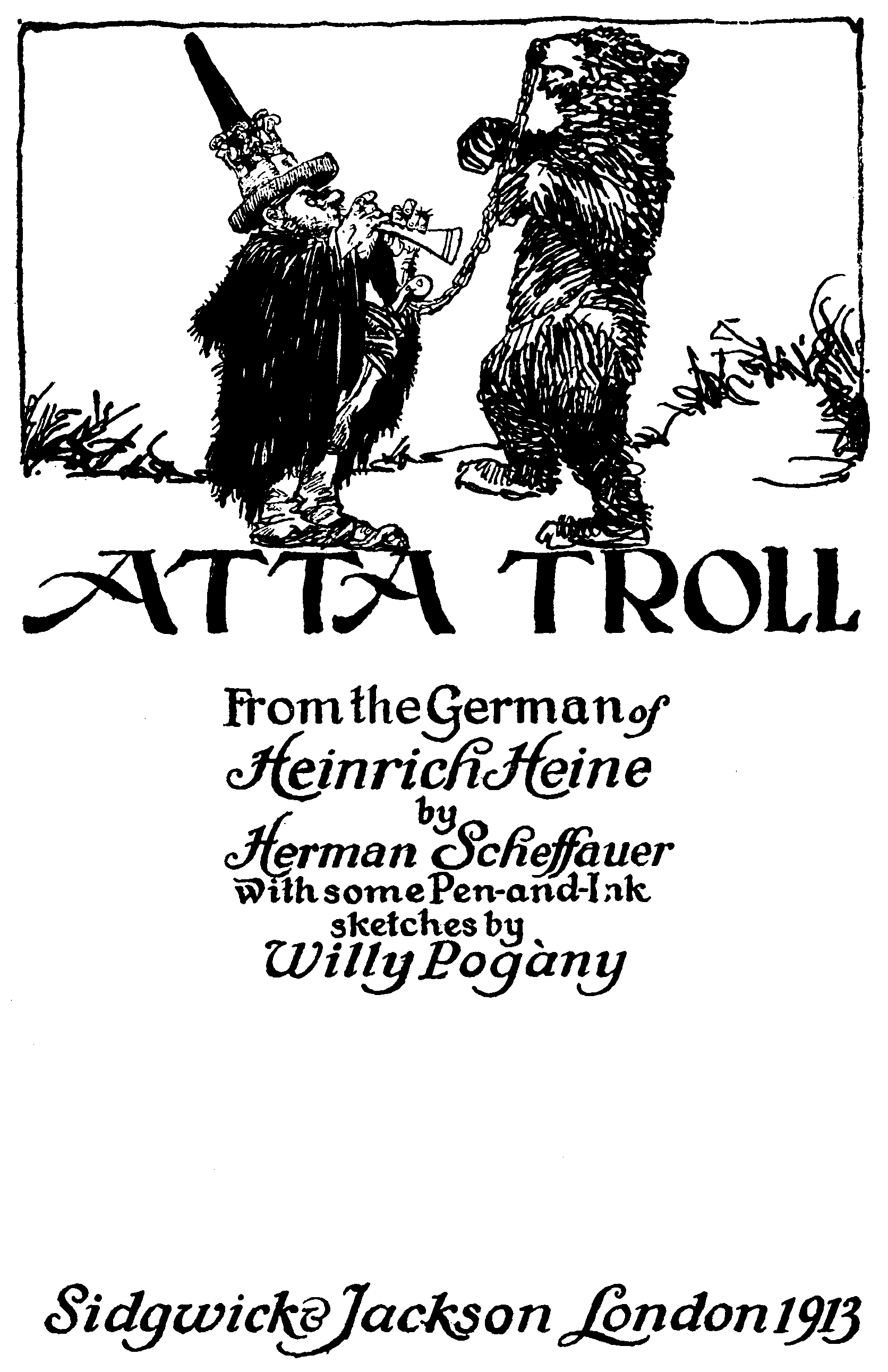
| TITLE-PAGE | iii |
| ATTA TROLL | iv |
| INTRODUCTION (Half-Title) | 1 |
| ATTA TROLL (Half-Title) | 33 |
The headings and tail-pieces to the Cantos are by Horace Taylor
AN INTERPRETATION OF
HEINRICH HEINE'S
"ATTA TROLL"
HE who has visited the idyllic isle of Corfu must have seen, gleaming white amidst its surroundings of dark green under a sky of the deepest blue, the Greek villa which was erected there by Elizabeth, Empress of Austria. It is called the Achilleion. In its garden there is a small classic temple in which the Empress caused to be placed a marble statue of her most beloved of poets, Heinrich Heine. The statue represented the poet seated, his head bowed in profound melancholy, his cheeks thin and drawn and bearded, as in his last illness.
Elizabeth, Empress of Austria, felt a sentimental affinity with the poet; his unhappiness, his Weltschmerz, touched a responsive chord in her own unhappy heart. Intellectual sympathy with Heine's thought or tendencies there could have been little, for no woman has ever quite understood Heinrich Heine, who is still a riddle to most of the men of this age.
After the assassination of the hapless Empress, the beautiful villa was bought by the German Emperor. He at once ordered Heine's statue to be removed—whither no one knows. Royal (as well as popular) spite has before this been vented on dead or inanimate things—one need only ask Englishmen to remember what happened to the body of Oliver Cromwell. The Kaiser's action, by the way, did not pass unchallenged. Not only in Germany but in several other countries indignant voices were raised at the time, protesting against an act so insulting to the memory of the great singer, upholding the fame of Heine as a poet and denouncing the new master of the Achilleion for his narrow and prejudiced views on art and literature.
There was, however, a sound reason for the Imperial interference. Heinrich Heine was in his day an outspoken enemy of Prussia, a severe critic of the House of Hohenzollern and of other Royal houses of Germany. He was one who held in scorn the principles of State and government that are honoured in Germany, and elsewhere, to this very day. He was one of those poets—of whom the nineteenth century produced only a few, but those amongst the greatest—who had begun to distrust the capacity of the reigning aristocracy, who knew what to expect from the rising bourgeoisie, and who were nevertheless not romantic enough to believe in the people and the wonderful possibilities hidden in them. These poets—one and all—have taken up a very negative attitude towards their contemporaries and have given voice to their anger and disappointment over the pettiness of the society and government of their time in words full of satire and contempt.
Of course, the echo on the part of their audiences has not been wanting. All these poets have experienced a fate surprisingly similar, and their relationship to their respective countries reminds one of those unhappy matrimonial alliances which—for social or religious reasons—no divorce can ever dissolve. And, worse than that, no separation either, for a poet is—through his mother tongue—so intimately wedded to his country that not even a separation can effect any sort of relief in such a desperate case. All of them have tried separation, all of them have lived in estrangement from their country—we might almost say that only the local and lesser poets of the last century have stayed at home—and yet in spite of this separation the mutual recriminations of these passionate poetical husbands and their obstinate national wives have never ceased. Again and again we hear the male partner making proposals to win his spouse to better and nobler ways, again and again he tries to "educate her up to himself" and endeavours to direct her anew, pointing out to her the danger of her unruly and stupid behaviour; again and again his loving approaches are thwarted by the well-known waywardness of the feminine character, and so all his friendly admonitions habitually turn into torrents of abuse and vilification. There have been many unhappy unions in the world, but the compulsory mésalliances of such great nineteenth-century writers as Heine, Byron, Stendhal, Gobineau, and Nietzsche with Mesdames Britannia, Gallia, and Germania, those otherwise highly respectable ladies, easily surpass in grotesqueness anything that has come to us through divorce court proceedings in England and America. That, as every one will agree, is saying a good deal.
The German Emperor, as I have said, had some justification for his action, some motives that do credit, if not to his intellect, at least to what in our days best takes the place of intellect; that is to say his character and his principles of government. The German Emperor appears at least to realize how offensive and, from his point of view, dangerous, the spirit of Heinrich Heine is to this very day, how deeply his satire cuts into questions of religion and State, how impatient he is of everything which the German Emperor esteems and venerates in his innermost heart. But the German people, on the whole, and certainly all foreigners, have long ago forgiven the poet, not because they have understood the dead bard better than the Emperor, but because they understood him less well. It is always easier to forgive an offender if you do not understand him too well, it is likewise easier to forgive him if your memory be short. And the peoples likewise resemble our womenfolk in this respect, that as soon as they are widowed of their poets, they easily forget all the unpleasantness that had ever existed between them and their dead husbands. It is then and only then that they discover the good qualities of their dead consorts and go about telling everybody "what a wonderful man he was." Their behaviour reminds me of a picture I once saw in a French comic paper. It represented a widow who, in order to hear her deceased husband's voice, had a gramophone put at his empty place at the breakfast table. And every morning she sat opposite that gramophone weeping quietly into her handkerchief, gazing mournfully at the instrument—decorated with her dead hubby's tasselled cap—and listening to the voice of the dear departed. But the only words which came out of the gramophone every morning were: Mais fiche-moi donc la paix—tu m'empêches de lire mon journal! (For goodness' sake, leave me alone and let me read my paper.) This, however, did not appear to disturb the sentimental widow at all, as little indeed as a good sentimental people resents being abused by its dead poet.
And how our poet did abuse them during his life! And not only during his life, for Heine would not have been a great poet if his loves and hatreds, his censure and his praise had not outlasted his life, nay, had not come to real life only after his death. Thus the shafts of wit and satire which Heine levelled at his age and his country will seem singularly modern to the reader of to-day. It is this peculiar modern significance and application that has been one of the two reasons for presenting to the English public the first popular edition of Heine's lyrico-satiric masterpiece "Atta Troll." The other reason is the fine quality of the translation, made by one who is himself well known as a poet, my friend Herman Scheffauer. I venture to say that it renders in a remarkable degree the elusive brilliance, wit, and tenderness of the German original.
The poem begins in a sprightly fashion full of airy mockery and romantic lyricism. The reader is beguiled as with music and led on as in a dance. Heine himself called it das letzte freie Waldlied der Romantik ("The last free woodland-song of Romanticism"); and so we hear the alluring sound of flutes and harps, we listen to the bells ringing from lonely chapels in the forest, and many beautiful flowers nod to us, the mysterious blue flower amongst them. Then our eyes rejoice at the sight of fair maidens, whose nude and slender bodies gleam from under their floods of golden hair, who ride on white horses and throw us provocative glances, that warm and quicken our innermost hearts. But just as we are on the point of responding to their fond entreaties we are startled by the cracking of the wild hunter's whip, and we hear the loud hallo and huzza of his band, and see them galloping across our path in the eerie mysterious moonlight. Yes, in "Atta Troll" there is plenty of that moonshine, of that tender sentimentality, which used to be the principal stock-in-trade of the German Romanticist.
But this moonshine and all the other paraphernalia of the Romantic School Heine handled with all the greater skill, inasmuch as he was no longer a real Romanticist when he wrote "Atta Troll." He had left the Romantic School long ago, not without (as he himself tells us) "having given a good thrashing to his schoolmaster." He was now a Greek, a follower of Spinoza and Goethe. He was a Romantique défroqué—one who had risen above his neurotic fellow-poets and their hazy ideas and wild endeavours. But for this very reason he is able to use their mode of expression with so much the greater skill, and, knowing all their shortcomings, he could give to his Dreamland a semblance of reality which they could never achieve. Only after having left a town are we in a position to judge the height of its church steeple, only as exiles do we begin to see the right relation in which our country stands to the rest of the world, and only a poet who had bidden farewell to his party and school, who had freed himself from Romanticism, could give us the last, the truest, the most beautiful poem of Romanticism.
It is possible, even probable, that "Atta Troll" will appeal to a majority of readers, not through its satire, but through its wonderful lyrical and romantic qualities—our age being inclined to look askance at satire, at least at true satire, at satire that, as the current phrase goes, "means business." Weak satire, aimless satire, humour, caricature—that is to say satire which uses blank cartridges—this age of ours will readily endure, nay heartily welcome; but of true satire, of satire that goes in for powder and shot, that does not only crack, but kill, it is mortally, and, if one comes to think of it rightly, afraid. But let even those who object to powder and shot approach "Atta Troll" without fear or misgiving. They will not be disappointed. They will find in this work proof of the old truth that a satirist is always and originally a man of high ideals and imagination. They will gain an insight into his much slandered soul, which is always that of a great poet. They will readily understand that this poet only became a satirist through the vivacity of his imagination, through the strength of his poetic vision, through his optimistic belief in humanity and its possibilities; and that it was precisely this great faith which forced him to become a satirist, because he could not endure to see all his pure ideals and the possibilities of perfection soiled and trampled upon by thoughtless mechanics, aimless mockers and babbling reformers. The humorist may be—and very often is—a sceptic, a pessimist, a nihilist; the satirist is invariably a believer, an optimist, an idealist. For let this dangerous man only come face to face, not with his enemies, but with his ideals, and you will see—as in "Atta Troll"—what a generous friend, what an ardent lover, what a great poet he is. Thus no one will be in the least disturbed by Heine's satire: on the contrary, those who object to it on principle will hardly be aware of it, so delighted will they be with the wonderful imagination, the glowing descriptions, and the passionate lyrics in which the poetry of "Atta Troll" abounds. The poem may be and will be read by them as "Gulliver's Travels" is read to-day by young and old, by poet and politician alike, not for its original satire, but for its picturesque, dramatic, and enthralling tale.
But let those who still believe that writing is fighting, and not sham-fighting only, those who hold that a poet is a soldier of the pen and therefore the most dangerous of all soldiers, those who feel that our age needs a hailstorm of satire, let these, I say, look closer at the wonderfully ideal figures that pass before them in the pale mysterious light. Let them listen more intently to the flutes and harps and they will discover quite a different melody beneath—a melody by no means bewitching or soothing, nor inviting us to dreams, sweet forgetfulness, soft couches, and tender embraces, but a shrill and mocking tune that is at times insolently discordant and that strikes us as decidedly modern, realistic, and threatening. As the poet himself expressed it in his dedication to Varnhagen von Ense:
"Aye, my friend, such strains arise
From the dream-time that is dead
Though some modern trills may oft
Caper through the ancient theme.
"Spite of waywardness thou'lt find
Here and there a note of pain...."
Let their ears seek to catch these painful notes. Let their eyes accustom themselves to the deceitful light of the moon; let them endeavour to pierce through the romanticism on the surface to the underlying meaning of the poem.... A little patience and we shall see clearly....
Atta Troll, the dancing bear, is the representative of the people. He has—by means of the French Revolution, of course—broken his fetters and escaped to the freedom of the mountains. Here he indulges in that familiar ranting of a sansculotte, his heart and mouth brimming over with what Heine calls frecher Gleichheitsschwindel ("the barefaced swindle of equality"). His hatred is above all directed against the masters from whose bondage he has just escaped, that is to say against all mankind as a race. As a "true and noble bear" he simply detests these human beings with their superior airs and impudent smiles, those arrogant wretches, who fancy themselves something lofty, because they eat cooked meat and know a few tricks and sciences. Animals, if properly trained, if only equality of opportunity were given to them, could learn these tricks just as well—there is therefore no earthly reason why
"these men,
Cursèd arch-aristocrats,
Should with haughty insolence
Look upon the world of beasts."
The beasts, so Atta Troll declares, ought not to allow themselves to be treated in this wise. They ought to combine amongst themselves, for it is only by means of proper union that the requisite degree of strength can ever be attained. After the establishment of this powerful union they should try to enforce their programme and demand the abolition of private property and of human privileges:
"And its first great law shall be
For God's creatures one and all
Equal rights—no matter what
Be their faith, or hide, or smell,
"Strict equality! Each ass
May become Prime Minister,
On the other hand the lion
Shall bear corn unto the mill."
This outrageous diatribe of the freed slave cuts deeply into the poet's heart. He, the poet, does not believe in equal, but in the "holy inborn" rights of men, the rights of valid birth, the rights of the man of ἁρετἡ. He, the poet, the admirer of Napoleon, believes in the latter's la carrière ouverte aux talents, but not in opportunity given to every dunce or dancing bear. He holds Atta Troll's opinion to be "high treason against the majesty of humanity," and since he can endure this no longer, he sets out one fine morning to hunt the insolent bear in his mountain fastnesses.
A strange being, however, accompanies him. This is a man of the name of Lascaro, a somewhat abnormal fellow, who is very thin, very pale, and apparently in very poor health. He is consequently not exactly a pleasant comrade for the chase: he does not seem to enjoy the sport at all, and his one endeavour is to get through with his task without losing more of his strength and health. Even now he is more of an automaton than a human being, more dead than alive, and yet—greatest of all miseries!—he is not allowed to die. For he has a mother, the witch Uraka, who keeps him artificially alive by anointing him every night with magic salve and giving him such diabolic advice as will be useful to him during the day. By means of the sham health she gives to her son, the magic bullets she casts for him, the tricks and wiles she teaches him, Lascaro is enabled to find the track of Atta Troll, to lure him out of his lair and to lay him low with a treacherous shot.
Who is this silent Lascaro and his mysterious mother, whom the poet seems to hold in as slight regard as the noisy Atta Troll? Who is this Lascaro, whose methods he deprecates, whose health he doubts, whose cold ways and icy smiles make him shudder? Who is this chilliest of all monsters? The chilliest of all monsters—we may find the answer in "Zarathustra"—is the State: and our Lascaro is nothing else than the spirit of reactionary government, kept artificially alive by his old witch-mother, the spirit of Feudalism. The nightly anointing of Lascaro is a parody on the revival of mediæval customs, by means of which the frightened aristocracy of Europe in the middle of the last century tried to stem the tide of the French Revolution—the anointed of the Lord becoming in Heine's poem the anointed of the witch. But in spite of his nightly massage, our Lascaro does not gain much strength or spirit: no mediæval salves, no feudal pills, no witch's spell, will ever cure him. Not even a wizard's experiments (we may add, with that greater insight bestowed upon us by history) could do him any good, not even the astute magic tricks that were lavished upon the patient in Heine's time by that arch wizard, the Austrian Minister Metternich. For we must not forget the time in which "Atta Troll" was written, the time of the omnipotent Metternich! Let us recall to our memories this cool, clever, callous statesman, who founded and set the Holy Alliance against the Revolution, who calmly shot down the German Atta Troll, who skilfully strangled and stifled that promising poetical school, "Young Germany," to which Heine belonged. Let us recall this man, who likewise artificially revived the old religion and the old feudalism, who repolished and regilded the scutcheons of the decadent aristocracy, and who, despite all his energy, had at heart no belief in his work, no joy in his task, no faith in the anointed dummies he brought to life again in Europe—and those puzzling personalities of Uraka and Lascaro will be elucidated to us by a real historical example.
Metternich is now part of history. But, alas! we cannot likewise banish into that limbo of the past those two superfluous individuals, the revolutionary Atta Troll and the reactionary Lascaro. Alas! we cannot join the joyful, but inwardly so hopeless, band of those who sing the pæan of eternal progress, who pretend to believe that the times are always "changing for the better." Let these good people open their eyes, and they will see that Atta Troll was not shot down in the valley of Roncesvalles, but that he is still alive, very much alive, and making a dreadful noise, and that not in the Pyrenees, but just outside our doors, where he still keeps haranguing about equality and liberty and occasionally breaks his fetters and escapes from his masters. And when this occurs, then that icy monster Lascaro is likewise seen, with his hard, pallid face and his joyless mouth, and his disgust with his own task and his doubts and disbeliefs in himself. He still carries his gun and he still possesses some of that craftiness which his mother the witch has taught him, and he still knows how to entrap that poor, stupid Atta Troll, and to shoot him down when the spirit of "order and government," the spirit of a soulless capitalism, requires it.
No, there is very little feeling in the man as yet, and he seems as difficult to move as ever. There is apparently only one thing that can rouse him into action, and that is when a poet appears, one who knows the truth and who dares to speak the truth not only about Atta Troll, the people, but also about its Lascaros, its leaders, its emperors, and kings. Then and then only his hard features change, and his affected self-possession leaves him, then and then only his mask of calmness is thrown off, and he waxes very angry with the poet, and has his name banished from his court and his statues turned out of his cities and villas—nay, he would even level his gun to slay the truth-telling poet as he slew Atta Troll.
From which we may see that the modern Lascaro has become a sort of Don Quixote—for, truly is it not the height of folly for a mortal emperor to shoot at an immortal poet?
OSCAR LEVY
PREFACE BY HEINE
"ATTA TROLL" was composed in the late autumn of 1841, and appeared as a fragment in The Elegant World, of which my friend Laube had at that time resumed the editorship. The shape and contents of the poem were forced to conform to the narrow necessities of that periodical. I wrote at first only those cantos which might be printed and even these suffered many variations. It was my intention to issue the work later in its full completeness, but this commendable resolve remained unfulfilled—like all the mighty works of the Germans—such as the cathedral of Cologne, the God of Schelling, the Prussian Constitution, and the like. This also happened to "Atta Troll"—he was never finished. In such imperfect form, indifferently bolstered up and rounded only from without, do I now set him before the public, obedient to an impulse which certainly does not proceed from within.
"Atta Troll," as I have said, originated in the late autumn of 1841, at the time when the great mob which my enemies of various complexions, had drummed together against me, had not quite ceased its noise. It was a very large mob and indeed I would never have believed that Germany could produce so many rotten apples as then flew about my head! Our Fatherland is a blessed country! Citrons and oranges certainly do not grow here, and the laurel ekes out but a miserable existence, but rotten apples thrive in the happiest abundance, and never a great poet of ours but could write feelingly of them! On the occasion of that hue and cry in which I was to lose both my head and my laurels it happened that I lost neither. All the absurd accusations which were used to incite the mob against me have since then been miserably annihilated, even without my condescending to refute them. Time justified me, and the various German States have even, as I must most gratefully acknowledge, done me good service in this respect. The warrants of arrest which at every German station past the frontier await the return of this poet, are thoroughly renovated every year during the holy Christmastide, when the little candles glow merrily on the Christmas trees. It is this insecurity of the roads which has almost destroyed my pleasure in travelling through the German meads. I am therefore celebrating my Christmas in an alien land, and it will be as an exile in a foreign country that I shall end my days.
But those valiant champions of Light and Truth who accuse me of fickleness and servility, are able to go about quite securely in the Fatherland—as well-stalled servants of the State, as dignitaries of a Guild, or as regular guests of a club where of evenings they may regale themselves with the vinous juices of Father Rhine and with "sea-surrounded Schleswig-Holstein" oysters.
It was my express intention to indicate in the foregoing at what period "Atta Troll" was written. At that time the so-called art of political poetry was in full flower. The opposition, as Ruge says, sold its leather and became poetry. The Muses were given strict orders that they were thenceforth no longer to gad about in a wanton, easy-going fashion, but would be compelled to enter into national service, possibly as vivandières of liberty or as washerwomen of Christian-Germanic nationalism. Especially were the bowers of the German bards afflicted by that vague and sterile pathos, that useless fever of enthusiasm which, with absolute disregard for death, plunges itself into an ocean of generalities. This always reminds me of the American sailor who was so madly enthusiastic over General Jackson that he sprang from the mast-head into the sea, crying out: "I die for General Jackson!" Yes, even though we Germans as yet possessed no fleet, still we had plenty of sailors who were willing to die for General Jackson, in prose or verse. In those days talent was a rather questionable gift, for it brought one under suspicion of being a loose character. After thousands of years of grubbing deliberation, Impotence, sick and limping Impotence, at last discovered its greatest weapon against the over-encouragement of genius—it discovered, in fact, the antithesis between Talent and Character. It was almost personally flattering to the great masses when they heard it said that good, average people were certainly poor musicians as a rule, but that, on the other hand, fine musicians were not usually good people—that goodness was the important thing in this world and not music. Empty-Head now beat resolutely upon his full Heart, and Sentiment was trumps. I recall an author of that day who accounted his inability to write as a peculiar merit in himself, and who, because of his wooden style, was given a silver cup of honour.
By the eternal gods! at that time it became necessary to defend the inalienable rights of the spirit, above all in poetry. Inasmuch as I have made this defence the chief business of my life, I have kept it constantly before me in this poem whose tone and theme are both a protest against the plebiscite of the tribunes of the times. And verily, even the first fragments of "Atta Troll" which saw the light, aroused the wrath of my heroic worthies, my dear Romans, who accused me not only of a literary but also of a social reaction, and even of mocking the loftiest human ideals. As to the esthetic worth of my poem—of that I thought but little, as I still do to-day—I wrote it solely for my own joy and pleasure, in the fanciful dreamy manner of that romantic school in which I whiled away my happiest years of youth, and then wound up by thrashing the schoolmaster. Possibly in this regard my poem is to be condemned. But thou liest, Brutus, thou too, Cassius, and even thou, Asinius, when ye declare that my mockery is levelled against those ideals which constitute the noble achievements of man, for which I too have wrought and suffered so much. No, it is just because the poet constantly sees these ideas before him in all their clarity and greatness that he is forced into irresistible laughter when he beholds how raw, awkward, and clumsy these ideas may appear when interpreted by a narrow circle of contemporary spirits. Then perforce must he jest about their thick temporal hides—bear hides. There are mirrors which are ground in so irregular a way that even an Apollo would behold himself as a caricature in them, and invite laughter. But we do not laugh at the god but merely at his distorted image.
Another word. Need I lay any special emphasis upon the fact that the parodying of one of Freiligrath's poems, which here and there somewhat saucily titters from the lines of "Atta Troll," in no wise constitutes a disparagement of that poet? I value him highly, especially at present, and account him one of the most important poets who have arisen in Germany since the Revolution of 1830. His first collection of poems came to my notice rather late, namely just at the time when I was composing "Atta Troll." The fact that the Moorish Prince affected me so comically was no doubt due to my particular mood at that time. Moreover, this work of his is usually vaunted as his best. To such readers as may not be acquainted with this production—and I doubt not such may be found in China and Japan, and even along the banks of the Niger and Senegal—I would call attention to the fact that the Blackamoor King, who at the beginning of the poem steps from his white tent like an eclipsed moon, is beloved by a black beauty over whose dusky features nod white ostrich plumes. But, eager for war, he leaves her, and enters into the battles of the blacks, "where rattles the drum decorated with skulls," but, alas! here he finds his black Waterloo, and is sold by the victors unto the whites. They take the noble African to Europe and here we find him in a company of itinerant circus folk who intrust him with the care of the Turkish drum at their performances. There he stands, dark and solemn, at the entrance to the ring, and drums. But as he drums he thinks of his erstwhile greatness, remembers, too, that he was once an absolute monarch on the far, far banks of the Niger, that he hunted lions and tigers:
"His eye grew moist; with hollow thunder
He beat the drum, till it sprang in sunder."
HEINRICH HEINE
Out of the gleaming, shimmering tents of white
Steps the Prince of the Moors in his armour bright—
So out of the slumbering clouds of night,
The moon in its dark eclipse takes flight.
"The Prince of Blackamoors,"
by Ferdinand Freiligrath.