
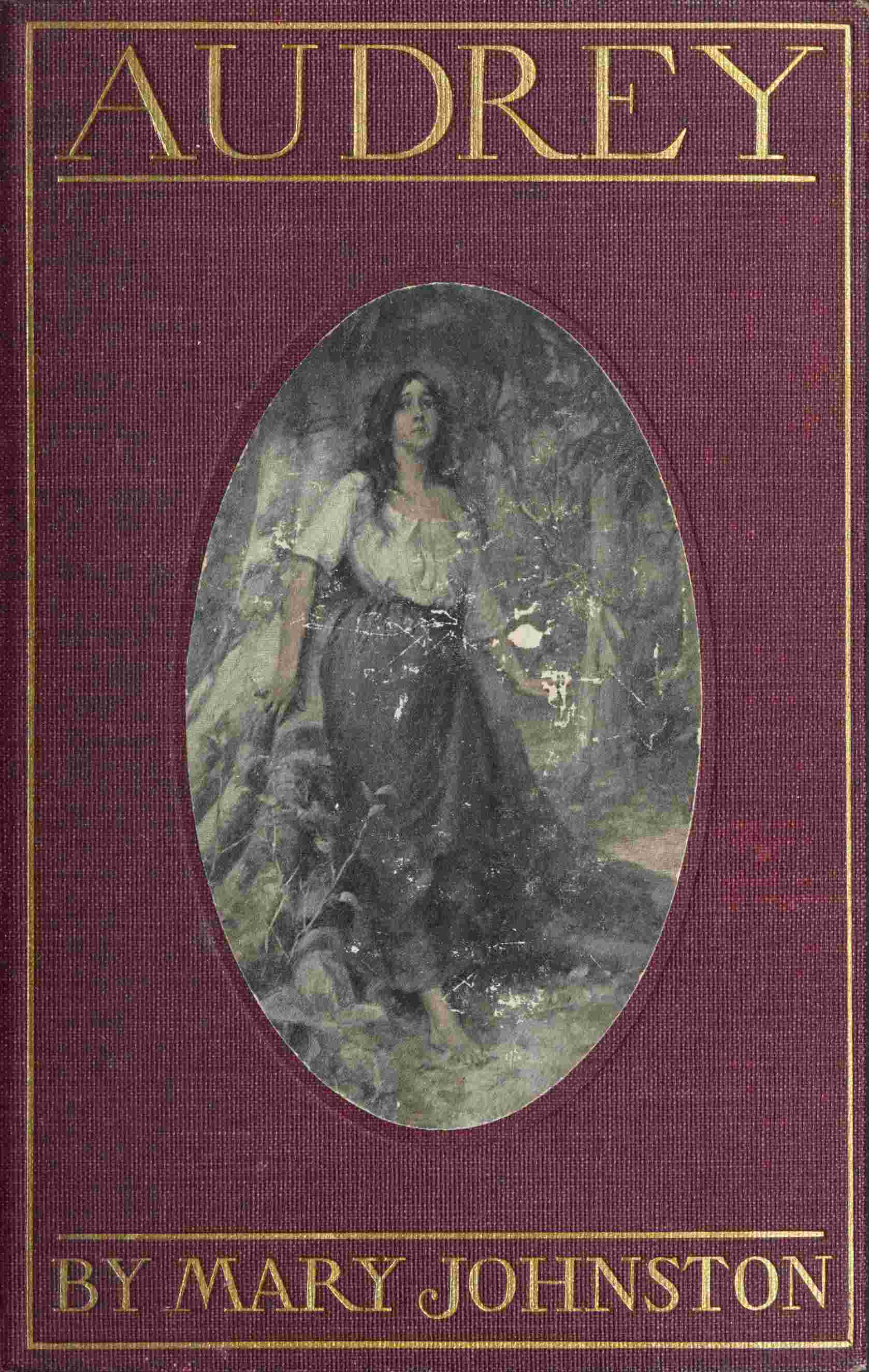
"Ma'm'selle Audrey," whispered the trader, staring as at a spirit.
"Yes, Jean Hugon," she answered, and looked down the glimmering reaches of the James, then at the slender canoe and the deep and dark water that flowed between the piles. In the slight craft, with that strong man the river for ally, she were safe as in a tower of brass.
"I am going home, Jean," she said. "Will you row me down the river to-night, and tell me as we go your stories of the woods and your father's glories in France? If you speak of other things I will drown myself, for I am tired of hearing them. In the morning we will stop at some landing for food, and then go on again. Let us hasten"—
The trader moistened his lips. "And him," he demanded hoarsely,—"that Englishman, that Marmaduke Haward of Fair View, who came to me and said, 'Half-breed, seeing that an Indian and a bloodhound have gifts in common, we will take up the quest together. Find her, though it be to lose her to me that same hour! And look that in our travels you try no foul play, for this time I go armed,'—what of him?"
Audrey waved her hand toward the house she had left. "He is there. Let us make haste." As she spoke she descended the steps, and, evading his eager hand, stepped into the canoe. He looked at her doubtfully, half afraid, so strange was it to see her sitting there, so like a spirit from the land beyond the sun, a revenant out of one of old Pierre's wild tales, had she come upon him. With quickened breath he loosed the canoe from its mooring and took up the paddle. A moment, and they were quit of the Westover landing and embarked upon a strange journey, during which hour after hour Hugon made wild love, and hour after hour Audrey opened not her lips. As the canoe went swiftly down the flood, lights sprung up in the house it was leaving behind. A man, rising from his chair with a heavy sigh, walked to the parlor window and looked out upon lawn and sky and river, but, so dark had it grown, saw not the canoe; thought only how deserted, how desolate and lonely, was the scene.
In Williamsburgh as at Westover the autumn was dying, the winter was coming, but neither farewell nor greeting perturbed the cheerful town. To and fro through Palace and Nicholson and Duke of Gloucester streets were blown the gay leaves; of early mornings white frosts lay upon the earth like fairy snows, but midday and afternoon were warm and bright. Mistress Stagg's garden lay to the south, and in sheltered corners bloomed marigolds and asters, while a vine, red-leafed and purple-berried, made a splendid mantle for the playhouse wall.
Within the theatre a rehearsal of "Tamerlane" was in progress. Turk and Tartar spoke their minds, and Arpasia's death cry clave the air. The victorious Emperor passed final sentence upon Bajazet; then, chancing to glance toward the wide door, suddenly abdicated his throne, and in the character of Mr. Charles Stagg blew a kiss to his wife, who, applauding softly, stood in the opening that was framed by the red vine.
"Have you done, my dear?" she cried. "Then pray come with me a moment!"
The two crossed the garden, and entered the grape arbor where in September Mistress Stagg had entertained her old friend, my Lady Squander's sometime waiting-maid. Now the vines were bare of leaves, and the sunshine streaming through lay in a flood upon the earth. Mary Stagg's chair was set in that golden warmth, and upon the ground beside it had fallen some bright sewing. The silken stuff touched a coarser cloth, and that was the skirt of Darden's Audrey, who sat upon the ground asleep, with her arm across the chair, and her head upon her arm.
"How came she here?" demanded Mr. Stagg at last, when he had given a tragedy start, folded his arms, and bent his brows.
"She ran away," answered Mistress Stagg, in a low voice, drawing her spouse to a little distance from the sleeping figure. "She ran away from the glebe house and went up the river, wanting—the Lord knows why!—to reach the mountains. Something happened to bring her to her senses, and she turned back, and falling in with that trader, Jean Hugon, he brought her to Jamestown in his canoe. She walked from there to the glebe house,—that was yesterday. The minister was away, and Deborah, being in one of her passions, would not let her in. She's that hard, is Deborah, when she's angry, harder than the nether millstone! The girl lay in the woods last night. I vow I'll never speak again to Deborah, not though there were twenty Baths behind us!" Mistress Stagg's voice began to tremble. "I was sitting sewing in that chair, now listening to your voices in the theatre, and now harking back in my mind to old days when we weren't prosperous like we are now.... And at last I got to thinking of the babe, Charles, and how, if she had lived and grown up, I might ha' sat there sewing a pretty gown for my own child, and how happy I would have made her. I tried to see her standing beside me, laughing, pretty as a rose, waiting for me to take the last stitch. It got so real that I raised my head to tell my dead child how I was going to knot her ribbons, ... and there was this girl looking at me!"
"What, Millamant! a tear, my soul?" cried the theatric Mr. Stagg.
Millamant wiped away the tear. "I'll tell you what she said. She just said: 'You were kind to me when I was here before, but if you tell me to go away I'll go. You need not say it loudly.' And then she almost fell, and I put out my arm and caught her; and presently she was on her knees there beside me, with her head in my lap.... And then we talked together for a while. It was mostly me—she didn't say much—but, Charles, the girl's done no wrong, no more than our child that's dead and in Christ's bosom. She was so tired and worn. I got some milk and gave it to her, and directly she went to sleep like a baby, with her head on my knee."
The two went closer, and looked down upon the slender form and still, dark face. The sleeper's rest was deep. A tress of hair, fallen from its fastening, swept her cheek; Mistress Stagg, stooping, put it in place behind the small ear, then straightened herself and pressed her Mirabell's arm.
"Well, my love," quoth that gentleman, clearing his throat. "'Great minds, like Heaven, are pleased in doing good.' My Millamant, declare your thoughts!"
Mistress Stagg twisted her apron hem between thumb and finger. "She's more than eighteen, Charles, and anyhow, if I understand it rightly, she was never really bound to Darden. The law has no hold on her, for neither vestry nor Orphan Court had anything to do with placing her with Darden and Deborah. She's free to stay."
"Free to stay?" queried Charles, and took a prodigious pinch of snuff. "To stay with us?"
"Why not?" asked his wife, and stole a persuasive hand into that of her helpmate. "Oh, Charles, my heart went out to her! I made her so beautiful once, and I could do it again and all the time. Don't you think her prettier than was Jane Day? And she's graceful, and that quick to learn! You're such a teacher, Charles, and I know she'd do her best.... Perhaps, after all, there would be no need to send away to Bristol for one to take Jane's place."
"H'm!" said the great man thoughtfully, and bit a curl of Tamerlane's vast periwig. "'Tis true I esteem her no dullard," he at last vouchsafed; "true also that she hath beauty. In fine, solely to give thee pleasure, my Millamant, I will give the girl a trial no later than this very afternoon."
Audrey stirred in her sleep, spoke Haward's name, and sank again to rest. Mr. Stagg took a second pinch of snuff. "There's the scandal, my love. His Excellency the Governor's ball, Mr. Eliot's sermon, Mr. Marmaduke Haward's illness and subsequent duels with Mr. Everard and Mr. Travis, are in no danger of being forgotten. If this girl ever comes to the speaking of an epilogue, there'll be in Williamsburgh a nine days' wonder indeed!"
"The wonder would not hurt," said Mistress Stagg simply.
"Far from it, my dear," agreed Mr. Stagg, and closing his snuffbox, went with a thoughtful brow back to the playhouse and the Tartar camp.
CHAPTER XXVII
THE MISSION OF TRUELOVE
Mistress Truelove Taberer, having read in a very clear and gentle voice the Sermon on the Mount to those placid Friends, Tobias and Martha Taberer, closed the book, and went about her household affairs with a quiet step, but a heart that somehow fluttered at every sound without the door. To still it she began to repeat to herself words she had read: "Blessed are the peacemakers, for they shall be called the children of God ... blessed are the peacemakers"—
Winter sunshine poured in at the windows and door. Truelove, kneeling to wipe a fleck of dust from her wheel, suddenly, with a catch of her breath and a lifting of her brown eyes, saw in the Scripture she had been repeating a meaning and application hitherto unexpected. "The peacemaker ... that is one who makes peace,—in the world, between countries, in families, yea, in the heart of one alone. Did he not say, last time he came, that with me he forgot this naughty world and all its strife; that if I were always with him"—
Truelove's countenance became exalted, her gaze fixed. "If it were a call"—she murmured, and for a moment bowed her head upon the wheel; then rose from her knees and went softly through the morning tasks. When they were over, she took down from a peg and put on a long gray cloak and a gray hood that most becomingly framed her wild-rose face; then came and stood before her father and mother. "I am going forth to walk by the creekside," she said, in her sweet voice. "It may be that I will meet Angus MacLean."
"If thee does," answered one tranquil Friend, "thee may tell him that upon next seventh day meeting will be held in this house."
"Truly," said the other tranquil Friend, "my heart is drawn toward that young man. His mind hath been filled with anger and resistance and the turmoil of the world. It were well if he found peace at last."
"Surely it were well," agreed Truelove sweetly, and went out into the crisp winter weather.
The holly, the pine, and the cedar made green places in the woods, and the multitude of leaves underfoot were pleasant to tread. Clouds were in the sky, but the spaces between were of serenest blue, and in the sunshine the creek flashed diamonds. Truelove stood upon the bank, and, with her hand shading her eyes, watched MacLean rowing toward her up the creek.
When he had fastened his boat and taken her hand, the two walked soberly on beside the sparkling water until they came to a rude seat built beneath an oak-tree, to which yet clung a number of brown leaves. Truelove sat down, drawing her cloak about her, for, though the sun shone, the air was keen. MacLean took off his coat, and kneeling put it beneath her feet. He laughed at her protest. "Why, these winds are not bleak!" he said. "This land knows no true and honest cold. In my country, night after night have I lain in snow with only my plaid for cover, and heard the spirits call in the icy wind, the kelpie shriek beneath the frozen loch. I listened; then shut my eyes and dreamed warm of glory and—true love."
"Thy coat is new," said Truelove, with downcast eyes. "The earth will stain the good cloth."
MacLean laughed. "Then will I wear it stained, as 'tis said a courtier once wore his cloak."
"There is lace upon it," said Truelove timidly.
MacLean turned with a smile, and laid a fold of her cloak against his dark cheek. "Ah, the lace offends you,—offends thee,—Truelove. Why, 'tis but to mark me a gentleman again! Last night, at Williamsburgh, I supped with Haward and some gentlemen of Virginia. He would have me don this suit. I might not disoblige my friend."
"Thee loves it," said Truelove severely. "Thee loves the color, and the feel of the fine cloth, and the ruffles at thy wrists."
The Highlander laughed. "Why, suppose that I do! Look, Truelove, how brave and red are those holly berries, and how green and fantastically twisted the leaves! The sky is a bright blue, and the clouds are silver; and think what these woods will be when the winter is past! One might do worse, meseems, than to be of God's taste in such matters."
Truelove sighed, and drew her gray cloak more closely around her.
"Thee is in spirits to-day, Angus MacLean," she said, and sighed once more.
"I am free," he answered. "The man within me walks no longer with a hanging head."
"And what will thee do with thy freedom?"
The Highlander made no immediate reply, but, chin in hand, studied the drifts of leaves and the slow-moving water. "I am free," he said at last. "I wear to-day the dress of a gentleman. I could walk without shame into a hall that I know, and find there strangers, standers in dead men's shoon, brothers who want me not,—who would say behind their hands, 'He has been twelve years a slave, and the world has changed since he went away!' ... I will not trouble them."
His face was as sombre as when Truelove first beheld it. Suddenly, and against her will, tears came to her eyes. "I am glad—I and my father and mother and Ephraim—that thee goes not overseas, Angus MacLean," said the dove's voice. "We would have thee—I and my father and mother and Ephraim—we would have thee stay in Virginia."
"I am to stay," he answered. "I have felt no shame in taking a loan from my friend, for I shall repay it. He hath lands up river in a new-made county. I am to seat them for him, and there will be my home. I will build a house and name it Duart; and if there are hills they shall be Dun-da-gu and Grieg, and the sound of winter torrents shall be to me as the sound of the waters of Mull."
Truelove caught her breath. "Thee will be lonely in those forests."
"I am used to loneliness."
"There be Indians on the frontier. They burn houses and carry away prisoners. And there are wolves and dangerous beasts"—
"I am used to danger."
Truelove's voice trembled more and more. "And thee must dwell among negroes and rude men, with none to comfort thy soul, none to whom thee can speak in thy dark hours?"
"Before now I have spoken to the tobacco I have planted, the trees I have felled, the swords and muskets I have sold."
"But at last thee came and spoke to me!"
"Ay," he answered. "There have been times when you saved my soul alive. Now, in the forest, in my house of logs, when the day's work is done, and I sit upon my doorstep and begin to hear the voices of the past crying to me like the spirits in the valley of Glensyte, I will think of you instead."
"Oh!" cried Truelove. "Speak to me instead, and I will speak to thee ... sitting upon the doorstep of our house, when our day's work is done!"
Her hood falling back showed her face, clear pink, with dewy eyes. The carnation deepening from brow to throat, and the tears trembling upon her long lashes, she suddenly hid her countenance in her gray cloak. MacLean, on his knees beside her, drew away the folds. "Truelove, Truelove! do you know what you have said?"
Truelove put her hand upon her heart. "Oh, I fear," she whispered, "I fear that I have asked thee, Angus MacLean, to let me be—to let me be—thy wife."
The water shone, and the holly berries were gay, and a robin redbreast sang a cheerful song. Beneath the rustling oak-tree there was ardent speech on the part of MacLean, who found in his mistress a listener sweet and shy, and not garrulous of love. But her eyes dwelt upon him and her hand rested at ease within his clasp, and she liked to hear him speak of the home they were to make in the wilderness. It was to be thus, and thus, and thus! With impassioned eloquence the Gael adorned the shrine and advanced the merit of the divinity, and the divinity listened with a smile, a blush, a tear, and now and then a meek rebuke.
When an hour had passed, the sun went under a cloud and the air grew colder. The bird had flown away, but in the rising wind the dead leaves rustled loudly. MacLean and Truelove, leaving their future of honorable toil, peace of mind, and enduring affection, came back to the present.
"I must away," said the Highlander. "Haward waits for me at Williamsburgh. To-morrow, dearer to me than Deirdre to Naos! I will come again."
Hand in hand the two walked slowly toward that haunt of peace, Truelove's quiet home. "And Marmaduke Haward awaits thee at Williamsburgh?" said the Quakeress. "Last third day he met my father and me on the Fair View road, and checked his horse and spoke to us. He is changed."
"Changed indeed!" quoth the Highlander. "A fire burns him, a wind drives him; and yet to the world, last night"—He paused.
"Last night?" said Truelove.
"He had a large company at Marot's ordinary," went on the other. "There were the Governor and his fellow Councilors, with others of condition or fashion. He was the very fine gentleman, the perfect host, free, smiling, full of wit. But I had been with him before they came. I knew the fires beneath."
The two walked in silence for a few moments, when MacLean spoke again: "He drank to her. At the last, when this lady had been toasted, and that, he rose and drank to 'Audrey,' and threw his wineglass over his shoulder. He hath done what he could. The world knows that he loves her honorably, seeks her vainly in marriage. Something more I know. He gathered the company together last evening that, as his guests, the highest officers, the finest gentlemen of the colony, should go with him to the theatre to see her for the first time as a player. Being what they were, and his guests, and his passion known, he would insure for her, did she well or did she ill, order, interest, decent applause." MacLean broke off with a short, excited laugh. "It was not needed,—his mediation. But he could not know that; no, nor none of us. True, Stagg and his wife had bragged of the powers of this strangely found actress of theirs that they were training to do great things, but folk took it for a trick of their trade. Oh, there was curiosity enough, but 'twas on Haward's account.... Well, he drank to her, standing at the head of the table at Marot's ordinary, and the glass crashed over his shoulder, and we all went to the play."
"Yes, yes!" cried Truelove, breathing quickly, and quite forgetting how great a vanity was under discussion.
"'Twas 'Tamerlane,' the play that this traitorous generation calls for every 5th of November. It seems that the Governor—a Whig as rank as Argyle—had ordered it again for this week. 'Tis a cursed piece of slander that pictures the Prince of Orange a virtuous Emperor, his late Majesty of France a hateful tyrant. But for Haward, whose guest I was, I had not sat there with closed lips. I had sprung to my feet and given those flatterers, those traducers, the lie! The thing taunted and angered until she entered. Then I forgot."
"And she—and Audrey?"
"Arpasia was her name in the play. She entered late; her death came before the end; there was another woman who had more to do. It all mattered not, I have seen a great actress."
"Darden's Audrey!" said Truelove, in a whisper.
"That at the very first; not afterwards," answered MacLean. "She was dressed, they say, as upon the night at the Palace, that first night of Haward's fever. When she came upon the stage, there was a murmur like the wind in the leaves. She was most beautiful,—'beauteous in hatred,' as the Sultan in the play called her,—dark and wonderful, with angry eyes. For a little while she must stand in silence, and in these moments men and women stared at her, then turned and looked at Haward. But when she spoke we forgot that she was Darden's Audrey."
MacLean laughed again. "When the play was ended,—or rather, when her part in it was done,—the house did shake so with applause that Stagg had to remonstrate. There's naught talked of to-day in Williamsburgh but Arpasia; and when I came down Palace Street this morning, there was a great crowd about the playhouse door. Stagg might sell his tickets for to-night at a guinea apiece. 'Venice Preserved' is the play."
"And Marmaduke Haward,—what of him?" asked Truelove softly.
"He is English," said MacLean, after a pause. "He can make of his face a smiling mask, can keep his voice as even and as still as the pool that is a mile away from the fierce torrent its parent. It is a gift they have, the English. I remember at Preston"—He broke off with a sigh. "There will be an end some day, I suppose. He will win her at last to his way of thinking; and having gained her, he will be happy. And yet to my mind there is something unfortunate, strange and fatal, in the aspect of this girl. It hath always been so. She is such a one as the Lady in Green. On a Halloween night, standing in the twelfth rig, a man might hear her voice upon the wind. I would old Murdoch of Coll, who hath the second sight, were here: he could tell the ending of it all."
An hour later found the Highlander well upon his way to Williamsburgh, walking through wood and field with his long stride, his heart warm within him, his mind filled with the thought of Truelove and the home that he would make for her in the rude, upriver country. Since the two had sat beneath the oak, clouds had gathered, obscuring the sun. It was now gray and cold in the forest, and presently snow began to fall, slowly, in large flakes, between the still trees.
MacLean looked with whimsical anxiety at several white particles upon his suit of fine cloth, claret-colored and silver-laced, and quickened his pace. But the snow was but the lazy vanguard of a storm, and so few and harmless were the flakes that when, a mile from Williamsburgh and at some little distance from the road, MacLean beheld a ring of figures seated upon the Gounod beneath a giant elm, he stopped to observe who and what they were that sat so still beneath the leafless tree in the winter weather.
The group, that at first glimpse had seemed some conclave of beings uncouth and lubberly and solely of the forest, resolved itself into the Indian teacher and his pupils, escaped for the afternoon from the bounds of William and Mary. The Indian lads—slender, bronze, and statuesque—sat in silence, stolidly listening to the words of the white man, who, standing in the midst of the ring, with his back to the elm-tree, told to his dusky charges a Bible tale. It was the story of Joseph and his brethren. The clear, gentle tones of the teacher reached MacLean's ears where he stood unobserved behind a roadside growth of bay and cedar.
A touch upon the shoulder made him turn, to find at his elbow that sometime pupil of Mr. Charles Griffin in whose company he had once trudged from Fair View store to Williamsburgh.
"I was lying in the woods over there," said Hugon sullenly. "I heard them coming, and I took my leave. 'Peste!' said I. 'The old, weak man who preaches quietness under men's injuries, and the young wolf pack, all brown, with Indian names!' They may have the woods; for me, I go back to the town where I belong."
He shrugged his shoulders, and stood scowling at the distant group. MacLean, in his turn, looked curiously at his quondam companion of a sunny day in May, the would-be assassin with whom he had struggled in wind and rain beneath the thunders of an August storm. The trader wore his great wig, his ancient steinkirk of tawdry lace, his high boots of Spanish leather, cracked and stained. Between the waves of coarse hair, out of coal-black, deep-set eyes looked the soul of the half-breed, fierce, vengeful, ignorant, and embittered.
"There is Meshawa," he said,—"Meshawa, who was a little boy when I went to school, but who used to laugh when I talked of France. Pardieu! one day I found him alone when it was cold, and there was a fire in the room. Next time I talked he did not laugh! They are all"—he swept his hand toward the circle beneath the elm—"they are all Saponies, Nottoways, Meherrins; their fathers are lovers of the peace pipe, and humble to the English. A Monacan is a great brave; he laughs at the Nottoways, and says that there are no men in the villages of the Meherrins."
"When do you go again to trade with your people?" asked MacLean.
Hugon glanced at him out of the corners of his black eyes. "They are not my people; my people are French. I am not going to the woods any more. I am so prosperous. Diable! shall not I as well as another stay at Williamsburgh, dress fine, dwell in an ordinary, play high, and drink of the best?"
"There is none will prevent you," said MacLean coolly. "Dwell in town, take your ease in your inn, wear gold lace, stake the skins of all the deer in Virginia, drink Burgundy and Champagne, but lay no more arrows athwart the threshold of a gentleman's door."
Hugon's lips twitched into a tigerish grimace. "So he found the arrow? Mortdieu! let him look to it that one day the arrow find not him!"
"If I were Haward," said MacLean, "I would have you taken up."
The trader again looked sideways at the speaker, shrugged his shoulders and waved his hand. "Oh, he—he despises me too much for that! Eh bien! to-day I love to see him live. When there is no wine in the cup, but only dregs that are bitter, I laugh to see it at his lips. She,—Ma'm'selle Audrey, that never before could I coax into my boat,—she reached me her hand, she came with me down the river, through the night-time, and left him behind at Westover. Ha! think you not that was bitter, that drink which she gave him, Mr. Marmaduke Haward of Fair View? Since then, if I go to that house, that garden at Williamsburgh, she hides, she will not see me; the man and his wife make excuse! Bad! But also he sees her never. He writes to her: she answers not. Good! Let him live, with the fire built around him and the splinters in his heart!"
He laughed again, and, dismissing the subject with airiness somewhat exaggerated, drew out his huge gilt snuffbox. The snow was now falling more thickly, drawing a white and fleecy veil between the two upon the road and the story-teller and his audience beneath the distant elm. "Are you for Williamsburgh?" demanded the Highlander, when he had somewhat abruptly declined to take snuff with Monsieur Jean Hugon.
That worthy nodded, pocketing his box and incidentally making a great jingling of coins.
"Then," quoth MacLean, "since I prefer to travel alone, twill wait here until you have passed the rolling-house in the distance yonder. Good-day to you!"
He seated himself upon the stump of a tree, and, giving all his attention to the snow, began to whistle a thoughtful air. Hugon glanced at him with fierce black eyes and twitching lips, much desiring a quarrel; then thought better of it, and before the tune had come to an end was making with his long and noiseless stride his lonely way to Williamsburgh, and the ordinary in Nicholson Street.
CHAPTER XXVIII
THE PLAYER
About this time, Mr. Charles Stagg, of the Williamsburgh theatre in Virginia, sent by the Horn of Plenty, bound for London, a long letter to an ancient comrade and player of small parts at Drury Lane. A few days later, young Mr. Lee, writing by the Golden Lucy to an agreeable rake of his acquaintance, burst into a five-page panegyric upon the Arpasia, the Belvidera, the Monimia, who had so marvelously dawned upon the colonial horizon. The recipient of this communication, being a frequenter of Button's, and chancing one day to crack a bottle there with Mr. Colley Cibber, drew from his pocket and read to that gentleman the eulogy of Darden's Audrey, with the remark that the writer was an Oxford man and must know whereof he wrote.
Cibber borrowed the letter, and the next day, in the company of Wilks and a bottle of Burgundy, compared it with that of Mr. Charles Stagg,—the latter's correspondent having also brought the matter to the great man's notice.
"She might offset that pretty jade Fenton at the Fields, eh, Bob?" said Cibber. "They're of an age. If the town took to her"—
"If her Belvidera made one pretty fellow weep, why not another?" added Wilks. "Here—where is't he says that, when she went out, for many moments the pit was silent as the grave—and that then the applause was deep—not shrill—and very long? 'Gad, if 'tis a Barry come again, and we could lay hands on her, the house would be made!"
Gibber sighed. "You're dreaming, Bob," he said good-humoredly. "'Twas but a pack of Virginia planters, noisy over some belle sauvage with a ranting tongue."
"Men's passions are the same, I take it, in Virginia as in London," answered the other. "If the belle sauvage can move to that manner of applause in one spot of earth, she may do so in another. And here again he says, 'A dark beauty, with a strange, alluring air ... a voice of melting sweetness that yet can so express anguish and fear that the blood turns cold and the heart is wrung to hear it'—Zoons, sir! What would it cost to buy off this fellow Stagg, and to bring the phoenix overseas?"
"Something more than a lottery ticket," laughed the other, and beckoned to the drawer. "We'll wait, Bob, until we're sure 'tis a phoenix indeed! There's a gentleman in Virginia with whom I've some acquaintance, Colonel William Byrd, that was the colony's agent here. I'll write to him for a true account. There's time enough."
So thought honest Cibber, and wrote at leisure to his Virginia acquaintance. It made small difference whether he wrote or refrained from writing, for he had naught to do with the destinies of Darden's Audrey. 'Twas almost summer before there came an answer to his letter. He showed it to Wilks in the greenroom, between the acts of "The Provoked Husband." Mrs. Oldfield read it over their shoulders, and vowed that 'twas a moving story; nay, more, in her next scene there was a moisture in Lady Townly's eyes quite out of keeping with the vivacity of her lines.
Darden's Audrey had to do with Virginia, not London; with the winter, never more the summer. It is not known how acceptable her Monimia, her Belvidera, her Isabella, would have been to London playgoers. Perhaps they would have received them as did the Virginians, perhaps not. Cibber himself might or might not have drawn for us her portrait; might or might not have dwelt upon the speaking eye, the slow, exquisite smile with which she made more sad her saddest utterances, the wild charm of her mirth, her power to make each auditor fear as his own the impending harm, the tragic splendor in which, when the bolt had fallen, converged all the pathos, beauty, and tenderness of her earlier scenes. A Virginian of that winter, writing of her, had written thus; but then Williamsburgh was not London, nor its playhouse Drury Lane. Perhaps upon that ruder stage, before an audience less polite, with never a critic in the pit or footman in the gallery, with no Fops' Corner and no great number of fine ladies in the boxes, the jewel shone with a lustre that in a brighter light it had not worn. There was in Mr. Charles Stagg's company of players no mate for any gem; this one was set amongst pebbles, and perhaps by contrast alone did it glow so deeply.
However this may be, in Virginia, in the winter and the early spring of that year of grace Darden's Audrey was known, extravagantly praised, toasted, applauded to the echo. Night after night saw the theatre crowded, gallery, pit, and boxes. Even the stage had its row of chairs, seats held not too dear at half a guinea. Mr. Stagg had visions of a larger house, a fuller company, renown and prosperity undreamed of before that fortunate day when, in the grape arbor, he and his wife had stood and watched Darden's Audrey asleep, with her head pillowed upon her arm.
Darden's Audrey! The name clung to her, though the minister had no further lot or part in her fate. The poetasters called her Charmante, Anwet, Chloe,—what not! Young Mr. Lee in many a slight and pleasing set of verses addressed her as Sylvia, but to the community at large she was Darden's Audrey, and an enigma greater than the Sphinx. Why would she not marry Mr. Marmaduke Haward of Fair View? Was the girl looking for a prince to come overseas for her? Or did she prefer to a dazzling marriage the excitement of the theatre, the adulation, furious applause? That could hardly be, for these things seemed to frighten her. At times one could see her shrink and grow pale at some great clapping or loud "Again!" And only upon the stage did the town behold her. She rarely went abroad, and at the small white house in Palace Street she was denied to visitors. True, 'twas the way to keep upon curiosity the keenest edge, to pique interest and send the town to the playhouse as the one point of view from which the riddle might be studied. But wisdom such as this could scarce be expected of the girl. Given, then, that 'twas not her vanity which kept her Darden's Audrey, what was it? Was not Mr. Haward of Fair View rich, handsome, a very fine gentleman? Generous, too, for had he not sworn, as earnestly as though he expected to be believed, that the girl was pure innocence? His hand was ready to his sword, nor were men anxious to incur his cold enmity, so that the assertion passed without open challenge. He was mad for her,—that was plain enough. And she,—well she's woman and Darden's Audrey, and so doubly an enigma. In the mean time, to-night she plays Monimia, and her madness makes you weep, so sad it is, so hopeless, and so piercing sweet.
In this new world that was so strange to her Darden's Audrey bore herself as best she might. While it was day she kept within the house, where the room that in September she had shared with Mistress Deborah was now for her alone. Hour after hour she sat there, book in hand, learning how those other women, those women of the past, had loved, had suffered, had fallen to dusty death. Other hours she spent with Mr. Charles Stagg in the long room downstairs, or, when Mistress Stagg had customers, in the theatre itself. As in the branded schoolmaster chance had given her a teacher skilled in imparting knowledge, so in this small and pompous man, who beneath a garb of fustian hugged to himself a genuine reverence and understanding of his art, she found an instructor more able, perhaps, than had been a greater actor. In the chill and empty playhouse, upon the narrow stage where, sitting in the September sunshine, she had asked of Haward her last favor, she now learned to speak for those sisters of her spirit, those dead women who through rapture, agony, and madness had sunk to their long rest, had given their hands to death and lain down in a common inn. To Audrey they were real; she was free of their company. The shadows were the people who lived and were happy; who night after night came to watch a soul caught in the toils, to thunder applause when death with rude and hasty hands broke the net, set free the prisoner.
The girl dreamed as she breathed. Wakened from a long, long fantasy, desolate and cold to the heart in an alien air, she sought for poppy and mandragora, and in some sort finding them dreamed again, though not for herself, not as before. It can hardly be said that she was unhappy. She walked in a pageant of strange miseries, and the pomp of woe was hers to portray. Those changelings from some fateful land, those passionate, pale women, the milestones of whose pilgrimage spelled love, ruin, despair, and death, they were her kindred, her sisters. Day and night they kept her company: and her own pain lessened, grew at last to a still and dreamy sorrow, never absent, never poignant.
Of necessity, importunate grief was drugged to sleep. In the daylight hours she must study, must rehearse with her fellow players; when night came she put on a beautiful dress, and to lights and music and loud applause there entered Monimia, or Belvidera, or Athenais. When the play was done and the curtain fallen, the crowd of those who would have stayed her ever gave way, daunted by her eyes, her closed lips, the atmosphere that yet wrapped her of passion, woe, and exaltation, the very tragedy of the soul that she had so richly painted. Like the ghost of that woman who had so direfully loved and died, she was wont to slip from the playhouse, through the dark garden, to the small white house and her quiet room. There she laid off her gorgeous dress, and drew the ornaments from her dark hair that was long as Molly's had been that day beneath the sugar-tree in the far-away valley.
She rarely thought of Molly now, or of the mountains. With her hair shadowing her face and streaming over bared neck and bosom she sat before her mirror. The candle burned low; the face in the glass seemed not her own. Dim, pale, dark-eyed, patient-lipped at last, out of a mist and from a great distance the other woman looked at her. Far countries, the burning noonday and utter love, night and woe and life, the broken toy, flung with haste away! The mist thickened; the face withdrew, farther, farther off; the candle burned low. Audrey put out the weak flame, and laid herself upon the bed. Sleep came soon, and it was still and dreamless. Sometimes Mary Stagg, light in hand, stole into the room and stood above the quiet form. The girl hardly seemed to breathe: she had a fashion of lying with crossed hands and head drawn slightly back, much as she might be laid at last in her final bed. Mistress Stagg put out a timid hand and felt the flesh if it were warm; then bent and lightly kissed hand or arm or the soft curve of the throat. Audrey stirred not, and the other went noiselessly away; or Audrey opened dark eyes, faintly smiled and raised herself to meet the half-awed caress, then sank to rest again.
Into Mistress Stagg's life had struck a shaft of colored light, had come a note of strange music, had flown a bird of paradise. It was and it was not her dead child come again. She knew that her Lucy had never been thus, and the love that she gave Audrey was hardly mother love. It was more nearly an homage, which, had she tried, she could not have explained. When they were alone together, Audrey called the older woman "mother," often knelt and laid her head upon the other's lap or shoulder. In all her ways she was sweet and duteous, grateful and eager to serve. But her spirit dwelt in a rarer air, and there were heights and depths where the waif and her protectress might not meet. To this the latter gave dumb recognition, and though she could not understand, yet loved her protégée. At night, in the playhouse, this love was heightened into exultant worship. At all times there was delight in the girl's beauty, pride in the comment and wonder of the town, self-congratulation and the pleasing knowledge that wisdom is vindicated of its children. Was not all this of her bringing about? Did it not first occur to her that the child might take Jane Day's place? Even Charles, who strutted and plumed himself and offered his snuffbox to every passer-by, must acknowledge that! Mistress Stagg stopped her sewing to laugh triumphantly, then fell to work more diligently than ever; for it was her pleasure to dress Darden's Audrey richly, in soft colors, heavy silken stuffs upon which was lavished a wealth of delicate needlework. It was chiefly while she sat and sewed upon these pretty things, with Audrey, book on knee, close beside her, that her own child seemed to breathe again.
Audrey thanked her and kissed her, and wore what she was given to wear, nor thought how her beauty was enhanced. If others saw it, if the wonder grew by what it fed on, if she was talked of, written of, pledged, and lauded by a frank and susceptible people, she knew of all this little enough, and for what she knew cared not at all. Her days went dreamily by, nor very sad nor happy; full of work, yet vague and unmarked as desert sands. What was real was a past that was not hers, and those dead women to whom night by night she gave life and splendor.
There were visitors to whom she was not denied. Darden came at times, sat in Mistress Stagg's sunny parlor, and talked to his sometime ward much as he had talked in the glebe-house living room,—discursively, of men and parochial affairs and his own unmerited woes. Audrey sat and heard him, with her eyes upon the garden without the window. When he lifted from the chair his great shambling figure, and took his stained old hat and heavy cane, Audrey rose also, curtsied, and sent her duty to Mistress Deborah, but she asked no questions as to that past home of hers. It seemed not to interest her that the creek was frozen so hard that one could walk upon it to Fair View, or that the minister had bought a field from his wealthy neighbor, and meant to plant it with Oronoko. Only when he told her that the little wood—the wood that she had called her own—was being cleared, and that all day could be heard the falling of the trees, did she lift startled eyes and draw a breath like a moan. The minister looked at her from under shaggy brows, shook his head, and went his way to his favorite ordinary, rum, and a hand at cards.
Mistress Deborah she beheld no more; but once the Widow Constance brought Barbara to town, and the two, being very simple women, went to the play to see the old Audrey, and saw instead a queen, tinseled, mock-jeweled, clad in silk, who loved and triumphed, despaired and died. The rude theatre shook to the applause. When it was all over, the widow and Barbara went dazed to their lodging, and lay awake through the night talking of these marvels. In the morning they found the small white house, and Audrey came to them in the garden. When she had kissed them, the three sat down in the arbor; for it was a fine, sunny morning, and not cold. But the talk was not easy; Barbara's eyes were so round, and the widow kept mincing her words. Only when they were joined by Mistress Stagg, to whom the widow became voluble, the two girls spoke aside.
"I have a guinea, Barbara," said Audrey. "Mr. Stagg gave it to me, and I need it not,—I need naught in the world. Barbara, here!—'tis for a warm dress and a Sunday hood."
"Oh, Audrey," breathed Barbara, "they say you might live at Fair View,—that you might marry Mr. Haward and be a fine lady"—
Audrey laid her hand upon the other's lips. "Hush! See, Barbara, you must have the dress made thus, like mine."
"But if 'tis so, Audrey!" persisted poor Barbara. "Mother and I talked of it last night. She said you would want a waiting-woman, and I thought—Oh, Audrey!"
Audrey bit her quivering lip and dashed away the tears. "I'll want no waiting-woman, Barbara. I'm naught but Audrey that you used to be kind to. Let's talk of other things. Have you missed me from the woods all these days?"
"It has been long since you were there," said Barbara dully. "Now I go with Joan at times, though mother frowns and says she is not fit. Eh, Audrey, if I could have a dress of red silk, with gold and bright stones, like you wore last night! Old days I had more than you, but all's changed now. Joan says"—
The Widow Constance rising to take leave, it did not appear what Joan had said. The visitors from the country went away, nor came again while Audrey dwelt in Williamsburgh. The schoolmaster came, and while he waited for his sometime pupil to slowly descend the stairs talked learnedly to Mr. Stagg of native genius, of the mind drawn steadily through all accidents and adversities to the end of its own discovery, and of how time and tide and all the winds of heaven conspire to bring the fate assigned, to make the puppet move in the stated measure. Mr. Stagg nodded, took out his snuffbox, and asked what now was the schoolmaster's opinion of the girl's Monimia last night,—the last act, for instance. Good Lord, how still the house was!—and then one long sigh!
The schoolmaster fingered the scars in his bands, as was his manner at times, but kept his eyes upon the ground. When he spoke, there was in his voice unwonted life. "Why, sir, I could have said with Lear, 'Hysterica passio! down, thou climbing sorrow!'—and I am not a man, sir, that's easily moved. The girl is greatly gifted. I knew that before either you or the town, sir. Audrey, good-morrow!"
Such as these from out her old life Darden's Audrey saw and talked with. Others sought her, watched for her, laid traps that might achieve at least her presence, but largely in vain. She kept within the house; when the knocker sounded she went to her own room. No flowery message, compliment, or appeal, not even Mary Stagg's kindly importunity, could bring her from that coign of vantage. There were times when Mistress Stagg's showroom was crowded with customers; on sunny days young men left the bowling green to stroll in the shell-bordered garden paths; gentlemen and ladies of quality passing up and down Palace Street walked more slowly when they came to the small white house, and looked to see if the face of Darden's Audrey showed at any window.
Thus the winter wore away. The springtime was at hand, when one day the Governor, wrought upon by Mistress Evelyn Byrd, sent to Mr. Stagg, bidding him with his wife and the new player to the Palace. The three, dressed in their best, were ushered into the drawing-room, where they found his Excellency at chess with the Attorney-General; a third gentleman, seated somewhat in the shadow, watching the game. A servant placed, chairs for the people from the theatre. His Excellency checkmated his antagonist, and, leaning back in his great chair, looked at Darden's Audrey, but addressed his conversation to Mr. Charles Stagg. The great man was condescendingly affable, the lesser one obsequious; while they talked the gentleman in the shadow arose and drew his chair to Audrey's side. 'Twas Colonel Byrd, and he spoke to the girl kindly and courteously; asking after her welfare, giving her her meed of praise, dwelling half humorously upon the astonishment and delight into which she had surprised the play-loving town. Audrey listened with downcast eyes to the suave tones, the well-turned compliments, but when she must speak spoke quietly and well.
At last the Governor turned toward her, and began to ask well-meant questions and to give pompous encouragement to the new player. No reference was made to that other time when she had visited the Palace. A servant poured for each of the three a glass of wine. His Excellency graciously desired that they shortly give 'Tamerlane' again, that being a play which, as a true Whig and a hater of all tyrants, he much delighted in, and as graciously announced his intention of bestowing upon the company two slightly tarnished birthday suits. The great man then arose, and the audience was over.
Outside the house, in the sunny walk leading to the gates, the three from the theatre met, full face, a lady and two gentlemen who had been sauntering up and down in the pleasant weather. The lady was Evelyn Byrd; the gentlemen were Mr. Lee and Mr. Grymes.
Audrey, moving slightly in advance of her companions, halted at the sight of Evelyn, and the rich color surged to her face; but the other, pale and lovely, kept her composure, and, with a smile and a few graceful words of greeting, curtsied deeply to the player. Audrey, with a little catch of her breath, returned the curtsy. Both women were richly dressed, both were beautiful; it seemed a ceremonious meeting of two ladies of quality. The gentlemen also bowed profoundly, pressing their hats against their hearts. Mistress Stagg, to whom her protégée's aversion to company was no light cross, twitched her Mirabell by the sleeve and, hanging upon his arm, prevented his further advance. The action said: "Let the child alone; maybe when the ice is once broken she'll see people, and not be so shy and strange!"
"Mr. Lee," said Evelyn sweetly, "I have dropped my glove,—perhaps in the summer-house on the terrace. If you will be so good? Mr. Grymes, will you desire Mr. Stagg yonder to shortly visit me at my lodging? I wish to bespeak a play, and would confer with him on the matter."
The gentlemen bowed and hasted upon their several errands, leaving Audrey and Evelyn standing face to face in the sunny path. "You are well, I hope," said the latter, in her low, clear voice, "and happy?"
"I am well, Mistress Evelyn," answered Audrey. "I think that I am not unhappy."
The other gazed at her in silence; then, "We have all been blind," she said. "'Tis not a year since May Day and the Jaquelins' merrymaking. It seems much longer. You won the race,—do you remember?—and took the prize from my hand. And neither of us thought of all that should follow—did we?—or guessed at other days. I saw you last night at the theatre, and you made my heart like to burst for pity and sorrow. You were only playing at woe? You are not unhappy, not like that?"
Audrey shook her head. "No, not like that."
There was a pause, broken by Evelyn. "Mr. Haward is in town," she said, in a low but unfaltering voice, "He was at the playhouse last night. I watched him sitting in a box, in the shadow.... You also saw him?"
"Yes," said Audrey. "He had not been there for a long, long time. At first he came night after night.... I wrote to him at last and told him how he troubled me,—made me forget my lines,—and then he came no more."
There was in her tone a strange wistfulness. Evelyn drew her breath sharply, glanced swiftly at the dark face and liquid eyes. Mr. Grymes yet held the manager and his wife in conversation, but Mr. Lee, a small jessamine-scented glove in hand, was hurrying toward them from the summer-house.
"You think that you do not love Mr. Haward?" said Evelyn, in a low voice.
"I loved one that never lived," said Audrey simply. "It was all in a dream from which I have waked. I told him that at Westover, and afterwards here in Williamsburgh. I grew so tired at last—it hurt me so to tell him ... and then I wrote the letter. He has been at Fair View this long time, has he not?"
"Yes," said Evelyn quietly. "He has been alone at Fair View." The rose in her cheeks had faded; she put her lace handkerchief to her lips, and shut her hand so closely that the nails bit into the palm. In a moment, however, she was smiling, a faint, inscrutable smile, and presently she came a little nearer and took Audrey's hand in her own.
The soft, hot, lingering touch thrilled the girl. She began to speak hurriedly, not knowing why she spoke nor what she wished to say: "Mistress Evelyn"—
"Yes, Audrey," said Evelyn, and laid a fluttering touch upon the other's lips, then in a moment spoke herself: "You are to remember always, though you love him not, Audrey, that he never was true lover of mine; that now and forever, and though you died to-night, he is to me but an old acquaintance,—Mr. Marmaduke Haward of Fair View. Remember also that it was not your fault, nor his perhaps, nor mine, and that with all my heart I wish his happiness.... Ah, Mr. Lee, you found it? My thanks, sir."
Mr. Lee, having restored the glove with all the pretty froth of words which the occasion merited, and seen Mistress Evelyn turn aside to speak with Mr. Stagg, found himself mightily inclined to improve the golden opportunity and at once lay siege to this paragon from the playhouse. Two low bows, a three-piled, gold-embroidered compliment, a quotation from his "To Sylvia upon her Leaving the Theatre," and the young gentleman thought his lines well laid. But Sylvia grew restless, dealt in monosyllables, and finally retreated to Mistress Stagg's side. "Shall we not go home?" she whispered. "I—I am tired, and I have my part to study, the long speech at the end that I stumbled in last night. Ah, let us go!"
Mistress Stagg sighed over the girl's contumacy. It was not thus in Bath when she was young, and men of fashion flocked to compliment a handsome player. Now there was naught to do but to let the child have her way. She and Audrey made their curtsies, and Mr. Charles Stagg his bow, which was modeled after that of Beau Nash. Then the three went down the sunny path to the Palace gates, and Evelyn with the two gentlemen moved toward the house and the company within.
CHAPTER XXIX
AMOR VINCIT
By now it was early spring in Virginia, and a time of balm and pleasantness. The season had not entered into its complete heritage of gay hues, sweet odors, song, and wealth of bliss. Its birthday robe was yet a-weaving, its coronal of blossoms yet folded buds, its choristers not ready with their fullest pæans. But everywhere was earnest of future riches. In the forest the bloodroot was in flower, and the bluebird and the redbird flashed from the maple that was touched with fire to the beech just lifted from a pale green fountain. In Mistress Stagg's garden daffodils bloomed, and dim blue hyacinths made sweet places in the grass. The sun lay warm upon upturned earth, blackbirds rose in squadrons and darkened the yet leafless trees, and every wind brought rumors of the heyday toward which the earth was spinning. The days were long and sweet; at night a moon came up, and between it and the earth played soft and vernal airs. Then a pale light flooded the garden, the shells bordering its paths gleamed like threaded pearls, and the house showed whiter than a marble sepulchre. Mild incense, cool winds, were there, but quiet came fitfully between the bursts of noise from the lit theatre.
On such a night as this Audrey, clothed in red silk, with a band of false jewels about her shadowy hair, slipped through the stage door into the garden, and moved across it to the small white house and rest. Her part in the play was done; for all their storming she would not stay. Silence and herself alone, and the mirror in her room; then, sitting before the glass, to see in it darkly the woman whom she had left dead upon the boards yonder,—no, not yonder, but in a far country, and a fair and great city. Love! love! and death for love! and her own face in the mirror gazing at her with eyes of that long-dead Greek. It was the exaltation and the dream, mournful, yet not without its luxury, that ended her every day. When the candle burned low, when the face looked but dimly from the glass, then would she rise and quench the flame, and lay herself down to sleep, with the moonlight upon her crossed hands and quiet brow.
She passed through the grape arbor, and opened the door at which Haward had knocked that September night of the Governor's ball. She was in Mistress Stagg's long room; at that hour it should have been lit only by a dying fire and a solitary candle. Now the fire was low enough, but the room seemed aflare with myrtle tapers. Audrey, coming from the dimness without, shaded her eyes with her hand. The heavy door shut to behind her; unseeing still she moved toward the fire, but in a moment let fall her hand and began to wonder at the unwonted lights. Mistress Stagg was yet in the playhouse; who then had lit these candles? She turned, and saw Haward standing with folded arms between her and the door.
The silence was long. He was Marmaduke Haward with all his powers gathered, calm, determined, so desperate to have done with this thing, to at once and forever gain his own and master fate, that his stillness was that of deepest waters, his cool equanimity that of the gamester who knows how will fall the loaded dice. Dressed with his accustomed care, very pale, composed and quiet, he faced her whose spirit yet lingered in a far city, who in the dreamy exaltation of this midnight hour was ever half Audrey of the garden, half that other woman in a dress of red silk, with jewels in her hair, who, love's martyr, had exulted, given all, and died.
"How did you come here?" she breathed at last. "You said that you would come never again."
"After to-night, never again," he answered. "But now, Audrey, this once again, this once again!"
Gazing past him she made a movement toward the door. He shook his head. "This is my hour, Audrey. You may not leave the room, nor will Mistress Stagg enter it. I will not touch you, I will come no nearer to you. Stand there in silence, if you choose, or cover the sight of me from your eyes, while for my own ease, my own unhappiness, I say farewell."
"Farewell!" she echoed. "Long ago, at Westover, that was said between you and me.... Why do you come like a ghost to keep me and peace apart?"
He did not answer, and she locked her hands across her brow that burned beneath the heavy circlet of mock gems. "Is it kind?" she demanded, with a sob in her voice. "Is it kind to trouble me so, to keep me here"—
"Was I ever kind?" he asked. "Since the night when I followed you, a child, and caught you from the ground when you fell between the corn rows, what kindness, Audrey?"
"None!" she answered, with sudden passion. "Nor kindness then! Why went you not some other way?"
"Shall I tell you why I was there that night,—why I left my companions and came riding back to the cabin in the valley?"
She uncovered her eyes, "I thought—I thought then—that you were sent"—
He looked at her with strange compassion. "My own will sent me.... When, that sunny afternoon, we spurred from the valley toward the higher mountains, we left behind us a forest flower, a young girl of simple sweetness, with long dark hair,—like yours, Audrey.... It was to pluck that flower that I deserted the expedition, that I went back to the valley between the hills."
Her eyes dilated, and her hands very slowly rose to press her temples, to make a shadow from which she might face the cup of trembling he was pouring for her.
"Molly!" she said, beneath her breath.
He nodded. "Well, Death had gathered the flower.... Accident threw across my path a tinier blossom, a helpless child. Save you then, care for you then, I must, or I had been not man, but monster. Did I care for you tenderly, Audrey? Did I make you love me with all your childish heart? Did I become to you father and mother and sister and fairy prince? Then what were you to me in those old days? A child fanciful and charming, too fine in all her moods not to breed wonder, to give the feeling that Nature had placed in that mountain cabin a changeling of her own. A child that one must regard with fondness and some pity,—what is called a dear child. Moreover, a child whose life I had saved, and to whom it pleased me to play Providence. I was young, not hard of heart, sedulous to fold back to the uttermost the roseleaves of every delicate and poetic emotion, magnificently generous also, and set to play my life au grand seigneur. To myself assume a responsibility which with all ease might have been transferred to an Orphan Court, to put my stamp upon your life to come, to watch you kneel and drink of my fountain of generosity, to open my hand and with an indulgent smile shower down upon you the coin of pleasure and advantage,—why, what a tribute was this to my own sovereignty, what subtle flattery of self-love, what delicate taste of power! Well, I kissed you good-by, and unclasped your hands from my neck, chided you, laughed at you, fondled you, promised all manner of pretty things and engaged you never to forget me—and sailed away upon the Golden Rose to meet my crowded years with their wine and roses, upas shadows and apples of Sodom. How long before I forgot you, Audrey? A year and a day, perhaps. I protest that I cannot remember exactly."
He slightly changed his position, but came no nearer to her. It was growing quiet in the street beyond the curtained windows. One window was bare, but it gave only upon an unused nook of the garden where were merely the moonlight and some tall leafless bushes.
"I came back to Virginia," he said, "and I looked for and found you in the heart of a flowering wood.... All that you imagined me to be, Audrey, that was I not. Knight-errant, paladin, king among men,—what irony, child, in that strange dream and infatuation of thine! I was—I am—of my time and of myself, and he whom that day you thought me had not then nor afterwards form or being. I wish you to be perfect in this lesson, Audrey. Are you so?"
"Yes," she sighed. Her hands had fallen; she was looking at him with slowly parting lips, and a strange expression in her eyes.
He went on quietly as before, every feature controlled to impassivity and his arms lightly folded: "That is well. Between the day when I found you again and a night in the Palace yonder lies a summer,—a summer! To me all the summers that ever I had or will have,—ten thousand summers! Now tell me how I did in this wonderful summer."
"Ignobly," she answered.
He bowed his head gravely. "Ay, Audrey, it is a good word." With a quick sigh he left his place, and walking to the uncurtained window stood there looking out upon the strip of moonlight and the screen of bushes; but when he turned again to the room his face and bearing were as impressive as before in their fine, still gravity, their repose of determination. "And that evening by the river when you fled from me to Hugon"—
"I had awaked," she said, in a low voice. "You were to me a stranger, and I feared you."
"And at Westover?"
"A stranger."
"Here in Williamsburgh, when by dint of much striving I saw you, when I wrote to you, when at last you sent me that letter, that piteous and cruel letter, Audrey?"
For one moment her dark eyes met his, then fell to her clasped hands. "A stranger," she said.
"The letter was many weeks ago. I have been alone with my thoughts at Fair View. And to-night, Audrey?"
"A stranger," she would have answered, but her voice broke. There were shadows under her eyes; her lifted face had in it a strained, intent expectancy as though she saw or heard one coming.
"A stranger," he acquiesced. "A foreigner in your world of dreams and shadows. No prince, Audrey, or great white knight and hero. Only a gentleman of these latter days, compact like his fellows of strength and weakness; now very wise and now the mere finger-post of folly; set to travel his own path; able to hear above him in the rarer air the trumpet call, but choosing to loiter on the lower slopes. In addition a man who loves at last, loves greatly, with a passion that shall ennoble. A stranger and your lover, Audrey, come to say farewell."
Her voice came like an echo, plaintive and clear and from far away: "Farewell."
"How steadily do I stand here to say farewell!" he said. "Yet I am eaten of my passion. A fire burns me, a voice within me ever cries aloud. I am whirled in a resistless wind.... Ah, my love, the garden at Fair View! The folded rose that will never bloom, the dial where linger the heavy hours, the heavy, heavy, heavy hours!"
"The garden," she whispered. "I smell the box.... The path was all in sunshine. So quiet, so hushed.... I went a little farther, and I heard your voice where you sat and read—and read of Eloïsa.... Oh, Evelyn, Evelyn!"
"The last time—the last farewell!" he said. "When the Golden Rose is far at sea, when the winds blow, when the stars drift below the verge, when the sea speaks, then may I forget you, may the vision of you pass! Now at Fair View it passes not; it dwells. Night and day I behold you, the woman that I love, the woman that I love in vain!"
"The Golden Rose!" she answered. "The sea.... Alas!"
Her voice had risen into a cry. The walls of the room were gone, the air pressed upon her heavily, the lights wavered, the waters were passing over her as they had passed that night of the witch's hut. How far away the bank upon which he stood! He spoke to her, and his voice came faintly as from that distant shore or from the deck of a swiftly passing ship. "And so it is good-by, sweetheart; for why should I stay in Virginia? Ah, if you loved me, Audrey! But since it is not so—Good-by, good-by. This time I'll not forget you, but I will not come again. Good-by!"
Her lips moved, but there came no words. A light had dawned upon her face, her hand was lifted as though to stay a sound of music. Suddenly she turned toward him, swayed, and would have fallen but that his arm caught and upheld her. Her head was thrown back; the soft masses of her wonderful hair brushed his cheek and shoulder; her eyes looked past him, and a smile, pure and exquisite past expression, just redeemed her face from sadness. "Good-morrow, Love!" she said clearly and sweetly.
At the sound of her own words came to her the full realization and understanding of herself. With a cry she freed herself from his supporting arm, stepped backward and looked at him. The color surged over her face and throat, her eyelids drooped; while her name was yet upon his lips she answered with a broken cry of ecstasy and abandonment. A moment and she was in his arms and their lips had met.
How quiet it was in the long room, where the myrtle candles gave out their faint perfume and the low fire leaped upon the hearth! Thus for a time; then, growing faint with her happiness, she put up protesting hands. He made her sit in the great chair, and knelt before her, all youth and fire, handsome, ardent, transfigured by his passion into such a lover as a queen might desire.
"Hail, Sultana!" he said, smiling, his eyes upon her diadem. "Now you are Arpasia again, and I am Moneses, and ready, ah, most ready, to die for you."
She also smiled. "Remember that I am to quickly follow you."
"When shall we marry?" he demanded. "The garden cries out for you, my love, and I wish to hear your footstep in my house. It hath been a dreary house, filled with shadows, haunted by keen longings and vain regrets. Now the windows shall be flung wide and the sunshine shall pour in. Oh, your voice singing through the rooms, your foot upon the stairs!" He took her hands and put them to his lips. "I love as men loved of old," he said. "I am far from myself and my times. When will you become my wife?"
She answered him simply, like the child that at times she seemed: "When you will. But I must be Arpasia again to-morrow night. The Governor hath ordered the play repeated, and Margery Linn could not learn my part in time."
He laughed, fingering the red silk of her hanging sleeve, feasting his eyes upon her dark beauty, so heightened and deepened in the year that had passed. "Then play to them—and to me who shall watch you well—to-morrow night. But after that to them never again! only to me, Audrey, to me when we walk in the garden at home, when we sit in the book-room and the candles are lighted. That day in May when first you came into my garden, when first I showed you my house, when first I rowed you home with the sunshine on the water and the roses in your hair! Love, love! do you remember?"
"Remember?" she answered, in a thrilling voice. "When I am dead I shall yet remember! And I will come when you want me. After to-morrow night I will come.... Oh, cannot you hear the river? And the walls of the box will be freshly green, and the fruit-trees all in bloom! The white leaves drift down upon the bench beneath the cherry-tree.... I will sit in the grass at your feet. Oh, I love you, have loved you long!"
They had risen and now with her head upon his breast and his arm about her, they stood in the heart of the soft radiance of many candles. His face was bowed upon the dark wonder of her hair; when at last he lifted his eyes, they chanced to fall upon the one uncurtained window. Audrey, feeling his slight, quickly controlled start, turned within his arm and also saw the face of Jean Hugon, pressed against the glass, staring in upon them.
Before Haward could reach the window the face was gone. A strip of moonlight, some leafless bushes, beyond, the blank wall of the theatre,—that was all. Raising the sash, Haward leaned forth until he could see the garden at large. Moonlight still and cold, winding paths, and shadows of tree and shrub and vine, but no sign of living creature. He closed the window and drew the curtain across, then turned again to Audrey. "A phantom of the night," he said, and laughed.
She was standing in the centre of the room, with her red dress gleaming in the candlelight. Her brow beneath its mock crown had no lines of care, and her wonderful eyes smiled upon him. "I have no fear of it," she answered. "That is strange, is it not, when I have feared it for so long? I have no other fear to-night than that I shall outlive your love for me."
"I will love you until the stars fall," he said.
"They are falling to-night. When you are without the door look up, and you may see one pass swiftly down the sky. Once I watched them from the dark river"—
"I will love you until the sun grows old," he said. "Through life and death, through heaven or hell, past the beating of my heart, while lasts my soul!... Audrey, Audrey!"
"If it is so," she answered, "then all is well. Now kiss me good-night, for I hear Mistress Stagg's voice. You will come again to-morrow? And to-morrow night,—oh, to-morrow night I shall see only you, think of only you while I play! Good-night, good-night."
They kissed and parted, and Haward, a happy man, went with raised face through the stillness and the moonlight to his lodging at Marot's ordinary. No phantoms of the night disturbed him. He had found the philosopher's stone, had drunk of the divine elixir. Life was at last a thing much to be desired, and the Giver of life was good, and the summum bonum was deathless love.