
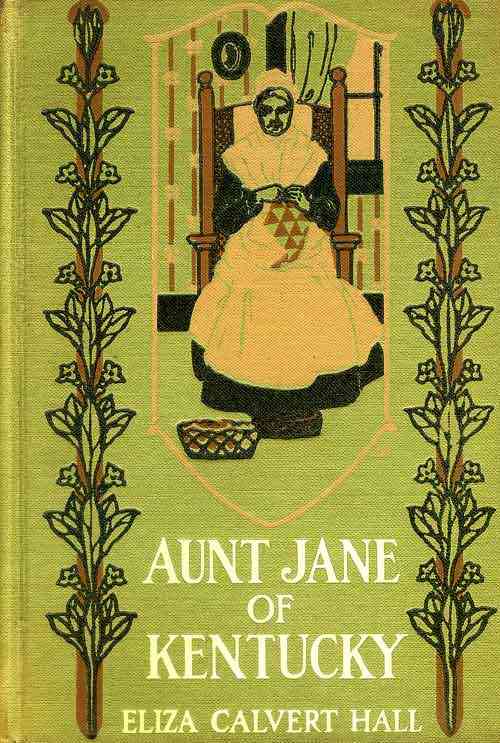
The Project Gutenberg eBook of Aunt Jane of Kentucky
Title: Aunt Jane of Kentucky
Author: Eliza Calvert Hall
Illustrator: Beulah Strong
Release date: September 30, 2008 [eBook #26728]
Language: English
Credits: Produced by Sankar Viswanathan, Suzanne Shell, and the
Online Distributed Proofreading Team at http://www.pgdp.net
AUNT JANE
OF KENTUCKY
BY ELIZA CALVERT HALL
Author of "The Land of Long Ago."
With Frontispiece and Page Decorations
By BEULAH STRONG
A. L. BURT COMPANY
Publishers New York
Copyright, 1898, 1899, 1900,
By John Brisbane Walker.
Copyright, 1904,
By Cosmopolitan Publishing Company.
Copyright, 1907,
By Little, Brown, and Company.
TO
MY MOTHER AND FATHER
I Dedicate this Book
CHAPTERS
| PAGE | |||
| I. | Sally Ann's Experience | 1 | |
| II. | The New Organ | 29 | |
| III. | Aunt Jane's Album | 53 | |
| IV. | "Sweet Day of Rest" | 83 | |
| V. | Milly Baker's Boy | 105 | |
| VI. | The Baptizing at Kittle Creek | 141 | |
| VII. | How Sam Amos Rode in the Tournament | 169 | |
| VIII. | Mary Andrews' Dinner-Party | 193 | |
| IX. | The Gardens of Memory | 247 |
"There is not an existence about us but at first seems colorless, dreary, lethargic: what can our soul have in common with that of an elderly spinster, a slow-witted plowman, a miser who worships his gold?... But ... the emotion that lived and died in an old-fashioned country parlor shall as mightily stir our heart, shall as unerringly find its way to the deepest sources of life as the majestic passion that ruled the life of a king and shed its triumphant luster from the dazzling height of a throne."—Maeterlinck.
I
SALLY ANN'S EXPERIENCE
ome right in and set down. I was jest wishin' I had somebody to talk to. Take that chair right by the door so's you can get the breeze."
And Aunt Jane beamed at me over her silver-rimmed spectacles and hitched her own chair a little to one side, in order to give me the full benefit of the wind that was blowing softly through the white-curtained window, and carrying into the room the heavenliest odors from a field of clover that lay in full bloom just across the road. For it was June in Kentucky, and clover and blue-grass were running sweet riot over the face of the earth.
Aunt Jane and her room together always carried me back to a dead and gone generation. There was a rag carpet on the floor, of the "hit-or-miss" pattern; the chairs were ancient Shaker rockers, some with homely "shuck" bottoms, and each had a tidy of snowy thread or crochet cotton fastened primly over the back. The high bed and bureau and a shining mahogany table suggested an era of "plain living" far, far remote from the day of Turkish rugs and Japanese bric-a-brac, and Aunt Jane was in perfect correspondence with her environment. She wore a purple calico dress, rather short and scant; a gingham apron, with a capacious pocket, in which she always carried knitting or some other "handy work"; a white handkerchief was laid primly around the wrinkled throat and fastened with a pin containing a lock of gray hair; her cap was of black lace and lutestring ribbon, not one of the butterfly affairs that perch on the top of the puffs and frizzes of the modern old lady, but a substantial structure that covered her whole head and was tied securely under her chin. She talked in a sweet old treble with a little lisp, caused by the absence of teeth, and her laugh was as clear and joyous as a young girl's.
"Yes, I'm a-piecin' quilts again," she said, snipping away at the bits of calico in her lap. "I did say I was done with that sort o' work; but this mornin' I was rummagin' around up in the garret, and I come across this bundle of pieces, and thinks I, 'I reckon it's intended for me to piece one more quilt before I die;' I must 'a' put 'em there thirty years ago and clean forgot 'em, and I've been settin' here all the evenin' cuttin' 'em and thinkin' about old times.
"Jest feel o' that," she continued, tossing some scraps into my lap. "There ain't any such caliker nowadays. This ain't your five-cent stuff that fades in the first washin' and wears out in the second. A caliker dress was somethin' worth buyin' and worth makin' up in them days. That blue-flowered piece was a dress I got the spring before Abram died. When I put on mournin' it was as good as new, and I give it to sister Mary. That one with the green ground and white figger was my niece Rebecca's. She wore it for the first time to the County Fair the year I took the premium on my salt-risin' bread and sponge cake. This black-an'-white piece Sally Ann Flint give me. I ricollect 'twas in blackberry time, and I'd been out in the big pasture pickin' some for supper, and I stopped in at Sally Ann's for a drink o' water on my way back. She was cuttin' out this dress."
Aunt Jane broke off with a little soprano laugh.
"Did I ever tell you about Sally Ann's experience?" she said, as she laid two three-cornered pieces together and began to sew with her slender, nervous old fingers.
To find Aunt Jane alone and in a reminiscent mood! This was delightful.
"Do tell me," I said.
Aunt Jane was silent for a few moments. She always made this pause before beginning a story, and there was something impressive about it. I used to think she was making an invocation to the goddess of Memory.
"'Twas forty years ago," she began musingly, "and the way of it was this. Our church was considerably out o' fix. It needed a new roof. Some o' the winder lights was out, and the floor was as bare as your hand, and always had been. The men folks managed to git the roof shingled and the winders fixed, and us women in the Mite Society concluded we'd git a cyarpet. We'd been savin' up our money for some time, and we had about twelve dollars. I ricollect what a argument we had, for some of us wanted the cyarpet, and some wanted to give it to furrin missions, as we'd set out to do at first. Sally Ann was the one that settled it. She says at last—Sally Ann was in favor of the cyarpet—she says, 'Well, if any of the heathen fails to hear the gospel on account of our gittin' this cyarpet, they'll be saved anyhow, so Parson Page says. And if we send the money and they do hear the gospel, like as not they won't repent, and then they're certain to be damned. And it seems to me as long as we ain't sure what they'll do, we might as well keep the money and git the cyarpet. I never did see much sense anyhow,' says she, 'in givin' people a chance to damn theirselves.'
"Well, we decided to take Sally Ann's advice, and we was talkin' about app'intin' a committee to go to town the follerin' Monday and pick out the cyarpet, when all at once 'Lizabeth Taylor—she was our treasurer—she spoke up, and says she, 'There ain't any use app'intin' that committee. The money's gone,' she says, sort o' short and quick. 'I kept it in my top bureau drawer, and when I went for it yesterday, it was gone. I'll pay it back if I'm ever able, but I ain't able now.' And with that she got up and walked out o' the room, before any one could say a word, and we seen her goin' down the road lookin' straight before her and walkin' right fast.
"And we—we set there and stared at each other in a sort o' dazed way. I could see that everybody was thinkin' the same thing, but nobody said a word, till our minister's wife—she was as good a woman as ever lived—she says, 'Judge not.'
"Them two words was jest like a sermon to us. Then Sally Ann spoke up and says: 'For the Lord's sake, don't let the men folks know anything about this. They're always sayin' that women ain't fit to handle money, and I for one don't want to give 'em any more ground to stand on than they've already got.'
"So we agreed to say nothin' about it, and all of us kept our promise except Milly Amos. She had mighty little sense to begin with, and havin' been married only about two months, she'd about lost that little. So next mornin' I happened to meet Sam Amos, and he says to me, 'Aunt Jane, how much money have you women got to'rds the new cyarpet for the church?' I looked him square in the face, and I says, 'Are you a member of the Ladies' Mite Society of Goshen church, Sam Amos? For if you are, you already know how much money we've got, and if you ain't, you've got no business knowin'. And, furthermore,' says I, 'there's some women that can't keep a secret and a promise, and some that can, and I can.' And that settled him.
"Well, 'Lizabeth never showed her face outside her door for more'n a month afterwards, and a more pitiful-lookin' creatur' you never saw than she was when she come out to prayer-meetin' the night Sally Ann give her experience. She set 'way back in the church, and she was as pale and peaked as if she had been through a siege of typhoid. I ricollect it all as if it had been yesterday. We sung 'Sweet Hour of Prayer,' and Parson Page prayed, and then called on the brethren to say anything they might feel called on to say concernin' their experience in the past week. Old Uncle Jim Matthews begun to clear his throat, and I knew, as well as I knew my name, he was fixin' to git up and tell how precious the Lord had been to his soul, jest like he'd been doin' every Wednesday night for twenty years. But before he got started, here come 'Lizabeth walkin' down the side aisle and stopped right in front o' the pulpit.
"'I've somethin' to say,' she says. 'It's been on my mind till I can't stand it any longer. I've got to tell it, or I'll go crazy. It was me that took that cyarpet money. I only meant to borrow it. I thought sure I'd be able to pay it back before it was wanted. But things went wrong, and I ain't known a peaceful minute since, and never shall again, I reckon. I took it to pay my way up to Louisville, the time I got the news that Mary was dyin'.'
"Mary was her daughter by her first husband, you see. 'I begged Jacob to give me the money to go on,' says she, 'and he wouldn't do it. I tried to give up and stay, but I jest couldn't. Mary was all I had in the world; and maybe you that has children can put yourself in my place, and know what it would be to hear your only child callin' to you from her death-bed, and you not able to go to her. I asked Jacob three times for the money,' she says, 'and when I found he wouldn't give it to me, I said to myself, "I'm goin' anyhow." I got down on my knees,' says she, 'and asked the Lord to show me a way, and I felt sure he would. As soon as Jacob had eat his breakfast and gone out on the farm, I dressed myself, and as I opened the top bureau drawer to get out my best collar, I saw the missionary money. It come right into my head,' says she, 'that maybe this was the answer to my prayer; maybe I could borrow this money, and pay it back some way or other before it was called for. I tried to put it out o' my head, but the thought kept comin' back; and when I went down into the sittin'-room to get Jacob's cyarpetbag to carry a few things in, I happened to look up at the mantelpiece and saw the brass candlesticks with prisms all 'round 'em that used to belong to my mother; and all at once I seemed to see jest what the Lord intended for me to do.
"'You know,' she says, 'I had a boarder summer before last—that lady from Louisville—and she wanted them candlesticks the worst kind, and offered me fifteen dollars for 'em. I wouldn't part with 'em then, but she said if ever I wanted to sell 'em, to let her know, and she left her name and address on a cyard. I went to the big Bible and got out the cyard, and I packed the candlesticks in the cyarpetbag, and put on my bonnet. When I opened the door I looked up the road, and the first thing I saw was Dave Crawford comin' along in his new buggy. I went out to the gate, and he drew up and asked me if I was goin' to town, and said he'd take me. It looked like the Lord was leadin' me all the time,' says she, 'but the way things turned out it must 'a' been Satan. I got to Mary just two hours before she died, and she looked up in my face and says, "Mother, I knew God wouldn't let me die till I'd seen you once more."'"
Here Aunt Jane took off her glasses and wiped her eyes.
"I can't tell this without cryin' to save my life," said she; "but 'Lizabeth never shed a tear. She looked like she'd got past cryin', and she talked straight on as if she'd made up her mind to say jest so much, and she'd die if she didn't git to say it."
"'As soon as the funeral was over,' says she, 'I set out to find the lady that wanted the candlesticks. She wasn't at home, but her niece was there, and said she'd heard her aunt speak of the candlesticks often; and she'd be home in a few days and would send me the money right off. I come home thinkin' it was all right, and I kept expectin' the money every day, but it never come till day before yesterday. I wrote three times about it, but I never got a word from her till Monday. She had just got home, she said, and hoped I hadn't been inconvenienced by the delay. She wrote a nice, polite letter and sent me a check for fifteen dollars, and here it is. I wanted to confess it all that day at the Mite Society, but somehow I couldn't till I had the money right in my hand to pay back. If the lady had only come back when her niece said she was comin', it would all have turned out right, but I reckon it's a judgment on me for meddling with the Lord's money. God only knows what I've suffered,' says she, 'but if I had to do it over again, I believe I'd do it. Mary was all the child I had in the world, and I had to see her once more before she died. I've been a member of this church for twenty years,' says she, 'but I reckon you'll have to turn me out now.'
"The pore thing stood there tremblin' and holdin' out the check as if she expected somebody to come and take it. Old Silas Petty was glowerin' at her from under his eyebrows, and it put me in mind of the Pharisees and the woman they wanted to stone, and I ricollect thinkin', 'Oh, if the Lord Jesus would jest come in and take her part!' And while we all set there like a passel o' mutes, Sally Ann got up and marched down the middle aisle and stood right by 'Lizabeth. You know what funny thoughts people will have sometimes.
"Well, I felt so relieved. It popped into my head all at once that we didn't need the Lord after all, Sally Ann would do jest as well. It seemed sort o' like sacrilege, but I couldn't help it.
"Well, Sally Ann looked all around as composed as you please, and says she, 'I reckon if anybody's turned out o' this church on account o' that miserable little money, it'll be Jacob and not 'Lizabeth. A man that won't give his wife money to go to her dyin' child is too mean to stay in a Christian church anyhow; and I'd like to know how it is that a woman, that had eight hundred dollars when she married, has to go to her husband and git down on her knees and beg for what's her own. Where's that money 'Lizabeth had when she married you?' says she, turnin' round and lookin' Jacob in the face. 'Down in that ten-acre medder lot, ain't it?—and in that new barn you built last spring. A pretty elder you are, ain't you? Elders don't seem to have improved much since Susannah's times. If there ain't one sort o' meanness in 'em it's another,' says she.
"Goodness knows what she would 'a' said, but jest here old Deacon Petty rose up. And says he, 'Brethren,'—and he spread his arms out and waved 'em up and down like he was goin' to pray,—'brethren, this is awful! If this woman wants to give her religious experience, why,' says he, very kind and condescendin', 'of course she can do so. But when it comes to a woman standin' up in the house of the Lord and revilin' an elder as this woman is doin', why, I tremble,' says he, 'for the church of Christ. For don't the Apostle Paul say, "Let your women keep silence in the church"?'
"As soon as he named the 'Postle Paul, Sally Ann give a kind of snort. Sally Ann was terrible free-spoken. And when Deacon Petty said that, she jest squared herself like she intended to stand there till judgment day, and says she, 'The 'Postle Paul has been dead ruther too long for me to be afraid of him. And I never heard of him app'intin' Deacon Petty to represent him in this church. If the 'Postle Paul don't like what I'm sayin', let him rise up from his grave in Corinthians or Ephesians, or wherever he's buried, and say so. I've got a message from the Lord to the men folks of this church, and I'm goin' to deliver it, Paul or no Paul,' says she. 'And as for you, Silas Petty, I ain't forgot the time I dropped in to see Maria one Saturday night and found her washin' out her flannel petticoat and dryin' it before the fire. And every time I've had to hear you lead in prayer since then I've said to myself, "Lord, how high can a man's prayers rise toward heaven when his wife ain't got but one flannel skirt to her name? No higher than the back of his pew, if you'll let me tell it." I knew jest how it was,' said Sally Ann, 'as well as if Maria'd told me. She'd been havin' the milk and butter money from the old roan cow she'd raised from a little heifer, and jest because feed was scarce, you'd sold her off before Maria had money enough to buy her winter flannels. I can give my experience, can I? Well, that's jest what I'm a-doin',' says she; 'and while I'm about it,' says she, 'I'll give in some experience for 'Lizabeth and Maria and the rest of the women who, betwixt their husbands an' the 'Postle Paul, have about lost all the gumption and grit that the Lord started them out with. If the 'Postle Paul,' says she, 'has got anything to say about a woman workin' like a slave for twenty-five years and then havin' to set up an' wash out her clothes Saturday night, so's she can go to church clean Sunday mornin', I'd like to hear it. But don't you dare to say anything to me about keepin' silence in the church. There was times when Paul says he didn't know whether he had the Spirit of God or not, and I'm certain that when he wrote that text he wasn't any more inspired than you are, Silas Petty, when you tell Maria to shut her mouth.'
"Job Taylor was settin' right in front of Deacon Petty, and I reckon he thought his time was comin' next; so he gets up, easy-like, with his red bandanna to his mouth, and starts out. But Sally Ann headed him off before he'd gone six steps, and says she, 'There ain't anything the matter with you, Job Taylor; you set right down and hear what I've got to say. I've knelt and stood through enough o' your long-winded prayers, and now it's my time to talk and yours to listen.'
"And bless your life, if Job didn't set down as meek as Moses, and Sally Ann lit right into him. And says she, 'I reckon you're afraid I'll tell some o' your meanness, ain't you? And the only thing that stands in my way is that there's so much to tell I don't know where to begin. There ain't a woman in this church,' says she, 'that don't know how Marthy scrimped and worked and saved to buy her a new set o' furniture, and how you took the money with you when you went to Cincinnata, the spring before she died, and come back without the furniture. And when she asked you for the money, you told her that she and everything she had belonged to you, and that your mother's old furniture was good enough for anybody. It's my belief,' says she, 'that's what killed Marthy. Women are dyin' every day, and the doctors will tell you it's some new-fangled disease or other, when, if the truth was known, it's nothin' but wantin' somethin' they can't git, and hopin' and waitin' for somethin' that never comes. I've watched 'em, and I know. The night before Marthy died she says to me, "Sally Ann," says she, "I could die a heap peacefuler if I jest knew the front room was fixed up right with a new set of furniture for the funeral."' And Sally Ann p'inted her finger right at Job and says she, 'I said it then, and I say it now to your face, Job Taylor, you killed Marthy the same as if you'd taken her by the throat and choked the life out of her.'
"Mary Embry, Job's sister-in-law, was settin' right behind me, and I heard her say, 'Amen!' as fervent as if somebody had been prayin'. Job set there, lookin' like a sheep-killin' dog, and Sally Ann went right on. 'I know,' says she, 'the law gives you the right to your wives' earnin's and everything they've got, down to the clothes on their backs; and I've always said there was some Kentucky law that was made for the express purpose of encouragin' men in their natural meanness,—a p'int in which the Lord knows they don't need no encouragin'. There's some men,' says she, 'that'll sneak behind the 'Postle Paul when they're plannin' any meanness against their wives, and some that runs to the law, and you're one of the law kind. But mark my words,' says she, 'one of these days, you men who've been stealin' your wives' property and defraudin' 'em, and cheatin' 'em out o' their just dues, you'll have to stand before a Judge that cares mighty little for Kentucky law; and all the law and all the Scripture you can bring up won't save you from goin' where the rich man went.'
"I can see Sally Ann right now," and Aunt Jane pushed her glasses up on her forehead, and looked with a dreamy, retrospective gaze through the doorway and beyond, where swaying elms and maples were whispering softly to each other as the breeze touched them. "She had on her old black poke-bonnet and some black yarn mitts, and she didn't come nigh up to Job's shoulder, but Job set and listened as if he jest had to. I heard Dave Crawford shufflin' his feet and clearin' his throat while Sally Ann was talkin' to Job. Dave's farm j'ined Sally Ann's, and they had a lawsuit once about the way a fence ought to run, and Sally Ann beat him. He always despised Sally Ann after that, and used to call her a 'he-woman.' Sally Ann heard the shufflin', and as soon as she got through with Job, she turned around to Dave, and says she: 'Do you think your hemmin' and scrapin' is goin' to stop me, Dave Crawford? You're one o' the men that makes me think that it's better to be a Kentucky horse than a Kentucky woman. Many's the time,' says she, 'I've seen pore July with her head tied up, crawlin' around tryin' to cook for sixteen harvest hands, and you out in the stable cossetin' up a sick mare, and rubbin' down your three-year-olds to get 'em in trim for the fair. Of all the things that's hard to understand,' says she, 'the hardest is a man that has more mercy on his horse than he has on his wife. July's found rest at last,' says she, 'out in the graveyard; and every time I pass your house I thank the Lord that you've got to pay a good price for your cookin' now, as there ain't a woman in the country fool enough to step into July's shoes.'
"But, la!" said Aunt Jane, breaking off with her happy laugh,—the laugh of one who revels in rich memories,—"what's the use of me tellin' all this stuff? The long and the short of it is, that Sally Ann had her say about nearly every man in the church. She told how Mary Embry had to cut up her weddin' skirts to make clothes for her first baby; and how John Martin stopped Hannah one day when she was carryin' her mother a pound of butter, and made her go back and put the butter down in the cellar; and how Lije Davison used to make Ann pay him for every bit of chicken feed, and then take half the egg money because the chickens got into his garden; and how Abner Page give his wife twenty-five cents for spendin' money the time she went to visit her sister.
"Sally Ann always was a masterful sort of woman, and that night it seemed like she was possessed. The way she talked made me think of the Day of Pentecost and the gift of tongues. And finally she got to the minister! I'd been wonderin' all along if she was goin' to let him off. She turned around to where he was settin' under the pulpit, and says she, 'Brother Page, you're a good man, but you ain't so good you couldn't be better. It was jest last week,' says she, 'that the women come around beggin' money to buy you a new suit of clothes to go to Presbytery in; and I told 'em if it was to get Mis' Page a new dress, I was ready to give; but not a dime was I goin' to give towards puttin' finery on a man's back. I'm tired o' seein' the ministers walk up into the pulpit in their slick black broadcloths, and their wives settin' down in the pew in an old black silk that's been turned upside down, wrong side out, and hind part before, and sponged, and pressed, and made over till you can't tell whether it's silk, or caliker, or what.'
"Well, I reckon there was some o' the women that expected the roof to fall down on us when Sally Ann said that right to the minister. But it didn't fall, and Sally Ann went straight on. 'And when it comes to the perseverance of the saints and the decrees of God,' says she, 'there ain't many can preach a better sermon; but there's some of your sermons,' says she, 'that ain't fit for much but kindlin' fires. There's that one you preached last Sunday on the twenty-fourth verse of the fifth chapter of Ephesians. I reckon I've heard about a hundred and fifty sermons on that text, and I reckon I'll keep on hearin' 'em as long as there ain't anybody but men to do the preachin'. Anybody would think,' says she, 'that you preachers was struck blind every time you git through with the twenty-fourth verse, for I never heard a sermon on the twenty-fifth verse. I believe there's men in this church that thinks the fifth chapter of Ephesians hasn't got but twenty-four verses, and I'm goin' to read the rest of it to 'em for once anyhow.'
"And if Sally Ann didn't walk right up into the pulpit same as if she'd been ordained, and read what Paul said about men lovin' their wives as Christ loved the church, and as they loved their own bodies.
"'Now,' says she, 'if Brother Page can reconcile these texts with what Paul says about women submittin' and bein' subject, he's welcome to do it. But,' says she, 'if I had the preachin' to do, I wouldn't waste time reconcilin'. I'd jest say that when Paul told women to be subject to their husbands in everything, he wasn't inspired; and when he told men to love their wives as their own bodies, he was inspired; and I'd like to see the Presbytery that could silence me from preachin' as long as I wanted to preach. As for turnin' out o' the church,' says she, 'I'd like to know who's to do the turnin' out. When the disciples brought that woman to Christ there wasn't a man in the crowd fit to cast a stone at her; and if there's any man nowadays good enough to set in judgment on a woman, his name ain't on the rolls of Goshen church. If 'Lizabeth,' says she, 'had as much common sense as she's got conscience, she'd know that the matter o' that money didn't concern nobody but our Mite Society, and we women can settle it without any help from you deacons and elders.'
"Well, I reckon Parson Page thought if he didn't head Sally Ann off some way or other she'd go on all night; so when she kind o' stopped for breath and shut up the big Bible, he grabbed a hymn-book and says:
"'Let us sing "Blest be the Tie that Binds."'
"He struck up the tune himself; and about the middle of the first verse Mis' Page got up and went over to where 'Lizabeth was standin', and give her the right hand of fellowship, and then Mis' Petty did the same; and first thing we knew we was all around her shakin' hands and huggin' her and cryin' over her. 'Twas a reg'lar love-feast; and we went home feelin' like we'd been through a big protracted meetin' and got religion over again.
"'Twasn't more'n a week till 'Lizabeth was down with slow fever—nervous collapse, old Dr. Pendleton called it. We took turns nursin' her, and one day she looked up in my face and says, 'Jane, I know now what the mercy of the Lord is.'"
Here Aunt Jane paused, and began to cut three-cornered pieces out of a time-stained square of flowered chintz. The quilt was to be of the wild-goose pattern. There was a drowsy hum from the bee-hive near the window, and the shadows were lengthening as sunset approached.
"One queer thing about it," she resumed, "was that while Sally Ann was talkin', not one of us felt like laughin'. We set there as solemn as if parson was preachin' to us on 'lection and predestination. But whenever I think about it now, I laugh fit to kill. And I've thought many a time that Sally Ann's plain talk to them men done more good than all the sermons us women had had preached to us about bein' 'shame-faced' and 'submittin'' ourselves to our husbands, for every one o' them women come out in new clothes that spring, and such a change as it made in some of 'em! I wouldn't be surprised if she did have a message to deliver, jest as she said. The Bible says an ass spoke up once and reproved a man, and I reckon if an ass can reprove a man, so can a woman. And it looks to me like men stand in need of reprovin' now as much as they did in Balaam's days.
"Jacob died the follerin' fall, and 'Lizabeth got shed of her troubles. The triflin' scamp never married her for anything but her money.
"Things is different from what they used to be," she went on, as she folded her pieces into a compact bundle and tied it with a piece of gray yarn. "My son-in-law was tellin' me last summer how a passel o' women kept goin' up to Frankfort and so pesterin' the Legislatur', that they had to change the laws to git rid of 'em. So married women now has all the property rights they want, and more'n some of 'em has sense to use, I reckon."
"How about you and Uncle Abram?" I suggested. "Didn't Sally Ann say anything about you in her experience?"
Aunt Jane's black eyes snapped with some of the fire of her long-past youth. "La! no, child," she said. "Abram never was that kind of a man, and I never was that kind of a woman. I ricollect as we was walkin' home that night Abram says, sort o' humble-like: 'Jane, hadn't you better git that brown merino you was lookin' at last County Court day?'
"And I says, 'Don't you worry about that brown merino, Abram. It's a-lyin' in my bottom drawer right now. I told the storekeeper to cut it off jest as soon as your back was turned, and Mis' Simpson is goin' to make it next week.' And Abram he jest laughed, and says, 'Well, Jane, I never saw your beat.' You see, I never was any hand at 'submittin'' myself to my husband, like some women. I've often wondered if Abram wouldn't 'a' been jest like Silas Petty if I'd been like Maria. I've noticed that whenever a woman's willin' to be imposed upon, there's always a man standin' 'round ready to do the imposin'. I never went to a law-book to find out what my rights was. I did my duty faithful to Abram, and when I wanted anything I went and got it, and Abram paid for it, and I can't see but what we got on jest as well as we'd 'a' done if I'd a-'submitted' myself."
Longer and longer grew the shadows, and the faint tinkle of bells came in through the windows. The cows were beginning to come home. The spell of Aunt Jane's dramatic art was upon me. I began to feel that my own personality had somehow slipped away from me, and those dead people, evoked from their graves by an old woman's histrionism, seemed more real to me than my living, breathing self.
"There now, I've talked you clean to death," she said with a happy laugh, as I rose to go. "But we've had a real nice time, and I'm glad you come."
The sun was almost down as I walked slowly away. When I looked back, at the turn of the road, Aunt Jane was standing on the door-step, shading her eyes and peering across the level fields. I knew what it meant. Beyond the fields was a bit of woodland, and in one corner of that you might, if your eyesight was good, discern here and there a glimpse of white. It was the old burying-ground of Goshen church; and I knew by the strained attitude and intent gaze of the watcher in the door that somewhere in the sunlit space between Aunt Jane's door-step and the little country graveyard, the souls of the living and the dead were keeping a silent tryst.
II
THE NEW ORGAN
ittin' a new organ is a mighty different thing nowadays from what it was when I was young," said Aunt Jane judicially, as she lifted a panful of yellow harvest apples from the table and began to peel them for dumplings.
Potatoes, peas, and asparagus were bubbling on the stove, and the dumplings were in honor of the invited guest, who had begged the privilege of staying in the kitchen awhile. Aunt Jane was one of those rare housekeepers whose kitchens are more attractive than the parlors of other people.
"And gittin' religion is different, too," she continued, propping her feet on the round of a chair for the greater comfort and convenience of her old knees. "Both of 'em is a heap easier than they used to be, and the organs is a heap better. I don't know whether the religion's any better or not. You know I went up to my daughter Mary Frances' last week, and the folks up there was havin' a big meetin' in the Tabernicle, and that's how come me to be thinkin' about organs.
"The preacher was an evangelist, as they call him, Sam Joynes, from 'way down South. In my day he'd 'a' been called the Rev. Samuel Joynes. Folks didn't call their preachers Tom, Dick, and Harry, and Jim and Sam, like they do now. I'd like to 'a' seen anybody callin' Parson Page 'Lem Page.' He was the Rev. Lemuel Page, and don't you forgit it. But things is different, as I said awhile ago, and even the little boys says 'Sam Joynes,' jest like he played marbles with 'em every day. I went to the Tabernicle three or four times; and of all the preachers that ever I heard, he certainly is the beatenest. Why, I ain't laughed so much since me and Abram went to Barnum's circus, the year before the war. He was preachin' one day about cleanliness bein' next to godliness, which it certainly is, and he says, 'You old skunk, you!' But, la! the worse names he called 'em the better they 'peared to like it, and sinners was converted wholesale every time he preached. But there wasn't no goin' to the mourners' bench and mournin' for your sins and havin' people prayin' and cryin' over you. They jest set and laughed and grinned while he was gittin' off his jokes, and then they'd go up and shake hands with him, and there they was all saved and ready to be baptized and taken into the church."
Just here the old yellow rooster fluttered up to the door-step and gave a hoarse, ominous crow.
"There, now! You hear that?" said Aunt Jane, as she tossed him a golden peeling from her pan. "There's some folks that gives right up and looks for sickness or death or bad news every time a rooster crows in the door. But I never let such things bother me. The Bible says that nobody knows what a day may bring forth, and if I don't know, it ain't likely my old yeller rooster does.
"What was I talkin' about? Oh, yes—the big meetin'. Well, I never was any hand to say that old ways is best, and I don't say so now. If you can convert a man by callin' him a polecat, why, call him one, of course. And mournin' ain't always a sign o' true repentance. They used to tell how Silas Petty mourned for forty days, and, as Sally Ann said, he had about as much religion as old Dan Tucker's Derby ram.
"However, it was the organ I set out to tell about. It's jest like me to wander away from the p'int. Abram always said a text would have to be made like a postage stamp for me to stick to it. You see, they'd jest got a fine new organ at Mary Frances' church, and she was tellin' me how they paid for it. One man give five hundred dollars, and another give three hundred; then they collected four or five hundred amongst the other members, and give a lawn party and a strawberry festival and raised another hundred. It set me to thinkin' o' the time us women got the organ for Goshen church. It wasn't any light matter, for, besides the money it took us nearly three years to raise, there was the opposition. Come to think of it, we raised more opposition than we did money."
And Aunt Jane laughed a blithe laugh and tossed another peeling to the yellow rooster, who had dropped the rôle of harbinger of evil and was posing as a humble suppliant.
"An organ in them days, honey, was jest a wedge to split the church half in two. It was the new cyarpet that brought on the organ. You know how it is with yourself; you git a new dress, and then you've got to have a new bonnet, and then you can't wear your old shoes and gloves with a new dress and a new bonnet, and the first thing you know you've spent five times as much as you set out to spend. That's the way it was with us about the cyarpet and the organ and the pulpit chairs and the communion set.
"Most o' the men folks was against the organ from the start, and Silas Petty was the foremost. Silas made a p'int of goin' against everything that women favored. Sally Ann used to say that if a woman was to come up to him and say, 'Le's go to heaven,' Silas would start off towards the other place right at once; he was jest that mulish and contrairy. He met Sally Ann one day, and says he, 'Jest give you women rope enough and you'll turn the house o' the Lord into a reg'lar toy-shop.' And Sally Ann she says, 'You'd better go home, Silas, and read the book of Exodus. If the Lord told Moses how to build the Tabernicle with the goats' skins and rams' skins and blue and purple and scarlet and fine linen and candlesticks with six branches, I reckon he won't object to a few yards o' cyarpetin' and a little organ in Goshen church.'
"Sally Ann always had an answer ready, and I used to think she knew more about the Bible than Parson Page did himself.
"Of course Uncle Jim Matthews didn't want the organ; he was afraid it might interfere with his singin'. Job Taylor always stood up for Silas, so he didn't want it; and Parson Page never opened his mouth one way or the other. He was one o' those men that tries to set on both sides o' the fence at once, and he'd set that way so long he was a mighty good hand at balancin' himself.
"Us women didn't say much, but we made up our minds to have the organ. So we went to work in the Mite Society, and in less'n three years we had enough money to git it. I've often wondered how many pounds o' butter and how many baskets of eggs it took to raise that money. I reckon if they'd 'a' been piled up on top of each other they'd 'a' reached to the top o' the steeple. The women of Israel brought their ear-rings and bracelets to help build the Tabernicle, but we had jest our egg and butter money, and the second year, when the chicken cholery was so bad, our prospects looked mighty blue.
"When I saw that big organ up at Danville, I couldn't help thinkin' about the little thing we worked so hard to git. 'Twasn't much bigger'n a washstand, and I reckon if I was to hear it now, I'd think it was mighty feeble and squeaky. But it sounded fine enough to us in them days, and, little as it was, it raised a disturbance for miles around.
"When it come down from Louisville, Abram went to town with his two-horse wagon and brought it out and set it up in our parlor. My Jane had been takin' lessons in town all winter, so's to be able to play on it.
"We had a right good choir for them days; the only trouble was that everybody wanted to be leader. That's a common failin' with church choirs, I've noticed. Milly Amos sung soprano, and my Jane was the alto; John Petty sung bass, and young Sam Crawford tenor; and as for Uncle Jim Matthews, he sung everything, and a plenty of it, too. Milly Amos used to say he was worse'n a flea. He'd start out on the bass, and first thing you knew he'd be singin' tenor with Sam Crawford; and by the time Sam was good and mad, he'd be off onto the alto or the soprano. He was one o' these meddlesome old creeturs that thinks the world never moved till they got into it, and they've got to help everybody out with whatever they happen to be doin'. You've heard o' children bein' born kickin'. Well, Uncle Jim must 'a' been born singin'. I've seen people that said they didn't like the idea o' goin' to heaven and standin' around a throne and singin' hymns for ever and ever; but you couldn't 'a' pleased Uncle Jim better than to set him down in jest that sort o' heaven. Wherever there was a chance to get in some singin', there you'd be sure to find Uncle Jim. Folks used to say he enjoyed a funeral a heap better than he did a weddin', 'cause he could sing at the funeral, and he couldn't at the weddin'; and Sam Crawford said he believed if Gabriel was to come down and blow his trumpet, Uncle Jim would git up and begin to sing.
"It wouldn't 'a' been so bad if he'd had any sort of a voice; but he'd been singin' all his life and hollerin' at protracted meetin's ever since he got religion, till he'd sung and hollered all the music out of his voice, and there wasn't much left but the old creaky machinery. It used to make me think of an old rickety house with the blinds flappin' in the wind. It mortified us terrible to have any of the Methodists or Babtists come to our church. We was sort o' used to the old man's capers, but people that wasn't couldn't keep a straight face when the singin' begun, and it took more grace than any of us had to keep from gittin' mad when we seen people from another church laughin' at our choir.
"The Babtists had a powerful protracted meetin' one winter. Uncle Jim was there to help with the singin', as a matter of course, and he begun to git mightily interested in Babtist doctrines. Used to go home with 'em after church and talk about Greek and Hebrew words till the clock struck twelve. And one communion Sunday he got up solemn as a owl and marched out o' church jest before the bread and wine was passed. Made out like he warn't sure he'd been rightly babtized. The choir was mightily tickled at the idea o' gittin' shed o' the old pest, and Sam Crawford went to him and told him he was on the right track and to go ahead, for the Babtists was undoubtedly correct, and if it wasn't for displeasin' his father and mother he'd jine 'em himself. And then—Sam never could let well enough alone—then he went to Bush Elrod, the Babtist tenor, and says he, 'I hear you're goin' to have a new member in your choir.' And Bush says, 'Well, if the old idiot ever jines this church, we'll hold his head under the water so long that he won't be able to spile good music agin.' And then he give Uncle Jim a hint o' how things was; and when Uncle Jim heard that the Presbyterians was anxious to git shed of him, he found out right away that all them Greek and Hebrew words meant sprinklin' and infant babtism. So he settled down to stay where he was, and hollered louder'n ever the next Sunday.
"The old man was a good enough Christian, I reckon; but when it come to singin', he was a stumblin'-block and rock of offense to the whole church, and especially to the choir. The first thing Sally Ann said when she looked at the new organ was, 'Well, Jane, how do you reckon it's goin' to sound with Uncle Jim's voice?' and I laughed till I had to set down in a cheer.
"Well, when the men folks found out that our organ had come, they begun to wake up. Abram had brought it out Tuesday, and Wednesday night, as soon as prayer-meetin' broke, Parson Page says, says he: 'Brethren, there is a little business to be transacted. Please remain a few minutes longer.' And then, when we had set down again, he went on to say that the sisters had raised money and bought an organ, and there was some division of opinion among the brethren about usin' it, so he would like to have the matter discussed. He used a lot o' big words and talked mighty smooth, and I knew there was trouble ahead for us women.
"Uncle Jim was the first one to speak. He was so anxious to begin, he could hardly wait for Parson Page to stop; and anybody would 'a' thought that he'd been up to heaven and talked with the Father and the Son and the Holy Ghost and all the angels, to hear him tell about the sort o' music there was in heaven, and the sort there ought to be on earth. 'Why, brethren,' says he, 'when John saw the heavens opened there wasn't no organs up there. God don't keer nothin',' says he, 'about such new-fangled, worldly instruments. But when a lot o' sweet human voices git to praisin' him, why, the very angels stop singin' to listen.'
"Milly Amos was right behind me, and she leaned over and says, 'Well, if the angels'd rather hear Uncle Jim's singin' than our organ, they've got mighty pore taste, that's all I've got to say.'
"Silas Petty was the next one to git up, and says he: 'I never was in favor o' doin' things half-way, brethren; and if we've got to have the organ, why, we might as well have a monkey, too, and be done with it. For my part,' says he, 'I want to worship in the good old way my fathers and grandfathers worshiped in, and, unless my feelin's change very considerable, I shall have to withdraw from this church if any such Satan's music-box is set up in this holy place.'
"And Sally Ann turned around and whispered to me, 'We ought to 'a' got that organ long ago, Jane.' I like to 'a' laughed right out, and I leaned over, and says I, 'Why don't you git up and talk for us, Sally Ann?' and she says: 'The spirit ain't moved me, Jane. I reckon it's too busy movin' Uncle Jim and Silas Petty.'
"Jest then I looked around, and there was Abram standin' up. Well, you could 'a' knocked me over with a feather. Abram always was one o' those close-mouthed men. Never spoke if he could git around it any way whatever. Parson Page used to git after him every protracted meetin' about not leadin' in prayer and havin' family worship; but the spirit moved him that time sure, and there he was talkin' as glib as old Uncle Jim. And says he: 'Brethren, I'm not carin' much one way or another about this organ. I don't know how the angels feel about it, not havin' so much acquaintance with 'em as Uncle Jim has; but I do know enough about women to know that there ain't any use tryin' to stop 'em when they git their heads set on a thing, and I'm goin' to haul that organ over to-morrow mornin' and set it up for the choir to practise by Friday night. If I don't haul it over, Sally Ann and Jane'll tote it over between 'em, and if they can't put it into the church by the door, they'll hist a window and put it in that way. I reckon,' says he, 'I've got all the men against me in this matter, but then, I've got all the women on my side, and I reckon all the women and one man makes a pretty good majority, and so I'm goin' to haul the organ over to-morrow mornin'.'
"I declare I felt real proud of Abram, and I told him so that night when we was goin' home together. Then Parson Page he says, 'It seems to me there is sound sense in what Brother Parish says, and I suggest that we allow the sisters to have their way and give the organ a trial; and if we find that it is hurtful to the interests of the church, it will be an easy matter to remove it.' And Milly Amos says to me, 'I see 'em gittin' that organ out if we once git it in.'
"When the choir met Friday night, Milly come in all in a flurry, and says she: 'I hear Brother Gardner has gone to the 'Sociation down in Russellville, and all the Babtists are comin' to our church Sunday; and I want to show 'em what good music is this once, anyhow. Uncle Jim Matthews is laid up with rheumatism,' says she, 'and if that ain't a special providence I never saw one.' And Sam Crawford slapped his knee, and says he, 'Well, if the old man's rheumatism jest holds out over Sunday, them Babtists'll hear music sure.'
"Then Milly went on to tell that she'd been up to Squire Elrod's, and Miss Penelope, the squire's niece from Louisville, had promised to sing a voluntary Sunday.
"'Voluntary? What's that?' says Sam.
"'Why,' says Milly, 'it's a hymn that the choir, or somebody in it, sings of their own accord, without the preacher givin' it out; just like your tomatoes come up in the spring, voluntary, without you plantin' the seed. That's the way they do in the city churches,' says she, 'and we are goin' to put on city style Sunday.'
"Then they went to work and practised some new tunes for the hymns Parson Page had give 'em, so if Uncle Jim's rheumatism didn't hold out, he'd still have to hold his peace.
"Well, Sunday come; but special providence was on Uncle Jim's side that time, and there he was as smilin' as a basket o' chips if he did have to walk with a cane. We'd had the church cleaned up as neat as a new pin. My Jane had put a bunch of honeysuckles and pinks on the organ, and everybody was dressed in their best. Miss Penelope was settin' at the organ with a bunch of roses in her hand, and the windows was all open, and you could see the trees wavin' in the wind and hear the birds singin' outside. I always did think that was the best part o' Sunday—that time jest before church begins."
Aunt Jane's voice dropped. Her words came slowly; and into the story fell one of those "flashes of silence" to which she was as little given as the great historian. The pan of dumplings waited for the sprinkling of spice and sugar, while she stood motionless, looking afar off, though her gaze apparently stopped on the vacant whitewashed wall before her. No mind reader's art was needed to tell what scene her faded eyes beheld. There was the old church, with its battered furniture and high pulpit. For one brief moment the grave had yielded up its dead, and "the old familiar faces" looked out from every pew. We were very near together, Aunt Jane and I; but the breeze that fanned her brow was not the breeze I felt as I sat by her kitchen window. For her a wind was blowing across the plains of memory; and the honeysuckle odor it carried was not from the bush in the yard. It came, weighted with dreams, from the blossoms that her Jane had placed on the organ twenty-five years ago. A bob-white was calling in the meadow across the dusty road, and the echoes of the second bell had just died away. She and Abram were side by side in their accustomed place, and life lay like a watered garden in the peaceful stillness of the time "jest before church begins."
The asparagus on the stove boiled over with a great spluttering, and Aunt Jane came back to "the eternal now."
"Sakes alive!" she exclaimed, as she lifted the saucepan; "I must be gittin' old, to let things boil over this way while I'm studyin' about old times. I declare, I believe I've clean forgot what I was sayin'."
"You were at church," I suggested, "and the singing was about to begin."
"Sure enough! Well, all at once Miss Penelope laid her hands on the keys and begun to play and sing 'Nearer, My God, to Thee.' We'd heard that hymn all our lives at church and protracted meetin's and prayer-meetin's, but we didn't know how it could sound till Miss Penelope sung it all by herself that day with our new organ. I ricollect jest how she looked, pretty little thing that she was; and sometimes I can hear her voice jest as plain as I hear that robin out yonder in the ellum tree. Every word was jest like a bright new piece o' silver, and every note was jest like gold; and she was lookin' up through the winder at the trees and the sky like she was singin' to somebody we couldn't see. We clean forgot about the new organ and the Baptists; and I really believe we was feelin' nearer to God than we'd ever felt before. When she got through with the first verse, she played somethin' soft and sweet and begun again; and right in the middle of the first line—I declare, it's twenty-five years ago, but I git mad now when I think about it—right in the middle of the first line Uncle Jim jined in like an old squawkin' jay-bird, and sung like he was tryin' to drown out Miss Penelope and the new organ, too.
"Everybody give a jump when he first started, and he'd got nearly through the verse before we took in what was happenin'. Even the Babtists jest looked surprised like the rest of us. But when Miss Penelope begun the third time and Uncle Jim jined in with his hollerin', I saw Bush Elrod grin, and that grin spread all over the Babtist crowd in no time. The Presbyterian young folks was gigglin' behind their fans, and Bush got to laughin' till he had to git up and leave the church. They said he went up the road to Sam Amos' pasture and laid down on the ground and rolled over and over and laughed till he couldn't laugh any more.
"I was so mad I started to git up, though goodness knows what I could 'a' done. Abram he grabbed my dress and says, 'Steady, Jane!' jest like he was talkin' to the old mare. The thing that made me maddest was Silas Petty a-leanin' back in his pew and smilin' as satisfied as if he'd seen the salvation of the Lord. I didn't mind the Babtists half as much as I did Silas.
"The only person in the church that wasn't the least bit flustered was Miss Penelope. She was a Marshall on her mother's side, and I always said that nobody but a born lady could 'a' acted as she did. She sung right on as if everything was goin' exactly right and she'd been singin' hymns with Uncle Jim all her life. Two or three times when the old man kind o' lagged behind, it looked like she waited for him to ketch up, and when she got through and Uncle Jim was lumberin' on the last note, she folded her hands and set there lookin' out the winder where the sun was shinin' on the silver poplar trees, jest as peaceful as a angel, and the rest of us as mad as hornets. Milly Amos set back of Uncle Jim, and his red bandanna handkerchief was lyin' over his shoulders where he'd been shooin' the flies away. She told me the next day it was all she could do to keep from reachin' over and chokin' the old man off while Miss Penelope was singin'.
"I said Miss Penelope was the only one that wasn't flustered. I ought to 'a' said Miss Penelope and Uncle Jim. The old creetur was jest that simple-minded he didn't know he'd done anything out o' the way, and he set there lookin' as pleased as a child, and thinkin', I reckon, how smart he'd been to help Miss Penelope out with the singin'.
"The rest o' the hymns went off all right, and it did me good to see Uncle Jim's face when they struck up the new tunes. He tried to jine in, but he had to give it up and wait for the doxology.
"Parson Page preached a powerful good sermon, but I don't reckon it did some of us much good, we was so put out about Uncle Jim spilin' our voluntary.
"After meetin' broke and we was goin' home, me and Abram had to pass by Silas Petty's wagon. He was helpin' Maria in, and I don't know what she'd been sayin', but he says, 'It's a righteous judgment on you women, Maria, for profanin' the Lord's house with that there organ.' And, mad as I was, I had to laugh when I thought of old Uncle Jim Matthews executin' a judgment of the Lord. Uncle Jim never made more'n a half-way livin' at the carpenter's trade, and I reckon if the Lord had wanted anybody to help him execute a judgment, Uncle Jim would 'a' been the last man he'd 'a' thought of.
"Of course the choir was madder'n ever at Uncle Jim; and when Milly Amos had fever that summer, she called Sam to her the day she was at her worst, and pulled his head down and whispered as feeble as a baby: 'Don't let Uncle Jim sing at my funeral, Sam. I'll rise up out of my coffin if he does.' And Sam broke out a-laughin' and a-cryin' at the same time—he thought a heap o' Milly—and says he, 'Well, Milly, if it'll have that effect, Uncle Jim shall sing at the funeral, sure.' And Milly got to laughin', weak as she was, and in a few minutes she dropped off to sleep, and when she woke up the fever was gone, and she begun to git well from that day. I always believed that laugh was the turnin'-p'int. Instead of Uncle Jim singin' at her funeral, she sung at Uncle Jim's, and broke down and cried like a child for all the mean things she'd said about the pore old creetur's voice."
The asparagus had been transferred to a china dish, and the browned butter was ready to pour over it. The potatoes were steaming themselves into mealy delicacy, and Aunt Jane peered into the stove where the dumplings were taking on a golden brown. Her story-telling evidently did not interfere with her culinary skill, and I said so.
"La, child," she replied, dashing a pinch of "seasonin" into the peas, "when I git so old I can't do but one thing at a time, I'll try to die as soon as possible."