
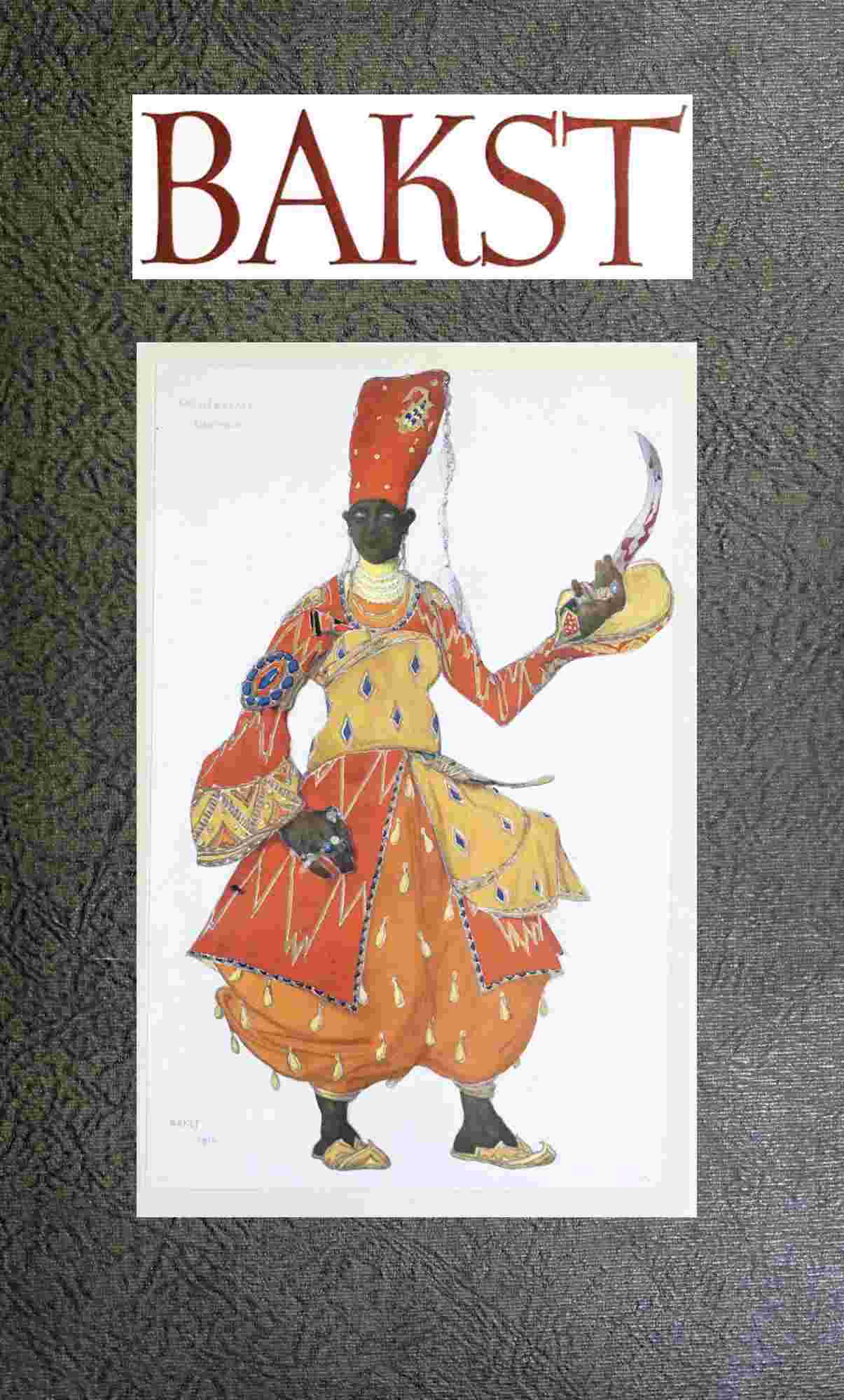
The Project Gutenberg eBook of Bakst
Title: Bakst
The story of Leon Bakst's life
Author: André Levinson
Artist: Léon Bakst
Amedeo Modigliani
Release date: May 3, 2023 [eBook #70695]
Language: English
Original publication: Germany: Alexander Kogan, 1922
Credits: Chuck Greif and the Online Distributed Proofreading Team at http://www.pgdp.net (This file was produced from images available at The Internet Archive)
COPYRIGHT
BY ALEXANDER KOGAN
PUBLISHING COMPANY, “RUSSIAN ART”,
BERLIN
MCMXXII
THE STORY
OF LEON BAKST’S
LIFE
TEXT
BY
ANDRÉ LEVINSON
B R E N T A N O ’ S,
N E W Y O R K
THE AMERICAN EDITION OF THIS WORK
CONSISTS OF 250 NUMBERED COPIES
Nº. 247
PRINTED IN GERMANY
DR. SELLE & Co. A.G.,
BERLIN
PREFACE
N the book of fame, the name of Leon Bakst is writ large. Many a time and oft, illustrious critics have heralded his praises. In speaking today of the contribution made by Bakst, there is really nothing that one can add or improve upon. The inventory of his achievements has been completed; the unexampled influence which he never ceased to exercise has been rightly evaluated. Nevertheless, there remains a task which must not be neglected. Paris, to be sure, enthusiastically watched the development of his art; but for us, Russians, has been reserved the most thrilling experience of all—that of chronicling the unfolding of his genius. We have here the spectacle of a towering, unusual, self=revealing personality, and of a style that develops progressively and that blazes new ways after bitter struggles.
More than that, in order to obtain a composite picture of his work, in order to arrive at a general estimate of the man, we must try to reproduce the intimate atmosphere of his artistic development, the material and intellectual surroundings which shaped his course.
As a compatriot and contemporary of the master, I have, on the whole, breathed this same atmosphere. I have been an eye=witness of those earlier creations of his that mark an epoch in the history of Russian painting and of the Russian theater. This knowledge constitutes my qualification for attempting this biography. The latter would be incomplete unless his childhood and adolescence were also to be recalled. In so far as this period of his life is concerned, I am reporting Bakst’s own words; with moderation I have supplied a running comment.
Thus these pages present the first attempt at a story of Bakst’s life.
THE YELLOW DRAWING ROOM
It was in a dull and mediocre home of the well=to=do middle class that our artist who, as the originator of expensive pageants and the dispenser of unheard=of splendor, was destined some day to modify profoundly the whole conception of the western stage, spent his early childhood. Leon Bakst’s family lived at Petrograd, on Sadovaia street. Now, there is nothing more incongruous than the different sections of the Russian capital—“the most phantastic in the world,” to use a phrase of Dostoievski.
The Sadovaia is a rather narrow but very lively street, which cuts across the market=place and is flanked by the arches of three huge galleries where countless small tradesmen carry on their business. Here, in the adjacent streets, in the gutters of the sidewalks which, depending upon the time of the year, were muddy or dusty, Roskolnikov lived his life of superhuman anguish; a few steps from here, in a gloomy red house, during all of a terrible night Rogojin and Prince Mishkin watched over their murdered love; here, too, one day Nicholas I, the giant=like autocrat with the countenance of an Apollo, standing at the entrance to the temple which overhangs Sennaia Square, by a single imperious word brought the revolting mob, which was exasperated by the plague and the shedding of blood, to their knees.
Thus to a dreamer who is haunted by memories the very stones of this district, which has been the silent witness of tragic fates, whether imaginary or real, seemed to be harbingers of bad luck.
And yet, notwithstanding, there is nothing more noisily commonplace than the daily routine in broad daylight of this same Sadovaia: large public houses, but devoid of rustic cheerfulness; mechanics’ shops in which the songs had died. Dull boredom of an industrious popular life, but how discolored, deadened, and enervated by the peculiar atmosphere of this artificial town—this city of officials, of soldiers and of ghosts!
Nevertheless the little soul of the well=behaved child, blocked up though it was by realities that afforded no way out, possessed its wondrous sesame, its secret garden. Every Saturday Levoushka would walk toward the Nevsky Prospect where, but a few steps from General Army Headquarters with its imposing semi=circular façade of red, from Winter Palace Square, and from the Admiralty—a veritable fairy=land of lofty architecture—, his grandfather lived, a noble and vaguely mysterious being who, without in the least being conscious of it, awakened in the future artist a reverence for Beauty, a holy fear of the Unknown.
The child thus came into unusual surroundings which constituted the artificial paradise of his early life. Whatever it was—precocious influence or atavism—this fascination dominated the life of Bakst and at least decided his calling. At any rate the master himself, who one day told me at length about his earliest recollections, seems to think so.
His grandfather, a peculiar fellow, was a Parisian of the Second Empire, a man of society who, it may well be, not long ago had been out walking with the Mornys and the Paivas. An amiable Epicurean he was, a man of fine discernment in the manner of his time, who had set up a retreat for himself at Petrograd that was well adapted to his ineffaceable memories.
Everything in this home of dreams appealed to the sensibilities of the child—the brocaded silks, the graceful and heavily gilded trinkets. But his greatest delight was the large gilded parlor, with panels of yellow tapestry, with furniture of rock and shell=work in the style of 1860, with its white marble, its yellow flower stand, filled at all times with rare plants, and (this constituted his supreme happiness) its four gilded cages in which canary birds were chirping. In a corner, on a stand, a large model of the Temple of Salomon displayed its imaginative architecture. A large painting had for its subject the lament of the Jews before the demolished walls of Zion, for the former Parisian “lion” did not renounce his race; he had not forgotten Jeremiah over Theresa.
The irritable old man at times scared the impulsive and vivacious urchin; kindhearted old grouch that he was, he often angrily charged the wretched disorder up to the young lad. Levoushka was therefore not sorry to see his grandfather leave for his customary Saturday promenade, for this was indeed the right moment for him to make the large clock, with its mechanical doll, ring, and to wind up the music boxes of every description that were to be found in the yellow drawing room.
His own home furnished Leon no such emotions. Besides, the indifference to matters of art was practically general in the Russian intellectual classes of that time. The grandfather was therefore the idol of the child, his sole arbiter of good taste. No sooner had he returned home, than Levoushka would turn his room upside down and would try to arrange his modest furniture according to the exquisite æsthetic principles of the yellow drawing room; and he would try to hide from view the things that were devoid of beauty.
Yet throughout all this there was never any idea of painting. Later, his grandfather never got to know that Bakst was sketching. Meanwhile Leon was about to become ten years old. His entry into school put an end to his weekly pilgrimages to the Nevsky Prospect. Sesame had closed.
THE UNGRATEFUL AGE
No sooner had Leon become encased in the uniform which distinguishes the city student from the provincial youngster in gray—viz., a black blouse with silver buttons—, than he came to know the monotonous and depressing life of the Russian schoolboy: rising by lamp=light during the long winter months; returning with his school=bag on his back; suffering the petty annoyances of an oppressive discipline and the black boredom of official education.
It was then that he discovered the theater. Not that he had ever been there. Like everybody else, his family had subscribed to a season ticket at the Italian Opera which was then at the height of favor and which eclipsed all efforts of an unappreciated national music to win its way; but our hero, being too small, was not allowed to go to the family box. With great difficulty, however, he had gained the privilege of staying up on Mondays—the days on which his family had the box—until their return. With delight he would then listen to his brother’s account of the “Puritans” or the “Favorita” and their tragical and pompous vicissitudes.
Tired of listening without acting, he constructed his own theater. He cut out his heroes from the sheets of colored paper soldiers, his princesses from the engravings in popular fairy tales illustrated at Epinal, his court ladies from the fashion magazines. Then he would place his actors on a paste board stage and “brush in” the scenery in water color with paint plundered from his color=box. The subjects were plentifully provided by the librettos of Verdi’s operas, augmented by supplementary murders. As for the audience—it was never lacking, Leon having always been the appointed and recognized entertainer of his little sisters.
This play of make=believe did not, however, entirely satisfy his precocious ardor. The strong desire for disguising and masking is, after all, quite general among children, who possess a genius for dramatizing the facts of life. Improvised plays were, therefore, put on. The most frequently recurring motif was the visit of the doctor. There was much
illness at Leon’s home! Young Leon, besides being stage manager, would now play the role of the doctor with black robe, now that of the druggist, now even, with self=denial, the rather contemptible part of the patient.
One day, as he had concocted a drug by diluting green coloring matter, he pursued realism to the point of swallowing the concoction. He fell ill. Only with the greatest effort in the world was it possible to save him by making him drink a quantity of milk.
Throughout all this, however, we do not yet see the painter come to the fore. Indeed, our schoolboy was decidedly not a success at drawing,
and with envy he watched how his chums sketched fine battle scenes upon the margins of their note books. His life’s calling announced itself for the first time when he was almost twelve years old. His school, known as “the sixth gymnasium”, was making preparations to celebrate the
centenary of Joukovsky, the celebrated Russian poet. A good portrait was wanted for the ceremony. Accordingly, a prize competition was organized. Bakst decided to enter it. He reverently took home the little engraving which was to serve as model, and four or five days later he brought back his drawing. The prize was awarded him, and his masterpiece put in a glass frame and hung in the gymnastic hall. From then on Bakst was unanimously proclaimed a painter, and he was able to pride himself on winning many a prize.
Leon’s father was not much pleased over this sort of success, especially since bad marks were raining thick in the other studies. He conceived the notion that his son’s predilection for drawing was due to sheer laziness. He therefore positively forbade him this pastime which, he argued, interfered with serious studies. Leon therefore continued drawing in secret, at night=time, by the light of a candle.
On the other hand his accomplishments brought him the friendship of his drawing and penmanship teacher, who became much attached to the youngster. Andrei Andreevitch was a diminutive little man with bowlegs; but this tail=coated freak in blue was fired with a divine enthusiasm. Striding about the class room he would talk incessantly to the pupils, now pondering the volutes of an acanthus leaf, now discussing the lives of great painters, their struggles, their triumphs. So volubly and so well did he speak that he stirred deeply the imaginative soul of little Bakst and awakened all the latent passion in him. Subsequently, the artist’s entire magnificent life was to be animated, as it were, by these rhythmic fits of intellectual fever, from which he was to emerge renewed, transformed, his mind’s eye turned toward unexplored horizons.
The profession of painting, therefore, suddenly appeared to Levoushka to be the highest of all destinies—one bearing the halo of heroism. Filled with this romantic dream, he was anxious to quit school at once. And he insisted with such impetuosity that his parents, routed in the argument, decided by way of setting him right to seek the advice of the sculptor Marc Antokolsky, a friend of the family and a recognized authority on all matters pertaining to art. The late Antokolsky was little known in Paris where he used to live, nor do people care much about him in Russia today, although his works, which are quite numerous, fill the museums of Moscow and especially of Petrograd. So deceptive is artistic glory!
For indeed, he had his day of glory. In Russia he was the sculptor of the century—of that nineteenth century which had lost the plastic
arts almost completely. The conception of a strict naturalism placed at the service of humanitarian and social ideals, dominated by the idol People, a conception that also characterized the notable and prophetic “Association des expositions ambulantes”, was also his. Moreover, Stassov, the voluble and prolix critic who composed for the great Moussorgsky the monstrously confused text of “Khovanshchina”, turned Antokolsky’s mind toward Russian history.
And thus, through his bronze and marble sculptures, Antokolsky became the historical illustrator and portraitist of Russia. He wrought Ivan the Terrible, Nestor the Annalist, Peter the Great, and even Ermak the Cossack, conqueror of Siberia. With keen psychological sense he also composed the likenesses of heroes and martyrs of free thought: a dying Socrates, a Spinoza and a Christ insulted, the latter work being conceived in the spirit of Strauss and Renan. All these monumental figures which greatly stirred his contemporaries no longer show any signs of life.
There remains the personality of Antokolsky, which was in every respect a pure one. Not without reason did this poor and pertinacious young Jew, who hardly knew how to write Russian, become the idol and the oracle of two generations. We see but too clearly today that he travelled the wrong road. But he had faith. His artistic convictions were unalterable, unselfish, absolute,—those of a fanatic. More than that—a thing seldom to be found—, this fanatic was kindness itself.
Antokolsky, then, on being consulted made much of the misfortunes and bitter disappointments that one embarking upon an artistic career must expect. But he was not unwilling to look Leon’s drawings over. Pestered by the youngster, his father sent several sketches to Paris. Lo and behold! when the reply, so anxiously awaited by the boy, arrived, it was favorable, decisive, almost intoxicating. The master had found the drawings quite well done and advised the boy’s going to the Academy of Fine Arts, on condition, however, that he pursue his general education.
Thus Leon, the intractable and mediocre schoolboy of the day before, was to become a painter, a chosen and quasi-legendary being. He was then sixteen years of age.
THE TWO SPHINXES
Leon, then, presented himself for examination but failed. Before being admitted to another test he had for a year to practice drawing from models; and only after he had solved the mysteries of this form of academic discipline, was he admitted. For another year he kept abreast of both his artistic studies and his general secondary education; soon, however, he neglected school and, after a few feeble attempts, gave it up altogether. Let us state the fact without bitterness: Bakst never received the Bachelor’s degree.
The first day that Bakst, attired in his new green uniform, wended his way along the granite embankment toward the Academy and, having passed under the eyes of the two Sphinxes from Thebes with a hundred gates which guard the sanctuary, decided to enter, his astonishment and his proud ecstasy knew no bounds. However, despite the grand pretense of a temple, the Imperial Academy of 1890 was a rather curious institution.
The academic instruction which flourished at the beginning of the century, maintained its power and authority until the close of Nicholas I’s reign. But from 1863 on it was badly shaken by the famous secession of the “Thirteen”, with Kramskoi at the head. These thirteen later became the first “wanderers”; they were destined to herald the arrival of a certain humanitarian realism closely related to the teachings of Proudhon and of Courbet. They professed the haughtiest contempt for disinterested pictorial beauty, for mere virtuosity, yes, even for sound craftmanship based upon traditional experience.
Among the “pompiers” classicism had degenerated into hackneyed copying; teaching became vulgar pedantry. Among the revolutionaries classicism was the complete and absolute negation of art, admitted only as a function of social apostleship. But the younger artists had public opinion behind them, which hailed the catastrophe as a liberation. Yet for thirty years the Academy, powerful solely because of its official authority, continued to stick to the past and to live outside the pale of a throbbing artistic life.
Not until 1893 did the “wanderers”, led by Makovsky and Repine, enter the citadel in order to establish a bold and frank dilettantism while still respecting the remnants of the old Academy. At that time Bakst had already broken with his first masters; we shall soon see why.
Let us first, however, briefly complete the history of the institution on the Nicholas Embankment. Toward 1910 a reaction set in against the anarchy of the “wanderers” and in favor of a classic revival, of a rehabilitation of craftmanship. This movement was of short duration, however, for the October Revolution abolished the Academy and established free studios upon its ruins, the management of which was placed in the hands of artists who supported the Communist regime. On the day of its death the Russian Imperial Academy was more than 150 years old.
Thus, at the Fine Arts School, Bakst found a training that clung to unchanged formulæ, but that was decadent, inert, and lifeless. He spent three months drawing from bas=reliefs and one year sketching models. Then, after having passed the class in costumes and copied draped mannequins, he was admitted to the studio class. His teacher, Tchistiakoff, did not encourage him to continue; he considered Bakst a promising sculptor, and whenever his pupil tried to talk painting to him, he would invariably turn the conversation to sculpture. Tchistiakoff’s colleague, Venig, was more far=sighted and, while disapproving of a certain vivacity and truculence of colors which netted young Bakst the ironical title of “Rubens newly ground”, he was not unfriendly to him. This meant a great deal, for it was impossible to think of any more intimate relations—any communion of ideas or of feelings—between the pope=like officials and their pupils who were as yet unknown quantities.
Far more important were his relations with his fellow students, especially with the class that was about to leave. At school and at his paternal home he had been placed in a position of isolation because of his artistic aspirations; here he found himself surrounded by young people devoted to that same art that was viewed with such suspicion by the Russian intellectuals of yesteryear. At the Academy Bakst met Nesteroff who, following Vasnetzoff and contemporaneous with Vroubel, was to attempt a revival of the ikon,—a revival which, besides proving abortive, was more in the nature of sentimental and artificial imitation. This craze for old national art went hand in hand among certain students with a strong animosity against the “métèques”; besides, anti-Semitism was officially encouraged and stimulated, since it served to side=track the hatred which was more and more undermining the autocratic power. Bakst, sensitive and meticulous, was grieved at this. He therefore clung all the more closely to Seroff, several years his senior, who was finishing his education and who aspired to winning the Grand Prize for Painting—the gold medal. This future portraitist was a son of the celebrated musician whose masterpiece, “Judith”, is known to Parisians only by partial selections. Already he had achieved, in the eyes of his fellow students, the intellectual and moral prestige that was due to the uprightness—albeit somewhat morose—of his character and the tenacity of his effort. Soon, indeed, he came to the forefront of his generation.
This man, already matured, reserved, and little given to effusive outbursts, took a fancy to the red haired young lad. The pair would sit together in the studio; they would spend the evenings chatting in the modest students’ apartment where Seroff lived and drinking plenty of tea. Those were the happy days! They lasted for eighteen months. Clouds were, however, gathering over the head of Bakst who had already given repeated offense to his superiors by his whims of independence. A free competition was announced in which “The Madonna Weeping Over Christ” was to be the subject and the Grand Medal of silver the prize. Bakst joined the competitors.
He sought inspiration from those artists of his time who had attempted a revival of religious subjects by displaying a realistic setting—thus breaking away from the iconographic traditions of the Renaissance—, by giving care to ethnographic detail, by minutely studying the expression observed. These artists included Repine and Polienoff in Russia, and Munkaczy abroad. But, carried away by a youthful enthusiasm, he wished to go beyond the fastidious and cautious realism of these painters and make a ten=strike.
He therefore chose a canvas of enormous dimensions—almost seven feet in length—and plunged into his work. For the characters of the legend he set down Jewish types that were obviously overdone, and imparted
a movement to them that imitated the gesticulation of Lithuanian clothing merchants or of elders in the synagogue. As to the Virgin, she was an old, dishevelled woman, with eyes red from weeping. Our candidate was, to be sure, vaguely conscious of the fact that he was digging his own grave; nevertheless he obstinately persisted in his daring attempt.
What anguish he suffered while he awaited the decision of the jury on the winding staircase that constituted the Bridge of Sighs for the young daubers of Petrograd!
And justly so, for when his name was called and he appeared before the tribunal, he saw his canvas crossed out by two furious strokes of crayon, and he had to listen to an official rebuke by the president.
The next day he quit the Academy under the impassive glances of the two bearded sphinxes of pink marble, emerging from the gloomy twilight.
A WRONG START
Leon was free now and left alone with his pride in his recent revolt; but there was also a great void in his soul. A country holiday out at Pavlovsk, the delightful suburban residence district where Constantine, the grand duke-poet, lived, afforded him salutary diversion. In the beautiful English park—the loveliest in all Russia—, where every clump of trees, every hill, every lawn forms part of a grandly-devised and complex general plan conceived by an architectural genius; in this park, in which he walked about carrying the burden of his liberty—a melancholy figure, he found what he lacked most: a friend. This new-found friend was a cartoonist by the name of Shpak, a pupil of Repine, and, though but a mediocre artist, yet one who gave himself to painting with a passionate and unselfish spirit. He guided Bakst in looking for motifs, spurred him on to direct observation of Nature, and awakened in him the proper respect for his profession. But this influence soon gave way to another.
Luck would have it that Bakst, during that same autumn, chanced to meet Albert Nikolaievitch Benois, the celebrated water-colorist who had no rival in Russia. He was a member of that “dynasty” of Benoises who have played so prominent a part in the artistic development of Russia. Albert Benois, a handsome, chivalrous and affable man, handled the brush with remarkable ease. He possessed a technique that was as natural for him as bel canto singing is to the Neapolitan beggar. But while his productions, at the same time that they possessed certain qualities of good taste and true knowledge of his art, nevertheless were rather too tame, their success in the eyes of the public was complete. This success of the “master”, who was fêted and flattered by his aristocratic and feminine entourage, and who was unanimously elected to the presidency of the society of water-color painters, dazzled young Bakst, blunted for a while in him the haughty pride of the seeker after new truths, and stimulated other ambitions in him. The fierce rebel who sneered at the Academy suddenly craved Success!
He achieved a success that was immediate, brilliant, and disastrous. Soon he began to neglect landscape painting in favor of the society portrait. Having tasted the apple, he next painted Eve. And, as he abandoned himself to these effeminate and futile pursuits with that same insatiable fervor with which he went into everything, he undertook, he simply allowed himself to drift. Besides, his good friend Shpak was no longer there to awaken his sleeping artistic conscience—he had died quite suddenly. Serov, too, was far away in Moscow and unable to warn him.
When I questioned him about this period of his life of which there are few traces left, Bakst spoke about them quite eloquently, yes, even persistently. He took evident pleasure in this confession; he seemed even to relish the mortification that it must have cost. Was it that in this race toward the abyss he tasted something of that spirit of adventure, of that happy faculty of spending without counting, of giving oneself body and soul to God or the Devil, which, indeed, was a part of his nature? Or was he dreaming of those pretty hands of women, slender but strong, which stroked his curly hair? As far as we are concerned, we must content ourselves with recounting briefly the outstanding facts in the early history of our friend and hero.
The most important of these is a long stay abroad. At Paris he made friends with Albert Edelfeldt, a Finnish painter and a remarkable man, to whose lot it fell to break the ground for the birth of a national art in his own country, in that he transmitted to it the enlightened knowledge of France. It should be noted in passing that all the Norse revivals which endowed the Scandinavian countries with an intense and original artistic life had their origin on the banks of the Seine. Edelfeldt was neither a creative genius nor an artist in the vanguard. He stuck to the cautious methods of a Bastien=Lepage. But he was a forceful and able painter. Some of his canvases are to be found in Paris, among them, if I remember correctly, his portrait of Pasteur.
The habit of working outdoors, the study of daylight and its effect upon massive subjects which Bakst pursued with his new friend who also in some respects became his teacher, contributed powerfully toward his success in performing the enormous task that was soon thrust upon his youthful energy. The Russian government asked the Prodigal Son
of the Imperial Academy to paint a canvas that was to have for its subject the arrival of Admiral Avellan in Paris.
Perhaps the reader remembers that this visit which, unless I am very much mistaken, took place in 1893, was one of the first formal ceremonies arranged in connection with the nascent Russo=French alliance. This canvas, the result of painstaking and honest labor, which displays a freshness of color and a virtuosity of touch that is by no means vulgar, is preserved today in the Navy Museum at Petrograd. Was the young rebel of yesterday to become the Roll or the Mentzel of the imperial fastes? Today we know that nothing of the sort happened.
One afternoon as Bakst, back from Paris, was lording it over a tea table surrounded by beautiful ladies, and was basking in the sunshine of his reputation, with flattering chatter all about him, he noticed a young man enter whose manners at first offended him. With a monocle in his eye, with haughty pride writ across his dark=complected face, round=shouldered, attired in the student’s green blouse with blue collar, he carried on the conversation with an ease that bordered upon disdain and insult. Yet in the very arrogance of the young upstart there was something that fascinated. Bakst took him aside and, when he pressed him for an expression of opinion as to what he thought of his painting, the young man replied candidly that, while he had the profoundest respect for the technical mastery of his questioner, the painting itself absolutely displeased him, and for good cause.
This young man’s name was Alexander Benois. As for Bakst, little did he imagine that he had arrived that afternoon at a turning point in his artistic career.
THE CLUB
For a number of years a group of students from May College a private institution, had been in the habit of meeting at the home of their comrade, Alexander Benois. Among them was Constantine Somoff, a son of the venerable director of the Hermitage, and the future originator of “Echoes of Days Past”; Philosophov who later, when he was associated with Dimitri Merejkovsky, was destined to become one of the revivers of religious sentiment in Russia; and others besides who afterward constituted the nucleus of the society named “The Artistic World” and who still later supplied the staff of the Russian Ballet. Unique, indeed, was the atmosphere of this house.
I have already had occasion to speak of the Benois family. They were the descendants of one of those numerous immigrants who for more than a century, from the accession of Peter the Great till the Moscow Fire, were called upon to help in the transformation of Russia. All of these newcomers went through a similar experience: the tremendous opportunities for initiative, the vast geographical extent and the artistic impulses of the young empire called forth the highest development of their abilities. Many a mediocre artist—or at least one assumed to be mediocre—who had become half suffocated amid the rabble of the western world, became transfigured in these favorable surroundings. The originality of the Russian character, the breadth of view of the grands=seigneurs of Catherine II’s time, the primitive simplicity of the life of the people—all this stirred their imagination. And so these men, who transplanted into Russia the artistic methods of the West, the conceptions of style and the traditions of art that had matured in Europe, became Russians themselves in heart and spirit. More than that: it is to these “Russianized” fellow=countrymen of ours that, in a large measure, we owe the birth of a modern Russian art.
The Benoises were related to the Cavos family, a veritable progeny of artists. Alexander’s maternal grandfather had been a noted composer of music, his uncle a theatrical architect of distinction. The Cavos family were of Venetian origin and never lost contact with their former
fatherland; the Benoises had French blood in their veins. All this is of importance to those who are interested in looking for the origin of certain aspirations, of certain artistic inclinations and habits of mind, in atavism or in the call of blood. All of which did not prevent the Benois brothers, two of whom we already know and the third one of whom was an architect and later was made rector of the Academy of Fine Arts, from becoming the eminent Russian artists that in fact they are.
As for Alexander, from earliest childhood he possessed all the qualities needed for becoming, if not an intellectual leader, at least an intellectual centre. His general culture, broad indeed and so varied as to have become eclectic; a certain pedagogic inclination,—a tendency to instruct, to educate, to make ideas spring forth; added to this, a liveliness of temperament, an acuteness of perception which made him a malcontent, a wide=awake dreamer—all these rare qualities determined his life’s work. His attempts at painting, excepting only his theatrical creations, never seemed able to free themselves of a certain amateurishness. But this was a natural complement to the fact that he was primarily a theoretician or rather a man of artistic tastes who re=enforces his intuitions and his sensibilities with an exact sense of logic and with the true talent of a writer.
For many years Alexander Benois has been the most famous critic of Russia. He is passionate and imaginative. He proceeds either by invective or by panegyric. He is a thunderbolt. He gets worked up over some artist, some idea. Oftimes he is mistaken and his candidate for fame fails. That is due to the fact that Benois, who had really constructed his hero from his imagination, endowed him with his own ideas, and magnified his own conceptions in him, would suddenly, some nice day, leave the poor wretch to his own designs.
When Bakst was admitted to this group, or club, the school boys had become students and the original circle had widened. Philosophov had introduced into it a cousin of his, just in from the provinces,—a fat, chubby lad, exceedingly free in his manners, dictatorial and quite aggressive, inexhaustible in paradoxes which at times were absurd, but which he defended to the limit without in the least attempting to be polite about it. Benois was the soul of this group; the newcomer was to become its will, its moving power—he was to lead it to its supremest heights. The name of this fellow from the provinces was Serge Diaghileff.
Now what was it that transpired during these interminable confabs? The club had set itself up as a supreme court which was to judge the quick and the dead. Before doing anything constructive—they didn’t know themselves what—its members first wanted to wipe out everything existing. They would agree upon the victime, appoint someone as prosecutor, and then conduct a trial. The defendant might be a Shishkin or a Verestchagin—in any case he was one of those celebrities whose wrongly acquired reputation was debasing the real character of Russian genius in the eyes of the whole world! But this whole work of tearing down could not satisfy this enthusiastic group of young people. They felt the need of giving themselves over to something, of consuming themselves