
beholds a landscape, an archipelago seen from a high elevation, and displayed like a map in relief; cliffs submerged by the rising waves; diminutive humanity seeking refuge under the porticos of the temples and attempting to escape the inevitable; an enormous stroke of lighting rending the air. It is the twilight of the gods, the last judgment of the Greek world, the end of Atlantis.
With its mysterious mixture of congealed grandeur and mad anguish the panel, when it was exhibited (if I am not mistaken) with the Association of Russian Artists, created something of a sensation. People flocked to the lectures of Viatcheslav Ivanov, the poet=philosopher and author of a treaty on Dionysios and the religion of the gods, who explained this Greek Apocalypse.
As for Bakst, this work of his constituted a striking but isolated episode in his life as an artist. Man of the theater that he was, his aim was that of utilizing and transforming space in accordance with his vision; here he transformed a surface, in the sense of material and philosophic depth.
THE SPIRAL ROAD
Into this period of researches and visions in Greece falls many an episode that is entirely different but no less significant. Since 1903 Bakst had been using the ballet of the “Dolls’ Fairy” on the imperial stage. It furnished the prototype of those romantic productions, of those entertainments for children which are colorless reflections of Hoffmann’s Coppelius or of Andersen’s tales and in which one sees toys awakened to an artificial and mechanical life by a magic wand—entertainments, furthermore, which have become vapid by their being produced on innumerable German stages. Also, he rendered homage thereby to that “old Petrograd” that was dear to the members of “Mir Iskousstva”.
The prologue, which represents the busy coming and going in a doll shop in the capital city of 1830, is acted by a big crowd of people—shop=attendants, customers of every sort, small merchants and grand ladies, lackeys and grenadiers, mailmen and policemen produced on the stage as the naive action unfolds. All these masques and costumes are absolutely authentic, but they seem fragile and delicate like a dream. The fact is that the documents from which the dossier of the decorator was constructed were anything but commonplace. Bakst did not seek his information from the more direct sources supplied by the engravings of that time: he went to the show cases of porcelain ware.
Too little are the charming products of Russian porcelain makers—the Gardners and the Popovs—known. To be sure, they often merely misrepresent, in their style, the models from Saxony or Sèvres, but they do it with a naive flash of pure color that appeals to rustic artisans. But side by side with such imitations these obscure Russian artists modeled an entire little world of their own in tender clay—cossacks in uniform, drunken serfs, nude women, coiffed “en cabriolet” and burying their chilly hands in fur muffs. Whatever tastefully conventional there was in these figures, Bakst transposed into the language of the theater. Ever since that time this form of ballad (or “boutade”, as it was called
in the time of Cardinal Mazarin), the dancing for which had been designed by Serge Legat, a splendidly endowed young man who committed suicide in a fit of passion and despair over a love affair, has maintained its place on the program. Examples of it are the “Carnival”, “Phantom of the Rose” and “Secret of Suzanne”, that delightful little=work in which one already sees Napoleon evolving from Bonaparte.
But Bakst had by no means given up his painter’s easel for his theatrical sketches. Numerous portraits of his bear out this fact, such as that of the philosopher and lay theologian Vassili Rosanov, of his friend Benois, of Levitan the remote emulator of Corot who discovered the intimate and poignant beauty of the humble Russian landscape, of Diaghileff and his old nurse. Painted with keen observation, with facility of touch and in vivid colors that spread over broad surfaces, these portraits coming from the school of Serov showed nothing of that painful affectation, of that anguish of definitive, absolute expression with which the Moscow master often endowed his canvases to the point of tiresomeness. In the case of Bakst there is nothing of the exact analyst who dissects and torments the soul of his model. With our artist everything seems to be improvisation, happy inspiration; it is a style for which the fine term “prime=sautier” (ready=wit), once coined by Montaigne, is exactly appropriate.
His growing familiarity, however, with Greek art, which is in a high degree plastic and linear, turned him in the direction of more concentrated and more simplified processes. The painting of vases in the merest outlines and on flat surfaces neatly silhouetted, imperceptibly drew him into the path followed by Ingres. He therefore gave up his paint brushes in favor of the lead pencil and the colored crayon. In his portraits thus designed it is the line which circumscribes the person, which sets it out in space, which expresses its character and suggests its size. Thus the Russian painter is already en route towards that strictly linear transposition of a body of three dimensions without the aid of the model, or of any standard of values, or of any material record; a style which some day Pablo Picasso employed as master and Modigliani as spiritual dreamer.
But even all this could not satisfy that fever for activity, that fecund restlessness which at all times determined the tremendous productivity of Bakst. It was necessary, people were agreed, to offer, in opposition to the Academy of Fine Arts, managed by pedantic dilettants who were embittered by the triumph of the new art, a form of instruction at once free and sane. The haughty air of the Academy’s official staff was not justified either because of any venerable tradition nor because of the most elementary savoir faire. The “wanderers”, having dislodged from the Academy the pedants whom Bakst knew, placed themselves in their seats. Their æsthetic carelessness was complete, their ignorance of Western art absolute and provoking. At the same time young artists who rebelled at this teaching were reduced to the necessity of acquiring the rudiments of painting by themselves.
Affairs were in such a condition that they absolutely needed to be remedied. Bakst therefore associated himself with Mstislas Doboujinsky,
a remarkable offspring of “Mir Iskousstva”, who excelled in the designing of the ornament and of the vignette, and who later worked with considerable success in the theater, in order to start a free school. I recall having been able, in connection with an exposition organized by the review “Apollo”, to estimate the results achieved during the first year of the school’s work. One series of studies symbolized a nude man on a background of red material. There was none of that “academic” way of placing things in a vacuum or in a neutral atmosphere, nor of sketches colored amid gray shadows. The bright red of the background played upon the subject in green lights; the rhythm of the colored surfaces superimposed itself upon the anatomic harmony of the body. All these attempts were strictly anonymous as far as the public was concerned; it was not the personal pride of the students that was to be flattered; it was merely a question of establishing the validity of the method. That did not hinder the fact, however, that some of those young unknown painters today enjoy a reputation that borders upon renown.
We have now reached the year 1908. Bakst seems to have condensed his effort. He has summoned back the ancient legendary tale and has restored it to the theater. This myth he has also projected upon a famous canvas. In his portraits his incisive line closely encompasses material and internal realities. In his romantic dreams he has been able to live again through what Stéphane Mallarmé has called “la grâce des choses fanées”. Later he makes a division of his artistic property among his enthusiastic students. How much there is in this to fill a beautiful life! One might think that the circle of such men as Bakst is completed in one harmonious curve. But it is nothing of the sort.
Bakst is one of those men whose road is laid out in spiral form. What seems like a stop, is in fact nothing but a turn of the road. And at each turn the circle widens. At Petrograd his task is completed. There is nothing left there except to follow. But there remains Paris and the universe.
In reality, I am at the end of my task, which is that of acquainting the reader with a Bakst who has not yet been written up, of speaking of his formative period and of the intimate and hidden sources of his inspiration. Once my hero had entered upon public life, I ought already to have left the domain of his private existence. It is with regret that I take leave of the good little fellow who goes into ecstasy over his grandfather’s canary birds; of the uncompromising youth who defies his ignorant masters; of the young man who risks his future—and what a
future!—for the sake of the exquisite form of a smile and the profile of a tapering hand; and finally of the artist whom I see in my country becoming identified with all big projects, either undertaking them or excelling in them.
But this study would perforce be incomplete if I did not decide to accompany our friend on his exodus toward the West and to put together the main facts of his recent activity which sends its rays over the entire world—an activity of which, for the most part, I am a witness.
A SHOW IN AN ARMCHAIR
In 1906 or thereabouts, following immediately upon the first Russian revolution that failed so grievously, the group of young artists and poets marched side by side through the breach that had been opened in the citadel of public opinion. The “modernists” of “Mir Iskousstva”, who had been jeered by the common herd, came into their own. But a certain uneasiness troubles this rising power; it feels itself incomplete, limited in a fatal manner. It is not equipped to reestablish great painting; it can only count upon illustrators, decorators, and poets of the
past. And, as is the case with authority everywhere when it feels itself threatened, so too this group, not being able to assert itself, was anxious to spread out.
Accordingly, they looked for new fields to conquer. Once again we see Diaghileff leading the attack. He releases that great exodus of Russians to the West—the brilliant and victorious march on Paris. The offensive starts with a Russian exhibition at the “Salon d’Automne”, an exhibition which under the guise of being retrospective is in reality a fighting manœuvre. A collection of icons, of numerous portraits of the eighteenth century symbolizes the return to a tradition which the young men of the “Monde Artiste” proclaim to be their own. Similarly the arbitrary gaps indicate their complete break with the unnatural art of the “wanderers”, the latter having been nearly entirely eliminated.
Bakst took part in this enterprise not alone as a painter. He decorated the hall of the eighteenth century, which had been transformed into a grove, with a trellis surmounted by vases. This conception of an exposition hall forming an organic whole, making a coherent ensemble, and therefore having a distinctive atmosphere—is not this, again, a gift belonging to the Russians?
This first attack could do no more than break through the first lines of the enemy. Painting, it was evident, was not sufficient as an object for combat. So Diaghileff thought of music. His historical concerts of Russian music caused the greatest excitement; Parisian opinion was deeply stirred. Bakst’s role in this first and formidable success was quite accidental. He drew some portraits for the program, notably that of Balakirev, the composer of “Thamar”: bold lines and a synthetic contour set out the head of the aged oriental sorcerer as though it were sculptured.
It now became a question of following up this first victory. Diaghileff turns once again to the theater, counting for his success upon its numbers and upon the wide range that it afforded. All circumstances are favorable for his project. His old group of co=workers surrounds him, abler through strife and experience. A galaxy of stars of the dance—Pavlova, Karsavina—await but the signal to make them gleam forth on the western sky. At the same time a marvellous dancer is discovered—Nijinsky. And, as a will is needed to give life to all these latent forces, behold, Michael Fokine presents himself,—Fokine, a young master of
the ballet, a rebel at the hundred=year=old tradition in vogue in the imperial theaters, who is ready to offer himself body and soul to the cause of the painters who take possession of the theater as masters. Into this renunciation of tradition he puts all the fervor of a neophyte and an infinite measure of talent. What was there that one could not dare to undertake with such a band of the élite?
What followed is well known: fifteen times the celebrated “Russian Seasons” have already borne in upon Paris like shining waves breaking into foam.
It is not for me here to trace in detail the fate of the “Seasons”,—the transformations which they underwent, their successes as well as their
failures, the latter oftentimes being more creditable than the successes. Whatever else may have been their mission, certain it is that they brought two men forth into fame and glory: Stravinsky the musician and Leon Bakst the painter.
“Cleopatra” had caused extraordinary surprise. “Sheherazade” in 1910 surpassed everything. In recalling the annals of the modern theater, it is scarcely possible to recollect any production that was given a similar reception.
I had intended to sum up the successive stages of the fifteen years of productive work accomplished. Yet here I find myself, as I face my sources and my documents, overwhelmed with the almost magic
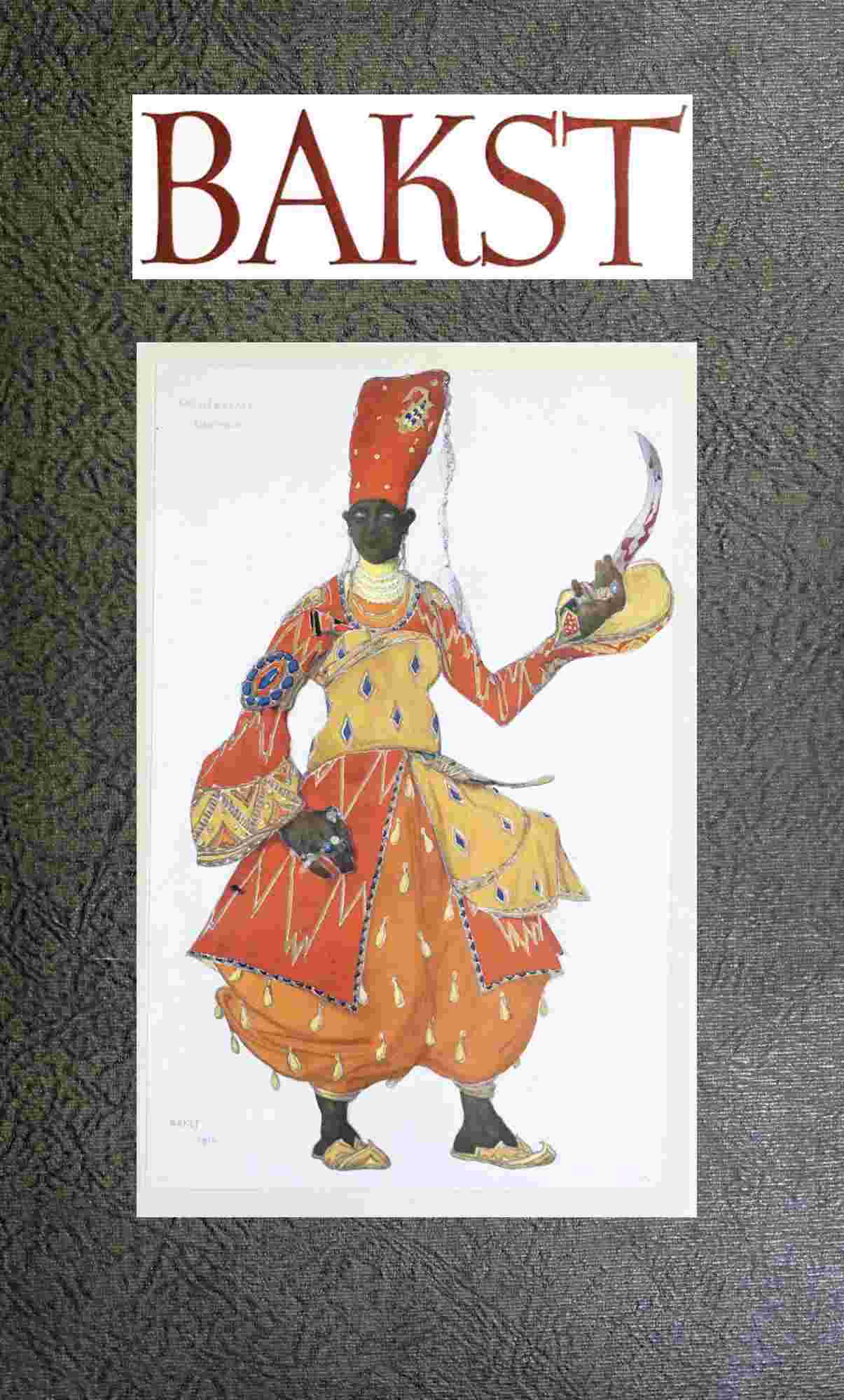
abundance of the material, the description, yes, the mere ordered enumeration of which would fill many a volume. These sources consist in part of numerous productions which maintain their place in the theater from season to season without losing their popularity because of the ever present memories of others. But on the other hand we also have the “dossiers” of these productions,—the sketches and models of the decorations and costumes. These sketches are without a doubt the most authentic references. But besides having value as documents they possess an intrinsic value as works of art. These water-colors or emphasized sketches are more than mere guide-lines for the scissors of the costume maker or the brush of the stage decorator. These statuettes of odalisques, of girls of the street, of a marquis each have an existence of their own, each possesses an individual rhythm. The artist imparts movement to them—the whole dynamic rhythm of the future ballet pre-exists there potentially. Jotted down upon a white sheet of Waltmann they energize and give life to this surface. More than that: they suggest the character of the particular role.
Think of the sensual passion of the Oriental dancers in pink or green or of the fragrance of the rustic idyll that breathes from the exquisite pages drawn for Daphne! Think of the Gothic and mournful sensuality of Sebastian! Indeed, what an inspiring “show in an armchair” it is to turn over these pages, which are a microcosm of a world come into reality upon the stage!
To this show I would invite the reader; as for myself, I would but turn the pages.
“Sheherazade” was Bakst’s real debut at Paris. “Cleopatra” had been a revival. It represented an attempt to utilize the small ballet inspired by a story of Théophile Gauthier’s and supported by a mediocre score composed by Arensky. On top of this score were grafted fragments from Rimsky-Korsakov, Moussorgsky, Glinka, and Glazounoff in order to transform it into an historic whole. Bakst undertook the thankless task of re-creating the unity of this heterogeneous collection. He created a monumental and sinister background, saturating the Egyptian granite with color. He wrought into an harmonious whole the motley crowd of brown slaves with white loin-cloths, the Greek young men raising the panther skin of Dionysos, the captive Jewesses with somber hooded cloaks punctuated by the white in which their single and troubled figure is draped.
The action which begins as an idyll and which is lulled by the soft music of the violin is suddenly upset by the strident notes of the flutes. Preceded by musicians who carry instruments of antique and unusual design and by solemn guards, a number of slaves carry a long closed box upon a litter. One side of the palanquin slides down and a mummy is revealed, tall and motionless, whom the slaves stand upright upon its feet encased in cothurns of sculpted wood. The slaves, running around her, free her of the bandages in which she is wrapped, and when the last fetters have thus dropped, the queen steps down from the cothurns, unnaturally tall, her hair colored with blue powder. She walks toward the regal couch and in doing so, a nude limb is revealed, longer and bolder than those of the fairies in the pictures of English pre-Raphaelite artists. This female being, this queen is Ida Rubinstein.
It is not the first time in the life of Bakst that we see this haughty and pallid profile of the implacable empress appear. Several years previously Bakst had adapted the stage setting of Sophocles’ “Antigone”
to this young débutante, who then appeared under an assumed name. I clearly remember this unique production. And I see again the proud maiden as she is wrapped in the numerous and complicated folds of her black mourning robe. In working out this conception Bakst had drawn his inspiration from a tombstone or else had deciphered the clever pattern from the sides of a Greek vase.
Later this young woman with her disconcerting and mysterious beauty, this mystical virgin, voluptuous yet frigidly cold, with a will
of iron underneath a fragile frame, and possessed of a haughty and cold intelligence, who dressed in eccentric clothes, became one of the Muses of our artist. Hers was the gift of driving his imagination to exasperation. Even after many years had elapsed she still held for him the allpowerful attraction of the strange, of the unreal, of the supernatural. His Muse—perhaps that is not the right term: rather, his Friendly Demon.
Having once touched upon the chapter of the Muses, another female image rises in my mind’s eye—that of Mme. Marie Kousnetzoff, the opera star. She is not the white and lunar Lilith; she is the Eve of the terrestrial paradise. This Russian brunette, with a Levantine face, a blooming flower in human flesh, with full, muscular form, seemed to have been created for the very purpose of wearing the turbans and the revealing veils designed by Bakst. Those who have seen her in the “Legend of Joseph”, garbed as a Venetian of the Renaissance, and wearing the thick-soled shoes suggested to Bakst by the celebrated costume designer Cesare Vecellio, brother of Titian, will forever retain this wonderful picture of the Biblical story of lust. Thus Mme. Kousnetzoff was the very incarnation of the oriental mirage that many a time haunted Bakst. Was she his Muse? No—his female Double!
But enough of these parenthetical remarks! Why was it that “Sheherazade” established itself and retained its place? Why was it that it could keep its prestige undiminished, even after it had called forth innumerable imitations in a territory extending all the way from the Opera to the meanest of suburban music halls?
The reason for it is the fact that this Persian ballet, which adapts the prologue of the “Thousand and One Nights” to a subtle and decorative score composed by Rimsky-Korsakoff, the eminent colorist, is the affirmation and, what is still more important, the realization of a great principle—the optic unity of a production. The sides of a large green tent enriched with gold and black encase and encircle the ladies’ apartment which is peopled with a crowd dressed in orange, pink and green clothes, who surround the single royal jewel, the Sultana Zobeide, a blue sapphire in a setting of rubies and emeralds. Thus the costumes either blend with the scenery in an infinity of fine shades and gradations of value that have been carefully studied out, or they contrast with the scenery in accordance with the visible logic of complementary colors.
Is the result, then, a ballet? It is a living scenery with interchangeable elements.
Was I going to speak of optic unity? Do I mean by it that unity stops at the surface? Certainly not! This ardent and cruel magnificence of color, this effluvium of sensuality which emanates from the setting produces an action in which the very excess of passionate ecstacy can only be satiated by the spilling of blood. This harmonious giddiness, this measured paroxysm seems to recall the title which Maurice Barrès gave to a famous book: “Concerning Blood, Sensuality, and Death.”
“Sheherazade” remains as the model work in Bakst’s oriental sphere of endeavor; neither he himself nor his competitors surpassed it. But
round about this luminous center other visions of hashish radiate forth: “Thamar”—a Cleopatra in Georgian style, a symphony in blue major; “The Blue God”, a Hindu fairy=tale; “Peri”, more recently, “Alladin”, and, only the other day, “The Adoration.” Astonishment takes hold of one as one tells the large pearls on this necklace that is worthy of the funeral=pile of Sardanapalus. Turn over the pages of the ballets that I have cited and look for the sketches; if you are in possession of the magic word of Ali=Baba, force open the sesame of the Museum of Decorative Arts in which are jealously guarded the most beautiful of these sketches; and you will find how justified was the saying of the late Joséfin Péladan, “Bakst, the Delacroix of the Costume.”
Consider the wisely arranged orgy of “Sheherazade”, (for Bakst has this supreme gift that great masters possess, of being concerned about the smallest button on a legging at the same time that they are getting a whole army to march) and in this whole eruption of vigorous colors you will not observe the slightest suggestion of white. There is, nevertheless, in the work of Bakst a whole corner, enveloped in sunshine, in which the white—shining and serene, virginal and fresh—dominates resolutely.
The sensual within him is duplicated by the romantic. We saw this come to the fore for the first time in the “Fairy of the Dolls”; Schumann’s “Carneval” revealed the “white Bakst” to the Parisians. They never grew tired of these adorable puppets, sentimental and crafty, who glide over the floor to the musical text of Schumann like the dolls on the cover of a music box. Harlequin and Pierrot, Chiarina or Colombine—they are not merely endless masks costumed in the styles of 1830, with furbelows and coiffures in ringlets; they are the incarnations of that playful and exquisite Viennese spirit; they are the descendants of Mozart and of Haydn. And the cut of their hazy cambrics, their whole bearing is in “Biedermayer” style—that quaint and charming style of bourgeois romanticism in the Germany of old. In order not to crush these fragile and delicate beings with the four walls of reality, as they flitted like butterflies about the stage. Bakst removed all stationary decoration: a background of drapery, a couch set off against this background—that was all. Nothing encumbers the view nor impedes the imagination of the spectator as he is enticed by the graceful or ironical episodes of the play to picture to himself a ball room or a boudoir or a park.
If the costumes of “Papillons”, which was connected with Schumann’s “Carneval” by Fokine, who discovered a certain aroma and dynamic rhythm common to both, are a continuation, so to speak, of the style of costumes employed in the first ballet, the “Spectre of the Rose”, on the other hand, carries us almost without our noticing it over to the land of France. The music is by Weber, the German composer who captivated Gèrard de Nerval, but it receives its orchestral form at the hands of Hector Berlioz, and the text is supplied by two lines from Théophile Gauthier, who had already inspired “Cleopatra” and the “Pavillon d’Armide” by Benois. This young girl in white flounced gown belongs more to Achille Dévéria and Eugène Lamy
than to Franz Krueger or Kriehuber; the ball from which she returns might be the ball at Sceaux of Honorè de Balzac; this night which filters through the glass door is a night in France; this dying rose which is impersonated by the divine ephebe Nijinsky is a rose of France. The young girls of times gone by, about whom the gentle Francis Jammes dreamed, would not be displeased at this airy pavilion with white wainscoting and white furniture in which, on the wall paper of blue cobalt, white bouquets are scattered about. Into this virginal quietude of soothing colors, detaching itself from the sombre verdure of the background, the human flower projects itself—a flower of purplish pink, feverish and consumed with amorous languor. The setting for a comic opera, “The Secret of Suzanne”, develops the same theme more in detail.
This brief catalogue of Bakst’s romantic cycle would, however, be incomplete were I not to mention the costumes of the “Boutique fantasque” which is in fact chiefly a sketch, but more centered, more pointed, more compressed than the “Fairy of the Dolls” which marks the beginning of Bakst’s career. This was a memorable enterprise, for it was marked by the collaboration of two great artists: the dolls by Bakst perform evolutions against a background painted by André Derain.
We have already seen how Bakst discovered the tragic and magnificently barbaric Greece of pre=Hellenic and ante=European times which he brought to the stage, by designing stage settings the rude grandeur of which formed a fit background for the growing despair of Antigone or for the doom that overwhelmed Oedipus. Once again he brings out all the anguish in the fear of the ancients, the primitive hysteria of people bewildered by the cruel play of unfathomable forces—the hot wind which blows from the Asiatic desert and which leashes the blood almost into insanity, the triumph of Eros in the midst of fratricide and horror. He staged this “Helen of Sparta” by Verhaeren for Mme. Rubinstein—this play in which a great modern poet incarnates his intent, violent and prophetic soul in the characters of a legend which had already absorbed the Grand Old Man of Weimar. The return of Helen, however, which for Goethe had been the symbol of restored and re=born classical antiquity, to the Flemish poet seemed a passionate and terribly human dilemma hidden under an archaic guise.
Now, Bakst designed a bare and harsh setting for the martyrdom of Helen, who is condemned to be coveted unto death by all who come in contact with her: the ground reduced to lime, stones that have a burnt smell, heavy gates of the royal fortress, smoke of woodpiles—in short, everything in this volcanic landscape is a latent menace.
This grim and desolate face of Hellas is seen for the last time in an act of “Daphnis and Chloe” where one sees the pirates dancing a war-dance among the steep declivities of the red rocks. But how sweet is the idyll which they disturb! All that there is of Ionic sweetness envelops this pastoral scene. I know nothing in the entire work of Bakst that is equal to these tender, fresh, damp greens of the meadow and of the forest where the two children walk about displaying the charming torment of love that knows nothing of itself. It is a sketch for the first act, but in it lies all of the Greece of Theocritus, of Moschus, and also of André Chenier’s Aoristys. Thus the short novel by Longus