
WeRead Powered by ReaderPub
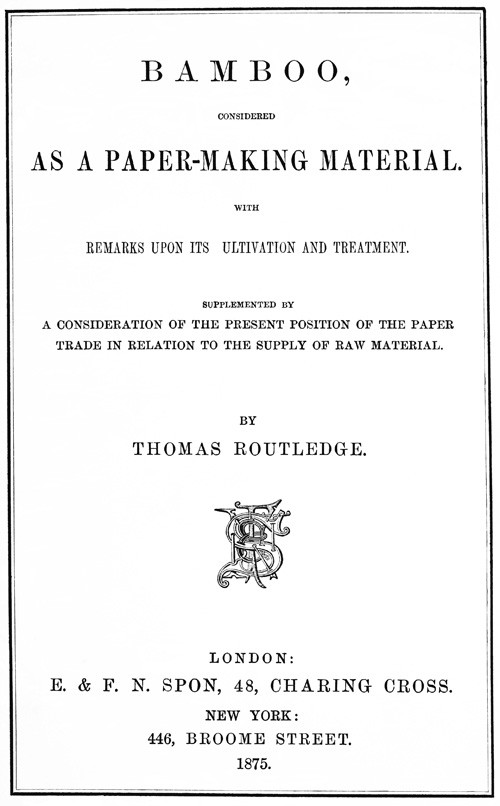
Bamboo, Considered as a Paper-making Material / With remarks upon its cultivation and treatment. Supplemented by a consideration of the present position of the paper trade in relation to the supply of raw material. cover

Bamboo, Considered as a Paper-making Material / With remarks upon its cultivation and treatment. Supplemented by a consideration of the present position of the paper trade in relation to the supply of raw material.

Chapter 11: Transcriber's Notes:
Open in WeRead

About This Book

The pamphlet examines bamboo as an alternative raw material for paper, surveying species, exceptional growth rates and geographic distribution, and contrasting fibre yields and cultivation costs with flax, hemp, jute, and cotton. It identifies problems with using mature, silica-rich stems that demand harsh pressure-chemistry and argues for harvesting young, sap-rich shoots that can be processed with mild alkaline baths at atmospheric pressure to yield clean fibres. Recommendations address plantation layout, irrigation, staged cutting for continuous supply, on-site processing to reduce transport, and practical treatment methods, concluding with considerations of the paper trade's raw-material supply.

FOOTNOTES:

A The Journal of the Society of Arts, 28th Nov., 1856, was printed on paper made from Esparto, at Eynsham Mills, near Oxford, then in my occupation.

Transcriber's Notes:

On page 15 some text is missing it is marked as ***.

Other than the corrections listed below, printer's inconsistencies in spelling, punctuation, hyphenation, and ligature usage have been retained.

The following misprints have been corrected:

  • changed
    "with "Hemp' and "Flax," where"
    into
    "with "Hemp" and "Flax," where" (page 8)
  • changed
    "the "15,000 tons of Rags estimated by"
    into
    "the "15,000 tons of Rags" estimated by" (page 22)