
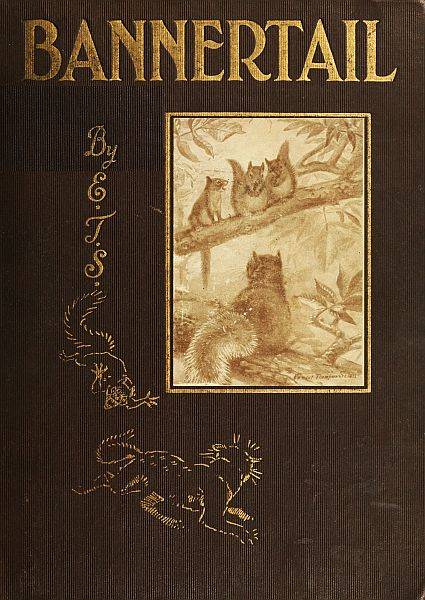
The Project Gutenberg eBook of Bannertail: The Story of a Graysquirrel
Title: Bannertail: The Story of a Graysquirrel
Author: Ernest Thompson Seton
Release date: May 28, 2013 [eBook #42827]
Most recently updated: October 23, 2024
Language: English
Credits: Produced by Heather Clark and the Online Distributed
Proofreading Team at http://www.pgdp.net (This file was
produced from images generously made available by The
Internet Archive)
BANNERTAIL
THE STORY OF A GRAYSQUIRREL
BANNERTAIL
THE STORY OF
A GRAYSQUIRREL
by
Author of
Wild Animals I have Known
Trail of the Sandhill Stag
Biography of a Grizzly
Lives of the Hunted
Monarch The Big Bear
New York
Charles Scribner's Sons
1922
ERNEST THOMPSON SETON
Printed in the United States of America
FOREWORD
These are the ideas that I have aimed to set forth in this tale.
1st. That although an animal is much helped by its mother's teaching, it owes still more to the racial teaching, which is instinct, and can make a success of life without its mothers guidance, if only it can live through the dangerous time of infancy and early life.
2d. Animals often are tempted into immorality—by which I mean, any habit or practice that would in its final working, tend to destroy the race. Nature has rigorous ways of dealing with such.
3d. Animals, like ourselves, must maintain ceaseless war against insect parasites—or perish.
4th. In the nut forests of America, practically every tree was planted by the Graysquirrel, or its kin. No squirrels, no nut-trees.
These are the motive thoughts behind my woodland novel. I hope I have presented them convincingly; if not, I hope at least you have been entertained by the romance.
CONTENTS
| Chapter | Page | |
| I. | The Foundling | 1 |
| II. | His Kittenhood | 9 |
| III. | The Red Horror | 15 |
| IV. | The New and Lonely Life | 19 |
| V. | The Fluffing of His Tail | 25 |
| VI. | The First Nut Crop | 31 |
| VII. | The Sun Song of Bannertail | 39 |
| VIII. | The Cold Sleep | 49 |
| IX. | The Balking of Fire-eyes | 57 |
| X. | Redsquirrel, the Scold of the Woods | 65 |
| XI. | Bannertail and the Echo Voice | 71 |
| XII. | The Courting of Silvergray | 77 |
| XIII. | The Home in the High Hickory | 85 |
| XIV. | New Rivals | 91 |
| XV. | Bachelor Life Again | 97 |
| XVI. | The Warden Meets an Invader | 103 |
| XVII. | The Hoodoo on the Home | 109 |
| XVIII. | The New Home | 117 |
| XIX. | The Moving of the Young | 125 |
| XX. | The Coming-out Party | 135 |
| XXI. | Nursery Days of the Young Ones | 141 |
| XXII. | Cray Hunts for Trouble | 147 |
| XXIII. | The Little Squirrels Go to School | 151 |
| XXIV. | The Lopping of the Wayward Branch | 157 |
| XXV. | Bannertail Falls into a Snare | 163 |
| XXVI. | The Addict | 173 |
| XXVII. | The Dregs of the Cup | 181 |
| XXVIII. | The Way of Destruction | 185 |
| XXIX. | Mother Carey's Lash | 191 |
| XXX. | His Awakening | 199 |
| XXXI. | The Unwritten Law | 205 |
| XXXII. | Squirrel Games | 213 |
| XXXIII. | When Bannertail Was Scarred for Life | 221 |
| XXXIV. | The Fight with the Black Demon | 229 |
| XXXV. | The Property Law among Animals | 243 |
| XXXVI. | Gathering the Great Nut Harvest | 251 |
| XXXVII. | And To-day | 261 |
ILLUSTRATIONS
| Facing Page | |
| His kittenhood | 12 |
| Baffling Fire-eyes | 60 |
| They twiddled whiskers good night | 82 |
| With an angry "Quare!" Silvergray scrambled up again | 130 |
| The little squirrels at school | 154 |
| Cray sank—a victim to his folly | 160 |
| A dangerous game | 226 |
| The battle with the Blacksnake | 238 |
THE FOUNDLING
CHAPTER I
She appeared to have no mate; at least none was seen. No doubt the outlaw gunners could have told a tale, had they cared to admit that they went gunning in springtime; and now the widow was doing the best she could by her family in the big gnarled tree. All went well for a while, then one day, in haste maybe, she broke an old rule in Squirreldom; she climbed her nesting tree openly, instead of going up its neighbor, and then crossing to the den by way of the overhead branches. The farm boy who saw it, gave a little yelp of savage triumph; his caveman nature broke out. Clubs and stones were lying near, the whirling end of a stick picked off the mother Squirrel as she tried to escape with a little one in her mouth. Had he killed two dangerous enemies the boy could not have yelled louder. Then up the tree he climbed and found in the nest two living young ones. With these in his pocket he descended. When on the ground he found that one was dead, crushed in climbing down. Thus only one little Squirrel was left alive, only one of the family that he had seen, the harmless mother and two helpless, harmless little ones dead in his hands.
Why? What good did it do him to destroy all this beautiful wild life? He did not know. He did not think of it at all. He had yielded only to the wild ancestral instinct to kill, when came a chance to kill, for we must remember that when that instinct was implanted, wild animals were either terrible enemies or food that must be got at any price.
The excitement over, the boy looked at the helpless squirming thing in his hand, and a surge of remorse came on him. He could not feed it; it must die of hunger. He wished that he knew of some other nest into which he might put it. He drifted back to the barn. The mew of a young Kitten caught his ear. He went to the manger. Here was the old Cat with the one Kitten that had been left her of her brood born two days back. Remembrance of many Field-mice, Chipmunks and some Squirrels killed by that old green-eyed huntress, struck a painful note. Yes! No matter what he did, the old Cat would surely get, kill, and eat the orphan Squirrel.
Then he yielded to a sudden impulse and said: "Here it is, eat it now." He dropped the little stranger into the nest beside the Kitten. The Cat turned toward it, smelled it suspiciously once or twice, then licked its back, picked it up in her mouth, and tucked it under her arm, where half an hour later the boy found it taking dinner alongside its new-found foster-brother, while the motherly old Cat leaned back with chin in air, half-closed eyes and purring the happy, contented purr of mother pride. Now, indeed, the future of the Foundling was assured.
HIS KITTENHOOD
CHAPTER II
The Kitten too grew up, and in midsummer was carried off to a distant farmhouse to be "their cat."
Now the Squirrel was over half-grown, and his tail was broadening out into a great banner of buff with silver tips. His life was with the old Cat; his food was partly from her dish. But many things there were to eat that delighted him, and that pleased her not. There was corn in the barn, and chicken-feed in the yard, and fruit in the garden. Well-fed and protected, he grew big and handsome, bigger and handsomer than his wild brothers, so the house-folk said. But of that he knew nothing; he had never seen his own people. The memory of his mother had faded out. So far as he knew, he was only a bushy-tailed Cat. But inside was an inheritance of instincts, as well as of blood and bone, that would surely take control and send him herding, if they happened near, with those and those alone of the blowsy silver tails.
THE RED HORROR
CHAPTER III
There was a growing, murmuring sound, then smoke from the barn, like that he had seen coming from the red mystery in the cook-house. But this grew very fast and huge; men came running, horses frantically plunging hurried out, and other living things and doings that he did not understand. Then when the sun was high a blackened smoking pile there was where once had stood the dear old barn; and a new strange feeling over all. The old Cat disappeared. A few days more and the house-folk, too, were gone. The place was deserted, himself a wildwood roving Squirrel, quite alone, without a trace of Squirrel training, such as example of the old ones gives, unequipped, unaccompanied, unprepared for the life-fight, except that he had a perfect body, and in his soul enthroned, the many deep and dominating instincts of his race.
THE NEW AND LONELY LIFE
CHAPTER IV
Food there was in abundance now, for it was early autumn; and who was to be his guide in this: "What to eat, what to let alone?" These two guides he had, and they proved enough: instinct, the wisdom inherited from his forebears, and his keen, discriminating nose.
Scrambling up a rotten stub one day, a flake of bark fell off, and here a-row were three white grubs; fat, rounded, juicy. It was instinct bade him seize them, and it was smell that justified the order; then which, it is hard to say, told him to reject the strong brown nippers at one end of each prize. That day he learned to pry off flakes of bark for the rich foodstuffs lodged behind.
At another time, when he worked off a slab of bark in hopes of a meal, he found only a long brown millipede. Its smell was earthy but strange, its many legs and its warning feelers, uncanny. The smell-guide seemed in doubt, but the inborn warden said: "Beware, touch it not." He hung back watching askance, as the evil thing, distilling its strange pestilent gas, wormed Snake-like out of sight, and Bannertail in a moment had formed a habit that was of his race, and that lasted all his life. Yea, longer, for he passed it on—this: Let the hundred-leggers alone. Are they not of a fearsome poison race?
Thus he grew daily in the ways of woodlore. He learned that the gum-drops on the wounded bark of the black birch are good to eat, and the little faded brown umbrella in the woods is the sign that it has a white cucumber in its underground cellar; that the wild bees' nests have honey in them, and grubs as good as honey; but beware, for the bee has a sting! He learned that the little rag-bundle babies hanging from vine and twig, contain some sort of a mushy shell-covered creature that is amazingly good to eat; that the little green apples that grow on the oaks are not acorns, and are yet toothsome morsels of the lighter sort, while nearly every bush in the woods at autumn now had strings of berries whose pulp was good to eat and whose single inside seed was as sweet as any nut. Thus he was learning woodcraft, and grew and prospered, for outside of sundry Redsquirrels and Chipmunks there were few competitors for this generous giving of the Woods.
THE FLUFFING OF HIS TAIL
CHAPTER V
Why? What the trunk is to the elephant and the paw to the monkey, the tail is to the Graysquirrel. It is his special gift, a vital part of his outfit, the secret of his life. The 'possum's tail is to swing by, the fox's tail for a blanket wrap, but the Squirrel's tail is a parachute, a "land-easy"; with that in perfect trim he can fall from any height in any tree and be sure of this, that he will land with ease and lightness, and on his feet.
This thing Bannertail knew without learning it. It was implanted, not by what he saw in Kitten days, or in the woods about, but by the great All-Mother, who had builded up his athlete form and blessed him with an inner Guide.
THE FIRST NUT CROP
CHAPTER VI
October, the time of the nut harvest, came. Dry leaves were drifting to the ground, and occasional "thumps" told of big fat nuts that also were falling, sometimes of themselves and sometimes cut by harvesters; for, although no other Graysquirrel was to be seen, Bannertail was not alone. A pair of Redsquirrels was there and half a dozen Chipmunks searching about for the scattering precious nuts.
Their methods were very different from those of the Graysquirrel race. The Chipmunks were carrying off the prizes in their cheek-pouches to underground storehouses. The Redsquirrels were hurrying away with their loads to distant hollow trees, a day's gathering in one tree. The Graysquirrels' way is different. With them each nut is buried in the ground, three or four inches deep, one nut at each place. A very precise essential instinct it is that regulates this plan. It is inwrought with the very making of the Graysquirrel race. Yet in Bannertail it was scarcely functioning at all. Even the strongest inherited habit needs a starter.
How does a young chicken learn to peck? It has a strong inborn readiness to do it, but we know that that impulse must be stimulated at first by seeing the mother peck, or it will not function. In an incubator it is necessary to have a sophisticated chicken as a leader, or the chickens of the machine foster-mother will die, not knowing how to feed. Nevertheless, the instinct is so strong that a trifle will arouse it to take control. Yes, so small a trifle as tapping on the incubator floor with a pencil-point will tear the flimsy veil, break the restraining bond and set the life-preserving instinct free.
Like this chicken, robbed of its birthright by interfering man, was Bannertail in his blind yielding to a vague desire to hide the nuts. He had never seen it done, the example of the other nut-gatherers was not helpful—was bewildering, indeed.
Confused between the inborn impulse and the outside stimulus of example, Bannertail would seize a nut, strip off the husk, and hide it quickly anywhere. Some nuts he would thrust under bits of brush or tufts of grass; some he buried by dropping leaves and rubbish over them, and a few, toward the end, he hid by digging a shallow hole. But the real, well-directed, energetic instinct to hide nut after nut, burying them three good inches, an arm's length, underground, was far from being aroused, was even hindered by seeing the Redsquirrels and the Chipmunks about him bearing away their stores, without attempting to bury them at all.
So the poor, skimpy harvest was gathered. What was not carried off was hidden by the trees themselves under a layer of dead and fallen leaves.
High above, in an old red oak, Bannertail found a place where a broken limb had let the weather in, so the tree was rotted. Digging out the soft wood left an ample cave, which he gnawed and garnished into a warm and weather-proof home.
The bright, sharp days of autumn passed. The leaves were on the ground throughout the woods in noisy dryness and lavish superabundance. The summer birds had gone, and the Chipmunk, oversensitive to the crispness of the mornings, had bowed sedately on November 1, had said his last "good-by," and had gone to sleep. Thus one more voice was hushed, the feeling of the woods was "Hush, be still!"—was all-expectant of some new event, that the tentacles of high-strung wood-folk sensed and appraised as sinister. Backward they shrank, to hide away and wait.
THE SUN SONG OF BANNERTAIL
CHAPTER VII
This was the season of the shortest days, though no snow had come as yet to cover the brown-leaved earth. Few birds were left of the summer merrymakers. The Crow, the Nuthatch, the Chickadee, and the Woodwale alone were there, and the sharp tang of the frost-bit air was holding back their sun-up calls. But Bannertail, a big Graysquirrel now, found gladness in the light, intensified, it seemed, by the very lateness of its coming.
"Qua, qua, qua, quaaaaaa," he sang, and done into speech of man the song said: "Hip, hip, hip, hurrahhh!"
He had risen from his bed in the hollow oak to meet and greet it. He was full of lusty life now, and daily better loved his life. "Qua, qua, qua, quaaaa!"—he poured it out again and again. The Chickadee quit his bug hunt for a moment to throw back his head and shout: "Me, too!" The Nuthatch, wrong end up, answered in a low, nasal tone: "Hear, hear, hear!" Even the sulky Crow joined in at last with a "'Rah, 'rah, 'rah!" and the Woodwale beat a long tattoo.
"Hip, hip, hip, hurrah, hurrah, hurrah!" shouted Bannertail as the all-blessed glory rose clear above the eastern trees and the world was aflood with the Sun-God's golden smile.
A score of times had he thus sung and whip-lashed his tail, and sung again, exulting, when far away, among the noises made by birds, was a low "Qua, quaaa!"—the voice of another Graysquirrel!
His kind was all too scarce in Jersey-land, and yet another would not necessarily be a friend; but in the delicate meaningful modulations of sound so accurately sensed by the Squirrel's keen ear, this far-off "Qua, qua," was a little softer than his own, a little higher-pitched, a little more gently modulated, and Bannertail knew without a moment's guessing. "Yes, it was a Graysquirrel, and it was not one that would take the war-path against him."
The distant voice replied no more, and Bannertail set about foraging for his morning meal.
The oak-tree in which he had slept was only one of the half-a-dozen beds he now claimed. It was a red oak, therefore its acorns were of poor quality; and it was on the edge of the woods. The best feeding-grounds were some distance away, but the road to them well known. Although so much at home in the trees, Bannertail travelled on the ground when going to a distance. Down the great trunk, across an open space to a stump, a pause on the stump to fluff his tail and look around, a few bounds to a fence, then along the top of that in three-foot hops till he came to the gap; six feet across this gap, and he took the flying leap with pride, remembering how, not so long ago, he used perforce to drop to the ground and amble to the other post. He was making for the white oak and hickory groves; but his keen nose brought him the message of a big red acorn under the leaves. He scratched it out and smelled it—yes, good. He ripped off the shell and here, ensconced in the middle, was a fat white grub, just as good as the nut itself, or better. So Bannertail had grub on the half-shell and nuts on the side for his first course. Then he set about nosing for hidden hickory-nuts; few and scarce were they. He had not found one when a growing racket announced the curse-beast of the woods, a self-hunting dog. Clatter, crash, among the dry leaves and brush, it came, yelping with noisy, senseless stupidity when it found a track that seemed faintly fresh. Bannertail went quietly up a near elm-tree, keeping the trunk between himself and the beast. From the elm he swung to a basswood, and finished his meal of basswood buds. Keeping one eye on the beast, he scrambled to an open platform nest that he had made a month ago, where he lazed in the sun, still keeping eyes and ears alert for tidings from the disturber below.
The huge brute prowled around and found the fresh scent up the elm, and barked at it, too, but of course he was barking up the wrong tree, and presently went off. Bannertail watched him with some faint amusement, then at last went rippling down the trunk and through the woods like a cork going down a rushing stream.
He was travelling homeward by the familiar route, on the ground, in undulated bounds, with pauses at each high lookout, when again the alarm of enemies reached him—a dog, sniffing and barking, and farther off a hunter. Bannertail made for the nearest big tree, and up that he went, keeping ever the trunk between. Then came the dog—a Squirrel Hound—and found the track and yelped. Up near the top was a "dray," or platform nest, one Bannertail had used and partly built, and in this he stretched out contentedly, peering over the edge at the ugly brutes below. The dog kept yelping up the trunk, saying plainly: "Squirrel, squirrel, squirrel, up, up, up!" And the hunter came and craned his neck till it was cricked, but nothing he saw to shoot at. Then he did what a hunter often does. He sent a charge of shot through the nest that was in plain view. There were some heavy twigs in its make-up, and it rested on a massive fork, or the event might have gone hard with Bannertail. The timber received most of the shock of the shot, but a something went stinging through his ear tip that stuck beyond the rim. It hurt and scared him, and he was divided between the impulse to rush forth and seek other shelter, and the instinct to lie absolutely still. Fortunately he lay still, and the hunter passed on, leaving the Squirrel wiser in several ways, for now he knew the danger of the dray when gunners came and the wisdom of "lay low" when in doubt.
THE COLD SLEEP
CHAPTER VIII
For two days the storm raged, and when the white flakes ceased to pile upon the hills and trees, a cutting blast arose that sent snow-horses riding across the fields and piled them up in drifts along the fences.
It made life harder for the Squirrel-Folk by hiding good Mother Earth from their hungry eyes; but in one way the wind served them, for it swept the snow from all the limbs that served the tree-folk as an over-way.
For two days the blizzard hissed. The third day it was very cold; on the fourth day Bannertail peeped forth on the changed white world. The wind, the pest of wild life in the trees, had ceased, the sky was clear, and the sun was shining in a weak, uncertain way. It evoked no enthusiasm in the Graycoat's soul. Not once did he utter his Sun-salute. He was stiff and sleepy, and a little hungry as he went forth. His hunger grew with the exercise of moving. Had he been capable of such thought he might have said: "Thank goodness the wind has swept the snow from the branches." He galloped and bounded from one high over-way to another, till a wide gap between tree-tops compelled him to descend. Over the broad forest floor of shining white he leaped, and made for the beloved hickory grove. Pine-cones furnish food, so do buds of elm and flower-buds of maple. Red acorns are bitter yet eatable, white acorns still better, and chestnuts and beechnuts delicious, but the crowning glory of a chosen feast is nuts of the big shag hickory—so hard of shell that only the strongest chisel teeth can reach them, so precious that nature locks them up in a strong-box of stone, enwrapped in a sole-leather case; so sought after, that none of them escape the hungry creatures of the wood for winter use, except such as they themselves have hidden for just such times. Bannertail quartered the surface of the snow among the silent bare-limbed trees, sniffing, sniffing, alert for the faintest whiff.