
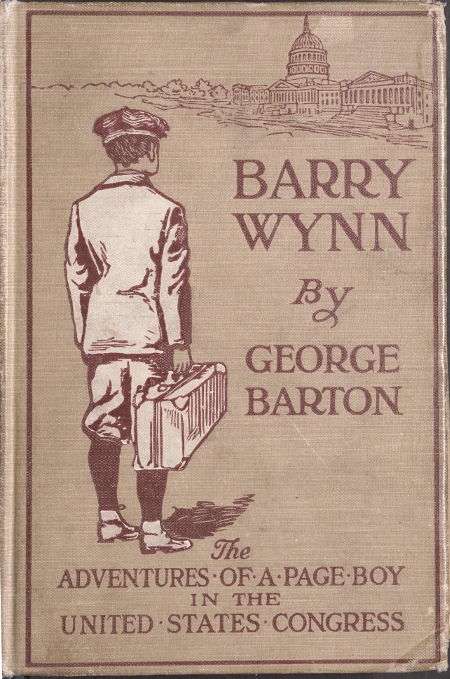
CHAPTER V A WINK AND A NOD
At breakfast the next morning Mrs. Johnson informed Barry that Congressman Carlton had sent a message to the house requesting that he call at his office as early as possible that day. The boy hurried through his meal and in a few minutes was swinging down Pennsylvania Avenue on his way to the Capitol. Despite his hurry, his eye lingered on the various edifices which were springing up on either side indicating the beautiful city in store for future generations. Indeed, the charm of Washington always remained fresh in Barry's mind.
He learned that Mr. Carlton had his headquarters in the new office building of the House of Representatives, which was but a stone's throw from the Capitol. In a few minutes the boy was tapping timidly at the door opening from one of the marble corridors of the substantial building. There was no response and he turned the knob and walked in. He found that he was in a suite of rooms, and through the door he could see the Congressman seated at his desk in another room.
He paused a moment before announcing himself. John Carlton, absorbed in the work before him, presented an interesting study. His smooth-shaven face was most attractive, and even in the privacy of his room he did not lose that appearance of authority which is carried so well by men who mix in the practical affairs of life. A half smile hovered about his lips, but at that very moment a kind of sadness showed itself in his eyes. He was a combination of the man of imagination and the man of the practical world. As he laid down the letter which he had been reading, he raised his eyes and saw the boy standing in the doorway.
"Come in, Barry," he exclaimed. "Come in and let me get a good look at you."
The new page walked in and stood before the desk very modestly.
"I suppose," said the Congressman, "that you are feeling very big this morning?"
Barry looked at him in surprise.
"Why, no," he said, "I don't quite understand you, Mr. Carlton."
The legislator lay back in his chair and laughed with undisguised enjoyment.
"I am glad of it. I am heartily glad of it," he said. "It proves that there is one person in Washington who is not likely to be afflicted with the awful disease which goes down here under the name of 'swelled head.'"
The boy's eyes were globular with wonder.
"I don't suppose you know what I am talking about, Barry, do you?"
"No," was the simple response, "I do not."
"Well, I'll tell you," said the Congressman, speaking very slowly. "You came mighty near making yourself famous in the House yesterday. Your alacrity in bringing Warrington to us was the means of saving a very important bill. If he had not come at the time he did, the measure would have been delayed and probably beaten. As it was, you helped us to win the day. The measure, that is now sure of success, gives the President of the United States the right to withdraw certain public lands for the benefit of future generations. It is a part of what is popularly known as the Conservation Movement."
"I am glad that I was useful," said Barry.
"You are not half so glad as I am," said the Congressman, "and I am delighted to know that you take it so sensibly. You simply did your duty, and if you continue to do your duty in this modest sort of way I know that you will be a success."
The telephone bell rang and Mr. Carlton answered it. As he hung up the receiver the boy said:
"I was told that you wanted to see me this morning."
"Yes," said Mr. Carlton, drumming on his desk with his finger tips. "Barry, can you work the typewriter?"
"Yes, sir; and I have a good knowledge of stenography, too."
"Well," was the response, "I suppose it may sound a little sentimental, but I have written the bill to make an appropriation for the new Naval Repair Station at Cleverly, and I want you to run it off on the typewriter. You know very well the feeling I had towards your father, and I would like to be able to say that you wrote the bill for this big improvement in your native town. It's not much, I know, but I thought you might like it."
Barry's eyes were glistening. He spoke eagerly:
"I think it's just fine, Mr. Carlton, and I want to assure you that I appreciate it very much indeed."
Without further ado, Mr. Carlton gave him the manuscript copy of the bill, and Barry, going to a typewriter in a corner of the room, began to transcribe the document. While Barry was at work on the machine Mr. Carlton began the task of going through his mail. It was no easy job, for there were probably a hundred letters on his desk and that merely represented one day's crop. He ran an opener through one envelope after another and remarked casually as he did so:
"I am waiting for my secretary, Barry. I don't know what keeps him so late."
At that moment the door opened and the tall, spare form of Felix Conway, the journalist, entered the room. Mr. Carlton pretended to frown:
"You're late, sir."
"Yes, sir," was the reply, with mock humility. "I'm sorry to say, sir, that I overslept myself, sir."
At this both men burst into laughter. Barry was so interested and so surprised that he forgot to run his typewriter. Mr. Carlton turned and noticed the look of amazement on the boy's face.
"It's all right, Barry," he exclaimed. "Mr. Conway is not actually my secretary, but he has consented to act the part for the next few weeks. My real secretary is ill, and I was in dire need of someone who understood legislative and departmental matters when Mr. Conway was good enough to step in and help me out in the emergency."
"Yes," laughed the journalist, "and in helping you out, I will only be repaying, in a small measure, the many kindnesses you have shown me since I came to Washington."
Barry worked slowly on the typewriter, because he was anxious to have his first piece of work as accurate as possible, and besides the fact that the Congressman and Mr. Conway were engaged in conversation distracted him more or less from the task in hand. He could not help but overhear the talk that passed between the two men.
For instance, Mr. Carlton pulled a letter from an envelope and after reading it, passed it over to the volunteer secretary.
"Here's a man who wants a pass from Boston to Cleverly," he said. "Tell him the new Interstate Commerce law forbids the issuance of passes, and that if the railroad granted his request, the officers of the corporation would be liable to a fine and imprisonment."
The journalist laughed at the sarcasm of the statesman.
"I guess the constituent who wrote that letter must have been asleep for the last two years," he commented. "He don't seem to have kept up with the procession."
Mr. Carlton nodded in assent and handed another letter to the newspaper man.
"Here's a communication from a constituent in the country. He applies for seed. Send it to the Agricultural Department with my endorsement."
Mr. Conway noted the instructions on a corner of the envelope, using a sort of shorthand that was all his own.
After this came a letter from an inventive genius, who had a flying machine which he wished to have adopted by the United States Army. It was referred to the Secretary of War. There were twenty or thirty letters asking for information of bills that were pending. They were laid aside to be answered in their turn. Finally they reached a communication from a poor widow who was applying for a pension. Mr. Carlton carefully deciphered the uncertain handwriting and then said to his assistant:
"Felix, I wish you would take this up in person with the head of the Pension Bureau. I think the woman deserves consideration. Her husband served his country in its hour of need, and this nation is too great to neglect those who have risked their lives in its service."
"Have you anything else?" asked the young man.
"Yes," was the reply, "here is a five-page letter."
"What is it?"
"It is from a man who wants me to get the Army to purchase a new kind of saddle that he has constructed."
"What shall I say to him?"
"Tell him that I'm not a salesman."
Felix Conway gathered up the pile of letters and went into an ante-room for the purpose of dictating suitable replies to a waiting stenographer. The Congressman, in the meantime, looked at Barry with a benevolent smile, and said:
"Barry, you have just had a glimpse of a part of the work that falls to the lot of an active member of Congress. You will see from this that the job of being a statesman is not a sinecure. In fact, it is very hard work, and I am sorry to say that some of the voters look upon the members of Congress as errand boys, whose sole time should be devoted to carrying messages to the various heads of Departments."
"That is not all the work, either?" asked Barry.
"Not by any means; the most exacting work that falls to the lot of a member is that of discussing and digesting proposed legislation when it comes before the various Committees of the House."
By this time Barry had finished making his copy of the bill providing for the new Federal building in Cleverly. He handed it to Mr. Carlton, who read it over very carefully. He made one or two minor corrections, and then said he was very much pleased with the work.
The Congressman laid the bill down on the desk, and was about to turn to some other work when there was a tap on the door and two gentlemen entered the room. One of them was a little man, dressed in black, and wearing a white linen bow tie. He wore side whiskers and had a peculiar expression. Barry looked at him the second time, and then discovered that his face was really conventional, and that its unusual expression was caused by the queer drooping of the eyelid of the left eye. The man who accompanied him was a tall, sallow-faced, loose-jointed person, who gazed steadfastly at the floor. Mr. Carlton arose at once and greeted both men heartily. The little man gave him a quick grasp of the hand in reply, while the sallow-faced person said "Good morning" without looking at his host. They talked in whispers for a few minutes and then Mr. Carlton called Barry over to him.
"Barry," he said, indicating the little man in black, "I want you to meet the Hon. Jesse Hudson. Mr. Hudson is one of my colleagues, a member of the House of Representatives."
Then, turning to Hudson, he said:
"This boy comes from my native town. He is the son of one of my oldest friends. I have made him a page in the House, and if you ever get an opportunity to help him, I wish you would do so."
Congressman Hudson took Barry's hand with that quick, convulsive movement which seemed to be one of his characteristics, and said:
"Glad to meet you. If you ever need anything call on me."
After this Barry was presented to the sallow-faced man, who proved to be Mr. Joel Phipps, who was the clerk to the Committee on Naval Affairs.
As the general conversation was resumed, Barry withdrew and took his seat in the corner of the room. Just as they were about to leave, Congressman Carlton said suddenly:
"By the way, Hudson, I am going to introduce a bill in the House in a few days to appropriate a million dollars for a Naval Repair Station at Cleverly. I know that you are a member of the Committee on Naval Affairs, and I wish you would help me to put this measure through. We need it and it's a just and proper appropriation."
Mr. Carlton stooped down to pick up a paper, when Congressman Hudson, turning to the clerk, said:
"Oh, we will help you with it, won't we, Joel?"
As he said this he deliberately winked at the sallow-faced man, and in return he nodded and replied:
"Yes, certainly we will help Mr. Carlton."
And after that they both withdrew. As the door closed Mr. Carlton turned to the boy and said:
"Those are good people to know, Barry. Both the Congressman and the clerk have considerable influence in legislation and they have the power to either help or hurt you."
"I suppose they have," responded Barry.
He longed to tell his friend of the sign that had passed between the two men, but he was afraid that if he mentioned it, Mr. Carlton might think that he was very presumptuous. Besides that, he thought that possibly he might have been mistaken. However, he said finally, with a great deal of diffidence:
"I can't say, Mr. Carlton, that I am very much attracted by either of those men."
"Well, Barry," said the Congressman, a little coldly, "you must take people as you find them in this world, and not as you think they should be."
All the same, Barry did not relish the recollections of the wink that had passed between the two men.
CHAPTER VI HUDSON STRIKES A SNAG
Joe Hart went to great pains to show his growing regard for Barry. He instructed him in his work as page and pointed out various ways of making himself useful to the members of Congress. One of these ways was to familiarize himself with the numerous public documents issued by the Government. Every member, said Joe, had calls for bills and reports from time to time, and if a page boy could tell a member where to put his hands on a certain paper at a given time, the value of the page would be immensely enhanced in the eyes of the member. Barry took the advice to heart and determined to profit thereby.
One morning, when Barry was on his way to the Capitol, it occurred to him that it would be a good thing to call upon Congressman Carlton and ascertain whether there was anything he could do for him. He found the Congressman at his desk in his office immersed in a great heap of correspondence that was before him.
"Good morning, Mr. Carlton," said Barry. "I don't want to disturb you. I just dropped in to ask whether there was anything I could do for you before I went to the House."
The Congressman paused for a moment and looked at Barry, while he tried to recall some particular thing that he was very anxious to have done. It came to him quickly.
"By George!" he exclaimed; "you're the very boy I want. There's a big pile of Committee Reports in the next room that I would like to have sorted out and piled up in regular order. I have no doubt that most of 'em are only fit for the furnace, but I'm afraid to destroy any of 'em for fear that I may burn the very documents I need."
Barry's eyes sparkled.
"I'll be delighted to undertake the job, Mr. Carlton," he said. "It's something I'm interested in, anyhow."
The Congressman stared at the boy.
"Interested? What do you mean?"
"Oh, nothing; except that Joe Hart tells me that I should become familiar with public documents of all kinds in order to increase my usefulness to members of Congress."
The Congressman clapped his hands on his flat top desk with quiet delight.
"Bully for you! If you continue in this way there's no telling where you may land. You know every boy in this country has a right to aspire even to the Presidency."
Barry reddened with embarrassment.
"Oh, Mr. Carlton, I never dreamed of anything like that."
"Of course, you haven't. No healthy boy ever really expects to reach such a great honor as that, but you can aspire to other big things. One of the oldest members of the Senate served in the position that you hold now, while a half dozen members of the House were pages at your age."
"Well," said Barry, with boyish confidence, "I am certainly going to try to amount to something."
"Very good," said the Congressman, and he dismissed the boy with a wave of the hand. "Now, you go into the other room and see what you can do with that old junk."
Barry went to work with a will. He found that he had a pretty big job ahead of him, but he went at it systematically and resolutely. He took the reports according to dates and piled them up in little heaps in the order of the months and the years in which they had been printed. Occasionally he was attracted by the heading of some of the documents, and in one or two instances he was so interested that he read the reports from beginning to end. In this way several hours passed, and looking up at the clock, he discovered that it was twenty minutes of twelve. He realized that he had just about enough time to get over to the House and to report for duty. He was about to go in and speak to Mr. Carlton when he heard the door open and someone came into the Congressman's room. The gentleman spoke to Mr. Carlton. Barry recognized the voice at once. It was that of the Hon. Jesse Hudson.
"Hello, Carlton," said Hudson, "when are you going to introduce that bill for a Naval Repair Station in your town?"
"I'm going to do it soon," said Carlton. "It's pretty nearly in shape for presentation."
"Good," was the response. "You can count on my help in getting it through the Committee. If you meet with any obstacles, just come to me and I will be glad to give you a lift. Are you going over to the House?"
"Not for a few minutes," was the response. "I've a couple of telegrams that I want to send out before I leave here."
"All right; I'll go over alone then. By the way," he continued, as he paused at the door, "I've got a measure coming up today, and I'd like you to help me get it through."
"What is it?" asked Carlton.
"It is known as the Garner claim. A family in my district had their property destroyed during the Civil War. It seems that the Federal troops occupied their house and barn and when they got through with them they were practically ruined."
"What is the bill for?" asked Carlton.
"It is to reimburse the heirs for their loss. It calls for an appropriation of $96,000. It should have been paid long ago!"
"Who are the heirs? The children of the claimant?"
"No, not the children, but some of their relatives."
"Is it all right, Hudson?"
"Sure, it's all right."
"Well," was the slow response, "if it's a fair bill, I suppose I will have to turn in and vote for it, but I don't like to support these claims for damages without knowing all about them."
"Oh, it's all right," was the confident response; "I'll see you later. Good-bye."
As he swung out of the room Felix Conway, the journalist, walked in.
"Hello, Felix," exclaimed Carlton. "You're just the man I want to see. You know everything, don't you?"
The newspaper correspondent shook his head and said, smilingly:
"No, not everything—nearly everything."
"Well," said Carlton, "I'd like to know what you can tell me about the Garner claim. It calls for an appropriation of $96,000 to repay certain heirs of the Garner family for property destroyed during the Civil War."
The journalist looked blankly at the Congressman.
"Blest if I know a thing about it. It's the first I've heard of it."
"I'm awfully sorry," said the Congressman, "because I'm anxious to get some of the facts in the case."
As Felix Conway left the room Barry Wynn emerged from the little apartment where he had been sorting out and piling up the public documents.
"Mr. Carlton," he said, timidly, "I couldn't help overhearing your conversation with Mr. Hudson and Mr. Conway. You were speaking to them about the Garner claim."
"I was, indeed," was the response. "You don't mean to tell me that you know anything about it?"
"Yes," was the hesitating reply, "I know a little about it."
"When did you hear of it?" was the surprised question.
"The first I heard of it was when Mr. Hudson came in," replied Barry, "but I read about it an hour ago."
"Read about it?"
"Yes; when I was going through those old papers I found a report from the House Committee concerning the Garner claim."
Carlton's eyes glistened.
"Where is it? Where is it? Let me have it."
Barry went into the other room and came out again in a few moments with a small public document.
Mr. Carlton seized it eagerly and read the heading:
"Report of the House Committee concerning a claim of the heirs of Samuel Garner for damages sustained to their property during the War of the Rebellion."
That was enough for him. He sat back in his chair and read the document from start to finish. It was an adverse report. The document was ten years old, but the Committee that had been entrusted with the investigation of the matter reported that the claim was a very doubtful one, and that in any event the heirs should be compelled to go into court for the purpose of obtaining relief.
Carlton stuffed the report in his inside pocket, and slapping Barry on the back, said:
"Barry, you've done me a great favor."
Ten minutes later Carlton was at his desk in the House of Representatives, and Barry was standing by the desk of the chief clerk, waiting for the proceedings of the day to begin. At the stroke of twelve the Speaker brought his gavel down on the top of the marble block before him and called the House to order. The Chaplain made a brief prayer, and then the members from all parts of the great hall began rising in their places and presenting bills. The pages ran up one aisle and down another, with bills fluttering in their hands, rushing and laughing and tumbling about like so many little imps. Barry kept his eye on Mr. Carlton, and when that gentleman rose in his seat, made a mad rush in his direction.
"The Gentleman from Maine," called the Speaker, in a loud tone.
Whereupon Mr. Carlton presented a number of minor bills. Barry was at his elbow, and taking the papers hurried to the Speaker's platform and had the satisfaction of seeing the bills referred to the various Committees of the House.
After his measures had been safely disposed of, John Carlton made a search for Jesse Hudson. He had determined to inform him that he would not support the bill in favor of the Garner heirs. When he reached Hudson's seat, he found that gentleman busily engaged in conversation with another man, but that did not deter him. He broke in between the two and said:
"Hudson, I'd like to speak to you for a moment."
The other frowned and waved his hand, saying:
"You will have to excuse me. I am very busy at present."
Carlton walked back to his own seat very much dissatisfied. Fifteen minutes later he noticed that Hudson was disengaged and walked over in his direction. The moment Hudson saw him, however, he slipped out of his seat and left the House. The inference was obvious. Hudson was trying to evade Carlton. The business of the House continued for about half an hour and then the clerk, in stentorian tones, announced that the next business in order was the consideration of the bill granting relief to the heirs of Samuel Garner. Hudson was in his seat. Carlton grasped the opportunity and was by his side in an instant.
"Hudson," he said, "I've been trying to reach you all morning to tell you that I can't support—"
"Don't talk to me now," cried the other, impatiently. "Don't you see that I'm busy?"
"You can't be too busy to talk business," was the angry retort. "I want you to know that I can't support your Garner bill. I'm simply telling you this, so that you can be under no false impressions in the matter."
"Why, what's the matter?" asked Hudson, simulating a look of surprise.
"Well, I'm sorry to say the matter is that I don't think it's a fit bill to vote for."
"What do you mean?"
"Just what I say. After you left me this morning, I got a report of the House Committee that was made nearly ten years ago, and it seems very conclusive to me—so conclusive that I've made up my mind to fight your bill."
"Oh, you're splitting hairs," cried Hudson, in a tone of annoyance.
"Well, you can give it any name you like."
"But, see here, Carlton," cried Hudson, eagerly, "I won't ask you to vote for it if you don't feel like doing so; but promise me one thing."
"What's that?"
"Don't make a speech against it. Don't oppose it openly. It's backed by some of the most important men in my district—men who can make or break me."
"I can't make any more promises," said Carlton, and he moved slowly back to his own seat.
In the meantime the House was giving close consideration to the Garner claim. Near the end of the debate Jesse Hudson arose and made a strong speech in favor of the passage of the bill. The sentiment of the House seemed strongly for the heirs. If the members had taken a vote after Hudson's speech, the chances are that the bill would have become a law. But just at that critical moment John Carlton rose in his place and was recognized by the Speaker.
"Mr. Speaker and Gentlemen," he said, with great deliberation, "before the House votes on the bill that is now pending, I desire to read a copy of the report that was made on this very claim by a Committee of this House ten years ago. The members can find the document by referring to their files, volume II, page 1072."
There was a lifting of desk lids and a scurrying of page boys, and every member in the House seemed seized with a desire to get a copy of the document in question. In the meantime John Carlton read the report in slow, measured tones. As he concluded he said:
"Mr. Speaker, I have no comment whatever to make upon this report. I merely call it to your attention. For my own part, after reading that report, I cannot see my way clear to vote for this bill."
It was as though a bomb shell had been thrown into a quiet, peaceable gathering. Members stood on their feet, and talked, and gesticulated, while the Speaker vainly motioned the members to their seats. Presently, the calling of the roll brought order out of chaos. Hudson ran from one member to another imploring them to vote for his bill, but it was too late. When the vote was announced it was found that the Garner claim had been overwhelmingly defeated.
Shortly after that the House adjourned. Hudson, in leaving his seat, almost bumped against John Carlton. He looked at him with a malignant frown, and said bitterly:
"You're a fine fellow to promise to support a bill!"
"I withdrew my promise before it was too late," said the other one, quietly.
"Yes, you withdrew it, but you made me a promise all the same."
"I didn't make any promise."
"I say you did!"
"Well," said Carlton, easily, "there's no use wrangling over it. It's all over now."
Hudson doubled up his fist, and shaking it at his adversary, said:
"It's not all over. Not by a long sight! Every dog has his day, and I'll have mine sooner than you think!"
Carlton laughed.
"There's no use borrowing trouble," he said, lightly. "The dog-days won't be here for some time yet."
As they passed out of the door into the corridor of the Capitol, a third member came up to Carlton and said:
"John, were in the world did you dig up that report?"
"Oh," was the response, "it was pulled out of a pile of old junk in my office."
"How did you have the patience to go through that stuff?" asked the inquirer.
"I didn't," was the reply. "It was discovered for me by a very bright boy, named Barry Wynn."
CHAPTER VII BARRY STUMBLES
As Barry Wynn and Joe Hart were walking down Pennsylvania Avenue the following morning, Joe suddenly turned to his friend and exclaimed laughingly:
"Barry, this is the happiest day of all the glad new year!"
Barry looked at Joe blankly.
"Why; what's happened? Have you good news?"
"Bully news."
"What do you mean?"
"Can't you guess?"
"No, I can't."
"Why, you old hayseed, this is pay-day."
Barry's face beamed. Naturally he looked forward with great pleasure to the first money he had ever earned. He voiced his feelings to Joe:
"The work here has been so pleasant that I actually lost count of the days. I never dreamt that I'd been in Washington for a month."
"Well," said the practical one, "you'll know all right when you go up to the cashier's office this morning."
The experienced boy led the novice to that part of the Capitol building where the pages received their checks. Barry had to sign the pay-roll and after that swore that he had rendered the service for which he was about to be paid. He was handed a nice, bright, crisp check drawn to the order of Barry Wynn against the Treasurer of the United States. He looked at it with ill-concealed curiosity and then gave a gasp of delight. The check was for sixty-eight dollars. He had worked a little less than a month, but the sight of the voucher for so much money gave him a sense of elation that he had never felt before.
With Joe still acting as mentor, he cashed the check, and on reporting for duty to the Sergeant-at-Arms, was gratified to learn that he had been given leave of absence for the day. Joe also, by some occult influence, managed to be excused. Barry's first move was to call on Congressman Carlton and to inform him of the amount of money he had received. Mr. Carlton was delighted, but somewhat taken aback when Barry handed him a ten-dollar note.
"What's this for?" he asked, somewhat stiffly.
"It's the money you advanced for my railroad fare to Washington."
The good-natured man burst into a hearty laugh. He clapped his big palm on Barry's shoulder and said jovially:
"Just put that away. You'll have lots of use for it. The money I sent you was a present."
"But, Mr. Carlton," insisted Barry, "mother made me promise that the first money I received should be used to pay you back the ten dollars you sent me for my ticket."
"Nonsense! I don't want it."
"But, I must give it to you," persisted Barry. "If I don't my mother will never forgive me."
Mr. Carlton accepted the note somewhat reluctantly.
"By the way," he said, reaching into his pocket, "here's an old wallet that I have no more use for. Now that you have become a man of wealth it may be a convenient thing for holding your money."
Barry took the gift and thanked Mr. Carlton.
"Now, Barry," said the statesman, "I don't want to overburden you with advice, but if I were in your place my first move would be to pay your landlady for the board that is due her, and then give her a week or so in advance. After that lay some money aside for your personal use, and then skedaddle to the postoffice and make out a money order for the balance in favor of your mother. She will appreciate it more than words can tell."
"I'll do it," was the fervent response.
"All right. Good-bye, and good luck to you."
As Barry left the Capitol building he came in contact with Joe Hart, who had also cashed his warrant. The two boys proceeded to their boarding house and both of them paid Mrs. Johnson the money that was due her, together with an advance payment towards the coming month.
"Now, what are you going to do?" asked Joe.
"I'm going up stairs and write a letter to my mother," said Barry. "I want to enclose a money order to her and get it off in the mail as soon as possible."
"All right," said Joe. "I'll wait for you, and then we'll go down town together. Or, if you want to," he added, as an after consideration, "you can walk right over to the postoffice building and write your letter there."
Barry adopted the suggestion and the two boys left the house together. As they turned the corner of the Treasury building, the clock in the neighborhood struck the hour of twelve.
"Jiminy!" exclaimed Joe, "it's time to eat."
The remark put an idea into Barry's head.
"Joe," he said, "this is pay-day; let's celebrate!"
"Celebrate?" echoed the other.
"Yes. I want you to take dinner with me today."
Joe looked at his friend in silence for a moment, and then something suspiciously like moisture glistened in the corner of each eye.
"Barry," he said, "I'll go you—it's the first time in my life that I ever remember anybody asking me out to dinner."
Barry was determined to do the honors becomingly, so he sought out a first-class restaurant and ordered dinner for two. The linen was white and the dining room splendidly furnished. An orchestra, hidden behind a cluster of palms, enlivened the occasion with the popular songs of the day. The meal was complete; it began with soup and ended with ice cream. To say that the two boys enjoyed themselves would be putting it very mildly indeed. They felt as though they were in an enchanted fairyland. The fact that Joe's legs were too short to touch the floor, and that he swung them to and fro on the chair did not detract from his dignity in the least, and when the head waiter, who had seated them with all the pomp and ceremony which can only be employed effectively by a head waiter, and addressed them as "gentlemen," their cup of happiness seemed full to overflowing, but the limit had not yet been reached. After the meal was finished and the attendant placed a finger bowl in front of each of the boys, the giggling and the whispering and the mischievous glances that passed between them would have been sufficient to have gladdened the heart of the most confirmed pessimist. But the crowning act of all came when Barry, after having paid the bill, majestically tipped the waiter. From that moment he was a superior being in the eyes of Joe Hart.
After leaving the restaurant they resumed their walk down Pennsylvania Avenue. The events of the preceding hour had raised them both in their own estimation. They strolled along very proudly, indeed, and did not feel a bit ashamed when three Justices of the Supreme Court passed them on the street. Senators and members of the lower House of Congress they looked upon as very ordinary beings indeed; in fact, when the President shot by in an automobile on his way to the White House, they regarded it—as it was in fact in Washington—as an incident of everyday life. It was about two o'clock by this time, and they were half way down the avenue when Barry's attention was attracted by a large sign advertising a moving picture show.
"Joe," he said, with proper dignity in his voice and manner, "I want to do this treat right. Let's take in the picture show."
Joe did not require a second invitation. In a few minutes they had paid their dimes and were ushered into the seats of the little temporary theatre. In the rush of hurrying in, the two boys had become separated, although they managed to obtain places in the same row. A woman with a market basket was on one side of Barry, while a burly fellow, with a red necktie, was on the other. Presently the place was filled and the lights were turned down. The films began to operate upon the canvas. The scene represented an explosion in a coal mine. It was very vivid and very lifelike. There was a flash of lightning and then a low rumbling sound which marked the beginning of the disaster. At the most interesting stage of the performance Barry felt himself being crowded by the man who sat next to him. The fellow acted so roughly that Barry protested.
"Stop pushing me!" he cried.
"Oh, I beg your pardon," was the polite reply, "I didn't intend to annoy you. It was an accident."
The moment that Barry had spoken he was sorry. It was probable, he thought, that the man had leaned against him unintentionally and he regretted his resentment. He wondered whether he should not apologize. The lights went up in a minute or two, but Barry found, to his surprise, that his neighbor with the red necktie had already departed.
The two boys wended their way out to the street together and were glad to get in a whiff of fresh air. They made their way slowly towards the new postoffice building on Pennsylvania Avenue, and after selecting a convenient desk, Barry began writing his letter to his mother. The work of composition was aided by Joe Hart, who, at intervals, offered many unique and unsolicited suggestions. Finally the missive was completed and Barry exclaimed:
"Now for the money order. I'll go over to the window and buy it."
He reached into his pocket for the wallet in which he had placed his money. His hand slid into vacancy. A look of grief overspread his face.
"What's the matter, Barry," cried Joe; "are you sick?"
"No," said Barry, "I'm not sick. The pocketbook's gone!"
The two boys stood looking at each other speechlessly for many moments. Presently Joe spoke:
"Do you think you had it when you went into the moving picture show?"
"I know I had it then."
"Well, the answer's simple—you've been robbed!"
For the time being Barry felt as though the universe had gone to pieces and lay in chaos at his feet, but after awhile he came to his senses, and at the suggestion of his friend, the two of them started to retrace their steps from the postoffice to the moving picture theatre. They had gone about two blocks when Joe Hart suddenly exclaimed:
"Look. What's that in the street?"
Barry followed the glance of his friend and saw a red wallet lying on the asphalt, in front of a Pennsylvania Avenue store. He ran over and picked it up. It was his own. He opened it and looked into one side of the wallet. It was empty. He turned to the other and looked in, and to his satisfaction, found a solitary ten-dollar bill. He showed it to Joe Hart.
"What do you think of it?" he asked.
"I think the man that stole the wallet took the money out of the one side and thought that that was all there was in it. Then he threw the wallet away to get rid of it."
After that the boys walked back to the postoffice, where Barry bought a postal order for ten dollars. He destroyed the letter which he had written to his mother originally, and began the composition of a second one. It was a slow and painful task.
"I don't know just what to say," he said. "I've told mother that I got sixty-eight dollars for my month's pay and I've explained how I used part of it in paying Mr. Carlton and another part in settling what I owe Mrs. Johnson. I'm sending her the other ten dollars, but she'll wonder what I've done with the rest. I haven't got the nerve to tell her that I've lost it. What would you do?"
"Don't know," said Joe, aimlessly.
"Maybe it would worry her," said Barry. "I'll just—"
"I say, Barry," interrupted Joe, with his queer expression; "do you know the best way?"
"No."
"Just tell her the truth—tell her exactly what happened."
And Barry did.
CHAPTER VIII AN UNEXPECTED MOVE
Mr. Carlton now had his Naval Repair Station measure in good shape and he considered the time ripe for its introduction in the House of Representatives. One morning, when the Speaker called for new bills, he handed in the typewritten document on which all of his ambitions and his hopes were pinned.
"The bill presented by the Gentleman from Maine is referred to the Committee on Naval Affairs," announced the Speaker.
Barry, who had carried the precious draft from the Congressman's desk to the Speaker's platform, could not resist the opportunity of whispering a word of exaltation to his patron.
"She's in at last, Mr. Carlton," he said, "and you ought to feel proud and happy."
The Congressman sighed.
"She's in, Barry, but that's only the first step in the battle."
"But it's a good bill," insisted the boy, earnestly, "and it has been approved by the Navy Department."
"Not yet, but I hope it will be soon," corrected Mr. Carlton.
"Then it will pass, sure."
The statesman smiled at the boy's enthusiasm.
"I'm not so positive of that," he said. "I've known many a good measure to go to a Committee and after that never see the light of day again."
Nevertheless John Carlton felt very optimistic over the Naval Repair Station bill. But he had been in Congress too long to permit himself to become affected with the political disease known as "over-confidence." He had prepared the draft of the law with great care. He knew of cases where the omission of a word, or the dropping of a comma, had destroyed the effect of important legislation.
Also, he had sounded a number of members of the Committee on Naval Affairs and found that they were well disposed toward the bill. He intended to push the legislation solely on its merits, but he knew that in Congress, as elsewhere, the intelligent and industrious representative is apt to outstrip the man who does not possess these homely but essential qualities.
Felix Conway was in the House when the bill was offered and he immediately began the preparation of a dispatch to the two evening newspapers that he represented. Both were in the district affected by the location of the Naval Repair Station in Cleverly, and both were enthusiastically in favor of the proposition. It was at the suggestion of Mr. Conway that these newspapers had avoided any premature announcement of the project. He feared that such advance publicity might produce a host of rival cities, all claiming to have available sites, for the proposed station. Now that the bill had actually been offered, it was featured in both of Mr. Conway's newspapers with big headlines and diagrams of the intended improvement. That night he wired it to the big New York newspaper which he also represented at Washington.
This was the beginning. Both the Congressman and his friend realized the importance of developing a public sentiment in favor of the bill. They knew that the site was an ideal one. It remained for them to impress that fact upon the members who would be called on to pass upon the bill. The mere introduction of the bill was a big piece of news, and it was printed broadcast in all of the newspapers of the country. But the greatest interest, of course, was displayed by the Eastern press.
Mr. Carlton made sure to attend the first meeting of the Committee on Naval Affairs after the introduction of the measure into Congress. After brief debate the bill was referred to the Secretary of the Navy for his consideration. He in turn passed it over to a Committee of experts, with a request for an early report. In the meantime day after day passed and Mr. Carlton watched anxiously to see if the people of any other locality would come forth with a site. But time went by and none appeared and he felt greatly relieved.
In the meantime events were moving rapidly. The Board of Experts visited Cleverly and made a careful inspection of the site of the proposed station. Mr. Smithers, the President of the Board of Trade, offered his services to the visitors and answered questions with such confidence and pointed out the advantages of the place so convincingly that the Board of Experts unanimously favored the bill. The Naval men realized that the Government had an opportunity that should not be neglected. They returned to Washington well pleased with their trip and in a few days sent a glowing report to the Secretary of the Navy, who, in his turn, forwarded it to the Committee on Naval Affairs.
John Carlton was delighted. Things were progressing better than he had expected. Felix Conway wrote a series of letters for his morning newspaper, showing that the location of the station at Cleverly would not only be good for the Government, but would also give permanent employment to five or six hundred men. He was enthusiastic and he elaborated on his theme. He even went so far as to declare that it meant a new era of prosperity and that not only the city and State, but the nation would share in the good times. This brought sharp retorts from newspapers out of the Cleverly zone and one or two of them hinted that Cleverly was not the hub of the universe in spite of the eloquent outbursts of Felix Conway.
Barry was now in the thick of events. Mr. Carlton had made an arrangement with him by which the boy was to give all of his time to him when he was not engaged in his duties as page. Barry was surprised at the number of things he was able to do. First he went through the newspapers and clipped out all editorials and news articles bearing upon the proposed Naval Repair Station. There were many hundreds of these, and the young page arranged them in large envelopes according to the views expressed therein. Those that favored Cleverly were placed in one package; those that opposed it, in another. He planned to keep the indifferent comments by themselves. Strange to say, none of the newspapers were indifferent. A few were unfriendly to the suggested site, but the great majority of the articles and the editorials agreed that Cleverly was the natural and desirable spot for the Naval Repair Station.
Resolutions, petitions, memorials, letters and telegrams came pouring in on Congressman Carlton commending him for presenting the bill, and urging him to carry his work to a successful conclusion. He felt well pleased with the situation. The new Naval Repair Station promised to make him popular as well as important. One of the members of the House congratulated him on his prominence in the public eye:
"It's very nice," he admitted, "but I'm not letting it take me off my feet. You know a political leader who receives bouquets today may get brick-bats tomorrow."
Finally the House fixed a date after which it was decided that no new bills could be introduced. Mr. Carlton put in some anxious hours. He wondered if something might not occur at the last moment to upset his plans. But the day arrived and passed and no new Naval Repair Station bill had been presented. Mr. Carlton was overjoyed. It seemed almost certain that his measure was to have smooth sailing.
The following day a meeting of the Committee on Naval Affairs was called for the purpose of transacting general business. Among other things the Clerk of the Committee read the report made by the Board of Naval Experts on the proposed Repair Station at Cleverly. It was clear and it was convincing. The words were music to the ears of John Carlton. But, as the clerk finished, Mr. Collins, one of the members of the Committee, arose and said:
"Mr. Chairman, I now request that the clerk read the bill making an appropriation for the construction of the Naval Repair Station."
Congressman Carlton was on his feet instantly.
"What is the purpose of having it read now?"
"I wish to offer a little amendment to the bill," was the reply.
"All right," said the unsuspecting member.
The bill was read, and as the clerk concluded, Mr. Collins rose and said:
"I move to strike out the portion of the bill fixing the location of the station at Cleverly, and to insert the words, 'Green Island.'"
Half a dozen members were on their feet at the same time, all claiming recognition at once. The Chairman nodded to Mr. Carlton and the others sat down.
"Mr. Chairman," cried the Congressman, "this is a most astounding amendment. It changes the whole purpose of the bill. It is not fair to do this at the last moment without giving the members a chance to consider what it means."
Mr. Collins flushed.
"The gentleman has no right to say that. It is a reflection on me."
"I have no desire to reflect on the member," said Mr. Carlton, "but I'd like to know the meaning of the amendment."
"I'm not prepared to discuss it now," confessed Mr. Collins. "In fact I presented the amendment by request."
"Then you're willing to postpone consideration for the present?"
"Yes."
"For how long?"
"Well, say two weeks."
And so it was agreed.
After the meeting Mr. Carlton went to his fellow member:
"See here, Collins; who are you representing in this matter?"
"My constituents, of course."
"No; but you said that you presented the amendment by request."
"That's true."
"By request of whom?"
The member smiled. He did not relish the aggressive manner of the gentleman from Maine. He answered rather ironically:
"I'm not prepared to give you that information—at least not for the present."
John Carlton was greatly chagrined at the turn of affairs. He was prepared for open opposition, but how could he fight a foe who remained in the dark? Green Island was not in Collins' district. So it was plain that the amendment was inspired by someone else. Carlton tried to find out who this one was and failed. Felix Conway was called into consultation and the two men went to the Congressman's office, where they discussed the question for more than an hour. But when they finished they were no nearer a solution than in the beginning. Just as they arose the door opened and Barry Wynn came into the room. He was breathless.
"Mr. Carlton!" he cried. "Mr. Carlton!"
"Well, what is it?"
"I've found out who got Mr. Collins to offer that amendment."
Both men were on their feet. They spoke simultaneously.
"Who was it?"
"It was Congressman Hudson," replied the boy.
CHAPTER IX ON THE TRAIL OF JOE HART
Barry had obtained the information which he had given his patron, in the most commonplace way. After the session of the Committee, he was sitting in the corner of the room talking to Joe Hart, when Jesse Hudson and Mr. Collins came along talking very earnestly. Hudson said to the other:
"Much obliged for offering that Green Island bill. I'll do as much for you some day."
That was enough for Barry. He realized the importance of this disclosure and hastened to tell Mr. Carlton. He met with some delay in locating him, but finally found him in his own room with Felix Conway, where he made his startling announcement.
Ten minutes after exploding this verbal bomb, Barry started home with Joe Hart. On the way it occurred to him that he was beginning to have a genuine affection for the mischievous page boy. Joe was as full of pranks as an egg is full of meat, but Barry was quick to learn that none of his tricks were cruel or mean. He was simply overflowing with animal spirits. He was capable also, quick to know what was required of him, and prompt to act. Joe Hart was not prepossessing to look upon. He had a thick thatch of red hair, a freckled face, and stub nose, and a pair of blue eyes that gazed upon you with a look of appealing inquiry and the innocence of an angel.
"Joe," said Barry one day, "you must have been a terror at school."
"Yes," replied Joe, with a comical twist of the mouth, "whenever any of the boys were bad, the teacher lathered me. He said he couldn't go wrong."
"The Sergeant-at-Arms of the House is very fond of you," suggested Barry.
"He must be," replied Joe, "he scolds me so much."
Barry had been in Washington three weeks, when he came home one evening about eleven o'clock and found Mrs. Johnson, his landlady, in tears. He was very much exercised at this unexpected sight. It was as though he had found his own mother crying.
"Why, what's the matter?" he asked.
"It is all about Joe Hart," she said, lifting a corner of her apron and furtively wiping away the tears.
"Why, what about him, Mrs. Johnson?"
"Well, you know he is like yourself: he is like a son to me. His mother placed him in my charge, and in a measure I am responsible for his conduct. Now, you know it would break her heart if he would go wrong or get into bad habits."
"Oh, he's all right, Mrs. Johnson."
"I wish I could feel so sure," she said. "I've been anxious about that boy for a long while. He is getting careless. He is spending all of his money and he stays out late at night."
"Well, I stay out myself sometimes, Mrs. Johnson."
"Yes," she said, "but I know where you are, and besides, you have never been out later than eleven o'clock. Why, one morning it was one o'clock when he got home, and you see tonight, it is already past eleven."
"Well, I think you'll find it's all right," said Barry, soothingly.
"But I must know that it's right," she persisted. "Won't you help me?"
"I'd be glad to do anything I could for you."
"Well, you can help if you want to."
"How?"
"By finding out where Joe Hart has been spending his nights."
Barry raised his hand in protest.
"Oh, Mrs. Johnson, I couldn't do anything like that."
"Yes, you could," she replied, with a doggedness that some women can employ so effectively.
"But I couldn't," he reiterated. "Joe 'd never forgive me."
The tears left her eyes at this response and a look of anger replaced them.
"Well," she said, angrily, "I can pry into his business and I am going to, and if you won't help me, I'll get somebody that will!"
Barry went to bed that night feeling very uncomfortable. He had his own suspicions concerning Joe Hart, but he did not have the courage to give voice to them. Besides it distressed him very much to feel that he had incurred the displeasure of his motherly landlady. All the next day the incident bothered him, and more than once he found himself looking anxiously at Joe and wondering whether it would not be a good thing to ask his young friend to explain the cause of his unusual conduct. But he did not, and the feeling of his discomfort weighed heavily upon him every hour of the day.
That night at dinner Barry noticed that Joe was very much preoccupied in his manner. He bolted his food and kept looking at the clock with an unnatural anxiety.
"What's the matter, Joe?" asked Barry. "Have to go out?"
"Yes."
"Where?"
Joe seemed confused for a moment and then said hastily:
"Oh, it don't make any difference."
A few minutes later Joe went to the door and looked out, and then came in again and began drumming on the table cloth.
"What's the weather like?" asked Barry, in an attempt to make conversation.
"Looks like rain," replied Joe, aimlessly.
Barry could stand this no longer. He walked to his young friend and said in a determined voice:
"Look here, Joe Hart, what do you mean? You say it looks like rain, and the sky's full of stars. You don't know what you're talking about. What's on your mind?"
Joe's freckled face reddened to the ears. He showed more confusion than Barry had ever known him to display before.
"I was thinking of something else," he mumbled. "I guess you're right about the weather. It doesn't look like rain at all."
Barry walked away very much dissatisfied. It was evident that Joe was trying to deceive him, and he did not relish that. Presently the boy came over to him very shyly.
"Barry," whispered Joe, in a sort of awe-stricken voice. "Have you got four or five dollars to spare?"
Barry hesitated.
"It's only until pay-day," said Joe, eagerly. "I'll get my check in a week and I'll be sure to pay you back."
"It's not that, Joe," said Barry, gently. "I'd be willing to give you every penny I've got in the world, but I hate to see you waste your money."
"Oh, it won't be wasted," he cried.
Without another word Barry put his hand in his pocket and pulled out a pocket-book, reached in and lifted out a five-dollar note and handed it to the other.
"You're a bully fellow," exclaimed Joe, in his old happy-go-lucky, care-free manner. "I knew you wouldn't go back on an old pal."
"Of eight weeks' standing," said Barry, drily.
Joe's eyes danced with delight.
"That's a long while in these days of fierce competition."
Five minutes later the door slammed and Joe had disappeared. At the same moment Mrs. Johnson came to Barry.
"I overheard your conversation, and it has distressed me more than I can explain. I feel more than ever that it is necessary to find out what this boy is doing with his money and where he spends his nights."
Barry looked at her helplessly.
"I don't see how I can help you, Mrs. Johnson."
Her eyes sparkled.
"Yes, you do. I have made up my mind that I will look after him and I have also made up my mind that you are going to help me."
Barry laughed, feebly.
"Well, if that's the case," he said, "I guess I might as well take my orders."
"Well, I want you to go after him right away. Don't let him see you, but find out what he does with that money."
"Oh, Mrs. Johnson," said Barry, "I couldn't do that."
She began to weep and in a moment or two threatened to become hysterical.
"I must know," she exclaimed. "I must know, and if you don't go after him I'll get my bonnet and go myself!"
After this there was nothing for Barry to do but put on his hat and follow Joe Hart. The boy had a start of three or four blocks, but Barry could see him passing under an electric light near the end of the Treasury Building. They went block after block until they reached the poorer section of the city on the outskirts of the railroad tracks. Presently Joe stopped at a fruit stand and began examining the stock of the Italian who presided over the place. In a few moments he had purchased a basketful of peaches, pears, and plums. At this stage of the pursuit Barry's better feelings came to the surface again and he resolved that he would follow Joe no farther. He turned off into a side street. Somehow or other he lost his way. Coming out of the other end of the street he almost ran face to face into Joe Hart. But the little page was so absorbed that he did not notice his friend. Joe walked up to a small, mean-looking house in the middle of the block, facing a large, vacant lot. Barry hid behind the trunk of a convenient tree. Joe rapped on the door and a poorly-clad, pale-faced woman responded. Her face brightened at the sight of Joe.
"Good evening, Mrs. Lewis," cried Joe, in his cheeriest voice, "how are the children getting along tonight?"
"They're better, thank God," she cried, fervently. "The doctor says that the crisis passed yesterday and they will be on the mend in a few days."
"I'm mighty glad to hear it," said Joe.
"It's very kind of you to come here," continued the woman; "and I'm sorry I can't ask you in."
"Don't mention it. I'm a busy man, and haven't much time to spare. Here's a basket of fruit. Here's the prescription you wanted last night, too."