
CHAPTER VII.
LOVE AND RIVALRY.
Finding that Billy was becoming far more accomplished as a rider and shot, than in his books, Mrs. Cody determined to send him to a small school that was only a few miles away.
Billy, though feeling himself quite a man, yielded to his mother's wishes and attended the school, which was presided over by a cross-grained Dominie that used the birch with right good earnest and seeming delight.
Of course Billy's love of mischief got him many a whipping; but for these he did not seem to care until there suddenly appeared in the school another pupil in the shape of a young miss just entering her teens.
The name of this young lady was Mollie Hyatt, and she was the daughter of a well-to-do settler who had lately arrived, and was as pretty as a picture.
Billy's handsome face and dark eyes won her young heart, and the love-match was going smoothly along until a rival appeared in the field in the shape of a youth two years the junior of young Cody, and larger and stronger.
These virtues on the part of Master Steve Gobel, with his growing love of Mollie, made him very assuming, and he forced his company upon the little maid, and had things pretty much his own way, as all the boys seemed afraid of him.
As for Billy he let him have his own way for awhile, and then determined not to stand it any longer he sought Steve Gobel for a settlement of the affair, the result of which was, the teacher hearing them quarreling and coming out took the word of young Cody's rival about it, and gave my hero a severe whipping before the whole school.
Since his meeting Mollie Hyatt, Billy had been a most exemplary youth, never having had a single whipping, and this cut him to the heart so deeply that he did not seem to feel the pain of the rod.
And it made him treasure up revenge against Steve Gobel, who was laughing at him during the castigation.
The next day Billy built for Mollie a pretty little arbor on the bank of the creek, and all admired it greatly excepting Steve Gobel, who, as soon as it was finished pulled it down.
Poor Mollie began to cry over her loss, and infuriated at beholding her sorrow, Billy rushed upon his rival and a fierce fight at once began between them.
Finding that he was no match for the bully in brute strength, and suffering under his severe blows, Billy drew from his pocket his knife, opened the blade with his teeth, and drove it into the side of his foe, who cried out in wild alarm.
Springing to his feet, amid the frightened cries of the children, Billy rushed to his pony, drew up the lariat pin, and springing upon his back, rode away across the prairie like the wind.
Coming in sight of a wagon-train bound for the West, he rode up to it and recognizing the wagon-master as an old friend of his father, he told him what had occurred, and that he feared he had killed Steve Gobel.
"Served him right, Billy, and we'll just go into camp, take the boys along, and go over and clean out the house o' l'arnin'," was the blunt reply of the wagon-master.
But this Billy would not bear to, and the wagon-master said:
"Well, my boy, I'm bound with the train to Fort Kearney, so come along with me, and I'll make a man of you."
"But what will my mother think of me?"
"Oh! I'll send a man back with word to her, while you stay, for I won't give you up to that boy's friends."
And thus it was settled; a man rode back to the Cody farm, and the following day he overtook the train again, and Billy's heart was made glad by a letter from his mother telling him that Steve Gobel was not badly wounded, but that under the circumstances he had better go on with the wagon-master and remain away until the anger of the Gobel family cooled down.
Thus, as a Boy Bullwhacker, Billy made his first trip across the plains, and months after, upon his return home, found that the Gobels had forgiven the past, and that Mary Hyatt had, little coquette that she was, found another beau.
But shortly after his return his father died, and having to aid in the support of his mother and sisters, Billy accepted a position as herder for a drove of Government cattle to be driven to the Army of General Albert Sydney Johnson, that was marching against the Mormons at Salt Lake.
CHAPTER VIII.
KILLING HIS FIRST INDIAN.
When the train and beef-herd, with which Billy Cody had gone, arrived in the vicinity of old Fort Kearney their first serious adventure occurred, and for a while the boy thought of his mother's prediction, that he "would be killed or captured by Indians."
Not expecting an attack from red-skins in that vicinity, the party had camped for dinner, and most of them were enjoying a siesta under the wagons, Billy being among the latter number, while but three men were on duty as herders.
But suddenly they were aroused by shots, wild yells, and rapid hoof-falls, and down upon them dashed a band of mounted warriors, while others had killed the three guards and the cattle were stampeding in every direction. But the train hands quickly sprung to their feet, rallied promptly for the fight, and met the advancing red-skins with a volley from their Mississippi yagers, which were loaded with ball and buck-shot, and checked their advance.
Knowing that they could not hold out there the train-master called out:
"Boys, make a run for the river, and the banks will protect us."
All started, when Billy called out:
"Don't let us leave these wounded boys."
They turned at his word, to find that two of their number had been wounded, one seriously in the side and the other in the leg.
Raising them in their arms they started at a run for the bank, ere the Indians had rallied from the fire that met them, and reached it in safety, though the man who had been shot in the side was dead ere they got there.
A short consultation was then held, and it was decided to make their way back to Fort Kearney, by wading in the river and keeping the bank as a breast work.
A raft of poles was constructed for the wounded man, and the party started down the stream, protected by the bank, and keeping the Indians at bay with their guns, for they followed them up closely.
As night came on, utterly worn out with wading and walking, Billy dropped behind the others; but trudged manfully along until he was suddenly startled by a dark object coming down over the bank.
It was moonlight, and he saw the plumed head and buckskin-clad form of an Indian, who, in peering over the bank to reconnoiter had lost his balance, or the earth had given way, and sent him down into the stream.
He caught sight of Billy as he was sliding down, and gave a wild war-whoop, which was answered by a shot from the boy's rifle, for though taken wholly by surprise he did not lose his presence of mind.
Hearing the war-whoop and the shot, and at the same time missing Billy, the men came running back and found him dragging the red-skin along in the stream after him.
"It's my Injun, boys," he cried exultantly.
"It are fer a fact, an' I'll show yer how ter take his scalp," replied Frank McCarthy the train-master, and he skillfully cut off the scalp-lock and handed it to Billy, adding:
"Thar, thet is yer first scalp, boy, an' I'm willin' ter swear it won't be yer last, for Billy, you is ther boss boy I ever see."
Billy thanked McCarthy for the gory trophy, gave a slight shudder as he took it, and said significantly:
"I ain't so tired as I was, and I guess I'll keep up with you all now, for if the bank hadn't caved in that Injun would have had me."
At daylight they came in sight of Kearney, and after a volley or two at the Indians still dogging their steps, made for the fort and reached it in safety.
The commanding officer at once sent out a force in pursuit of the red-skins; but they neither found them or the cattle they had driven off.
After a short stay at Fort Kearney Billy returned with a train to Leavenworth, where the papers dubbed him the "Boy Indian-Killer," and made a hero of him for his exploit on the South Platte.
CHAPTER IX.
WINNING A NAME.
When Billy returned home, after his first Indian-killing expedition, he carried with him the pay of a bullwhacker, and all of it he placed in his mother's hands, for the death of Mr. Cody had left the family in indigent circumstances.
Finding that she could not keep Billy at home when he had found out that by his exertions, boy though he was, he could support the family, Mrs. Cody gave a reluctant consent for him to make another trip to the far West under an old and experienced wagon-master named Lew Simpson, and who had taken a great fancy to the youthful Indian-fighter.
Bill was accordingly enlisted as an "extra," which meant that he was to receive full pay and be on hand ready to take the place of any one of the train that was killed, wounded, or got sick.
The wagon train pulled out of Leavenworth, all heavily freighted, each one carrying about six thousand pounds weight, and each also drawn by four yoke of oxen under charge of a driver, or "bullwhacker."
The train consisted of twenty-five wagons, under Lew Simpson, then an assistant wagon-master, next Billy, the "extra," a night herder, a cavallard driver, whose duty was driving the loose and lame cattle, and the bullwhacker for each team.
All were armed with yagers and Colt's revolvers, and each man had a horse along, Billy's being Sable Satan, still as good as the day he captured him, and a piece of equine property all envied the boy the possession of; in fact there were several of the men who swore they would yet have the horse.
"I guess not, pards; the boy caught that horse wild on the prairies, and the man that lays hands on him settles with me."
The speaker was J.B. Hickok, known to the world as "Wild Bill," and upon that trail he and William F. Cody for the first time met.
Wild Bill was assistant wagon-master on that trip, and all knew him so well that the idea of possessing Sable Satan by unfair means was at once given up and Billy felt secure in his treasure, for such the horse was, as his equal for speed and bottom had not been found on the plains.
As an "extra hand" Billy had nothing to do while the bullwhackers kept in good health, and no Indians were met with, so became the hunter of the train, keeping it well supplied with fresh meats and wild fowl.
It was upon one of these hunts that Billy won the name of Buffalo Billy, though afterward it was shortened by dropping the y after proving himself the champion buffalo-killer on the plains.
Dismounting from Sable Satan to cut up an antelope he had shot, he was suddenly startled by seeing his horse bound away over the prairie.
Springing to his feet he at once discovered the cause, for over a distant roll of the prairie a herd of thousands of buffaloes were coming at terrific speed.
One chance of escape alone presented itself and that was a lone cottonwood tree standing some few hundred yards distant.
In all the prairie around not another tree was visible, and Billy had noticed this lone sentinel as he was creeping up for a shot at the antelope.
At full speed he rushed for the tree and hastily climbed it, securing a safe seat amid its branches, while yet the herd was some distance away.
But glancing back over the huge drove to his horse he beheld a band of mounted warriors in full chase.
The center of the herd was headed directly for the tree, and the Indians were so following that they must come directly under it.
If discovered Billy knew well what his fate would be. The Indians would give up buffalo meat for a human scalp.
These thoughts flashed through the boy's mind, and he at once decided what he would do.
To remain, was certain death at the hands of the red-skins.
To leave, as he intended, by the means of a buffalo was a fearful risk.
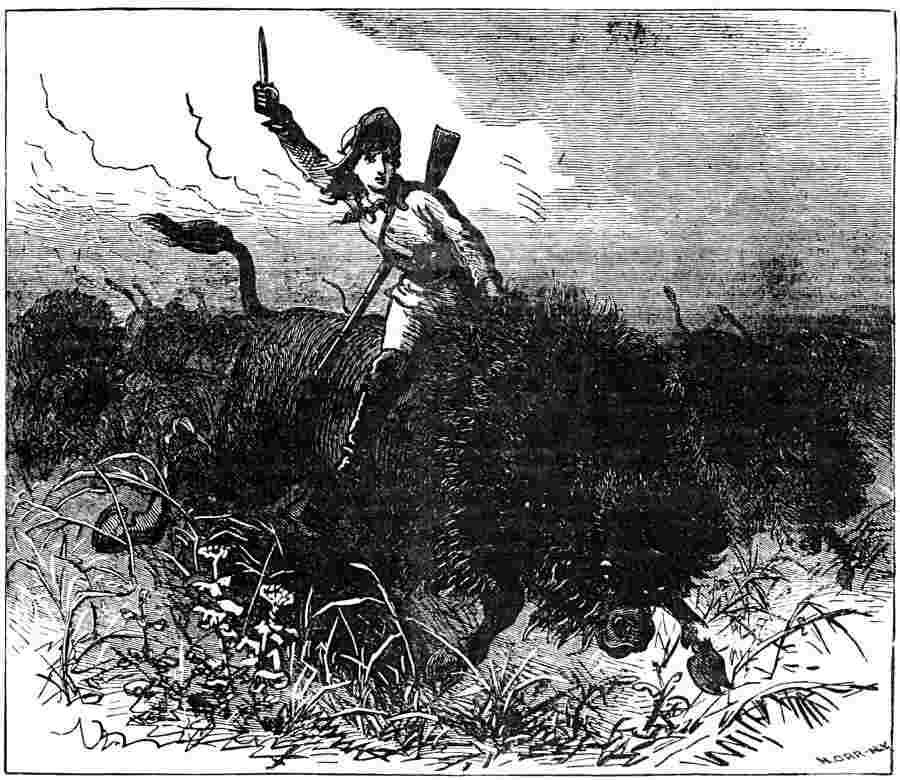
But he would take it; and accordingly strapped his rifle upon his back, picked out his buffalo, a huge bull, and swinging quickly from a limb, watched his chance and dropped down upon the back of his choice.
Clutching the long, shaggy mane he clung for dear life, at the same time holding himself on with his spurs.
Maddened with fright the bull bounded into the air, snorted wildly, gored those in the advance and soon led the herd.
Billy kept his seat nobly, a grim smile upon his face, and occasionally glanced backward at the herd and the pursuing Indians.
And straight for camp went the herd, until discovered by the train men, who started out in force to head them off.
But pell-mell into camp they went, stampeding the oxen and horses and frightening the men, and Billy began to feel that he must keep on his racer clear to the hills.
But the animal was tired out now and had dropped to the rear of the herd, and Wild Bill, seeing his young friend, raised his rifle and dropped the buffalo bull just as he was running out of camp.
From that day the boy was known as Buffalo Billy.
CHAPTER X.
CAPTURED BY DANITES.
With the usual adventures incident to a trip across the plains, an occasional fight with Indians, and several grand hunts, the train at last arrived near Green River in the Rocky Mountains.
Billy, Lew Simpson and another of the train had dropped back during the afternoon for a hunt, and upon drawing near the place where they were to encamp, were surprised to discover a band of horsemen coming toward them, whom they observed, however, to be white men.
Suspecting no harm from those of their own race, they rode forward, and, as they met, were startled to hear:
"Up with your hands! You are dead men if you resist!"
"Who are you?" asked Lew Simpson, angrily.
"Joe Smith, the Danite," was the calm reply of that leader.
"If I had known you were that accursed scoundrel I'd have shot you," growled Lew Simpson.
"Am awful glad you did not know it; but come, you are my prisoners, and your train is in my power," was the reply, and upon arriving at camp they found that it was but too true, for the boys had not suspected danger from men they had believed a party of United States cavalry.
The Danite leader, Joe Smith, then ordered all that could be packed on horses to be taken and the wagons set on fire, and told the train men to set out on foot for Fort Bridger, saying:
"You can reach there, but I guess Albert Sydney Johnson and his troops will never get the supplies."
The train was burned, all but one wagon, which carried supplies for the men, and armed only with their revolvers, they were ordered away by the Danites.
But Buffalo Billy was not one to see his splendid horse go without remonstrance, and, as begging did no good, offered to take him upon any terms he could get him on.
"Boy, ain't you the one who killed Hugh Hall in Kansas some time ago?" asked the man who had Billy's horse.
"I am."
"Well, I owe you one, for he was my pard, and you got me run out of the country by your work, so I'm willing to be even by keeping your horse."
"I'll fight you for him," said Billy, fiercely.
"What with, boy, fists or knives?"
"You are a fool to talk that way, for you weigh double what I do; but I'll fight you for the horse with rifle or pistol."
The train men tried to dissuade Billy from this determination, for they saw the Danite was anxious to take him at his word, and to kill him; but he had made the offer and the Mormon urged it on, and the arrangements were made to fight with pistols at fifty paces, walking on each other and firing until one fell.
They at once took their stands and Joe Smith gave the word, saying in a low tone before doing so:
"He's a boy in years; but he must be got rid of."
At the word the Danite advanced at a rapid walk firing; but Buffalo Billy stood still, and waited until he had received four shots, all coming dangerously near, when he suddenly threw his revolver to a level and drew trigger.
At the flash the man fell, shot in the leg, and the duel ended.
But the Danites would not give up the horse, saying that a wounded man could not continue the fight, and as Billy had not killed his foe, the animal could not be claimed by them.
Wild Bill and Lew Simpson roundly cursed Joe Smith and his Danites for a set of thieves, while Billy said sadly:
"Good-by, Sable, old fellow, good-by."
As he spoke he went up to his splendid horse, that stood saddled near, and throwing himself upon his back, with a defiant yell, bounded away like an arrow from the bow.
The Danites opened a perfect fusilade of pistol-shots upon the boy, but they flew harmlessly by him, and a number mounted and gave pursuit in hot haste.
But Sable Satan left them far behind and they gave up the chase, while Billy hung about until the train-men came along, and joined them, receiving from one and all the highest praise for his daring escape.
Some days after the disconsolate train-men reached Fort Bridger, to find that other trains than theirs had been robbed by the Danites.
CHAPTER XI.
A HOT INDIAN FIGHT.
As it was late in the fall Lew Simpson and his men were compelled to winter at the fort, where there were a number of troops and train employees of Russell, Majors and Waddell, who were formed into military companies, officered by wagon-masters.
As Wild Bill was placed in command of the battalion of train-men, he made Buffalo Billy an aide-de camp and the boy devoted himself assiduously to the duties devolving upon him, and before the long and tedious winter passed was forced to experience hardships of the severest kind, as the garrison had to live on mule meat, and haul wood from the distant mountains themselves, their animals having been served up as food.
In the spring Simpson started east with a train, and Buffalo Bill accompanied him as hunter for the men, his well known marksmanship and skill in securing game readily getting for him that position.
One day Lew Simpson and an "extra hand" accompanied him on one of his hunting expeditions, and to their surprise they came upon a band of Indians coming out of a canyon not far from them.
They were out on the prairie, and knowing that they could not escape on their mules, Simpson and the extra told Billy to ride off on Sable Satan and save himself.
But this the boy would not do, saying that he would remain with them.
"Then your horse must go with our mules," said Simpson.
"All right, Lew," said Billy, though the tears came into his eyes.
Telling them to dismount, just as they came to a buffalo wallow, Lew Simpson said:
"Now, give 'em a shot just back of the ears."
The shots were fired, Billy shutting his eyes as he pulled the trigger, and Sable Satan and the two mules dropped dead in their tracks.
In an instant they were dragged into position, so as to form a triangular fort, and getting into the wallow, with their knives the three threw up the dirt as rapidly as possible to make their position safer.
By this time the Indians, some half hundred in number, were rushing upon them with wildest yells.
But crouching down in their little fort of flesh and dirt, Lew Simpson and his man and boy comrade leveled their rifles over the bodies of the slain animals, and, as the bowling red-skins came within sixty yards, fired together.
Down went three Indians, and while Lew Simpson reloaded the yagers Billy and George Woods fired with their revolvers with such right good will the Indians were checked in their advance and turned to retreat out of range, followed by three more shots from the yagers.
Five Indians and four ponies were the result of this fight, and it gave the holders of the triangular fort confidence in themselves.
But the Indians did not give up the attack, but circled around and around the fort, firing upon the defenders with their arrows, and slightly wounding all three of them, while the bodies of the mules and horse were literally filled with shafts.
After a few rides around their pale-face foes, the Indians suddenly charged again, coming from every quarter, and forcing the whites to each defend the space in his front.
With demoniacal yells they came on once more, and once more the yagers opened, and then were thrown aside for the rapidly firing revolvers which did fearful execution.
Glancing toward Billy Lew Simpson saw that he was perfectly cool and had a revolver in each hand, although his shirt was saturated with blood from the arrow wound in his shoulder.
Unable to understand, or stand the hot fire of the revolvers, they again broke, when within twenty yards of the fort and rode off rapidly out of range.
"You got three that time, Billy," cried Lew Simpson gleefully, as he saw a trio of red-skins scattered along in the front of the boy.
Billy smiled grimly and reloaded his weapons, after which Lew Simpson dressed the wounds of his comrades, who returned a like favor for him.
But the Indians had by no means gone, for they had gone into camp in a circle around their foes, but well out of range of the fearful Mississippi yagers.
The three defenders in the mean time improved their opportunity to strengthen their fort with dirt and dig a deeper space within, while they also lunched upon their scanty supply of food.
"They'll starve us out if they can't take us by charging," said Simpson.
"They can't starve me as long as your mule holds out, Lew, for I won't eat poor Sable; it would choke me," replied Billy.
"Well, mule meat's good," said Woods.
"Yes, when there ain't anything else to eat, but I prefer buff'ler or Injun," was Billy's response.
"We may have to eat Injun yet," laughed Lew Simpson.
All made a wry face at this supposition and again prepared to meet a charge, for the red-skins were coming down in column.
But again they were checked with loss, and Billy's shot brought down the chief.
Darkness coming on, the Indians formed in line as though to ride away, when Lew Simpson said:
"They must take us for durned fools not to know that they won't leave their dead unburied, and that they think they can draw us out. No, here is where we live until the boys from the train come to look us up."
During the night the Indians, finding their foes would not leave their fort, set the grass on fire to burn them out.
But it was too scanty to burn well and only made a smoke, under cover of which they once more advanced, to be once more driven back.
With the morning they showed that their intention was to starve them out for they went into a regular camp in a circle upon the prairie.
But during the afternoon a party of horsemen appeared in sight, and the three hungry, suffering, half-starved defenders gave a yell of delight, which the red-skins answered with howls of disappointed rage as they hastily mounted their ponies and fled.
The train-men soon came up and were wild in their enthusiasm over the brave defense made, while the fort came in for general praise, although one and all deeply regretted Sable Satan's sad end, though his death had served a good purpose.
CHAPTER XII.
BOY TRAPPERS' ADVENTURES.
It was a proud day for Buffalo Billy when he returned home and was welcomed by his mother and sisters, to whom he gave all of his earnings, which were considerable, as his pay had been liberal.
The neighborhood, hearing from members of the train of Billy's exploits, for he was very close-mouthed about what he had done, made a hero of him, and many a pretty girl of seventeen regretted that the boy was not a man grown, to have him for a lover.
But Billy's restless nature would not allow him to remain idle at home, so he joined a party of trappers who were going to trap the streams of the Laramie and Chugwater for otter, beaver and other animals possessing valuable fur, as well as to shoot wolves for their pelts.
This expedition did not prove very profitable, and not wishing to return home without enough furs to bring a fair sum, Buffalo Billy joined a young man, only a few years his senior, by the name of Dave Harrington, and the two started off for the Republican.
Their outfit consisted of a wagon and yoke of oxen, for the transportation of their supplies and pelts, and they began trapping in the vicinity of Junction City, Kansas, and went up the Republican to Prairie Dog creek, where they found plenty of beaver.
While catching a large number of beavers, one day they returned to camp to find one of their oxen had fallen over a precipice and killed himself, and they were left without a team.
But the Boy Trappers, for Dave Harrington was not eighteen, determined to trap on through the winter, and in the spring one of them would go for a team to haul back their wagon.
Ill fortune seemed however to dog their steps as trappers, for one day, while chasing elk, Buffalo Billy fell and broke his leg, and Dave Harrington had to carry him to camp.
Here was a sad predicament, for the nearest settlement was one hundred miles distant.
But Dave set the leg as skillfully as he could, built a "dug-out," for the wounded boy to live in, filled it with wood and provisions, and then set out to procure a yoke of oxen and sled to return for Billy and their pelts.
The "dug-out," was a hole in the side of a bank, covered with poles, grass and sod, and with a fire-place in one end, and a bunk near it, was by no means uncomfortable; but the prospect of remaining there for a month alone, for it would take Harrington that time to go and return through the deep snow, was by no means a pleasant prospect for a boy under fourteen, and with a broken leg.
Dave started the following morning on foot, and Billy was left alone, helpless, and in the solitude of the mountain wilds.
To throw wood on the fire was a painful effort for him, and to move so as to cook his food was torture, and boys of his age can well feel for him in distress and loneliness.
But Buffalo Billy was made of stern stuff, and knew not what fear was; but who can picture the thoughts that were constantly in his young brain, when the winds were sweeping through the pines at night, the wolves were howling about his door, and the sleet and snow was almost continually falling.
It were enough to drive a strong man mad, let alone a boy.
But he stood it bravely, each day however counting with longing heart the hours that went so slowly by, and hoping for his comrade's return.
"Perhaps he has been frozen to death."
That was his thought one day about Harrington.
The next it was:
"I wonder if he has not lost his way?"
Again it was:
"I fear the Indians may have killed him."
When Dave had been gone about two weeks, Buffalo Billy was startled one day from a sound nap, to see an Indian standing by his side.
He was in full war-paint and feathers, which showed he was on the war-path, and Billy felt that it was all over with him.
Speaking to him in Sioux, which the boy understood, he asked:
"What pale-face boy do here?"
"My leg is broken."
"What for come here?"
"To get furs."
"This red-skin country?"
This laconic assertion Billy could not contradict, so he wisely held his peace.
"Let see leg," came next.
Billy showed him the bandaged limb, which was broken between the knee and ankle.
Just then another Indian entered whom Billy recognized, as having seen before, and whom he knew to be the great Sioux Chief, Rain-in-the-Face.
Billy called him by name, and he kept back the warriors, who were about to end the boy's life then and there.
"Boy pale-face know chief?" asked Rain-in-the-Face.
"Yes, I saw you at Fort Laramie, and gave you a knife," said Billy with hope in his heart.
"Ugh! chief don't forget; have knife here," and he showed a knife which he had doubtless often used upon the scalps of pale-faces.
"What pale-face boy do here?"
Billy told him.
"Where friend?"
"Gone after team."
"When come back?"
Billy was afraid to tell him the truth, so said:
"In two moons."
"Long time."
"Yes; but do your young men intend to kill me?"
"Me have talk and see."
The Indians then held a council together, and Billy could see that the chances were against him; but old Rain-in-the-Face triumphed in the end, and said:
"As pale-face boy is only pappoose, my young men not kill him."
Billy had often longed to be a man; but now he was happy that he was a boy, and answered:
"Yes, I am only a little pappoose."
"Him heap bad pappoose, me remember," said Rain-in-the-Face, recalling some of the jokes the boy played at Fort Laramie.
The Indians then unsaddled their ponies and camped at the dug-out for two days, and when they left they carried with them the sugar and coffee, Billy's rifle and one revolver, and most of the ammunition, besides what cooking utensils they needed.
Then old Rain-in-the-Face bade the boy good-by, and they rode off without poor Billy's blessing following them.
Hardly had they gone before a severe snow-storm sprung up, and it was hard indeed for the crippled boy to get wood enough to build a fire, for the red-skins had put it out before leaving.
The wolves, seemingly understanding how helpless the boy was, scratched at the door, and ran over the roof of the dug-out, at the same time howling viciously; but Billy frightened them off with an occasional shot, and resigned himself to his lonely fate.
But at last a month passed away, and with its end appeared brave Dave Harrington.
He had passed through innumerable dangers, but had at last come back in safety, and brought with him an ox-team.
Never in his life had Buffalo Billy felt the joy of that moment, and, though not a boy given to showing his feelings, he burst into tears of delight.
As it was impossible to at once return, on account of the very great depth of the snow, Dave told Billy they would wait until spring, as he had plenty of provisions, and that fur animals were plenty.
As soon as the snow began to melt Dave got his traps in, collected his pelts, which numbered a thousand, and putting them on the wagon, so as to serve as a bed for Billy, started his oxen homeward.
After twelve days they reached the ranch where Dave had purchased the oxen, paid in furs for the team, and started on to Junction City. Arriving there they sold their team, wagon and furs, the latter bringing them about two hundred and fifty dollars, a handsome sum for each when divided, and which made Billy's heart glad to take home with him, for it paid off a mortgage on his mother's farm.
CHAPTER XIII.
BUFFALO BILLY STRIKES IT RICH.
It was months before Billy obtained perfect use of his broken leg and was able to throw his crutches aside; but when he did do so it was with a glad heart, for once more he longed to be upon the plains.
Hearing of a rich discovery of gold in Colorado, he joined a party of miners that were bound there, and, reaching the mining camps, staked out a claim and began work.
He was the youngest person in the mines, in fact the only boy there, and with many he was a great favorite; but there were a few men there who sought to impose upon him on account of his youth.
This treatment Buffalo Billy was not the person to stand, and the result was one of his foes struck him one night without the slightest cause.
The result was a general row, for Billy's friends at once backed him in resenting the blow, and, though the fracas lasted but a few minutes, there were several burials next day as the result.
Of course this made Billy more disliked by those who, without reason, had become his foes, and to add to their dislike, he one day struck a rich vein that promised to pan out well in ore.
A few days he toiled in his lead, laying up considerable sums by his work, and one morning, as he went to his mine, he found it occupied by two rough-looking men whom he did not remember to have ever seen before.
"Well, pards, I guess you're up the wrong tree," he said, pleasantly.
"I guesses not; this are our lead," said one, rudely.
"How do you make that out?"
"We staked it months ago, and was called away, and now we has returned to it."
"Well, I believe you both to be lying, and until you prove it's your claim you can't have it," was the bold reply.
"Who's goin' ter say no?"
"I am."
"You!"
"Yes."
"Who is you?"
"I am named William Frederick Cody."
"You has handle enough."
"I have more than that."
"Waal."
"I'm called Buffalo Billy."
"We has heer'd o' you as a chap as has too much cheek fer one so young."
"Then if you know me you will understand that though I am but a boy I won't let you walk away with my claim."
"Get out, boy."
Billy obeyed; that is he went down to the camps and consulted his friends about what was best for him to do.
"We'll go up and call in their chips, Billy," was the universal decision.
"No, let us find out if the claim is theirs," said Billy.
"Find out nothin'; they has no right to it and 'tain't justice."
So up to the mine they went, and Billy's friends recognized the two claimants of the mine as two worthless fellows who had been in the valley months before, but who had no claim upon the boy's property.
"You must git!"
That was the decision; but just then others came up who sided with the desperadoes and things looked very scary for awhile, for half the crowd swore that the mine had belonged to the two claimants to it and that Billy ought to give it up.
But these were the men who disliked Billy and his party, as they were the honest miners, and who were willing to side with his foes.
"Ef ther boy wants ther mine he will hev to fight fer it," said one.
"He will fight for it and so will we!" cried one of Billy's friends.
All this time Billy had remained silent; but now he saw that his friends were in deadly earnest, and to prevent a general fight and much loss of life he said:
"The mine I own legally and I'll fight for it if that will settle it, but I don't want to have to fight both of you."
"Oh, but you must though," said one.
"If I must, I'll do it."
"But you shall not, Billy. These two devils only want to murder you so they can get the mine, and they sha'n't do it."
This was said by Billy's best pard and the others who liked the boy backed him up in his words, and pistols were drawn on both sides and the slightest act now all knew would cause trouble.
"If they'll fight me with revolvers and separately I'll be willing," said Billy, hastily, anxious to avert the trouble.
"Waal, we'll do that, so sail in," said one.
"No, not this way, you accursed coward, but go off there, stand with your back to the boy, as he will to you, and twenty paces apart, and at a word wheel and fire," cried Billy's friend.
This seemed fair and all agreed to it, and the man and the boy were placed in position, Billy pale but calm.
The other side won the word to wheel and fire, and though the man tried to aid his friend in giving it, Buffalo Billy was too quick for him and fired a second in advance of his adversary.
But that second was enough, for the bullet went straight to the heart of the one at which it was aimed, while his shot flew wild.
A yell burst from Billy's friends as they rushed forward while his foes were bringing up their other man.
But just then a stranger rode up, and leveling a pistol at the second claimant for the mine said sternly:
"Dick Malone, my gallows-bird, I arrest you in the name of the law."
The stranger was a United States detective, and the one he arrested an escaped convict.
This ended the fight for the mine; but after a few days' longer work in it Billy found that the vein panned out badly, and selling out his interest in it returned to his home once more, convinced that mining was not his forte, though he certainly had dug out enough of the yellow ore to prove to his mother that he had not been idle.
CHAPTER XIV.
THE YOUNG GUIDE.
The next time that Buffalo Billy left home it was in the capacity of assistant guide to a train of emigrants that were going to the far West to settle.
In Leavenworth one night he met in a common assembling room for all classes of men, a man who was Train Boss, or captain, and who was going to the West to raise cattle and also to farm.
His train, consisting of some thirty families, was encamped out of town resting and fitting up for the renewal of the march, and he had come into Leavenworth to secure a competent guide, the one who had been acting as such having been taken very ill.
He had just secured the services of a young man who professed to know the country well though he was a stranger in Leavenworth, and fearing an accident might deprive him of his services too, the captain was looking around for an assistant when he came upon Billy.
He liked the boy from the first, but feared, on account of his youth, that he might not be competent for the position, until assured by several teamsters that he was fully so, and consequently he engaged Billy at a fair salary.
The chief guide, who called himself Roy Velvet, Billy had never met, until the morning the train rolled out of camp on its way westward, and from the very first he did not like him.
He was a handsome, but dissipated looking young man, dressed like a dandy, was more than thoroughly armed, and rode a superb bay mare.
He smiled when Captain Luke Denham, the Train Boss, introduced Billy as an assistant guide, and said sneeringly:
"I guess he won't be of much use ten miles away from Leavenworth, captain."
Billy made no reply, but kept up considerable thinking, and set to work at his duties.
For some days the train went on finely, and all felt the new guide knew his business; but then there came some stormy days, it was hard traveling, several times the train had to make a dry camp, and once they were attacked by Indians, until some of the old teamsters felt confident that Roy Velvet had lost the way.
Yet on they plodded until at last the nature of the country was such that it was difficult for the train to travel, while, to add to their discomfort and fears, a large band of Indians were hovering near them.
"Well, Velvet, where will you find a camping place to-night?" asked Captain Denham, riding forward and joining the guide.
"Oh! I'll find a good place, and only a short distance ahead; after that the country will be all right for traveling," was the quiet answer.
"I don't believe it, for it has not that look."
"Then ask the assistant guide," was the stern reply.
"I would, but he is not with the train, and has not been seen since last night."
"Perhaps he got out of sight of the train and couldn't find his way back," sneered the guide.
"Oh no! that boy knows what he is about, and I'll trust him for it."
"Well, yonder is the camp," and Roy Velvet pointed to a little meadow not far distant, through which ran a deep stream, and beyond and overshadowing it, was a range of bold hills.
"It's a pleasant spot indeed, and I guess we'll halt a day or two," said the captain, and he gave orders for the train to encamp.
But suddenly up dashed Billy Cody, mounted upon a large horse no one had ever seen him ride before, and it was evident that he had been riding hard.
"Captain Denham, don't camp there, sir, for you place yourself at the mercy of the renegades and Indians that are dogging your trail," he said hastily.
"I am the guide, boy, and have selected the camp," sternly answered Roy Velvet.
"And you are my prisoner, Roy Velvet," and quicker than a flash the revolver of Buffalo Billy covered his heart.
Roy Velvet turned very pale, but said:
"Are you mad, boy?"
"No."
"Billy, what is the matter?" asked Captain Denham, while the teamsters and settlers gathered quickly around.
"Tie that man and I will tell you."
"But, Billy—"
"Tie him, captain, or I shall shoot him, for I know who and what he is," cried Billy, and his manner, his charge against the chief guide, his mysterious absence from the train for eighteen hours, and his return upon a strange horse, proved to all that he did know something detrimental to Roy Velvet.
"Speak, Billy, and if you know aught against this man, tell us," said the captain.
"Disarm him then for he is a tricky devil."
"Captain Denham, will you permit that boy to cover me with his revolver and hurl insult upon me?" cried the guide.
"As you will not do as I ask I will do it myself," and Billy rode up to the guide, still holding his cocked revolver upon him, and deliberately took from his belt his revolvers and knife.
"You are so sly, so soft in your cunning, Velvet, that I'll be on the safe side," said Billy with a smile, as he felt over the man for another weapon.
"Ah! I'll take this Derringer from your breast pocket," and out he drew the concealed weapon.
"Now, captain, I'll introduce to you Red Reid, the Renegade Chief."
All were astonished at this charge made by Billy against the guide, for Red Reid was one of the vilest road-agents that infested the overland trails to the West, and had robbed and murdered many a train of emigrants, and of Government supplies.
He was known also to be in league with the red-skins, and had them for allies, when his own force of renegades was not large enough to make a successful attack.
"He lies! I am not that monster," shouted the guide as white as a corpse.
"I do not lie, sir; from the first I did not like you, and knowing that you were going off the regular trail west I watched you.
"I have seen you, at night, slip out of camp and meet Indians, and last night I followed the one you met.
"I overtook him on the prairies, after a hard chase, and he shot my horse; but I shot him and found he was a white man in Indian disguise, and more, before he died he recognized me, for he was once my father's friend, but went to the bad.
"He told me who and what you were, and when he died to-day I mounted his horse and came on after the train, for I knew you were going to lead them here to attack this very night with your band that is not far away."
The story of Billy made a deep impression upon the train people, and the result was that Roy Velvet was seized, bound, and hanged to a tree within fifteen minutes, and the boy who had saved them from death was made chief guide.
At once he led them out of the dangerous locality where they could be ambushed and attacked, and the truth of the charge against Roy Velvet was sustained by the attack of the supposed Indians upon their camp; for, when driven off and the dead examined, a number of white men were found in the red paint and dress of Indian warriors.
Without difficulty Buffalo Billy led the train on to its destination, proving himself thereby a perfect guide, and after a short stop in the new settlement, he returned with a Government train bound East, and again was warmly welcomed "home again."