
CHAPTER XXIV.
SEEING SERVICE.
It was while in the capacity of scout at Fort Barker and Fort Hayes that Buffalo Bill added to his fame as an Indian-fighter, scout and guide, for almost daily he met with thrilling adventures, while his knowledge of the country enabled him to guide commands from post to post with the greatest of ease and without following a trail, but by taking a straight course across prairie or hill-land.
While in the vicinity of Hayes City Buffalo Bill had a narrow escape from capture, with a party that was under his guidance; in fact death would very suddenly have followed the capture of all.
A party of officers and their wives, well mounted and armed, were determined not to go with the slow wagon-train from one fort to the other, and accordingly Buffalo Bill was engaged to guide them.
He made known to them the great dangers of the trip, but they being determined, the party started, some dozen in all.
For awhile all went well, but then Buffalo Bill discovered signs of Indians, and hardly had the discovery been made when a large force, over two hundred in number, came in sight and gave chase.
Of course the party were terribly alarmed, and regretted their coming without on escort of soldiers.
But Buffalo Bill said quietly:
"You are all well mounted, so ride straight on, and don't push too fast, or get separated."
"And you, Cody?" asked an officer.
"Oh, I'll be along somewhere; but I've got a new gun, a sixteen-shooter, and I want to try just what it will do."
The Indians were now not more than half a mile away and coming on at full speed, with wild yells and whoops, confident of making a splendid capture.
Directing the officers what course to take, Buffalo Bill saw them start off at full speed while he remained quietly seated upon his splendid horse Brigham, a steed that equaled Sable Satan for speed and endurance.
It was evident that the red-skins were surprised at beholding a single horseman standing so calmly in their path, and awaiting their coming, and the party in flight looked back in great alarm as they saw that Buffalo Bill did not move, appearing like a bronze statue of horse and rider.
"What could it mean?"
"Was he mad?"
And many more were the comments made by the party, while the Indians were equally as inquisitive upon the subject.
Nearer and nearer came the rushing band, for what had two hundred mounted warriors to fear from one man?
Nearer and nearer, until presently Buffalo Bill was seen to raise his rifle, and a perfect stream of fire seemed to flow out of the muzzle, while the shots came in rapid succession.
It was a Winchester repeating rifle, and Buffalo Bill had been testing it thoroughly.
And the result was such that the Indians drew rein, for down in the dust had gone several of their number, while half a dozen ponies had been killed by the shots; in fact, fired into the crowded mass of men and horses, nearly every discharge had done harm.
With a wild, defiant war-cry, Buffalo Bill wheeled and rode away, loading his matchless rifle as he ran.
It did not take long for Brigham to over-take the horses in advance, and warm congratulations followed, for the officers and ladies had seen the daring scout check the entire band of red-skins.
But though temporarily stunned by the effects of the shots, for the Indians had not seen repeating rifles in those days, they soon rallied and came on once more at full speed.
And again did the scout drop behind and await their coming, to once more administer upon the amazed warriors a check that made them more cautious, for they kept out of range.
Yet they kept up the chase all day, and only drew off when the fort came in view, and the party arrived in safety in its walls.
CHAPTER XXV.
CAPTURING A HERD OF PONIES.
While at the fort the colonel in command complained at the non-arrival of a drove of Government horses, as he was anxious to make a raid into the Indian country, and Buffalo Bill volunteered to go and hurry the cattle on.
He had been gone but a few hours from the fort when he crossed a trail which he knew to have been made by a large Indian village on the move.
Cautiously he followed it, and just at sunset came in sight of the camp, pitched at the head of a valley, and saw below a large herd of horses grazing.
To return to the fort for aid he knew would take too long, so he determined to make an attempt to capture the herd himself, and, with his field-glass carefully reconnoitered the surroundings as long as it was light.
He saw that the nature of the valley was such that the herd could only escape by two ways, one through the Indian village and the other at the lower end, where he had observed four warriors placed as a guard and herders.
"That is my quartette," he said to himself, and mounting Brigham he began to make his way around to the lower end of the valley.
After an hour's ride he gained the desired point, and then set down to work.
Carrying with him in case of need a complete Indian costume, he was not long in rigging himself up in it and painting his face.
Then he left Brigham in a canyon near by and cautiously approached the entrance to the valley, which was not more than two hundred yards wide at this point.
Peering through the darkness he saw the four dark objects, about equal distances apart, which he knew were the ponies of the four warriors on guard, and that they were lying down near in the grass he felt confident.
Getting past the line of herders he boldly advanced toward the one nearest the hill on the left, and knew he would be taken for some chief coming from the village and accordingly not dreaded.
It was just as he had expected: the Indian herder saw him coming directly from the village, as he believed and did not even rise from the grass as Buffalo Bill drew near.
With a word in Sioux Buffalo Bill advanced and suddenly threw himself upon the prostrate warrior.
There was a short struggle, but no cry, as the scout's hand grasped the red-skin's throat, and then all was still, the Indian pony lariated near, not even stopping his grazing.
Throwing the red-skin's blanket over his body, Buffalo Bill moved away a few paces to where the pony stood, and called to the next herder in the Sioux tongue to come to him.
The unsuspecting warrior obeyed, and the next instant found himself in a gripe of iron and a knife blade piercing his heart.
"This is red work, but it is man to man and in a few days the whole band would make a strike upon the settlements," muttered the scout, as he moved slowly toward the position his enemy had left at his call.
As he reached the spot he saw the third warrior standing on his post and boldly walked up to him, when again the same short, fierce, silent fight followed and Buffalo Bill arose from the ground a victor.
The fourth, and only remaining guard he knew was over under the shadow of the hill, and thither he went.
Arriving near he did not see him, and looking around suddenly discovered him asleep at the foot of a tree.
"I'd like to let you sleep, Mr. Red-skin, but you'd wake up at the wrong time, so you must follow your comrades to the happy hunting-grounds," he muttered, as he bent over and seized the throat of the Indian in his powerful gripe.
The warrior was almost a giant in size, and he made a fierce fight for his life.
But the iron hold on his throat did not relax, and at last his efforts ceased and his grasp upon the scout, which had been so great he could not use his knife, weakened and there was no more show of resistance.
Then not an instant did Buffalo Bill tarry, but went up the valley, rounded up the herd of horses and quickly drove them away from the village, in which he knew slept half a thousand warriors.
Slowly he moved the large brute mass, and they went toward the mouth of the valley and were soon out upon the prairie.
Then mounting Brigham he urged them on until out of hearing of the camp, when he headed them for the fort.
It was a hard drive and taxed both Brigham and his rider fearfully; but at last the herd was driven to a good grazing place a few miles from the fort and Buffalo Bill left them and rode rapidly on, and just at dawn reported his valuable capture and that the same horses could be used in an attack upon the Indian camp.
The colonel at once acted upon his suggestion; the cavalrymen who had no horses, loaded with their saddles, bridles and arms, went at a quick march to the grazing place of the horses, and ere the day was three hours old three hundred men were mounted and on the trail for the red-skin village, while the remainder of the ponies were driven to the fort.
Deprived of the greater part of their horses, the red-skins could march but slowly; but they were in full retreat when Buffalo Bill led the command in sight of them, and though the dismounted warriors fought bravely, they were severely whipped and all their village equipage captured or destroyed, while instead of attacking the white settlements as they had intended, they were glad enough to beg for relief.
This gallant act made the name of Buffalo Bill, or Pa-e-has-ka (Long Hair), as they called him, known to every Indian on the north-west border, and they regarded him with the greatest terror, while it made him an idol among the soldiers.
CHAPTER XXVI.
THE CHAMPION OF THE PLAINS.
As Buffalo Bill was known to be the most successful hunter on the prairies, shortly after his capture of the herd of Indian ponies he received an offer from the Kansas Pacific Railroad Company to keep their workmen supplied with meat, and the terms allowed him were so generous that he felt he owed it to his family, for he had become the father of a lovely little daughter, Arta, born in Leavenworth, to accept the proposition, and did so.
The employees of the road numbered some twelve hundred, and Buffalo Bill's duty was to supply them with fresh meat, a most arduous task, and a dangerous one, for the Indians were constantly upon the war-path.
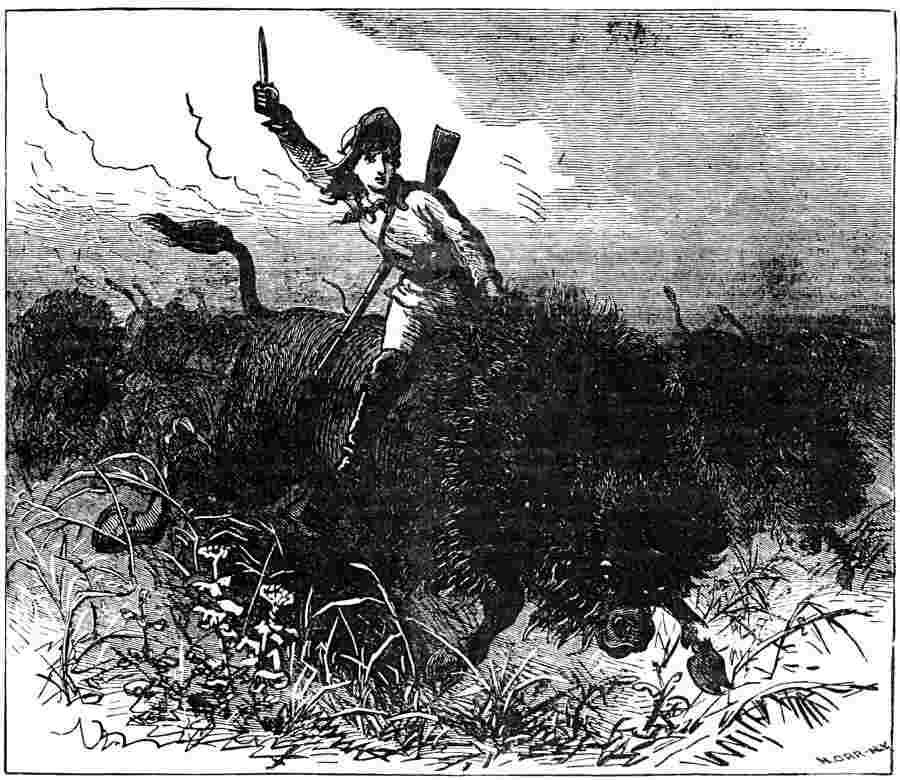
But he undertook the work, and it was but a very short while before his fame as a buffalo-killer equaled his reputation as an Indian-fighter, and often on a hunt for the shaggy brutes, he had to fight the red savages who constantly sought his life.
It was during his service for the Kansas Pacific that he was rechristened Buffalo Bill, and he certainly deserved the renewal of his name, as in one season he killed the enormous number of four thousand eight hundred and twenty buffaloes, a feat never before, or since equaled.
And during this time, in the perils he met with, and his numerous hair-breadth escapes, in conflict with red-skins, horse-thieves and desperadoes, it is estimated that over a score of human beings fell before his unerring rifle and revolvers, while, he still bearing a charmed life, received only a few slight wounds.
CHAPTER XXVII.
THE CHAMPION.
Some time after his great feat of killing buffalo for the Kansas Pacific, Buffalo Bill was challenged by Billy Comstock, another famous buffalo-hunter, and a scout and Indian interpreter, to a match at killing the shaggy wild animals.
Those who knew Comstock and had seen him among a herd of buffalo, and had heard of Buffalo Bill's exploits, were most desirous of making a match between the two to discover which was the best "killer."
On the other side, those who knew Buffalo Bill and had seen him at work at the buffaloes, were willing to bet high that he would prove the champion.
As the men were not only willing, but anxious to meet, it was not difficult for them to do so, and all preliminaries were satisfactorily arranged to all parties concerned.
The men were to, of course, hunt on horse-back, and to begin at a certain hour in the morning and keep it up for eight hours, a large herd having just been found and its locality marked for the day of the sport.
The stakes were made five hundred dollars a side, and there were numbers, both ladies and gentlemen, out on horseback to see the sport.
The herd having been located early the next morning, the two hunters left for the field, and the large crowd followed at a distance.
The counters, those chosen to follow each hunter and count his killed, followed close behind Bill and Comstock, who rode side by side, chatting in a most friendly way until the herd was sighted.
Buffalo Bill was mounted upon Brigham, a noted buffalo horse, and he was armed with a breech-loading Springfield rifle, and a weapon which had sent many a red-skin to the happy hunting-grounds.
Comstock was also splendidly mounted, and carried his favorite buffalo repeating rifle, and both men felt confident of victory.
Reaching the herd, the two hunters, followed by their counters, well mounted also, dashed into a herd, and it quickly divided, giving each one an opportunity to show his skill, as though the buffaloes themselves sympathized with the match and were willing to do all in their power to forward it.
In his first run Buffalo Bill killed thirty-eight, while in the same length of time Billy Comstock dropped twenty-three, which gave the former the advantage thus far.
A rest was then called for both horses and men, and once more they started out for the second run, a small herd appearing opportunely in sight.
In this run Buffalo Bill's tally was eighteen to Comstock's fourteen, and another halt was made for rest and refreshments.
When called to the scratch for the third run, Buffalo Bill, knowing he had the best buffalo horse in the country, stripped him of saddle and bridle and sprung upon his bare back.
A third herd was looked up, and the two killers began their work with a will, and Buffalo Bill sailed to the front with thirteen, which gave him a list of sixty-nine to Comstock's forty-six.
The third run closed the match, and Buffalo Bill was proclaimed the winner and the champion buffalo-killer of the prairies.
CHAPTER XXVIII.
A GAME FOR LIFE AND DEATH.
Having concluded his engagement with the Kansas Pacific Railroad, Buffalo Bill once more became a Government scout, and it was while serving on the far border that he won the hatred of a notorious band of desperadoes whom he had several times thwarted in their intended crimes.
Hearing that they had said they would kill him at sight, he boldly rode into the town where they had their haunts, and, true to their word, two of them came out and attacked him.
At the first shot Bill was wounded in the right arm, which destroyed his aim, and, ere he could draw a revolver with his left hand, his horse fell dead beneath him, pinning him to the ground.
Instantly his foes rushed upon him to complete their work, when, rising on his wounded arm, he leveled his revolver with his left hand and shot them down as they were almost upon him.
An army officer who witnessed the affray was so much pleased with the nerve of Buffalo Bill that he presented him with a splendid horse, one of a pair he had just received from the East, and having had his wound dressed the scout rode back to camp delighted with his present.
But the leader of the desperado band still swore to kill Buffalo Bill, and to pick a quarrel with him one night in a saloon, boldly dared him to play him a game of cards.
"Yes, you accursed thief and murderer, I'll play you a game of cards if you will let me name the stakes," said Buffalo Bill.
"All right, name what you please, so you play," was the answer, and the crowd gathered eagerly around, confident that there would be trouble.
"I'll name life and death as the stakes," said Buffalo Bill.
"What do you mean?"
"I mean that if you win the game I'll stand ten paces away and give you a shot at me; if I win, you are to give me a shot at you."
The desperado did not like this arrangement, but having challenged Buffalo Bill to play, and given him the choice of the stakes, he dared not back down, and said:
"All right, let us begin."
"Mind you, no cheating, for I shall shoot you the moment I catch you at it."
"Two can play at that game, Buffalo Bill," said the desperado, and seating themselves at the table the game was begun, each man having his revolver lying by his side.
Buffalo Bill was calm and smiling, for he had confidence in his universal good luck to win.
The desperado was pale and stern, and played warily, for he saw the eye of his foe watching him like a hawk.
Once Bill dropped his hand upon his revolver and his adversary attempted to do the same; but the scout was too quick for him and merely said:
"Beware, for if I catch you cheating, I will kill you."
"Who's cheating, Buffalo Bill?"
"You were about to make an attempt to do so; but I warn you," was the calm reply.
Then, in breathless silence the game went on, and Buffalo Bill won.
Instantly the desperado seized his revolver, but he felt against his head the cold muzzle of a weapon, and heard the stern tones:
"Bent, I guess I'll save Buffalo Bill from killing you, by hanging you to the nearest tree."
The speaker was Wild Bill, who had stood behind the chair of the desperado.
All knew him, and that he was an officer of the law, and would keep his word.
Buffalo Bill said nothing, and the crime-stained wretch was dragged out of the saloon, a rope put around his neck, and he was hanged for his many red deeds, thereby escaping death at the hands of the scout.
CHAPTER XXIX.
BILL'S STORY OF HIS BECOMING AN ACTOR.
As Buffalo Bill in the past few years has become known as an actor, and appears as such with his Dramatic Combination, during the winter months, when he is not on the plains, it will not be by any means uninteresting to my readers to learn how he came to go upon the stage, and the story I give in his own words, in relating his experience to a reporter who had called upon him for some jottings regarding his life.
He said:
"It was in the fall of '71, that General Sheridan came to the plains with a party of gentlemen for the purpose of engaging in a buffalo-hunt, to extend from Fort McPherson, Nebraska, to Fort Hayes, Kansas, on the Kansas Pacific Railroad, a distance of 228 miles, through the finest hunting country in the world. In the party were James Gordon Bennett of the New York Herald, Lawrence and Leonard Jerome, Carl Livingstone, S.G. Heckshire, General Fitzhugh of Pittsburg, General Anson Stager of the Western Union Telegraph Company, and other noted gentlemen. I guided the party, and when the hunt was finished, I received an invitation from them to go to New York and make them a visit, as they wanted to show me the East, as I had shown them the West. I was then Chief of Scouts in the Department of the Platte. And in January, 1872, just after the Grand Duke Alexis's hunt, which, by the way, I organized, I got a leave of absence, and for the first time in my life found myself east of the Mississippi river.
"Stopping at Chicago two days, where I was the guest of General Sheridan, I proceeded to New York, where I was shown the 'elephant.' During my visit I attended the performance at the Bowery Theater, in company with Colonel E.Z.C. Judson (Ned Buntline), and witnessed a dramatization of Judson's story, entitled 'Buffalo Bill, King of Border Men.' The part of 'Buffalo Bill' was impersonated by J.B. Studley, an excellent actor, and I must say the fellow looked like me, as his make-up was a perfect picture of myself. I had not watched myself very long before the audience discovered that the original Buffalo Bill was in the private box, and they commenced cheering, which stopped the performance, and they would not cease until I had shown myself and spoken a few words.
"At that time I had no idea of going on the stage, such a thought having never entered my head. But some enterprising managers, believing there was money in me, offered me as high as $1,000 per week to go on the stage. I told them I would rather face 1,000 Indians than attempt to open my mouth before all those people. I returned to my duties as a scout, and during the summer of 1872 Ned Buntline was constantly writing to me to come East and go on the stage, offering large inducements. As scouting business was a little dull, I concluded to try it for awhile, and started East in company with Texas Jack. Met Buntline in Chicago with a company ready to support me.
"We were to open in Chicago in Nixon's Amphitheater on December 16th, 1872. I arrived in Chicago December 12th, 1872. We were driven to the theater, where I was introduced to Jim Nixon, who said, 'Mr. Buntline, give me your drama, as I am ready to cast your piece, and we have no time to lose, if you are to open Monday, and these men who have never been on the stage will require several rehearsals.' Buntline surprised us all by saying that he had not written the drama yet, but would do so at once. Mr. Nixon said, 'No drama! and this is Thursday. Well, I will cancel your date.' But Buntline was not to be balked in this way, and asked Nixon what he would rent the theater one week for. 'One thousand dollars,' said Nixon. 'It's my theater,' said Buntline, making out a check for the amount. He rushed to the hotel, secured the services of several clerks to copy the parts, and in four hours had written 'The Scouts of the Prairie.' He handed Texas Jack and I our parts, told us to commit them to memory and report next morning for rehearsal. I looked at Jack's and then at my part. Jack looked at me and said, 'Bill, how long will it take you to commit your part?' 'About seven years, if I have good luck.' Buntline said, 'Go to work.' I studied hard, and next morning recited the lines, cues and all, to Buntline. Buntline said, 'You must not recite cues; they are for you to speak from—the last words of the persons who speak before you.' I said, 'Cues be d—d; I never heard of anything but a billiard cue.'
"Well, night came. The house was packed. Up went the curtain. Buntline appeared as Cale Durg, an old Trapper, and at a certain time Jack and I were to come on. But we were a little late, and when I made my appearance, facing 3,000 people, among them General Sheridan and a number of army officers, it broke me all up and I could not remember a word. All that saved me was my answer to a question put by Buntline. He asked, 'What detained you?' I told him I had been on a hunt with Milligan. You see Milligan was a prominent Chicago gentleman who had been hunting with me a short time before on the plains, and had been chased by the Indians, and the papers had been full of his hunt for some time; Buntline saw that I was 'up a stump,' for I had forgotten my lines, and he told me to tell him about the hunt. I told the story in a very funny way, and it took like wild-fire with the audience.
"While I was telling the story, Buntline had whispered to the stage manager that when I got through with my story to send on the Indians. Presently Buntline sung out: 'The Indians are upon us.' Now this was 'pie' for Jack and I, and we went at those bogus Indians red hot until we had killed the last one and the curtain went down amid a most tremendous applause, while the audience went wild. The other actors never got a chance to appear in the first act. Buntline said, 'Go ahead with the second act, it's going splendid.' I think that during the entire performance, neither Jack nor myself spoke a line of our original parts. But the next morning the press said it was the best show ever given in Chicago, as it was so bad it was good, and they could not see what Buntline was doing all the time if it took him four hours to write that drama.
"Our business was immense all that season, and if we had been managed properly we would have each made a small fortune. As it was I came out $10,000 ahead. In June, 1873, I returned to the plains, came East again in the fall, this time my own manager. I got a company, took the noted 'Wild Bill' with me, but could not do much with him as he was not an easy man to handle, and would insist on shooting the supers in the legs with powder, just to see them jump. He left a few months later and returned to the plains. He was killed in August, 1876, in Deadwood.
"In the summer of 1876 I was Chief of Scouts under General Carr, afterward with General Crook and General Terry.
"On the 17th of July I killed Yellow Hand, a noted Cheyenne chief, and took the first scalp for Custer. I returned to the stage in October, 1876, and during the season of 1876 and 1879 I cleared $38,000. I have generally been successful financially on the stage. I am now in the cattle business in Nebraska, to which place I will return as soon as the season is over, providing nothing serious occurs to call me home earlier."
CHAPTER XXX.
THE YELLOW HAND DUEL.
As Buffalo Bill, in the foregoing chapter speaks of his killing Yellow Hand, the celebrated Cheyenne chief, who was greatly feared by his own people, and a terror to the whites, I will give an account of that tragic duel between a white man and two Indians, for another chief also rode down and attacked the noted scout, after his red comrade had fallen.
When the Indian war of 1876 broke out Buffalo Bill at 01:00 closed his dramatic season, and started post haste for the West, having received a telegram from General E.A. Carr asking for his services as scout in the coming campaign.
He joined the command at Fort D.A. Russell, where the famous Fifth Cavalry Regiment was then in camp, and arriving received a boisterous welcome from his old comrades, who felt that, with Buffalo Bill as Chief of Scouts, they would surely have warm work with the Indians.
The Fifth Cavalry was at once ordered to operate in scouting the country on the South Fork of the Cheyenne and to the foot of the Black Hills, and it was while driving the Indians before them that the news came of Custer's fatal fight with Sitting Bull on the Little Big Horn.
General Merritt, who had superseded Carr in command marched at once to the Big Horn country, and while en route there came news of a large force of warriors moving down to join Sitting Bull.
Instantly five hundred picked men of the Fifth started back by forced marches, and Buffalo Bill, splendidly mounted, kept on ahead of the command a couple of miles.
Discovering the Indians, he at the same time beheld two horsemen whom he saw to be whites, riding along unconscious of the presence of foes.
He knew that they must be scouts bearing dispatches, and at once determined to save them for they were riding in a direction down one valley that would bring them directly upon the red-skins, who had already seen them, and had sent a force of thirty warriors out to intercept them.
Instantly Buffalo Bill dashed over the ridge of the hill that concealed him from the view of the Cheyennes, and rode directly toward the band going to attack the two white horsemen.
They halted suddenly at sight of him, but, seeing that he was alone, they started for him with wild yells.
But still he kept on directly toward them, until within range, when he opened upon them with his matchless Evans rifle, a thirty-four-shot repeater, and a hot fight began, for they returned the fire.
This was just what Buffalo Bill wanted, for the firing alarmed the horsemen and placed them on their guard, and he knew that the Indian volleys would be heard at the command and hasten them forward.
Having dropped a couple of red-skins and several ponies, Buffalo Bill wheeled to the rightabout, dashed up to the top of a hill, and, signaling to the two whites to follow him, headed for the command at full speed.
As he had anticipated, the two men were scouts with important dispatches for General Merritt, and Bill's bold act had not only saved their lives, but also the dispatches, and the result of it was that the Fifth Cavalry went at once into line of battle, while the Cheyennes also formed for battle, though evidently surprised at being headed off at that point.
But they saw that they were double the force of the whites, and were determined upon a fight, and their chiefs reconnoitered carefully their foes' strength and position.
Buffalo Bill also volunteered to go out and get a closer look at them, to see what they were up to, and General Merritt told him to do so, but not to venture too near and expose himself.
As he left the line two Indian horsemen also rode out from among their comrades, and one was some lengths in front of the other.
At a glance Buffalo Bill saw that the two were full chiefs, and they had not advanced far toward each other when he discovered that he was the especial object of their attention.
But though one halted, the other came on, and the scout and the chief came within a hundred yards of each other.
Then the Indian cried out in his own tongue:
"I know Pa-e-has-ka the Great White Hunter and want to fight him."
"Then come on, you red devil, and have it out," shouted back Buffalo Bill, and forgetting General Merritt's orders not to expose himself, and to the horror of the regiment, every man of whom saw him, as well as did the Indians, he dashed at full speed toward the chief, who likewise, with a wild yell rode toward him.
Together both fired, the chief with his rifle, and Buffalo Bill with his revolver, and down dropped both horses.
Buffalo Bill nimbly caught on his feet, while the Indian was pinned by one leg under his horse, and with his war-cry the scout rushed upon him.
As he advanced the chief succeeded in releasing his leg from beneath his horse and again fired, as did Buffalo Bill, and both of them with revolvers.
The Indian's bullet cut a slight gash in Bill's arm, while he struck the red-skin in the leg, and the next instant sprung upon him with his knife, which both had drawn.
The hand-to-hand fight was hardly five seconds in duration, and Buffalo Bill had driven his knife into the broad red breast, and then tore from his head the scalp and feather war-bonnet, and waving it over his head, shouted in ringing tones:
"Bravo! the first scalp to avenge Custer!"
A shout of warning from the cavalry caused him to turn quickly and he beheld the second chief riding down upon him at full speed.
But Bill turned upon him, and a shot from his revolver got him another scalp.
But hardly had he stooped to tear it from the skull, when the Indians, with wildest yells, charged upon him.
They were nearer to him than was the regiment, and it looked bad for Buffalo Bill; but the gallant Fifth charged in splendid style, met the Indians in a savage fight, and then began to drive them in wild confusion, and pushed them back into the Agency a sorely whipped body of Cheyennes, and grieving over heavy losses.
Upon reaching the Agency Buffalo Bill learned that the two Indians he had killed in the duel were Yellow Hand and Red Knife, and Cut Nose, the father of the former swore some day to have the scout's scalp.
But Buffalo Bill laughed lightly at this threat, evidently believing the old adage that "A threatened man is long lived."
CHAPTER XXXI.
CONCLUSION.
Having gone over many of the thrilling scenes in the life of W.F. Cody, Buffalo Bill, from boyhood to manhood, and shown what indomitable pluck he possesses, and the pinnacle of fame he has reached unaided, and by his own exertions and will, I can only now say that much remains to be told of his riper years, from the time he stepped across the threshold from youth to man's estate, for since then his life has been one long series of perilous adventures which, though tinged with romance, and seeming fiction, will go down to posterity as true border history of this most remarkable man, the truly called King of Prairiemen.
THE END.
1 (return)
A "bow-stall" is formed by taking a turn with a rope or
lariat between the nostrils and eyes of a horse, and passing one end
over the head, back of the ears and tied on the opposite side. A second
noose is then made around the jaws and from this the reins lead back
toward the rider, who can then thoroughly manage the animal.—The
Author.
Half-Dime Singer's Library
- 1 Whoa, Emma! and 59 other Songs.
- 2 Captain Cuff and 57 other Songs.
- 3 The Gainsboro' Hat and 62 other Songs.
- 4 Johnny Morgan and 60 other Songs.
- 5 I'll Strike You With a Feather and 62 others,
- 6 George the Charmer and 56 other Songs.
- 7 The Belle of Rockaway and 52 other Songs.
- 8 Young Fellah, You're Too Fresh and 60 others.
- 9 Shy Young Girl and 65 other Songs.
- 10 I'm the Governor's Only Son and 58 other Songs.
- 11 My Fan and 65 other Songs.
- 12 Comin' Thro' the Rye and 55 other Songs.
- 13 The Rollicking Irishman and 59 other Songs.
- 14 Old Dog Tray and 62 other Songs.
- 15 Whoa, Charlie and 59 other Songs.
- 16 In this Wheat By and By and 62 other Songs.
- 17 Nancy Lee and 58 other Songs.
- 18 I'm the Boy that's Bound to Blaze and 57 others.
- 19 The Two Orphans and 59 other Songs.
- 20 What are the Wild Waves Saying, Sister? and 59 other Songs.
- 21 Indignant Polly Wog and 59 other Songs.
- 22 The Old Arm-Chair and 58 other Songs.
- 23 On Coney Island Beach and 58 other Songs.
- 24 Old Simon, the Hot-Corn Man and 60 others.
- 25 I'm in Love and 56 other Songs.
- 26 Parade of the Guards and 56 other Songs.
- 27 Yo, Heave, Ho! and 60 other Songs.
- 28 'Twill Never do to Gib it up So and 60 others.
- 29 Blue Bonnets Over the Border and 54 others,
- 30 The Merry Laughing Man and 56 other Songs.
- 31 Sweet Forget-me-Not and 55 other Songs.
- 32 Leetle Baby Mine and 53 other Songs.
- 33 De Banjo am de Instrument for Me and 53 others.
- 34 Taffy and 50 other Songs.
- 35 Just to Please the Boys and 52 other Songs.
- 36 Skating on One in the Gutter and 52 others.
- 37 Kolored Kranks and 59 other Songs.
- 38 Nil Desperandum and 53 other Songs.
- 39 The Girl I Left Behind Me and 50 other Songs.
- 40 'Tis but a Little Faded Flower and 50 others.
- 41 Pretty Whilhelmina and 60 other Songs.
- 42 Dancing in the Barn and 68 other Songs.
- 43 H.M.S. Pinafore. Complete, and 17 other Songs.
Sold everywhere by Newsdealers, at five cents per copy, or sent post-paid, to any address, on receipt of Six cents per number.
BEADLE AND ADAMS, Publishers,
96 William Street, New York.