
The Project Gutenberg eBook of Ben Stone at Oakdale
Title: Ben Stone at Oakdale
Author: Morgan Scott
Release date: February 17, 2015 [eBook #48277]
Most recently updated: October 24, 2024
Language: English
Credits: E-text prepared by Stephen Hutcheson, Rick Morris, Rod Crawford, Dave Morgan, and the Online Distributed Proofreading Team (http://www.pgdp.net)
The Project Gutenberg eBook, Ben Stone at Oakdale, by Morgan Scott
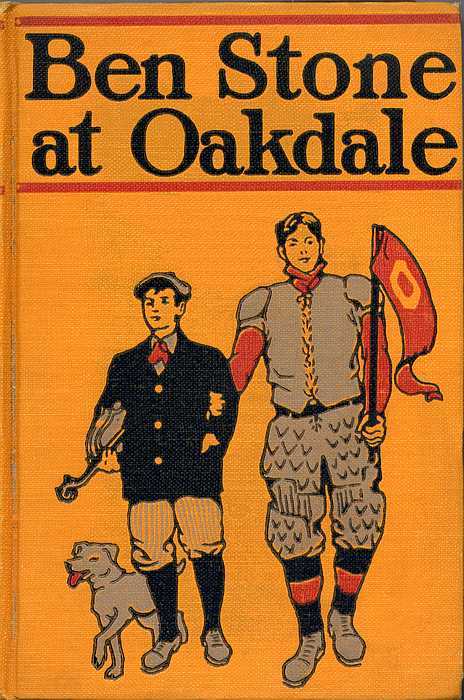
Book cover
“HERE THEY BE!”—PAGE 260.
| CHAPTER | PAGE | |
| I. | Ben Stone | 5 |
| II. | The Pariah | 16 |
| III. | One Ray of Light | 26 |
| IV. | A Brave Heart | 40 |
| V. | One More Chance | 49 |
| VI. | Into the Shadows | 61 |
| VII. | A Desperate Encounter | 71 |
| VIII. | A Rift | 83 |
| IX. | Proffered Friendship | 96 |
| X. | Stone’s Story | 105 |
| XI. | On the Threshold | 118 |
| XII. | The Skies Brighten | 127 |
| XIII. | Hayden’s Demand | 135 |
| XIV. | The Bone of Contention | 142 |
| XV. | The Fellow Who Wouldn’t Yield | 152 |
| XVI. | Stone’s Defiance | 162 |
| XVII. | An Armed Truce | 170 |
| XVIII. | The Game | 179 |
| XIX. | Between the Halves | 190 |
| CHAPTER | PAGE | |
| XX. | One Who Was True | 198 |
| XXI. | A Surprising Meeting | 209 |
| XXII. | A Sympathetic Soul | 218 |
| XXIII. | The Blind Fugitive | 228 |
| XXIV. | Clouds Gather Again | 235 |
| XXV. | Flight | 247 |
| XXVI. | The Arrest | 256 |
| XXVII. | The Darkest Hour | 265 |
| XXVIII. | On Trial | 280 |
| XXIX. | Sleuth’s Clever Work | 296 |
| XXX. | Clear Skies | 309 |
BEN STONE AT OAKDALE.
CHAPTER I.
As he was leaving the academy on the afternoon of his third day at school in Oakdale, Ben Stone was stopped by Roger Eliot, the captain of the football team. Roger was a big, sturdy chap, singularly grave for a boy of his years; and he could not be called handsome, save when he laughed, which was seldom. Laughter always transformed his features until they became remarkably attractive.
Compared with Ben, however, Roger appeared decidedly comely, for the new boy was painfully plain and uncouth. He was solid and stocky, with thick shoulders and rather big limbs, having a freckled face and reddish hair. He had a somewhat large nose, although this alone would not have been detrimental to his appearance. It was his square jaw, firm-shut mouth, and seemingly sullen manner that had prevented any of the boys of the school from seeking his acquaintance up to this point. Half of his left ear was gone, as if it had been slashed off with some sharp instrument.
Since coming to Oakdale Ben had seemed to shun the boys at the school, seeking to make no acquaintances, and he was somewhat surprised when the captain of the eleven addressed him. Roger, however, was not long in making his purpose clear; he took from his pocket and unfolded a long paper, on which were written many names in two extended columns.
“Your name is Stone, I believe?” he said inquiringly.
“Yes, sir,” answered Ben.
“Well, Stone, as you are one of us, you must be interested in the success of the football team. All the fellows are, you know. We must have a coach this year if we expect to beat Wyndham, and a coach costs money. Everybody is giving something. You see, they have put down against their names the sums they are willing to give. Give us a lift, and make it as generous as possible.”
He extended the subscription paper toward the stocky boy, who, however, made no move to take it.
Several of the boys, some of them in football clothes, for there was to be practice immediately after school, had paused in a little group a short distance from the academy steps and were watching to note the result of Roger’s appeal to the new scholar.
Ben saw them and knew why they were waiting there. A slow flush overspread his face, and a look of mingled shame and defiance filled his brownish eyes. Involuntarily he glanced down at his homespun clothes and thick boots. In every way he was the poorest-dressed boy in the school.
“You’ll have to excuse me,” he said, in a low tone, without looking up. “I can’t give anything.”
Roger Eliot showed surprise and disappointment, but he did not immediately give over the effort.
“Why, of course you’ll give something,” he declared, as if there could be no doubt on that point. “Every one does. Every one I’ve asked so far has; if you refuse, you’ll be the first. Of course, if you can’t afford to give much——”
“I can’t afford to give a cent,” interrupted Ben grimly, almost repellantly.
Roger slowly refolded the paper, looking the other over closely. He took note of the fellow’s well-worn clothes and poverty-touched appearance, and with dawning comprehension he began to understand the meaning of the flush on Ben’s cheeks. Instead of being offended, he found himself sorry for the new boy.
“Oh, all right!” he said, in a manner that surprised and relieved Stone. “You know your own business, and I’m sure you’d like to give something.”
These words, together with Eliot’s almost friendly way, broke down the barrier of resentment which had risen unbidden in the heart of the stocky lad, who suddenly exclaimed:
“Indeed I would! I’m powerful sorry I can’t. Perhaps—by an’ by—if I find I’m going to get through all right—perhaps I’ll be able to give something. I will if I can, I promise you that.”
“Well, now, that’s the right stuff,” nodded Roger heartily. “I like that. Perhaps you can help us out in another way. You’re built for a good line man, and we may be able to make use of you. All the candidates are coming out to-day. Do you play?”
“I have—a little,” answered Ben; “but that was some time ago. I don’t know much about the game, and I don’t believe I’d be any good now. I’m all out of practice.”
“Never you mind that,” said the captain of the team. “Lots of the fellows who are coming out for practice have never played at all, and don’t know anything about it. We need a good lot of material for the coach to work up and weed out when we get him, so you just come along over to the field.”
Almost before Ben realized what was happening, Roger had him by the arm and was marching him off. They joined the others, and Roger introduced him to “Chipper” Cooper, Sile Crane, Billy Piper, and the rest. He noticed in particular the three named, as each was characteristic in his appearance to a distinct degree.
Cooper was a jolly chap, with mischievous eyes and a crooked nose. He had the habit of propounding ancient conundrums and cracking stale jokes. Crane was a long, lank, awkward country boy, who spoke ungrammatically, in a drawling, nasal voice. Piper, who was addressed as “Sleuth” by his companions, was a washed-out, colorless fellow, having an affected manner of keenness and sagacity, which were qualities he did not seem to possess to any great degree.
They passed down the gravel walk to the street, and crossed over to the gymnasium, which stood on the shore of the lake, close behind the fenced field that served for both a football and baseball ground.
The gymnasium was a big, one-story frame building, that had once been used as a bowling alley in the village. The man who built it and attempted to run it had failed to find business profitable, and in time it was purchased at a low price by Urian Eliot, Roger’s father, who moved it to its present location and pledged it to the academy as long as the scholars should continue to use it as a gymnasium.
Inside this building Ben was introduced to many more boys, a large number of whom had prepared or were making ready for football practice. There was Charley Tuttle, called “Chub” for short, a roly-poly, round-faced, laughing chap, who was munching peanuts; Tim Davis, nicknamed “Spotty,” even more freckled than Ben, thin-legged, sly-faced, and minus the two front teeth of his upper jaw; Sam Rollins, a big, hulking, low-browed fellow, who lost no opportunity to bully smaller boys, generally known as “Hunk”; Berlin Barker, a cold blond, rather good-looking, but proud and distant in his bearing; and others who did not impress the new boy at all with their personalities.
Few of these fellows gave Ben any attention after nodding or speaking to him when introduced. They were all busily engaged in discussing football matters and prospects. Stone heard some of this talk in the big dressing-room, where Eliot took him. The captain of the eleven opened a locker, from which he drew a lot of football clothing.
“I have my regular suit here, Stone,” he said; “and here are some other things, a lot of truck from which you can pick out a rig, I think. Take those pants and that jersey. Here are stockings and shoes. My shoes ought to fit you; I’m sure the rest of the stuff is all right.”
Ben started to object, but Roger was in earnest and would not listen to objections. As he was getting into the outfit provided by Eliot, Ben lent his ear to the conversation of the boys.
“We’ve got to beat Wyndham this year,” said one. “She buried us last year, and expects to do so again. Why, they have a regular Harvard man for a coach over there.”
“Beat her!” cried another. “You bet we will! Wait till we get our coach. I say, captain, how are you making it, gathering the needful?”
“First rate,” answered Roger, who was lacing his sleeveless jacket. “I’ll raise it all right, if I have to tackle every man, woman and child in town with that paper.”
“That’s the stuff!” whooped Chipper Cooper. “Being captain of a great football team, you are naturally a good man to tackle people. Rah! rah! rah! Cooper!” Then he skipped out of the dressing-room, barely escaping a shoe that was hurled at him.
“Bern’s home,” said a boy who was fussing over a head harness. “Came on the forenoon train with his folks. I saw him as I came by. Told him there’d be practice to-night, and he said he’d be over.”
“He’s a corking half-back,” observed a fellow who wore shin guards. “As long as we won’t have Roger with us next year, I’ll bet anything Bern is elected captain of the team.”
“Come on, fellows,” called Eliot, who had finished dressing in amazingly quick time. “Come on, Stone. We want to do as much as we can to-night.”
They trooped out of the gymnasium, Ben with them. A pleasant feeling of comradery and friendliness with these boys was growing upon him. He was a fellow who yearned for friends, yet, unfortunately, his personality was such that he failed to win them. He was beginning to imbibe the spirit of goodfellowship which seemed to prevail among the boys, and he found it more than agreeable.
Fortune had not dealt kindly with him in the past, and his nature had been soured by her heavy blows. He had come to Oakdale for the purpose of getting such an education as it was possible for him to obtain, and he had also come with the firm determination to keep to himself and seek no friends; for in the past he had found that such seeking was worse than useless.
But now circumstances and Roger Eliot had drawn him in with these fellows, and he longed to be one of them, longed to establish himself on a friendly footing with them, so that they would laugh and joke with him, and call him by his first name, and be free and easy with him, as they were among themselves.
“Why can’t I do it?” he asked himself, as he came out into the mellow afternoon sunshine. “I can! I will! They know nothing about the past, and they will never know.”
Never had the world looked more beautiful to him than it did as he passed, with his schoolmates about him, through the gate and onto the football field. Never had the sky seemed so blue and the sunshine so glorious. He drank in the clear, fresh air with his nostrils, and beneath his feet the springy turf was delightfully soft and yet pleasantly firm. Before him the door to a new and better life seemed flung wide and inviting.
There were some boys already on the field, kicking and passing a football. One of these—tall, handsome, supple and graceful—was hailed joyously as “Bern.” This chap turned and walked to meet them.
Suddenly Ben Stone stood still in his tracks, his face gone pale in an instant, for he was face to face with fate and a boy who knew his past.
CHAPTER II.
The other boy saw him and halted, staring at him, astonishment and incredulity on his face. In that moment he was speechless with the surprise of this meeting.
Ben returned the look, but there was in his eyes the expression sometimes seen in those of a hunted animal.
The boys at a distance continued kicking the football about and pursuing it, but those nearer paused and watched the two lads, seeming to realize in a moment that something was wrong.
It was Roger Eliot who broke the silence. “What’s the matter, Hayden?” he asked. “Do you know Stone?”
The parted lips of Bernard Hayden were suddenly closed and curved in a sneer. When they parted again, a short, unpleasant laugh came from them.
“Do I know him!” he exclaimed, with the utmost disdain. “I should say I do! What’s he doing here?”
“He’s attending the academy. He looks to me like he might have good stuff in him, so I asked him out for practice.”
“Good stuff!” cried Hayden scornfully. “Good stuff in that fellow? Well, it’s plain that you don’t know him, Eliot!”
The boys drew nearer and gathered about, eager to hear what was to follow, seeing immediately that something unusual was transpiring.
Not a word came from Ben Stone’s lips, but the sickly pallor still clung to his uncomely face, and in his bosom his heart lay like a leaden weight. He had heard the boys in the gymnasium talking of “Bern,” but not for an instant had he fancied they were speaking of Bernard Hayden, his bitterest enemy, whom he felt had brought on him the great trouble and disgrace of his life.
He had come from the gymnasium and onto the football field feeling his heart exulting with a new-found pleasure in life; and now this boy, whom he had believed so far away, whom he had hoped never again to see, rose before him to push aside the happiness almost within his grasp. The shock of it had robbed him of his self-assertion and reliance, and he felt himself cowering weakly, with an overpowering dread upon him.
Roger Eliot was disturbed, and his curiosity was aroused. The other boys were curious, too, and they pressed still nearer, that they might not miss a word. It was Eliot who asked:
“How do you happen to know him, Hayden?”
“He lived in Farmington, where I came from when we moved here—before he ran away,” was the answer.
“Before he ran away?” echoed Roger.
“Yes; to escape being sent to the reformatory.”
Some of the boys muttered, “Oh!” and “Ah!” and one of them said, “He looks it!” Those close to Stone drew off a bit, as if there was contamination in the air. Immediately they regarded him with disdain and aversion, and he looked in vain for one sympathetic face. Even Roger Eliot’s grave features had hardened, and he made no effort to conceal his displeasure.
Sudden rage and desperation seemed to swell Ben’s heart to the point of bursting. The pallor left his face; it flushed, and from crimson it turned to purple. He felt a fearful desire to leap upon his enemy, throttle him, strike him down, trample out his life, and silence him forever. His eyes glared, and the expression on his face was so terrible that one or two of the boys muttered their alarm and drew off yet farther.
“He’s going to fight!” whispered Spotty Davis, the words coming with a whistling sound through his missing teeth.
Ben heard this, and immediately another change came upon him. His hands, which had been clenched and half-lifted, opened and fell at his sides. He bowed his head, and his air was that of utter dejection and hopelessness.
Bern Hayden observed every change, and now he laughed shortly, cuttingly. “You see, he doesn’t deny it, Eliot,” he said. “He can’t deny it. If he did, I could produce proof. You’d need only to ask my father.”
“I’m sorry to hear this,” said the captain of the eleven, although to Ben it seemed there was no regret in his voice. “Of course we don’t want such a fellow on the team.”
“I should say not! If you took him, you couldn’t keep me. I wouldn’t play on the same team with the son of a jail-bird.”
“What’s that?” cried Roger. “Do you mean to say his father——”
“Why, you’ve all heard of old Abner Stone, who was sent to prison for counterfeiting, and who was shot while trying to escape.”
“Was that his father?”
“That was his father. Oh, he comes of a fine family! And he has the gall to come here among decent fellows—to try to attend the academy here! Wait till my father hears of this! He’ll have something to say about it. Father was going to send him to the reformatory once, and he may do it yet.”
Roger’s mind seemed made up now. “You know where my locker is, Stone,” he said. “You can leave there the stuff I loaned you.”
For a moment it seemed that the accused boy was about to speak. He lifted his head once more and looked around, but the disdainful and repellant faces he saw about him checked the words, and he turned despairingly away. As he walked slowly toward the gate, he heard the hateful voice of Bern Hayden saying:
“Better watch him, Eliot; he may steal those things.”
The world had been bright and beautiful and flooded with sunshine a short time before; now it was dark and cold and gloomy, and the sun was sunk behind a heavy cloud. Even the trees outside the gate seemed to shrink from him, and the wind came and whispered his shame amid the leaves. Like one in a trance, he stumbled into the deserted gymnasium and sat alone and wretched on Roger Eliot’s locker, fumbling numbly at the knotted shoestrings.
“It’s all over!” he whispered to himself. “There is no chance for me! I’ll have to give up!”
After this he sat quite still, staring straight ahead before him with eyes that saw nothing. Full five minutes he spent in this manner. The sound of boyish voices calling faintly one to another on the football field broke the painful spell.
They were out there enjoying their sport and football practice, while Ben found himself alone, shunned, scorned, outcast. He seemed to see them gather about Hayden while Bern told the whole shameful story of the disgrace of the boy he hated. The whole story?—no, Ben knew his enemy would not tell it all. There were some things—one in particular—he would conveniently forget to mention; but he would not fail to paint in blackest colors the character of the lad he despised.
Once Ben partly started up, thinking to hasten back to the field and defend his reputation against the attacks of his enemy; but almost immediately he sank down with a groan, well knowing such an effort on his part would be worse than useless. He was a stranger in Oakdale, unknown and friendless, while Hayden was well known there, and apparently popular among the boys. To go out there and face Hayden would earn for the accused lad only jeers and scorn and greater humiliation.
“It’s all up with me here,” muttered the wretched fellow, still fumbling with his shoestrings and making no progress. “I can’t stay in the school; I’ll have to leave. If I’d known—if I’d even dreamed Hayden was here—I’d never come. I’ve never heard anything from Farmington since the night I ran away. I supposed Hayden was living there still. How does it happen that he is here? It was just my miserable fortune to find him here, that’s all! I was born under an unlucky star.”
All his beautiful castles had crumbled to ruins. He was bowed beneath the weight of his despair and hopelessness. Then, of a sudden, fear seized him and held him fast.
Bern Hayden had told the boys on the football field that once his father was ready to send Stone to the reformatory, which was true. To escape this fate, Ben had fled in the night from Farmington, the place of his birth. Nearly two years had passed, but he believed Lemuel Hayden to be a persistent and vindictive man; and, having found the fugitive, that man might reattempt to carry out his once-baffled purpose.
Ben thrust his thick middle finger beneath the shoestrings and snapped them with a jerk. He almost tore off Eliot’s football clothes and flung himself into his own shabby garments.
“I won’t stay and be sent to the reform school!” he panted. “I’d always feel the brand of it upon me. If others who did not know me could not see the brand, I’d feel it, just as I feel——” He lifted his hand, and his fingers touched his mutilated left ear.
A few moments later he left the gymnasium, walking out hurriedly, that feeling of fear still accompanying him. Passing the corner of the high board fence that surrounded the football field, his eyes involuntarily sought the open gate, through which he saw for a moment, as he hastened along, a bunch of boys bent over and packed together, saw a sudden movement as the football was passed, and then beheld them rush forward a short distance. They were practicing certain plays and formations. Among them he caught a glimpse of the supple figure of Bern Hayden.
“I’d be there now, only for you!” was Ben’s bitter thought, as he hastened down the road.
Behind him, far beyond Turkey Hill, the black clouds lay banked in the west. They had smothered the sun, which could show its face no more until another day. The woods were dark and still, while harsh shadows were creeping nearer from the distant pastures where cowbells tinkled. In the grass by the roadside crickets cried lonesomely.
It was not cold, but Ben shivered and drew his poor coat about him. Besides the fear of being sent to a reformatory, the one thought that crushed him was that he was doomed forever to be unlike other boys, to have no friends, no companions—to be a pariah.
CHAPTER III.
As he passed, he looked up at the academy, set far back in its yard of many maple trees, and saw that the great white door was closed, as if shut upon him forever. The leaden windows stared at him with silent disapproval; a sudden wind came and swung the half-open gate to the yard, which closed with a click, making it seem that an unseen hand had thrust it tight against him and held it barred.
Farther along the street stood a square, old-fashioned, story-and-a-half house, with a more modern ell and shed adjoining, and a wretched sagging barn, that lurched on its foundations, and was only kept from toppling farther, and possibly falling, by long, crude timber props, set against its side. The front yard of the house was enclosed by a straggling picket fence. As well as the fence, the weather-washed buildings, with loose clapboards here and there, stood greatly in want of paint and repairs.
This was the home of Mrs. Jones, a widow with three children to support, and here Ben had found a bare, scantily-furnished room that was within his means. The widow regarded as of material assistance in her battle against poverty the rent money of seventy-five cents a week, which her roomer had agreed to pay in advance.
For all of her misfortune and the constant strain of her toil to keep the wolf from the door and a roof over the heads of herself and her children, Mrs. Jones was singularly happy and cheerful. It is true the wounds of the battle had left scars, but they were healed or hidden by this strong-hearted woman, who seldom referred to them save in a buoyant manner.
Jimmy Jones, a puny, pale-faced child of eight, permanently lamed by hip disease, which made one leg shorter than the other, was hanging on the rickety gate, as usual, and seemed to be waiting Ben’s appearance, hobbling out to meet him when he came along the road.
“You’re awful late,” cried the lame lad, in a thin, high-pitched voice, which attested his affliction and weakness. “I’ve been watchin’. I saw lots of other fellers go by, but then I waited an’ waited, an’ you didn’t come.”
A lump rose in Ben’s throat, and into his chilled heart crept a faint glow. Here was some one who took an interest in him, some one who did not regard him with aversion and scorn, even though it was only a poor little cripple.
Jimmy Jones had reminded Ben of his own blind brother, Jerry, which had led him to seek to make friends with the lame boy, and to talk with him in a manner that quickly won the confidence of the child. This was his reward; in this time when his heart was sore and heavy with the belief that he was detested of all the world, Jimmy watched and waited for him at the gate, and came limping toward him with a cheery greeting.
Ben stooped and caught up the tiny chap, who was pitifully light, swinging him to a comfortable position on his bent left arm.
“So you were watching for me, were you, Jimmy?” he said, in a wonderfully soft voice for him. “That was fine of you, and I won’t forget it.”
“Yep, I waited. What made you so late? I wanted to tell you, I set that box-trap you fixed for me so it would work, an’ what do you think I ketched? Bet you can’t guess.”
“A squirrel,” hazarded Ben.
“Nope, a cat!” laughed the little fellow, and Ben whistled in pretended great surprise. “But I let her go. We don’t want no cats; we got enough now. But that jest shows the trap will work all right now, an’ I’ll have a squirrel next, I bet y’u.”
“Sure you will,” agreed Ben, as he passed through the gate and caught a glimpse of the buxom widow, who, hearing voices, had hastened from the kitchen to peer out. “You’ll be a great trapper, Jimmy; not a doubt of it.”
“Say, if I ketch a squirrel, will you help me make a cage for him?” asked Jimmy eagerly.
“I don’t know,” answered Ben soberly. “If I can, I will; but——”
“Course you ken! Didn’t you fix the trap? I expect you know how to make ev’ry kind of thing like that.”
“If I have a chance to make it, I will,” promised Ben, as he gently placed the boy on the steps and forced to his face a smile that robbed it in a remarkable way of its uncomeliness.
“I don’t s’pose we ken begin now?”
“It’s too late to-night, and I’m in a hurry. We’ll have to put it off, Jimmy.”
The smile vanished from his face the moment he passed round the corner of the house on his way to the back door. “Poor little Jimmy!” he thought. “I can’t help you make your squirrel-cage, as I’m not going to stay here long enough to do it.”
He ascended the narrow, uncarpeted stairs to his small, uncarpeted room over the kitchen, where a loose board rattled beneath his feet, and the dull light from a single window showed him the old-fashioned, low-posted, corded bedstead—with its straw tick, coarse sheets and patchwork quilt—pushed back beneath the sloping rafters of the roof.
Besides the bed, there was in the room for furniture a broken-backed rocking-chair; a small table with a split top, on which stood a common kerosene hand-lamp; a dingy white earthen water pitcher and bowl—the former with a circular piece broken out of its nose—sitting on a washstand, made of a long box stood on one end, with a muslin curtain hanging in front of it. His trunk was pushed into a corner of the room opposite the bed.
Another part of the room, which served as a wardrobe, or was intended for that purpose, was set off by a calico curtain. The kitchen chimney ran up through one end of the room and served to heat it a little—a very little.
Such a room as this was the best Ben Stone could afford to pay for from his meager savings. He had been satisfied, and had thought it would do him very well; for Mrs. Jones had genially assured him that on evenings when the weather became colder he would be welcome to sit and study by the open fire in the sitting-room, a concession for which he had been duly grateful.
But now he would need it no more; his hopes, his plans, his dreams were ended. He sat down dumbly on the broken chair, his hard, square hands lying helpless in his lap. The shadows of the dingy little chamber crept upon him from the corners; and the shadows of his life hovered thick about him.
Finally he became aware of the smell of cooking, which came to him from below, and slowly the consciousness that he was hungry grew upon him. It did not matter; he told himself so. There was in his heart a greater hunger that might never be satisfied.
It had grown quite dark and he struck a light, after which he pulled out his small battered trunk and lifted the lid. Then, in a mechanical manner, he began packing it with his few belongings.
At last the craving of his stomach became so insistent that he took down a square tin box from a shelf behind the calico curtain and opened it on the little table. It had been full when he came on Monday, but now there was left only the end of a stale loaf of bread and a few crumbs of cheese. These, however, were better than nothing, and he was about to make the best use of them, when there sounded a step outside his door, followed by a knock that gave him a start.
Had it come so soon? Would they give him no more time? Well, then, he must meet them; and, with his face gray and set, he opened the door.
With a long, nicked, blue platter, that served as a tray, Mrs. Jones stood outside and beamed upon him. On the tray were a knife, a fork, pewter spoons, and dishes of food, from one of which—a steaming bowl—came a most delightful odor.
“Land sakes!” said the widow. “Them stairs is awful in the dark, an’ I didn’t darst bring a lamp; I hed my han’s full. I brought y’u somethin’ hot to eat; I hope y’u don’t mind. It ain’t right for a big, growin’ youngster like you to be alwus a-eatin’ cold vittles, ’specially when he’s studyin’ hard. It’s bad f’r the dejesshun; an’ Joel—my late departed—he alwus had somethin’ the matter with his dejesshun. It kep’ him from workin’ reg’ler an’ kinder sp’iled his prospects, poor man! an’ left me in straightened circumstances when he passed away. But I ain’t a-repinin’ or complainin’; there is lots in this world a heap wuss off’n I be, an’ I’m satisfied that I’ve got a great deal to be thankful f’r. If I’d thought, I’d a-brought up somethin’ f’r a tablecloth, but mebbe you can git along.”
She had entered while talking, bringing with her, besides the odor of food, another odor of soapsuds, which clung to her from her constant labor at the washtubs, where, with hard, backaching toil, she uncomplainingly scrubbed out a subsistence. For Mrs. Jones took in washings, and in Oakdale there was not another whose clothes were so white and spotless, and whose work was done so faithfully.
Ben was so taken aback that he stood speechless in the middle of the floor, watching her as she arranged the dishes on the table.
“There’s some beef stew,” she said, depositing the steaming bowl. “An’ here’s hot bread an’ butter, an’ some doughnuts I fried to-day. Joel alwus uster say my doughnuts was the best he ever tasted, an’ he did eat a monst’rus pile of ’em. I don’t think they was the best thing in the world f’r his dejesshun, either. Mis’ Collins give me some apples this mornin’, an’ I made a new apple pie. I thought y’u might like to try it, though it ain’t very good, an’ I brought y’u up a piece. An’ here’s a glass of milk. Jimmy he likes milk, an’ I hev to keep it in the house f’r him. He don’t eat much, nohow. I saw you with Jimmy when you come in, an’ I noticed you looked kinder tired an’ pale, an’ I says to myself, ‘What that boy needs is a good hot supper.’ Jimmy he’s bin talkin’ about you all day, an’ how y’u fixed his squirrel trap. Now, you jest set right up here, an’ fall to.”
She had arranged the dishes and placed the old chair at the table, after which, as had become habitual with her on rising from the wash-tub, she wiped her hands on her apron and rested them on her hips, her arms akimbo. She was smiling at him in such a healthy, motherly manner, that her whole face seemed to glow like the genial face of the sun when it appears after a dark and cloudy day.
To say that Ben was touched, would be to fail utterly in expressing the smallest degree of his feelings, yet he was a silent, undemonstrative fellow, and now he groped in vain for satisfactory words with which to thank the widow. Unattractive and uncomely he was, beyond question, but now his unspeakable gratitude to this kind woman so softened and transformed his face that, could they have seen him, those who fancied they knew him well would have been astonished at the change.
“Mrs. Jones,” he faltered, “I—I—how can I——”
“Now you set right down, an’ let the victuals stop y’ur mouth,” she laughed. “You’ve bin good to my Jimmy, an’ I don’t forgit nobody who’s good to him. I’d asked y’u down to supper with us, but you’re so kinder backward an’ diffident, that I thought p’raps y’u wouldn’t come, an’ Mamie said she knowed y’u wouldn’t.”
Ben felt certain that back of this was Mamie’s dislike for him, which something told him had developed in her the moment she first saw him. She was the older daughter, a strong, healthy girl of seventeen, who never helped her mother about the work, who dressed in such cheap finery as she could obtain by hook or crook, who took music lessons on a rented melodeon paid for out of her mother’s hard earnings, who felt herself to be a lady unfortunately born out of her sphere, and who was unquestionably ashamed of her surviving parent and her brother and sister.
“Set right down,” persisted Mrs. Jones, as she took hold of him and pushed him into the chair. “I want to see y’u eatin’. That’s Mamie!” she exclaimed, her face lighting with pride, as the sound of the melodeon came from a distant part of the house. “She’s gittin’ so she can play real fine. She don’t seem to keer much f’r books an’ study, but I’m sartin she’ll become a great musician if she keeps on. If Sadie was only more like her; but Sadie she keeps havin’ them chills. I think she took ’em of her father, f’r when he warn’t ailin’ with his dejesshun he was shakin’ with a chill, an’ between one thing an’ t’other, he had a hard time of it. It ain’t to be wondered at that he died with debt piled up and a mortgage on the place; but I don’t want you to think I’m complainin’, an’ if the good Lord lets me keep my health an’ strength, I’ll pay up ev’ry dollar somehow. How is the stew?”
“It—it’s splendid!” declared Ben, who had begun to eat; and truly nothing had ever before seemed to taste so good.
As he ate, the widow continued to talk in the same strain, strong-hearted, hopeful, cheerful, for all of the ill-fortune that had attended her, and for all of the mighty load on her shoulders. He began to perceive that there was something heroic in this woman, and his admiration for her grew, while in his heart her thoughtful kindness had planted the seed of affection.
The warm bread was white and light and delicious, and somehow the smell of the melting butter upon it made him think vaguely of green fields and wild flowers and strawberries. Then the doughnuts—such doughnuts as they were! Ben could well understand how the “late departed” must have fairly reveled in his wife’s doughnuts; and, if such perfect productions of the culinary art could produce the result, it was fully comprehensible why Mr. Jones’ “dejesshun” had been damaged.
But the pie was the crowning triumph. The crust was so flaky that it seemed to melt in the boy’s mouth, and the apple filling had a taste and flavor that had been imparted to it in some magical manner by the genius of the woman who seemed to bestow something sweet and wholesome upon the very atmosphere about her.
With her entrance into that room, she had brought a ray of light that was growing stronger and stronger. He felt it shining upon him; he felt it warming his chilled soul and driving the shadows from his gloomy heart; he felt it giving him new courage to face the world and fight against fate—fight until he conquered.